
Younger second language (L2) learners often struggle with grammar acquisition due to cognitive, linguistic, and developmental factors. Unlike vocabulary, which they can pick up more naturally, grammar rules require abstract thinking, memory, and metalinguistic awareness, which are still developing in young learners. Below are the key reasons why younger L2 learners find grammar learning challenging:
1. Limited Cognitive development
1.1 Abstract Thinking is Not Fully Developed
- Grammar rules involve abstract concepts (e.g., verb conjugations, subject-verb agreement, and tenses).
- Piaget’s (1954) Cognitive Development Theory states that children under 11 operate in the concrete operational stage, meaning they struggle with abstract rules.
- Older learners (adolescents and adults) use formal operational thinking (age 12+), making them better at understanding syntactic structures
1.2 Working Memory Limitations
- Younger children have smaller working memory capacity (Gathercole & Alloway, 2008), meaning they struggle to hold and process multiple grammar rules at once.Older learners can store and manipulate grammatical structures more efficiently.
- Older learners can store and manipulate grammatical structures more efficiently.
2. Lack of Metalinguistic Awareness
2.1 Younger learners do not consciously analyze language
- Metalinguistic awareness is the ability to think about and manipulate language structures, which develops with age.
- Studies (Bialystok & Barac, 2012) show that younger L2 learners focus more on communication rather than explicit grammar rules.
2.2 Struggle with Error Correction
- Because of their lack of metalinguistic awareness and limited levels of LAA* (language analytical ability), younger learners do not benefit much from error correction
- Older learners can self-correct grammatical mistakes by applying rules.
- Younger children often repeat mistakes without realizing why they are incorrect.
3. Implicit vs. Explicit Learning Differences
- Younger learners rely more on implicit learning (unconscious absorption of rules), while older learners benefit from explicit instruction. That is why using EPI, which relies heavily on structural priming (subconscious learning of grammar) is so powerful at primary.
- Grammar requires explicit learning (Ellis, 2006), and young children struggle with rule-based learning since they primarily learn through exposure and repetition rather than conscious analysis.
4. Difficulty Generalizing Grammar Rules
4.1 Overgeneralization of rules
- Younger L2 learners tend to overgeneralize grammatical patterns (e.g., saying “goed” instead of “went”).
- This happens because they rely on patterns rather than understanding exceptions, which is common in early L1 and L2 learning (Pinker, 1999).Grammar Rules Change Based on Context
4.2 Grammar Rules Change Based on Context
- Some grammatical structures vary depending on context (e.g., past tense in regular vs. irregular verbs).
- Young learners struggle to apply rules flexibly in different contexts.
5. Limited Input and Reinforcement
5.1 Grammar exposure in early L2 learning is inconsistent
- Young learners often hear simplified language (e.g., teachers and caregivers speaking in basic sentences).
- Without frequent rich input, grammar structures take longer to acquire.
5.2 Grammar Rules Change Based on Context
- Young learners struggle to apply rules flexibly in different contexts.
- Some grammatical structures vary depending on context (e.g., past tense in regular vs. irregular verbs).
6.6. Pronunciation and Phonological Constraints Affect Grammar Learning
Syntax and morphology take longer to develop, especially in languages with complex word order (e.g., German, Russian).
Younger learners focus more on pronunciation and vocabulary, delaying grammar acquisition.
7. Limited Literacy Skills
Reading and writing skills support grammar acquisition
- Older learners benefit from written reinforcement (e.g., textbooks, grammar exercises).
- Younger learners, especially pre-literate children, lack exposure to written forms of grammar.
Conclusions
Younger L2 learners acquire vocabulary naturally but struggle with grammar because it requires abstract thinking, rule analysis, and memory capacity.
Older learners are better at learning grammar explicitly due to stronger cognitive abilities and metalinguistic awareness.
Young learners need repeated exposure, interactive learning, and implicit reinforcement rather than direct rule-based teaching. The exposure must be as multimodal as possible and .cognizant of the TAP (transfer appropriate processing) phenomenon, i.e. the context-dependency of memory (e.g. a grammar rule learnt through rehearsing a song many times over is not likely to be transferred to other contexts and tasks, but is going to sty confined to that song).
The grammar content needs to be light and informed by the learners’ readiness to acquire the target structures.
The students should not be asked to produce language too soon and in the contexts of tasks that challenge them beyond their current level of competence. This applies to learners of any age, but it is particularly true of primary-age students, as they are low monitors of grammar accuracy.
EPI (Extensive Processing Instruction) is very powerful in this respect as it capitalizes on subsconscious learning through syntactic priming, i.e. where exposure to a specific sentence structure increases the likelihood of using the same structure in subsequent speech or writing. It occurs in both first (L1) and second language (L2) learning, reinforcing grammatical patterns through repetition. For example, if someone hears “The cat was chased by the dog” (passive voice), they are more likely to later produce another passive sentence like “The book was read by the student.” Studies (Bock, 1986) show syntactic priming helps L2 learners internalize complex structures, aiding fluency and reducing cognitive load during sentence formation.
Here’s a summary of the above points:
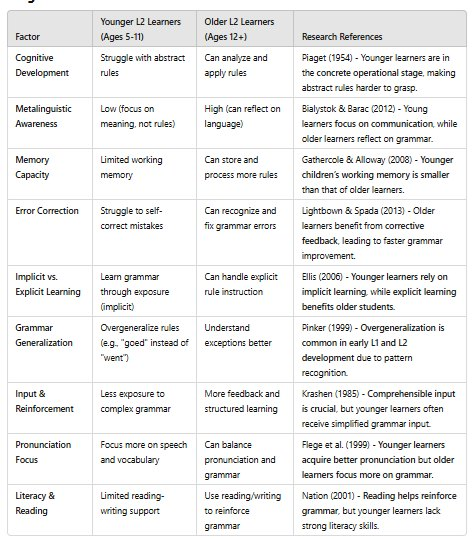
*Language Analytical Ability (LAA) refers to the cognitive skill that enables learners to analyze, understand, and manipulate linguistic structures in a second language (L2). It is crucial for explicit grammar learning, problem-solving in language acquisition, and recognizing language patterns.
 The Language Gym
You must be logged in to post a comment.