by Gianfranco Conti, PhD. Co-author of 'The Language Teacher toolkit', 'Breaking the sound barrier: teaching learners how to listen', 'Memory: what every teacher should know' and of the 'Sentence Builders' book series. Winner of the 2015 TES best resource contributor award, founder and CEO of www.language-gym.com, co-founder of www.sentencebuilders.com and creator of the E.P.I. approach.
One of the most efficient ways to teach grammar explicitly, without overwhelming students with full paradigms or overloading working memory, is through a technique often referred in the literature as contrastive pairs.
The technique is quite simple. First off, you present learners with two near-identical sentences that differ in only one meaningful way. You then ask them what changes, what stays the same, and what that change means. Next, you isolate the contrast. Then you provide a minimal rule. Finally, you practise the difference. That’s it.
The key thing is that only one variable changes whilst the rest remains stable. This reduces noise and sharpens attention.
Note that contrastive pairs are not about teaching an entire tense system or unpacking every exception. They are about clarifying one functional boundary at a time.
Used properly, they are precise, economical and cognitively aligned with how learners refine emerging grammatical control.
Why Contrastive Pairs Work (The Scientific Rationale)
There are several strong theoretical reasons why this technique is effective. First, contrastive pairs reduce cognitive load. By isolating a single difference, they minimise the number of elements students must hold in working memory (Sweller, 1998; Sweller et al., 2011).
Second, they sharpen noticing. Learners must attend to form in order to detect the meaningful difference (Schmidt, 1990), hence, attention is not diffused across a whole system. It is directed solely to one contrast.
Third, they support form–meaning mapping, a key step in effective grammar acquisition, as the latter must encompass Form, Meaning and Use. According to input processing theory (VanPatten, 2015), however, learners prioritise meaning over form. Contrastive pairs help them see how a small formal change affects meaning. In the Expansion phase, this refines partially proceduralised knowledge (DeKeyser, 2007).
Finally, research on explicit instruction suggests that clarification after exposure strengthens accuracy without replacing acquisition processes (Ellis, 2006). In my approach, EPI, clarification after exposure is the key underlying principle when teaching grammar.
In short, contrastive pairs clarify and stabilise learning — they do not initiate it.
The Step-by-Step Contrastive Routine
Here is what a clean, disciplined sequence could look like.
Step 1: Present two near-identical sentences students already know
The sentences must be familiar. You are not introducing new vocabulary (in EPI by the time grammar is taught, the students will have already internalised the unit-at-hand target vocabulary).
Example:
María es aburrida.
María está aburrida.
Ask:
What changes?
What stays the same?
Step 2: Identify the single meaningful difference
Guide learners to articulate what the change signals.
In this case:
es aburrida → describes personality (permanent trait)
está aburrida → describes current state (temporary condition)
Do not move beyond that boundary
Step 3: Give the minimal rule
Just provide one sentence. No lecture.
Use ser + adjective for permanent characteristics. Use estar + adjective for temporary states.
Stop there.
Step 4: Controlled contrast practice
Now the contrast must matter. For instance:
A/B choice
Mi profesor (es / está) simpático hoy.
Londres (es / está) una ciudad grande.
Sorting task Column A: permanent characteristics Column B: temporary states
Transformation Change a permanent sentence into a temporary one.
Step 5: Semi-structured task using both forms
Now learners must use both contrasts within one communicative task.
Example:
Describe two people: – their personality – how they feel today
Checklist:
At least two examples of ser + adjective
At least two examples of estar + adjective
The contrast must be necessary to complete the task successfully.
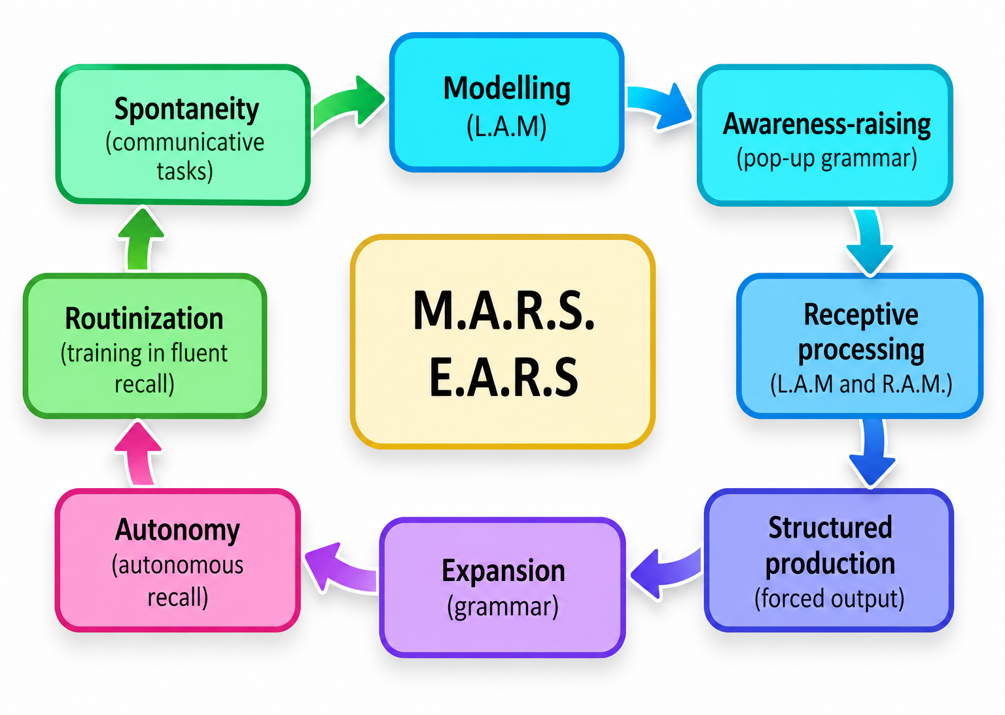
Where Contrastive Pairs Fit in EPI’s MARS-EARS framework
Contrastive pairs belong in the Expansion phase, after learners have already processed the structure during MARS.
During MARS, students:
encounter the structure repeatedly,
build form–meaning associations,
begin to use it in constrained contexts.
In Expansion, we:
clarify boundaries,
prevent overgeneralisation,
build exam-safe accuracy.
Contrastive pairs are not used during early modelling or awareness-raising, because premature comparison can interrupt natural form–meaning mapping.
In MARSE-EARS, contrastive pairs refine and stabilise learning. They do not initiate it.
A Sample Full Sequence: SER + Adjective vs ESTAR + Adjective
Let’s situate this properly within MARSE-EARS.
Before Expansion, learners have already encountered both forms repeatedly during MARS:
through sentence builders
through listening input
through guided oral rehearsal
through limited structured output
They recognise the patterns. Now we refine them.
Expansion Lesson Outline
Re-entry (5 minutes) Quick retrieval of familiar sentences containing both forms.
Word order contrasts (German verb-final; French pronoun placement)
Preposition contrasts (por/para; since/for)
With Which Structures They Work Less Well
Large irregular paradigms with many unpredictable forms
Morphology without a clear meaning difference
Vocabulary-heavy distinctions
Abstract discourse-level grammar
Structures not yet encountered through input
Contrastive pairs require prior exposure. Without it, they become rule-teaching by another name.
Conclusion: Why This Matters
Contrastive pairs are not a fashionable trick, but rather are a disciplined way of making grammar clearer, lighter and more cognitively realistic. When used at the right time — after meaningful exposure — they help learners:
sharpen boundaries between similar forms
prevent overgeneralisation
build accuracy for exams
and move from “I recognise it” to “I can control it”
They work because they respect how learning happens: meaning first, clarification second.
Bottom line for teachers
If you want contrastive pairs to work:
Use them after exposure, not before.
Change one variable at a time.
Give a minimal rule, not a full lecture.
Practise the contrast, not the entire system.
Move quickly back into meaningful use.
Contrastive pairs are by no means the engine of acquisition. Rather, their role is to tighten and stabilise acquisition. In my experience, if the technique is used sparingly and strategically within MARSEARS, they make grammar clearer — and students more confident — without ever overwhelming them.
I’ve lost count of how many times, over the years, I’ve seen colleagues — often intelligent, well-intentioned, committed teachers — get themselves tangled up in what is, in essence, one of the most persistent (and, if I’m honest, most sterile) debates in language education: lexicogrammar versus traditional grammar instruction.
You know the script, don’t you? One camp is presented as enlightened, modern, acquisition-friendly, almost morally superior; the other as old-fashioned, rule-obsessed, joyless, and probably responsible for everything that has ever gone wrong in language teaching since the dawn of time! And every time I hear this framing, I find myself thinking: ma perché? Why are we still doing this to ourselves?
Because the truth — and it’s a truth we’d all be better off accepting — is that these two approaches are not enemies at all. They are simply two different lenses through which we observe the same linguistic system. Used intelligently, and at the right moment, they do very different jobs, and both jobs matter.
What traditional grammar instruction is really about (and why I haven’t thrown it out of the window)
Traditional grammar instruction, at its core, treats language as a rule-governed system: something that can be described, categorised, labelled, and explained, preferably with neat headings and reassuring terminology.It focuses on things like:
parts of speech
verb tenses and conjugations
agreement rules
sentence structure
accuracy and error correction
In real classrooms — real ones, not the imaginary ones in methodology books — this usually looks like:
explicit explanations (“The imperfect is used for habitual actions…”)
verb tables (lots of them…)
controlled gap-fills
error-spotting tasks
long stretches of metalanguage
translation tasks
Now, let me say this very clearly, because it matters: there is nothing inherently wrong with this. In fact, traditional grammar instruction does some things extremely well. It:
gives learners clarity and labels
supports accuracy, especially in writing
helps with exam performance
appeals to analytical learners
gives teachers the feeling that they have…done their duty!
I’ve seen this countless times. I’ve worked with pupils — and adults, for that matter — who needed that clarity, who felt calmer once something had been named, boxed, explained. So no, grammar is not the villain of the piece.
The problem only starts when grammar becomes the starting point (!), rather than what it should be: a supporting tool.
Because we have all met them, haven’t we? The students who can explain a rule beautifully, recite it almost poetically, apply it flawlessly in a written exercise… and then collapse entirely when asked to process the same structure in listening, or produce it spontaneously in speaking. They understand how the engine works, yes — but they’ve barely driven the car, let alone taken it on the motorway. In other words, they have develop Declarative Knowledge of the target grammar structure but have not built the Procedural knowledge required in the real world, the one that makes fluent retrieval possible in the streets of Paris, Berlin, Rome or Madrid.
What lexicogrammar is about (and why it feels so much closer to reality)
Lexicogrammar starts from a different assumption — one that, to me at least, feels far more psychologically plausible — namely that grammar and vocabulary are not separable, and that language is processed primarily as patterns and chunks, not as isolated rules waiting to be memorised. From this perspective:
meaning drives form
words come bundled with grammar
frequency matters enormously
grammar emerges from repeated exposure to patterned input
So instead of solemnly announcing that today, class, we are learning the present tense, learners simply meet:
je joue au foot
je vais au cinéma
je fais du sport
Instead of dissecting “because + clause”, they repeatedly encounter:
parce que c’est amusant
parce que c’est trop cher
Instead of a formal lecture on “the imperfect”, they live with:
quand j’étais petit…
il y avait beaucoup de…
And here’s the thing — and anyone who has actually watched learners process language will recognise this — this is how acquisition really happens. Lexicogrammar:
reduces cognitive load
supports fluency
builds automaticity
feeds listening and speaking directly
I’ve seen this play out so many times in my own classrooms and workshops that it would be dishonest to pretend otherwise. Learners use language earlier, more confidently, and with far less visible strain. But — and this is important — left entirely unchecked, lexicogrammar can also lead to problems, as accuracy can plateau, editing skills can remain weak and high-stakes writing and exams can expose gaps that intuition alone doesn’t fix.
The real difference — and the false opposition that refuses to die
So what is the real contrast here? It’s not “grammar versus lexicogrammar”, despite how tempting that slogan might be. In my view, it is:
rule → example versus example → pattern
form-led teaching versus meaning-led teaching
declarative knowledge versus procedural knowledge
Traditional grammar explains correctness whilst lexicogrammar enables use. Both matter — but not at the same moment. And this, I would argue, is where so much of the confusion comes from!
Where grammar and lexicogrammar intersect: pattern awareness
This, for me, is the crucial point, the hinge on which the whole debate turns.
Good lexicogrammar teaching:
floods learners with high-frequency patterns
makes those patterns noticeable
recycles them relentlessly
builds intuitive familiarity
Good grammar instruction:
names patterns learners already recognise
explains contrasts they’ve already experienced
sharpens accuracy once meaning is secure
In other words — and I cannot stress this enough — grammar works best when it explains what learners have already partially acquired.
I’ve seen this so clearly with structures like il y a and il n’y a pas de. If learners have met these dozens of times in listening and reading, a later explanation of existential structures and negation doesn’t feel abstract, theoretical, or painful. It feels clarifying. Almost relieving.
That is the intersection point which I have witnessed time and again throughout my career.
Lexicogrammar vs traditional grammar: a functional comparison
Dimension
Lexicogrammar
Traditional grammar
Starting point
Meaningful examples
Abstract rules
Teaching sequence
Example → pattern
Rule → example
Unit of learning
Chunks and constructions
Individual forms
Cognitive load
Lower (pattern recognition)
Higher (rule processing)
Primary knowledge type
Procedural
Declarative
Best supports
Listening, speaking, early writing
Editing, accuracy, exams
Risk if overused
Accuracy plateau
Inert knowledge
Where EPI fits in: doing both, deliberately (and unapologetically)
This is precisely where Extensive Processing Instruction (EPI) sits — and why it is so often misunderstood, sometimes caricatured, and occasionally dismissed by people who, I suspect, haven’t really looked at it closely.
Let’s be clear: EPI is not anti-grammar. It is anti PREMATURE grammar.
How EPI handles lexicogrammar
EPI starts where acquisition actually starts — not where tradition says it should start:
high-frequency chunks
narrow, carefully controlled input
repeated processing of the same structures
listening and reading as the engine of learning
Learners don’t “learn the imperfect”. They process:
il y avait…
quand j’étais petit…
c’était…
They don’t “learn negation”. They process:
je n’aime pas…
il n’y a pas de…
Grammar is embedded, unavoidable, and meaningful — but never shoved to the front before the system is ready. I’ve watched pupils who had “done the imperfect” three times before suddenly get it — not because of a better explanation, but because the input finally made sense.
How EPI handles grammar instruction
And here’s the bit that often gets conveniently ignored: EPI does not stop there.
Once patterns are:
familiar
automatised
meaning-secure
EPI introduces explicit grammar instruction as:
a noticing tool
a refining tool
a precision tool
At that point — and only at that point — explanations stick. They make sense. They actually improve output. I’ve seen learners nod, not because they’re being polite, but because something has genuinely clicked.
This is grammar from language, not grammar before language.
Why EPI works: research-rooted advantages
EPI advantage
Rationale
Research source
Reduced cognitive load
Learners process meaning before form, avoiding working-memory overload
Sweller; VanPatten
Faster automatisation
Repeated exposure to the same structures builds procedural memory
For a long time now, and certainly across many of the classrooms I have visited in recent years teachers have been working hard to improve GCSE writing outcomes while quietly sensing that something was not quite lining up. Pupils write more, practise more, produce longer pieces, and yet the grades often fail to match the effort, which understandably leads to frustration and, in some cases, resignation.
The arrival of the new GCSE writing paper has not been dramatic or loudly announced, but in my view represents a decisive shift in what is being assessed, and my prediction is that many departments will only fully realise this once mock results begin to expose patterns that feel unfamiliar.
For years, GCSE writing has been taught on the assumption that effort, creativity and risk-taking would somehow be rewarded, that “having a go” was a sensible strategy, and that ambitious language could compensate for shaky control. That assumption no longer holds – sadly.
The new GCSE writing paper rewards accuracy, control and task fulfilment, not linguistic risk-taking, and this, far from being a matter of preference or interpretation, is built directly into the mark schemes.
This article, written as I prep my upcoming workshop on this topic in a couple of weeks time, examines what the new writing paper actually assesses, how marks are generated, where the critical thresholds lie, and what this means for classroom practice.
Structure of the new GCSE writing paper
The writing paper now consists of a tightly constrained set of tasks designed to test retrieval and control under pressure rather than expressive freedom. A central feature is the inclusion of English into target language translation as a compulsory writing task.
In the translation mark scheme, marks are awarded for:
accurate transfer of meaning
correct vocabulary selection
grammatical accuracy, including tense, agreement and word order
There are no marks for approximation. Responses either convey the intended meaning or they do not.
Translation removes choice, paraphrase and creativity, and forces precise retrieval under time pressure, hence it is structurally impossible to succeed by merely “having a go”. This task alone signals that the assessment is testing control, not effort or intention.
Stimulus coverage and task fulfilment
Across both the 90-word and 150-word writing tasks, candidates are required to respond directly to bullet-point prompts.
The paper explicitly states that to achieve the highest marks, candidates must write something about each bullet point. In the mark scheme, failure to address all bullet points caps access to the higher bands, regardless of linguistic ambition elsewhere.
As a result, a response that uses adventurous language but misses part of the stimulus will score lower than a response that uses simpler language but completes the task fully. This is a structural feature of the assessment which I personally don’t agree with but we have to live with.
Use of familiar language
Both exam boards assess writing through the use of:
a range of familiar vocabulary and structures.
This phrase is central to understanding the assessment construct.
The mark schemes do not reward originality or experimentation. They reward:
accurate selection of known language
consistent use
successful manipulation
Lower bands are characterised by frequent errors and loss of control whilst higher bands are characterised by secure handling of familiar language. The construct being assessed becomes procedural control (!), not creative expression as in the past GCSE.
Accuracy and band progression
Nowhere in the mark schemes does “ambitious but inaccurate” outperform “simple but accurate”. This stifles the risk-taking attitude that you would want language pedagogy to encourage and reward. A huge mistake which is a legacy of the NCELP’s flawed pedagogy.
So, in the new GCSE, ambition that destabilizes accuracy typically pushes candidates down a band. Errors are tolerated only insofar as they do not impede communication, and that tolerance is limited. The mark scheme allows a small number of minor errorsonly if meaning remains clear and control is otherwise secure, but once errors become frequent, patterned, or start to affect clarity, the response is automatically pushed into a lower band. In other words, accuracy is not judged generously or holistically: there is a clear ceiling beyond which additional errors are no longer “overlooked”, even if the ideas are good or the language is ambitious.
This means that the long-standing advice to “take risks” in GCSE writing is no longer assessment-neutral Under the new mark schemes, risk-taking without control is actively disadvantageous.
Timeframes as a retrieval challenge
To access the higher bands, candidates must refer to more than one timeframe and do so accurately. A candidate who uses two time frames accurately will usually score higher than a candidate who attempts three timeframes inaccurately.
In other words, time frames function as a retrieval stress test, not as an opportunity to demonstrate grammatical ambition.
Cognitive pressure built into the assessment
The writing paper combines:
multiple tasks
strict time limits
bullet-point constraints
word limits
no dictionary
accuracy-focused marking
The mark schemes then reward consistency, reliability and control – deliberate cognitive load engineering. The assessment measures what candidates can retrieve and control when working memory is stretched.
What distinguishes Grades 7–9 from Grade 6
This is the threshold that is most often misunderstood by the teachers I have worked with recently
Characteristics of a secure Grade 6 response
A Grade 6 response typically:
addresses the task adequately
covers most or all bullet points
uses familiar vocabulary correctly much of the time
attempts more than one timeframe, but not always securely
shows some inconsistency in accuracy
may rely on memorised chunks or repetition
In mark-scheme terms, this represents competent communication, but not sustained control.
What changes at Grade 7
The move from Grade 6 to Grade 7 is not about writing more or using more complex grammar.
It is about stability under pressure.
A Grade 7 response:
addresses all bullet points precisely and efficiently
uses a range of familiar structures with consistent accuracy
handles at least two timeframes securely
maintains accuracy as sentence length increases
shows conscious control rather than chance success
Errors are occasional rather than frequent, and accuracy does not deteriorate as the task progresses.
What characterises Grades 8–9
At Grades 8 and 9, nothing fundamentally new appears. What improves is:
consistency
reliability
density of accurate language
Responses at this level sustain accuracy across the entire task, integrate timeframes naturally, and show minimal breakdown in meaning. This reflects automaticity, not flair.
The critical implication
The difference between a Grade 6 and a Grade 7 is not creativity or risk-taking, but the ability to retrieve and control familiar language reliably under exam conditions.
Comparison of AQA and Edexcel writing assessments
Despite differences in layout and wording, both boards assess writing in fundamentally the same way.
Feature
AQA
Edexcel
Assessment implication
Core construct
Control of familiar language
Identical construct
Translation
Integrated into writing paper
Retrieval over creativity
Stimulus coverage
Explicit bullet-point requirement
Task fulfilment weighted
Task control is essential
Accuracy weighting
Strong emphasis
Strong emphasis
Ambition without control is penalised
Timeframes
Multiple accurate timeframes required
Multiple accurate timeframes expected
Retrieval under pressure
Creativity
Rewarded only if accuracy is secure
Creativity is conditional
Despite presentational differences, both boards reward the same thing: stable, accurate, task-focused writing under pressure.
Who is likely to struggle with the new format
The pupils who are most likely to struggle are not necessarily the weakest linguists, but those whose learning has been built on habits that the new assessment penalises.
These include:
pupils reliant on memorised essays
pupils encouraged to take grammatical risks they cannot control
pupils with weak listening and reading foundations
pupils trained to prioritise ideas over linguistic control
Departments that delay systematic work on accuracy, sentence-level control and retrieval until late in the course are also likely to face difficulties, as habits formed earlier are hard to reverse.
Why “having a go” no longer aligns with the assessment
Taken together, the mark schemes:
penalise inaccuracy
cap incomplete responses
reward familiar language
prioritise task fulfilment
embed translation as a control task
As a result, the assessment rewards control under cognitive pressure, not effort or ambition.
Implications for teaching practice
Writing is no longer assessed as expressive output. It is assessed as accurate retrieval of automatised language under constraint.
Teaching writing primarily through early free production now conflicts with:
the assessment objectives
the band descriptors
the cognitive design of the paper
This is not a matter of preference or ideology, but one of construct validity In my upcoming workshop on how to ace the GCSE writing paper in early February I will deal extensively with what teachers can do to prepare their students effectively for this tricky paper
Conclusion
The new GCSE writing paper has not made writing harsher. It has made misalignment between teaching and assessment visible.
If writing continues to be taught as though effort, creativity and risk can compensate for weak control, outcomes are unlikely to improve. If, however, teaching aligns with what the mark schemes actually reward — familiarity, retrieval and accuracy under pressure — then the path forward becomes clearer.
In my view, pupils become better writers not by writing earlier or more freely, but by writing later, with less choice, and with language they have processed deeply and repeatedly. Once this is understood, the logic of the new GCSE writing paper becomes difficult to argue with.
After twenty-eight years in the classroom I feel reasonably confident saying that students are far more consistent in what they value in their language teachers than we, as a profession, often like to admit Perhaps because their priorities do not always sit comfortably alongside inspection frameworks, policy BS, or whatever pedagogical fashion happens to be doing the rounds this term…
In my experience, and I say this having taught across different countries, systems and policy cycles that arrived with great noise and left quietly through the back door, students are not primarily concerned with whether we are methodologically fashionable, digitally fluent, or capable of delivering a textbook-perfect observed lesson at 9am on a wet Monday morning. What they care about,often desperately, is whether learning in our classroom feels emotionally survivable,cognitively manageable, and worth the effort on days when motivation is fragileand confidence even more so. And those days, sadly, come around in my experience more often than we sometimes admit.
Unfortunately, this is not always the order in which we are trained to think about teaching, is it…
2. What students value (ranked, explained, and grounded in research)
1. Empathy and emotional support — ranked as number one
In my opinion, and very much in line with what the research has been telling us for decades now, empathy sits firmly at the top because language learning without emotional safety simply does not function, however elegante our schemes of work may look on paper.
Students value teachers who are patient, non-judgemental, emotionally predictable, and who create classrooms where making mistakes does not feel like a personal failure played out in public, lesson after lesson. Research on affect in language learning, from Arnold’s early work through to Dewaele and Mercer’s studies on teacher empathy, shows that anxiety and fear of negative evaluation significantly reduce willingness to communicate, participation, and risk-taking – in other words the prerequisites for any significant language learning to happen! On the other hand, Rebecca Oxford’s work on learner well-being reinforces the idea that emotional variables are not decorative extras but structural foundations.
In my experience, when this emotional safety is missing, students rarely kick off or complain loudly; instead, they withdraw quietly, comply politely, and disappear cognitively,,, which is far easier to miss and far harder to reverse.
2. Ability to motivate and inspire — ranked as number two
Motivation comes a very close second because, sadly, language learning is a long game with few immediate rewards, and in my experience without sustained encouragement many learners simply decide that the effort required is not worth the emotional cost involved, especially in exam-driven contexts.
Research on L2 motivation, particularly by Dörnyei, shows that teacher behaviour — not just task design — plays a decisive role in sustaining learner effort over time. Guilloteaux and Dörnyei demonstrated that motivational teaching practices are linked to higher levels of engagement, while Lamb’s more recent work shows how teacher encouragement can keep learners going even when intrinsic interest is fragile and the syllabus feels relentless.
In my opinion, students are rarely demotivated by difficulty itself; they are demotivated by the creeping sense that effort leads nowhere,, and teachers who keep belief alive — often quietly, without fireworks — make an enormous difference here, even if nobody applauds them for it!!
3. Clarity of explanation and instructional clarity — ranked as number three
Clarity sits in the middle of the ranking because confusion is both cognitively and emotionally exhausting, and students place far more value than we sometimes realise on teachers who help them feel oriented rather than overwhelmed.
Hattie’s synthesis of classroom research consistently identifies teacher clarity as a strong predictor of achievement, while Borg and Macaro remind us that clarity in language teaching is not about dumbing things down but about sequencing, scaffolding, and making form–meaning relationships visible. Students want to know what they are learning, why they are learning it, and what success looks like today, not at some vague point in the future.
Personally, I have always been less impressed by how eloquently I explain something and far more interested in whether anyone can actually tell me what they are supposed to be learning and why, a shift that has saved me from many self-inflicted illusions,, and a few awkward lessons too.
4. Strong subject knowledge (language and pedagogy) — ranked as number four
Subject knowledge, while absolutely essential in my opinion, tends to be experienced indirectly by learners, which explains why students value it but rarely place it at the very top of their rankings.
Research on teacher language awareness, particularly by Andrews and Mullock, shows that deep subject knowledge improves modelling, explanations, and responsiveness to learner questions, while Borg’s work on teacher cognition reinforces the idea that what teachers know shapes what they notice and how they respond in real time.
In my experience, students assume competence as a baseline; they notice subject knowledge most when it is missing, when explanations wobbles, examples feel shaky, or questions are dodged a little too quickly… when expertise is strong, it quietly underpins clarity, confidence, and trust without demanding centre stage.
5. Adaptability and responsiveness to learner needs — ranked as number five
Adaptability appears last not because it is unimportant — tutt’altro! — but because students often experience it implicitly rather than as a named quality.
Research on differentiation and learner-centred instruction, from Tomlinson through to more recent work by Papi and Hiver, shows that responsiveness to learner needs supports motivation, autonomy, and sustained engagement. From a learner’s point of view, however, adaptability often blends into perceptions of fairness and care rather than being recognised as a technical skill.
In my experience, students simply say that a teacher “understands” or “explains again if we don’t get it”, without any awareness of the pedagogical decision-making involved,, and that very invisibility is precisely why adaptability, though crucial, tends to sit lower in student rankings.
3. Summary table: what students value most (research-informed)
Quality valued by students
What this looks like in practice (student perspective)
Key research sources
Empathy & emotional support
Feeling safe to speak, make mistakes, and participate without fear of ridicule or judgement.
Dewaele & Mercer (2018); Arnold (1999); Oxford (2016)
Ability to motivate and inspire
Belief in improvement, encouragement to persist, and teacher enthusiasm sustaining effort over time.
Clear explanations, structured lessons, transparent goals, and reduced confusion.
Hattie (2009); Borg (2006); Macaro (2008)
Strong subject knowledge
Accurate modelling, confident explanations, and meaningful responses to questions.
Andrews (2007); Borg (2015); Mullock (2006)
Adaptability to learner needs
Adjusting pace, difficulty, feedback, and support in response to learners.
Tomlinson (2014); Papi & Hiver (2020)
4. Why the ranking looks the way it does
I strongly believe that the ranking above reflects the sequence of emotional and cognitive thresholds learners must cross in order to remain engaged in language learning. If students do not feel emotionally safe, they disengage. If they do not feel encouraged, they stop trying. If they do not feel oriented, they become frustrated. Wherever I have taught, be it in challenging inner-city area schools or posh private schools in rich neighbourhoods, only once these conditions were met did subject expertise and adaptability become fully visible and impactful from the learner’s perspective… simple, really, though not always easy.
So this ranking is not a claim about what matters most in teaching in some abstract, absolute sense, but about what students experience first and depend on most in order to keep going, which is a rather different question altogether.
5. Conclusion
After nearly three decades of teaching, observing, mentoring, and occasionally getting it wrong in public, I am increasingly convinced that what students value most in us aligns remarkably well with what research tells us facilitates language acquisition, even if this alignment is not always reflected in accountability systems or professional discourse.
Students are not asking us to be entertainers, influencers, or walking grammar encyclopaedias. In my experience, they are asking us — often quietly, often indirectly — to create conditions in which effort feels worthwhile, failure feels survivable, and progress feels possible….
Key references
Andrews, S. (2007). Teacher language awareness. Cambridge University Press.
Arnold, J. (Ed.). (1999). Affect in language learning. Cambridge University Press.
Borg, S. (2015). Teacher cognition and language education: Research and practice. Bloomsbury.
Csizér, K., & Nagy, B. (2020). The dynamic interaction of motivation, self-regulation, and autonomous learning in second language acquisition. System, 92, 102249.
Dewaele, J.-M., & Mercer, S. (2018). Do ESL/EFL teachers’ emotional intelligence, empathy and self-efficacy predict learner-centredness? System, 79, 31–43.
Dörnyei, Z. (2001). Motivational strategies in the language classroom. Cambridge University Press.
Guilloteaux, M. J., & Dörnyei, Z. (2008). Motivating language learners: A classroom-oriented investigation of the effects of motivational strategies on student motivation. TESOL Quarterly, 42(1), 55–77.
Lamb, M., & Arisandy, F. E. (2020). The motivational dimension of language teaching. Language Teaching Research, 24(3), 1–24.
Macaro, E. (2008). Language learner strategies: Thirty years of research and practice. Oxford University Press.
Mullock, B. (2006). The pedagogical knowledge base of four TESOL teachers. The Modern Language Journal, 90(1), 48–66.
Oxford, R. L. (2016). Toward a psychology of well-being in second language acquisition. Studies in Second Language Learning and Teaching, 6(1), 3–29.
Papi, M., & Hiver, P. (2020). Language learning motivation as a complex dynamic system. The Modern Language Journal, 104(1), 209–229.
Tomlinson, C. A. (2014). The differentiated classroom: Responding to the needs of all learners (2nd ed.). ASCD.
Every few months — sometimes more often than that — social media fills up with posts telling us that research proves a particular language-teaching method works best. You know the sort of thing. One week it is storytelling. The next week it is explicit grammar. The week after is EPI (Yes – guilty as charged!) Then it is “input only”, or “no output”, or whatever the label happens to be this time. The pattern never really changes.
And let me say this clearly before someone misreads what follows: the problem is rarely the research itself. The real problem is what happens after the research leaves the journal and enters the hands of people who are actively trying to justify selling their method, their training, their books, their conference slots, or their latest online course.
So, before we swallow yet another “research-backed” claim whole, it might be worth slowing down and asking a few boring but necessary questions… even if they spoil the excitement.
First of all: who were the learners in the study? This sounds so obvious that it almost feels insulting to mention it, and yet it is ignored with remarkable consistency. Language learning looks very different depending on whether we are talking about preschool children, primary beginners, secondary pupils working towards exams, or university students who already have years of schooling behind them. Findings from one group do not automatically apply to another, no matter how confidently someone says they do. When studies involving very young learners, or learners with extremely limited language, are used to justify methods for GCSE or A-level classrooms, surely the correct response is not enthusiasm but caution… or at least a pause.
Second — and this is absolutely central — what level did the learners start from? Baseline language ability is not a small technical detail tucked away in the methods section for researchers to worry about. In practice, it often explains more than anything else. When learners begin with almost no vocabulary, very little exposure to structured language, and limited experience of listening to or using language in organised ways, teaching does something very specific: it lays foundations. It does not suddenly accelerate learning in magical ways. So when an intervention produces gains in the exact words that were taught, but little beyond that, this is not surprising at all. It is exactly what we would expect. Using such findings to make claims about learners who already have years of exposure, larger vocabularies and basic narrative competence is not careful interpretation. It is misuse. Ignoring starting level is one of the easiest ways to turn sensible research into bad pedagogy.
Third: was the study actually about learning a second or foreign language? This is where things often get very slippery. Research from first-language literacy or early childhood development is regularly brought into language-teaching debates as if the jump were obvious and unproblematic. Yes, storytelling helps children develop language in their first language. No, that does not automatically mean it drives grammatical development in a second language. The same mistake appears when research on first-language grammar is used to justify grammar-heavy second-language teaching. Different learning problems, different conditions, different outcomes… surely that matters?
Fourth: what did the researchers actually measure? Did learners understand a story while it was being told? Did they recognise forms they had just seen? Did they do well on a test straight after instruction? Or did they show that they could use the language later, on their own, in new situations, without help? These are not minor distinctions. Much research reports short-term performance under controlled conditions, and that is fine. What is not fine is pretending that this is the same thing as long-term acquisition.
Fifth: was there a proper comparison group? Without a meaningful comparison, improvement does not tell us very much. Learners usually improve over time anyway. Teachers get better. Familiarity with tasks increases. Comparing an intervention to “no instruction” might look impressive, but it tells us almost nothing about whether the approach is better than other plausible alternatives.
Sixth: did the gains last? Were learners tested again weeks or months later, or was everything measured immediately, while the material was still fresh? Without delayed testing, claims about learning should be treated with extreme caution. Short-term gains are easy to produce. Long-term retention is much harder. We have known this for well over a century, and yet it is routinely ignored… why?
Seventh: was grammar actually tested in free use? Doing well in gap-fills, multiple-choice tasks, or highly scaffolded activities is not the same as using language accurately when speaking or writing under pressure. Too often, grammar learning is assumed rather than demonstrated. We should be asking whether learners can actually use what they supposedly “acquired”, not whether they can recognise it when prompted.
Eighth: is one element being sold as the whole solution? Input matters. So does practice. So does feedback. So does retrieval. So does time. When one of these is isolated and presented as the answer, something has gone wrong. No serious account of learning supports the idea that a single ingredient, however valuable, can replace everything else.
Ninth: what do the authors themselves say about limits? Most researchers are careful. They talk about context. They talk about constraints. They warn against overgeneralisation. When these warnings quietly disappear in conference talks or social-media posts, that should worry us. If the caveats are gone, the research has already been bent out of shape.
Finally: who stands to gain from this interpretation? This is uncomfortable, but unavoidable. When claims are tied to training packages, branded methods, books, or speaking circuits, there is an incentive to oversell. That does not automatically make the research wrong. But it should make us sceptical… very sceptical.
The study looked at a structured story-based intervention delivered to very young children from low-income backgrounds who started with extremely weak language. The children improved on the vocabulary that was explicitly taught to them. That is a sensible and useful finding. What it does not show is that storytelling leads to broad second-language acquisition, that it replaces explicit instruction, or that it applies to older learners in secondary schools. The learners were preschoolers. Their starting level was extremely low. The effects were narrow and closely tied to what was taught. The context was highly specific. And the authors themselves warned against overgeneralisation.
Turning that into an argument for TPRS as a general solution is not research-informed practice. It is spin. After all, TPRS has been around for ages, yet it is a very niche approach in secondary education. Even if we ignore the research misuse, there are practical reasons why TPRS has never really taken hold in mainstream state secondary education. It depends heavily on unusually skilled and confident teachers. It makes syllabus coverage difficult to guarantee. It works far better with beginners than with learners who need increasing accuracy. It does not align well with exam demands. And it takes time — time that most state schools simply do not have.
None of this means storytelling is useless. It means it is limited. And whilst it is one of many instructional strategies that can be used once or twice a term to add variety and spice up the curriculum, it cannot be the one and only method to use with students who will be sitting a high-stake national exam which does not involve storytelling. This is not because I don’t espouse or like this method; but, rather, because, as cognitive psychology teaches us, what one learns through storytelling doesn’t transfer to the tasks used to assess students in national examinations around the world!
Another example: The Finnish miracle… and the context everyone forgets
The same pattern shows up well beyond language teaching, and the way Finland has been held up for years – based on credible research studies – as proof that there is a single “better” way to teach is probably the clearest example of this problem. Finnish education has been praised, copied, packaged and exported as if it were a set of techniques rather than the product of a very particular country, culture and history. Although the research backing the effectiveness of Finnish education is absolutely credible, what tends to be ignored is that Finland is small, socially cohesive, linguistically homogeneous, and built on unusually high levels of trust in teachers, low child poverty, strong welfare support, and minimal inequality between schools. Teachers are highly selected, highly trained, and enjoy professional autonomy that would be politically impossible in many systems. Classrooms operate in a context where behaviour, attendance, parental support and social safety nets are not constant battles. To point at Finnish outcomes and say “do this and you will get the same results” is to ignore all of that… and yet this is exactly what happens. The method is praised, the context quietly disappears, and what was once careful comparative research turns into a convenient story that sounds great in conferences, policy documents and consultancy brochures, but tells us very little about what will actually work in crowded, exam-driven, high-stakes state school systems elsewhere.
Conclusions
Storytelling has value. Explicit grammar has value. Input has value. Practice has value. EPI has value. But when any of these is turned into the answer, backed by selective readings of research and pushed hard by snake-oil salesmen who have something to sell, teachers should stop, breathe, and ask the very dull questions in the table below.
Research does not give us silver bullets. It gives us boundaries. When those boundaries disappear, what we are left with is not innovation or evidence-based teaching, but marketing dressed up as science. And frankly, we should be tired of that by now…
I still remember marking a set of Year 10 writing tasks years ago and thinking, not without a certain irritation tinged with professional unease, “They understand this… so why can’t they write it?” They could recognise the language with little difficulty in aural tasks, manipulate it orally when supported, and even demonstrate decent control in tightly scaffolded activities; and yet, the moment they were asked to write independently, the output collapsed into short, brittle sentences, missing endings, hesitant word order, and a palpable sense of effort that went far beyond what the task seemed to warrant. Why? Why here? Why now?
What teachers often interpret as a lack of effort, resilience, or ambition in L2 writing is, in my experience, more accurately understood as a mismatch between task demands and cognitive capacity For a long time, I nevertheless explained the problem away as a practice deficit, reassuring myself that what pupils needed was simply more writing, more exposure, more rehearsal.
The moment when that explanation began to feel intellectually untenable came when I started my PhD in the early 2000s and immersed myself in the L2 writing literature, particularly research examining the cognitive differences between writing in one’s first language and writing in an additional one. What became increasingly obvious to me was that L2 writing is not merely slower or less accurate L1 writing, but a qualitatively different cognitive activity, one that places radically different demands on working memory, attentional control, and linguistic retrieval, such that pedagogical approaches borrowed wholesale from L1 contexts are almost guaranteed to misfire.
In my opinion, unless pedagogy is designed with this difference explicitly in mind, persistent weakness in writing should surprise no one… and yet, how often do we still default to “just write more”? And why do we expect a different outcome?
1. Two languages are active simultaneously and compete for selection (Kroll, Bobb & Wodniecka, 2006)
When learners write in an L2, their L1 does not simply step aside and…wait its turn. Lexical, syntactic, and even pragmatic representations from both languages remain active and compete for selection, which means that hesitation, reformulation, and interference are not symptoms of poor learning or insufficient effort, but the predictable consequence of bilingual activation unfolding in real time. The brain, quite simply, is doing two things at once, juggling competing representations while attempting to maintain coherence. Should we really be surprised? Please note: this happens with more L2 proficient writers like myself too!
Pedagogical implications. Implication 1: Allow planned use of L1 at the planning stage (ideas, notes), because content generation does not need to drain scarce L2 resources that will be required later for accurate encoding. Implication 2: Teach contrastive chunks explicitly (L1 ≠ L2 structures), so that interference is anticipated and managed rather than discovered painfully through error. Implication 3: Avoid banning L1 outright; manage interference instead, because in my experience such bans tend to increase cognitive friction and anxiety rather than promote fluency.
2. Grammar competes directly with idea generation (Skehan, 1998)
In L1 writing, grammatical encoding is largely automatised and therefore cognitively ‘cheap’, allowing writers to focus almost entirely on meaning, organisation, and nuance. In L2 writing, it is not. Formulation draws on the same limited working-memory resources as idea generation, so when grammatical decisions require conscious attention, something else must give way — and it is almost always content, complexity, or risk-taking. How could it be otherwise?
Pedagogical implications. Implication 1: Separate content planning from language encoding in time and task design, so that pupils are not asked to generate ideas and encode unfamiliar language simultaneously. Implication 2: Use sentence builders so grammar is effectively pre-loaded, reducing the processing burden at the point of writing. Implication 3: Delay extended writing until forms are automatised, not merely “covered”, because exposure without control does not lead to fluency.
3. Working memory overloads quickly in L2 writing (Sweller, 1998)
As already implied above, one point that teachers consistently underestimate is how early working memory overload occurs in L2 writing. Add new vocabulary, unfamiliar grammar, new content, and time pressure, and the system saturates fast; performance does not decline gently but collapses, often in ways that look like carelessness yet are entirely predictable cognitive consequences.
Pedagogical implications. Implication 1: Reduce task length deliberately (quality > quantity), recognising that fewer sentences written with control are more developmentally valuable than longer texts produced under strain. Implication 2: Limit the amount of new language per writing task, so that attention can settle on consolidation rather than constant retrieval. Implication 3: Scaffold heavily at first, then fade support gradually, because, as often reiterated on this blog, overload is not challenge; it is interference.
4. Pauses happen at morphology and function words (Spelman Miller, 2006)
Keystroke-logging studies show that L2 writers pause most frequently around verb endings, agreement, prepositions, and connectors — not around ideas or content generation. This finding, while awkward for certain assumptions about creativity and spontaneity, is deeply revealing of where cognitive effort is actually being spent. During the think-aloud protocols I staged with my informants during my PhD study, this was one of my most interesting findings. When asked about it, every single one of my students replied that they needed to think about them harder, especially when it came to verb endings they had learnt by memorizing verb tables (due to the TAP phenomenon) and prepositions (due to the differences in L1 vs L2 usage).
Pedagogical implications. Implication 1: Over-teach verb endings, agreements, and connectors as chunks, treating them as high-frequency building blocks rather than incidental details. Implication 2: Practise micro-writing (one or two sentences) so that attention can focus on these pressure points without overwhelming the system. Implication 3: Recycle the same structures across many tasks, relentlessly, because, as often reiterated on this blog, working-memory overload — not lack of ambition — is the real enemy.
5. Accuracy is prioritised over fluency under pressure(Ellis, 2009)
Under time pressure, even advanced L2 writers protect accuracy first and sacrifice fluency shortening sentences, simplifying syntax, and avoiding risk. This is not a motivational issue, nor a lack of resilience; it is a rational response to finite cognitive resources. And yet… how often do we assess both as if they were the same thing?
Pedagogical implications. Implication 1: Don’t time extended writing too early, especially before core structures are stable. Implication 2: Use untimed drafting before timed exam practice, allowing control to consolidate before speed is imposed. Implication 3: Assess fluency and accuracy separately, at least diagnostically, so that pupils are not penalised for unavoidable cognitive trade-offs.
6. L2 writers plan less and monitor locally (Hayes & Chenoweth, 2006)
This was the most obvious phenomenon I observed during my PhD into L2 writers’ self-monitoring habits: unlike L1 writers, L2 writers often move sentence by sentence, monitoring locally rather than structuring ideas globally, because attentional resources are already stretched thin by encoding demands. Planning does not magically transfer… why would it, given the load?
Pedagogical implications. Implication 1: Teach explicit planning frames (who / when / where / why) so that organisation is not left to chance. Implication 2:Model planning aloud before writing, making invisible cognitive processes visible. Implication 3: Use paragraph-level sentence starters until patterns are internalised, rather than withdrawing support prematurely.
7. L2 writing relies on effortful executive control (Bialystok, 1990)
Early L2 writing is governed not by creativity, but by executive control: inhibition, selection, monitoring, and constant checking. There is simply no spare capacity for “free expression” at this stage, however desirable it may seem pedagogically. This is not an argument against creativity, but an argument about timing.
Pedagogical implications. Implication 1: Avoid “creative free writing” with novices, not because creativity is unimportant, but because the system is already overloaded. Implication 2: Build automatisation through repetition of familiar language, recognising repetition as a cognitive necessity rather than a pedagogical failure. Implication 3: Treat writing as skill-building, not self-expression (yet), postponing creativity until control is secure.
8. Under time pressure, learners regress (Robinson, 2001)
When under pressure – especially during high stakes tests – learners retreat to safer grammar and simpler syntax, relying on what is most reliable rather than what is most ambitious. This regression is by design, not by weakness.
Pedagogical implications. Implication 1: Train exam conditions gradually, rather than imposing them suddenly. Implication 2: Practise speed on familiar language only, ensuring that pace does not come at the expense of accuracy. Implication 3: Teach safe grammar strategies for exams, so pupils know what to fall back on when pressure rises.
9. Translation causes heavy cognitive interference (Kern, 1994)
Translating from L1 to L2 activates both systems simultaneously and forces alignment, creating interference that often makes the task cognitively heavier than composing directly in the L2. Counter-intuitive, perhaps, but well attested.
Pedagogical implications. Implication 1: Avoid L1→L2 translation as a main writing task, particularly for extended output. Implication 2: Prefer guided L2 composition, supported by models and chunks. Implication 3: Use translation sparingly and diagnostically, to reveal interference patterns rather than generate text.
Here we go again some of you will say! Conti’s obsession: chunks ! However, chunks are not just a methodological preference of mine; they are a cognitive solution. Sequences such as in my opinion, I think that, because I like, when I was younger, in the future I would like to, on the one hand… on the other hand, or it is important to are processed as single units, freeing working memory and allowing attention to be redirected toward meaning. Why would we deny learners that advantage? As I am writing this article, right now, I can feel myself retrieving one chunks after another, sequencing and moving them around inserting connectives, adverbs and adjectives here and there.
Pedagogical implications. Implication 1: Teach whole sentences, not isolated words, as the primary unit of instruction. Implication 2: Recycle chunks across listening, reading, and writing until retrieval is fast and automatic. Implication 3: Make chunk recall the core success criterion, as often reiterated on this blog, because availability rather than originality is what ultimately drives fluency.
11. Editing is not writing, and treating it as such is a mistake (Hayes, 1996)
One final cognitive distinction that is too often blurred in classroom practice is the difference between writing and editing. In L1 contexts, editing is often treated as a natural extension of composition: writers draft, reread, revise, and refine with relatively little additional cognitive cost. In L2 writing, however, editing constitutes a separate, highly demanding task, one that places additional strain on working memory. Why? Because it requires learners to reread text they have already struggled to produce while simultaneously evaluating form, meaning, and accuracy.
For many learners, this creates a perfect storm! By the time they reach the editing stage, cognitive resources are already depleted, which means that “editing” frequently degenerates into either superficial tinkering or indiscriminate rewriting, rather than targeted improvement. Errors that teachers expect pupils to notice remain invisible, not because pupils are careless, but because the act of noticing itself requires cognitive capacity that is no longer available.
Pedagogical implications. Implication 1: Editing must be taught and sequenced as a distinct phase, not bolted on at the end of writing tasks, with clear limits on what pupils are expected to attend to (e.g. verb endings only, or agreement only). Implication 2: Editing should be selective rather than comprehensive, focusing on a small number of high-frequency features, so that attention is not diffused across too many competing demands. Implication 3: Editing routines should be highly scaffolded and repetitive, using checklists, models, and shared correction, until learners develop the procedural knowledge required to edit with some degree of independence.
Crucially, editing should not be treated as evidence of autonomy or maturity, but as another skill that needs to be explicitly taught, practised, and automatised. Without this, we risk mistaking cognitive overload for indifference, and missed errors for lack of effort.
Table 1: A Cognitive Taxonomy of Editing in L2 Writing
Editing type
What it targets
Cognitive load
When it is viable
Classroom example
Main pedagogical risk if misused
1. Surface accuracy editing
Verb endings, agreement, articles, high-frequency prepositions, spelling of familiar forms
Low–moderate (narrow attentional focus)
After highly scaffolded writing; with short texts; when target forms are already practised
“Check only past tense verb endings.”
Overload if combined with higher-level editing; pupils change nothing or everything
2. Lexical precision editing
Word choice, replacing vague words, retrieval of taught chunks
Moderate
Once a core lexical repertoire is secure; with models available; limited alternatives
“Replace ‘I like’ with one practised alternative chunk.”
Slips into creative rewriting rather than editing
3. Morphosyntactic restructuring
Sentence structure, word order, subordination already taught
High (partial re-encoding)
After sentence-level automatisation; with sentence builders; one sentence at a time
With very short texts; higher proficiency; explicit planning frames
“Check each paragraph answers one bullet from the plan.”
Form accuracy deteriorates rapidly
5. Stylistic editing
Register, tone, variety, expressiveness
Extremely high
Very late in development; with highly familiar language only
Rarely appropriate below advanced level
Competes with all other processes; derails learning focus
12. Conclusion
Across these strands of research, a pattern emerges with uncomfortable consistency: pupils struggle with L2 writing not because they lack ideas or resilience, but because the task routinely exceeds their cognitive capacity. Why would they keep taking risks in such conditions?
An approach such as Extensive Processing Instruction, with its emphasis on rich input, structured processing, chunking, and delayed output, aligns naturally with what cognitive research tells us about how writing develops. In practical terms, this means a curriculum in which rich input, repeated processing, and controlled output precede extended writing, rather than the other way around. In my experience, writing improves not because pupils are pushed harder, but because the task is redesigned to fit how cognition actually works… and once you see that, it is very hard to unsee.
Table 2: A Cognitive Taxonomy of Editing in L2 WritingSummary table
What the brain does in L2 writing
Pedagogical implication 1
Pedagogical implication 2
Pedagogical implication 3
1. L1 and L2 are both active during L2 writing
Allow planned use of L1 at the planning stage (ideas, notes)
Delay extended writing until forms are automatised
3. Working memory overloads quickly in L2
Reduce task length (quality > quantity)
Limit new language per writing task
Scaffold heavily, then fade support gradually
4. Pauses happen at morphology and function words
Over-teach verb endings, agreements, connectors as chunks
Practise micro-writing (1–2 sentences)
Recycle the same structures across many tasks
5. Accuracy is prioritised over fluency under pressure
Don’t time extended writing too early
Use untimed drafting before timed exam practice
Assess fluency and accuracy separately
6. L2 writers plan less and monitor locally
Teach explicit planning frames (who / when / where / why)
Model planning aloud before writing
Use paragraph-level sentence starters
7. L2 writing relies on effortful executive control
Avoid “creative free writing” with novices
Build automatisation through repetition
Treat writing as skill-building, not self-expression
8. Under time pressure, learners regress
Train exam conditions gradually
Practise speed on familiar language only
Teach “safe grammar” strategies for exams
9. Translation causes heavy cognitive interference
Avoid L1→L2 translation as a main writing task
Prefer guided L2 composition
Use translation sparingly and diagnostically
10. Chunks dramatically reduce cognitive load
Teach whole sentences, not isolated words
Recycle chunks across listening, reading, writing
Make chunk recall the core success criterion
References
Bialystok, E. (1990). Communication strategies: A psychological analysis of second-language use. Oxford: Blackwell.
Ellis, R. (2009). The differential effects of task planning on fluency, complexity and accuracy. Applied Linguistics, 30(4), 474–509.
Flower, L., & Hayes, J. R. (1981). A cognitive process theory of writing. College Composition and Communication, 32(4), 365–387.
Hayes, J. R. (1996). A new framework for understanding cognition and affect in writing. In C. M. Levy & S. Ransdell (Eds.), The science of writing (pp. 1–27). Mahwah, NJ: Lawrence Erlbaum.
Hayes, J. R., & Chenoweth, N. A. (2006). Is working memory involved in the transcribing and editing of texts? Written Communication, 23(2), 135–149.
Kellogg, R. T. (1996). A model of working memory in writing. In C. M. Levy & S. Ransdell (Eds.), The science of writing (pp. 57–71). Mahwah, NJ: Lawrence Erlbaum.
Kern, R. G. (1994). The role of mental translation in second language reading. Studies in Second Language Acquisition, 16(4), 441–461.
Kroll, J. F., Bobb, S. C., & Wodniecka, Z. (2006). Language selectivity in bilingual speech. Bilingualism: Language and Cognition, 9(2), 119–135.
Levelt, W. J. M. (1989). Speaking: From intention to articulation. Cambridge, MA: MIT Press.
Manchón, R. M. (Ed.). (2011). Learning-to-write and writing-to-learn in an additional language. Amsterdam: John Benjamins.
Nation, I. S. P. (2013). Learning vocabulary in another language (2nd ed.). Cambridge: Cambridge University Press.
Robinson, P. (2001). Task complexity and language production. Applied Linguistics, 22(1), 27–57.
Roca de Larios, J., Manchón, R. M., & Murphy, L. (2008). Strategic behaviour in L2 writing processes. Journal of Second Language Writing, 17(1), 30–47.
Skehan, P. (1998). A cognitive approach to language learning. Oxford: Oxford University Press.
Spelman Miller, K. (2006). The pause phenomenon in second language writing. In K. P. H. Sullivan & E. Lindgren (Eds.), Computer keystroke logging and writing (pp. 11–30). Amsterdam: Elsevier.
Sweller, J. (1998). Cognitive load during problem solving. Cognitive Science, 12(2), 257–285.
VanPatten, B. (2015). Input processing in second language acquisition. New York: Routledge.
Wray, A. (2002). Formulaic language and the lexicon. Cambridge: Cambridge University Press.
After nearly three decades of teaching, examining, observing lessons, reading scripts, delivering CPD, and, perhaps most importantly, sitting next to pupils as they struggled to produce writing under exam conditions or as part of research projects, I have come to a fairly consistent conclusion: GCSE MFL writing underperformance is rarely about motivation or even knowledge.
In my experience, it is about poorly trained processes.
What follows is not a critique of effort but a set of practical failure points, each paired with specific, teachable solutions that I have used myself or seen work repeatedly in real classrooms and if some of this feels uncomfortably familiar, that is precisely the point, quid est enim veritas?
1. Inadequate attention to bullet-point coverage (sine qua non)
The single most common reason students fail to access higher content bands is simple: they do not fully address the bullet points! In my observation, students often believe that if they write enough, or sound fluent enough, the examiner will infer that they have “covered” the task. But since when has implication ever been rewarded in a mark scheme? It hasn’t — and it won’t! This aligns closely with what examiner reports repeatedly flag and with assessment research showing that explicit task fulfilment is a primary determinant of score outcomes (e.g. Shaw & Weir, 2007).
Bullet points are marking hooks, not suggestions, sine qua non.
Concrete classroom fixes:
Teach a mandatory bullet routine: underline, micro-plan, tick off.
Build bullet audits into marking.
Run bullet-only drills with no extended writing.
Is it glamorous No. Is it transformative? Absolutely.
2. Writing practice that does not transfer across prompts (mutatis mutandis)
Many students perform quite well on familiar task types but falter when the exam changes the angle slightly.Why does this happen, despite “lots of practice”? In my experience because students practise topic content, not transferable structures. This is a textbook example of poor transfer, a phenomenon long documented in educational psychology (Perkins & Salomon, 1988) which I have written extensively about on this blog (see my posts on TAP). Students know what to say, but not how to adapt it — mutatis mutandis.
Concrete classroom fixes:
Recycle key structures across topics.
Vary prompts relentlessly while holding form constant.
Rewrite answers to new questions using the same frames.
After all, if the exam changes the rules slightly shouldn’t our preparation anticipate that?
3. Insufficient automatisation of core grammar (festina lente)
In my opinion, grammar remains the main bottleneck in GCSE writing — not because students have never been taught it, but because it has not been automatised.
Under exam pressure, grammar that is not routinised collapses — and collapses fast the lesson here is old but enduring: festina lente. This mirrors findings from skill acquisition theory, which consistently show that declarative knowledge does not reliably convert into performance without extensive procedural practice (DeKeyser, 2007).
Concrete classroom fixes:
Define a high-frequency grammar core.
Practise it daily through retrieval.
Mark it selectively.
Enforce grammar self-check routines.
Slow, secure mastery beats rushed coverage every time does it not?
4. Excessive linguistic ambition without sufficient control (primum non nocere)
Students are often encouraged to “include complex language” without really being taught how to control it. This well-intentioned advice does more harm than good. Cognitive Load Theory explains why: adding complexity before automatisation overwhelms working memory and degrades performance (Sweller, Ayres & Kalyuga, 2011). Why reward risk when risk predictably lowers accuracy?
Concrete classroom fixes:
Teach tiered ambition explicitly: a secure core plus one controlled stretch.
Require students to choose their stretch in advance (e.g. tense shift or subordinate clause, not both).
Judge success by execution, not aspiration: inaccurate complexity scores lower than accurate simplicity.
Build stretch rehearsal into lessons: practise the same upgrade repeatedly across different topics until it becomes automatic.
Use post-task self-evaluation: students identify whether their chosen stretch was accurate and, if not, rewrite only that sentence.
Complexity is not bravery. It is control.
5. Reliance on word-for-word translation during writing (cui bono?)
One of the most damaging habits students develop is writing in English first and translating as they go.
It feels logical — but cui bono? Who actually benefits from this cognitively punishing process? Certainly not the student under exam pressure! Research on L2 writing repeatedly shows that heavy reliance on L1 translation increases cognitive load and error rates, particularly for less proficient writers (Kormos, 2012). So, whilst translation is an effective way to scaffold more creative writing in that it promotes retrieval practice and preps the students for the translation tasks in the GCSE exams, it shouldn’t be considered as the main way to build writing proficiency.
Concrete classroom fixes:
Ban sentence-level English planning.
Plan in bullet notes or L2 cues.
Model assembly writing.
Restrict dictionary use.
Reward simplification.
When students stop translating accuracy rises — almost embarrassingly quickly.
6. Limited development of sentence complexity (gradatim)
Many students produce grammatically correct but simplistic writing because they have never been taught how to combine sentences.
Why would complexity appear spontaneously, without instruction it doesn’t — gradatim. Writing research shows that sentence-combining instruction is one of the most effective ways to improve syntactic maturity and control (Graham & Perin, 2007). Over the years I have published quite a few free resources on the TES platform which involves sentence recombining.
Concrete classroom fixes:
Teach sentence combining explicitly.
Practise orally before writing.
Limit complexity focus per task.
Step by step beats leap and collapse.
7. Insufficient practice under timed conditions (tempus fugit)
Students often practise writing slowly and then panic in the exam.
Is this surprising? Not at all — tempus fugit and writing is a speeded performance. Research on writing fluency and assessment performance shows that time pressure fundamentally alters output quality unless fluency has been trained (Hayes & Flower, 1980; revisited in Hayes, 2012).
Concrete classroom fixes:
Weekly micro-timed writes.
Minimal success criteria.
Untimed vs timed comparisons.
Confidence comes from familiarity not reassurance.
8. Writing practice without explicit strategy instruction (ars docendi)
Writing is often treated as an output activity rather than a taught process.
But teaching is an art — ars docendi and processes must be made visible. Decades of research on writing instruction confirm that explicit modelling and strategy instruction outperform unguided practice (Graham, Harris & Santangelo, 2015).
Concrete classroom fixes:
Model thinking aloud.
Use joint construction.
Build reflection into every task.
Students cannot imitate what they have never seen.
9. Overly detailed or unfocused feedback (multum non multa)
Teachers often mark too much and students fix too little.
In my experience less is more — multum non multa. Feedback research consistently shows that focused, actionable feedback has greater impact than extensive commentary (Hattie & Timperley, 2007).
Concrete classroom fixes:
Two targets only.
Mandatory short rewrite.
Whole-class feedback for patterns.
Feedback should move learning forward not exhaust goodwill.
10. Lack of an explicit proofreading routine (ultima ratio)
Many marks are lost to errors students could correct themselves. Proofreading is the last line of defence — ultima ratio yet it is rarely trained! Research on self-regulation in writing shows that explicit editing routines significantly improve accuracy when automatised (Zimmerman & Risemberg, 1997). I have written extensively about how to foster self-monitoring in the MFL classroom based on my PhD research and classroom practice.
Concrete classroom fixes:
Error-hunt classroom routines focusing on common errors.
Fixed checking order.
Guided proofreading on models.
Visible evidence of checking.
Explicit training in self-monitoring strategies (see my dedicated post on this)
If it matters in the mark scheme it deserves rehearsal.
Conclusion (ex usu)
In my opinion, GCSE MFL writing improves not through more content, but through better processes.
Everything outlined here comes directly from classroom experience — mine and others’ — and reflects the principles underpinning the EPI approach and much of what I share in CPD sessions. None of it is theoretical. All of it is teachable. And all of it works — ex usu.
When we stop hoping students will “just get better” and instead train the processes that writing actually requires outcomes improve — quietly, steadily, and predictably.
In my experience, one of the most persistent myths in language education is that vocabulary growth comes from introducing lots of new words quickly. Research, however, tells a very different story. Vocabulary learning is slow, cumulative, and constrained by cognitive limits, especially when it comes to working memory and processing speed. These limits differ markedly between primary and secondary learners, which means the “right” number of words per lesson is not the same across phases.
What often goes missing from this discussion, however, is how vocabulary is taught. Muche research suggests that teaching words in isolation and teaching them as chunks or multi-word units place very different demands on the brain — and this has important implications for how much learners can realistically handle.
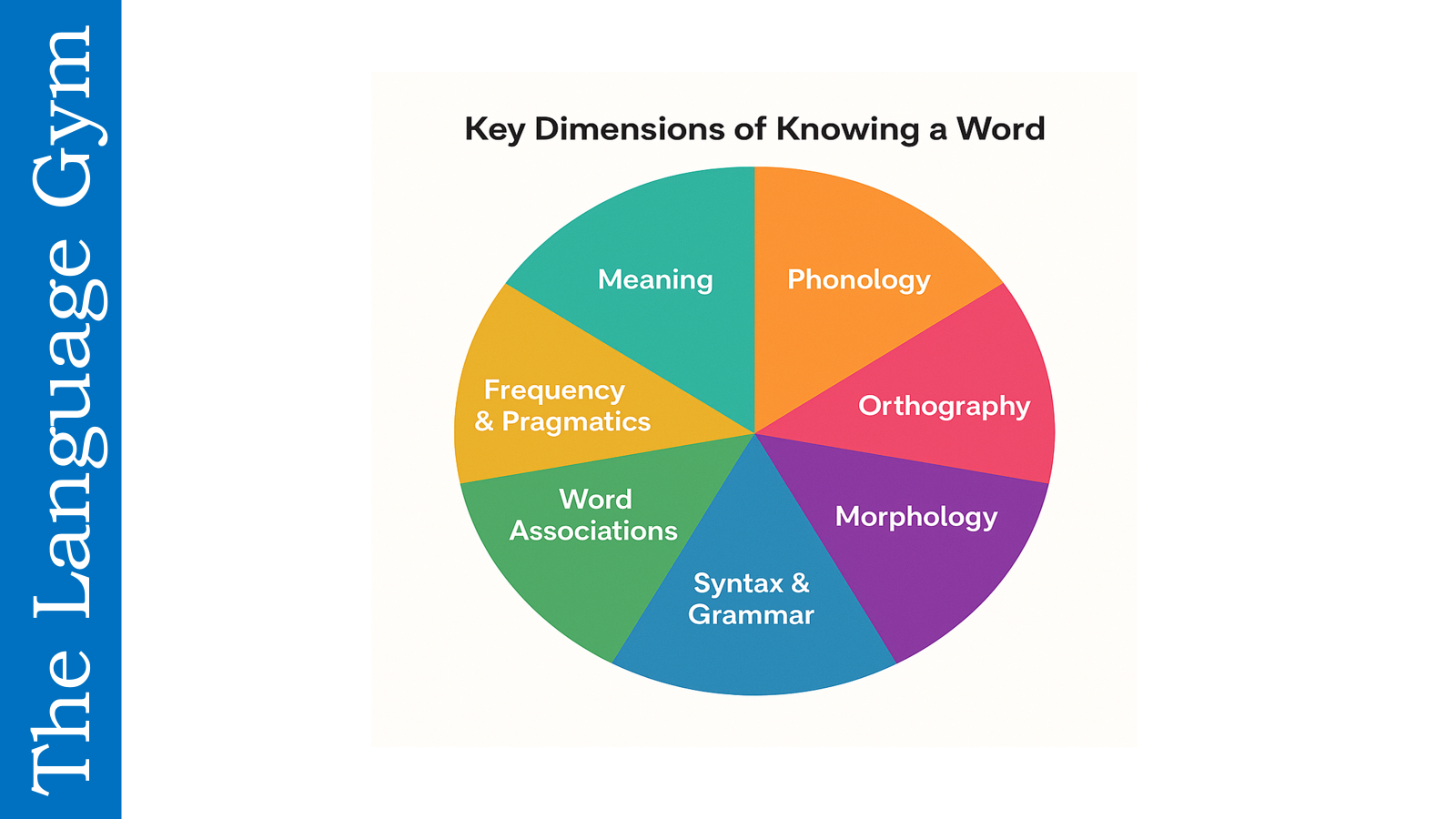
A necessary caution: what does it mean to “learn” a word?
Before addressing how many words can be taught in a lesson, I believe it is important to clarify what learning a word actually entails. Vocabulary knowledge is not an all-or-nothing phenomenon. Research consistently shows that knowing a word involves multiple dimensions: recognising its spoken and written form, understanding its meaning, knowing how it behaves grammatically, and being able to retrieve and use it appropriately (Nation, 2001; Schmitt, 2008). In classroom terms, this means that many words students encounter in a lesson may be noticed or partially understood without being fully learned or retained. The figures discussed in this chapter therefore refer to words or chunks that can realistically be taught for durable learning, not merely encountered or temporarily recognised.
Table 0. The dimensions of word knowledge
Dimension
What it involves
Classroom implications
Spoken form (phonological)
Recognising and producing the word’s sounds accurately
Learners may know a word in writing but fail to recognise it in listening
Written form (orthographic)
Recognising and spelling the word correctly
Spelling knowledge can support memory, especially at secondary level
Meaning (semantic)
Understanding what the word refers to
Meaning is often partial at first and becomes more precise over time
Form–meaning connection
Linking the sound/spelling to the correct meaning
This link is fragile in early learning and easily breaks under time pressure
Conceptual knowledge
Understanding the concept behind the word
Abstract or culturally unfamiliar concepts are harder to learn
Grammatical behaviour
Knowing the word’s part of speech and how it behaves grammatically
Includes gender, agreement, verb patterns, count/uncount status
Collocations
Knowing which words typically occur with it
Crucial for fluency and naturalness (e.g. make a mistake, not do)
Formulaic use / chunks
Knowing how the word functions inside common phrases
Supports faster processing and listening comprehension
Register
Knowing whether the word is formal, informal, slang, etc.
Prevents inappropriate usage in speaking and writing
Frequency
Knowing how common the word is
High-frequency words deserve more classroom time
Associations
Knowing related words (synonyms, antonyms, semantic fields)
Supports lexical networks and faster retrieval
Pragmatic use
Knowing when and why the word is used
Includes politeness, social norms, and discourse function
Receptive knowledge
Understanding the word when heard or read
Usually develops before productive knowledge
Productive knowledge
Being able to use the word accurately
Requires more practice and stronger memory traces
Automaticity
Retrieving the word quickly under pressure
Essential for fluent listening and speaking
L2 primary learners (approx. ages 5–11)
I have taught primary learners between the ages of 7 and 10 for 18 years and one thing that never ceased to surprise me was how fast their forgetting rate without constant revision was! This is because young learners face particularly strong cognitive constraints when learning vocabulary in an additional language. Working memory capacity is limited, attentional control is still developing, and phonological representations in the L2 are fragile and slow to stabilise. In addition, primary learners often have limited literacy skills in both their first language and the target language, which reduces their ability to use orthography as a support. As a result, vocabulary learning at this stage is highly incremental and depends heavily on repetition, salience, and recycling across time.
Table 1. Research findings: vocabulary learning in L2 primary learners
Research
Key findings relevant to “words per lesson”
Cameron (2001)
Vocabulary learning in young learners is gradual and fragile; introducing too many new words at once leads to shallow learning and rapid forgetting
Nation (2001)
Small numbers of new words should be taught explicitly, with repeated encounters over time; depth of processing matters more than quantity
Gathercole & Alloway (2008)
Children’s working memory capacity is very limited, strongly constraining how many unfamiliar items can be processed simultaneously
Pinter (2017)
Young learners benefit most when new vocabulary is embedded in familiar routines and recycled frequently
Kersten et al. (2010)
Vocabulary uptake improves when lexical load is low and exposure is distributed over time
Table 2. Studies informing how many words can be taught per lesson (Primary)
Study
Learners
Implication for words per lesson
Nation (2001)
Primary & early L2 learners
Around 3–5 new items can be taught effectively when recycling is built in
Cameron (2001)
Primary L2 learners
Fewer than 5 items per lesson supports retention
Gathercole & Alloway (2008)
Children
Working memory limits suggest very small lexical loads
Kersten et al. (2010)
Young L2 learners
Learning improves when lessons focus on few items, frequently recycled
Pinter (2017)
Primary learners
Depth over breadth; typically 3–4 items per lesson
What changes when words are taught in chunks?
In my experience, when vocabulary is taught as formulaic chunks (e.g. I like football, on the table, there is a dog) words are retained better by younger learners. One can also teach them more words, as the brain does not treat each word as a separate unit. Instead, the entire sequence can be processed as a single cognitive chunk.
Psycholinguistic research shows that:
working memory operates on chunks rather than individual words (Miller, 1956; Cowan, 2001)
frequently occurring multi-word sequences are stored and retrieved holistically (Wray, 2002; Ellis, 2003)
chunking reduces the need for online grammatical computation, freeing cognitive resources for meaning (Ellis, 1996; Nation, 2013)
For primary learners, this is particularly important. Because attentional resources are limited and processing is slow, treating a phrase as one unit allows learners to engage with meaningful language without having to assemble it word by word.
In sum, while primary learners can typically only learn around 3–5 new items per lesson, those items can be multi-word expressions rather than isolated words. Chunking does not increase memory capacity, but it significantly increases the amount of functional language that can be processed and retained.
How this translates into KS2 practice (Years 3–6)
Based on the research above, and taking into account developmental changes in working memory, phonological automatisation, and classroom listening demands, the following ranges are realistic teaching targets, not exposure limits.
Table 3. Recommended teachable vocabulary load per lesson (KS2)
Year group
New items per lesson (taught for retention)
Notes
Year 3
2–3 items
Strong reliance on chunks; heavy recycling essential; listening load must be very light
Year 4
3–4 items
Chunks preferred; begin gentle variation within familiar frames
Year 5
4–5 items
Mix of chunks and high-frequency single words; listening tasks still limit capacity
Year 6
5 items (occasionally 6)
Greater tolerance for analysis, but chunking remains more efficient than isolation
These figures assume that items are recycled across lessons and revisited in multiple modalities. Teaching more items in a single lesson does not increase long-term retention.
L2 secondary learners (approx. ages 11–16)
Secondary learners obviously benefit from several cognitive and experiential advantages as compared to their primary counterparts. First off, working memory capacity is greater, especially at 16 where it reaches the adult-like levels. Secondly, attentional control is more stable and learners are better able to analyse language explicitly. They also tend to have more developed literacy skills, allowing them to use spelling and morphology to support retention. As a result, vocabulary learning becomes more efficient, although it remains constrained by time pressure and real-time processing demands, particularly in listening.
Table 4. Research findings: vocabulary learning in L2 secondary learners
Research
Key findings relevant to “words per lesson”
Nation (2001)
Vocabulary acquisition is cumulative; teaching too many items at once reduces retention
Hulstijn (2001)
Intentional vocabulary learning is effective only when cognitive load is manageable
Schmitt (2008)
Knowing a word involves multiple dimensions, requiring repeated encounters
Field (2008)
Lexical overload impairs listening comprehension; fewer new items improve decoding
Vandergrift & Goh (2012)
Lexical familiarity is a strong predictor of listening success
Table 5. Studies informing how many words can be taught per lesson (Secondary)
Study
Learners
Implication for words per lesson
Nation (2001)
Adolescent L2 learners
Typically 6–10 new items per lesson with recycling
Listening lessons should stay toward lower end (6–8 items)
Vandergrift & Goh (2012)
Secondary learners
Lexical familiarity constrains how many items can be processed
What changes when words are taught in chunks?
At secondary level, chunking supports processing efficiency and fluency rather than basic capacity expansion. Research shows that formulaic sequences are retrieved faster than novel combinations (Pawley & Syder, 1983; Conklin & Schmitt, 2008) and reduce the cognitive cost of real-time comprehension.
To sum up, while secondary learners can typically learn 6–10 new items per lesson, teaching these items as chunks allows teachers to expose learners to a far greater volume of language without increasing cognitive overload.
Teaching vs exposure: revisited through chunking
The distinction between teaching and exposure becomes clearer when chunking is considered.
Teaching isolated words often leads to fragmented knowledge
Teaching chunks supports immediate comprehension and production
Exposure to many words inside a small number of chunks is cognitively efficient
Chunking therefore allows teachers to teach fewer items while delivering richer input.
Pros and cons of teaching words in isolation
Teaching vocabulary in isolation is not inherently wrong, but it has specific strengths and limitations.
Advantages
supports semantic precision
useful for low-frequency or content-specific nouns
facilitates dictionary skills and explicit form–meaning mapping
easier to assess in short written tasks
Limitations
high cognitive load during listening
weak support for fluency and real-time processing
encourages word-by-word decoding
delays access to functional language use
Isolated-word teaching is most effective when it is limited in quantity and quickly integrated into phrases or chunks.
When the words are cognates
Cognates occupy a special position in vocabulary learning. Because they share form and meaning with words in the learner’s first language, they place a much lighter burden on working memory and phonological decoding.
When teaching cognates:
learners can often process more items per lesson
sound–meaning mapping is faster
retention is generally higher
In practical terms, lessons focusing on transparent cognates may safely exceed the usual word-count limits, provided pronunciation differences are explicitly addressed to avoid fossilisation.
Factors affecting the learnability of words
Before considering how many words to introduce in a lesson, it is essential to recognise that not all words are equally learnable. Learnability refers to the extent to which a lexical item can be easily noticed, processed, stored, and retrieved by learners. Cognitive factors such as phonological complexity and length interact with experiential factors like frequency, transparency, and conceptual familiarity. Pedagogically, this means that raw word counts are misleading unless we also consider what kinds of words are being taught.
Table 6. Factors influencing how easily words are learned
Factor
Effect on learnability
Frequency
High-frequency words are learned faster
Phonological simplicity
Simple, familiar sound patterns are easier to retain
Transparency / cognacy
Cognates reduce cognitive load
Imageability
Concrete words are easier than abstract ones
Morphological regularity
Regular forms are easier to generalise
Length
Shorter words and chunks are easier to process
Contextual support
Rich context aids retention
Prior knowledge
Familiar concepts are learned more easily
Learnability directly affects how many words can be taught in a lesson. Highly learnable items allow for slightly higher word counts; low-learnability items sharply reduce capacity. Effective planning therefore requires managing both quantity and quality of vocabulary.
Why listening lowers the threshold (even with chunks)
Listening remains demanding because learners must decode sounds, segment speech, and hold information in working memory under time pressure. Chunking, of course, reduces these demands but does not remove them, which is why listening-heavy lessons should operate at the lower end of recommended word counts.
Conclusion
Vocabulary learning is governed not by ambition but by cognition. Across both primary and secondary phases, learners can only process and retain a limited number of new items in a single lesson. Teaching vocabulary in chunks does not change these limits, but it allows each item to carry more meaning, structure, and communicative value. Effective curricula therefore prioritise fewer items, taught more deeply, recycled more often, and embedded in meaningful input over time.
Chunking does not allow us to teach more words — it allows us to teach language more effectively.
If I have learnt one thing throughout 28 years of teaching, is that there is no such thing as “teaching SEN pupils” in the abstract. SEN profiles are so diverse, messy, and contradictory! However, research from cognitive psychology, SLA, and special education converges on a clear set of principles that consistently make MFL more accessible to learners with additional needs.
What follows are ten key things to bear in mind when teaching languages to SEN students, grounded in research and translated into classroom practice and materials design. Rest assured that none of these are gimmicks. Most are uncomfortable because they require us to slow down, simplify, and rethink what we mean by “progress”.
Finally, do note that I have included in this post a section dedicated solely to teaching dyslexic children, as research indicates that up to around 10 % of the UK population are estimated to have dyslexia — meaning a significant proportion of MFL learners may struggle with reading, processing and recall in ways that traditional materials and assessments do not adequately support
1. SEN pupils struggle more with retrieval than understanding
One of the most persistent myths in MFL – one that I always try to debunk in my posts – is that if a pupil cannot produce language, they do not “know” it. Research on working memory and retrieval (Gathercole & Alloway; Hulstijn) shows that recognition and recall are different cognitive processes.
Classroom implication
A pupil who can match la piscine to a picture but cannot spell or say it is not failing ! — they are operating at a different stage of acquisition.
Materials implication
Design tasks that separate recognition from production:
matching before recall
word banks before blank pages
partial dictation before full dictation
If your material jumps straight from exposure to free writing, SEN pupils fall off a cliff. In my approach (EPI) this translates into having a robust Receptive Processing phase (the first ‘R’ in the MARSEARS framework).
2. Cognitive load kills learning faster than lack of ability
Cognitive Load Theory (Sweller) is, of course, brutally relevant to SEN learners. Overloaded working memory doesn’t result in slower learning — it results in no learning at all.
Classroom implication
If a task requires pupils to simultaneously:
read instructions
decode new vocabulary
apply grammar rules consciously step by step
and write accurately
…you are not teaching language; you are testing executive function.
Materials implication
Reduce load by design:
one linguistic focus per task
minimal text per page
predictable task formats (this is key! Don’t be afraid to be repetitive)
visual consistency
98% comprehensible input (note: 98% comprehensible input does not mean simplified content, but content made accessible through scaffolding, repetition, and chunking)
A “busy” worksheet is often inaccessible before the pupil even starts!
3. Listening must be the engine, not the afterthought
Many SEN pupils (especially dyslexic learners) process language far more effectively through sound than print. SLA research consistently supports the primacy of input — yet textbooks still privilege reading and writing – and not the accessible sort either!
Classroom implication
Listening should dominate early sequences:
teacher modelling
choral repetition
narrow listening
listening with purpose, not just “play and answer”
Materials implication
Design materials where:
listening precedes reading
texts are short, repeated, and recycled (e.g. the EPI’s narrow listening)
audio is exploited multiple times in different ways (e.g. the EPI’s thorough processing techniques)
If listening is just “activity 3”, SEN pupils are already excluded.
4. Patterns must be made visible
SEN pupils are less likely to infer grammatical patterns implicitly. This is not laziness; it’s a cognitive difference. Research on explicit instruction (Norris & Ortega; Spada & Tomita) shows that guided noticing matters. However, research also shows that complicated grammatical explanations are less accessible by students with a lower IQ or less developed executive function.
Classroom implication
Do not assume pupils will “pick it up”. Show them:
colour-coded structures
sentence frames (e.g. EPI’s sentence builders)
chunked patterns
Materials implication
Avoid presenting:
vocabulary lists without structure
grammar rules without exemplars
Instead, design lexico-grammatical chunks:
voy a + infinitive me gusta + noun
Patterns first. Labels later. The greatest applied linguists on the planet agree that teaching chunks should come first and explicit grammar explanation should come later – Ellis & Shintani (2014), N. Ellis (2015), Nation (2013), VanPatten (2015), Webb & Nation (2017), etc. In EPI, this is reflected by having a short and snappy Awareness-raising phase (the first A in MARSEARS) immediately after the initial modelling through sentence builders and visual aids and a more robust explicit grammar teaching phase (the E in MARSEARS) after three or for lessons of receptive and productive retrieval of the target chunks.
5. SEN pupils need overlearning, not coverage
Forgetting curves are much steeper for many SEN learners. What looks like “they’ve done this already” is often they’ve seen it once.
Classroom implication
Hence, Recycling is not revision — it is core instruction. If the average child requires
Materials implication
Good SEN-friendly materials:
reuse the same language across lessons
vary tasks, not language
return to the same chunks in different contexts
If your scheme introduces new language every lesson without revisiting old material, SEN pupils are permanently behind. This is one of the biggest shortcoming of the textbooks currently in use in most UK schools, e.g. Stimmt, Viva, Mira,, Dynamo, Tricolore, Studio. Possibly the worst ones are the recently published textbooks based on the new GCSE – often by no fault of the authors, in my opinion, who are constrained by the number of pages set by the publishers and by the ridiculous high volume of content they need to cover.
Table 1 –Encounters with a lexical item required by learners of different abilities (from the average ability ones to those with severe SEN) to develop a BASIC knowledge of it
Key clarification (important)
These encounters must be meaningful, not just visual exposure
Textbooks often assume pupils can work independently after one model despite decades of research suggesting otherwise! Sociocultural theory argues that learning happens most reliably in the Zone of Proximal Development—i.e., when pupils can succeed with structured guidance that is then gradually withdrawn (Vygotsky, 1978). Reviews of scaffolding research emphasise that effective support is not “help for the weak”, but a deliberate design feature that enables learners to process language they only partially control and to internalise procedures over time (Malik, 2017; Ertugruloglu, 2023). In the UK MFL context, the Teaching Schools Council’s MFL Pedagogy Review also warns—implicitly for exactly this reason—that textbooks should be chosen for how well they support planned teaching of vocabulary/grammar/phonics and should often be supplemented rather than relied on as the sole engine of learning, because many published materials don’t provide enough structured practice and guided attention to detail for all learners to access them independently. Read this article if you want to know more on this topic: https://www.tandfonline.com/doi/full/10.1080/2331186X.2017.1331533
Classroom implication
Remove scaffolds gradually, not suddenly as we do in EPI, where students arrive at production only after a highly structured journey from input to output which gradually moves from receptive retrieval at sentence-level to more challenging work with connected text in the Receptive phase and then scaffolds the progression from easier productive retrieval at sentence level (e.g. Oral Ping-pong) to harder information-gap tasks (e.g. ‘Back-to-back’ or ‘Ask the experts’) in the Structured Production phase.
Materials implication
Build tasks that move from:
full support → partial support → no support
Not:
support → (nearly) nothing
For SEN learners, the “blank page” is often the point of collapse. This is another major pitfalls of currently available textbooks, even when a lower-ability specific version of the textbooks does exist. The scaffolding is so bad, that the Listening and Reading activities are not logically linked with the ensuing Speaking and Writing activities! Bizarre, of course, as the former are meant to scaffold the latter. Hence, do ensure that, as we do in EPI, the receptive activities are carefully designed and implemented in a bid to ensure that speaking and writing skills emerge seamlessly and organically from the listening and reading activities staged at the beginning of your instructional sequences.
7. Writing is the hardest output — treat it as such
Writing combines:
recall
spelling
grammar
motor skills
working memory
For SEN pupils, this is the highest-load skill. Even higher than speaking! The typical textbook expects students to read one or two texts, do a reading comprehension tasks or two on each and then write something similar. This is not going to help the average learner, let alone an SEN child!
Classroom implication
Do not use writing as your default proof of learning. This is the most commonly made mistakes with SEN pupils. Do plenty of scaffolding (see the previous point) ! Give them highly structured 100% feasible output.
Materials implication
Before extended writing, include:
sentence completion
sentence manipulation
ordering tasks
easy sentence-puzzle games
copying with attention
If the first time pupils write independently is for assessment, you’ve set them up to fail. Delay writing assessment with SEN pupils as much as humanly possible
8. Pace matters more than enthusiasm
Fast-paced lessons are often praised — but for SEN pupils, speed frequently equals panic.
Classroom implication
Calm, predictable pacing reduces anxiety and improves retention.
Materials implication
Design sequences with:
repeated task types
familiar routines
clear expectations
Surprise is motivating for some pupils; it is destabilising for others.
9. Differentiation should be built in, not bolted on
SEN pupils should not always be working on “the easier sheet”. Research on inclusive design stresses universal design for learning.
Classroom implication
Design tasks with multiple entry points, not multiple worksheets.
Materials implication
A good task allows:
all pupils to start
some to go further
no one to be exposed as “different”
Ramped difficulty beats personalised worksheets every time.
10. Progress for SEN pupils is often invisible unless you know where to look
Traditional assessments privilege speed, accuracy, and written output. SEN progress often shows up first in:
faster recognition
reduced hesitation
improved pronunciation
willingness to attempt
Classroom implication
If you only value what you can mark, you will miss most progress.
Materials implication
Include low-stakes checks:
oral responses
mini whiteboards
matching and sorting tasks
listening discrimination
These reveal learning long before writing does.
Specific advice for teaching MFL to dyslexic children
Table 2 – Teaching strategies specifically aimed at dyslexic children
Teacher Strategy
Why this Matters Specifically for Dyslexic Learners
Research Basis
Explicit teaching of sound–spelling correspondences (as we do in EPI)
Dyslexia is strongly associated with phonological processing difficulties; learners do not reliably infer grapheme–phoneme links implicitly
Snowling (2000); Hulme & Snowling (2016)
Overt phoneme segmentation and blending in the target language (as we do in EPI)
Dyslexic learners struggle to segment spoken words into phonemes, which directly affects spelling, decoding and pronunciation
Goswami (2008); Ziegler & Goswami (2005)
Slow, exaggerated modelling of pronunciation (as we do in EPI)
Reduced phonological sensitivity means fast or “natural” speech often collapses into noise
Szenkovits & Ramus (2005)
Consistent font, spacing and visual layout across materials (as we do in EPI)
Visual stress and reduced visual tracking make dense or changing layouts disproportionately difficult
British Dyslexia Association (2018)
Avoidance of copying from the board as a learning activity (in EPI this is done sparingly after much modelling)
Copying overloads visual processing and working memory without strengthening language representations
Elliott & Grigorenko (2014)
Teaching spelling as pattern-based, not word-by-word (as we do in EPI)
Dyslexic learners do not retain arbitrary orthographic forms well but benefit from rule-based generalisations
Seymour (2014)
Why EPI is particularly suitable for SEN learners
Many of the principles outlined above are not incidental features of Extensive Processing Instruction (EPI); they are foundational to its design. EPI is particularly well suited to SEN learners because it systematically removes the very barriers that traditional MFL materials create.
First, EPI places input before output. SEN learners are not rushed into premature production; instead, they are given repeated, highly comprehensible exposure to language through listening and reading before being expected to retrieve it independently. This aligns closely with what we know about the recognition–recall gap in SEN profiles.
Second, EPI actively controls cognitive load. Sentence builders, chunked input, and tightly staged activities mean that learners are rarely asked to process multiple new elements simultaneously. The linguistic focus is narrow, explicit, and sustained over time, which allows SEN pupils to build secure mental representations without overload.
Third, EPI makes patterns visible and reusable. Grammar and vocabulary are not treated as separate pillars but as interlocking parts of lexico-grammatical chunks. For SEN learners who struggle with abstraction, this concreteness is critical: they are not asked to infer rules from sparse examples but are immersed in recurring, meaningful structures.
Fourth, EPI is built around recycling and overlearning. The same language appears again and again across different tasks and modalities, reducing forgetting and increasing automaticity. This is precisely what SEN learners need, yet what textbooks rarely provide.
Finally, EPI embeds scaffolding as a progression, not a crutch. Sentence builders, guided tasks, and structured production phases allow learners to move gradually towards independence. Support is not removed abruptly; it fades as confidence and competence grow.
In short, EPI does not “adapt” to SEN learners after the fact. It is inherently inclusive by design, and what makes it effective for SEN pupils is exactly what makes it effective for everyone else.
Conclusion
Teaching MFL to SEN pupils is not about lowering expectations. It is about changing the route.
When we slow input, reduce cognitive load, foreground patterns, recycle relentlessly, and scaffold intelligently, SEN pupils do not merely cope — they often outperform our expectations. The uncomfortable truth is that many of the practices we label as “SEN strategies” are, in fact, good language teaching full stop.
If SEN pupils struggle in our classrooms, the question is not whether they are capable of learning a language, but whether our materials and sequences are capable of teaching one.
Design for the margins, and the centre takes care of itself.
The first lessons after a holiday are far more consequential than they appear on paper, because although they look like “normal lessons” on the timetable, pedagogically they are anything but! In my experience, what we do in January very often determines whether the rest of the term feels calm, purposeful and cumulative, or whether it slowly turns into a fight against disengagement, widening gaps and the erosion of standards. The mistakes teachers make at this point are rarely the result of poor practice; more often, they emerge from good intentions colliding with fatigue and an underestimation of just how much the holiday has disrupted pupils cognitively and behaviourally.
Common January Mistakes in Language Classrooms (All Phases)
Mistake 1: Assuming pupils will just slot straight back in
In my experience, this is the single most common January error, because we tend to assume continuity where actually there is none! Pupils return with weaker retrieval, frayed routines and a noticeably lower tolerance for sustained cognitive effort. And when teachers behave as if “nothing has changed”, they often find themselves spending weeks firefighting behaviour, attention and effort that could have been stabilised early on. In my opinion, January requires a deliberate reset in which expectations, routines and focus are re-established explicitly, calmly and unapologetically. Otherwise, the term begins on borrowed time and never truly recovers!
What has always worked with my classes instead included: silent starter retrieval tasks on entry, explicit re-modelling of classroom routines, short and highly structured tasks with clear success criteria, and timed activities that re-establish pace and focus while signalling that standards are back where they belong.
Mistake 2: Starting immediately with new or demanding content
I see this every year, often driven by a sense of pressure to “get going”, to cover ground quickly, or to make up for perceived lost time. The result is frequently the introduction of new grammar, complex texts or cognitively heavy tasks in the very first lessons back, yet pupils don’t experience this as challenge; they experience it as failure! In my opinion, January should begin with reactivation rather than progression, because pupils need time to reconnect with familiar language, rebuild confidence and feel competent again before anything genuinely new is layered on top.
What works instead includes sentence reordering using previously taught structures, translation of familiar language in both directions, listening to already-known texts with confidence-building tasks, and scaffolded sentence expansion that reminds pupils what they already know they can do.
Mistake 3: Talking too much to compensate for forgetting
In my opinion, holiday rust triggers one of the most counterproductive teacher instincts: the urge to explain more. We remind, re-explain, justify and elaborate, while pupils sit there passively, nodding along, without actually retrieving anything themselves. Although longer explanations can feel reassuring in the moment, they do very little to rebuild learning, and in my experience what pupils need in January is not more teacher talk but more structured opportunities to remember, process and reuse language, even if that initially feels slower and less impressive.
What works instead includes mini-whiteboard retrieval questions, choral repetition and reading aloud, partial-to-full dictation, and error-spotting tasks that focus on familiar language and force active engagement.
Mistake 4: Treating behaviour as a secondary concern
There is often a temptation to “let things slide” in the first week back, because it’s January, pupils are tired, and nobody wants to start the term feeling heavy-handed. In my experience, this is a mistake, because January is a behavioural hinge point and what you allow in the first lessons back very quickly becomes the norm. In my opinion, routines around entry, silence, equipment and transitions need to be reset explicitly and consistently, not harshly but clearly, because calm firmness early on saves an enormous amount of energy later.
What works instead includes immediate “do now” tasks, rehearsed stop–start signals, short timed tasks that limit off-task behaviour, and whole-class response strategies that keep everyone cognitively involved.
Mistake 5: Planning ‘fun’ lessons with no linguistic payoff
I understand the instinct completely: after a long break, we want pupils to enjoy being back, to ease them in gently and to avoid unnecessary stress. However, in my experience, “fun” without linguistic purpose does not rebuild habits, confidence or competence, and while pupils may enjoy it in the moment, they often leave having learned very little, with the underlying problems still intact. In my opinion, January engagement needs to be purposeful, so activities should feel accessible and motivating while also clearly moving language learning forward.
What works instead includes: low-stakes retrieval games, listening bingo built around known language, competitive sentence-building tasks, and tightly scaffolded speaking games that balance enjoyment with progress.
Mistake 6: Forgetting to engineer early success
This mistake is subtle but crucial, because pupils returning from a break are more vulnerable than we often realise, particularly those who already struggle with languages. In my experience, if the first lessons back end in confusion or failure, motivation drops alarmingly fast, which is why January lessons should be designed to end with visible success, whether that means correct answers, completed sentences or something pupils can point to and think, “I can still do this”. Confidence first, stretch later – that has always been my motto in the first couple of weeks back from any holiday break.
What works instead includes highly scaffolded writing tasks, intentionally high-success listening activities, whole-class correction that normalises accuracy, and exit tickets that show tangible progress.
January Mistakes at GCSE Level (Assuming December Mocks Have Taken Place)
At GCSE, January is not a neutral reset, because pupils return with mock results, grades and a strong sense of where they believe they now “stand”. In my experience, this is the point at which January can either become a moment of strategic repair or the moment when underperformance quietly fossilises.
GCSE Mistake 1: Treating January as a “fresh start”
December mocks have already generated valuable diagnostic information, and when that data is ignored, a critical opportunity is wasted! Rather than restarting schemes or ploughing on regardless, January should be used to prioritise the highest-impact gaps revealed by the mocks, particularly in listening decoding, verb control and core structures. For example, if a class performed reasonably well in reading and writing but collapsed in listening, January lessons might include short, slowed-down listening extracts reused across several lessons, with pupils underlining cognates, identifying verb endings or matching phrases to meanings before ever attempting exam-style questions.
GCSE Mistake 2: Reteaching everything the mock exposed
When January turns into a catalogue of weaknesses, pupils quickly feel overwhelmed and demoralised, which in my opinion is one of the fastest ways to kill momentum. A more effective approach is to identify the two or three biggest leverage points per skill and focus relentlessly on those, because less content and more precision almost always produce better results. For instance, instead of revisiting every tense pupils used incorrectly in the writing paper, a teacher might focus exclusively on improving the accuracy of the present tense and one past structure, using sentence transformation tasks, guided translation and short paragraph rewrites where success is visible and measurable.
GCSE Mistake 3: Teaching to the mock paper rather than the skill deficit
Simply repeating mock-style tasks does very little if pupils don’t understand why they struggled in the first place. In my experience, progress accelerates when teachers diagnose the real issue, whether it is speed of processing, decoding, retrieval failure or accuracy, and then design tasks that directly train that skill – rather than rehearse the paper itself. For example, if pupils ran out of time on the reading paper, the solution is not another full reading paper but timed micro-reading tasks in which pupils practise scanning for key information under strict time limits, gradually increasing both speed and confidence.
GCSE Mistake 4: Neglecting listening after poor mock results
Listening is frequently the weakest GCSE paper and also the hardest skill to rebuild if it is postponed. January is therefore the moment to make listening central again through short, repeated extracts, decoding-focused tasks, dictation and confidence-building exposure that rebuilds competence rather than anxiety. A realistic approach might involve playing a 20–30 second extract several times across a lesson, first for gist, then for specific words, then as a partial dictation, before finally linking it to a short exam-style question.
GCSE Mistake 5: Using mock grades as fixed labels
Pupils very quickly internalise December outcomes as destiny, particularly those who underperformed, and unless this narrative is actively challenged, effort often drops. In my experience, mocks need to be reframed explicitly as information rather than judgement, with clear messaging about what is fixable and how. For example, teachers might share anonymised class data showing common errors and explicitly state that these are skills problems, not ability problems, before modelling how targeted practice can improve a specific question type.
GCSE Mistake 6: Failing to engineer post-mock success
After receiving results, pupils are psychologically exposed, and if January lessons reinforce failure, the damage can be long-lasting. GCSE lessons during this period should therefore be designed to end with visible success, such as improved listening scores, cleaner sentences or measurable gains pupils can recognise and trust. This might involve ending a lesson with a short listening task that pupils previously failed in the mock but now complete successfully after targeted practice, or a brief writing task where everyone produces a correct, exam-valid sentence using a structure they struggled with before Christmas.
GCSE Mistake 7: Obsessing over grade boundaries instead of controllable gains
After December mocks, conversations often drift towards grades, boundaries and questions like “how many marks do I need for a 6, 7 or 8”, yet in my experience this focus is largely unhelpful in January. Pupils fixate on outcomes they cannot control and lose sight of the behaviours and skills that actually move marks, while borderline pupils can become paralysed by the feeling that the gap is either too big or unfairly small. A more productive approach is to translate grades into concrete, controllable actions, so instead of telling a pupil they are “three marks off a grade 5”, a teacher might show them that improving one listening question type or securing verb accuracy in one writing bullet point reliably yields those marks.
GCSE Mistake 8: Ignoring option strategy and question selection
Another GCSE-specific oversight is failing to revisit option strategy after mocks, because many pupils lose marks not through lack of language but through poor decision-making under pressure. They attempt all bullets when fewer would score higher, over-write weak answers or panic when encountering unfamiliar vocabulary. January is the ideal moment to address this explicitly by modelling how to choose the strongest bullet points in writing tasks, how to abandon a weak listening question and move on, or how to prioritise questions that play to a pupil’s strengths, which is not exam-technique overload but decision-making training that pays off disproportionately.
GCSE Mistake 9: Treating speaking as a future problem
Because speaking exams feel distant in January, they are often quietly deprioritised, yet in my experience this is a mistake because the language required for speaking overlaps heavily with writing and listening success. Delaying speaking preparation increases anxiety later while missing opportunities for reinforcement now. January speaking work does not need to involve full role plays or mock exams; short, controlled speaking routines using already-secure language, brief photo descriptions or rehearsed answers to familiar questions can be woven into lessons without pressure, keeping speaking alive and preventing the spring term from becoming a panic-driven boot camp.
GCSE Mistake 10: Misaligning revision with frequency and payoff
After mocks, pupils often revise indiscriminately, working through long vocabulary lists, obscure topic words or low-frequency structures that feel impressive but deliver little return. In my opinion, January is where this must be corrected, because GCSE success depends disproportionately on high-frequency language used accurately rather than on linguistic breadth for its own sake. Teachers can address this by refocusing pupils on a core lexical and structural spine, revisiting how a small set of verbs behaves across multiple tenses or contexts, which often improves performance across listening, reading and writing simultaneously.
January at GCSE is not about acceleration; it is about precision repair. Teachers who chase coverage tend to spend the spring firefighting, while those who use January to target the right deficits build confidence, competence and momentum that lasts all the way to the exams.
Conclusion
In my experience, January is never a neutral moment in the language classroom. What we do in the first few lessons back is either a decisive point of recalibration or the quiet beginning of drift. The mistakes teachers make at this time are rarely dramatic; they are subtle, well-intentioned and entirely understandable. We often rush because we feel behind. We explain more because pupils look rusty. We push on because the syllabus looms. And yet, those instincts – which I remember all too well – often create more problems than they solve, especially when it comes to our more vulnerable students.
What January really demands is restraint, precision and, most importantly, clarity of purpose. Not more content, but the right content. Not more talk, but better designed opportunities for pupils to retrieve, process and succeed. At GCSE in particular, January is not about acceleration or reinvention; it is about repair, alignment and restoring pupils’ belief that progress is still within reach.
When teachers resist the urge to panic and instead use January to reset routines, rebuild confidence and target high-leverage skills, the rest of the year becomes calmer, more efficient and ultimately more successful.
In short, January doesn’t reward urgency; it rewards intentionality. Get January right, and you don’t just recover from the holidays… you quietly set the conditions for everything that follows!
You must be logged in to post a comment.