
Introduction
When I first heard the phrase “You shall know a word by the company it keeps” by J.R. Firth during my MA in TEFL around 25 years ago, it reshaped how I thought about vocabulary teaching. Like many teachers, I had been presenting vocabulary in isolated lists, assuming learners simply needed to understand definitions. But Firth’s words revealed something far deeper: words acquire meaning, function, and use through the other words and structures they habitually appear with.
What became increasingly clear to me was that learners often make persistent errors not because they misunderstand meaning, but because they’ve never encountered words in natural, repeated combinations. Yet, many language classrooms continue to focus heavily on single-word vocabulary and grammar rules—leaving learners to try to construct fluent language from scratch, often under impossible cognitive constraints. They know what “temps” means, but say “il est soleil” instead of “il fait beau.” They know “regarder” and “télé,” but say “je regarde à la télé” instead of “je regarde la télé.” They say “je suis 14 ans” instead of “j’ai 14 ans.” These weren’t gaps in knowledge but in collocational awareness.
Collocations refer to words that habitually co-occur—word partnerships that sound natural to native speakers but often baffle learners. These include verb-noun combinations like faire une erreur or prendre une décision in French, or tener razón and cometer un error in Spanish. Learners often substitute literal equivalents like hacer un error or tomar una decisión without realising these combinations are unnatural or incorrect.
Colligations, on the other hand, refer to the grammatical patterns that typically occur with specific words. For instance, in Spanish, me gusta bailar is correct, but learners often say me gusta a bailar by wrongly inserting a preposition. Similarly, in French, learners might misuse structures such as je suis fini instead of j’ai fini, misapplying the auxiliary verb due to interference from English.
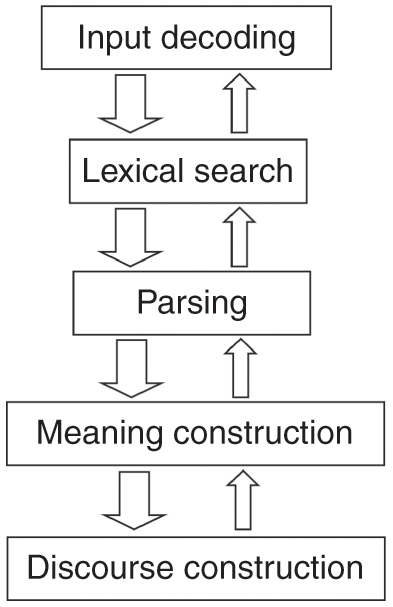
These patterns are central to Michael Hoey’s Lexical Priming Theory (2005), which argues that our brains store words not in isolation, but with the words and grammatical structures they frequently appear alongside. Levelt’s foundational model of speech production (1989) provides the framework for understanding how these patterns interact in real-time speech, while Hoey’s theory shows how these expectations are shaped by learners’ exposure to lexical environments over time. For example, in Spanish, repeated exposure to tener que + infinitive (e.g., tengo que estudiar) or acabar de + infinitive (e.g., acabo de llegar) primes learners to expect and produce those structures. In French, structures like être en train de + infinitive or avoir besoin de + noun become cognitively entrenched through repetition.
Hoey explains that each encounter with these chunks primes learners not only lexically, but grammatically and even stylistically. This means that repeated exposure not only strengthens associations between words, but also builds expectations around the grammatical patterns and the discourse contexts they typically appear in. For instance, in Spanish, a chunk like tener que + infinitive not only teaches a functional expression of obligation but also primes learners to use infinitive verb forms that follow it. Stylistically, a phrase like acabo de llegar is not only grammatically accurate but also carries informal, conversational resonance that learners internalise through frequency of exposure. In French, chunks like il faut que + subjunctive prime both the grammatical form and its frequent use in formal or instructional contexts. Hoey’s theory thus provides a powerful explanation for how fluent speakers seem to ‘just know’ what sounds natural—because their brains have been consistently primed through repeated exposure across registers and contexts.
Building on this, Michael Lewis’s Lexical Approach (1993, 1997) emphasises that language is not merely a system of rules to be applied but a repertoire of prefabricated chunks. Lewis encourages the teaching of high-frequency expressions and semi-fixed patterns such as ça me plaît, il faut que + subjunctive, or estar a punto de + infinitive. He suggests that learners gain fluency not by mastering abstract grammatical paradigms but by internalising and reproducing these lexicalised structures. His work positions collocations and colligations as the foundation for natural-sounding language.
This article draws on these frameworks to explore how collocations and colligations work, why they matter, and how to teach them effectively. It concludes with a practical toolkit of classroom activities designed to help learners internalise the natural patterns of language use—and ultimately, to sound more fluent, more accurate, and more confident.
Collocations, Colligations, and Chunk-Based Fluency
Understanding and teaching collocations and colligations is at the heart of effective chunk-based instruction. This is not just a matter of teaching learners to pair the right words or use correct structures—it is about making the act of speaking less cognitively demanding and more automatic.
Kormos’s (2006) adaptation of Levelt’s model of speech production to second language learners highlights where fluency often breaks down: in the formulation stage. Here, learners must retrieve lexis, apply grammar, sequence ideas, and prepare for articulation—all in real time. The time constraints are significant: research suggests that fluent speech requires lexical retrieval within 150–250 milliseconds per word (Indefrey & Levelt, 2004). Add to this the demands of working memory, limited automaticity, and interference from the L1, and it’s easy to see why formulation becomes a major bottleneck. Every second counts, and learners often don’t have enough of them to assemble well-formed utterances from scratch. For many, this bottleneck causes hesitation, slow speech, and error-prone output. This is why, as many studies suggest, between 50% and 80% of native speaker speech and writing consists of formulaic sequences such as collocations, chunks, and fixed expressions (Erman & Warren, 2000; Wray, 2002; Conklin & Schmitt, 2008).
Teaching prefabricated lexical chunks—particularly those that combine collocational and colligational knowledge—helps bypass this bottleneck. When learners internalise high-frequency phrases such as je voudrais réserver une table or tengo que estudiar esta noche, they do not need to construct these sentences from scratch. They retrieve them as whole units, reducing the burden on working memory and allowing attention to shift toward fluency, pronunciation, or interaction.
Formulaic language research (e.g., Wray, 2002; Wood, 2010) strongly supports this approach. It shows that fluent speakers rely heavily on chunks to maintain flow, and that repeated exposure to and retrieval of these structures builds automaticity over time. This is why instruction that integrates collocational and colligational awareness within chunk-based practice can dramatically boost real-time performance.
When learners are trained to recognise and produce these patterns early on, they experience more success in oral tasks, develop greater confidence, and are better prepared to manage spontaneous interactions.
Implications for the Classroom
The insights from lexical priming and the Lexical Approach have clear pedagogical consequences. First, vocabulary should not be taught as isolated items but through meaningful, repeated exposure in context. Language learners benefit from activities that help them notice and internalise recurring patterns of words and structures—especially those that reflect natural usage.
Teachers should encourage learners to attend to both collocations (common word pairings) and colligations (preferred grammatical structures). This means embedding lexis-rich input across all modalities and offering frequent opportunities for structured output. Lexical patterning should be integrated into listening and reading comprehension, as well as in writing and speaking production tasks.
Furthermore, instruction should reflect the priming nature of language exposure. Activities should include repeated encounters with lexical items, scaffolded across different tasks and modalities. Form-focused instruction that highlights typical collocational and colligational behaviour helps learners notice and internalise these patterns.
Techniques for Teaching Chunks Effectively
A number of well-established instructional techniques can significantly boost learners’ acquisition and internalisation of lexical chunks. Here are some of the key ones:
- Input Flood: Learners are exposed to high concentrations of target chunks in meaningful input, which increases the chances of noticing and retention.
- Input Enhancement: Target collocations are visually or aurally highlighted (e.g., bolded in a text or stressed in speech) to direct learners’ attention to them (Sharwood Smith, 1993).
- Repeatable input: if students hear collocations and colligations but are unable to repeat them because they are either pronounced in an unintelligible or overy rapid way, they will never be able to acquire them in their oral form!
- Repeated Processing: Learners revisit the same lexical chunks across different contexts and tasks, helping deepen mental encoding and strengthen retrieval paths.
- Thorough and Deep Processing: Learners engage with chunks through tasks that require analysis, manipulation, or evaluation—for example, comparing similar chunks, or identifying register differences.
- Task-Induced Involvement: According to Laufer and Hulstijn (2001), tasks that require learners to focus on form, meaning, and use (i.e., high-involvement tasks) lead to better retention of chunks.
- Pushed Output: Learners are required to produce language that includes the target chunks under communicative pressure. This encourages retrieval and consolidation.
- Spaced Retrieval Practice: Chunks are revisited across spaced intervals in time, improving long-term retention and automaticity (Nation, 2013; Barcroft, 2007).
- Task Repetition: Learners perform the same task multiple times with slight variations, allowing them to refine fluency and accuracy while embedding recurring chunks (Bygate, 2001).
- Retrieval-Based Interleaving: Previously learned chunks are mixed with newer ones in practice sessions, enhancing discrimination and long-term learning.
- Text Reconstruction: Activities such as dictogloss, sentence puzzles, and rebuilding gapped texts encourage learners to focus on both lexical accuracy and grammatical structure, reinforcing both collocations and colligations in context.
These techniques work best when integrated into a carefully sequenced curriculum that builds up from controlled exposure to semi-controlled use and, eventually, to fluent, spontaneous production.
Classroom Activities
What does it all look like in action? What follows is a curated set of classroom activities I’ve used (and refined) over the years, drawn from research but grounded in the practical reality of what works in the language classroom. These activities, some of which EPI users will be familiar with, are all about helping learners notice, process, and produce collocations and colligations in meaningful, engaging, and purposeful ways. Whether you’re working on reading, writing, listening, or speaking, there’s something here for every mode of communication—and every type of learner.
Reading Activities
- Tarsia Puzzles: Learners match parts of collocations, definitions, or translations on puzzle pieces to form a complete shape. This promotes active recall and visual processing while reinforcing connections between collocates.
- Picture-Match Reading: Learners read sentences and match collocations (“fast food,” “strong coffee”) to pictures.
- Collocation Hunt: Provide a short, simplified text and ask learners to underline repeated word pairings (e.g., “good morning,” “take a break”).
- Break the Flow: Provide a text where all spaces between words are removed. Students listen to the teacher read and mark boundaries.
- Gapped Letters: Provide a text with target collocations where certain letters are omitted. Students fill in the gaps as they read.
- Collocation Cloze: Fill-in-the-blank exercises using collocations from an authentic article. Contextual clues help reinforce chunked meanings (Hill, 2000).
- Reading as Modelling (RAM): Use rich written texts and follow-up activities to help learners notice and internalise collocations.
- Sentence puzzles: Learners reorder mixed-up sentences that contain collocations, reinforcing structure and word order.
- Sentence Stealer: Present learners with sentences containing target collocations. In pairs, students take turns reading sentences aloud and attempting to “steal” them by recalling and reproducing them from memory.
- Narrow Reading: Offer a series of short, thematically related texts that contain repeated instances of target collocations.
- Genre Awareness: Compare how collocations differ in formal vs. informal texts (e.g., “conduct research” vs. “do some digging”).
- Corpus Exploration: Use learner-friendly corpora (e.g., CRFC for French, Corpus del Español for Spanish) to look up common collocates of academic words like “approach,” “issue,” or “evidence.”
- Genre Transformation: Rewrite a formal text in an informal style or vice versa, noticing collocational shifts.
Writing Activities
- Collocational Cohesion: Learners use collocational chains to create textual cohesion across a longer piece of writing.
- Collocation Essay Challenge: Assign thematic collocations (e.g., “raise awareness,” “take part in”) to be used in a short essay.
- Communicative Translation Drills: Short dialogues including L1 sentences with target collocations for 2 students working in paris to translate into the target language whilst a third student monitor their output supported by the L2 version
- Dictogloss: Read a short text containing target collocations. Students reconstruct the text together, encouraging attention to structure and collocational use.
- Error Correction: Provide texts with common miscollocations for learners to spot and correct (Boers & Lindstromberg, 2008).
- Lexical Upgrading: Learners revise a basic paragraph by substituting simple combinations with richer collocations (e.g., “say sorry” → “offer an apology”).
- Matching Game: Match verbs and nouns (“make a cake,” “take a photo”) before writing short sentences.
- No Snakes No Ladders: A board game where students move forward by correctly using target collocations in full sentences.
- Oral Ping-Pong: In pairs, students take turns constructing sentences using given collocations, promoting active recall and use.
- Sentence puzzle: Provide jumbled sentences containing collocations for learners to unscramble, reinforcing grammar and chunking.
- Sentence Frames: Provide starters like “I have a ___” or “I like to ___” with a set of collocating nouns/verbs to choose from.
Listening
- Audio Sorting: Learners listen to collocations in context and sort them into categories (e.g., emotion, movement).
- Bingo with Collocations: Use audio tracks with high-frequency collocations; learners check off what they hear.
- Collocational Noticing: Play academic talks or news clips. Learners identify and note down recurring collocations.
- Dictogloss with Collocations: Read a short passage twice; learners reconstruct it with a focus on the target collocations.
- Track the Pattern: Learners listen to a passage multiple times and highlight recurring collocations or grammatical patterns, training their ear to notice structured repetition.
- Guess the Next Word: Learners listen to a sentence or short passage and pause before a target collocation or chunk. They predict what comes next, encouraging anticipation and awareness of typical lexical patterns.
- Listening as Modelling (LAM): Use rich audio texts and follow-up activities to help learners notice and internalise collocations.
- Listening Cloze: Provide a transcript with missing collocations. Learners fill in the blanks while listening.
- Minimal Pairs with Chunks: Focus on collocations that differ by a single word (“take a break” vs. “make a break”) to build discrimination.
- Narrow Listening: Provide several audio clips on the same topic, all containing key collocations, for focused exposure.
- Transcription and Chunking: Learners transcribe a short audio segment and highlight the collocations, then reflect on why they work together.
Speaking Activities
- Chain Reaction: Each learner adds a sentence using a new collocation that links logically to the previous one.
- Chain Storytelling: In groups, learners build a story sentence by sentence, each incorporating a given collocation.
- Debate with Collocations: Assign collocation banks for persuasive language (“weigh the evidence,” “draw a conclusion”).
- Drill Chains: Learners repeat and vary common collocations (“go shopping,” “go running,” “go swimming”).
- Find Someone Who: Mingling activity using collocational prompts to gather information from peers.
- Fluency Tasks with Constraints: Learners must use at least 5 academic or idiomatic collocations during a presentation.
- Mind Reading: Teacher thinks of a sentence with a collocation; students guess by asking yes/no questions.
- Oral Ping-Pong: Pairs engage in rapid exchanges using target collocations in fluent, spontaneous ways.
- Prompted Opinions: Learners respond to prompts using target collocations (“I believe strongly that…”, “I take the view that…”).
- Role Play with Prompts: Give situations (e.g., ordering food, meeting someone) and collocation prompts to use.
- Debate with Collocations: Assign collocation banks for persuasive language (“weigh the evidence,” “draw a conclusion”).
- Fluency Tasks with Constraints: Learners must use at least 5 academic or idiomatic collocations during a presentation.
Conclusion
If vocabulary is the building block of language, then collocations are the cement that binds those blocks together. Research consistently confirms that collocational competence is key to fluent, natural, and contextually appropriate language use. From Firth’s early insights to Hoey’s priming theory and contemporary SLA studies, the evidence is overwhelming: teaching words through their habitual contexts is not just beneficial—it’s essential.
Classroom activities across reading, writing, listening, and speaking should prioritise meaningful input and output that highlight and reinforce collocational patterns. With practice, learners can internalise not just what words mean, but how they live and behave—by the company they keep.
References
Barcroft, J. (2007). Effect of opportunities for word retrieval during second language vocabulary learning. Language Learning, 57(1), 35–56.
Bygate, M. (2001). Effects of task repetition on the structure and control of oral language. In M. Bygate, P. Skehan, & M. Swain (Eds.), Researching pedagogic tasks (pp. 23–48). Pearson.
Hoey, M. (2005). Lexical priming: A new theory of words and language. Routledge.
Indefrey, P., & Levelt, W. J. M. (2004). The spatial and temporal signatures of word production components. Cognition, 92(1–2), 101–144.
Kormos, J. (2006). Speech production and second language acquisition. Routledge.
Laufer, B., & Hulstijn, J. (2001). Incidental vocabulary acquisition in a second language: The construct of task-induced involvement. Applied Linguistics, 22(1), 1–26.
Lewis, M. (1993). The lexical approach: The state of ELT and a way forward. Language Teaching Publications.
Lewis, M. (1997). Implementing the lexical approach: Putting theory into practice. Language Teaching Publications.
Nation, P. (2013). Learning vocabulary in another language (2nd ed.). Cambridge University Press.
Sharwood Smith, M. (1993). Input enhancement in instructed SLA. Studies in Second Language Acquisition, 15(2), 165–179.
Wood, D. (2010). Formulaic language and second language speech fluency: Background, evidence and classroom applications. Bloomsbury.
Wray, A. (2002). Formulaic language and the lexicon. Cambridge University Press.
Conklin, K., & Schmitt, N. (2008). Formulaic sequences: Are they processed more quickly than nonformulaic language by native and nonnative speakers? Applied Linguistics, 29(1), 72–89.
Erman, B., & Warren, B. (2000). The idiom principle and the open choice principle. Text, 20(1), 29–62.
Levelt, W. J. M. (1989). Speaking: From intention to articulation. MIT Press.



 The Language Gym
You must be logged in to post a comment.