
Introduction
Effective listening is a cornerstone of language learning, yet it is often overlooked or taught superficially. In this post I will summarise the content of a chapter in the Cambridge Handbook of Second Language Learning authored by John Field, a leading researcher in the field in 2019.
John Field’s insights into second language listening instruction offer powerful guidance for educators aiming to deepen learners’ comprehension skills. By emphasizing cognitive processes, vocabulary acquisition, strategic interventions, and targeted practice, Field provides a clear roadmap for transforming listening instruction from passive comprehension checks into active, skill-building opportunities.
The process-based approach to aural instruction adopted in the Receptive Phase in EPI’s MARSEARS (KS3) and PIRCO (KS4/5) pedagogical cycles, is largely based on John Field’s work.
Going Beyond Correct Answers—Focusing on the Process
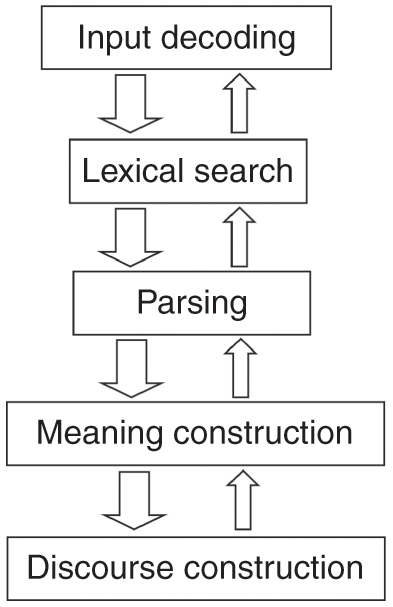
Traditionally, second language listening lessons have revolved around students’ ability to produce correct answers to comprehension questions. Yet, John Field encourages teachers to rethink this model. He introduces a comprehensive cognitive model of listening, breaking down the listening process into distinct stages:
- Sound recognition: Identifying and distinguishing individual sounds.
- Input decoding: Recognizing individual sounds (phonemes).
- Segmentation: Identifying the boundaries of words within continuous speech.
- Lexical search: Matching sounds to known words in memory.
- Parsing: Constructing grammatical meaning from groups of words.
- Meaning construction: Interpreting the immediate contextual meaning of utterances.
- Discourse construction: Understanding the overall coherence and intention of the entire conversation or text.
Field emphasizes the importance of bottom-up processing skills (accurate decoding, rapid lexical recognition, syntactic parsing) as essential foundations for higher-level comprehension. He advocates specific micro-skill activities tailored for each listening phase, such as phoneme discrimination, vocabulary recognition tasks, syntactic exercises, contextual inference tasks, and discourse-level summarization activities.
What stands out here is that traditional listening tasks excessively emphasize outcomes rather than the actual listening process.
Figure 1 – John’Field’s account of the listening process. In his process-based approach, the instructor will include in their instructional sequences tasks deliberately targeting the sub-processes in the model
Vocabulary—Why It Matters More Than You Think
Field strongly emphasizes that the vocabulary students need for effective listening is often underestimated. Success depends largely (>70%) on vocabulary recognition! Learners typically find spoken vocabulary more challenging than written vocabulary, as they encounter words in variable spoken forms. Field highlights the necessity of explicitly teaching vocabulary through listening activities, emphasizing phonological familiarity and recognition in authentic speech. Activities such as listening cloze exercises or focused listening for lexical recognition are recommended.
What stands out is Field’s assertion that vocabulary knowledge acquired through listening is essential for successful comprehension.
Cracking the Code of Connected Speech
One of the major hurdles learners face is connected speech, the fluid nature of spoken language where words blend, sounds disappear, and pronunciation shifts drastically from textbook forms. Field identifies several issues here, including unclear word boundaries, elision (omission of sounds), assimilation (sounds adapting to adjacent sounds), and variability in pronunciation.
Field advocates using targeted transcription exercises highlighting natural speech patterns, enabling learners to decode authentic spoken language effectively. Exercises might include transcribing short extracts featuring challenging pronunciation phenomena.
The standout insight is that connected speech variability presents significant comprehension challenges for learners.
The Challenge of Speed—A Race Against Time
Another significant issue highlighted by Field is the speed of spoken input. Unlike reading, listeners cannot control the pace at which information arrives, resulting in potential overload and anxiety. Field stresses that teachers need to help students practice managing real-time processing through tasks that gradually increase speed and complexity, thereby building learners’ automaticity and processing efficiency.
What stands out here is the need for practice activities designed specifically to help students cope with the demands of real-time listening.
Visual Aids—Are They Helpful or Distracting?
Field discusses the mixed effectiveness of visual aids like videos or PowerPoint slides. While visuals provide context and clarity for advanced listeners, they might overwhelm beginners already struggling with perceptual demands. Teachers should carefully select visuals directly supporting the spoken input, initially introducing simple visuals (as we do in EPI) and gradually progressing to more complex multimodal inputs.
Thus, a key insight here is that visuals must be integrated thoughtfully, matching the learners’ proficiency level to avoid cognitive overload.
Empowering Learners—Autonomous Listening Practice
Field strongly advocates promoting autonomy in listening practice. Recognizing the diversity in individual learner challenges, he suggests personalized, self-access listening resources. This approach encourages learners to independently identify difficult segments, replay them, and practice until comprehension improves. Digital self-access resources enable learners to pinpoint difficult sections and replay them as often as necessary.
Notably, Field emphasizes personalized listening practice through self-access tasks, empowering learners to address their specific comprehension challenges.
Strategic Listening—Equipping Students for Real-life Communication
Field underscores the importance of explicitly teaching listening strategies, distinguishing clearly between fundamental listening skills and compensatory strategies. He advocates direct instruction of strategies such as metacognitive strategies (planning, monitoring, evaluating), cognitive strategies (inferring meanings, guessing from context), and social-affective strategies (managing anxiety, collaborative listening). Specifically, for teaching metacognitive strategies, Field suggests combining direct teaching (explicitly naming and demonstrating strategies) with indirect teaching (discussing strategies after task completion).
The notable takeaway is the clear role strategy instruction plays in managing comprehension gaps, thus improving overall listening proficiency.
Common Obstacles in Listening Comprehension
Field clearly outlines several common obstacles L2 listeners face:
- Difficulty recognizing phonemes due to variability in pronunciation.
- Unclear word boundaries in continuous speech.
- Challenges in decoding connected speech (elision, assimilation).
- Limited automaticity in spoken vocabulary recognition.
- Cognitive overload from rapid speech input.
- Additional cognitive load from visual inputs.
- Anxiety related to real-time processing without replay opportunities.
Implications for Pedagogy
Drawing from Field’s insights, several key pedagogical implications emerge:
- Teachers should move away from comprehension checks towards diagnostic listening instruction, aimed at identifying the obstacles in comprehension
- Practice tasks should include activities targeting the micro-skills of listening, with a strong emphasis on decoding skills (phonemes, syllables and word-boundaries recognition), especially, but not exclusively, at lower levels of proficiency
- Listening instruction should explicitly teach and reinforce vocabulary through listening-specific tasks. This is KEY
- Incorporating transcription tasks highlighting features of connected speech
- Provide explicit strategy training, focusing on both direct and indirect instruction of metacognitive strategies like planning, monitoring, and evaluating aimed at enabling students to be more invested in the listening process and understand which strategies works best for them. Note: effective strategy training takes months of systematic practice of the target strategies
- Practice tasks should systematically develop learners’ ability to cope with authentic speech speeds by gradually increasing speed and complexity. ‘Gradually’ is the key word here!
- Use visual aids judiciously, matching the complexity to learners’ proficiency.
- Strategically allow replaying audio, particularly at early proficiency levels, to reduce anxiety. Note: replaying audio is likely to be more effective when you pause at the end of problematic sentences, as any new incoming speech signal will erase the previous one; hence, pausing will lessen the cognitive load. Also, it is likely to be more effective when the students are directed to listen selectively, i.e. for specific details which you have found to be more challenging to comprehend. Gapped translation tasks can be good in this respect.
Towards the Future—Personalized Listening Instruction
Looking forward, Field predicts a shift in listening instruction towards personalized and autonomous learning environments, largely driven by digital technologies. These tools will allow students to tailor their listening practice according to their individual needs. Teachers will increasingly facilitate personalized listening experiences, thus enhancing real-world communicative competence.
Concluding remarks
John Field’s approach to second language listening challenges traditional methods by advocating a shift from testing comprehension to actively teaching listening. His recommendations cover detailed cognitive processes, strategic instruction, authentic exposure, and careful scaffolding.
Notably, the Extensive Processing Instruction (EPI) framework naturally embodies these recommendations, focusing deeply on bottom-up skills, extensive vocabulary practice through listening, meaningful repetition with careful segmentation and strategic management of cognitive load and anxiety. EPI integrates the essence of Field’s findings into practical classroom strategies, ensuring learners develop robust, transferable listening skills for effective real-world communication.
If you want to know more on the listening process, do get hold of my book with Steve Smith, ‘Breaking the sound barrier: teaching learners how to listen’ or attend one my workshops on listening instruction on http://www.networkforlearning.org.uk
 The Language Gym
You must be logged in to post a comment.