
Introduction
Let’s face it: in the chaotic symphony of vocabulary lists, verb drills, and assessment pressure, cognates are the low-hanging fruit we often forget to pick. And yet, they’re the closest thing to linguistic gold we’ve got in the MFL classroom—a built-in bridge between English and French (or Spanish, or German) just waiting to be walked across.
Cognates are the words that look like English, sound like English, and—hallelujah—mean the same thing as English. Nation, communication, participer, pollution… You say them, and students get them. Or do they?
Because here’s the twist: while cognates can fast-track recognition, build confidence, and turbo-charge reading and listening skills, they can also trip learners up, mislead them, or lull them into false fluency. Not all that glitters is gold—especially if it turns out to be a false friend in disguise.
This article dives into the power, the pitfalls, and the untapped potential of cognates. We’ll unpack why they work, when they fail, and how to teach them with more than just a passing nod. You’ll get research, strategy grids, and even a few false friends to watch out for.
So whether you’re new to teaching or seasoned in the MFL trenches, read on: it’s time to give cognates the spotlight they deserve.
What Are Cognates, and Why Do We Use Them?
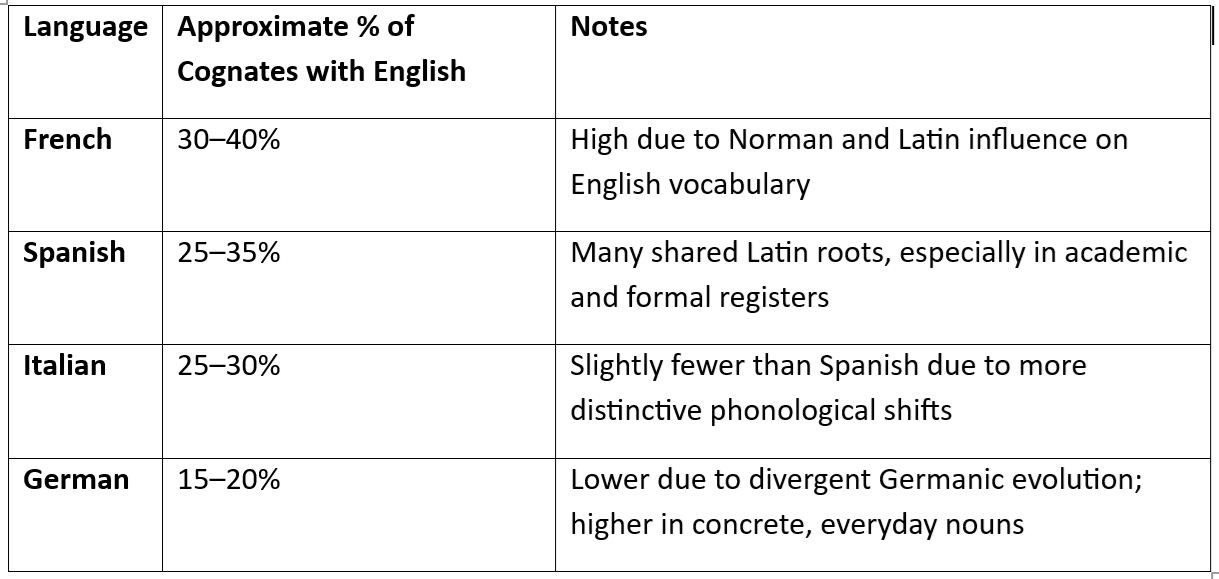
Cognates are words in two different languages that look or sound similar and mean the same thing. For example, information in English and information in French are cognates. Teachers love using cognates because they help learners feel successful early on. Up to 30–40% of words in French GCSE lists have a cognate in English, so it’s tempting to highlight them often.
Table 1 – Percentage of English cognates in French, Spanish, Italian and German
Psycholinguists say that when we see a cognate, both our first language (L1) and second language (L2) “light up” in the brain. This speeds up word recognition. In terms of brain science, this effect is tied to how bilinguals store and retrieve words across both languages. According to the BIA+ model (Dijkstra & Van Heuven, 2002), word recognition happens in a shared network that handles both languages simultaneously, allowing for what’s called non-selective lexical access. In short, the brain doesn’t “switch off” one language when using the other—it activates both. Brain imaging studies (van Hell & Tanner, 2012) confirm this, showing that learners process cognates with less effort, especially in reading tasks, due to overlapping neural representations in areas like the left inferior frontal gyrus.
What Makes Cognates Helpful?
a. They speed up understanding
When we see a familiar-looking word in a new language, our brain recognises it faster. Costa et al. (2000) found that learners were 30% faster at recognising cognates than non-cognates in word recognition tasks. This is because both language systems in the brain activate together, allowing a kind of shortcut through the brain’s semantic network.
b. They support memory
Because cognates activate both L1 and L2 memory at the same time, they are more likely to stick. This is called co-activation, and it helps learners retrieve the word more easily later. Connectionist models of language processing (like those developed by McClelland & Elman, 1986) suggest that overlapping nodes in a neural network strengthen memory links through repeated exposure, making cognates more retrievable than unrelated new words.
c. They create early success
In beginner classrooms, recognising a word like chocolat or télévision can boost students’ confidence. This can increase motivation and encourage learners to keep going. From a psycholinguistic point of view, this early success taps into the brain’s reward system, reinforcing continued effort through a feedback loop of positive emotional response and reduced cognitive load.
Why Cognates Are Not Always Easy: The Hidden Challenges
Despite these advantages, recognising and using cognates isn’t always as easy as it seems. First, students often fall for false friends—words that look the same but don’t mean the same. For instance, actuellement in French means currently, not actually. These “traps” can mislead learners and cause misunderstandings.
Table 2 – 15 tricky false friends in French
| English Word | French False Friend | Real Meaning in French |
|---|---|---|
| Actually | Actuellement | Currently |
| Library | Librairie | Bookshop |
| Coin | Coin | Corner |
| Sympathetic | Sympathique | Nice, friendly |
| College | Collège | Secondary school |
| Attend | Assister | To be present (not to help) |
| Pretend | Prétendre | To claim (not to act) |
| Sensible | Sensé | Sensible |
| Name | Nom | Name |
| Fabric | Fabrique | Factory |
| Delay | Délai | Deadline / time limit |
| Injury | Injure | Insult |
| Large | Large | Wide |
| Resume | Résumer | To summarise |
| Eventually | Éventuellement | Possibly |
Second, research shows that even true cognates aren’t always recognised correctly. A study by Otwinowska (2015) found that Polish learners of English only recognised 45% of potential cognates in a text, even at intermediate level. This shows that simply pointing them out once isn’t enough. Why is it? The answer is that even though certain cognates might look and sound familiar in French or Spanish, students will only successfully recognise them as “safe matches” if they’ve built up a strong, reinforced mental representation of the word in their first language (L1)—and done so in the same modality (reading, listening, etc.). Let’s unpack this with research:
- Input modality matters:
According to Carroll (2017) and Otwinowska (2015), learners are far more likely to correctly recognise a cognate in reading if they’ve encountered the English equivalent in print. Conversely, if they’ve mostly heard a word orally (e.g., through TV or conversation), they’re better at recognising the cognate in listening tasks. The brain’s phonological and orthographic pathways are somewhat separate in early L2 development. - Frequency builds strength:
In connectionist models of language acquisition (e.g. McClelland & Elman, 1986), word recognition relies on the strength of neural activation pathways, which grow through repetition and context diversity. If a learner has read “information” in ten different articles, the concept and form become tightly linked. When they see information in French, their brain is more likely to light up with the correct match. - Cross-modal mismatch leads to errors:
Learners who hear a word often but have never seen it written may not recognise a cognate when reading—and vice versa. This is especially problematic in French, where spelling-sound mismatches are common. For example, a student who hears “accident” on the news might not recognise accident in French reading tasks if they’ve never seen the English version written down. - Shallow L1 familiarity = higher error rate:
Otwinowska (2015) also showed that learners with lower L1 vocabulary depth had up to 40% lower cognate recognition rates, even when the words were formally transparent. In other words, even a perfect formal match doesn’t guarantee transfer—semantic familiarity is key.
Third, hearing cognates in spoken language is even harder. In listening tasks, differences in pronunciation often mask the similarity. Carroll (2017) found that learners recognised only 28% of oral cognates they had previously identified in writing.
This is because phonological input relies heavily on auditory processing, and the brain must match incoming sounds to stored word forms across two languages. This can be especially difficult if the sound patterns differ significantly from those in the learner’s L1. Neural studies (Proverbio et al., 2004) show increased activation in the anterior cingulate cortex—a region linked to conflict monitoring—when learners process false or unfamiliar cognates, especially under time pressure.
Why Cognate Training Needs Time and Structure
Many teachers assume that students will naturally spot cognates, but research into Strategy Training shows the opposite. Learners need structured, repeated practice in identifying and using cognates across different skills—especially listening.
Research indicates that metacognitive strategy training—such as learning how to guess meaning from context or sound out similarities—must be taught explicitly over several weeks. Without this, students revert to shallow guessing or ignore difficult words.
Gu & Johnson (1996) found that learners who received at least 6 weeks of metacognitive strategy training showed significantly greater vocabulary retention and inference accuracy—including the ability to use cognates appropriately.
Macaro (2001) emphasised that lexical inferencing (the process of guessing meaning, often via cognates) is not an innate skill and requires explicit modelling, repeated practice, and metacognitive reflection across at least 5–6 weeks.
Otwinowska (2015) reported that effective cognate identification required multimodal exposure (reading, listening, speaking) over time, with structured support, particularly for learners with lower L1-L2 language distance.
Table 3 – Recommended duration of a cognate-recognition training based on research
| Focus Area | Minimum Effective Duration | Research Source |
| Written cognate recognition (reading) | 4–6 weeks | Gu & Johnson (1996); Otwinowska (2015) |
| Oral cognate recognition (listening) | 6–8 weeks | Carroll (2017); Macaro (2001) |
| Cross-skill integration | 6+ weeks | Macaro (2001); Nation (2007) |
Note: Most MFL classrooms do not offer this kind of long-term structured training, especially at KS3 and KS4. Cognates are often mentioned in passing, but not practised systematically.
Conclusions
Cognates can be a powerful teaching tool—when used with intention. They offer early wins, speed up recognition, and make learners feel more confident. But they can also lead to confusion, mislearning, and overconfidence if used without care.
To make the most of cognates:
- Teach the difference between true and false cognates
- Train reading and listening strategies that help students spot cognates in speech. Listening with transcripts can be very effective in training students in oral recognition of cognates.
- Use retrieval and metacognition (like confidence scales) to track which ones stick
- Don’t assume students “just see them”—train them to do it
Used well, cognates help unlock the language. Used poorly, they can block real understanding.
Teachers cannot expect students to recognize cognates easily, especially under the highly demanding cognitive constraints posed by an exam, without any substantive and systematic formal training in cognate-recognition strategies.
Some key stats and research facts that every teacher should always bear in mind
- Students recognise 30% cognates faster than non-cognates (Costa et al., 2000)
- In practice, learners only recognise 45% of true cognates in texts (Otwinowska, 2015)
- In listening, recognition drops to just 28% (Carroll, 2017)
- A strategy-training programme in cognate recognition needs to last at least 6 weeks
- Students from low socio-economic background are less likely to recognize cognates as these tend to be latinate words used in higher-register English
References (Selected)
- Carroll, G. (2017). Cognate recognition in L2 listening. Journal of French Language Studies.
- Costa, A., Caramazza, A., & Sebastián-Gallés, N. (2000). The cognate facilitation effect. Journal of Experimental Psychology.
- Dijkstra, T., & Van Heuven, W. J. B. (2002). The architecture of the bilingual word recognition system: From identification to decision. Bilingualism: Language and Cognition.
- Gu, Y., & Johnson, R. K. (1996). Vocabulary learning strategies and language learning outcomes. Language Learning.
- Macaro, E. (2001). Learning strategies in foreign and second language classrooms.
- McClelland, J. L., & Elman, J. L. (1986). The TRACE model of speech perception. Cognitive Psychology.
- Otwinowska, A. (2015). Cognate vocabulary in language acquisition and use. Multilingual Matters.
- Proverbio, A. M., et al. (2004). Electrophysiological analysis of semantic processing in bilinguals. Psychophysiology.
- van Hell, J. G., & Tanner, D. (2012). Neural activity during cognate processing in L2 learners. Language Learning.
 The Language Gym