by Gianfranco Conti, PhD. Co-author of 'The Language Teacher toolkit', 'Breaking the sound barrier: teaching learners how to listen', 'Memory: what every teacher should know' and of the 'Sentence Builders' book series. Winner of the 2015 TES best resource contributor award, founder and CEO of www.language-gym.com, co-founder of www.sentencebuilders.com and creator of the E.P.I. approach.
Here is a provisional list of my upcoming online events from early October to December. Many more are going to be added, with a few brand new ones focusing only on the new GCSE and EPI at Key Stage four.
If you are in the UK and would like to join a face-to-face event on EPI, please note that I will be at Radley College on 2nd October (see flyer below).
At KS3, I typically plan a term as ~20–24 lessons split into five sub-units: the first four run MARSEA with new material, and the fifth is RS to consolidate/automatise and interleave old with new. This creates repeated encounters, steadily shifts the load from input to output, and culminates in unplanned speech under time pressure.
How a term typically unfolds (macro view)
Sub-units 1–4 (MARSEA): new sentence patterns taught and practised (input-heavy → pushed output → brief grammar focus → quick checks).
Sub-unit 5 (RS):fluency training and spontaneous tasks that recycle the whole term’s “universals” (core phonics, lexis, grammar) plus items from earlier terms.
Please note: average-attaining groups usually need 1.5–2 lessons for the Structured production phase, not just one.
The 8 stages (micro view)
1) Modelling
Goal: Establish clear sentence patterns with high comprehensibility. How: Present with Sentence Builders (optionally preceded by flashcards to wake up prior lexis/grammar, e.g., auxiliaries for a French perfect tense unit). Keep input tightly controlled and meaning-rich.
You do: brief, lively teacher modelling; choral/individual echo of whole chunks, not isolated words.
2) Awareness-raising
Goal: Make learners notice the key features they’ll need to hear/see again. Focus:
SSC (sound–spelling mappings), phonotactics/liaison, intonation, grammar/syntax—all as short pop-ups embedded in modelling.
You do: 30–90-second “pop-up” moments while modelling: “Listen for the /ʒ/; spot the clitic; where’s the boundary?”
3) Receptive processing
Goal: Turn models into robust decoding and parsing skills before output. Two parts (especially Y7–Y9):
Sentence-level work: rapid, enjoyable listening/reading tasks that target phoneme/syllable decoding, segmentation, lexical access, parsing and meaning.
Connected texts: narrow listening/reading (near-identical texts), 90%+ comprehensible input, input flooding + input enhancement (acoustic/visual) so the target forms recur and “pop”. I call this Listening-As-Modelling (LAM) and Reading-As-Modelling (RAM)—input that is deliberately teaching you how to speak/write later.
You do: scripted listening (audio + text) for decoding, chunk-highlighting, quick gist/detail cycles, micro-dictations, “find the boundary,” etc. Teacher keeps explicitly pointing at the target features so implicit and explicit learning work together.
4) Structured production (pushed, but highly scaffolded)
Goal: Bridge from recognition → retrieval and production while keeping accuracy, willingness to speak, and inclusion high. Two parts:
Chunking-aloud games (e.g., Sentence Stealer, Sentence Chaos, Mind-Reading, Lie-Detector) to build articulatory fluency and keep attention on form and meaning.
Guided communicative tasks: tightly-framed role-plays, info/reasoning/opinion gaps; lots of retrieval practice; many tasks are peer-managed so the teacher can roam and give formative feedback. Plan ~1.5–2 lessons for average groups.
5) Expansion (explicit grammar focus)
Goal: Now that learners have processed the pattern many times, make the rule explicit (if you wish) and practise it. Approach:Deductive (brief teaching), guided discovery, or inductive from examples; reuse earlier tasks but make the target rule task-essential to succeed.
6) Autonomous recall (quick checks)
Goal: Low-stakes, fast achievement tests to see if at least receptive mastery is there (earlier checks receptive; later ones may be productive). These are short and easy to mark.
7) Routinization (fluency training)
Goal: Speed up retrieval (what I call “making known language easier and faster to access”). Design principles (after Nation):
Repeated processing, task repetition, pre-task priming/planning, increasing time pressure. Tasks: e.g., Messengers, Dictogloss, Five, Detectives & Informants, Secret Sentences, View-and-Recall race; also form-oriented sprints like Chain Reading/Dictation, Tongue-Twisters, Fast & Furious, Puzzle Race. Use only familiar lexis/grammar here—fluency automates what’s already learned.
8) Spontaneity (real operating conditions)
Goal:Unplanned output under time constraints—pictures, interviews, role-plays—mirroring exam-style pressure/real use. One task can serve as an assessment. For lower attainers, allow some planning/priming time.
Where recycling sits
Across the term, RS phases interleave current items with previous units and earlier years’ “universals” (core phonics, lexis, grammar) to fight forgetting and build durable networks— I always stress the importance of curriculum-wide recycling, not just within a unit.
What you’ll see in a planner (example pattern)
Weeks 1–7/8: Four MARSEA sub-units on new patterns.
Weeks 8–10: RS sub-unit for fluency + spontaneity checks on the combined content.
Assessment moments: quick Autonomous recall mini-checks near the end of each MARSEA sub-unit; a Spontaneity performance in the RS block. Structured production often spans ~1.5–2 lessons each time.
Why this longer arc (not PPP)?
Short, textbook-style PPP cycles can’t reach proceduralization/automatization; slower, input-heavy sequences with staged output are more inclusive at KS3 and save reteaching at KS4. The aim is durable learning and self-efficacy, not speeding to a rule table.
Strengths and Potential Pitfalls
Strengths
Input → output with purpose. Modelling → heavy receptive work before speaking/writing fits how learners actually build representations; fewer fossilised errors, better confidence.
Listening first, properly. Explicit decoding/segmentation tasks, narrow input, and cue-noticing are usually the missing middle in curricula; MARSEARS puts them center stage.
Recycling at scale. The RS block (routinisation + spontaneity) is essentially spaced retrieval + task repetition under time pressure—exactly what sticks learning.
Assessment moments that are humane. Quick Autonomous Recall checks keep stakes low but surface gaps fast.
Inclusion. Average and lower-attaining classes benefit from the additional time in Structured Production; the sequence reduces the “I can’t” barrier.
Where it can misfire (and how to guard against it)
Time pressure vs syllabus velocity. If you try to cover the same number of topics at MARSEARS depth, you’ll feel “behind.” Fix: trim content, teach less but better; map 4 MARSEA sub-units + 1 RS per term and stay disciplined.
Resource load. It lives or dies on good, narrow texts/audio. Fix: build a reusable bank (3–5 texts per sub-unit), record quick teacher audio, and recycle across years.
Over-scaffolding risk. Some classes get comfy in Structured Production and never leap. Fix: schedule the RS block like a deadline; add visible time-pressure ramps each cycle.
Teacher talk creep in Modelling. Enthusiasm can turn into mini-lectures. Fix: keep pop-ups to 30–90 seconds; move explanation to the Expansion stage or the debrief.
Assessment alignment. If your school only values last-minute exam drills, MARSEARS can look “slow.” Fix: track second-listen gains, cue-detection rates, wpm in fluency tasks and show that graph.
When we teachers pick a listening text, it is easy to go with our gut feeling: “This one sounds a bit harder,” or “It is slower so the pupils will understand it.” But in truth, the reasons why a listening text is difficult are many and often not very obvious.
In this post I want to share—very simply—what the research tells us. My hope is that it helps you, as it helped me over the years, to see clearly what makes a text tricky so you can choose or create materials that truly suit your learners. I will first describe the main factors, then give my own thoughts on what this means for how we teach listening.
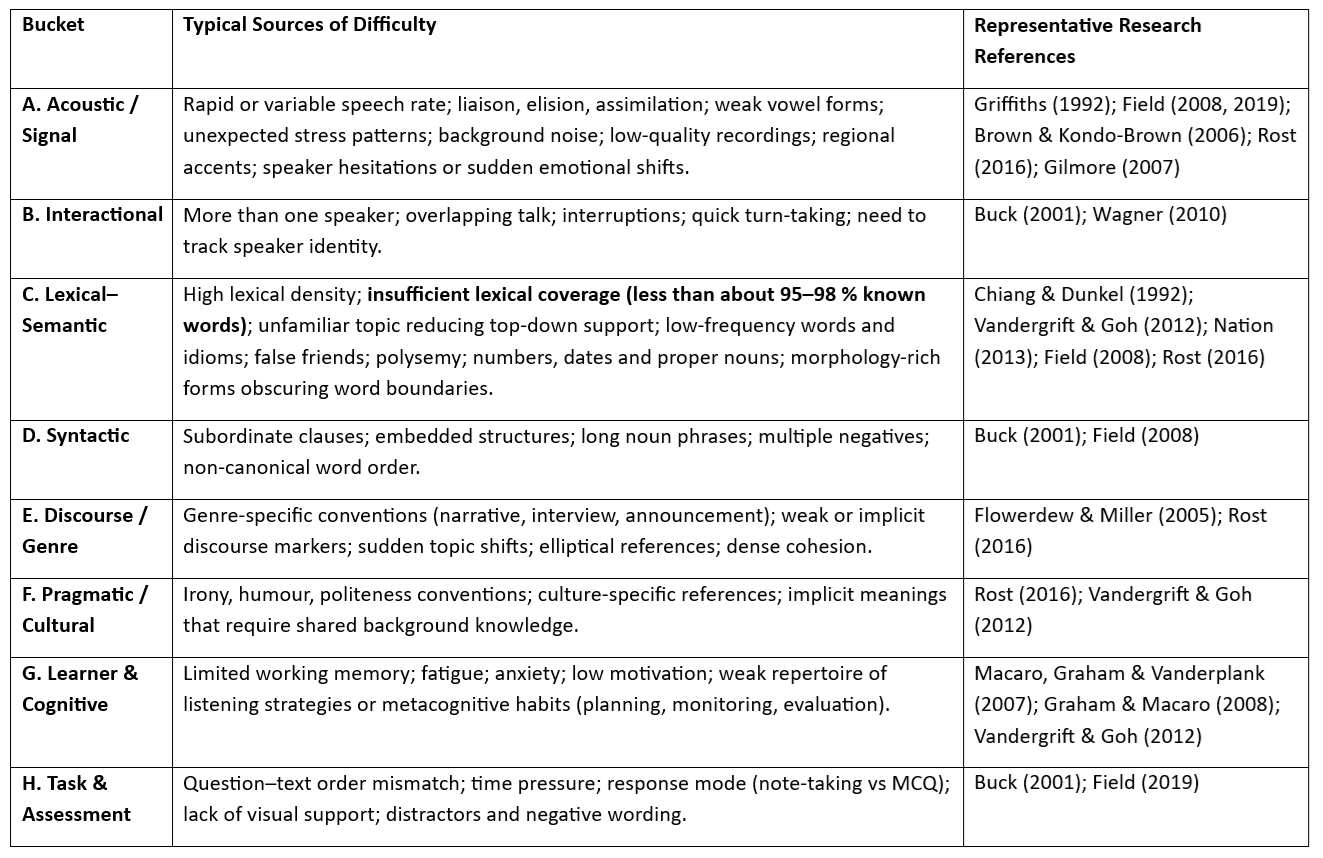
Eight Buckets of Listening Difficulty
1. The Sound of the Message: Acoustic and Signal Factors
The first challenge is, of course, the sound itself – the sound barrier that Steve and I allude it in the title of our book (Conti and Smith, 2019). If the speaker talks quickly or suddenly speeds up, pupils have very little time to process what they hear (Griffiths, 1992; Field, 2008). And even when the speed is not high, connected speech—liaison, elision, assimilation—can make the words melt together (Brown & Kondo-Brown, 2006). Weak vowel sounds, unexpected stress patterns and unfamiliar accents add, of course, more work for the ear (Rost, 2016). Poor recording quality or background noise can be as damaging as a strong accent. Small hesitations, laughter or sudden changes of emotion in the speaker also catch pupils off guard.
2. Following the Conversation: Interactional Factors
Texts with several speakers are naturally harder for obvious reasons: the listener must keep track of who is talking, manage overlapping voices and cope with quick turn-taking (Buck, 2001; Wagner, 2010). I often notice even strong pupils lose the thread when two people talk over each other.
3. Words and Meaning: Lexical–Semantic Factors
The vocabulary load of a text is, of course, one of the strongest predictors of how well pupils will understand it, since, as I often reiterate in my blog, 70 to 90 % of success at listening tasks hinges on word recognition. When a passage is packed with content words (nouns, verbs, adjectives and adverbs) —what researchers call high lexical density — working memory is quickly stretched (Vandergrift & Goh, 2012).
Equally important is lexical coverage, the percentage of words the listener already knows. Studies show that learners generally need to know around 95 % of the running words for basic comprehension and close to 98 % for comfortable, detailed understanding (Laufer, 1989; Nation, 2006, 2013). If coverage drops below that threshold, even confident pupils spend so much effort guessing unknown words that the overall message slips away.
Topic familiarity is another key factor: when the theme is new, pupils cannot draw on background knowledge to predict meaning (Chiang & Dunkel, 1992). And of course the usual culprits remain: low-frequency words, idioms, false friends, numbers, dates and proper nouns are classic stumbling blocks (Field, 2008; Nation, 2013).
Finally, some languages add an extra twist—rich morphology can blur word boundaries, which in my opinion is one of the hardest elements to teach explicitly (Rost, 2016).
4. Grammatical Complexity: Syntactic Factors
Texts containing subordinate clauses, embedded structures, long noun phrases, multiple negatives or unusual word orders are more challenging as these features all increase the mental effort needed to hold information while the sentence continues (Buck, 2001; Field, 2008).
5. How the Text Is Organised: Discourse and Genre
Different genres—narrative, interview, public announcement—signal meaning in different ways. When discourse markers are weak or missing, pupils can easily miss topic changes or elliptical references (Flowerdew & Miller, 2005). I often see this when students listen to authentic interviews where speakers jump from one idea to another.
6. Culture and Pragmatics
Irony, humour, politeness formulas and culture-specific references call for more than vocabulary; they rely on shared cultural knowledge and pragmatic inference, which, in my experience are rarely explicitly taught (Rost, 2016; Vandergrift & Goh, 2012). Even a simple sentence can mislead when this knowledge is absent.
7. The Listener’s Own Resources
Not all the difficulty is in the text. Working-memory limits, tiredness or anxiety often explain a poor result more than the audio itself (Macaro, Graham & Vanderplank, 2007). Learners who have not developed metacognitive habits—planning, monitoring, evaluating—will struggle even with familiar topics (Graham & Macaro, 2008; Vandergrift & Goh, 2012). From my own classroom I can say that a calm, confident pupil usually hears more than a nervous one.
8. The Task and the Assessment Frame
Finally, the way we test or exploit the text matters. If the question order does not follow the text, if there is no visual support, or if distractors and negative wording are used, the task itself raises the level of challenge (Buck, 2001; Field, 2019). The new GCSE listening papers often include exactly these features.
Table 1 – Summary
From KS3 to KS4: Why This Matters
The step from lower secondary (KS3) to the new GCSE is not only about “more difficult vocabulary”. Exam papers deliberately increase multi-speaker interactions, speed up delivery, broaden topics and remove many visual cues (Ofqual, 2021). Pupils who have grown used to carefully graded KS3 recordings can suddenly face a much heavier cognitive load.
Implications for Listening Instruction
1. Audit and Anticipate
Use the eight buckets as a difficulty checklist whenever you select or write a text. Decide which factors will probably trip up your learners and plan support in advance—perhaps pre-teach key chunks (Webb & Nation, 2017), run a short phonology warm-up, or model turn-taking signals.
2. Teach Listening for Learning, Not Only for Testing
Field (2008, 2019) argues that listening lessons should build skill, not simply rehearse exams. Give pupils several purposeful listens—prediction, gist, detail—then use diagnostic listening: show the transcript, ask them to mark what they misheard and discuss why. After that, I like to run quick “Fix & Re-train” tasks such as minimal-pair drills or shadow-reading of the lines they found hardest.
5. Check or estimate lexical coverage
When selecting or writing a listening text, it is key to check or estimate lexical coverage. Sadly, this is not commonly done If your learners know far less than 95 % of the words:
Pre-teach the most useful new chunks before the first listen (Webb & Nation, 2017).
Or simplify the text so that unknown items fall within that 2–5 % “tolerable” window.
This small step often makes the difference between a frustrating and a genuinely instructive listening lesson.
Don’t rely on the fact that some of the unknown vocabulary consists of cognates, as research consistently finds that roughly a third of obvious cognates go unrecognised in L2 listening – see Weber & Cutler (2004) and Broersma & Cutler (2011) – a gap teachers should address when preparing pupils for real-world or GCSE-style listening tasks
4. Place Listening Inside an Input→Output Sequence
Comprehension rises when key vocabulary is taught before the first listen (Webb & Nation, 2017). This is the Input-Plus condition described by Krashen (1985): input just above the learner’s level, paired with meaningful focus. My PIRCO cycle puts this into practice:
P – Priming: model key lexis and sounds, use a short reading text,
I – Input: three purposeful listens,
R – Review: quick reflection on strategies,
C – Consolidation: diagnostic listen and Fix & Re-train,
O – Output: structured speaking or writing tasks.
5. Let PIRCO Grow with the Learners
KS3: keep PIRCO strong—plenty of priming and a full diagnostic stage.
Year 10 and early Year 11: move to a medium version—priming in one lesson, a shorter diagnostic phase, grammar and structured output follow quickly.
Exam run-up (Year 11 Term 2): switch to PIR—quick priming and exam-style listening; most consolidation and output happen elsewhere.
6. Build Metacognitive Habits
Encourage pupils to plan, monitor and evaluate (PME) their listening (Vandergrift & Goh, 2012). Even a short checklist—“Before I listen I will… During I will… After I will…”—can help them become more independent. In my opinion, this small routine pays off far more than an extra comprehension exercise. PME, too is routinely and seamlessly built in the PIRCO cycle.
Conclusions
Fast speech is only the tip of the iceberg. The real challenge of aural texts lies in a network of factors: the sound signal, the way speakers interact, the words and grammar they choose, and even the test format itself.
By recognising these eight areas and by scaffolding listening through a PIRCO-based input–to–output sequence, we can select or create texts that fit our classes much more precisely. In my own experience, this careful matching—together with clear metacognitive routines—helps students cross the KS3→KS4 bridge with far greater confidence and prepares them not only for the new GCSE but for real communication beyond the exam hall.
Key References
Buck, G. (2001). Assessing Listening. Cambridge University Press. Chiang, C. & Dunkel, P. (1992). TESOL Quarterly, 26(2). Field, J. (2008). Listening in the Language Classroom. Cambridge University Press. Field, J. (2019). In The Cambridge Handbook of Second Language Acquisition. Flowerdew, J. & Miller, L. (2005). Second Language Listening: Theory and Practice. Graham, S. & Macaro, E. (2008). Language Learning, 58(4). Griffiths, R. (1992). Studies in Second Language Acquisition, 14(3). Krashen, S. (1985). The Input Hypothesis. Macaro, E., Graham, S. & Vanderplank, R. (2007). Language Teaching, 40(2). Nation, I. S. P. (2013). Learning Vocabulary in Another Language (2nd ed.). Cambridge University Press. Rost, M. (2016). Teaching and Researching Listening (3rd ed.). Routledge. Vandergrift, L. & Goh, C. (2012). Teaching and Learning Second Language Listening. Routledge. Webb, S. & Nation, P. (2017). International Review of Applied Linguistics, 55(1). Wagner, E. (2010). TESOL Quarterly, 44(4).
Helping learners hear—and then repair—their own pronunciation is one of the most powerful ways to build both accuracy and confidence. ‘Best Recording’, an activity I have magpied and adapted from the great Paul Nation, turns a simple text into a mini-cycle of metacognitive training. Across a single lesson pupils plan, monitor and evaluate their speaking, using recordings and peer feedback to make their progress visible.
It begins with a teacher model and a short phoneme focus, then moves into paired preparation, where a “ planner” spots tricky sounds and a “coach” suggests fixes.Pairs identify their three biggest hurdles before making a first individual recording. Partners then swap recordings, give two positives and one next step, and listen again as the teacher re-models key sentences. Armed with a personal mini-goal (“I will emphasise the final ‘r’ in hiver”), pupils re-record, then carry out a self- and peer-evaluation using a simple pro-forma. Finally, each learner saves a best version and writes a short reflection and next target—closing the loop from planning, through monitoring, to evaluation. The result is a lively, structured activity that blends pronunciation practice with the development of independent, metacognitively aware language learners. Below, is how the activitty unfolds in detail in my version of this activity.
Best recording, step by step
Teacher model + phoneme focus Teacher reads the text once while pupils shadow-read. Teacher highlights 2–3 key pronunciation targets (e.g. nasal vowels, silent final consonants).
Paired preparation with roles Pair a stronger and a weaker reader. Give each pair 8–10 minutes:
Planner role – notes tricky words/sounds.
Coach role – listens and suggests fixes.
Identify hurdles (Planning) Each pair lists their top 3 pronunciation challenges and how they might tackle them (e.g. “liaison in les‿amis—slow down before vowel”).
First recording (Baseline) Students record a first attempt individually.
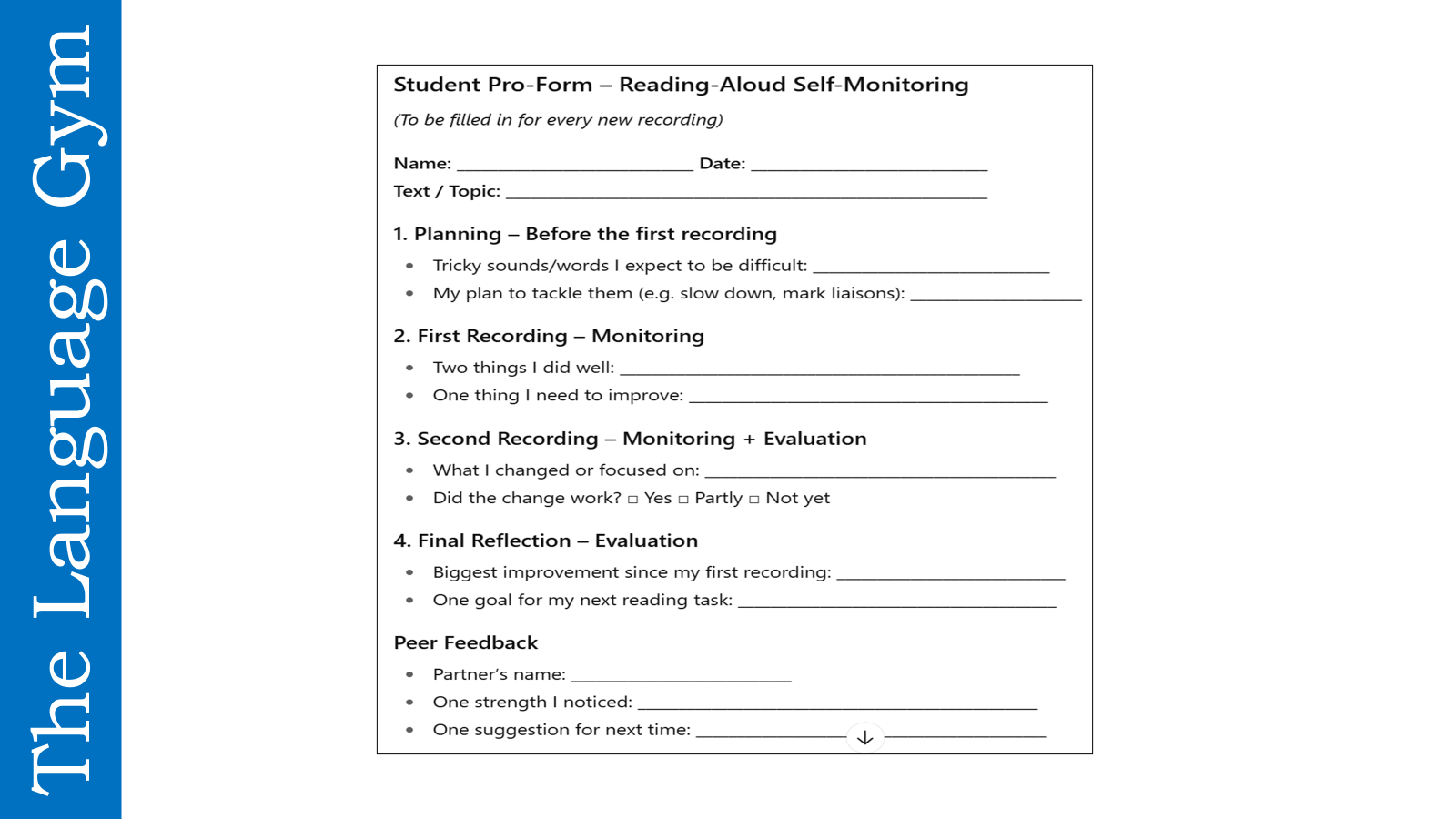
Focused peer feedback (Monitoring) Partners listen to each other’s recordings and write 2 positives and 1 “next step” on the sheet below (see picture 1) Teacher re-reads key sentences so pupils can re-check sounds.
Picture 1 – Pro-forma to be used by the students during the activity
Strategy tweak + second recording Pupils set a mini-goal (“I will emphasise the final ‘r’ in hiver”) and re-record.
Self- and peer-evaluation (Monitoring + Evaluation) Students listen back to both their own and their partner’s second recordings. They complete the pro-forma, noting improvements and remaining issues.
Best version + reflection (Evaluation) When satisfied, students save a “best recording”. They write a brief reflection and one target for next time. This can be guided by prompts like the ones below:
•Compared with my first recording, what has improved the most?
•Which sound or word is still not as accurate as I’d like?
•How well did my strategies (slow down, mark liaisons, practise phonemes) work?
•What feedback from my partner was most useful?
•What is one specific goal for my next reading-aloud task?
•Which practice activity will help me reach that goal?
The benefits
1. Strong Metacognitive Design
Follows the full Planning–Monitoring–Evaluation (PME) cycle: pupils plan (identify phoneme hurdles), monitor (peer feedback, self-recording), and evaluate (self/peer reflection).
Makes metacognition explicit, not just implicit: pupils talk about strategies and record their own progress.
2. Evidence-based Pronunciation Practice
Teacher’s initial phoneme focus ensures targeted input on specific sounds.
Repeated listening–speaking–recording gives distributed, deliberate practice—known to improve phonological accuracy.
3. Peer-Learning and Cooperative Roles
Pairing a stronger with a weaker reader plus Planner/Coach roles encourages peer modelling and scaffolded support.
Builds collaborative skills and makes every pupil both a learner and a helper.
4. Use of Technology for Immediate Feedback
Recording and replaying allows pupils to hear themselves objectively, often catching errors they can’t detect while speaking.
Provides tangible evidence of improvement between recordings, which boosts self-efficacy.
5. Clear, Repeatable Structure
Step-by-step routine is easy to reuse with new texts; once pupils know the sequence it runs with minimal teacher input.
The pro-form captures progress over time and supports formative assessment.
6. Motivation and Ownership
“Best version” at the end and visible progress from first to final recording give pupils a sense of achievement and control over their learning.
Reflection tasks help them set personal pronunciation goals, fostering long-term independence.
7. Integration of Language and Learning Skills
Combines phonological accuracy, listening discrimination, peer feedback, and metacognitive awareness in one coherent activity—addressing both linguistic and learner-strategy development.
Reflecting on my twenty-eight years of teaching listening in French, Spanish and Italian—from primary through lower and upper secondary—I notice one thing very clearly: the problems my students faced whilst listening did not simply disappear as they advanced; they changed their shape. Research has found the same (Field, 2008; Vandergrift, 2007): the beginner’s obstacles usually evolve into more subtle, but equally tricky, intermediate ones. In this post I intend to discuss how each area of difficulty typically develops.
Phonological decoding: from “all a blur” to “I hear the words, but…”
At the beginning, students often say things like: “When I listen to Spanish it is just a river of sound.” They are right: in many languages vowels are reduced or run together; in French, liaison and elision swallow syllables (a phenomenon called ‘assimilation), and beginners cannot yet segment the stream. By the intermediate stage, they can pick out many individual words but still mis-hear rapid speech or regional accents. Think of a learner who recognises il y a on paper but misses it when it contracts to y’a. The challenge evolves from total blur to fine-grained perception.
Lexical processing: from panic at unknown words to distraction by low-frequency ones
Beginners often freeze when they meet a single unknown item, as if that one gap blocks all meaning. In other words, their tolerance for ambiguity threshold is very low. In my experience, they rarely exploit context or cognates—for instance, not noticing that información in Spanish is transparently ‘information’.”
Later, with a larger vocabulary, they stop panicking at every unknown term, yet a new trap appears: they waste time puzzling over rare, low-frequency words and lose the thread of the message. Research has found that moving from “every word matters” to “ignore the unimportant” is a key milestone in listening fluency (Goh, 2010).
Grammatical / syntactic parsing: from word-by-word decoding to complex-clause confusion
At first, learners decode each word separately and often miss function words or tense endings. Ask a beginner after a French listening task, “Did you hear the passé composé marker?” or the preposition ‘pour’ and you will likely get a blank look By intermediate level, they can follow simple sentence patterns, but longer sentences with embedded clauses still derail them. Even strong B1 students, in my experience, can misread a Spanish relative clause and misunderstand who is doing what. The struggle moves from basic recognition to higher-level parsing.
Use of top-down knowledge: from little prediction to overconfidence
Beginners rarely activate background knowledge before listening. Prediction simply does not occur to them. Intermediates, however, often swing to the opposite extreme: they do predict—sometimes too eagerly to the point that they often hear words they predict where they do not exist… They often cling to their first hypothesis and ignore evidence that contradicts it, a classic confirmation bias. So the evolution is from underuse to over-reliance.
Metacognitive control: from passivity to late monitoring
In my experience, novices tend to treat listening as a test: press “play” and hope for the best. They cannot say where or why they lost meaning. With experience, learners begin to monitor, but often notice problems only after the key moment has passed. Research has found that modelling the plan–monitor–evaluate cycle (Vandergrift & Tafaghodtari, 2010) is what gradually turns late monitoring into timely self-regulation.
Strategic behaviour: from bottom-up obsession to risky guessing
Beginners typically chase every single word—classic bottom-up trap. Intermediates, perhaps tired of that strain, sometimes lean too heavily on top-down guessing, risking mis-hearing when their predictions are wrong. The difficulty morphs from not seeing the forest for the trees to trusting the forest and missing a tree that matters.
Affective factors: from anxiety to overconfidence
Anxiety at the start is high: “If I miss one word, I fail.” Confidence grows with competence, but at intermediate level another danger appears: complacency. Learners overestimate their comprehension and stop refining strategies. Research has found that both extremes—fear and overconfidence—interfere with progress (Graham & Macaro, 2008).
Interaction and negotiation: from silence to hesitant repair
In interactive tasks—say, a role-play in German or an information-gap in Italian—beginners rarely ask for clarification; they fear looking incompetent. Intermediates begin to use repair moves (for example Come scusi? or ¿Cómo?), but may hesitate or choose awkward phrasing. The growth is visible, yet the skill is still fragile: from no repair to imperfect repair.
Table 1: Typical Mistakes in MFL Listening at Beginner and Intermediate Levels(Sources: Field 2008; Vandergrift 2007; Goh 2010; Graham & Macaro 2008)
Conclusions
To my Italian eyes, the path from beginner to intermediate in French, Spanish or German is like climbing a mountain: the scenery changes, but the effort does not lessen. The first part of the climb demands strength just to keep moving—decoding sounds, catching words. Higher up, the air is clearer but the rocks are trickier: confirmation bias, complex syntax, and a dangerous touch of complacency. Our job as teachers is to guide learners through each new landscape and help them understand that progress brings new, different challenges, not an end to difficulty.
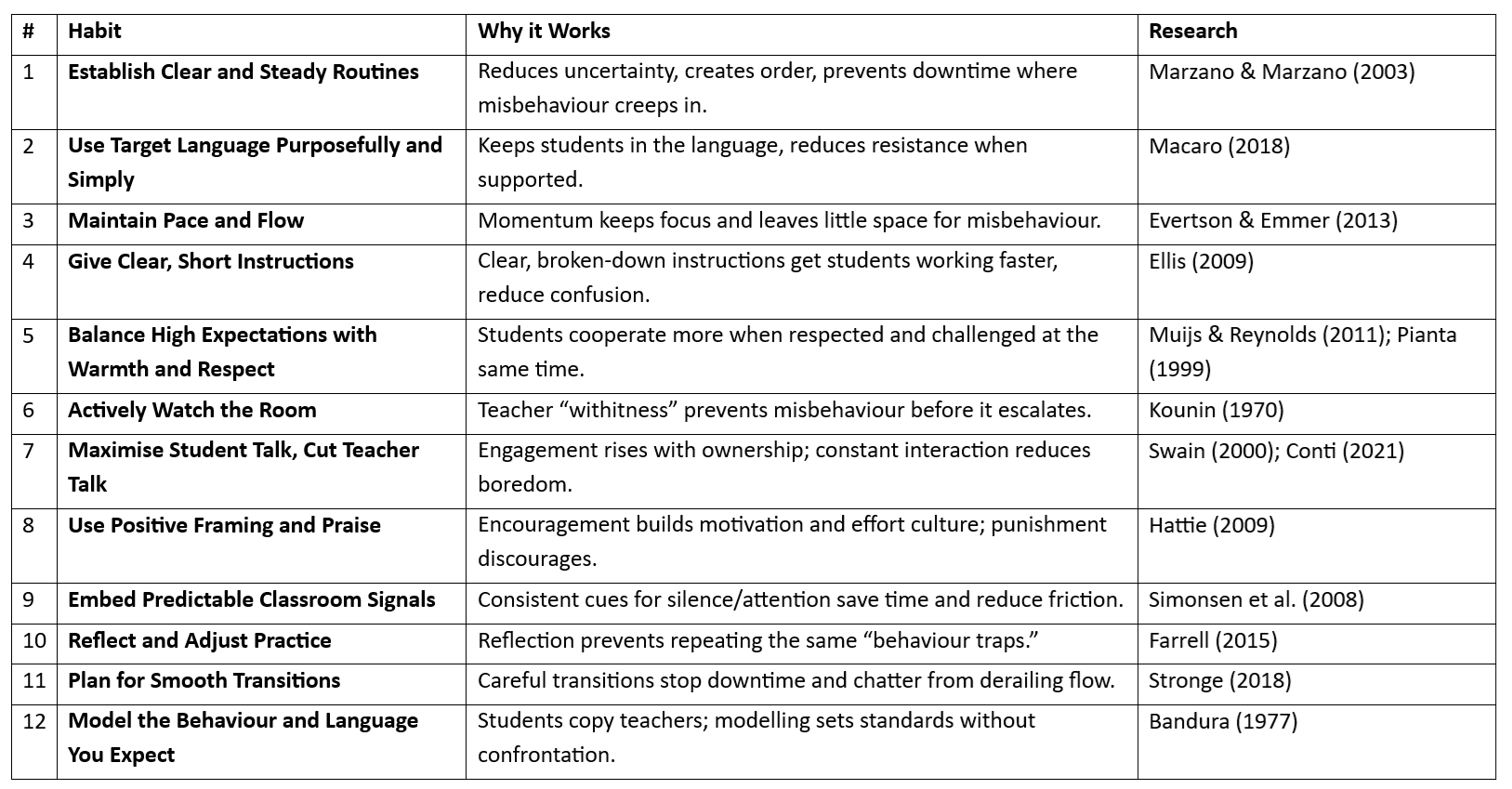
Classroom management in Modern Foreign Languages is not only about discipline — it is more about creating the right situation where learning can really happen. Because MFL lessons usually have speaking, interaction, and the use of the target language, they are often more lively compared to other subjects. This liveliness is like a double-edged sword: it brings a lot of energy, but it also opens the door to distraction if routines, clarity, and pace are missing. Research from general pedagogy and also from language teaching shows time and again a set of habits that good MFL teachers normally use. What follows is a discussion of these habits, showing how small and steady actions may help classrooms to be calmer, more engaging, and productive places.
1.Establish Clear and Steady Routines
• Habit: Greeting at the door, same starter(s) each lesson (retrieval task, drill, listening warm-up). This is something that all of my mentors at the beginning of my teaching career always emphasized the importance of and they were right. The few times I didn’t do that because I was busy setting up the computer or dealing with a student, it did impact negatively the beginning of my lessons. • Why it works: Reduces uncertainty, creates order, and cuts downtime where misbehaviour can creep in. • Research: Marzano & Marzano (2003) found that when teachers are consistent with routines, lessons run more smoothly and students’ behaviour problems are reduced. • When it’s missing: Mr Patel once skipped his usual retrieval starter and let students settle themselves, and within minutes half were chatting and looking lost! In my experience, routines may save much more time than they waste, because they prevent the chaos that always takes longer to fix. Isn’t it better to spend two minutes on a starter than ten minutes calming things down later?
2. Use Target Language Purposefully and Simply
• Habit: High but comprehensible TL use with clear non-verbal scaffolds (gestures, visuals, sentence frames). If what you are saying in the target language and too complicated to convey through gestures or other visuals, simply use the students’ L1. Remember: no students should be left behind, confused or irritated by the target language explanation. Not even one. • Why it works: Keeps students engaged in “doing languages” rather than “doing discipline,” and predictability reduces worry and resistance. • Research : Macaro (2018) shows that when teachers use the target language in a clear and supported way, students pay attention better and stay motivated. • When it’s missing: Ms Dupont tried a full French-only lesson without scaffolds. Students stared blankly and whispered “I don’t get it,” and by the end even she felt very frustrated, since the lack of support left them adrift. In my view, scaffolds are what may turn TL use into success rather than confusion… as I have often said in my blogs. Could we really expect teenagers to cope without support when even adults would struggle?
3. Maintain Pace and Flow
• Habit: Rapid transitions, chunked activities (no long dead time), visible countdowns, and planned variety. This has always been my greatest strength. It can be exhausting but it pays enormous dividends. In my lessons the students simply didn’t have the time to misbehave. • Why it works: Idle time is the enemy of behaviour, since “momentum” reduces chances for distraction. • Research: Evertson & Emmer (2013) showed that lessons where teachers kept up a steady pace had fewer behaviour issues and students’ focus was stronger. • When it’s missing: Mr Jones handed out a long reading without clear timing. Students drifted into side-conversations while he fiddled with the projector, and he saw that energy may drain very quickly when pace dips, which convinced him that momentum is as important as content. In my experience, it’s momentum more than anything else that protects behaviour.
4. Give Clear, Short Instructions (in TL or L1 as needed)
• Habit: Brief, step-by-step instructions, often backed with visuals or gestures are gold, especially when you have students with special needs. Instructions needn’t be in the target language, the most important thing is that the task is. • Why it works: Unclear instructions invite off-task chatter, whereas clarity gets students working faster. • Research: Ellis (2009) explains that when instructions are clear and broken down, students understand more easily and are less likely to go off task. • When it’s missing: Ms Ahmed once gave a five-minute grammar lecture before a task, and although she thought she was being thorough, students weren’t sure what to do and copied the wrong exercise. Since then she has found that keeping instructions short and visual works best. In my view, nothing may derail a class faster than muddled instructions!
5. Balance High Expectations with Warmth and Respect
• Habit: Combine firm insistence on participation (“everyone speaks”) with friendly relational warmth, always showing respect for students and their space. Respect here means listening, allowing thinking time, noticing effort, and treating students’ contributions with fairness. If you disrespect a student, you will get disrespect back – often many times over. • Why it works: Students are much more likely to cooperate when they feel respected and supported. High standards matter, but they only work when learners also feel safe and valued. • Research: Muijs & Reynolds (2011) show that classrooms where teachers combine warmth with high expectations have fewer discipline problems, and Pianta (1999) adds that respectful teacher–student relationships are central to students’ behaviour and learning. • When it’s missing: Mr Williams wanted to be “the nice teacher” and didn’t insist on TL answers. Gradually, students stopped trying, and he later saw that warmth without challenge breeds low effort — and that respect without clear boundaries can quickly slip into indulgence. In my experience, the best classes are both strict and friendly, with respect running both ways. Isn’t that what we would want if we were in their shoes? And how would you feel as a student if no one really listened to your answers?
6. Actively Watch the Room
• Habit: Circulate, make eye contact, use proximity, and point out positive behaviour. Nothing worse than a teacher sitting behind the desk for most of the lessons. • Why it works: “Withitness” (Kounin, 1970) reduces misbehaviour before it builds. • Research: Kounin (1970) showed that when teachers scan the room often and move around, misbehaviour drops because students know the teacher is aware of students’ actions. • When it’s missing: Ms Rossi stayed rooted at the front with her laptop, and a group at the back began sharing headphones, so by the time she noticed, focus was gone. In my experience, the teacher who never leaves the front is the one who loses control.
7.Maximise Student Talk, Cut Teacher Talk
• Habit: Structured pair work, sentence-builder scaffolds, choral response, micro-interactions. • Why it works: Engagement rises when learners feel ownership, and boredom drops when interaction is constant. • Research: Swain (2000) shows that when students have to produce language regularly, they stay more focused and are less likely to drift off task. • When it’s missing: Mr O’Connor explained grammar for twenty minutes without pause, and although he felt he was being clear, students switched off and when it was time to speak the energy was flat. In my experience, the more students talk, the less likely it is for behaviour to become an issue.
8.Use Positive Framing and Praise
• Habit: Notice effort (“Very fluent !” – in the case of a student who has managed to speak fluently despite a few mistakes) more often than punishing errors. • Why it works: Builds much stronger motivation and a culture of effort rather than fear. • Research : Hattie (2009) found that praise and encouragement have a bigger effect on students’ learning and behaviour than punishment or criticism. • When it’s missing: Ms Green corrected every mistake bluntly, and although she thought she was helping accuracy, over time volunteers dwindled. Once she switched to praising effort first, students bounced back. In my experience, classrooms thrive when effort is noticed more than errors.
9. Embed Predictable Classroom Signals
• Habit: Consistent cues for silence, transitions, attention (hand signals, countdowns, TL phrases). • Why it works: Students respond faster when cues are automatic, reducing friction. • Research : Simonsen et al. (2008) showed that when teachers use the same signals consistently, students follow instructions more quickly and lessons run more smoothly. • When it’s missing: Mr Chen had no fixed signal — sometimes clapping, sometimes waiting — and students took longer each time to respond, which wasted time and caused frustration. A simple countdown solved it. A predictable signal is worth ten shouted reminders! After all, how can students concentrate if the rules of attention keep changing?
10. Reflect and Adjust Practice
• Habit: Regularly check which activities trigger drift (e.g., too much copying, too open-ended) and change them. • Why it works: Flexibility prevents repeating the same “behaviour traps.” • Research: Farrell (2015) argues that teachers who reflect regularly improve classroom control because they see what doesn’t work and adapt it. • When it’s missing: Ms Lopez set up a free discussion in Spanish, and within minutes it was all in English, which showed her that it needed scaffolds and sentence frames — and next time, it worked. In my experience, reflection is the difference between repeating mistakes and turning them into learning… as I have often said in my blogs.
11. Plan for Smooth Transitions Between Activities
• Habit: Signal changes clearly, prepare materials in advance, and keep movement purposeful. • Why it works: Transitions are “danger moments” when chatter and off-task behaviour start, so smooth handovers reduce downtime. • Research : Stronge (2018) shows that teachers who plan transitions carefully waste less time and prevent flare-ups in students’ behaviour. • When it’s missing: Mr Ahmed handed out worksheets one by one, and the class slowly lost focus, so he decided to prepare resources on desks before the lesson and behaviour stayed very steady.
12. Model the Behaviour and Language You Expect
• Habit: Show enthusiasm for the TL, model politeness, and show how to stay on task. Respect also has to be modelled: when teachers consistently show courtesy and fairness, students copy that behaviour. • Why it works: Students copy teacher behaviour, and modelling sets the standard without confrontation. • Research : Bandura (1977) showed that students copy what teachers do, so if we model language and respectful behaviour, students’ responses are likely to follow. • When it’s missing: Ms Carter told students to use Spanish greetings but never used them herself, and unsurprisingly within days the class had dropped them too. Once she modelled consistently, the routine stuck!
Table 1 – Summary
Conclusion
Effective classroom management in MFL is not about quick fixes or charisma — it is about small, research-backed habits used steadily. In my experience, predictable routines, clear instructions, structured TL use, high pace, smooth transitions and positive reinforcement together can create a purposeful climate where students focus on learning and not on disruption. By building these habits — including showing respect for students and their space, modelling expectations, and planning transitions with care — teachers may discover that they reduce the stress of discipline and free up energy to do what is most important: helping learners build much greater self-efficacy, confidence, fluency, and joy in using the language. And in the end, is this not the real aim of MFL teaching?
References
Bandura, A. (1977). Social learning theory. Englewood Cliffs, NJ: Prentice-Hall.
Ellis, R. (2009). Task-based language teaching: Sorting out the misunderstandings. International Journal of Applied Linguistics, 19(3), 221–246. https://doi.org/10.1111/j.1473-4192.2009.00231.x
Evertson, C. M., & Emmer, E. T. (2013). Classroom management for elementary teachers (9th ed.). Boston, MA: Pearson.
Farrell, T. S. C. (2015). Reflective language teaching: From research to practice. London: Bloomsbury.
Hattie, J. (2009). Visible learning: A synthesis of over 800 meta-analyses relating to achievement. London: Routledge.
Kounin, J. S. (1970). Discipline and group management in classrooms. New York: Holt, Rinehart & Winston.
Macaro, E. (2018). English medium instruction. Oxford: Oxford University Press.
Marzano, R. J., & Marzano, J. S. (2003). The key to classroom management. Educational Leadership, 61(1), 6–13.
Muijs, D., & Reynolds, D. (2011). Effective teaching: Evidence and practice (3rd ed.). London: Sage.
Pianta, R. C. (1999). Enhancing relationships between children and teachers. Washington, DC: American Psychological Association.
Simonsen, B., Fairbanks, S., Briesch, A., Myers, D., & Sugai, G. (2008). Evidence-based practices in classroom management: Considerations for research to practice. Education and Treatment of Children, 31(3), 351–380.
Stronge, J. H. (2018). Qualities of effective teachers (3rd ed.). Alexandria, VA: ASCD.
Swain, M. (2000). The output hypothesis and beyond: Mediating acquisition through collaborative dialogue. In J. P. Lantolf (Ed.), Sociocultural theory and second language learning (pp. 97–114). Oxford: Oxford University Press.




 The Language Gym
You must be logged in to post a comment.