What really happens in the brain when we listen in a foreign language

Introduction

Listening has long been called a “receptive skill,” but that label is deceptive. Listening is not passive at all — it’s a fast, distributed, multisensory, and deeply predictive process. Recent cognitive neuroscience helps us understand just how much is happening in those few seconds between hearing sounds and understanding meaning.

In this post, we’ll walk through what happens in the brain during listening and why it matters for MFL teaching.

0. The brain’s processing hubs

The diagram below offers a simple but powerful way of visualising what actually happens in the brain during listening. As shown in the picture, listening recruits multiple specialised areas simultaneously: some focus on decoding sound, others on accessing vocabulary and grammar, while still others coordinate articulation, timing, and multimodal integration. This orchestration of neural systems happens in fractions of a second, enabling learners to transform a rapid stream of sound into meaningful language. Understanding this complexity helps us design listening instruction that aligns more closely with how the brain really processes speech.

1. From Ear to Cortex: The Signal Relay

When sound waves hit the ear, they’re transformed into neural signals and relayed to the primary auditory cortex. This is the brain’s “first stop” for incoming sound. At this stage, the brain isn’t interpreting language — it’s simply detecting and classifying the raw acoustic signal.

2. Acoustic Analysis: Pitch, Rhythm, Phoneme Decoding

The primary auditory cortex breaks down the sound stream into its building blocks:

  • Pitch
  • Rhythm and stress
  • Individual phonemes

Think of this as the brain’s phonological decoder. A learner who hasn’t yet automated this stage will often miss words even if they know them.

3. Lexico-Semantic Processing: Making Contact with Meaning

Next, the signal travels to Wernicke’s area, where the brain accesses the mental lexicon. This is where sounds become words, and words link to meaning.

For language learners, this stage is slower — because lexical access depends on familiarity, frequency, and contextual support.

4. Syntax, Grammar, and Inner Rehearsal

Broca’s area plays a dual role:

  • Parsing grammar and syntax (word order, tense, agreement)
  • Supporting inner speech — mentally repeating and holding language in working memory.

This is why learners often “mutter along” internally during listening tasks. It’s not a bad habit; it’s the brain’s way of keeping language active long enough to make sense of it.

5. Articulatory Rehearsal: The Motor Loop

The somatosensory and motor cortex engage to rehearse sounds — even silently. This articulatory loop helps learners stabilise new sequences of sounds in memory.

This is particularly relevant in phonologically complex languages, where unfamiliar sound sequences place extra load on working memory.

6. Visual and Semantic Integration

The angular gyrus and primary visual cortex bring in visual and semantic context — for example, gestures, facial expressions, slides, or lip movements.

This is why listening comprehension improves dramatically when teachers provide audiovisual input instead of just pure audio.

7. Timing, Rhythm and Coordination

Timing structures in the brain (notably the cerebellum) coordinate perception and production. They allow us to:

  • Keep pace with fast speech
  • Anticipate upcoming words
  • Align comprehension with natural speech rhythms

8. The Real Listening Chain

Here’s the listening chain in simple terms:

Ear → Auditory cortex (sound) → Wernicke’s (words & meaning)  
→ Broca’s (grammar + inner speech) → Motor loop (rehearsal)  
→ Visual & semantic systems (context) → Meaning construction

Listening is not linear. All these systems work together in milliseconds — predicting, decoding, integrating, rehearsing.

9. Pedagogical Implications for MFL Teachers

These implications have already been discussed at length in several of my previous posts, but here is a brief recap that brings them together through the lens of what happens in the brain during listening. If listening involves simultaneous phonological decoding, lexical access, syntactic parsing, articulatory rehearsal and multimodal integration, then it makes little sense to treat it as a single, undifferentiated skill. Instead, effective teaching should deliberately scaffold and strengthen each component. This means foregrounding phonological decoding through explicit phonics and repeated exposure to spoken input; making space for inner speech and rehearsal through choral repetition and oral ping-pong routines; supporting lexico-semantic processing through extensive, comprehensible input; and maximising multimodal support (gestures, images, lip movements, captions) to lower cognitive load. It also means building in retrieval and recycling, giving learners the chance to re-encounter and automatise sound-meaning links over time. In short, a research-informed listening pedagogy is less about “testing comprehension” and more about orchestrating conditions that align with how the brain actually processes language.

In my approach, EPI, the teacher deliberately targets every single one of the processes involved in decoding aural input through a range of specialised micro-listening tasks which usually involves interaction between the teacher and the students.

Conclusion

If we understand listening as a multi-system, active process, we stop treating it like a black box.
Instead of asking “Why didn’t they understand?” we can start designing listening tasks that support each stage of this cognitive chain — especially phonological decoding, rehearsal, and multimodal integration.

The next time your students listen to you speak, remember: dozens of brain systems are firing in synchrony, trying to transform sound into meaning in real time. Our job is to make that job easier.

12 (Nearly) Useless Things Language Teachers Do When Teaching Grammar

Introduction

I grew up in an educational culture where grammar was sacred! As an Italian learner — and later teacher — grammar was drilled into us like holy scripture: conjugation tables chanted in chorus, endless rule explanations, 100% accuracy being a must, red pen corrections worthy of a bloodbath… When I started teaching, I brought that entire tradition with me to England into the classroom, which, because I was still young and stubborn and quite convinced I was “doing it properly,” made me blind to how little of it actually worked.

I genuinely believed that if I explained things clearly enough, if I corrected enough, if I drilled enough, the grammar would stick forever ! But of course… it didn’t. Not the way I expected, at least. My students memorised beautifully, then promptly forgot. They “knew” the rule but couldn’t use it in real time — which, if I’m honest, made me more frustrated than them.

And here’s the awkward truth: as a young Italian teacher who thought grammar was the sun around which all learning revolved, I clung to practices that looked good but did very little. I built lessons around clarity rather than acquisition, around rules rather than readiness… even when, deep down, I felt something wasn’t working. It took me years — and a painful amount of self-awareness — to realise that much of what felt like “good grammar teaching” was, in fact, a comforting illusion.

So here they are — 12 (nearly) useless things language teachers do when teaching grammar. And I say “they”… but I really mean we. I’ve done every single one of them.

1. Aiming to teach “50% grammar and 50% vocabulary” as if they were ‘equal’ strands

Most teachers I know believe that a balanced curriculum means splitting lesson time between explicit grammar instruction and vocabulary teaching. This approach stems from the traditional “building blocks” view of language: vocabulary supplies meaning, grammar supplies structure. But… if grammar doesn’t develop on command, why do we keep treating it as if it does? Extensive input processing research (e.g. Bill VanPatten; Stephen Krashen) has shown that lexical knowledge drives much of language comprehension and production, while grammar tends to emerge gradually through repeated, meaningful encounters. In my opinion, this is where so many schemes of work go wrong: they treat grammar as if it obeyed the same logic as vocabulary. I remember early in my career, trying to give exactly “half the lesson” to grammar and half to vocabulary… and being puzzled when students learned the words but kept ignoring the structures. And let’s be honest, grammar does not bend so easily to the teacher’s timetable, particularly when the learner’s internal syllabus — that invisible, stubborn system — has its own sequence of what it’s willing to process and when! Unlike vocabulary, grammar cannot be “taught and learned” in neatly packaged units… Overallocating instructional time to grammar assumes learners can proceduralise rules through exposure to explanation alone — which they can’t!

Why it feels good: It gives lessons a neat structure and a sense of control.

Why it’s useless: Grammar doesn’t behave like vocabulary — it resists timetabling.

Modest benefit: Helps keep teachers aware of “balance,” though the balance itself is illusory.

2. Starting with a “clear explanation” of the rule

Correct me if I am wrong, but beginning a grammar lesson with an explicit explanation is still one of the most widespread practices in language classrooms! It stems from the belief that a well-sequenced deductive explanation lays the foundation for later practice. I still recall a lesson where I gave what I thought was the most lucid explanation of the subjunctive I had ever produced… my students nodded, smiled, repeated after me — and then, in the next activity, cheerfully ignored everything I had just explained. Have you ever had that moment — when you’re speaking with absolute clarity, and the class is nodding like a choir — and yet nothing sticks? In my opinion, this happens because explanations without prior exposure are like arrows shot into fog: technically straight, but never landing where you need them. According to Bill VanPatten and Rod Ellis, learners must first build a mental representation of a structure through meaningful input before explicit rules can support noticing or refinement. And truly, as any good maestro would say, a rule explained too soon is a rule wasted… especially when the learner — bewildered but polite — nods along while their brain files the explanation under “maybe later.”

Why it feels good: Teachers feel clear, structured, professional.

Why it’s useless: Without mental representation, the explanation floats away.

Modest benefit: Might support later noticing if the input foundation is strong.

3. Relying on form-focused drills as the main grammar practice

Form-focused drills—such as conjugation runs, substitution exercises, or transformation tasks—are seductive because they look rigorous and keep classrooms orderly! I used to run those tidy, military-style conjugation drills… everyone in unison, every verb ending perfectly shouted out… and yet, when it came to spontaneous speaking, the endings dissolved like sugar in hot coffee. In my opinion, drills give teachers a comforting illusion of progress precisely because they’re measurable and neat, not because they’re effective. Research (e.g. Michael Long, Nina Spada, Roy Lyster) shows that mechanical manipulation tends to remain in declarative memory. It is a bit like rehearsing a dance step alone in front of the mirror — elegant perhaps, but never quite the real thing, especially when the music, the partner, and the unpredictable rhythm of actual communication are missing entirely. Drills can support familiarisation, but they don’t develop implicit knowledge on their own.

Why it feels good: Neat, measurable, controlled practice.

Why it’s useless: Doesn’t transfer to spontaneous language use.

Modest benefit: Can build familiarity with forms if used sparingly.

4. Re-explaining the rule every time students make a mistake

This is one of the most deeply ingrained teacher habits! Many assume that if students continue to make errors, it must be because they’ve forgotten the rule. I can still picture myself, twenty years ago, circling like a hawk around one poor Year 10 class… re-explaining the same structure for weeks… convinced that if only I said it better this time, they’d finally get it. But how many times can you explain the same thing before realising the problem lies elsewhere? Personally, I believe this ritual of re-explaining is more about calming our own anxiety as teachers than helping students actually acquire the structure. Research in interlanguage development (e.g. Tracy Terrell, Bill VanPatten, Shawn Loewen) shows that most errors are developmental rather than due to ignorance. To insist too much here is like explaining pasta recipes to someone who’s never boiled water — it simply won’t work, because until they have felt the bubbling pot and the weight of the pasta softening, the words remain just that: words. Re-explaining the rule rarely leads to restructuring; learners nod in recognition but their interlanguage remains unchanged!

Why it feels good: Feels patient and thorough.

Why it’s useless: Re-explaining rarely leads to restructuring.

Modest benefit: Can reassure anxious learners — but that’s all.

5. Teaching grammar points simply because they’re next in the textbook

Textbook pacing and syllabus structure often dictate grammar sequencing rather than psycholinguistic readiness! I remember marching into a lesson one October with full enthusiasm… ready to teach the conditional tense to students who could barely produce il y a without mangling it. It was like trying to hang a chandelier in a house without walls. In my opinion, this is one of the most dangerous habits in language teaching: letting the book decide what learners are ready for. Studies on teachability (e.g. Manfred Pienemann) demonstrate that learners can only internalise certain structures once their interlanguage has reached the appropriate developmental stage. Ah, but here lies the classic tragedy: the book marches on… but the learner does not follow… and the teacher — caught between pacing and patience — often knows, deep down, that the grammar has slid off their students like water off marble. Why do we persist in following the book as if it knew the students better than we do?

Why it feels good: It keeps you on schedule and “aligned” with the curriculum.

Why it’s useless: Readiness isn’t dictated by pacing guides.

Modest benefit: Ensures coverage… but not acquisition.

6. Using isolated translation sentences to ‘check mastery’

Translation has long been used as a proxy for grammatical understanding! I used to assign long lists of translation sentences for homework… very traditional, very proper… and then wonder why, during oral work, those same structures evaporated from their minds like mist. In my opinion, translation is the educational equivalent of teaching someone to ride a bike indoors on a stationary trainer: neat, safe, but utterly disconnected from the real road. If translation worked so well, why was their spoken grammar still full of holes? Decades of research (e.g. Stephen Krashen, Rod Ellis) have shown that explicit, controlled production does not equate to procedural ability. Translation may reveal explicit knowledge, but it does not foster automatisation, particularly under communicative pressure! And let’s face it, no one ever became fluent by translating sentence after sentence in splendid isolation… as if the language were an obedient little puzzle rather than a living, breathing system.

Why it feels good: It looks rigorous, academic, “serious.”

Why it’s useless: Tests explicit knowledge, not proceduralised use.

Modest benefit: May reveal gaps — but doesn’t fix them.

7. Turning grammar into a polished PowerPoint performance

The well-designed grammar presentation is seductive because it looks “professional”! I’ve spent hours polishing slides… adding colour-coded timelines and cute arrows… only to realise later that the only thing students remembered was the animation. Isn’t it funny how the more beautiful the slides, the less they seem to learn? Personally, I think this reflects our obsession with control and clarity more than any real evidence of what helps acquisition. Research on input processing (e.g. Bill VanPatten, Teresa Cadierno) repeatedly shows that even the clearest presentation has little impact on acquisition if it’s not anchored in meaningful, repeated input. It is, as one might say, like serving a beautiful plate with nothing on it — the form without the substance, the music without the notes, the speech without the heartbeat. Learners may understand at the surface level, but they don’t retain or proceduralise!

Why it feels good: Looks polished and authoritative.

Why it’s useless: Presentation ≠ acquisition.

Modest benefit: May aid clarity if tied to rich input.

8. Using grammar quizzes and tests as proof of learning

Assessment practices often reflect institutional priorities more than learning realities! I’ve had entire departments celebrate good grammar quiz results… myself included… only to be brought down to earth the moment those same students tried to speak spontaneously. In my opinion, grammar quizzes are one of the great comfort blankets of language teaching: they give us something easy to measure, not something meaningful to trust. Studies (e.g. Norris and Ortega, Shawn Loewen) show that traditional grammar tests mostly tap explicit declarative knowledge. They produce neat data but don’t reveal whether learners can use grammar spontaneously in real time! And what good is a neat number on a spreadsheet if, the moment a student must actually speak, the carefully “learned” structure vanishes like steam from a pot left unattended on the stove? What use is a neat score when the grammar crumbles in the heat of real communication?

Why it feels good: Gives tangible, trackable results.

Why it’s useless: Measures short-term recall, not competence.

Modest benefit: Helps identify what students can recall — briefly.

9. Rewarding grammatical accuracy over processing and fluency

Accuracy-based grading schemes prioritise error-free production over communicative competence! I used to mark with the merciless red pen of a grammar purist… every error circled, every deviation noted… and then wonder why students spoke less and less each term. Isn’t it ironic how the more we correct, the less they speak? To me, this obsession with accuracy reflects a deep cultural inheritance in language teaching — one that values form over flow. Research on fluency and output (e.g. Merrill Swain, Bill VanPatten) shows that overemphasis on correctness encourages monitoring and risk avoidance. Learners produce less, rely on safe language, and develop fossilised habits! And in this way, what begins as a noble quest for precision slowly becomes a slow suffocation of expression, as if every note in the music had to be perfect before the orchestra was even allowed to play.

Why it feels good: Feels rigorous, high standards, academic.

Why it’s useless: Encourages monitoring, not communication.

Modest benefit: Can raise awareness of accuracy — if not overdone.

10. Relying on grammar-based recasts during conversation practice as the main feedback strategy

Recasts—implicit reformulations of errors—have received considerable attention in SLA research! I once spent weeks conscientiously reformulating every student error during pair work… convinced I was gently shaping their language… until I realised, watching them, that they weren’t even registering half of it. In my opinion, this is one of those strategies that survives not because it works, but because it feels good to the teacher. If they don’t even notice, who exactly are we correcting? Studies (e.g. Roy Lyster, Alison Mackey, Shawn Loewen) reveal that learners frequently fail to notice recasts, especially for low-salience grammatical features. Even when noticed, recasts rarely trigger long-term restructuring unless enhanced (through stress, repetition, or salience). It is like whispering to the wind and hoping it changes direction — a lovely gesture perhaps, but one that rarely moves anything but the whisperer’s own lips. They are far less effective for grammar than for pronunciation! Yet teachers love them because they feel natural and non-intrusive!

Why it feels good: Feels gentle, natural, communicative.

Why it’s useless: Often unnoticed, rarely leads to durable change.

Modest benefit: Can support pronunciation or high-salience forms.

11. Correcting everything: the ‘all-out correction’ fallacy

Many teachers still believe that correcting every single grammatical error during oral production is the most effective way to build accuracy! I can still see the look on my students’ faces years ago… when I stopped them mid-sentence again and again… the spark went out of their speech as surely as air from a punctured tyre. Personally, I think this habit says more about our discomfort with errors than about their pedagogical value. Research on corrective feedback (e.g. Roy Lyster, Shawn Loewen) has consistently shown that excessive correction overwhelms learners, disrupts fluency, and often fails to lead to uptake. And truly, too much correction is like seasoning a dish with the entire salt cellar — unbearable and useless — but worse still when the learner, trying to speak, is interrupted so often that the sentence withers before it’s even born. When every slip is corrected, students focus on monitoring rather than communicating, leading to increased anxiety and reduced output! Do we honestly believe that a wall of correction can build confidence?

  • Why it feels good: Creates the illusion of control and rigour.
  • Why it’s useless: Overwhelms learners, kills fluency.
  • Modest benefit: Works in selective, focused form — not all-out.

12. Believing that everyone can “do grammar”

This, in my opinion, is one of the most seductive illusions in language teaching: the idea that, with enough explanation, practice and feedback, every learner can process grammar the same way! I used to stand there with my conjugation charts and my crystal-clear explanations, honestly convinced that clarity was the great leveller… until I noticed how some students thrived while others — intelligent, engaged, capable — stared back with quiet panic in their eyes. Decades of research (e.g. Peter Skehan, Richard Schmidt) show that grammar instruction interacts strongly with individual differences in aptitude, working memory and cognitive style. Not everyone can hold a rule in their head, process it consciously and use it spontaneously. Some can. Many can’t. And what’s more… they don’t have to. Plenty of successful language learners have never “done grammar” in this way — they’ve simply acquired it through patterned, meaningful exposure. Pretending otherwise creates frustration, shame, and a classroom hierarchy where the “grammar kids” shine and others quietly withdraw. How many brilliant learners have we lost to this quiet, invisible divide?

Why it feels good: Suggests that “good teaching” works for everyone.

Why it’s useless: Learners vary greatly in aptitude and processing capacity.

Modest benefit: Encourages some to engage with rules — but not all can or should.

Conclusion

When I look back at my early years in the classroom, I see a young Italian teacher armed with rules, drills, grammar tables, and unwavering faith in explanation. I thought precision was everything… and communicative reality was something that came after. But language doesn’t work that way — and neither do learners.

These “nearly useless” practices aren’t malicious. They persist because they look like teaching. They make us feel in control. But control isn’t acquisition. Real learning happens in the messy, implicit, input-driven, developmentally timed space where rules don’t always behave.

And so, with a mix of affection and irony, I can say: I was my own worst example. And that’s why I know these habits so well.

11 surprising Truths About Grammar Acquisition — and How Long It Really Takes to Master It!

If you’ve been teaching languages long enough, you’ll know the scene. You spend a whole week hammering a grammar point. You explain it clearly. They nod enthusiastically. You set up the practice. They ace it. And then — the next day — it’s vanished into thin air. Why?! It’s not bad teaching. It’s just how the brain actually learns grammar.

Over the past 30 years, psycholinguists and cognitive scientists have unearthed findings that quietly blow up much of what we used to take for granted about grammar teaching. What follows are ten of the most counter-intuitive, game-changing insights I’ve come across — ordered from the most jaw-dropping to the more familiar. Think of them less as rules to follow and more as truths to wrestle with!

1. Grammar is not a knowledge problem — it’s a perception problem!

And here’s the kicker: a large share of grammar errors aren’t about students not knowing the rule. They’re about students not even hearing what they’re supposed to be learning in the first place (Field 2019; Cutler 2021). If you can’t perceive the plural ending in ils mangent because it’s acoustically weak, then no amount of rule teaching will help. You’re building a castle on sand!

In my experience, this is the real invisible elephant in the room. Learners can’t master what their ears never caught. Imagine trying to master German case endings if half of them were whispered into a pillow. Of course you’d miss them. So do they!

Example: A learner who’s only ever heard fast native speech processes “ils mangent” as “il mange”. The plural marker simply never made it in.

Implication: Grammar teaching has to start with the ear, not the rulebook. Slower speech, clearer prosody, exaggerated patterns, looping input — all those unfashionable things — give the structure a fighting chance of being noticed. Make the grammar audible before you expect it to be learnable!

2. Grammar learning keeps happening long after “mastery” — why?!

Here’s something we rarely admit out loud: mastery is a mirage. Interlanguage research shows grammar knowledge is constantly being quietly restructured beneath the surface (McLaughlin 1990; Ellis 2016; Ortega 2020). What looks stable is often just a plateau — temporary, fragile, waiting for new input to push it somewhere else!

I’ve seen this so many times. A structure that students get “wrong” for months suddenly clicks… not because of my genius as a teacher, but because their brains finally reorganised behind the scenes.

Example: For weeks a student says “J’ai allé”. Then one day, without explicit correction, it becomes “Je suis allé”. What happened? The input environment changed. The system self-corrected.

Implication: Forget about “covering” grammar. In my experience, the structures you think are “done” are just hibernating. Bring them back. Recycle them. Spiral them. That’s how mastery actually happens!

3. Grammar learning is 80 % forgetting and relearning!

We don’t talk about this enough. Grammar acquisition isn’t a straight line. It’s more like a wobbly staircase — you climb, you slide, you climb again! Longitudinal research (DeKeyser 2017; Suzuki 2021) shows learners lose and regain the same grammar over and over again.

I’ll never forget watching a group of Year 8s who’d “lost” voy a ir over the summer and then, two weeks later, picked it up again like an old friend. That wasn’t failure. It was the brain doing its pruning and strengthening work!

Example: A Spanish learner nails “voy a ir” in June, forgets it after the break, and recovers it after two narrow listening cycles in September — this time more solidly.

Implication: Recycling isn’t a nice extra. It’s the backbone of real acquisition. In my experience, planned forgetting — followed by smart reactivation — works better than the most elegant one-off explanation!

4. Grammar errors are often memory failures, not rule gaps!

Let’s not kid ourselves. Many so-called “errors” happen because students’ brains are just too busy! Under cognitive load, low-salience grammar gets chucked out of working memory like excess luggage (Ellis & Roehr-Brackin 2018; McDonough 2019).

You’ve seen it: students get everything right in controlled practice… and then it falls apart in spontaneous speech. Why? Not ignorance. Overload!

Example: A learner confidently says “Elle a mangé hier” in a drill but under time pressure blurts out “Elle manger hier”. The tense didn’t vanish. It just didn’t make the cut in the moment.

Implication: Build fluency and retrieval before you expect accuracy under pressure. Otherwise, you’re setting them up to fail — and then blaming them for it!

5. You can’t skip developmental stages!

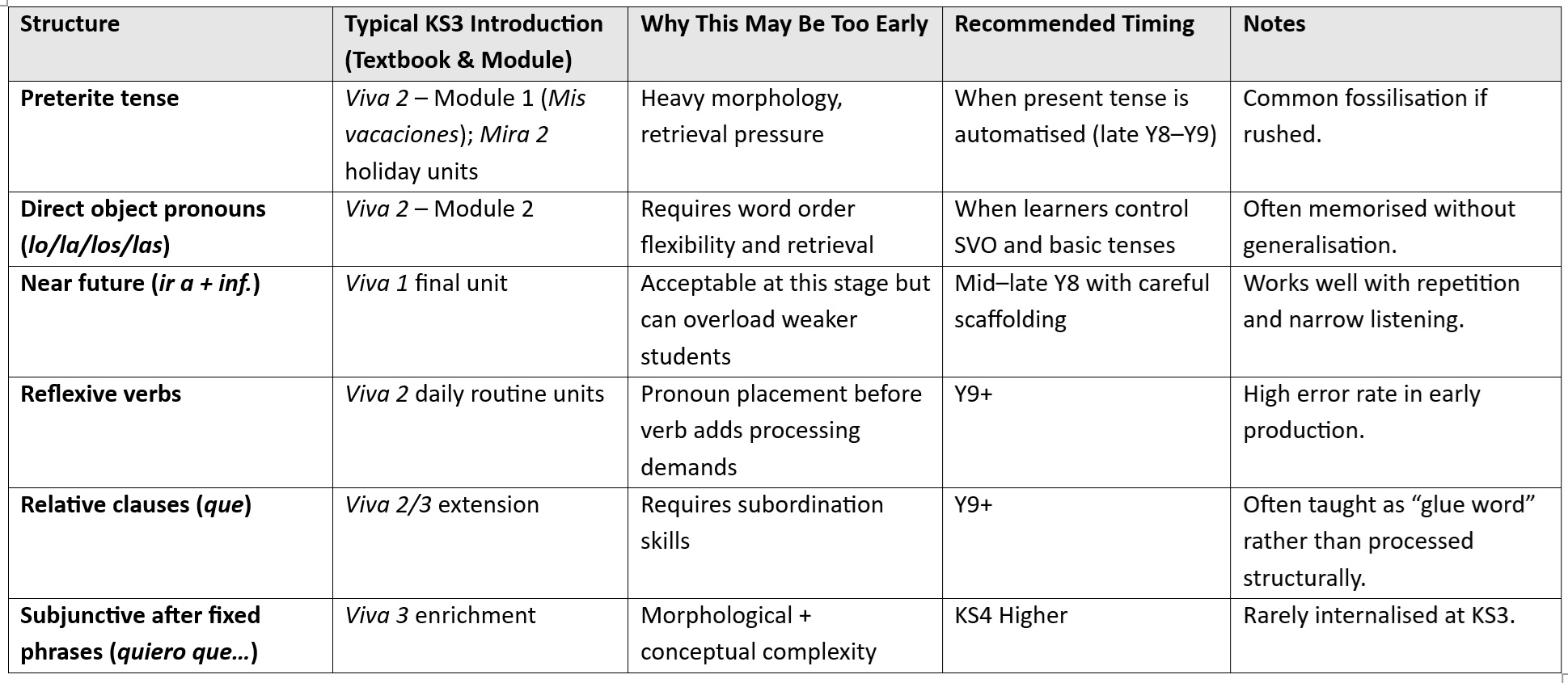
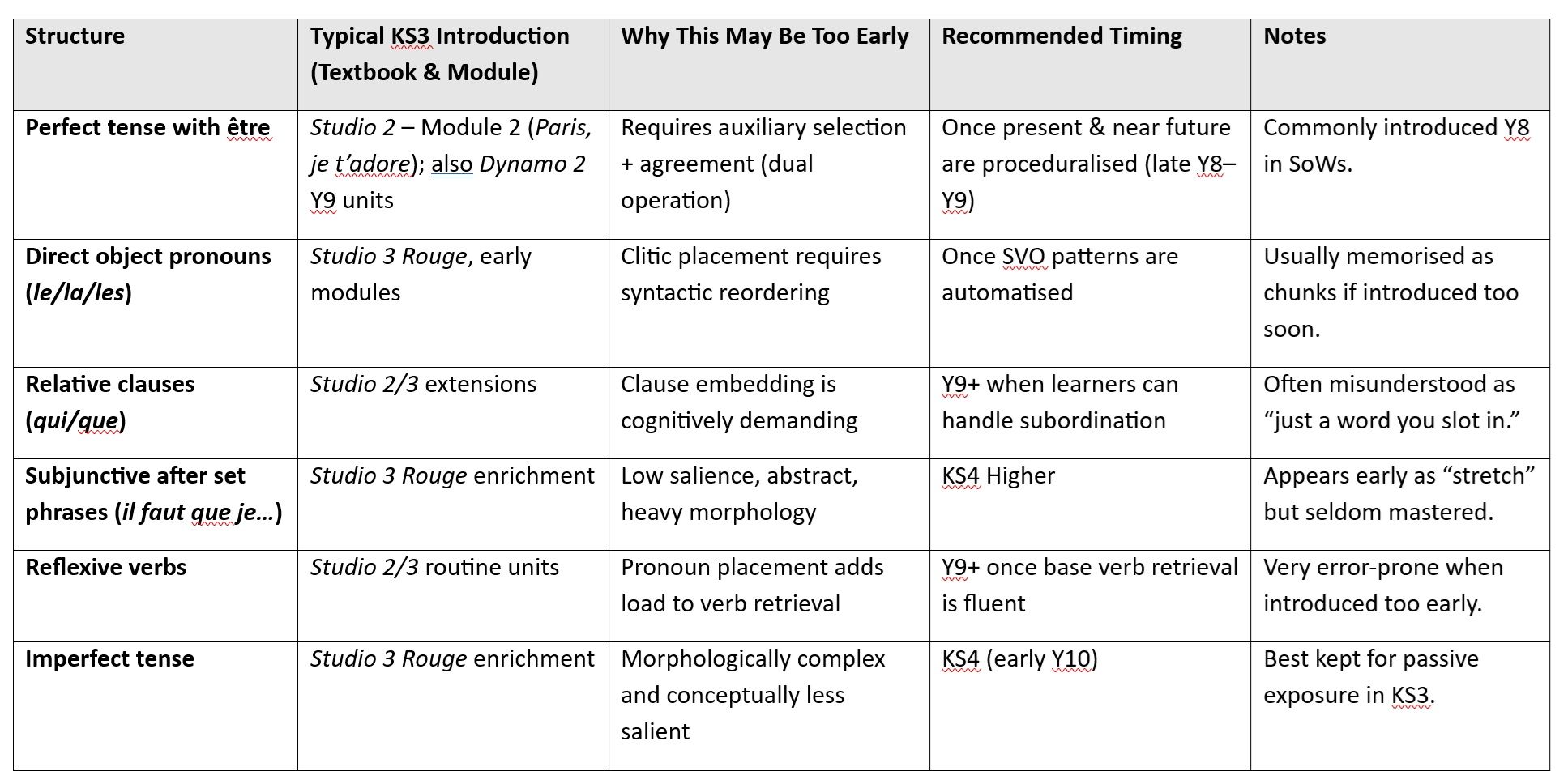
We’ve all tried it: teaching a structure “early” because the textbook says so. And it flops! Pienemann’s Processability Theory (1998) explains why. The brain follows a predictable developmental sequence. You can prime a structure early, but you can’t make the brain process what it’s not yet ready for (Lightbown & Spada 2021).

Example: Try teaching je le vois to Year 7. Good luck. Come back when they’ve automatised simpler SVO patterns, and suddenly pronouns seem “easy.”

Implication: Teach grammar when it’s teachable. Why bash your head against a wall when the timing is the real issue?!

Here are some French and Spanish grammar structures that are commonly taught prematurely, when the students are not developmentally ready:

Tables 1 & 2: Spanish and French structures commonly taught prematurely

6. The brain filters out grammar it can’t yet process!

Even when the structure is “technically audible,” the brain sometimes just doesn’t care! VanPatten’s Primacy of Meaning Principle (1990) shows learners focus on getting the gist, not the form. If they can understand the message without attending to the grammar — they will. Every time!

Example: In “Mes amis sont partis hier”, a beginner might only process mes amis…hier. The auxiliary and participle simply vanish into background noise.

Implication: “Authentic speed” isn’t authentic learning! Comprehensible, chunked, repeatable input makes the grammatical form unavoidable. And when it’s unavoidable, it finally sticks!

7. Feedback works — but only when it’s narrow and repeated!

You know the type of correction that vanishes into the ether? The scattergun kind. The kind where everything is corrected, so nothing is learned. Research tells us feedback does work — but only if it’s tight, consistent, and relentlessly focused on one target (Lyster & Saito 2010; Li 2020).

Example: Correcting ils mange to ils mangent every time, and then reinforcing it through dictations and listening work, gets results. Correcting twenty things at once gets… nothing!

Implication: Feedback isn’t a magic bullet. It’s a drip feed!

8. Grammar is stored as patterns, not rules!

Here’s a truth teachers often feel in their bones: learners don’t think in rules. They think in chunks! Usage-based linguistics confirms it (Bybee 2006; Ellis 2016). They don’t “apply” grammar. They retrieve patterns they’ve heard a hundred times.

Example: Students use “j’ai fini”, “j’ai mangé”, and “j’ai bu” perfectly… but ask them to explain why and they look at you blankly. And honestly? That’s fine!

Implication: The best grammar teaching isn’t about clever explanations. It’s about flooding the mind with patterns so they can be retrieved at will.

9. Narrow, repetitive input beats broad coverage!

Variety is seductive. But the brain loves predictability! Narrow listening (Ellis & Ferreira-Junior 2009; DeKeyser 2017) gives learners the same structure in slightly different guises again and again until it’s carved into their procedural memory.

Example: “Je me lève à sept heures / huit heures / neuf heures.” Ten times. Different speakers. Slight variations. The brain gets the point. Ten random dialogues? Not so much!

Implication: Fluency grows in pattern density, not topic variety. Less glitter, more grooves!

10. Adults can still learn grammar implicitly!

No, it’s not too late! The idea that implicit learning dies after childhood is just wrong (Reber 1993; Williams 2005; Godfroid 2020). Adults still absorb grammar implicitly — it just takes more exposure and a bit of clever design.

Example: Adults hearing “j’ai fini” often enough in comprehensible, repeated listening tasks start using it correctly without ever touching a conjugation chart.

Implication: Don’t underestimate what rich, well-designed input can do. Explicit explanation has its place, but implicit uptake is the engine that drives long-term grammar growth!

11. How long it really takes to master grammar?

Here’s the uncomfortable truth: it takes far, far longer to proceduralise a structure than to recognise it. Research on skill acquisition (DeKeyser 2017; Nation 2022; Anderson 1983) makes it clear: filling in a gap-fill correctly is a beginning, not an end.

Why? Because grammar knowledge must travel from declarative (rule-based, conscious) to procedural (automatic, spontaneous) memory. That leap isn’t small — it’s huge. In my experience, teachers routinely underestimate the time gap by a factor of ten!

Level of MasteryDescriptionEstimated Hours of Focused Practice per StructureTypical Classroom Outcome
Declarative masteryLearners can recognise and apply a rule correctly in gap-fills, multiple choice, or written drills when prompted and unhurried. They rely on explicit knowledge and metalinguistic recall.4–8 hours of focused exposure and practice (≈ 200–300 meaningful encounters)Correct answers in written tasks, but errors or hesitation in spontaneous speech.
Procedural masteryLearners can retrieve and deploy the structure automatically in unplanned oral communication, under time pressure and while attending to meaning. Grammar is retrieved intuitively, not consciously.40–100 hours of spaced, varied, meaningful encounters (≈ 2,000–3,000 processing cycles)Consistent, fluent, accurate use in natural speech and writing; flexible use in unfamiliar contexts (e.g., GCSE oral improvisation).

To put it bluntly: the gap between exercise fluency and exam spontaneity is enormous! A student who can fill in ils mangent correctly after a week of practice is nowhere near being able to say it fluently and automatically in real conversation.

This is why EPI places such a premium on structured recycling, narrow listening, and high-frequency encounters: they’re not extras — they’re the path to proceduralisation. Grammar needs thousands of retrievals before it becomes reflexive. There are no shortcuts!

Conclusions

  • Grammar failure often begins in the ear, not in the rulebook!
  • What looks like stability is often a plateau hiding restructuring!
  • Forgetting isn’t a bug — it’s a feature!
  • Memory, perception, and developmental readiness trump explicit rules!
  • Patterned exposure and repeated retrieval are the real accelerators!
  • Adults can still learn grammar implicitly — if we give them the right input!
  • And most importantly… true mastery takes time. Much more time than we’ve been led to believe.

For teachers, this means ditching the fantasy that grammar can be delivered. Instead, we need to engineer the conditions for it to be absorbed!

IF YOU WANT TO FIND OUT MORE, DO ATTEND MY ONLINE COURSES ORGANIZED BY THE UNIVERSITY OF BATH SPA, HERE: http://www.networkforlearning.org.uk

Références

  • John R. Anderson. (1983). The Architecture of Cognition. Harvard University Press.
  • Joan Bybee. (2006). “From usage to grammar: The mind’s response to repetition.” Language, 82(4), 711–733.
  • Robert M. DeKeyser. (2017). “Knowledge and skill in SLA.” In S. Loewen & M. Sato (Eds.), The Routledge Handbook of Instructed Second Language Acquisition (pp. 15–32). Routledge.
  • Nick C. Ellis. (2016). “Cognitive perspectives on SLA: The associative-cognitive CREED.” Second Language Research, 32(3), 341–359.
  • Nick C. Ellis & Fernando Ferreira-Junior. (2009). “Construction learning as a function of frequency, frequency distribution, and function.” Modern Language Journal, 93(3), 370–385.
  • Nick C. Ellis & Katrin Roehr-Brackin. (2018). “Implicit and explicit knowledge in second language learning, testing and teaching.” Studies in Second Language Acquisition, 40(2), 435–442.
  • Aline Godfroid. (2020). “Implicit and explicit learning in SLA.” In B. VanPatten, G. D. Keating, & S. Wulff (Eds.), Theories in Second Language Acquisition: An Introduction (3rd ed., pp. 127–146). Routledge.
  • Shaofeng Li. (2020). “Corrective feedback in L2 classrooms: A meta-analysis.” Studies in Second Language Acquisition, 42(4), 993–1020.
  • Patsy M. Lightbown & Nina Spada. (2021). How Languages are Learned (5th ed.). Oxford University Press.
  • Roy Lyster & Yuko Saito. (2010). “Oral feedback in classroom SLA: A meta-analysis.” Studies in Second Language Acquisition, 32(2), 265–302.
  • Ellen Bialystok McLaughlin. (1990). “Restructuring.” Applied Linguistics, 11(2), 113–128.  (Note: McLaughlin’s 1990 “Restructuring” article is often cited simply under McLaughlin, 1990.)
  • Kim McDonough. (2019). Cognition and Second Language Instruction. Cambridge University Press.
  • Bill VanPatten. (1990). “Attending to content and form in the input: An experiment in consciousness.” Studies in Second Language Acquisition, 12(3), 287–301.
  • Bill VanPatten. (2015). “Input processing in adult SLA.” In B. VanPatten & J. Williams (Eds.), Theories in Second Language Acquisition (2nd ed., pp. 113–134). Routledge.
  • Manfred Pienemann. (1998). Language Processing and Second Language Development: Processability Theory. John Benjamins.
  • Arthur S. Reber. (1993). Implicit Learning and Tacit Knowledge: An Essay on the Cognitive Unconscious. Oxford University Press.
  • Yoichi Suzuki. (2021). “Relearning and the spacing effect in L2 grammar acquisition.” Studies in Second Language Acquisition, 43(5), 1092–1112.
  • Robert M. DeKeyser & Nick C. Ellis. (Eds.). (2017). Implicit and Explicit Learning in Second Language Acquisition. John Benjamins.
  • Stephen Krashen. (1982). Principles and Practice in Second Language Acquisition. Pergamon.
  • Diane Larsen-Freeman. (1997). “Chaos/complexity science and second language acquisition.” Applied Linguistics, 18(2), 141–165.
  • Peter Skehan. (1998). A Cognitive Approach to Language Learning. Oxford University Press.
  • Nick C. Ellis. (2002). “Frequency effects in language processing.” Studies in Second Language Acquisition, 24, 143–188.
  • John Truscott. (1996). “The case against grammar correction in L2 writing classes.” Language Learning, 46(2), 327–369.
  • John Truscott. (1999). “The case for ‘The case against grammar correction in L2 writing classes’: A response to Ferris.” Journal of Second Language Writing, 8(2), 111–122.
  • John Truscott. (2007). “The effect of error correction on learners’ ability to write accurately.” Journal of Second Language Writing, 16(4), 255–272.
  • Nick C. Ellis & Lourdes Ortega. (Eds.). (2005). Handbook of Research in Second Language Teaching and Learning. Routledge.
  • Lourdes Ortega. (2009). Understanding Second Language Acquisition. Routledge.
  • John Williams. (2005). “Learning without awareness.” Studies in Second Language Acquisition, 27(2), 269–304.

How to make listening ACTUALLY drive acquisition: Ten staples of Listening as Modelling

Introduction

Listening is not a passive skill. It is the most cognitively demanding of all receptive modes and, paradoxically, the least explicitly taught. In the Extensive Processing Instruction (EPI) framework, Listening as Modelling is the engine that drives grammar and lexicon acquisition. It provides the brain with exemplars — auditory models — from which learners infer patterns, internalise sound-meaning mappings, and ultimately develop procedural fluency.

Below I outline ten principles, ranked in order of importance, for designing listening input that does precisely that: not merely test comprehension, but model the language system.

1. Repeatability of input

By repeatability, I don’t simply mean that the audio should be played multiple times (see point 9 for this). I mean that learners must be able to repeat what they hear — at least in their heads. In other words, for listening to lead to learning, the input must be mentally rehearseable. This hardly ever happens with standard textbook recordings, which are typically delivered too fast, too dense, and too prosodically complex for beginners to internalise. Yet, if learners cannot replay a phrase mentally — if the acoustic trace fades before they can process it — no real learning can occur.

Research on working memory and the phonological loop (Baddeley 2003; Vandergrift & Goh 2012) confirms that learners need time and manageable input to build stable sound–form representations.
Similarly, Kadota’s (2019) shadowing studies show that subvocal rehearsal (“inner repetition”) strengthens the connection between auditory perception and articulatory memory — a key precursor to oral fluency.
Segalowitz (2010) likewise found that mental rehearsal promotes automaticity by reducing reaction time in lexical retrieval.

That’s why, in EPI, listening materials are slowed down slightly, chunked clearly, and delivered with natural but accessible prosody. The goal is to make every utterance repeatable in the mind’s ear, so that learners can shadow, rehearse, and gradually consolidate what they hear into long-term memory.

2. Comprehensibility

Listening as modelling presupposes that the input is 95–98 % comprehensible (Nation 2014).
Below this threshold, working memory is overwhelmed and attention shifts from pattern detection to survival decoding.

Comprehensible input (Krashen 1985) still holds true here, but not as passive exposure — rather, as carefully scaffolded auditory material that allows the learner to perceive grammar in action.
In EPI, we achieve this through rich visual context, pre-teaching of key lexis, and cumulative recycling.
Only when meaning is secure can attention move to form (VanPatten 1996).

Field (2008) and Vandergrift & Goh (2012) both note that comprehension is the entry point for awareness: once meaning is predictable, learners can start noticing the fine phonetic or morphological detail.
If the learner’s brain is too busy decoding, it cannot engage in grammatical hypothesis formation.

3. Input flood

If the aim is to model a linguistic feature, that feature must occur frequently. A single instance of the perfect tense does not enable abstraction; dozens do. Ellis (2002) refers to this as frequency-driven implicit learning: learners infer form–function mappings statistically. In cognitive terms, the learner’s brain needs repeated co-occurrence between meaning and form to establish reliable probabilistic patterns (Bybee 2006).

Hence, the listening text should be an input flood — dense with the target structure but still natural.
For example, to model reflexives, one might use a short monologue containing multiple je me lève / je me prépare / je me couche instances. Repetition creates the conditions for unconscious rule formation.

4. Practice across all micro-skills of listening

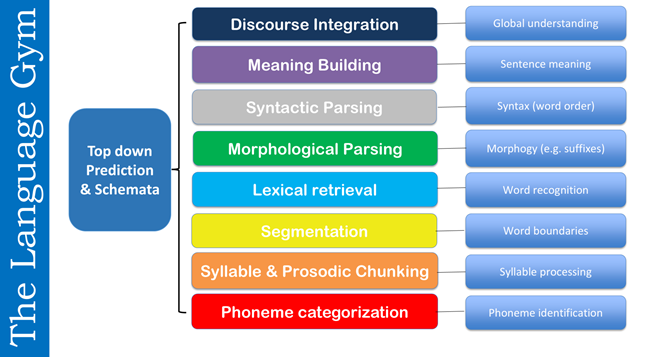
Listening competence depends on a finely layered hierarchy of micro-skills — each contributing a distinct cognitive operation to comprehension. These operate simultaneously and interact dynamically, from bottom-up decoding (sound to meaning) to top-down prediction (context-driven inference).

The figure below (The Language Gym, © Conti 2025) illustrates these interconnected levels:

At the lowest tier lie phoneme categorisation and identification, essential for distinguishing minimal contrasts and stabilising L2 phoneme boundaries (e.g., beau vs bon, pero vs perro). Above this sit syllable and prosodic chunking, through which learners perceive rhythm, stress, and intonation patterns — the “music” of speech that signals grammatical and pragmatic boundaries (Field 2008). Next comes segmentation, the ability to infer word boundaries in continuous speech, one of the hardest perceptual skills for beginners (Cutler & Norris 1988).

Once segments are recognised, lexical retrieval allows the brain to map sound to known word forms rapidly (Segalowitz 2010), while morphological parsing enables the listener to extract grammatical information from endings or prefixes (-ais, -ons, -ment). Syntactic parsing then assembles these decoded items into an organised sentence structure, enabling propositional meaning to emerge.

At higher levels, meaning building integrates lexical and syntactic cues into coherent sentence-level understanding, while discourse integration extends comprehension across utterances, managing anaphora, coherence, and topic flow. Finally, overarching all levels is top-down prediction and schemata activation (Anderson & Lynch 1988; Vandergrift & Goh 2012): the listener’s use of prior knowledge and contextual cues to anticipate meaning.

Training these skills explicitly — from phoneme awareness up to discourse coherence — transforms listening from a purely receptive act into a deliberate cognitive apprenticeship. Each sub-skill must be nurtured systematically in EPI through highly patterned, repeatable input that strengthens automaticity across the processing chain.

5. Highly patterned input

Patterning reduces cognitive load and magnifies predictability. As Goh (2000) observed, predictable prosodic and syntactic patterns help beginners allocate attention to variable elements (e.g. verb endings) rather than re-decoding sentence structure every time. For weaker learners, patterned listening might involve recurring frames such as

Je vais au cinéma / Tu vas au supermarché / Il va à l’école / Nous allons à la piscine.

Once the skeleton is known, the brain can focus on the change — the noun, the verb form, or the preposition — thereby supporting noticing of contrast (Schmidt 1990). Leow (2015) and DeKeyser (2017) both show that pattern-based repetition fosters proceduralisation by creating automatic parsing routines.

In the EPI approach, this principle underpins Narrow Listening, a technique where learners hear several near-identical texts differing only in 10–12 micro-details such as times, places, or subjects.
For instance, one speaker might say “Je me lève à sept heures” while another says “Je me lève à huit heures”. This slight variability within a highly stable frame allows learners to anticipate structure, detect meaningful contrasts, and internalise morpho-syntactic regularities with minimal cognitive strain.

The predictability of the scaffold facilitates pattern recognition, while the changing elements promote semantic differentiation — a dual process supported by research on input variability and implicit abstraction (Ellis & Ferreira-Junior 2009; Spada & Tomita 2010). In short, Narrow Listening à la Conti turns auditory input into a finely tuned laboratory for implicit grammar learning.

6. Thorough processing

Listening tasks must elicit deep semantic and syntactic engagement, not just recognition of key words. Field (2008) distinguishes between text-driven comprehension (surface) and form-driven processing (analytic). Both are essential, but only the latter produces durable change.

By “thorough processing,” I mean detailed processing of the text, not merely the gist. In other words, learners should not only understand what is said but also attend to how it is said — at the level of morphology, syntax, and meaning relationships.

Activities such as faulty translation, spot the intruder, spot the missing detail, sentence puzzle, faulty transcript / spot the nonsense, and dictations (including gapped or narrow variants) compel learners to focus on the smallest form–meaning correspondences. These tasks ensure that every morpheme, lexical nuance, or grammatical marker is consciously processed.

This contrasts sharply with the partial processing typically elicited by textbook comprehension questions (e.g., multiple choice, true/false, gist-based tasks). Such tasks promote top-down inference and selective attention, not bottom-up accuracy. Learners extract just enough semantic information to answer, leaving vast portions of the input unanalysed.

As Field (2019) and Vandergrift & Goh (2012) point out, comprehension-based listening often leads to what they call “good enough processing” — the brain’s tendency to settle for approximate understanding rather than full parsing.

In this sense, standard listening comprehension is diagnostic, not instructional. It measures what learners can already understand, rather than improving their parsing skill or phonological awareness. By contrast, thorough processing tasks disrupt this comfort zone. They push learners into analytic listening, where meaning must be verified at the micro-level. This aligns with the Levels of Processing Hypothesis (Craik & Lockhart 1972): the deeper the semantic and syntactic engagement, the stronger and more durable the memory trace. Boers (2013) further notes that such semantic elaboration leads to double the retention rate compared to surface comprehension.

In EPI, therefore, “thorough processing” means deliberately engineering listening activities that force the learner to process the input in depth — decoding, analysing, and verifying it step by step. The result is not just understanding, but awareness through comprehension — the foundation of procedural grammar learning.

7. Repeated processing

Processing the same input in different ways multiplies the learning payoff. Rost (2011) calls this multi-pass listening: each pass adds a new purpose — gist, detail, inferencing, noticing of form, then reproduction. Each repetition consolidates mapping between sound, structure, and meaning — the triad at the heart of proceduralisation. Ellis & Shintani (2014) note that varied retrieval is more effective than mechanical repetition; each new processing task forces deeper encoding.


This is where EPI’s MARSEARS sequence (Modelling, Awareness, Receptive Processing, Structured Production, etc.) operationalises listening as a cyclical, ever-deepening process rather than a one-off comprehension exercise.

8. Chunking

Fluent listening depends on recognising multi-word units (Pawley & Syder 1983). Beginners, however, tend to process word by word, overloading short-term memory (Baddeley 2003). By training learners to perceive formulaic sequences — je voudrais un café, no me gusta nada, tengo que estudiar — we lighten the processing load. Shadowing, echo repetition, and rhythmic chanting help store these as single phonological items. Once chunks are automatised, syntactic parsing accelerates and comprehension becomes near-instantaneous.

Boers (2021) and Ellis (2016) confirm that formulaic sequences are the fastest route to fluency because they reduce grammatical computation in real time. In EPI, listening texts are deliberately chunk-heavy: lexical bundles are recycled across sessions until retrieval is automatic, forming the auditory basis for later spontaneous speech.

9. Input enhancement

Attention is selective; learners won’t notice grammar unless something draws their focus. Input enhancement (Sharwood Smith 1993) involves manipulating acoustic or visual salience to highlight target forms: slowing down, stressing endings, or colour-coding transcripts. Field (2019) warns against artificial exaggeration, but moderate enhancement helps learners form accurate phonological representations of new morphology. For example, lengthening -ed in English past tense or emphasising -ons in nous mangeons allows perception to precede production. Saito (2019) shows that such enhancement can speed up the acquisition of phonological categories for L2 learners.

In the EPI classroom, enhancement is often achieved not by artificial stretching but by teacher-led acoustic tuning — conscious, intelligible speech that models prosody without distortion.
This makes the grammar audible without making it unnatural.

10. Task essentialness

Finally, learners must need to process the target feature to complete the task successfully. VanPatten (1996) calls this processing instruction: ensuring that meaning cannot be derived without attending to form. If students can answer by recognising one word, the modelling opportunity is lost. But if success depends on perceiving a morphological cue — tense, number, or gender — attention will be naturally drawn to it. Lee & VanPatten (2003) and Marsden (2006) show that task essentialness drives deeper form-meaning mapping than explicit rule explanation ever could.

Within EPI, this principle ensures that the communicative intent of listening tasks always rests upon understanding the grammar embedded in the input. In other words, listening becomes learning only when the grammar matters for meaning.

Putting it all together

An effective Listening as Modelling lesson follows a coherent sequence built around all ten principles:

  1. Repeatability of input – begin with input learners can mentally rehearse (inner repetition/subvocal echo).
  2. Comprehensibility – keep the text at ~95–98% known so working memory can notice form.
  3. Input flood – saturate the text with the target feature to support frequency-driven learning.
  4. Highly patterned input – use stable frames (including Narrow Listening à la Conti, i.e., near-identical texts with 10–12 micro-changes) to reduce cognitive load and highlight contrasts.
  5. Practice across all micro-skills – deliberately exercise the full hierarchy (phoneme categorisation → syllable/prosody → segmentation → lexical retrieval → morphological parsing → syntactic parsing → meaning building → discourse integration, supported by top-down prediction/schemata).
  6. Thorough processing – require detailed analysis beyond gist (see section above).
  7. Repeated processing – cycle through multi-pass purposes (gist, detail, inferencing, noticing, reproduction).
  8. Chunking – foreground and recycle formulaic sequences to lighten processing and boost fluency.
  9. Input enhancement – make the target form perceptually salient without distorting natural prosody.
  10. Task essentialness – design success criteria that depend on perceiving the target feature.

When all ten operate in concert, listening ceases to be a comprehension test and becomes the principal means of grammatical acquisition; the classroom turns into an acoustic laboratory where learners repeatedly experience language as both a model and a mirror of their emerging competence.

IF YOU WANT TO FIND OUT MORE, DO ATTEND MY ONLINE COURSES ORGANIZED BY THE UNIVERSITY OF BATH SPA, HERE: http://www.networkforlearning.org.uk

The Secret Ingredient in Listening We Never Teach: Prosody and Chunking

Introduction

One of the great paradoxes of language teaching I have observed in 28 years of language teaching is this: pupils are often perfectly able to recognise and translate words on paper, yet completely miss them in a listening passage. In my experience this happens far more because of how speech is packaged than because of vocabulary gaps. I’ve lost count of how many times, during a past-paper drill, a pupil has thrown up his hands: “Sir, I knew the word — it was on my vocab list — but I didn’t hear it at all!” This isn’t laziness or lack of effort; it’s the brain doing what it always does when we listen: processing the continuous sound stream in chunks and rhythms rather than neat, dictionary-style words. If our learners haven’t been trained to notice and anticipate those patterns, they will keep failing to recognise words they “know”. And yet, strangely enough, the very same pupils who flounder when faced with a recording often cope rather well with written work, which has demonstrated to me over the years that the issue lies not in their capacity but in the way the input is presented and received.

I still remember a Year 9 top-set lesson where several students were absolutely and uncompromisingly adamant they’d heard “vous savez” in a French recording when the speaker actually said “vous avez”—the liaison and pace fused it into one smooth unit. In Spanish, a Year 10 group missed “lo he hecho” because at natural speed it came out as [loe-echo], which many wrote as “lo echo” (different meaning entirely). And in German, more than a few learners struggled to spot the tiny “es” in “ich habe es”, because the speaker reduced it to “ich hab’s”—one neat chunk that disappears unless you’re trained to expect it. As I mentioned before, the culprit isn’t weak vocabulary — it’s the neglect of prosody and chunking in the way we teach listening. It is, I would say, a kind of collective blind spot in our profession, because it is easier to test isolated comprehension than to coach learners into hearing speech as a sequence of rhythm groups.

What is Prosody?

Prosody is basically the music of spoken language — the rhythm, stress and intonation patterns that shape how words flow in real time as we speak. It’s what makes speech sound native and natural, and it’s also, and more importantly, what allows the brain to break a continuous stream of sound into units we can decode. I often say in my workshops that without prosody, listening is like reading a sentence with no spaces or punctuation; with it, learners can anticipate where one chunk ends and another begins. One could say that prosody acts as the scaffolding of speech, invisible most of the time, but once you remove it the whole structure…it wobbles and collapses!

SubcomponentWhat It Means (plain English)Example in FrenchWhy It Matters for Learners
RhythmThe timing/beat of speech; how syllables are spaced.Je vais / au cinéma (two clear beats).Helps the brain process speech in manageable pieces rather than a blur.
StressWhich syllables or words get emphasis.Final-syllable stress: chocolat, cinéma.Points to important information and helps with word boundaries.
IntonationThe rise and fall of pitch across a sentence.Tu viens ? (rising for a question).Signals questions, surprise, contrast — boosts comprehension.
Connected speechHow sounds blend/reduce when we talk naturally.Il y a[ya]; je ne sais pas[ʒsépa].Explains why pupils “know” a word but can’t hear it in fast speech.
Pausing / ChunkingNatural mini-breaks that group words.Ce soir / je vais au cinéma / avec mes amis.Gives the brain cut-points for chunking; lowers cognitive load.

How the Brain Processes Prosody and Chunks

Cognitive science is fairly clear: fluent listening is not word-by-word decoding; the brain grabs rhythmic units (prosodic phrases) and groups them into chunks of meaning. Three big implications follow.

  1. Segmentation. Prosody gives the “punctuation” in the sound stream, telling us where one chunk ends and another one begins – which is key to vocabulary recognition! Without this, learners can’t separate il y a from the blur around it. This means that what appears to the teacher as a “simple word” is, in fact, an unmarked blur unless signposted by rhythm and stress.
  2. Prediction. Intonation and rhythm also help the brain guess what’s coming next – another key skill – which reduces the listener’s effort, thereby freeing up space in working memory and enhancing fluency. For example: a rising contour primes us for a question, a fall often signals the end of a statement. If we neglect to teach this predictive function – as often happens in my experience – we condemn learners to decoding blindly, always half a step behind.
  3. Memory load reduction. By chunking, the brain treats several words as one unit (e.g. “je ne sais pas” processed as [ʒnesépa]), freeing working memory for meaning rather than sound-by-sound assembly. It is this economy of processing that allows fluent speakers to listen and think at the same time, rather than expend all their mental energy on decoding.

When prosody and chunking aren’t trained, learners attempt syllable-by-syllable decoding, overload working memory, and miss the gist, which is exactly what we see in listening papers when pupils say “It was too fast”!

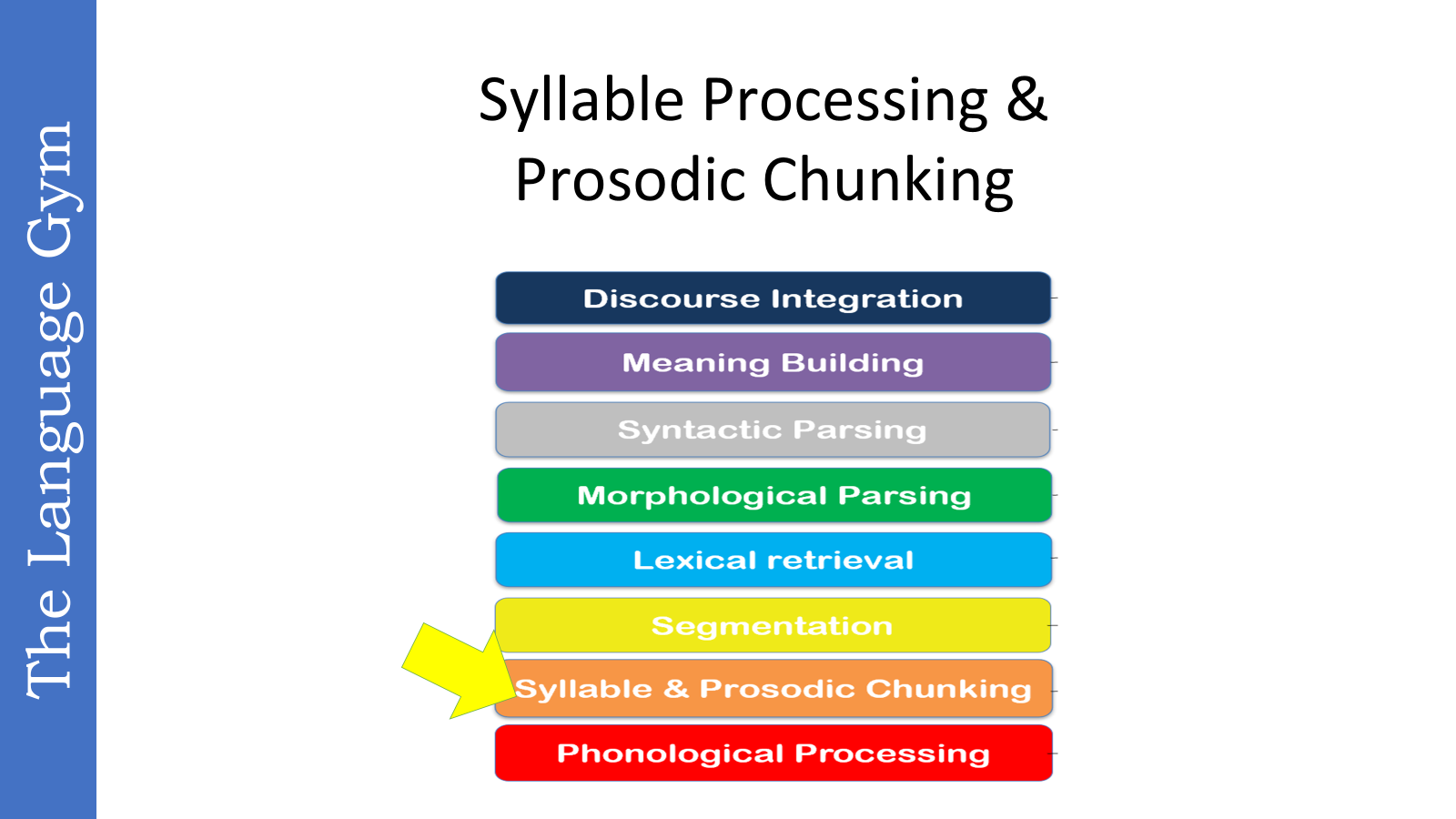
Figure 1 – The listening process and where Prosodic chunking sits in the decoding process (from my workshop on ‘Listening at high school”

The Obstacles in French, Spanish and German

Each language throws up specific prosodic challenges for English-speaking learners:

  • French
    • Final-syllable stress (versus English’s stress-timed rhythm).
    • Frequent liaisons (vous‿avez, très‿utile).
    • Reductions/blends: je ne sais pas[ʒsépa], il y a[ya], tu as[t’a].
    • Flatter intonation can make boundaries harder to hear. The consequence is that French can feel like one long, undifferentiated stream to a Year 9 ear.
  • Spanish
    • Fast syllable-timed rhythm; every syllable feels equally prominent.
    • Contractions (del, al) and vowel elision across boundaries (lo estoy[lo’stoy]).
    • Clitics attach and move: decírselo, me lo dio — one prosodic unit. This means learners often don’t realise what looks like four words on the page has become one smooth unit of sound.
  • German
    • Strong initial stress can hide endings.
    • V2 and verb-final patterns shift the rhythm: Heute habe ich gegessen; …, weil ich keine Zeit hatte.
    • Reduced forms are common: habe ich[habich], ich habe[ich hab’]. The result is that students chase endings they never hear, and often assume they are missing vocabulary rather than listening to a natural reduction.

Implications for the Classroom

If prosody and chunking are central to fluent listening, then it goes without saying that listening must be taught as a skill to be trained, not a test to be survived. This is a profound shift, because it asks us to see classroom listening not as passive exposure or exam rehearsal but, as I often advocate, as a craft that can and must be scaffolded.

KS3 (build the ear early)

  • Train decoding from day one: when you model a new chunk, also model its rhythm, reduction and likely liaison. Pupils should hear the sound unit as a unit, not as four separate syllables.
  • Use LAM (Listening-as-Modelling): pupils shadow, echo and track rhythm groups before any comprehension quiz. This deliberate imitation is essential, because it conditions the ear to pick up rhythm in future encounters.
  • Normalise reduced forms early (e.g. y’a alongside il y a), so they don’t feel like “wrong” French. Otherwise, exams will continue to feel like trickery when in fact they only reflect natural speech.

KS4 (speed + stability under pressure)

  • Rehearse faster processing with short, repeated extracts; then move to exam-like conditions. This staged acceleration prepares students to survive the shock of exam recordings that never slow down.
  • Treat past papers as forensic training, not just score-gathering: “Why didn’t you hear it? Where was the stress? Which sounds blended?” Such metacognitive questioning is more valuable than another mark out of ten. Use the transcripts to do some of the activities below, both to identify issues and to fix them.
  • Teach the “signposts” of longer passages (connectors, fillers, contour shifts) so pupils can map the structure as they listen. In other words, let them see that listening is navigation, not simply catching isolated words.

Classroom Activities for Prosody and Chunking

1) Rhythm Dictation (micro)

  • How: Play a 10–12s clip. Pupils first mark slashes / for rhythm groups, then attempt the words.
  • Trains: segmentation, phrasing before spelling.
  • KS3: 2–3 short clauses.
    KS4: longer sentence with a connector + reduction.

2) Shadow Reading (echo → gap → no text)

  • How: Shadow with text → with gapped text → without text (still shadowing).
  • Trains: alignment to native timing, stress, liaison/reduction.
  • KS3: short dialogues.
    KS4: exam extracts; track speed at native pace.

3) Chunk Spotting (with transcript)

  • How: Give transcript with no pauses. Pupils mark where the speaker chunks; replay to check.
  • Trains: noticing natural cut-points, liaison spots.
  • KS3: teacher models first pass.
    KS4: independent; justify choices.

4) Contour Copy (intonation tracing)

  • How: Teacher draws quick pitch arrows over a sentence while it plays. Pupils copy the contour (hum mmm) then say the line.
  • Trains: question vs statement melody; contrastive stress.
  • KS3: one line each.
    KS4: short paragraph; identify where pitch resets.

5) Spot the Reduction

  • How: Play lines containing reduced forms (e.g., [ʒsépa], [hab’s], [lo’stoy]). Pupils highlight the reduction in the transcript; tick when they hear it.
  • Trains: mapping reduced → full forms.
  • KS3: pre-highlight options to choose from.
    KS4: free annotate + add another example.

6) Liaison Hunt (French)

  • How: Pupils predict compulsory liaisons (vous‿avez, très‿utile), then listen and tick correct occurrences.
  • Trains: connected speech boundaries that change word edges.
  • KS3: 6–8 liaisons in a short text.
    KS4: include optional/forbidden liaisons; discuss why.

7) Tap-the-Beat / Metronome Listening

  • How: Pupils lightly tap table on each rhythm group as a clip plays; second pass they whisper only the stressed syllables.
  • Trains: rhythmic timing, prominence.
  • KS3: slow metronome.
    KS4: native speed; compare taps with partner.

8) Minimal Prosody Pairs

  • How: Contrast near pairs at speed (Fr: vous avez / vous savez; Es: lo he / lo e…; De: hab ich / habe ich). Pupils choose A/B while listening and justify.
  • Trains: fine-grained prosodic discrimination.
  • KS3: teacher-led, 6 items.
    KS4: quickfire 12–16 items, self-score.

9) Gated Audio (progressive reveal)

  • How: Play only the first rhythm group, pause: pupils predict next group; reveal; continue.
  • Trains: prediction from melody and phrasing, not just words.
  • KS3: two gates per sentence.
    KS4: full paragraph with 4–5 gates.

10) Backchaining (listening-led)

  • How: Play the final rhythm group; pupils repeat. Add the previous group + final; build backwards to full line.
  • Trains: end-focus prosody; reduces overload.
  • KS3: 2–3 groups.
    KS4: 4–5 groups, faster tempo.

11) Narrow Listening Set (same frame, varied details)

  • How: Three micro-clips with identical syntax/contour but different nouns/adverbs. Pupils mark identical chunks and prosodic pattern each time.
  • Trains: prosodic invariants; chunk stability across lexis.
  • KS3: 6–8 lines total.
    KS4: 12–15 lines; map recurring contour.

12) Repair the Transcript

  • How: Give a transcript missing slashes/liaisons. Pupils fix it while listening; annotate what “tricked” them and why.
  • Trains: metalinguistic noticing of prosodic cues.
  • KS3: teacher models first fix.
    KS4: independent + pair compare.

13) Rhythm Bingo (listening)

  • How: Bingo grid of target chunks (e.g., il y a, je vais, il faut, hab’ ich, tengo que). Play a clip; pupils cross chunks they hear; must hum/say the chunk with accurate rhythm to keep the point.
  • Trains: rapid chunk recognition; retrieval with prosody.
  • KS3: 6–8 chunks.
    KS4: 12+ chunks incl. reduced forms.

14) 4–3–2 Shadow

  • How: Pupils shadow the same 12–15s clip three times with shrinking prep/play time (e.g., 40s → 30s → 20s), aiming to keep contour and liaison.
  • Trains: stability under time pressure.
  • KS3: slower clips; allow one pause.
    KS4: native speed; one take per round.

15) Chunk Targeting (Selective listening)

  • How: Before listening, set 2–3 chunks to “catch” (e.g., je viens de, il faut + inf., me lo dio). Pupils note time-stamps or positions when they appear.
  • Trains: attentional focus; cue-based listening.
  • KS3: teacher names the chunks.
    KS4: pupils choose and justify their targets.

16) Prosody Karaoke (performance listen→say)

  • How: After listening twice, pupils perform the dialogue with exaggerated intonation/rhythm, then a natural take.
  • Trains: intonation control; phrase length.
  • KS3: short, fun scripts.
    KS4: exam-style monologues/dialogues.

17) Intonation ID (function from melody)

  • How: Play the same sentence as a statement, question, surprise. Pupils label which is which without words on screen.
  • Trains: mapping melody → meaning.
  • KS3: teacher cues with hand signals.
    KS4: include contrastive focus (It was yesterday, not today).

18) “Where’s the Stress?” (word & phrase)

  • How: Play isolated words and short phrases; pupils mark stressed syllables and then the phrase stress.
  • Trains: stress placement; phrase prominence.
  • KS3: familiar lexis only.
    KS4: add multi-clausal phrases.

19) Echo & Erase (listen-led)

  • How: Listen and echo with text → listen and echo with gaps → echo from memory while audio plays.
  • Trains: prosodic tracking without visual over-reliance.
  • KS3: 1–2 lines.
    KS4: 3–4 lines; quicker erasure.

Quick marking / AfL ideas (listening-focused)

  • Prosody ticks: 3 criteria on a slip—kept rhythm groups / handled reduction / matched intonation (✓/– per clip).
  • Peer spot-check: one partner listens and marks a simple grid while the other shadows.
  • Exit ticket: place slashes on one sentence heard once; compare to teacher version.

Conclusion

In conclusion: prosody and chunking are not “extras.” They are the invisible glue that holds listening together and if we don’t teach them, our learners will keep failing to hear words they already know. if we do it on a daily bais, starting them young, however, they will begin to hear the music of the language and, in my opinion, that’s when fluency stops being a slogan and starts becoming a habit. Past papers become practice rather than punishment; listening becomes learnable, not luck. And perhaps more importantly, pupils discover that listening is not some mysterious gift some possess and others lack, but a discipline that can be acquired and built upon step by step, with patience and persistence.