
Introduction
One of the great paradoxes of language teaching I have observed in 28 years of language teaching is this: pupils are often perfectly able to recognise and translate words on paper, yet completely miss them in a listening passage. In my experience this happens far more because of how speech is packaged than because of vocabulary gaps. I’ve lost count of how many times, during a past-paper drill, a pupil has thrown up his hands: “Sir, I knew the word — it was on my vocab list — but I didn’t hear it at all!” This isn’t laziness or lack of effort; it’s the brain doing what it always does when we listen: processing the continuous sound stream in chunks and rhythms rather than neat, dictionary-style words. If our learners haven’t been trained to notice and anticipate those patterns, they will keep failing to recognise words they “know”. And yet, strangely enough, the very same pupils who flounder when faced with a recording often cope rather well with written work, which has demonstrated to me over the years that the issue lies not in their capacity but in the way the input is presented and received.
I still remember a Year 9 top-set lesson where several students were absolutely and uncompromisingly adamant they’d heard “vous savez” in a French recording when the speaker actually said “vous avez”—the liaison and pace fused it into one smooth unit. In Spanish, a Year 10 group missed “lo he hecho” because at natural speed it came out as [loe-echo], which many wrote as “lo echo” (different meaning entirely). And in German, more than a few learners struggled to spot the tiny “es” in “ich habe es”, because the speaker reduced it to “ich hab’s”—one neat chunk that disappears unless you’re trained to expect it. As I mentioned before, the culprit isn’t weak vocabulary — it’s the neglect of prosody and chunking in the way we teach listening. It is, I would say, a kind of collective blind spot in our profession, because it is easier to test isolated comprehension than to coach learners into hearing speech as a sequence of rhythm groups.
What is Prosody?
Prosody is basically the music of spoken language — the rhythm, stress and intonation patterns that shape how words flow in real time as we speak. It’s what makes speech sound native and natural, and it’s also, and more importantly, what allows the brain to break a continuous stream of sound into units we can decode. I often say in my workshops that without prosody, listening is like reading a sentence with no spaces or punctuation; with it, learners can anticipate where one chunk ends and another begins. One could say that prosody acts as the scaffolding of speech, invisible most of the time, but once you remove it the whole structure…it wobbles and collapses!
| Subcomponent | What It Means (plain English) | Example in French | Why It Matters for Learners |
|---|---|---|---|
| Rhythm | The timing/beat of speech; how syllables are spaced. | Je vais / au cinéma (two clear beats). | Helps the brain process speech in manageable pieces rather than a blur. |
| Stress | Which syllables or words get emphasis. | Final-syllable stress: chocolat, cinéma. | Points to important information and helps with word boundaries. |
| Intonation | The rise and fall of pitch across a sentence. | Tu viens ? (rising for a question). | Signals questions, surprise, contrast — boosts comprehension. |
| Connected speech | How sounds blend/reduce when we talk naturally. | Il y a → [ya]; je ne sais pas → [ʒsépa]. | Explains why pupils “know” a word but can’t hear it in fast speech. |
| Pausing / Chunking | Natural mini-breaks that group words. | Ce soir / je vais au cinéma / avec mes amis. | Gives the brain cut-points for chunking; lowers cognitive load. |
How the Brain Processes Prosody and Chunks
Cognitive science is fairly clear: fluent listening is not word-by-word decoding; the brain grabs rhythmic units (prosodic phrases) and groups them into chunks of meaning. Three big implications follow.
- Segmentation. Prosody gives the “punctuation” in the sound stream, telling us where one chunk ends and another one begins – which is key to vocabulary recognition! Without this, learners can’t separate il y a from the blur around it. This means that what appears to the teacher as a “simple word” is, in fact, an unmarked blur unless signposted by rhythm and stress.
- Prediction. Intonation and rhythm also help the brain guess what’s coming next – another key skill – which reduces the listener’s effort, thereby freeing up space in working memory and enhancing fluency. For example: a rising contour primes us for a question, a fall often signals the end of a statement. If we neglect to teach this predictive function – as often happens in my experience – we condemn learners to decoding blindly, always half a step behind.
- Memory load reduction. By chunking, the brain treats several words as one unit (e.g. “je ne sais pas” processed as [ʒnesépa]), freeing working memory for meaning rather than sound-by-sound assembly. It is this economy of processing that allows fluent speakers to listen and think at the same time, rather than expend all their mental energy on decoding.
When prosody and chunking aren’t trained, learners attempt syllable-by-syllable decoding, overload working memory, and miss the gist, which is exactly what we see in listening papers when pupils say “It was too fast”!
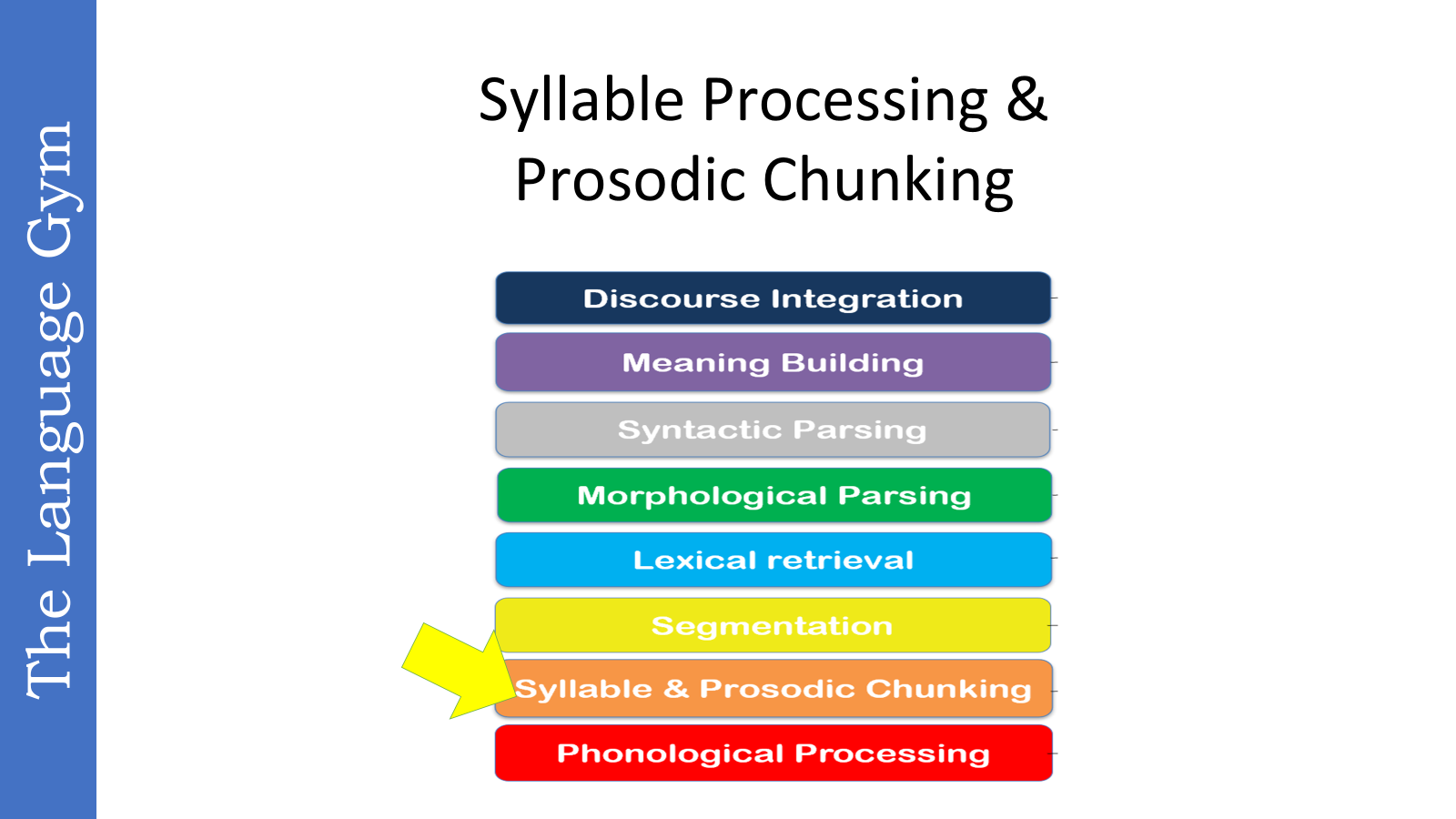
Figure 1 – The listening process and where Prosodic chunking sits in the decoding process (from my workshop on ‘Listening at high school”
The Obstacles in French, Spanish and German
Each language throws up specific prosodic challenges for English-speaking learners:
- French
- Final-syllable stress (versus English’s stress-timed rhythm).
- Frequent liaisons (vous‿avez, très‿utile).
- Reductions/blends: je ne sais pas → [ʒsépa], il y a → [ya], tu as → [t’a].
- Flatter intonation can make boundaries harder to hear. The consequence is that French can feel like one long, undifferentiated stream to a Year 9 ear.
- Spanish
- Fast syllable-timed rhythm; every syllable feels equally prominent.
- Contractions (del, al) and vowel elision across boundaries (lo estoy → [lo’stoy]).
- Clitics attach and move: decírselo, me lo dio — one prosodic unit. This means learners often don’t realise what looks like four words on the page has become one smooth unit of sound.
- German
- Strong initial stress can hide endings.
- V2 and verb-final patterns shift the rhythm: Heute habe ich gegessen; …, weil ich keine Zeit hatte.
- Reduced forms are common: habe ich → [habich], ich habe → [ich hab’]. The result is that students chase endings they never hear, and often assume they are missing vocabulary rather than listening to a natural reduction.
Implications for the Classroom
If prosody and chunking are central to fluent listening, then it goes without saying that listening must be taught as a skill to be trained, not a test to be survived. This is a profound shift, because it asks us to see classroom listening not as passive exposure or exam rehearsal but, as I often advocate, as a craft that can and must be scaffolded.
KS3 (build the ear early)
- Train decoding from day one: when you model a new chunk, also model its rhythm, reduction and likely liaison. Pupils should hear the sound unit as a unit, not as four separate syllables.
- Use LAM (Listening-as-Modelling): pupils shadow, echo and track rhythm groups before any comprehension quiz. This deliberate imitation is essential, because it conditions the ear to pick up rhythm in future encounters.
- Normalise reduced forms early (e.g. y’a alongside il y a), so they don’t feel like “wrong” French. Otherwise, exams will continue to feel like trickery when in fact they only reflect natural speech.
KS4 (speed + stability under pressure)
- Rehearse faster processing with short, repeated extracts; then move to exam-like conditions. This staged acceleration prepares students to survive the shock of exam recordings that never slow down.
- Treat past papers as forensic training, not just score-gathering: “Why didn’t you hear it? Where was the stress? Which sounds blended?” Such metacognitive questioning is more valuable than another mark out of ten. Use the transcripts to do some of the activities below, both to identify issues and to fix them.
- Teach the “signposts” of longer passages (connectors, fillers, contour shifts) so pupils can map the structure as they listen. In other words, let them see that listening is navigation, not simply catching isolated words.
Classroom Activities for Prosody and Chunking
1) Rhythm Dictation (micro)
- How: Play a 10–12s clip. Pupils first mark slashes / for rhythm groups, then attempt the words.
- Trains: segmentation, phrasing before spelling.
- KS3: 2–3 short clauses.
KS4: longer sentence with a connector + reduction.
2) Shadow Reading (echo → gap → no text)
- How: Shadow with text → with gapped text → without text (still shadowing).
- Trains: alignment to native timing, stress, liaison/reduction.
- KS3: short dialogues.
KS4: exam extracts; track speed at native pace.
3) Chunk Spotting (with transcript)
- How: Give transcript with no pauses. Pupils mark where the speaker chunks; replay to check.
- Trains: noticing natural cut-points, liaison spots.
- KS3: teacher models first pass.
KS4: independent; justify choices.
4) Contour Copy (intonation tracing)
- How: Teacher draws quick pitch arrows over a sentence while it plays. Pupils copy the contour (hum mmm) then say the line.
- Trains: question vs statement melody; contrastive stress.
- KS3: one line each.
KS4: short paragraph; identify where pitch resets.
5) Spot the Reduction
- How: Play lines containing reduced forms (e.g., [ʒsépa], [hab’s], [lo’stoy]). Pupils highlight the reduction in the transcript; tick when they hear it.
- Trains: mapping reduced → full forms.
- KS3: pre-highlight options to choose from.
KS4: free annotate + add another example.
6) Liaison Hunt (French)
- How: Pupils predict compulsory liaisons (vous‿avez, très‿utile), then listen and tick correct occurrences.
- Trains: connected speech boundaries that change word edges.
- KS3: 6–8 liaisons in a short text.
KS4: include optional/forbidden liaisons; discuss why.
7) Tap-the-Beat / Metronome Listening
- How: Pupils lightly tap table on each rhythm group as a clip plays; second pass they whisper only the stressed syllables.
- Trains: rhythmic timing, prominence.
- KS3: slow metronome.
KS4: native speed; compare taps with partner.
8) Minimal Prosody Pairs
- How: Contrast near pairs at speed (Fr: vous avez / vous savez; Es: lo he / lo e…; De: hab ich / habe ich). Pupils choose A/B while listening and justify.
- Trains: fine-grained prosodic discrimination.
- KS3: teacher-led, 6 items.
KS4: quickfire 12–16 items, self-score.
9) Gated Audio (progressive reveal)
- How: Play only the first rhythm group, pause: pupils predict next group; reveal; continue.
- Trains: prediction from melody and phrasing, not just words.
- KS3: two gates per sentence.
KS4: full paragraph with 4–5 gates.
10) Backchaining (listening-led)
- How: Play the final rhythm group; pupils repeat. Add the previous group + final; build backwards to full line.
- Trains: end-focus prosody; reduces overload.
- KS3: 2–3 groups.
KS4: 4–5 groups, faster tempo.
11) Narrow Listening Set (same frame, varied details)
- How: Three micro-clips with identical syntax/contour but different nouns/adverbs. Pupils mark identical chunks and prosodic pattern each time.
- Trains: prosodic invariants; chunk stability across lexis.
- KS3: 6–8 lines total.
KS4: 12–15 lines; map recurring contour.
12) Repair the Transcript
- How: Give a transcript missing slashes/liaisons. Pupils fix it while listening; annotate what “tricked” them and why.
- Trains: metalinguistic noticing of prosodic cues.
- KS3: teacher models first fix.
KS4: independent + pair compare.
13) Rhythm Bingo (listening)
- How: Bingo grid of target chunks (e.g., il y a, je vais, il faut, hab’ ich, tengo que). Play a clip; pupils cross chunks they hear; must hum/say the chunk with accurate rhythm to keep the point.
- Trains: rapid chunk recognition; retrieval with prosody.
- KS3: 6–8 chunks.
KS4: 12+ chunks incl. reduced forms.
14) 4–3–2 Shadow
- How: Pupils shadow the same 12–15s clip three times with shrinking prep/play time (e.g., 40s → 30s → 20s), aiming to keep contour and liaison.
- Trains: stability under time pressure.
- KS3: slower clips; allow one pause.
KS4: native speed; one take per round.
15) Chunk Targeting (Selective listening)
- How: Before listening, set 2–3 chunks to “catch” (e.g., je viens de, il faut + inf., me lo dio). Pupils note time-stamps or positions when they appear.
- Trains: attentional focus; cue-based listening.
- KS3: teacher names the chunks.
KS4: pupils choose and justify their targets.
16) Prosody Karaoke (performance listen→say)
- How: After listening twice, pupils perform the dialogue with exaggerated intonation/rhythm, then a natural take.
- Trains: intonation control; phrase length.
- KS3: short, fun scripts.
KS4: exam-style monologues/dialogues.
17) Intonation ID (function from melody)
- How: Play the same sentence as a statement, question, surprise. Pupils label which is which without words on screen.
- Trains: mapping melody → meaning.
- KS3: teacher cues with hand signals.
KS4: include contrastive focus (It was yesterday, not today).
18) “Where’s the Stress?” (word & phrase)
- How: Play isolated words and short phrases; pupils mark stressed syllables and then the phrase stress.
- Trains: stress placement; phrase prominence.
- KS3: familiar lexis only.
KS4: add multi-clausal phrases.
19) Echo & Erase (listen-led)
- How: Listen and echo with text → listen and echo with gaps → echo from memory while audio plays.
- Trains: prosodic tracking without visual over-reliance.
- KS3: 1–2 lines.
KS4: 3–4 lines; quicker erasure.
Quick marking / AfL ideas (listening-focused)
- Prosody ticks: 3 criteria on a slip—kept rhythm groups / handled reduction / matched intonation (✓/– per clip).
- Peer spot-check: one partner listens and marks a simple grid while the other shadows.
- Exit ticket: place slashes on one sentence heard once; compare to teacher version.
Conclusion
In conclusion: prosody and chunking are not “extras.” They are the invisible glue that holds listening together and if we don’t teach them, our learners will keep failing to hear words they already know. if we do it on a daily bais, starting them young, however, they will begin to hear the music of the language and, in my opinion, that’s when fluency stops being a slogan and starts becoming a habit. Past papers become practice rather than punishment; listening becomes learnable, not luck. And perhaps more importantly, pupils discover that listening is not some mysterious gift some possess and others lack, but a discipline that can be acquired and built upon step by step, with patience and persistence.
 The Language Gym
You must be logged in to post a comment.