
Introduction
When we speak about reading fluency in the MFL classroom, we are often—understandably—thinking about vocabulary and comprehension. However, research over the last decade has made something abundantly clear: it is not simply what students know that determines their success in reading exams, but how automatically, smoothly, and confidently they can process what they know. Reading is a dynamic orchestration of decoding, chunking, grammatical pattern recognition, and meaning-making—under time pressure. And if one part of that orchestration falters, the whole performance wobbles.
Understanding the Reading Process
L2 reading is best understood as multiple processes working at the same time, not one after the other. Skilled reading is fast, layered, and automatic.
The Reading System: Step-by-Step
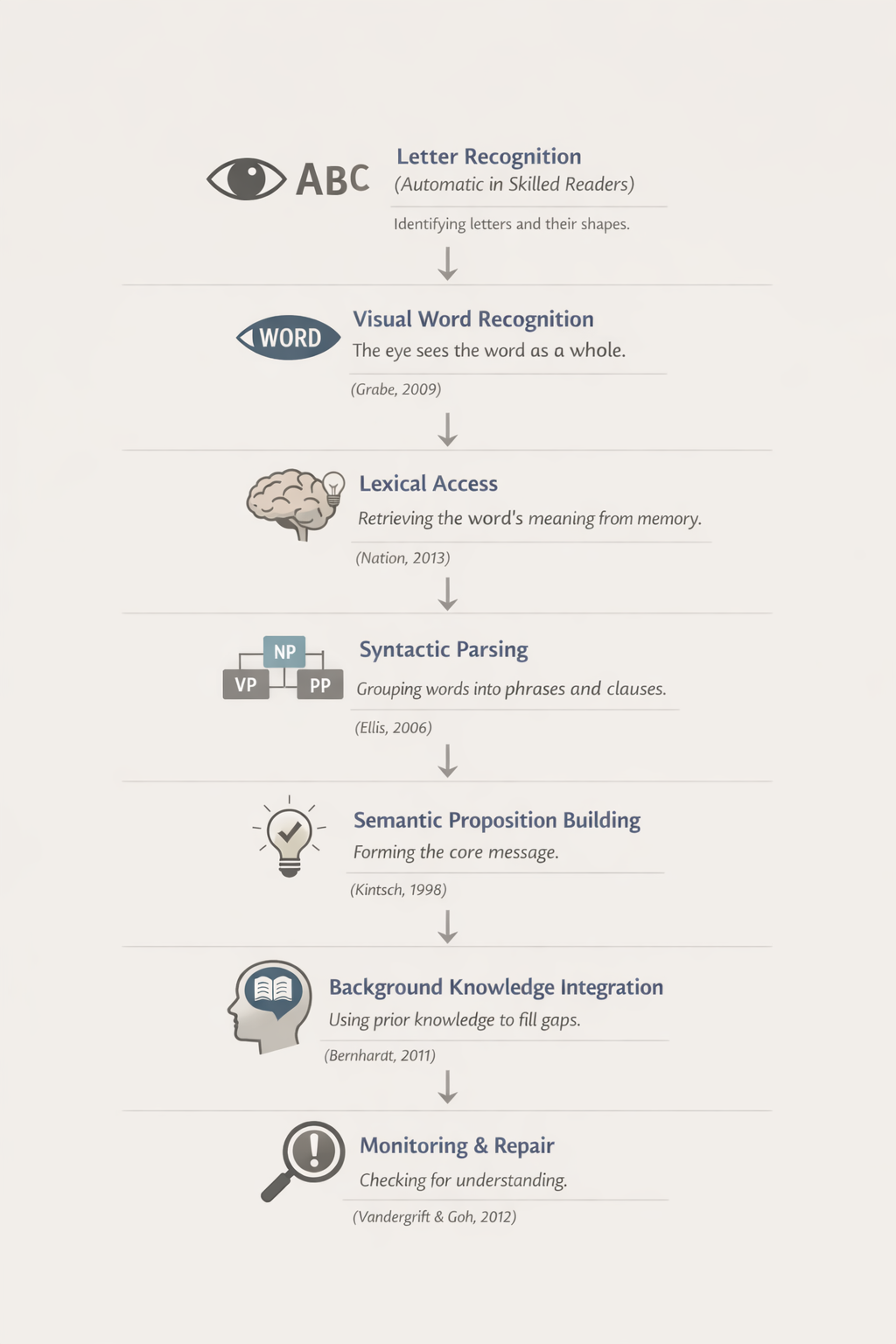
Reading comprehension unfolds as a layered process, and each layer comes with its own typical pitfall in the classroom. Here is a breakdown of the whole process, illustrated in figure 1 below.
The process begins with letter recognition, where the reader identifies written symbols; a common mistake here is assuming this is fully secure in all learners (especially in L2), when in fact shaky grapheme–phoneme knowledge can silently undermine everything that follows. When students read silently they subvocalize in their dominant language. Hence the importance of teaching effective and speedy sound-to-spelling correspondence.
Next comes visual word recognition, where words are recognised as whole units; teachers often overestimate how many words students can recognise automatically, leading to texts that exceed the 95–98% coverage threshold (Nation), and therefore overload processing often leading to errors and/or undermining the learner’s motivation to read.
Then we have lexical access, retrieving meaning from memory. This is, of course, the most important process, as 60-80% of the success at reading hinges on effective lexical retrieval. The typical error here is equating “I taught this word” with “it is retrievable under time pressure”, ignoring the need for repeated, varied encounters.
The process then moves to syntactic parsing, grouping words into meaningful phrases; a very common mistake is neglecting to train students to notice function words and word order, resulting in “word-by-word decoding” that distorts meaning.
After that comes semantic proposition building, where the reader constructs the core message; here, learners often latch onto isolated familiar words and guess the meaning without integrating the full sentence.
This is followed by background knowledge integration, where prior knowledge supports understanding; the danger is assuming students possess the cultural or contextual knowledge needed, which can lead to misinterpretation even when the language is understood.
Finally, in monitoring and repair, skilled readers check and adjust their understanding; the most frequent issue is that weaker learners simply do not notice breakdowns in comprehension, or lack strategies (e.g. rereading, waiting for the next clause) to recover meaning.
Figure 1- The reading process, as conceptualised by the leading researchers in the field.
If any of the first three stages are slow — reading collapses.
This is exactly what GCSE weaker readers experience.
10 Key Facts and Classroom Implications for GCSE Preparation
1) Fluency is more than speed
(Rasinski, 2012)
Fluent reading means:
- Correct words (accuracy)
- Smooth rhythm (flow)
- Words grouped together meaningfully (phrasing)
If students read fast but in the wrong places, they do not understand anything.
Example:
Poor: Je suis / alléauci / néma / hier soir
Better: Je suis allé / au cinéma / hier soir.
GCSE implication:
Teach students to read in “sense groups”—where the phrase makes meaning, not just noise.
Mini routine: Underline phrases, not words.
2) Slow decoding drains mental energy
(Samuels, 1979)
When students must stop to decode lots of words:
- Their working memory gets overloaded
- They lose the sentence meaning
- Confidence drops → anxiety increases → performance worsens
Example:
They decode malheureusement correctly, but by the time they finish, they’ve forgotten the sentence.
GCSE implication:
Focus fluency building on:
- high-frequency verbs
- connectives
- pronoun + verb chunks (e.g., je voudrais / j’ai pensé / il y avait)
Students cannot understand what they cannot process quickly.
3) High-frequency words drive reading
(Nation, 2013)
GCSE texts rely heavily on:
- Common verbs (être, avoir, faire, aller)
- Time and opinion structures (je pense que, c’était, il y a)
- Modals (on peut, il faut)
Teaching 200 hyper-frequent chunks >>> teaching 1,000 topic nouns.
GCSE implication:
Recycle the same useful expressions every week.
Do not chase word list inflation.
4) Guessing from context only works when load is low
(Laufer & Hulstijn, 2001)
Students can only infer unknown words when they:
- Already understand most of the sentence
- Have spare cognitive bandwidth
If the text is too dense → no inference happens → panic.
GCSE implication:
Provide just enough vocabulary first.
Then practise flow.
Then practise inference.
Never the other way around.
5) Phrasing is understanding
(Kuhn & Stahl, 2003)
Meaning is stored in chunks, not single words.
If students can identify:
- Relative clause boundaries
- Connective-based transitions
- Verb phrase groupings
Their comprehension skyrockets.
GCSE implication:
Teach students to mark chunk boundaries before reading questions.
This directly improves translation accuracy.
6) Repeated reading builds fluency
(Taguchi, 2016)
Reading the same short text multiple times:
- Reduces cognitive load
- Improves speed + comfort
- Increases comprehension without teaching new vocabulary
GCSE implication:
Use micro-texts (60–100 words) and re-read daily.
Variety of topics is less important than repeated exposure.
7) Oral reading supports silent reading
(Webb & Nation, 2017)
Speaking text aloud:
- Reinforces word recognition
- Stabilises chunk recall
- Builds rhythm and intonation → faster inner reading voice
GCSE implication:
Do choral reading, echo reading, paired reading — even in KS4.
It is not childish. It is neurologically efficient.
8) Fluency needs automatic grammar chunks
(Ellis, 2006)
Grammar must operate as pattern recognition, not rule consultation.
Example:
Students should recognise:
- negation blocks (ne … pas / n’a pas pu / ne voulait pas)
- tense frames (j’allais / je suis allé / j’irai)
- subordination triggers (parce que / quand / comme / si)
GCSE implication:
We teach grammar by repetition in meaningful contexts, not by abstract explanation.
9) Reading fluency strengthens listening
(Vandergrift & Goh, 2012)
When students already know a chunk visually, the brain recognises it faster in speech.
GCSE implication:
Use the same text:
- Read it
- Listen to it
- Summarise it
This improves Paper 1 + Paper 2 in one move.
10) Confidence is a fluency factor
(Zimmerman, 2000)
Students who feel they can read:
- Take more risks
- Try longer texts
- Persist under exam stress
Students who believe they “can’t read” → shut down instantly.
GCSE implication:
Use visible progress routines:
- Timed re-readings
- Confidence self-ratings
- “Look how much faster I am now” charts
Conclusion
Conclusion
Reading fluency is not a luxury skill—it is the foundation upon which comprehension, confidence, and exam success are built. When students’ decoding is slow, when chunk recognition is weak, or when grammatical patterns haven’t been automatised, everything else in the reading process strains to compensate. Working memory overloads, anxiety climbs, and performance drops. This isn’t a question of ability. It is a question of cognitive conditions.
The solution is not to give students harder texts sooner, nor to plough through long word lists, nor to train them to guess desperately from context. It is to build fluency deliberately and systematically: to recycle high-frequency chunks, to rehearse phrasing, to revisit micro-texts, to read aloud, to stabilise the grammar that actually drives meaning-making in real time. When we do this, we are not simply preparing students for a GCSE paper. We are giving them the tools to read with ease, to process language with confidence, and to experience the feeling—rare but transformative—of language becoming effortless.
 The Language Gym
You must be logged in to post a comment.