
Five compelling reasons to ‘over-emphasize’ pronunciation at Primary school (or in the early stages of acquisition)

1. To facilitate and ‘speed up’ the development of speaking proficiency – as Levelt’s model of first language speaking production posits (see picture 1, below), spoken output requires the orchestration of many complex processes, some more complex than others, but all placing serious demands on our brain, in terms of processing efficiency. The speech production process starts in the conceptualizer that generates ideas and ‘sends’ them to the formulator which translates them into meaningful and grammatically correct sentences; then the monitoring system steps in checking the output accuracy before any sentence is uttered; finally, the articulator will orchestrate the use of the larynx, pharynx and mouth organs, whilst the monitoring system will have been overseeing speech production every step of the way.This process becomes even harder when the ideas generated by the brain (in the conceptualizer) need to be translated into speech in real time in a foreign language; the whole process slows down considerably – hence the hesitations and pauses in our language learners, even the more advanced ones, when speaking in the target language; and their errors, due more to cognitive overload than to carelessness (unless by ‘carelessness’ we mean lack of effective monitoring).

Picture1–Levelt’s model of language production (adapted from: http://homepage.ntlworld.com)

 LEVELTa

The complexity of the language production process and the challenges of performing it in a foreign language mean that our Working Memory has to juggle simultaneously all of the tasks that speaking involves and may lead less expert L2 speakers, as already mentioned, to slow down production and make mistakes due to processing efficiency. Hence, foreign language learners need to learn to master the lower order skills, i.e. effective control over larynx, pharynx and articulators  as early as possible in order to ‘free up space’ in Working Memory for the kind of cognitive processing that happens in the conceptualizer and formulator; this will allow Working Memory to work more efficiently and focus only on the higher order skills, i.e.: the negotiation and creation of meaning, the transformation of meaning into the target language vocabulary, the application of grammar rules and self-monitoring.

Consequently, if we do not foster the automatization of pronunciation earlier on, through regular practice, we will delay our students’ development as fluent speakers. I have experienced this often in the past on taking on Year 7 classes which had been given very little pronunciation and/or speaking practice during two years of French/Spanish in Primary. Is this an argument against the Comprehensible Input hypothesis or The Silent way? Maybe.

2.Fossilization – On the other hand, if we plunge L2 learners into highly demanding oral tasks too soon, without focusing long and hard enough on pronunciation through easy and controlled tasks, their Working Memory will  have less monitoring space for sound articulation, as they will focus on the generation of meaning (i.e. what happens in picture 1’s conceptualizer) with potentially ‘disastrous’ consequences for  their pronunciation , in that they will resort to their first language phonological encoding to produce the target language sounds (language transfer). If pronunciation errors due to this issue will keep slipping into performance lesson after lesson, oral practice after oral practice, the mistakes will become fossilized and carried over to later stages of proficiency as fossilized errors tend to be impervious to correction.

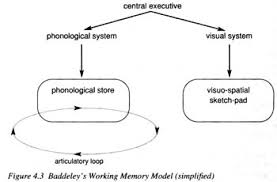
3.Phonological encoding affects recall – the more the learners become versed in the articulation of the target language sounds, the faster and more effective will be their retention of target language words in their Long-term memory (encoding). Why? This is because of the limitations of the ‘phonological encoding device’ in our brain’s Working Memory, i.e.: the articulatory loop (see picture 2 below). The articulatory loop has limited space (or channel capacity as psycholinguists call it), hence, if a word is not pronounced ‘fast enough’ the brain may not simply be able to encode it. The faster the articulatory loop ‘pronounces’ the target language the easier it will be (a) to memorize new words, especially longer and more challenging ones (from a phonological point of view) and (b) for Working Memory to process longer units of language (phrases/sentences) – as the less space words take on in the articulatory loop the greater the chances will be for longer words to be held in Working Memory at any one time. This speeds rehearsal in Working Memory and, consequently, uptake as well retrieval and production.

 Picture 2 – adapted from: http://homepage.ntlworld.com/vivian.c/SLA/STM.htm
 images (6)

4. Stigmatizing output may lead to simpler L2-input from L2-native speakers – I am not a fan of Stephen Krashen but I do admit that he has come up with some great ideas, such as Narrow Listening and the one that relates to the point I am about to make; the fact, that is, that if a beginner/intermediate learner has bad pronunciation, any L2 expert who will interact with him/her may actually send easier L2 linguistic input his/her way presuming that his/her level of proficiency and/or language aptitude – as signaled by his/her pronunciation – is low. This will have negative implications for  learning as if you are exposed to simplified input when you are at the early stages of language learning you may not learn much from it, not enough to bring you to next level, so to speak.

I tend to agree with Krashen on this one as I have seen this happen several times. And I will add, that often, in naturalistic environments, something even worse may occur: L2 native speakers may avoid engaging in conversations with L2 non-native speakers with poor pronunciation, for fear of not being understood or not understand and having going through the awkward process of asking the interlocutor to repeat.

 5. The critical age hypothesis – This applies only to the first years of Primary school, when children are 5 to 8 years old (or younger); the age, that is, where the sensory-motor skills which control the movement of the larynx, pharynx and the articulators are still ‘plastic’, i.e. amenable to modification. After that age, it seems that the child’s receptiveness to pronunciation modelling/instruction diminishes drastically. If this is true, as compelling recent research evidence suggests, it is at this age that learners must be focused on pronunciation and taught ‘phonics’, pretty much as happens in their first language lessons, through fun and engaging speaking activities, lots of singing, listening and computer assisted phonetic learning.
How to lessen the negative interference of our learners’ mother tongue on their target language pronunciation

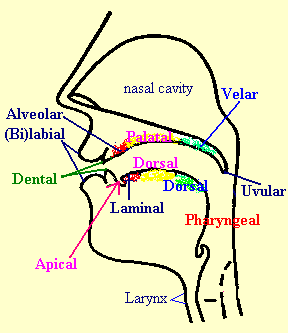
speechorgans

This article suggests teaching strategies based on sensory-motor research findings on bilingual speech aimed at reducing the impact of negative first language transfer on L2 target language speech. I will start by examining the process involved in language transfer and its consequence on the acquisition of L2 pronunciation in light of the latest recent research evidence. I shall then proceed to discuss the implications for the foreign language classroom.

Language Transfer

As we all know, our first language (or any other language we know for that matter) can cause interference in the process of acquiring a new one. We refer to this phenomenon as language transfer. Language transfer can be positive (i.e. facilitating learning or performance) or negative (i.e. impeding learning or performance) depending on the similarity/distance between the pre-existing language and the new language one is learning.

For instance, an English native speaker will experience negative transfer when it comes to pronouncing ‘P’ in Spanish ( negative transfer), because in this language the ‘p’ sound is a non-aspirated labial sound with a short onset time, whereas in English it is an aspirated sound with a relatively long onset time. On the other hand, a native speaker of Italian will have no problem with that sound as in his/her language it is pronounced in exactly the same way as it is in Spanish (positive transfer)

The main cognitive cause of Language Transfer is that when we learn a new language our brain uses our default language(s) – more than often our first language – as the starting point for the hypotheses we formulate to make sense of that language and/or as a communicative strategy to fill in any communicative gaps. In the specifics of foreign language pronunciation L2-learners transfer refers to the L2-learners’ application of their L1-phonological categories to decode and represent the foreign language sound system. This phenomenon is exacerbated by the fact that their motor commands (their control over larynx, phrarynx and articulators) have been conditioned by years and years of first language pronunciation. Hence, especially at the early stages, the ‘phonological distance’ (differences in pronunciation) between two languages will play a very important role in determining the accuracy of L2- learner pronunciation.

Negative transfer is more likely to cause error at pronunciation level, when speech occurs in contexts that are difficult to monitor or which require a greater mastery of motor skills. So, for instance, a beginner foreign language learner talking spontaneously in the context of uncontrolled communicative practice will have less time to monitor pronunciation because his/her Working Memory is focused on higher metacomponents such as meaning and grammar; in this kind of context, the target language sounds that s/he finds problematic will be seriously affected by the lack of monitoring. On the other hand, the pronunciation of those problematic sounds is usually much more accurate when they are uttered in isolation, as discrete items – just like a toddler’s blabbing – due to the absence of articulatory interference from the preceding and following sounds in the word/surrounding words and ease of monitoring.

Another way in which L1-transfer affects pronunciation pertains to the fact that skilled L1-readers are very familiar with the written form of their native language, and automatically decode every grapheme (i.e. letter or cluster of letters) they read by producing a phonological representation of the sound (Snow,2002). This means that, when a learner reads a foreign language word its Working Memory will automatically match that sound with a first language phonological representation (i.e. will pronounce it the first language way). Thus, even if that learner reads a given word aloud following the teacher’s rendition of it, the L1 phonological representation of that word in the learner’s Working Memory will cause interference, with negative consequences for learning.

Another less recent finding (Neufeld, 1979) suggests that second language learners’ pronunciation might benefit from a mute period – a period of intense auditory exposure to L2 before attempting to produce the sounds. In Neufeld (1979) students were trained on pronunciation of sounds from Inuktitut, a language to which they had not been exposed previously. The learning process involved intensive listening to the language, with no attempt at producing the sounds. They were later instructed to produce the sounds and their attempts were rated as being mostly native-like. Neufeld claimed that the silent period at the beginning helped the students to accurately produce the language later. Removing students’ own attempts allowed perception to remain more plastic, such that the L2 acoustic template is heard accurately before erroneous phonetic utterances in L2 become fossilised. Producing the sound too early, and therefore incorrectly, would have influenced this acoustic template and thus hindered their production.

A mute period may prove beneficial in enabling the learner to hear (and thus produce) subtly different phonetic features, new phoneme distinctions and unfamiliar sequences of stress patterns. One possibility is that an artificially induced mute period may protect the learner from using first language phonological categories to represent the L2 system, thus enabling higher levels of production performance and avoiding L1 transfer or interference.

The threats posed by L1- language transfer to the correct uptake of  L2- pronunciation at the earlier stages of language acquisition are worrying only if we are aiming at 100 % accuracy due to the risk of fossilization, a phenomenon which, as explained in a previous post refers to the automatisation – often impervious to correction – of L2 learner errors. In most L2- classroom settings, unless we are training future international spies, we will be mostly aiming at clear and intelligible pronunciation with the majority of our learners and near-native accent only with a few talented ones.

How can we reduce the negative impact of L2-transfer on pronunciation?

Firstly, in order to avoid interference from a grapheme’s L1 phonological encoding (see the point made five paragraphs ago) on first introducing a new word it would be preferable not to expose the learners to its written form – this would avoid automated representation of the native phonological representation in Working Memory. In other words, it is better to present it orally, first in association with an image and, after some listening practice, to show it in its written form.

Secondly, L2 learners should be exposed to as much listening as possible in the context of a mute period before engaging in oral activities. Realistically speaking, in a typical state school classroom setting the pre-communicative mute period cannot be that long; but the most important lesson to be learnt from Neufeld’s (1979) research is that students should not be thrown into unstructured communicative practice straight away after presenting the target lexical items. The listening activities the students should be engaged in during this mute period should not only include test-like listening comprehension activities in the traditional sense: e.g. question and answer or true or false which focus solely on meaning. They should also include bottom-up processing activities that focus students on pronunciation and intonation, which involve matching words to sounds,  such as jigsaw listening, gap-fills with options to choose from or , at the basic level, circling a word or phrase from a choice of three or four options.

Thirdly, the observation that students seem to perform challenging L2 phonemes (sounds) more effectively when pronounced in isolation would seem to suggest – according to Simmonds, Wise and Leech (2011) that a babbling phase in which students imitate the target speech sounds in isolation might also improve non-native pronunciation. This can be done at the beginning of a lesson as a warm-up activity – I have done it quite often and it can be fun, depending on how you pitch it to the student and how you conduct it. Or, it can be set a homework activity to be carried out at home for a few minutes, recorded and sent to the teacher for feedback (were the  target sounds performed correctly? What could be done to improve them, etc.)

Finally, students need lots of practice in the context of structured and unstructured communicative activities. Such activities should, in my view, be staged after:

(a) effective modelling of the correct pronunciation;

(b) the mute listening period discussed above;

(c) extensive vocabulary practice through plenty of deep processing learning activities (e.g. the work-outs found on www.language-gym.com);

(d) Structured oral activities (e.g. find someone who; structured surveys; role-plays with prompts; timed oral translations) preceded by sufficient preparation time

(e) Less structured oral activities (at a later stage) in which students, through interviews, simulations, improvised role-plays, etc. converse freely about the topic-in-hand.

Traditional pronunciation drills (audiolingual style), minimal pairs and tongue-twisters or any other activities focusing students on pronunciation can be thrown in at the pre-communicative stage, provided that they maintain students motivation high and the students understand and accept the rationale behind them.

In conclusion, it is up to teachers to decide – with the course requirement they teach on as well as the interest of the stakeholders in mind, of course – how much emphasis they should put on accuracy. What research shows is that plunging students into unstructured oral communicative practice straight away is not beneficial to the development of accurate pronunciation. The above strategies may not always be easy or practical to implement but are in my experience very effective in enhancing student grasp and execution of the target language pronunciation.