When Listening Feels Like a Blur: How to Train Learners to Hear Word Boundaries

Introduction

When beginner and intermediate students tell us that listening in the target language feels like “a blur of sound,” they are not exaggerating. Research has long shown that one of the biggest hurdles for developing listeners is simply recognising where one word ends and the next begins. In written text, boundaries are clear: spaces mark word separation. In speech, however, the listener must rely on phonological, prosodic, and contextual cues. For second language learners, this is a minefield.

The Illusion of “No Gaps”

Native speakers perceive words effortlessly, but not because speech offers obvious gaps. In fact, continuous speech is acoustically seamless. Cutler and Butterfield (1992) demonstrated that in English, there are almost no reliable pauses between words. Learners must infer boundaries based on cues such as stress, rhythm, and coarticulation patterns.

For beginners, these cues are unfamiliar. Goh (2000) found that novice learners often described speech as “one long word,” unable to separate even familiar lexical items. This is not a vocabulary issue per se; it is a segmentation problem. Even when students “know” the word, they cannot recognise it in connected speech.

Why Beginners Struggle More

Several factors converge to make word-boundary recognition especially difficult for beginner-to-intermediate learners:

  1. Coarticulation and Reduction – fluent speech erases clear markers through assimilation and weak forms (going to → gonna). (Field, 2008)
  2. Different Prosodic Systems – segmentation cues differ across languages; L1 prosody often misleads learners (Vandergrift & Goh, 2012).
  3. Cognitive Overload – beginners’ working memory collapses under the strain of decoding + boundary detection simultaneously.
  4. Lexical Knowledge Thresholds – below ~95% coverage, learners cannot use top-down knowledge to assist segmentation (Stæhr, 2009).
  5. Lack of Strategy Awareness – learners often listen passively, without techniques to catch boundaries (Graham, 2006).

What This Means for Teachers

Segmentation must be taught explicitly. Below are eight activities (from the many included in our 2019 book, Breaking the Sound Barrier: Teaching learners how to listen) that target boundary recognition directly, each with a pedagogical rationale grounded in research.

1. Word Count Listening (Field, 2008)

Learners hear a short sentence (4–8 words). Their task is to guess how many words they heard.

Rationale: Trains attention to prosodic cues (stress, pauses, rhythm) rather than meaning. Field (2008) notes that even when learners cannot recognise words, they can begin to “hear” boundaries as units of rhythm, building sensitivity to segmentation patterns.

2. Chunk Dictation (Micro-Dictogloss) (Field, 2008)

Learners transcribe only short bursts (3–5 words), not whole passages.

Rationale: By focusing on micro-chunks, learners sharpen their bottom-up decoding skills. Goh (2000) showed that reconstructing short phrases helps learners perceive coarticulated forms and trains the phonological loop of working memory without overwhelming it.

3. Spot the Intruder (Conti and Smith, 2019)

Learners see a transcript with an extra word not in the recording. They must detect and cross out the “intruder.”

Rationale: Forces learners to synchronise sound with text, noticing what is not there. This builds precision and discourages over-reliance on top-down guessing. It cultivates a match-mismatch awareness central to Schmidt’s (1990) noticing hypothesis.

4. Spot the Missing Word (Conti and Smith, 2019)

The transcript omits a word that is in the recording. Learners listen and fill in the blank.

Rationale: Trains learners to notice weak and unstressed words (e.g. at, of, to) that often vanish in connected speech. Research shows that learners tend to skip function words (Field, 2008). This task makes those invisible boundaries audible.

5. Break the Flow (Conti and Smith, 2019)

Learners are given transcripts where common reductions (gonna, wanna, lemme) appear. They listen and identify them in fluent speech.

Rationale: Cauldwell (2013) calls this exposing learners to the “messy” reality of authentic input. Learners realise that “known” words do not always sound like their dictionary form. This training helps them map phonological variants to mental lexicon entries and forces them to track segmentation in speech that does not align with orthographic expectations.

6. Formulaic Sequence Training (Wray, 2002)

Learners practise listening for and repeating chunks such as at the end of the, il y a, ¿qué tal?.

Rationale: Wray (2002) shows that processing formulaic sequences as units reduces cognitive load and supports segmentation. Learners “hear” a whole chunk rather than trying to cut it into individual words, which is how natives process speech fluently.

7. Write It As You Hear It (Vandergrift, 2007)

Learners write down a sentence exactly as they perceive it on first hearing, even if spelling or segmentation is wrong. Then they compare their version to the correct transcript.

Rationale: This activity externalises the learner’s perceptual errors — they see where they failed to hear a boundary (e.g. writing “Idontknow” instead of “I don’t know”). Vandergrift (2007) argues that reflecting on listening processes is as important as practice itself; here, the mismatch fosters awareness of weak points in segmentation.

8. Guess what comes next (Conti & Smith, 2019)

The teacher pauses the recording just before a likely word boundary. Learners predict the next word or phrase, then listen to confirm.

Rationale: This combines bottom-up segmentation with anticipatory processing. Learners practise recognising where one unit ends while also engaging top-down knowledge to guess what might follow. Vandergrift & Goh (2012) highlight this as a way to integrate segmentation skills with prediction, two core processes of fluent listening.

9. Using Sentence Builders Orally

Sentence builders, when used orally rather than purely visually, offer an additional route into segmentation training. Typically, teachers use them to scaffold speaking and writing, but they can be equally effective in developing listening, especially at the beginner and intermediate stages.

Why it helps:

  1. Controlled, high-frequency input – Sentence builders recycle a limited set of words and structures. Hearing these in oral practice exposes learners repeatedly to the same lexical items in connected speech, helping them recognise recurring word boundaries more reliably.
  2. Clear-to-blurred progression – In the early stages, teachers articulate model sentences slowly and clearly from the builder. Gradually, speed and natural reductions can be introduced, mirroring how authentic listening becomes less “coursebook-like” over time.
  3. Form-meaning mapping in context – Because sentence builders generate meaningful sentences, learners don’t just hear isolated words but see how boundaries work within authentic syntax.
  4. Dual coding of visual and aural channels – When sentence builders are projected while the teacher models orally, learners receive visual segmentation cues (the spaces and blocks on the builder) aligned with the aural stream.
  5. From scaffold to autonomy – Oral sentence builder work eventually transitions into learners generating their own sentences at speed, but only once perception has stabilised.

Example classroom flow (beginner-safe):

  1. The teacher models 5–6 sentences (one at a time, slowly) from the sentence builder while the students write their meanings on their mini whiteboards.
  2. Then, the teacher rereads each sentence omitting a word each time (Spot the Missing Detail).
  3. Next, the teacher starts each sentence but pauses halfway through to play Pause and Predict.
  4. Now, the sentence builder is removed and a Break the Flow activity is played, forcing learners to catch boundaries without visual scaffolding.
  5. Finally, a delayed dictation can be staged, consolidating perception and reinforcing segmentation.

This flow avoids pushing learners into premature choral repetition. Instead, it treats the sentence builder primarily as a listening scaffold, gradually training learners to segment and notice before any attempt at oral production.

Table 1 – Suggested Segmentation-focused activities

ActivityTargeted SkillWhy It Works (Pedagogical Rationale)
1. Word Count ListeningSensitivity to prosodic boundariesForces learners to attend to rhythm, stress, and segmentation cues instead of meaning.
2. Chunk Dictation (Micro-Dictogloss)Short-span segmentationFocuses on short bursts, helping learners process coarticulation without overload.
3. Spot the IntruderSound–text synchronisationNoticing mismatches sharpens segmentation and discourages top-down guessing.
4. Spot the Missing WordDetecting weak/unstressed wordsTrains learners to notice reduced function words that often disappear in connected speech.
5. Break the FlowRecognition of reduced formsConfronts learners with “messy” authentic reductions and builds tolerance for non-dictionary pronunciations.
6. Formulaic Sequence TrainingChunk-based processingReduces cognitive load: learners hear multi-word units rather than isolated words.
7. Write It As You Hear ItAwareness of segmentation errorsMakes learners’ misperceptions visible, supporting reflection and correction.
8. Pause and PredictAnticipatory segmentationCombines bottom-up boundary recognition with top-down prediction.
9. Oral Sentence Builder WorkScaffolded segmentation in contextProvides high-frequency, visually scaffolded input before free listening; aligns visual and aural cues.

Conclusion

For beginner-to-intermediate learners, listening is not only about vocabulary or grammar. It is also about learning to hear the spaces that aren’t really there. The difficulty of word-boundary recognition lies at the intersection of phonology, prosody, and cognitive load.

If teachers systematically target this skill — through word-count listening, micro-dictogloss, intruder/missing word spotting, Break the Flow training, formulaic chunk practice, write-it-as-you-hear-it diagnostics, pause-and-predict drills, and oral sentence builder work — learners begin to perceive the rhythm and segmentation cues that natives take for granted.

As Field (2008) reminds us, listening should be taught, not tested. And for many learners, that teaching begins not with comprehension questions, but with training the ear to hear where one word ends and the next begins.

References

  • Cauldwell, R. (2013). Phonology for Listening: Teaching the Stream of Speech. Birmingham: Speech in Action.
  • Conti, G., & Smith, S. (2019). Breaking the Sound Barrier: Teaching Learners How to Listen. London: Independently Published.
  • Cutler, A., & Butterfield, S. (1992). Rhythmic cues to speech segmentation: Evidence from juncture misperception. Journal of Memory and Language, 31(2), 218–236.
  • Field, J. (2008). Listening in the Language Classroom. Cambridge: Cambridge University Press.
  • Goh, C. (2000). A cognitive perspective on language learners’ listening comprehension problems. System, 28(1), 55–75.
  • Graham, S. (2006). Listening comprehension: The learners’ perspective. System, 34(2), 165–182.
  • Nation, I. S. P. (2001). Learning Vocabulary in Another Language. Cambridge: Cambridge University Press.
  • Schmidt, R. (1990). The role of consciousness in second language learning. Applied Linguistics, 11(2), 129–158.
  • Stæhr, L. S. (2009). Vocabulary knowledge and advanced listening comprehension in English as a foreign language. Studies in Second Language Acquisition, 31(4), 577–607.
  • Vandergrift, L. (2007). Recent developments in second language listening comprehension research. Language Teaching, 40(3), 191–210.
  • Vandergrift, L., & Goh, C. (2012). Teaching and Learning Second Language Listening: Metacognition in Action. New York: Routledge.
  • Wray, A. (2002). Formulaic Language and the Lexicon. Cambridge: Cambridge University Press.

Teaching Listening Strategies – When It Actually Works

Introduction

If there is one mantra I always repeat in every single CPD session of mine, it is that listening is the neglected skill. Many students find it opaque, many teachers often dread teaching it, and too many GCSE classes still treat it as a “test of memory under duress.” For several decades, strategy instruction has been hailed as the silver bullet—but is it?

Whilst research is now fairly consistent in evudencing that teaching learners how to plan, monitor, infer, and evaluate (PME) during listening tasks does improve comprehension, there’s an important catch—it only works if it is sustained over a long period of time), carefully structured, and balanced with language growth (i.e. the students have accrued a sizeable L2 vocabulary and substantive mastery of the L2 grammar). Below, I unpack what that actually means in practice.

Duration: the Long Game, Not the Quick Fix

One of the most common mistakes I have observed over the years in KS3 and KS4 classrooms is treating training in listening strategies as a one-off lesson or a half-term experiment. We know from studies such as Graham & Macaro (2008) that significant gains only show after a 10–12 week well-structured programme. By the same token, Liu, Zhang & Vandergrift’s (2024) meta-analysis showed that longer interventions inequivocably outperformed shorter ones – the effect sizes moving from “small” to “moderate-to-large” when the programme ran for a full term or more.

It is a bit like going to the gym: a few session won’t build much muscle. To embed metacognitive listening habits in the students’ modus operandi, students require repeated and sustained practice in the planning–monitoring–inferencing–evaluation ( PME) cycle until it becomes second nature.

Consistency: From Occasional Tips to Embedded Routines

Another common trap I have observed over the year is the “strategy tip of the week” approach—helpful reminders like “listen for cognates”, “skip what you don’t understand”, “search for key words”, etc. These are surface-level hints which may yield short-term gains, but not deep training which brings about durable change. What works is consistency: every listening lesson should include the same reflective prompts, nudging students through the process of predicting, checking, and evaluating. In my experience, this is rarely done. This consistency builds long-lasting metacognitive muscle. When students can anticipate the teacher asking “What did you predict you’d hear?” or “How did you verify that answer?”, then you know that they are beginning to internalise the target strategy sequence rather than seeing it as a bolt-on exercise of little consequence.

Structure: Scaffolding, Gradual Release, Feedback

In my experience, the most effective strategy training occurs when it is carefully thought out in terms of scaffolding. In the above-mentioned Graham & Macaro’s study, for instance, high-scaffold classes initially made greater progress: (1) first, the teachers modelled the steps ; (2) they then prompted the learners to articulate what they were doing; (3) they provided practice with the support of strategy lists; (4) finally, they provided feedback on both process and outcome. Later, a “low-scaffold” group which had not been initially supported and was consequently doing less well, caught up precisely because they were evebtually pushed to regulate themselves.

This suggests that effective instruction must start with heavy scaffolding but must gradually release responsibility in order to result in autonomous use. Without structure, weaker listeners flounder; without release, stronger listeners stagnate. The art is in balancing both.

The Graham & Macaro (2008) Programme: What It Was, and Where It Came From

This study is often cited by strategy training advocates but is less frequently explained. Hence, it may be worth pausing on the details of what it involved. Conducted with 107 lower-intermediate learners of French in English secondary schools, the programme lasted 10 weeks and involved a highly structured cycle of planning, monitoring, inferencing, verification, and evaluation.

  • Foundation: the programme was based on work of Larry Vandergrift (1997, 2003), who developed the metacognitive sequence model for listening underlying the intervention, and on O’Malley & Chamot’s (1990) research into learning strategies.
  • Two versions: One group received high-scaffold training, with the teachers explicitly modelling and guiding student reflection. Another group received low-scaffold training, with prompts but less teacher input.
  • Findings: Both groups outperformed the control group, with statistically significant effects on listening comprehension at both immediate post-test and six months later. It is notable that self-efficacy in listening improved, and the delayed post-test showed that the “low-scaffold” group actually surpassed the high-scaffold group—suggesting that initial support followed by learner independence is key.

This study is one of the most credible classroom-based demonstrations that listening strategy training can work in real secondary school conditions, not just in small-scale experimental set-ups.

Vocabulary and Grammar: The Hidden Bottleneck

What the advocates of strategy training often neglect to point out is that it cannot compensate for students who simply do not recognise enough words, collocations, or grammatical cues. John Field (2008) and Vandergrift & Goh (2012) both emphasise that listening success is severely constrained by bottom-up decoding. At KS3 and KS4, this means that vocabulary teaching, phonics, and grammatical automatisation are not “add-ons” but essential prerequisites without which listening comprehension fails. Learners need sufficient lexical coverage (at least 95%) and enough grammatical familiarity to parse clause boundaries and verb endings in real time (2 seconds per sentence!). Otherwise, strategies risk becoming merely elaborate ways of guessing.

How Many Words Are Enough?

A key question is: how many words does a learner need to know before listening strategies can genuinely help?

Much research in L2 vocabulary suggests that 95% lexical coverage of a text is the minimum required for reasonable comprehension, with 98% coverage allowing for comfortable, confident understanding (Nation, 2006; Stæhr, 2009).

In practice, this means that learners need at least 2,000–3,000 high-frequency word families in the target language for strategy training to be truly beneficial. Below that threshold, the sheer density of unknown words makes it very arduous if not impossible to apply planning, monitoring and inferencing effectively—because there is simply too little known language to work with.

For KS3 and KS4 learners, this has two implications:

  • Vocabulary building isn’t optional – it’s a must. Without it, strategy training collapses under the weight of unknown lexis.
  • Strategy gains are enhanced by lexical development. The more words one knows, the more powerful strategies like inferencing or verification become.

In short: listening strategy training is no substitute for vocabulary knowledge; it is a way to leverage that knowledge more effectively.

So, When Does It Work?

Pulling the threads together, listening strategy instruction works best when:

  • It lasts long enough (a term or more) to form habits.
  • It is consistent across lessons, not sporadic.
  • It is scaffolded, modelled, and then gradually released.
  • It runs in tandem with vocabulary, phonics, and grammar growth.
  • It is introduced once learners have a critical mass of high-frequency words.

In other words, strategy training is not a magic fix for listening difficulties; it is a multiplier. It amplifies what students can already do with their lexicon and grammar. It also builds confidence: learners report feeling less like “victims of the tape” and more like active problem-solvers.

Conclusion

As teachers, we owe it to our students to move listening beyond “press play and pray.” Strategy instruction is powerful, but only when is is carried out as part of interventions which are well-planned and highly scaffoled, not merely one-off sessions or sporadic reminders or tips . If we commit to that, we turn listening from the most feared skill into one of the most empowering.

References

  • Graham, S. & Macaro, E. (2008). Strategy instruction in listening for lower-intermediate learners of French. Language Learning, 58(4), 747–783.
  • Liu, Y., Zhang, J. & Vandergrift, L. (2024). A meta-analysis of listening strategy instruction effects. Language Teaching Research, advance online publication.
  • O’Malley, J. M. & Chamot, A. U. (1990). Learning Strategies in Second Language Acquisition. Cambridge: CUP.
  • Vandergrift, L. (1997). The comprehension strategies of second language (French) listeners. Foreign Language Annals, 30(3), 387–409.
  • Vandergrift, L. (2003). Orchestrating strategy use: Toward a model of the skilled second language listener. Language Learning, 53(3), 463–496.
  • Vandergrift, L. & Goh, C. C. M. (2012). Teaching and Learning Second Language Listening: Metacognition in Action. New York: Routledge.
  • Field, J. (2008). Listening in the Language Classroom. Cambridge: CUP.
  • Nation, I. S. P. (2006). How large a vocabulary is needed for reading and listening? Canadian Modern Language Review, 63(1), 59–82.
  • Stæhr, L. S. (2009). Vocabulary knowledge and advanced listening comprehension in English as a foreign language. Studies in Second Language Acquisition, 31(4), 577–607.

What Research Says About Why Students Struggle with Listening

Introduction

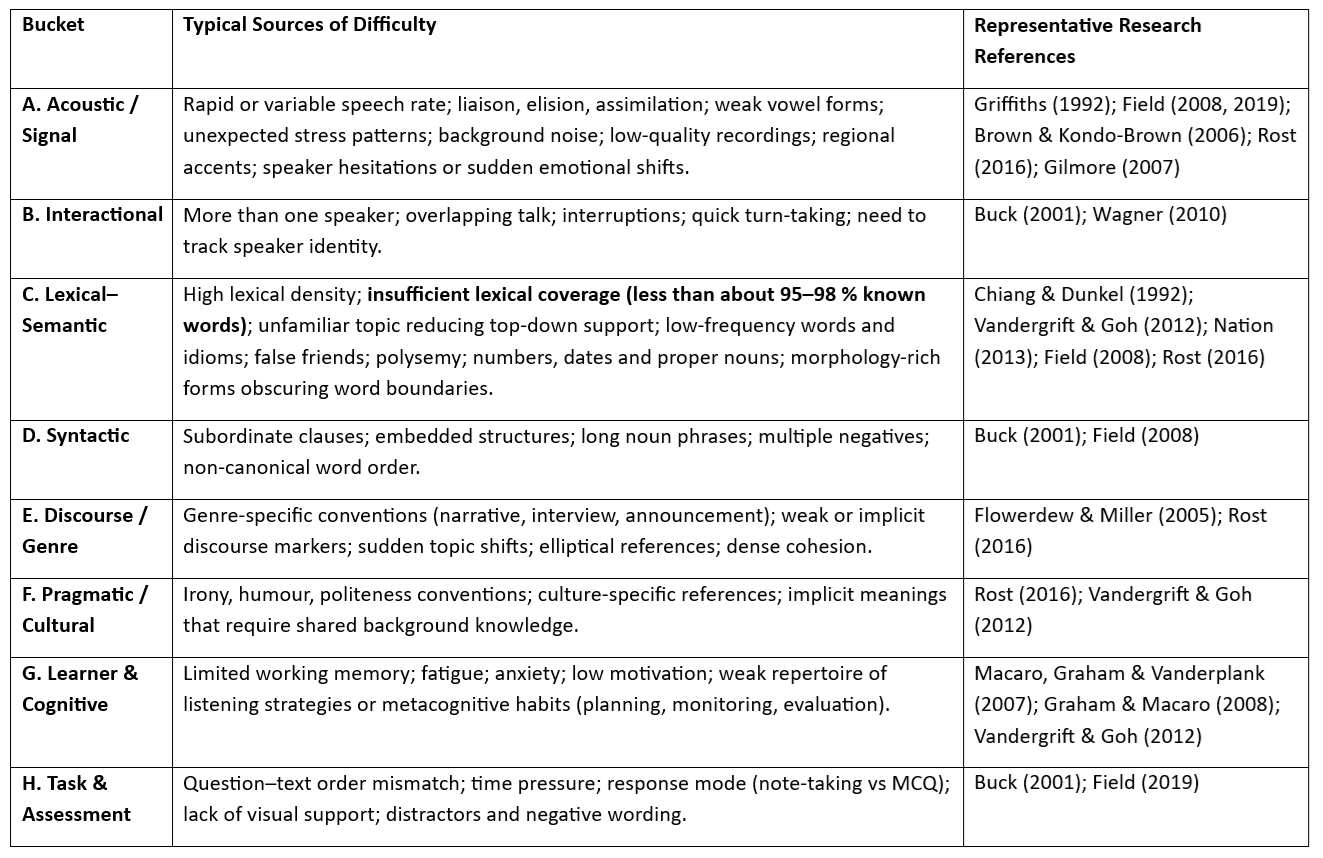
Listening is often rated by learners as the most difficult of the four language skills. Unlike reading, where the text remains on the page, listening is fast, transient, and offers no rewind button in real time. John Field (Listening in the Language Classroom, 2008) stresses that the fleeting nature of spoken input places unusual demands on the learner’s short-term and working memory. Research into learner perceptions (e.g. Goh, 2000; Graham, 2006; Vandergrift & Goh, 2012) consistently identifies clusters of recurring problems. Below, I detail ten of the most significant, with expanded commentary.

1. Speed of Delivery

A recurrent complaint in learner diaries (Goh, 2000) is that speech simply comes “too fast.” The problem is not only raw speed but the processing gap: learners are unable to decode sounds, map them onto lexical items, and integrate them into meaning quickly enough. Field (2008) distinguishes between decoding speed (turning sound into words) and integration speed (slotting words into syntactic and semantic frames). Advanced learners can automatise both processes; beginners cannot. Crucially, research on speech rate adjustment (Griffiths, 1992) suggests that moderately slowed speech benefits beginners, but artificially slow speech (common in coursebook recordings) creates a false sense of security. Learners need carefully scaffolded exposure that moves gradually toward natural pace — not an abrupt jump into “real-world” speed at A1.

2. Lack of Contextual Knowledge

Listening comprehension is not purely bottom-up; it is deeply dependent on top-down processing. Anderson and Lynch (Listening, 1988) showed that listeners draw heavily on schema knowledge (topic familiarity, cultural frames) to predict and interpret input. When students lack this background, comprehension deteriorates sharply. Goh (2000) reported learners describing listening as “guessing in the dark” when the topic was unfamiliar. Vandergrift & Goh (2012) argue that activating prior knowledge reduces processing load, freeing working memory to focus on decoding. Research on content schemata (Chiang & Dunkel, 1992) confirms that students score higher on listening tasks when the topic is culturally or contextually familiar.

3. Limited Vocabulary Knowledge

Vocabulary size is one of the strongest predictors of listening success. Nation (2001) suggests that learners need at least 95% lexical coverage for reasonable comprehension, while more recent work by van Zeeland & Schmitt (2013) puts the threshold closer to 98% for listening. Learners often fail not only because they lack the words but because they fail to recognise them in their spoken forms — reduced, stressed, or blended with neighbours. Graham (2006) highlights how many learners complain that “I knew the word on paper but didn’t catch it in listening.” Research on phonological mapping (Field, 2008) reinforces this: lexical knowledge must be linked to phonological forms, not just orthographic ones.

4. Parsing Long or Complex Sentences

Spoken language is not always broken into short, textbook-friendly clauses. Real input often contains multiple subordinate clauses, embedded structures, and left-branching sentences. This creates what Field (2008) calls a parsing problem: learners hold onto incomplete fragments in working memory, waiting for resolution, but lose the thread when the sentence extends too long. Gilmore (2007), in his work on authentic listening, found that learners often stumble not on single words but on sentence organisation — especially when discourse markers are absent. This highlights the importance of syntactic awareness and real input beyond the simplified scripts of pedagogical listening texts.

5. Recognising Word Boundaries

Unlike written language, speech lacks neat gaps between words. Learners must rely on phonotactic cues, stress patterns, and intonation to segment the stream. Vandergrift & Goh (2012) stress that this is one of the earliest hurdles in listening development: without segmentation, even known words go unrecognised. Goh (2000) reports that learners often describe listening as “a blur of sound” rather than distinct words. Field (2008) underlines that segmentation is language-specific: French listeners, for instance, often fail to hear English stressed syllables as cues to boundaries. Research into “listening training” (Cutler & Norris, 1988) suggests that explicit practice in identifying segmentation cues can improve perception, but this is rarely built into curricula.

6. Memory Overload

The ephemeral nature of speech places unusual strain on working memory. Listeners must retain earlier words, decode new ones, and integrate meaning almost simultaneously. Field (2008) explains that this explains why learners often catch the beginning of a sentence but “blank out” on the rest. Baddeley’s (2000) model of working memory is highly relevant here: the phonological loop can only hold about two seconds of speech, which means that if decoding is slow, earlier items decay before integration. Vandergrift (2007) found that successful listeners employ strategies to “chunk” meaning and reduce overload, whereas less successful ones try to hang onto words verbatim, quickly exceeding capacity.

7. Unfamiliar Discourse Markers

Discourse markers (well, you know, actually, on the other hand) play a vital role in signalling structure and speaker intention. Yet learners often fail to notice or interpret them. Field (2008) points out that these items are usually de-emphasised in teaching but are critical to discourse organisation. Vandergrift & Goh (2012) argue that missing discourse markers leads to comprehension that feels fragmented: students fail to track contrasts, digressions, or emphases. Tyler & Bro (1992) found that learners’ listening improved when they were explicitly taught to recognise markers as “signposts.” This highlights the pragmatic dimension of listening, often underrepresented in curricula.

8. Background Noise and Overlapping Speech

Unlike the classroom, real-world listening rarely occurs in silence. Graham (2006) reported that learners frequently “gave up” on listening tasks when background noise or poor sound quality interfered. Research in applied psycholinguistics shows that L2 listeners are more vulnerable to noise than native speakers because their processing demands are already heavier (Rost, 2011). Authentic settings — restaurants, stations, group conversations — often involve overlapping talk, and students unaccustomed to this struggle even more. Field (2008) stresses the importance of exposing learners to a range of listening environments rather than the pristine clarity of coursebook audio.

9. Concentration and Anxiety

Listening is cognitively demanding, but affective factors amplify the difficulty. Graham (2006) documented that test anxiety made students hyper-focused on “not missing words,” which paradoxically caused them to lose the overall thread. Goh (2000) notes that once students feel they have lost the meaning, panic sets in, leading to a downward spiral of attention loss. Vandergrift (2007) found that more successful listeners tolerate ambiguity and recover focus, whereas weaker listeners allow anxiety to dominate. This highlights the need to address listening not only as a cognitive skill but as an emotional one — requiring training in resilience and ambiguity tolerance.

10. Lack of Strategic Knowledge

Perhaps the most preventable problem is the absence of listening strategy awareness. Vandergrift & Goh (2012) emphasise that without strategies like predicting content, listening for gist, or selectively focusing, learners approach listening as passive reception. Goh (2008) showed that strategy instruction can significantly improve learner outcomes, particularly when combined with metacognitive reflection. Field (2008) warns that without this, learners fall into bottom-up traps, trying to decode word by word — a recipe for overload and frustration.

Table 1 – Summary table

DifficultyDescriptionResearch References
1. Speed of DeliveryLearners cannot keep up with the rapid pace of natural speech, losing meaning before processing is complete.Goh (2000); Field (2008)
2. Lack of Contextual KnowledgeWhen learners lack background knowledge of the topic, situation, or culture, they cannot make inferences or fill gaps in understanding.Vandergrift & Goh (2012); Goh (2000)
3. Limited Vocabulary KnowledgeUnfamiliar words and failure to recognise known words in spoken form block comprehension.Graham (2006); Goh (2000)
4. Parsing Long/Complex SentencesLearners lose track in long utterances with subordination or embedded clauses.Field (2008)
5. Recognising Word BoundariesContinuous speech lacks clear separation; learners struggle to segment into words.Goh (2000); Vandergrift & Goh (2012)
6. Memory OverloadTransient nature of speech strains working memory; earlier chunks are forgotten while processing new input.Field (2008)
7. Unfamiliar Discourse MarkersLearners fail to notice or understand discourse markers (e.g., well, you know, actually), missing cues about structure, contrast, or emphasis.Field (2008); Vandergrift & Goh (2012)
8. Background Noise & Overlapping SpeechNoise, poor audio, or multiple speakers reduce clarity and processing ability.Graham (2006)
9. Concentration & AnxietyLearners lose focus easily; stress and test anxiety make listening harder.Graham (2006); Goh (2000)
10. Lack of Strategic KnowledgeLearners often lack strategies (e.g., predicting, gist listening, tolerating ambiguity), focusing on detail instead of meaning.Vandergrift & Goh (2012)

Implications for Teaching: Research-Informed Strategies

1. Speed of Delivery

  • Beginners benefit from graded adjustments of speed — not artificially slow “robotic” speech, but natural recordings replayed with scaffolds (Griffiths, 1992).
  • Use listening cycles (Field, 2008): first for gist, second for detail, third with transcript support. This reduces the shock of pace.
  • Teachers can model “shadowing” and “choral repetition” to train learners’ processing speed, gradually aligning their output tempo with input.

2. Lack of Contextual Knowledge

  • Pre-listening schema activation is not fluff. Studies (Chiang & Dunkel, 1992) show that even short topic previews raise comprehension.
  • Build cultural literacy into lessons: for example, before listening to a train announcement, learners explore how such announcements are structured in the target culture.
  • Task design: compare “cold” listening (no prep) to “scaffolded” listening (schema activated) so learners themselves see the difference.

3. Limited Vocabulary Knowledge

This is the biggest bottleneck for listening comprehension.

  • Nation (2001) argues that 95–98% lexical coverage is needed for effective listening. This means vocabulary learning must be integrated into listening practice rather than left to reading.
  • Lexical segmentation tasks: learners highlight unknown words in transcripts after listening and then re-listen focusing only on those words.
  • Noticing reduced forms: E.g., training learners to recognise gonna, wanna, didja. Field (2008) stresses that without phonological mapping, vocabulary remains inert.
  • Recycling through narrow listening: several recordings on the same topic re-expose learners to a cluster of words in varied contexts (Chang, 2011).
  • Post-listening lexis work: learners categorise new words by collocations, affixes, or semantic fields, and then re-listen to deepen form-meaning mapping.

4. Parsing Long or Complex Sentences

  • Use text reconstruction tasks: learners reorder jumbled clauses after hearing the sentence.
  • Chunking practice: learners listen for pauses and mark intonation breaks, training awareness of clause boundaries.
  • Focused listening on sentence stress and intonation helps learners follow main clauses and subordinate structures (Gilmore, 2007).

5. Recognising Word Boundaries

  • Explicitly train segmentation. For example:
    • Play short stretches and ask learners to identify word counts.
    • Use minimal pairs to highlight likely mis-segmentation (an aim / a name).
  • Practice dictation and partial dictation: not for testing but for training learners to catch boundaries.
  • Use shadowing to force continuous tracking of boundaries.

6. Memory Overload

  • Adopt multi-pass listening: gist → detail → transcript (Field, 2008). This reduces strain on working memory.
  • Encourage note-taking strategies: symbols, arrows, diagrams rather than verbatim transcription. Vandergrift (2007) showed that effective listeners chunk and annotate rather than record everything.
  • Use pause-and-predict tasks: stop audio midstream, learners anticipate next phrase. This lightens memory load by promoting forward processing.

7. Unfamiliar Discourse Markers

  • Explicitly teach markers as “traffic signs” for listening. Tyler & Bro (1992) found instruction improved coherence perception.
  • Build noticing tasks: learners listen to a text, highlight discourse markers in transcript, then discuss their functions.
  • Contrastive tasks: learners compare versions of texts with vs. without markers to see the difference in coherence.

8. Background Noise and Overlapping Speech

  • Start with “clean” recordings, then gradually add noise (Field, 2008 calls this “noise inoculation”).
  • Use split listening tasks: one group listens to Speaker A, another to Speaker B in overlapping dialogues.
  • Classroom simulation: play background café noise under a recording and train learners to extract gist.

9. Concentration and Anxiety

  • Teach ambiguity tolerance: structured reflection on what can be ignored without losing the main message (Vandergrift, 2007).
  • Use confidence rating scales after tasks (Graham, 2006), letting learners reflect on their comprehension beliefs versus actual performance.
  • Lower affective filter: pre-task reassurance (“you won’t understand every word”) reduces panic-driven breakdowns (Krashen, 1982; still supported in anxiety studies).

10. Lack of Strategic Knowledge

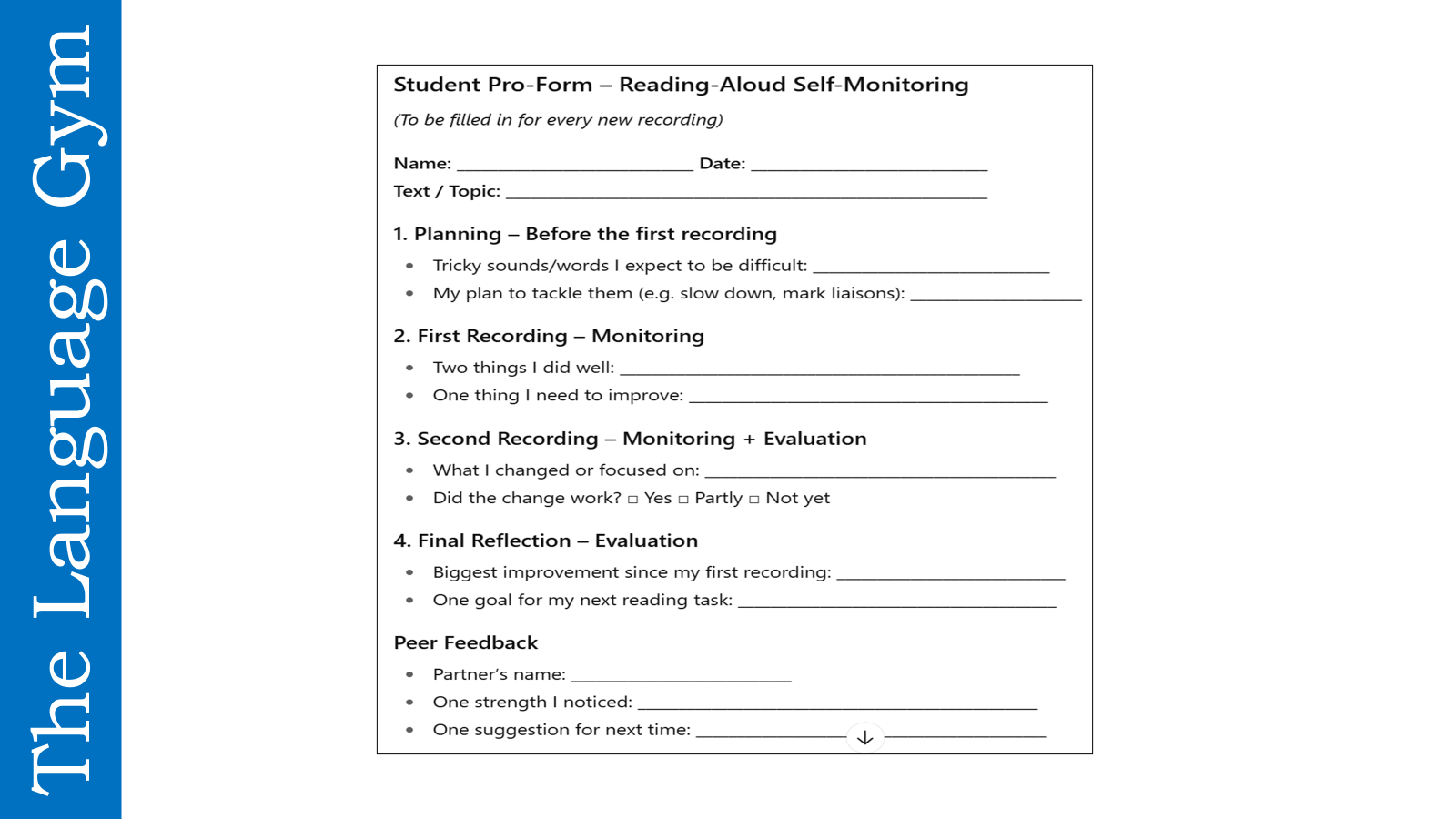
  • Integrate metacognitive cycles (Vandergrift & Tafaghodtari, 2010): predict → listen → verify → reflect. Learners explicitly discuss what strategies they used and how effective they were.
  • Train selective listening: focusing only on one category (dates, numbers, adjectives) in a text, to break the “everything at once” trap.
  • Promote self-regulation: learners set listening goals (e.g., “I will focus on noticing verbs today”) and reflect post-task.

Why Vocabulary Deserves Centre Stage

Let me emphasise this again: vocabulary is not a side issue but the linchpin of listening comprehension. Van Zeeland & Schmitt (2013) show that learners need recognition of 98% of tokens for confident understanding, but most classroom listening input gives them far less. Therefore:

  • Vocabulary must be taught through listening, not just for listening.
  • Listening tasks should feed into vocabulary recycling (word cards, retrieval practice, oral drills).
  • Phonological forms and collocations must be emphasised: learners need to hear, repeat, and notice words across contexts, not just read them on lists.

Conclusion

The difficulties learners face in listening are not random frustrations but predictable, research-documented problem areas. Studies from Goh (2000), Graham (2006), and Field (2008) to Vandergrift & Goh (2012) have shown that these challenges cluster around recurring themes: speed of delivery, limited vocabulary and segmentation skills, sentence parsing, working memory overload, lack of contextual and discourse awareness, vulnerability to noise, and the affective burden of anxiety. Each of these difficulties is compounded when learners lack strategic knowledge of how to listen effectively.

For teachers, the implication is clear: listening cannot remain the “poor cousin” of the skills, assessed through comprehension questions but not systematically taught. As Field (2008) argues, listening pedagogy must shift from a testing paradigm to a training paradigm, where learners are equipped with the tools to overcome these obstacles step by step. This requires structured interventions at multiple levels: vocabulary development through listening, segmentation and decoding practice, explicit attention to discourse markers, scaffolded exposure to authentic speed and noise, and above all, metacognitive training that helps learners become strategic, resilient listeners.

If we treat listening as an active, learnable skill — rather than a passive act of catching meaning — we empower our students to engage more confidently with the target language in real time. And in doing so, we align our pedagogy with what research has consistently told us: that listening is both the most fragile and the most essential skill for language acquisition.

Sentence Builders Crowned Number One on Amazon UK!

We’re thrilled to announce that the Sentence Builders Trilogy Part I — in French, German, and Spanish — has swept the Amazon UK Best Sellers list for Languages (KS1–4), proudly occupying the #1, #2, and #3 spots.

This recognition is more than a ranking. It reflects the trust that thousands of teachers and learners are placing in a new way of teaching and learning languages — one rooted in research, practical classroom needs, and student-friendly design.

Why Our Sentence Builders Trilogy Matters

So, what makes these books stand out from the crowd?

1. A Research-Based Approach

Every page is informed by second language acquisition research. High-frequency vocabulary, structured input, and systematic recycling underpin the design, ensuring that language doesn’t just get “covered” but actually sticks.

2. Practical for the Classroom

Teachers consistently tell us that the books save hours of planning. The ready-to-use sentence builders provide instant scaffolding, make differentiation straightforward, and slot seamlessly into real classroom routines.

3. Student-Friendly Design

Instead of memorising endless word lists or drilling decontextualised grammar, learners work with meaningful, communicative chunks of language they can use immediately in both speaking and writing.

4. A Strong Listening Focus

Listening is too often neglected in textbooks. In the Trilogy, every unit comes with dedicated listening activities designed around comprehensible input. Students are trained to notice, decode, and process spoken language in real time — turning what is usually the hardest skill into one of the most rewarding.

5. Dedicated Recycling Units

True acquisition comes from revisiting, not racing ahead. That’s why the Trilogy includes recycling units that deliberately return to earlier content in new contexts. This prevents the “learn and forget” cycle and helps learners consolidate their knowledge step by step.

6. Rich Supporting Resources

The Trilogy doesn’t stand alone. It’s backed up by:

  • A Grammar Book and a Speaking Activities Booklet.
  • The Language Gym, which offers:
    • Hundreds of interactive games tied directly to the books.
    • PowerPoints with lesson plans to save teachers time and provide ready-made sequences for classroom delivery.

7. Sustainable Progress

The three volumes together support progression across Key Stages 1–4. Instead of starting from scratch each year, learners build confidence and fluency step by step, with continuity that strengthens long-term outcomes.

Bridging Research and Real Classrooms

What unites the Trilogy is a simple but powerful principle: bridging the gap between research and classroom practice. These books take what we know about how languages are acquired and put it directly into the hands of teachers and students in a way that is accessible, engaging, and effective.

That’s why they are not just bestsellers — they are part of a growing movement to transform language learning into something sustainable, motivating, and truly effective.

Before the New Term Begins: Twelve Research-Backed Pitfalls NOVICE MFL Teachers Should Avoid

Introduction

Starting out as a Modern Foreign Languages teacher is exciting — but it can also feel overwhelming. Research in second language acquisition (SLA) and classroom pedagogy consistently highlights a number of traps that early-career teachers are especially prone to. I know this from experience: as a trainee in Hull back in 1992, I fell into many of these very pitfalls. Later, as a PGCE mentor, I saw novice teachers repeat them time and again.

This is hardly surprising. Research shows unequivocally that the way we teach is strongly shaped by our own experiences as language learners, as well as by the textbooks and materials we use in our schools. Habits and assumptions are inherited as much as they are chosen.

Of course, many of these pitfalls aren’t unique to beginners — even experienced colleagues slip into them occasionally. But novices often feel their impact more acutely, since they are juggling the simultaneous demands of behaviour management, heavy workload, and the pressure to “do it all.”

What follows are twelve of the most common and serious mistakes new MFL teachers make, along with reflections on why they matter — and how they can be avoided.

1. Teaching Too Much Grammar Too Soon

In the early years, many teachers feel they must “cover everything quickly.” This often leads to introducing multiple tenses or whole verb tables before learners have automatised the basics. Research shows that novice teachers often adopt a coverage model because they equate thoroughness with effectiveness (Borg, 2006; Farrell, 2012). SLA research (VanPatten, 1996, 2003; DeKeyser, 2005) shows that learners need sustained, meaningful practice with core structures before new ones can stick.

How textbooks contribute: While most modern textbooks no longer follow the old “one tense per unit” pattern, they often still present full paradigms or new structures in large chunks. Without careful pacing, teachers can end up introducing too much too soon.

2. Focusing on Accuracy Over Communication

Novices often correct every error out of fear that mistakes will fossilise. This “error-avoidance mindset” is well documented in teacher cognition studies (Borg, 2006; Copland, Garton & Burns, 2014). Yet Swain (1985, 1995) and Long (1996) show that negotiation of meaning and communicative risk-taking drive acquisition more than constant form-policing.

How textbooks contribute: Many textbook tasks are accuracy-driven (gap-fills, matching, drills) with fewer opportunities for authentic message-focused talk, which reinforces an “accuracy first” mindset.

3. Vocabulary Selection Without Sufficient Recycling

New teachers often follow the unit-by-unit pace of the book, which leads to one-off exposure to new words rather than long-term recycling (Borg, 2015; Newton, 2001). While recent reforms have improved textbooks by embedding frequency-based lists, research (Nation, 2001; Ebbinghaus, 1885) stresses that repeated encounters are essential for retention.

How textbooks contribute: Word lists are often thematically organised, and recycling across units is limited. Unless teachers deliberately revisit high-frequency items, words can disappear once a topic ends.

4. Making Lessons Too Dense and Hard to Process

Early-career teachers often “overteach” by cramming explanations or designing tasks with too many steps. This behaviour has been linked to the apprenticeship of observation effect — teachers reproduce the dense, teacher-fronted lessons they experienced themselves (Lortie, 1975; Borg, 2006). SLA research (Mayer, 2009; VanPatten, 2015) confirms that learners learn more when input is broken into smaller steps and scaffolded.

How textbooks contribute: Explanations are often presented as full-page tables or lengthy model texts, which can tempt teachers into overwhelming students with too much at once.

5. Limited Input and Reading Opportunities (receptive skills)

When it comes to the L2 input given to the students novices often prioritise the textbook’s comprehension activites, grammar drills and worksheets because they feel safer and more controllable than open-ended input tasks. Teacher education research shows that early-career teachers lean on form-focused, tightly structured activities to maintain classroom control (Farrell, 2009; Tsui, 2003). Yet acquisition depends on sustained exposure (Krashen, 1985; Lightbown & Spada, 2013).

How textbooks contribute: Reading and listening passages are typically short, exam-style texts written to practise specific vocabulary, rather than rich, extended input. This leaves little room for immersion.

6. Task Design That Stops at Controlled Practice (productive skills)

Novices often stop lessons at controlled speaking and writing drills because these feel safe and predictable, and they reduce behavioural risks (Borg, 2006; Johnson, 1996). However, SLA research (e.g. (Ellis, 2003; Willis, 1996) emphasises that controlled practice (e.g. ‘Oral ping-pong’ or highly structured role plays with prompts) must be a scaffold for freer tasks (e.g. ‘Market place’ or the ‘4,3,2 technique’).

How textbooks contribute: Many activities stop at substitution dialogues or controlled exchanges without providing natural follow-ups where learners need to adapt and improvise.

7. Ineffective Feedback Practices

Research shows that novice teachers frequently struggle with feedback — some over-correct to assert authority, others under-correct to avoid discouraging learners (Borg, 2015; Copland & Mann, 2010). SLA studies (Lyster & Ranta, 1997; Ellis, 2009) demonstrate that selective, targeted feedback works best, especially prompts that encourage learner repair.

How textbooks contribute: Textbook activities rarely anticipate errors or suggest feedback techniques. Their built-in “answer keys” encourage a right/wrong approach rather than nuanced correction.

8. Neglecting Listening Skills

Listening is often treated as “play once, answer questions.” Novice teachers tend to test comprehension rather than teach listening, partly due to limited training in listening pedagogy (Graham, 2006; Vandergrift & Goh, 2012). Yet listening development requires explicit strategy and decoding work (Field, 2008; Vandergrift, 2007).

How textbooks contribute: Recordings are short and often paired with multiple-choice or true/false questions, encouraging a “test what you caught” approach rather than systematic listening instruction.

9. Neglecting Phonics and Pronunciation Beyond the Introductory Stage

While newer textbooks include phonics, novice teachers often treat it as a one-off starter topic. Teacher training research shows pronunciation is often underemphasised in initial teacher education, leading to a lack of confidence and follow-through (Baker, 2014). Yet Woore (2018) and other studies show systematic phonics teaching boosts decoding, fluency, and listening comprehension.

How textbooks contribute: Phonics is now included in starter units, but it is rarely revisited consistently in later chapters. Without teacher intervention, it fades from the curriculum.

10. Ignoring Motivation and Affective Factors

Novice teachers often focus so heavily on curriculum delivery that they underplay motivation. Research on teacher beliefs (Borg, 2015; Williams & Burden, 1997) shows that early-career teachers tend to prioritise knowledge transmission over motivational strategies. Yet Dörnyei (2001, 2014) and Deci & Ryan (1985) demonstrate that motivation, autonomy, and enjoyment are central to persistence.

How textbooks contribute: Topics and tasks are often generic and exam-driven, with limited scope for personalisation. This can make lessons feel distant from learners’ interests.

11. Treating Cultural Content as an “Optional Extra”

Culture is often treated as peripheral. Studies in teacher practice (Byram, 1997; Sercu, 2005) show that many teachers lack confidence in teaching culture, reducing it to trivia or avoiding it altogether. Yet intercultural learning is a key motivator and gives authentic reasons to learn (Liddicoat & Scarino, 2013; Norton, 2013).

How textbooks contribute: Cultural inserts are usually confined to sidebars or one-off pages, which are easy to skip. They rarely integrate with the language focus of the unit.

12. Relying on Teacher Talk at the Expense of Student Talk

Novice teachers often fall into over-explaining and translating because it feels safer than handing control to students. Research (Tsui, 2003; Copland et al., 2014) shows that early-career teachers typically dominate talk time as a classroom management strategy. Yet Swain (1995) and Walsh (2011) stress that output and interaction are essential for learning.

How textbooks contribute: Textbook instructions and activities often assume a teacher-led delivery model, which can encourage too much teacher talk if not adapted into interactive formats.

Conclusions

Beginning a career as a Modern Foreign Languages teacher is a journey filled with both excitement and challenge. The pitfalls outlined here are not signs of weakness or failure but natural stages of professional growth. Every novice teacher has to grapple with the tension between coverage and depth, between control and freedom, between accuracy and communication. The key is not to avoid mistakes entirely — that’s impossible — but to learn to spot them early, reflect on their impact, and adjust.

If you recognise yourself in some of these tendencies, don’t despair: you are not alone. Many of us, myself included, made the very same missteps in our early years. What matters is cultivating the habit of reflection, drawing on SLA research as a compass, and remembering that good teaching grows slowly, like language learning itself. With time, you will find the balance that allows both you and your students to thrive.

Implications for Mentors and Supervisors

For those in supervisory roles, these pitfalls provide a useful diagnostic lens. Mentors, ITT tutors, and Heads of Department can help novices not by prescribing “quick fixes,” but by:

  • Framing mistakes as learning opportunities rather than deficiencies, reducing anxiety and building reflective capacity.
  • Making implicit beliefs explicit: encouraging trainees to articulate how their own learning experiences and textbooks shape their practice.
  • Slowing the pace: reassuring novices that less is often more, and that depth and recycling trump rapid coverage.
  • Modelling alternatives: showing how to adapt textbook tasks into richer communicative opportunities, or how to scaffold listening and pronunciation work more systematically.
  • Prioritising sustainability: helping early-career teachers manage workload, focus on high-impact routines, and resist the pressure to “do it all.”

In short, supervisors should see these pitfalls not as faults to correct, but as predictable hurdles that can be turned into stepping stones. The role of the mentor is to normalise these challenges, to connect novices with the research evidence that reframes them, and to model strategies that ease the path toward confident, reflective practice.

Results Day for MFL: A Step-by-Step Playbook for Department Heads

Introduction

For a Head of MFL, results day is more than opening an envelope or checking a spreadsheet. It’s the pivot point between one academic cycle and the next — a chance to celebrate successes, spot red flags, and shape the year ahead. The key? A calm, structured process that moves from rapid triage to long-term strategy.

Below is a tried-and-tested, step-by-step guide for managing results day and the critical weeks that follow.

1. Get the Fast Headline Picture

Before the corridor chatter begins, run the numbers. Calculate pass rates (e.g. 9–4/9–5) and compare them to last year, the three-year average, and your centre’s targets. Flag extreme outliers — papers or classes that are unexpectedly high or low. This gives you a quick, factual overview before emotions take over.

Tip: Have last year’s spreadsheet open in parallel to speed up comparisons.

2. Congratulate and Steady the Team

Results day can be emotionally charged — elation for some, disappointment for others. Share a short, factual headline with your staff, alongside key wins and priorities. Thank them for their work and set the tone for calm, measured action.

Tip: Draft this message the day before so you’re not scrambling under pressure.

3. Borderline & Anomaly Triage

Scan for students sitting within one to three raw marks of a grade boundary in any component. These are your candidates for a Review of Marking (RoR). If the risk is purely clerical, request a Clerical Check instead. If a script could yield teaching insights, request a copy via Access to Script (ATS).

Tip: Prioritise any scripts with university decision deadlines.

4. Component Deep-Dive

Build a table for each class showing results by skill: Reading, Listening, Writing, Speaking (or Papers 1–3). Compare to the cohort mean and national mean (if available). This reveals patterns — maybe Listening Paper Q4–Q6 consistently drags down performance, or Writing tasks aren’t hitting the mark.

5. Equality & Cohort Checks

Equity matters as much as averages. Slice your data by gender, Ever6, SEND, EAL, and prior attainment bands. Look for gaps greater than 5 percentage points and pinpoint where the biggest variations lie — by paper or by class. This helps ensure interventions are targeted and fair.

6. Report to SLT

Prepare a one-page summary for senior leaders: headline figures, how they compare to targets, key strengths, issues, post-results actions, and any early curriculum implications. Keep it tight, factual, and aligned to your school’s reporting format.

7. Targeted Parent Communication

Make proactive calls or send emails to high achievers, borderline candidates, and anyone with post-16 decisions to make. Be ready to explain the next steps and timelines clearly. Avoid sharing any other student’s data in these conversations.

8. Submit Post-Results Services

Finalise all RoR and ATS requests with your Exams Officer. Ensure you meet board deadlines and gain the necessary consent from students and parents. Every awarding body has its own forms, fees, and cut-off dates — know them in advance.

9. Curriculum Quick Wins

Use the results to make immediate teaching tweaks. If Listening scores dipped, embed extra listening strategy work; if translation was weak, increase micro-drill practice. Share a simple “What Changes Monday” sheet with your team so adjustments are immediate and consistent.

10. CPD & Moderation

Moderate a few ATS scripts as a team, blind-marking them before comparing to the board’s marks. This sharpens marking alignment and uncovers valuable teaching points. Capture three practical takeaways per paper to feed back into lesson design.

11. Student Intervention Setup

From your component analysis, form small, focused groups — perhaps a Listening Clinic, a Writing Accuracy club, or a Reading Inference group. Keep the cycles short (6–8 weeks) and attach measurable goals. This ensures progress is trackable and interventions stay tight.

12. Strategic Review

Produce a detailed departmental report (3–4 pages) mapping trends, gaps, and resource needs. This is where you make the case for investment — whether in listening hardware, speaking exam packs, or cultural enrichment activities.

13. Celebrate & Recruit

Finally, celebrate the wins. Share success stories (with permission), display outstanding work, invite alumni to speak, and use case studies at options evenings. It’s both a morale boost and a recruitment tool for the subject.

14. Summary table

Conclusion

Results day isn’t just a reaction moment — it’s a launchpad for the year ahead. A structured, data-informed approach allows MFL leaders to move from the rush of initial numbers to thoughtful, long-term improvement.

My upcoming online workshops for Bath Spa University

Here is a list of my upcoming webinars organised by the University of Bath Spa (UK). Please note that they count towards the EPI accreditation certification. If you are keen to enrol, you can do so at this link: http://www.networkforlearning.org.uk

Sociocognitive Load: Why Learners Freeze, Fumble, and Fall Silent

Introduction

When we ask our language learners to speak, we often imagine we’re giving them a chance to shine. A quick pair task, a role play, or a survey activity seems like an easy win. But too often, what we perceive as a simple speaking opportunity turns into a stilted exchange, a mumbled sentence, or a total shutdown. Teachers are left wondering: “But they knew the words! We practised this!”

The explanation may lie not in their lack of linguistic knowledge, but in an under-explored dimension of language learning: sociocognitive load.

What Is Sociocognitive Load?

Most teachers are familiar with cognitive load — the idea that our working memory has limited capacity and gets overwhelmed if we try to process too much at once (Sweller, 1988). But what’s often overlooked is that real-time communication involves more than linguistic recall. It requires regulating one’s behaviour, interpreting social signals, managing anxiety, adjusting to the listener, monitoring performance, and sometimes salvaging face.

This broader pressure is referred to in recent ISLA and sociocultural theory as sociocognitive load. It’s the composite mental demand of thinking + feeling + interacting while producing language. Scholars such as Atkinson (2011), Van Lier (2004), and Swain (2006) have long argued that language use is inherently social and embodied — and the cognitive strain of that social engagement is rarely acknowledged in language teaching.

What Does It Look Like in the Classroom?

Imagine a Year 9 student being asked to interview a partner about weekend plans. On paper, it’s a great communicative task: the grammar has been taught, the vocabulary is familiar, and a model dialogue has been practised. But in practice, the student freezes. Why?

Because here’s what’s really happening in their brain:

  • “What if I pronounce this wrong?”
  • “Will my partner laugh at me?”
  • “Do I remember the question structure?”
  • “What if the teacher hears me mess up?”
  • “How fast should I speak?”
  • “Can I ask for help without looking stupid?”

None of these concerns are about grammar or vocabulary. They are about performance in a socially charged environment.

This cognitive-emotional multitasking is what causes even well-prepared students to default to English, retreat into silence, or rush through the task with minimal output.

The Research Behind the Concept

  • Atkinson (2011) describes language use as a “socially distributed cognitive process” — meaning that thinking is shaped by who we’re talking to, the context, and the power dynamics involved.
  • Swain (2006) explains that speaking is not just output; it’s a moment of intense languaging — where thought, identity, and language meet.
  • Van Lier (2004) focuses on the affordances of the environment — that is, what the setting allows or inhibits in terms of communicative behaviour.
  • Bygate (2001) shows that even minimal task repetition can reduce cognitive and social load, resulting in more fluent and structurally complex output.

Together, these findings suggest that we cannot treat speaking tasks as neutral linguistic assessments. They are high-stakes social events for many learners.

What Can Teachers Do About It?

Understanding sociocognitive load helps us reframe learner silence, hesitation, or avoidance not as laziness or lack of preparation, but as evidence of real strain. Here are some practical strategies:

1. Rehearse Before Performing

Don’t jump straight into speaking. Allow silent planning, written scripting, or rehearsal with a partner before asking students to perform aloud. This reduces anxiety and builds procedural fluency.

Example: Before a role-play, give students 2 minutes to silently imagine the conversation, then 2 minutes to write key phrases, then rehearse once privately. Only then ask for a real-time version.

2. Repeat the Same Task

Research shows that repeating a communicative task boosts fluency, complexity, and confidence (Bygate, 2001). Each repetition lowers the sociocognitive burden.

Try: Do the same interview task two days in a row with different partners. On day two, learners will likely speak more, faster, and with fewer pauses.

3. Let Students Choose Partners Occasionally

While random pairing can build resilience, there are times when the peer dynamic overwhelms the task. For more personal or risky speaking tasks, allowing choice can dramatically reduce anxiety.

4. Reduce Linguistic Novelty

Don’t combine new grammar, new vocabulary, and speaking all at once. Build up gradually so that speaking tasks feel like a performance of known material, not an ambush.

5. Use Visual Anchors and Prompts

Displaying sentence stems, question starters, and visuals lowers processing load. It frees up working memory to focus on interpersonal engagement.

6. Normalise Pausing and Repair

Make it clear that it’s okay to pause, restart, or self-correct. This lowers the fear of failure and creates a more authentic communication environment.

You could say: “Even native speakers pause. Speaking fluently doesn’t mean speaking fast — it means staying in the conversation.”

Why This Matters

Too often, we assume learners aren’t speaking because they don’t know the words. But in many cases, it’s because we’re asking them to juggle too many things at once — linguistic retrieval, social performance, and emotional regulation.

By acknowledging sociocognitive load, we can:

  • Plan tasks that respect the mental effort required
  • Scaffold more effectively
  • Respond with empathy when learners freeze

Because speaking in a second language isn’t just about verbs and vocabulary. It’s about being willing to take a risk in public, with limited tools. And that, for our learners, is sometimes the biggest challenge of all.

References

Atkinson, D. (2011). Alternative Approaches to Second Language Acquisition. Routledge.

Bygate, M. (2001). “Effects of task repetition on the structure and control of oral language.” Researching pedagogic tasks: Second language learning, teaching and testing, 23(1), 23-48.

Swain, M. (2006). Languaging, agency and collaboration in advanced language proficiency. Springer.

Van Lier, L. (2004). The Ecology and Semiotics of Language Learning. Springer.

The ten cornerstones of effective listening instruction

Listening is often referred to as the “Cinderella skill” of language teaching—overlooked, under-instructed, and poorly understood. In many classrooms, it’s reduced to comprehension testing through multiple-choice or gap-fill tasks, with little or no explicit training. Yet decades of cognitive and applied linguistics research suggest that listening is not a passive process. It can be taught, developed, and practised like any other skill—if we do it right.

In this article, I outline ten research-backed principles that every language teacher should keep in mind when designing effective listening instruction. These insights are grounded in the work of researchers such as John Field, Christine Goh, Michael Rost, and others. Each principle has direct implications for classroom practice—and if implemented systematically, they can dramatically improve learners’ listening outcomes.

1. Start with decoding

The most common barrier to listening is not lack of vocabulary, but an inability to decode fast, connected, and reduced speech. Training learners to segment the stream of speech into recognisable chunks improves fluency and comprehension.
Field (2003); Cauldwell (2013); Vandergrift & Goh (2012)

2. Teach listening as a skill, not a test

Comprehension tasks do not teach listening. Without process-based training, learners stagnate. We must move away from “listen and answer” formats and instead develop learners’ perceptual and processing abilities.
Field (2008); Wilson (2003); Rost (2016)

3. Break the skill into micro-processes

Listening is not monolithic. It involves bottom-up (e.g. segmentation, intonation) and top-down (e.g. predicting, inferencing) skills. Teaching these in isolation before reintegration builds more robust performance.
Field (2003); Brown (2011); Rost (2011)

4. Address cognitive challenges

Working memory overload, not vocabulary gaps, often causes breakdowns. Training learners to process key segments and reducing task complexity helps reduce cognitive load. Understanding the factors that increase cognitive load whilst listening is key in this respect. Goh (2000); Vandergrift (2007); Field (2008)

Table 1: factors increasing cognitive challenge whilst listening

FactorWhy It Increases Cognitive Challenge
1. Speech rateFaster speech gives learners less time to process, decode, and segment the signal. It reduces opportunities for internal rehearsal or repair.
2. Lexical densityA high concentration of low-frequency or domain-specific vocabulary can overwhelm working memory and reduce decoding efficiency.
3. Accent and pronunciation variationUnfamiliar regional or non-native accents require additional processing resources to match phonetic input to known forms.
4. Lack of pauses or chunkingSpeech with fewer natural pauses makes segmentation harder, increasing processing load and reducing comprehension.
5. Background noise or poor audio qualityCompetes for attentional resources and impairs bottom-up decoding.
6. Complex syntaxSubordinate clauses, relative clauses, passives, and embeddings require more syntactic parsing, taxing working memory.
7. Task type (e.g., open-ended vs. multiple choice)Open-ended tasks require more inferencing, formulation, and metacognitive monitoring, increasing overall cognitive demand.
8. Ambiguity or unpredictability in the inputLack of clear discourse markers or topic cues means listeners must do more predictive and inferential work.
9. Time pressure or high-stakes conditionsAnxiety and reduced processing time impair both decoding and comprehension, especially under exam-like conditions.
10. Lack of contextual support (e.g., visuals, prior knowledge)When listeners can’t draw on schema or contextual cues, more mental effort is required to construct meaning from the audio alone.

5. Make form-focused listening a habit

Listening can and should be a context for grammatical noticing. Training learners to detect tenses, morphology, or syntax in audio strengthens both comprehension and grammar acquisition. This is rarely done and it is an innovative feature of the EPI approach, where these activities are common practice.
Ellis (2006); Field (2008); Cross (2012)

6. Use authentic and semi-authentic input wisely

Naturalistic input is essential, but must be scaffolded. Start with modified speech (simplified, highly patterned, flooded with the target language items and uttered at moderate speed) then increase complexity and speed incrementally, enabling learners to bridge the gap to real-world listening.
Gilmore (2007); Cross & Vandergrift (2015); Cauldwell (2013)

7. Design listening with purpose

Listening tasks should simulate real-world goals: identifying intentions, comparing viewpoints, following directions. Purposeful tasks drive motivation, attentional focus, and transfer.
Gilmore (2011); Nation & Newton (2009); Willis & Willis (2007)

8. Revisit input repeatedly

One exposure is rarely enough. Repeated listening—combined with varying tasks—helps learners focus on different aspects of the input and build more fluent decoding. This is where EPI’s narrow listening tasks can be very useful.
Field (2008); Vandergrift (2011); Goh & Aryadoust (2013)

9. Teach metacognition—but at the right time

Planning, monitoring, and evaluating are crucial—but they must rest on a solid base of decoding skills. If learners can’t segment input, strategy training often leads to frustration. Do remember that metacognitive strategies are no substitute for vocabulary knowledge (which is the single strongest predictor of successful listening comprehension).
Vandergrift & Goh (2012); Goh (2008); Cross (2011)

10. Give learners feedback on how they listen

Feedback should go beyond right/wrong answers. Reflection on how they listened—using transcripts, audio loops, or teacher commentary—improves awareness and long-term performance.
Goh (2008); Cross (2011); Vandergrift & Goh (2012)

Final Thought

We need to stop treating listening as a black box or comprehension lottery. The skill can—and should—be taught explicitly, systematically, and progressively. These ten principles offer a research-informed roadmap for teachers ready to transform their listening curriculum:

If you’re looking for how to bring these principles to life in the classroom, you’ll find over 100 ready-to-use strategies in my book with Steve Smith: Breaking the Sound Barrier – Teaching Learners How to Listen (Conti & Smith, 2019). It’s designed to bridge the gap between research and practice, one decoding-rich, purpose-driven task at a time.

Inside the Training Room: A Tongue-in-Cheek Taxonomy of MFL Teachers at professional development events

Introduction

Having delivered 150-200 professional development workshops a year for the past ten years, I’ve been afforded a unique window into the wonderfully varied and occasionally hilarious ecosystem of Modern Foreign Language (MFL) teachers. From the most ardent pedagogical missionaries to the CPD escape artists seeking only coffee and a break from cover duty, the MFL CPD room is a rich field of sociological study.

What follows is a semi-serious taxonomy — lovingly compiled, half-anthropological, half-therapeutic — of the MFL professionals you’re likely to encounter at your next training session. If you don’t see yourself in one of these types, look again… or ask your colleagues. They’ll know.

For those of you with a more serious disposition, I’ve also included a research-informed taxonomy that I’ve consistently found useful as a professional development provider — both in preparing for and delivering my workshops and keynotes.

A semi-serious Taxonomy

1. The Enthusiast

AKA: The Smiler, The “This Is Gold!” Type

  • Behaviour: Front-row sitter, nods frequently, already tweeting out takeaways.
  • Quote: “This is exactly what I needed!”
  • Function: Injects energy and optimism into the room.

2. The Skeptical Veteran

AKA: The “Seen It All Before” Guardian

  • Behaviour: Arms folded, occasional smirk, references ‘old-school’ methods with fondness.
  • Quote: “We tried this in 2007. Didn’t work.”
  • Function: Keeps the hype in check and brings a long-view perspective.

3. The CPD Collector

AKA: The training addict

  • Behaviour: Mentions prior workshops with name-drops, quotes research unprompted.
  • Quote: “At the workshop in Leeds last term, we discussed something similar.”
  • Function: Brings depth and connects dots across sessions.

4. The Workload Drowner

AKA: The Overwhelmed One

  • Behaviour: Slightly panicked expression, visibly thinking about their to-do list.
  • Quote: “I like this, but when would I even have time to laminate it?”
  • Function: Represents the reality of teacher burnout. Deserves biscuits.

5. The Evangelist

AKA: The CPD apostle

  • Behaviour: Hails the CPD as a game changer. Already rewriting the schemes of learning in their heads.
  • Quote: “This will change everything!”
  • Function: The ultimate CPD cheerleader.

6. The Hostage

AKA: The Unwilling Participant

  • Behaviour: Didn’t choose to attend. Checks phone constantly. Doesn’t speak.
  • Quote: “I was told to come.”
  • Function: Seat-filler. Sometimes surprisingly moved by Slide 46.

7. The Absorber

AKA: The Sponge, The Silent Strategist

  • Behaviour: Quiet, focused, takes notes diligently. Rarely speaks, but often acts.
  • Quote: “I just need to sit with this and process it a bit.”
  • Function: CPD gold. Will quietly implement more than anyone.

8. The Contrarian

AKA: Devil’s Advocate, The Challenger

  • Behaviour: Constantly questions assumptions. Engages in intense debate.
  • Quote: “But where’s the empirical evidence that this actually works?”
  • Function: Raises rigour. Also blood pressure.

9. The SLT Tourist

AKA: The Suit, The Surveillance Drone

  • Behaviour: Makes strategic eye contact. Says very little. Evaluates silently.
  • Quote: “Interesting… carry on.”
  • Function: Keeps everyone a bit on edge. Might fund something.

10. The CPD Burnout

AKA: The Numb Veteran.

  • Behaviour: Emotionally done. Can’t muster enthusiasm. Responds only to caffeine.
  • Quote: “Another day, another acronym.”
  • Function: A warning sign. Deserves both empathy and a nap.

Rare but Remarkable Species

The Pedagogical Magpie

  • Behaviour: Hoards ideas, shiny strategies, and buzzwords like treasure.
  • Quote: “Wait! I can blend retrieval with escape room mechanics!”
  • Function: Creates Frankenstein-like lessons — occasionally brilliant.

The Innovator-in-Exile

  • Behaviour: Genius ideas unrecognised by SLT. Whispers “just between us” before showing their best work.
  • Quote: “We’re not officially allowed to do this… but look what happened!”
  • Function: Underground educational revolutionary.

The Inner Rebel

  • Behaviour: Smiles sweetly during plenaries but mutters anarchic thoughts under breath.
  • Quote: “Let’s just say I don’t always follow the scheme.”
  • Function: Keeps the spirit of autonomy alive.

The Transformer

  • Behaviour: Arrives sceptical. Leaves radiant. Plans a revolution over lunch.
  • Quote: “I’ve got a completely new vision now.”
  • Function: The true CPD butterfly. Proof metamorphosis is possible.

Summary Table

TypeNicknameMain BehaviourCore Function
EnthusiastThe SmilerEngaged, excitedBoosts atmosphere
Skeptical VeteranSeen-It-All GuardianCautious, experiencedOffers historical context
CPD CollectorWorkshop NomadWell-informed, hyperlinked mindConnects disparate insights
Workload DrownerThe Overwhelmed OneDistracted, realisticBrings urgency and honesty
EvangelistCPD ApostleZealous, contagious optimismPromotes rapid adoption
HostageThe Unwilling OnePassive, uninterestedAdds statistical weight
AbsorberSilent StrategistThoughtful, measuredQuiet implementation star
ContrarianDevil’s AdvocateCritical, data-drivenProvokes higher standards
SLT TouristThe SuitPolished, formalAdds institutional accountability
CPD BurnoutThe ShellWeary, glazedSignals system strain
Pedagogical MagpieThe Idea CollectorMethod-blender, playfulSparks creative chaos
Innovator-in-ExileThe MaverickRules-optional geniusQuietly disrupts the system
Inner RebelThe Sweet SubversiveSmiling insurgentKeeps it real
TransformerThe Late BloomerAwakens mid-sessionDelivers CPD payoff

A research-informed taxonomy

Here is a more serious taxonomy, based on research. As you will notice, there are quite a few overlaps with the one I have provided above.

ProfileCore CharacteristicsResearch RootsImplications for CPD
The Pragmatic AdapterInterested in usable, classroom-ready strategies; ignores the theory.Implementation science; Timperley (2011)Needs practical modelling and follow-up support.
The Reflective PractitionerEnjoys critical engagement; seeks to link CPD to beliefs and context.Schön (1983); Boud & Walker (1990)Benefits from dialogic spaces and collaborative inquiry.
The Compliant AttenderAttends because it’s required; passive engagement.Kennedy (2014) – transmissive vs transformative modelsRisk of low impact unless agency is built in.
The Change AgentApplies and advocates for new practices; influences others.Desimone (2009); Fullan (2001)Ideal for peer coaching and leadership development.
The Skeptical ConsumerQuestions efficacy and credibility of approaches.Kennedy (2005); Coldwell (2017)Needs evidence, rationale, time to experiment.
The Overloaded PractitionerMentally engaged but emotionally depleted.Burnout literature; Day & Gu (2007)CPD must consider workload and wellbeing.
The Strategic CollectorGathers ideas for future use; delays application.Situated learning; Eraut (2004)Needs nudges, mentoring, or low-stakes trials.
The Novice ExplorerNew to teaching; eager but overwhelmed.Clarke & Hollingsworth (2002)Needs scaffolding, mentoring, and simplified frameworks.
The In-School InfluencerHigh social capital; their CPD stance shapes others’.Social learning theory; Bandura (1977)Can amplify or undermine school-wide CPD impact.

Why These Taxonomies Matter

It’s easy to dismiss CPD humour as light relief — but understanding who’s in the room helps us design better, more inclusive, and more effective professional learning experiences. The first taxonomy isn’t just a tongue-in-cheek portrait of MFL teachers; it’s a mirror for schools and trainers alike.

Recognising these types allows:

  • Facilitators to anticipate reactions, adapt tone, and avoid one-size-fits-all approaches.
  • Colleagues to build empathy, recognising that scepticism or silence isn’t always resistance — it might be burnout, overwork, or deep reflection.
  • Leaders to identify who might need more nurturing, who can be champions of change, and who could be gently nudged out of passive roles.

And for teachers? It’s an invitation to self-reflect. Are we always the same persona in every CPD? Or do we shift depending on context, energy, and topic? A strong CPD culture isn’t about converting everyone into an Evangelist — it’s about embracing the full cast, quirks and all, and ensuring each one leaves the room just a little more curious, hopeful, or empowered.

Conclusion

CPD isn’t just about content — it’s about community. These characters, in all their varied glory, are part of what makes MFL CPD vibrant, unpredictable, and oddly endearing. Whether you’re an Evangelist, an Escape Artist or somewhere in between, your presence shapes the room. And maybe, just maybe, you’re not just one type — but a bit of several, depending on the time of year, the topic, or how much coffee you’ve had.

So the next time you walk into a training room and scan the seating plan, look around: your tribe is there.

(Just don’t sit too close to the Contrarian. You’ve been warned.)