
How to enhance your students’ chances of succeeding at listening (part 1)

(co-authored with Steve Smith and Dylan Vinales)

images (2)

1.Introduction

The present article is a sequel to the post ‘Eleven reasons why your students underperform in Listening’ published a couple of days ago. I ended that post stating that in a follow-up article I would suggest practical ways to address the issues in the provision of listening instruction identified as common causes for L2-learner underperformance. Here it is. Please note, however, that since the original version of this article was quite long  I have decided to split it up in two. Hence this post only concerns itself with six of the issues listed below. I reserve to post the second part of the article over the next few days.

2. The issues

Here is a reminder of the issues identified in my previous post:

  1. Teachers are not sufficiently aware of the cognitive challenges that L2 learners face when they try to comprehend L2 aural input;
  2. Listening skills are only a peripheral concern; consequently,
  3. not sufficient time is devoted to listening practice in the classroom;
  4. Teachers do not teach listening skills, they quiz students through listening comprehensions, which are tests through and through;
  5. They usually do not train students in the mastery of bottom-up processing skills (decoding, parsing, etc.);
  6. They often do not teach students effective top-down processing strategies;
  7. Students do not perceive Listening as crucial to their learning;
  8. Teachers do not usually actually plan listening activities, and how they would best fit in the instructional sequence they are implementing. They typically follow the textbook or play recordings haphazardly at random points in the lessons;
  9. Many of the listening texts adopted do not contain comprehensible input, which makes listening become sheer guesswork;
  10. Students do not enjoy listening tasks;
  11. Students are not self-efficacious, i.e. their expectancy of success at listening tasks is low. Teachers do not plan for or scaffold success in listening adequately;

In the present post I will lay out my approach to listening instruction discussing the ways in which I addressed the above issues with my KS3  (1 to 13) and KS4/IGCSE (14-16) students.

2. A skill-based approach

Being based on Skill-theory, my approach is based on the principles below:

(a) Listening is a form of expertise which is acquired like any other skills, e.g. driving, playing chess, tennis or boxing;

(b) becoming an expert requires extensive practice in important processes so that they become more and more automatic;

(c) achieving any type of expertise requires the novice to adjust their performance slowly but steadily to the way in which an expert listener behaves. Hence, teachers needs to understand expert-listener behaviour if they are to induce it in novices.

This brings us to the first issue.

3.1 Teachers are not sufficiently aware of the cognitive challenges that L2 learners face when they try to comprehend L2 aural input (issue 1)

For listening instruction to be successful one needs to be fully aware of and/or consider in one’s planning the cognitive challenges that processing aural input poses to the novice-to-intermediate learner. Let us look at what makes Listening difficult:

  1. Listening is transitory; any sound stays in the brain (in Working Memory’s Phonological store) for one or two seconds and any incoming information will overwrite it;
  2. Hence, students have a very short time-window in which to analyse anything they hear and make sense of it and to carry forward what they understood in the mind in order to understand what comes next;
  3. When listening to a recording, the speech rate is not under the listener’s control (one cannot say ‘speak slower’ as one would do in real life to an interlocutor).

If we consider what a listener needs to do in order to comprehend any speech signal and build meaning, the picture becomes even more complex; comprehension of aural input goes through the following phases (Field, 2014):

  1. A decoding phase, in which she needs to ‘translate’ input into the sounds of the language
  2. A lexical search phase, in which she searches her brain (Long-term memory) for words which match or nearly match these sounds. This helps her break the speech flow she hears further and make sense of it (in a movement that goes from phoneme to syllable to word to phrase)
  3. A parsing phase, in which she must recognize a grammar pattern in a string of words and fit a word to the linguistic context surrounding it
  4. A meaning-building phase in which, having ‘broken’ the speech flow, identified the words she heard and how they fit grammatically in the sentence she finally makes sense of it
  5. A discourse-construction phase, in which the understanding of each unit of meaning (e.g. sentence) is connected to the larger context of the narrative. In this phase, one’s background knowledge will help enhance comprehension by using (a) using world knowledge; (b) knowledge of the speaker; (c) experiences of similar speech events; (d) knowledge of the topic; (c) what has been said so far. For less competent listeners this phase is very important as it compensates for gaps in understanding.

To make things harder, research evidence indicates that listeners do not wait until the end of an utterance before working out its meaning. They appear to analyse what a speaker is saying at a delay of only about ¼ second, or the length of an English syllable (Field, 2014). This means that listening is an on-line process which relies on automatic predictions by the brain which occur at very high speed in the brain.

Because listening is on-line, test-takers often form a first-pass hypothesis and cling to it – difficult to blame them in view of the very limited time-window they have to interpret the input. This entails that if one or two key words at the begining of a sentence or other important meaning unit are misunderstood, the knock-on effect on what follows may be disastrous and unlikely to be corrected during the second take when the audio is re-played.

Implications for teaching and learning – Firstly, effective listening instruction must concern itself with the mastery of each and every one of the above processes, with a special focus on Phases 1 to 3.

Secondly, although all of the above is crucial to effective comprehension, Decoding skills are obviously the most important set of skills, as without the effective identification of the boundaries of the words we hear, the aural input we process will sound as an unintelligible speech flow and the whole comprehension process could not even start. Ironically, though, this is also the most neglected set of skills in L2 instruction.

Since they are so important, Decoding Skills should be addressed explicitly in  any long-, medium- and short-term curriculum planning. I will  discuss how in section 3.4, below.

Thirdly, students must be taught masses of vocabulary through the aural medium, not as isolated items but across as wide a range of linguistic contexts and topics as possible. Important: no point teaching vocabulary only through the written medium as the lexical search phase is activated by its sound. Students must hear the words many times over whether through (a) peer read-aloud sessions; (b) jigsaw listening; (c) dictations (keep them short and snappy not to bore them); (d) gapped dictations; (e) songs or texts with gapped transcripts; (f) narrow listening and any other L.A.M. (listening-as-modelling) activities discussed here.

I feature three or four L.A.M. activities in every single lesson of mine and it has paid enormous dividends in terms of enhanced aural comprehension, decoding skills and pronunciation.

Fourthly, students must be trained in recognizing words fast, under time pressure. This will involve lots of practice which starts with the students being exposed to  aural input uttered at a slower speech rate and gradually increasing in speed of delivery.

For instance, at the beginning of a unit of work you may utter model sentences (for students to translate or transcribe on mini-whiteboards) at a moderate speech rate; as the unit progresses and students will have processed those or similar sentences several times aurally, you will increase the speed of delivery until their listening fluency will allow them to understand near-native talk.

Similarly, do use past exam papers for practice, but at the early stages of the GCSE course you will read them out to them at a slower rate pitched to the level of listening fluency of your students; as the year progresses you will gradually increase the speed until they will be ready for the exam recordings. During the early stages of this process, do repeat chunks of texts if the students ask you to do so – these requests will provide you with a valuable insight into their decoding and parsing issues.

Fifthly, limited grammar is not an option, as it is crucial for the parsing phase. Consequently, to begin with, one must ensure that the core grammar points in your Examination Board’ syllabus are covered thoroughly; secondly, students must process each grammar structure through the aural medium as often as possible – this is the most neglected dimension of L2-teaching and one of the main reasons, in my opinion, why students often struggle to acquire grammar.

Why? Firstly, because part of the challenges that L2 grammar poses to L2 learners refer to pronunciation and or to decoding skills. Secondly, because modelling and practising how grammar works solely through the visual modality clashes with the way our brain is wired. Thirdly, it is evident that learning the same concept through a synergy of modalities (listening + reading + speaking + writing) is likely to be more effective than simply doing it through one or two as usually happens. Finally, whilst listening the students need to focus harder and recruit more attentional resources which may result in greater cognitive arousal and increased Working Memory span

A zero preparation activity to achieve this consists in simply uttering sentences containing the target structure and ask them to translate on mini-boards – I do this in the first and last part of every single lesson of mine, uttering model sentences with high surrender value, i.e. sentences which can be used across several topics, contain core vocabulary and key grammar structures. Another very useful minimal preparation activity involves: (1) showing the students a sentence in which the target structure has been used incorrectly, then (2) uttering the correct version of that sentence and finally (3) asking to notice the difference and amend the initial sentence.

An activity requiring more preparation that I carry out in every single lesson of mine involves the use of sentence builders and sentence puzzles like the ones in the pictures below. I read out sentences putting together the different chunks in the sentence-builder/ sentence-puzzle to model the use of the grammar structure in context and students write translation on mini-board. This activity kills several birds with one stone because it addresses the decoding, lexical and parsing level all in one go and creates connections between a specific grammar structure and several lexical items. Figures 1 and 2 shows 2 sample activities. More techniques for enhancing parsing skills are suggested  below, in section 3.4.

Fig.1 Sentence puzzle : teacher pronounces  the jumbled-up sentences below in the correct order as the students re-write them in the table
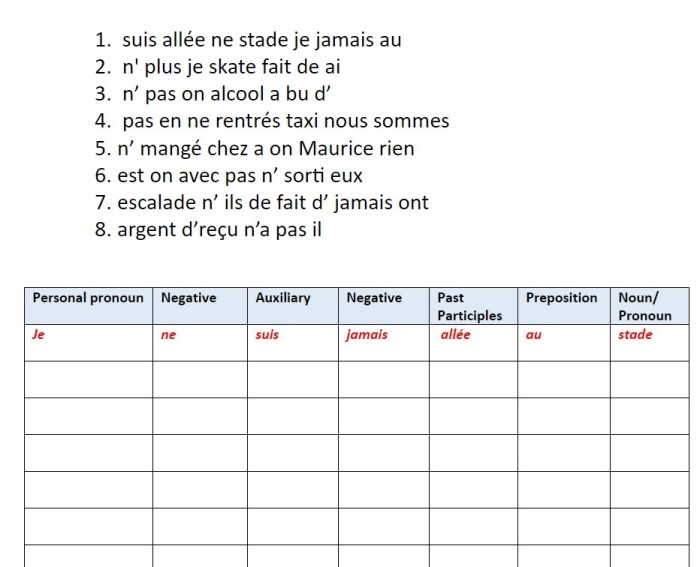
sentence-puzzles

Fig. 2  – Sentence builder.  (Typo in column 4 – it should read ‘à present’)

sin-titulo

3.2 Listening skills are only a peripheral concern (issue 2); consequently not sufficient time is devoted to listening practice (issue 3) and students do not perceive the importance of listening (issue 7)

In most Modern Language classrooms listening is grossly neglected, despite the fact that it is the most crucial skill in first language acquisition, as it is through the aural medium that humans learn to speak in the first place. According to a number of studies in naturalistic/immersive environments around 45% of language competence is obtained through listening, 30 % through speaking, 15% from reading and 10% only from writing (Renukadevi, 2014).

The human brain is wired to learn languages through listening; hence, by not using the aural medium to teach, we miss out on a daily basis on an extremely important opportunity to enhance our students’ learning. Both my article here and in Smiths and Conti’s (2016) – the Language Teacher Toolkit –  I suggest a range of minimal preparation / high impact listening-as-modelling activities which teach language through listening.

Moreover, even when we read we activate L2 words phonologically, which means that even when interpreting written texts we use the way it sounds to make sense of it. This means that if students do not distinguish clearly between words that sound similar their reading comprehension may be impaired.

Teachers need to recognize that Listening must be a priority not just because 25 % of the exam includes listening, but because learning a language through Listening greatly enhances acquisition. The teaching and learning in my lessons has been hugely enhanced by increasing my focus on listening in the last three years or so.

Finally we need to consider that, in view of the importance of Listening in the language learning process, by not emphasizing it in our lessons we are sending our students the message that listening is not important; this perception is unlikely to motivate them to work on it in class and to pursue it autonomously at home.

Implications for the classroom – First of all, I strongly recommend investing 40 to 60 % of each and every lesson into: (1) listening activities which consist of Listening-as-modelling activities or L.A.M. (this may include work on decoding skills); (2) oral interaction tasks (which includes listening); (3) critical listening (student listening to a peer’s oral output to evaluate or translate it) and (4) listening comprehension. I usually devote around 30 % of a typical lesson to listening, 30 % to speaking, 30 % to reading (mainly as a follow-up to the listening tasks) and only about 10 to writing (of the interpersonal sort).  As for vocabulary learning, I mainly flip it  (students do it at home in the run-up to the lesson as homework) unless we do vocab games or builders as a pre-reading or speaking task.

A culture of listening ought to be created in the classroom whereby (1) the students understand the importance of listening for their development as language learners; (2) they learn new language items from it; (3) they experience listening to appreciate the culture of the target language country (e.g. through videos, songs, movie trailers); (4) they are encouraged to practise listening autonomously (e.g. for personal, enrichment, fun, consolidation work).

Carrying out directed-critical-listening activities three or four times per term, in which the students evaluate oral output from their peers with a focus on specific sounds, intonation patterns or the correct deployment of a grammar structure helps me foster this culture of listening by bringing a metacognitive edge to the process.

An even more effectve way to bring Listening skills into the students and teachers’ focal awareness is by exploiting the exam ‘washback effect’. In other words, give more weighting or prominence to Listening in the exams so that you and your colleagues will be putting more effort into it and the students will focus on it more actively. I reckon that if Examination boards did this, the quality of teaching and learning in the UK will greatly improve.

Finally, another important implication for teachers is that they should not limit their listening activities to comprehension tasks – which brings me to the next point.

3.3   Issue 4: the vast majority of the listening activities staged in lessons consist of comprehension tasks

Listening tasks should be considered as tests through and through and, as I argued here, students do not learn much from them. Tasks like these do not explicitly train your students in decoding skills, do not teach new vocabulary or foster the noticing of new grammar/lexical structures – as the students are focusing on picking out details or establishing if certain statements are true or false and are not encouraged to focus on other levels of the text.

Implications for the classroom – Think about the five phases of listening outlined in paragraph 2.2, i.e.:

1.Decoding

2.Lexical search

3.Parsing

4.Sentence Meaning-construction

4.Whole Discourse construction

When teaching a specific topic or sub-topic, (1) ensure you have first trained your students to handle each of the above levels, especially the first three. (2) Do a lot of work on the decoding/pronunciation of the target vocabulary in that sub-topic, especially the words containing the most challenging phonemes (see in the next point how); (3) provide them with plenty of opportunities for processing the target vocabulary and the target grammar aurally. (4) When you are confident that they are ready to understand most of the text in the listening comprehension and all they need is a bit of inference and guesswork using context and their knowledge of the world, then, and only then, carry out one or more challenging comprehension tasks.

One useful tip: before you and/or the class mark the listening comprehension, put up on the screen the transcript and ask the students to explain why they gave the answer they came up with; it is a bit time consuming but will give you an insight into how much they really understood and into what they found most problematic. If you can, as a follow-up task, gap the transcript where the most interesting words and grammar structures are and do a partial dictation.

3.4.  Teachers do not train students in the mastery of bottom-up processing skills (decoding, parsing, etc.)

This is a point I have touched in paragraph 2.3 above and made in many previous posts of mine (e.g. here, here an here), so I will go straight to the implications for teaching.

Implications for teaching and learning

1.Decoding skills – Your Schemes of Work ought to include work on pronunciation and decoding skills (how to turn letters and combination of letters into sound) from the very early stages of instruction. Primary is the place where this is systematically done for the first language – why is not systematically done for the second language too?

So, first of all brainstorm with your colleagues the decoding issues which in your experience (both as a learner and a teacher) hinder your students’ understanding of the target language. In French, for instance, you will focus on things like liaison, the difference between ‘e’ and ‘é’, ‘je’ vs ‘j’ai’  and any other words or phrase that may sound similar (e.g. ‘mere’ and ‘maire’). When you have identified the core items, embed micro-listening enhancers (MLEs) like the ones below in your long-, medium- and short term planning. Make sure you recycle the core items across all units.

MLEs take little time to prepare, the students like them and learn a lot from them.

  1. Minimal pairs – two near homophones (e.g. ‘mere’ and ‘maire’) are provided in writing but you will pronounce only one of them; student to identify the one you uttered. This is a very useful activity because of what we said about listening being processed online, at very high speed; students lack flexibility in their interpretation of what they hear, hence, once they interpret a word wrongly they are not likely  to change their mind (Field, 2014). Since many weaker learners will often base their interpretation on one or two key words they hear to build meaning, they can be easily misled by near homophones;
  2. Focus-on-word-endings activities – these are  very useful when it comes to highly inflected languages like German, Spanish, Italian and French. Minimal prep activities: (1) gap the ending of words, utter the words and ask students to fill the gaps; (2) Write five or six words you are teaching as part of the current unit and utter five or six words you taught previously that rhyme with them; students to match the rhyming words; (3) Write 3 or 4 set of letters or combinations of letters (in French: ent, in, ont, ant) and utter ten words which contain those letters in their endings; students to identify which words contain the target letter-set.
  3. Spot the error – Give the students a list of sentences containing a given target item that you have just practised through minimal pairs (e.g. em). Then read them out loud making sure that you read the target item wrongly.
  4. Spot the liaison (in French) – write 8 sentences containing instances of liaison, read them out loud and ask students to identify where the liaison occurs
  5. Spot the intruder – Write a sentence on the board but when you read it out loud add in an extra word or sound. Students to write the extra word on mini-board or repeat the extra sound.

For more tasks of this sort, read here or here .

2.Parsing skills – First of all, make sure than when you introduce and practise a new grammar point you do so through the oral/aural medium; in my post on grammar teaching (here) I have given many examples of how this can be done. In sum, make sure that through sentence builders, partial dictation, L2-to-L1 translation on mini-white-boards (as you utter sentences containing the target grammar structures) the students ‘hear’ the grammar structure and process it orally.

A low prep/ high impact activity involves directed attention to specific grammar features. Whilst listening to the recording (or you) the students need to identify the occurrence(s) in the text of specific items (e.g. how many irregular adjectives/ perfect tenses/ if clauses did you spot? Songs add a bit of enjoyment to this type of activity ; get the lyrics from www.lyricsmania.com and identify any interesting grammar features you may want to direct your students’ attention to.

Inductive learning activities through listening are also very useful in this respect. For instance, provide the students with ten sentences in the first language containing the new grammar structure(s), e.g. the use of ‘rien’ in French. Then read out to them the translation of each sentence and ask them to infer the rule in groups of two or three.

Another task requiring minimal preparation involves giving students a first language sentence and then utter two translations of it, one grammatically correct and one wrong. Students to tell you which one is correct and why.

All of the above activities direct students’ attention to grammar through the listening medium training their ear to process grammar aurally and not simply through the visual (reading) or grapho-motor (writing) modality as far too often happens in the ML classroom.

Moreover it is also important to make sure that in every grammar lessons students employ the core grammar structures in the context of oral interaction. Stage work on decoding skills prior to the interaction and ask them to pay particular attention to specific sounds involved in the production of the grammar structure (e.g. Spanish: do not pronounce ‘h’ in pronouncing ‘Hacer’ ; French: focus on pronunciation of ‘je’, ‘ne’ ‘me’ as opposed to ‘j’ai’, ‘n’ai’, ‘mais’).

3. Lexical recognition skills – As already mentioned above, you ought to ensure that students process the core vocabulary over and over again through the aural medium and across as many linguistic contexts and topics as possible. Sentence builders come handy in this respect because they present words in several combinations with other parts of speech.When you are dealing with high frequency words which in your experience occur often in the listening exam papers, make sure the students can distinguish them clearly from their homophones or near homophones. Use minimal-pair activities to reinforce such differences.

4. Concluding remarks

Listening instruction and sound curriculum design ought to always keep in sight the full scope of the processes involved in the comprehension of aural input, the challenges they pose to the L2 learners and the abilities exhibited by expert listeners as they make sense of what they hear. In the above, I have outlined the main challenges and suggested ways in which teachers can address them in the classroom through minimal preparation / high impact activities. The main points I made:

  • Listening must be given more prominence in ML lessons;
  • Teachers must see the development of listening skills as a core concern in their practice and pass on this perception to their students whilst encouraging them to practise listening autonomously;
  • Listening activities should be used to model new language not simply to test students;
  • Decoding and parsing skills should be focused on in every lesson, especially at the early stages of instruction;
  • Listening instruction based solely on listening comprehension tasks is likely to be ineffective and to engender disaffection is less-able-to –guess students.

In the second part of the article I set out to explore how we can promote top-down processing skills (e.g. predictive strategies and using context to infer meaning), plan effective instructional sequences as well as affective issues referring to motivation and self-efficacy


Eleven reasons why your students are  underperforming in Listening

images (2)

These are the most common reasons for undeperforming at listening comprehension tasks that we have  identified both through an extensive review of the existing literature on Listening instruction and our own professional experience.  If your answers to most of the below are ‘Yes’, you may want to radically reconsider your approach to teaching listening and maybe read our next blog, ‘How you can improve your students’ exam results’ which we will publish shortly as well as my past posts on Listening.

  1. Less than 40% of your lesson time is devoted to some form of listening practice (this may include oral-interaction tasks).
  2. Listening-skills are only a peripheral concern in your – and possibly your Department’s – long-, medium- and short-term planning. Hence, you put most of your effort in the teaching of vocabulary and grammar and you have not been building over the years a wide-ranging bank of resources and a repertoire of instructional strategies.
  3. (mainly as a consequence of the two points above) Your students do not perceive Listening as crucial to their learning. Moreover, you have made little effort to ‘push’ them to practise listening autonomously.
  4. You are not sufficiently aware of the cognitive challenges that L2 learners in general and the specific group of your students face whilst listening or learning to listen effectively. In fact you may have not as yet reflected long and hard on this issue and have rarely done any serious research in this domain. When your students perform really poorly at a listening task you do not usually ask them what the issues that hindered their performance were.
  5. You do not actually plan your listening activities and how to exploit them in order to teach new language and/or inference strategies. You are mostly textbook-bound and simply pick the tasks/tracks in there and press the play button following the teacher’s book recommendations or at random points in the lesson. Most of the time you do not plan for any pre- and post-listening follow-up tasks.
  6. The texts you use in your Listening tasks do not usually contain comprehensible input (i.e. whereby the students understand 90 to 95 % of the vocabulary and the grammar structures and syntax do not pose major challenges).
  7. The vast majority of the listening activities you stage in class consist of comprehension tasks; you rarely use listening activities to model new language in context, sentence construction, correct grammar-structure deployment and pronunciation.
  8. You rarely consciously focus in your lessons on training the students in bottom-up processing skills, especially decoding skills (how to turn combination of letters into sounds) and any other skills which help students breaking the flow of sounds they hear into intelligible units of meaning (e.g. words). The ability to break the flow is paramount, as it speeds up working-memory executive function thereby facilitating comprehension. Poor decoding skills usually result in poor comprehension skills. When your students typically acquire grammar and vocabulary through the written medium and not through listening or oral interaction, this issue is greatly exacerbated.
  9. You rarely instruct your students in inference strategies (like the ones listed here by Rebecca Palmer.). And when you do, it is usually through a one-off session, with no substantive follow-up.
  10. Your students do not to enjoy listening tasks. You rarely actively think of ways of making Listening enjoyable. They usually roll their eyes when you tell them you are about to do a listening activity.
  11. Your students are not self-efficacious when it comes to Listening, i.e. they are not very confident that they will succeed at Listening tasks; they often say ‘but Miss, I am not good at listening!. Self-efficacious L2 student-listeners are more likely to be more focused, engaged and perseverant; consequently, poor levels of self-efficacy are likely to result in poorer performance. You do not consciously plan for and actively scaffold success in Listening.

In this post I suggest ways in which the above issues can be addressed.


Eleven low-preparation/high-impact tips for enhancing reading tasks

TES3

Please note: this post was authored in collaboration with Steve Smith of The Language Teacher Toolkit and Dylan Vinales of Garden International School 

Introduction

Reading texts are often under-exploited in most current published materials and typical Modern Language lessons. Moreover, the type of activities, the way they are sequenced and the levels of the text they address often seem to be chosen and planned haphazardly. In addition, the texts chosen for pre-intermediate to intermediate learners are not usually constructed in a way which is conducive to learning as they lack the sort of repetition and linguistic patterning that facilitate the noticing and uptake of new L2 items. Finally, no pre-task and post-task activities are typically carried out, which means that students come to the text not sufficiently prepped and that much of the newly processed language is lost.

Eleven tips for enhancing the impact of reading tasks

Here are eleven tips to address the above issues with novice-to-intermediate students through low-prep/high-impact activities that I use day in day out in my lessons.

1.Create the need to read – the most potent motivator in language learning is the need to understand and to communicate a message. Hence in selecting or designing written or aural input one should ask oneself: how can I make the students WANT to read on? What title, picture(s), first line or paragraph of a text can I come up with in order to get the students to want to read on the rest of the story, article, poem or lyrics of a song? For instance, last week I used a few – very dramatic – scenes from the video-clip of Kenza Farah’s song ‘Coup de Coeur’, as a teaser for my year 10 students. I then played the song to them and used the lyrics for a set of reading tasks. I have rarely seen them so motivated – they really could not wait to understand what the song was about.

Creating the need to read is not easy and I cannot say that I have fully cracked it; but I am trying and I think every language teacher should, considering that arising cognitive and emotional arousal of this sort is highly conducive to learning.

2.Ensure the students can recognize at least 90 % of the items in the text they are reading without having to resort to the dictionary (flip the learning of the key vocabulary prior to the reading of the text) – We often advise our students to read more in the belief that this will definitely help learn more vocabulary. However, it is not simply how extensively they read which will make a difference, but also what  and how they read. Research clearly indicates that for L2 reading to be an effective catalyst of vocabulary acquisition, the to-be-read material must be 95% comprehensible without much effort. This can be attained by using, besides words that have already been learnt, cognates, predictable contexts and repetition (see point 3 below).

Enabling the students to understand the gist or the main message of the text-in-hand or training them to answer a few reading comprehension questions does not enhance vocabulary acquisition. The students need to understand as much as possible of the linguistic environment surrounding the target lexis if we want them to acquire it.

This entails often having to alter authentic materials when dealing with novice-to-intermediate students and occasionally even the reading passages found in textbooks. In order to avoid having to modify the texts, what I do is flipping the learning of the more challenging vocabulary they contain prior to reading them; so, for example, knowing that my year 8 will read text ‘X’ on Monday next week, I will set vocabulary-building homework the Friday. before

3.Ensure there is a lot of repetition and highly patterned language – Repetition of words and patterns in texts is crucial and the lack of it is possibly the greatest shortcoming of most of the published Modern Languages reading materials currently on the market. Exposure to the target vocabulary and grammar through receptive processing being essential for effective acquisition every reading text we use in class should include as much repetition as possible on at least three levels: (1) the target lexical items (be them words or phrases), (2) the target grammar structure(s) and (3) syntactic patterns (e.g. the same sentence stem or slight variations of the same sentence stems as in: I live in a city called Paris ; I live in a village called Cagnes-sur-mer).

Sadly, one of the damages done by the Communicative Language Approach to Modern Language education is the notion that L2 students ought to read only or mainly authentic texts. However, I do not believe this to be always ‘healthy’ practice with novice-to-intermediate learners.as repetitions of words and patterns even when sounding redundant and artificial do scaffold learning.

Songs and poems are often more memorable because they use frequent repetitions and come in handy in the reading sessions; narrow-reading texts , many of which I have published (free) on www.tes.co.uk , are rife in recycling of words and patterns too.

4. If you do include the L1-translations of the challenging words, place them in a box in the margin of the page (not in brackets, next to the words) – Research evidence indicates that a gloss located in the margin of the text (where the L1 translation is provided) is more likely to facilitate future recall than placing the translation in brackets next to the unfamiliar word (within the text). I usually highlight or underline any unfamiliar words in the text that I have included in the gloss in order to signal to the students that it has been translated for them.

5.Before staging the reading do some work on decoding skills– Research by Walker (2009) indicates that learner issues with L2-decoding of the text-in-hand, especially when different L2 items may be pronounced by the students erroneously as homophones (i.e. phonetically identical) may hinder reading comprehension. Think about ‘je parle’ and ‘j’ai parlé’, for instance that many pre-intermediate learners of French pronounce identically. This phenomenon is caused by the fact that even when we read silently, the instant we process a word we activate its sound by engaging the phonological loop in our Working Memory. What I do, prior to engaging my students in reading, is to focus my students on the pronunciation of specific combinations of letters which I predict might cause them issues in processing the text-at-hand; for this purpose I use a range of my MLEs (Micro-listening enhancers).

 6.Warm the students up prior to the reading through work on top-down processing skills – this is as important as the work on bottom-up processing skills recommended in the previous point. The easiest zero-preparation way to do this is to tell the students the title and the topic(s) of the text and ask them to brainstorm as many words as possible in the target language which they associate with them. Alternatively or additionally you could give them a few pictures which refer to the content of the text and ask them to do the same – the pictures could be used to create the need to read alluded to in point one. Another minimum preparation strategy which involves writing (and even speaking if done in a group through a discussion) is to ask them to jot down a few sentences predicting the content of the to-be-read text.

7.Create several short tasks rather than one or two long ones  – in a very small-scale research of mine carried out a few years back I found that my students found more enjoyable and useful to carry out several short tasks with four or five questions rather than one or two longer tasks with eight to ten questions. This was particularly true of lower ability students. Several shorter tasks provide more variety, and a sense of having completed more challenges. Moreover, one can address more levels of the same texts and recycle the same items through different questions, which will facilitate acquisition.

8.Design tasks with varying foci – It always baffles me how limited the number and range of tasks that published materials associate with each of their texts are. When I design or plan reading activities I endeavour to address points (a) to (f) below, usually one per task; the fact that the tasks are many but short pre-empts the work from being tedious and time-consuming. Moreover, sequencing the task in ascending level of difficulty allows for effective differentiation.

(a) reading for gist – tasks that require the students to pick out the text’s key message/details (e.g. list the five main points made in the text about what constitute a healthy lifestyle);

(b) simple reinforcement of key words in the text – tasks that only aim at recycling the key items (e.g. translate the following French words/phrases in the text you have just read) and are not designed to ‘quiz’ the students, but merely to get them to re-visit the text and re-process it. This means that these tasks need not be particularly challenging as they serve the purpose of modelling; this is why I usually put this tasks as first or second in my reading-tasks sequence;

(c) fostering noticing of lexical/grammar structure– these are questions which promote the noticing of a specific L2 grammar items of syntactic structure (e.g. why does line 20 read “if I had gone’ and not ‘If I went’?);

(d) promoting use of inference strategies – these require the students to infer the meaning of unfamiliar words using context;

(e) practising using dictionaries/reference materials;

(f) L1-to-L2 translation skills.

9.Stage a read-aloud session – Staging a read-aloud session after performing the above tasks provides a cognitive break and gives you an idea, whilst you are walking around the class monitoring student-pronunciation, of how the acquisition of decoding skills is proceeding. This will inform the planning of any subsequent delivery of decoding-skill instruction.

10. Follow-up with one or more listening tasks – A follow-up through listening-as-modelling and listening-comprehension activities helps reinforcing the vocabulary and, more importantly, focuses the students on pronunciation. The easiest listening-as modelling activity to prepare is obviously dictation of sentences taken from the just-read-text containing the key-items you set out to teach (with or without L1-translation). Partial dictations require very little preparation too. Jigsaws are a bit more time-consuming but students enjoy them a lot.

11. Recycle key lexis in subsequent lessons – after reading a passage, some really nice idioms, structures or other interesting and useful lexis found in that text get left behind and often lost for ever. I do attempt to make sure that that does not happen, by: (a) setting it as homework using language-gym.com – but one can use Memrise or Quizlet instead; (b) creating a new reading text (my favourite strategy) which include those items; (c) devising a nice starter with which to begin the next lesson; (d) recycling the items alongside any new lexis you are planning to teach in the next lesson

Concluding remarks

Much too often the reading passages used in the ML lessons are under-exploited and a substantial part of the valuable material they contain gets ‘lost’ in the absence of adequate and consistent recycling in subsequent lessons. At present, I am not aware of any published material which effectively addresses all of the levels of exploitation of a text I outlined in the above post, which is appalling. This is due too many factors, one of which refers to the fear that the students might get bored, a concern I sympathize with to a certain extent; this issue can, however, be partly controlled for by providing several shorter tasks with varying foci.

The most important message this post purports to convey is that reading tasks should try to squeeze out as much learning out of any text-at-hand as possible; students should be prepped both in terms of bottom-up and top-down processing skills (especially decoding skills); they should also be encouraged to notice  new items through activities which engage them in deep processing; finally, unless we are merely equipping students with survival skills, limiting the focus of receptive processing (not simply reading but listening, too) to the understanding of the main points contained in a text has very little surrender value in terms of the enhancement of reading fluency and the acquisition of vocabulary, morphology, syntax and any other aspect of L2 competence.

Creating the need to read or understand should also be an important concern of ours as way too often the texts students work on in ML lessons are rather dull. Whilst this is quite difficult to do with the texts we give novice-to-intermediate learners, when working at higher level of proficiency it should not be an impossible task.

As far as point 2 to 11 are concerned, our frustration with the current lack of resources which address all of the above has led Steve Smith and myself to creating reading material and associated tasks which we are writing as we speak and whose first instalment is published here. The aim: to create a resource which enables intermediate learners of French to learn as much as possible from L2 written texts to the point of allowing them to translate short English passages (GCSE style) into French off the top of their head by the end of each unit.

As for point 1, i.e. ‘creating the need to read’, Steve and I are both working on developing a set of strategies which we intend to share with our readers in a future post.

To find out about our ideas on reading instruction, get hold of ‘The Language Teacher Toolkit’, the book Steve Smith and I co-authored .

‘Quizzifying’ feedback on error – four ways to spice up the correction of your students’ writing

TES3

Please note: this post was co-authored with Steve Smith of ‘The Language Teacher Toolkit’

1.Introduction

As my regular readers will know, I am not a fan of traditional explicit error correction (error pointed out and correction provided), as (a) it does not involve the students actively in the correction process – they are merely passive recipients of the feedback process and (b)  students do not usually pay attention to it (Cavalcanti, 1990; Conti, 2004).

Even the common practice of underlining and coding errors and asking the student to self-correct is of limited effectiveness. Firstly, because one cannot correct errors with structures one does not know. Secondly, for errors for which the rule is ‘known’, this practice stops at the product  (the mistake) thereby failing to address the most important issue: the cognitive processes which caused the mistake in the first place – which usually refer to cognitive overload/ divided attention. In order to address self-correctable performance errors effectively teachers have to provide the learners with practice in processing the linguistic environment(s) that caused those mistakes – during production of the same sort as the one in which they were made. This is very rarely done in my experience.

Any corrective intervention, in order to impact the target students, must (1) involve the students in deep processing of negative feedback (i.e. involving substantial cognitive investment and higher order thinking skills); (2) be as distinctive and memorable as possible, so as to bring the target mistake into the student’s focal awareness; (3) give rise to a positive affective response on the part of the students whilst lowering the anxiety resulting from being told they made mistakes; (4) provide students with a clear path to future success in the handling of the structure (e.g. by enhancing the metalinguistic awareness necessary for avoiding that mistake in the future and/or providing a memory strategy); (5) provide extensive practice aimed at eradicating the target mistake(s).

Moreover, for error correction to be effective, a culture of attention to formal accuracy has to be fostered and actively supported across all levels of receptive and productive practice. In many communicative classrooms nowadays this does not happen, and accuracy has become a secondary concern, regardless of the fact that if we are indeed preparing our students to use the target language for work – and not merely survival-level communication – their output needs to be as error-free as possible.

In this post I describe four techniques I use with my students to ‘spice up’ the correction process of performance errors. They are more time-consuming than ordinary correction techniques, hence I don’t use them all the time and only with groups I believe will benefit from them.

Let me reiterate the importance of providing our students with extensive practice with a ‘faulty’ structure in writing and speaking (in that order). Only repeated spaced practice fixes mistakes; explicit correction or self-correction with codes as well as any of the techniques below are only the beginning -the awareness-raising phase – of the remediation process. The reader should bear this in mind in reading the below.

2.The techniques

Here are the techniques. The reader should note that I usually ask the students, as a follow-up, to explain the rule either in writing or to a group of peers and to produce (as homework) 10 original sentences containing that structure on a set topic (e.g. health and lifestyle). All the techniques below can be turned into a competition; my more able groups love to compete against each other ‘in Error hunts’.

It goes without saying that one should only use these techniques with self-correctable errors which refer to L2 items that the students know in abstract how to use but occasionally fail to use under real operating conditions due to processing inefficiency/cognitive overload or to a specific linguistic context.

2.1 Choose the right option – a student has made a mistake in the handling of a structure. Instead of supplying the correction or asking to self-correct, you provide two or even three possible options to choose from – only one being correct – and ask her to provide a rationale for her choice. This technique is particularly useful when dealing with students who may find the self-correction task daunting as it provides a cue that might confirm their hypotheses. Example:

Intended meaning: if I had more money I would buy a new car

Error: si j’ai plus d’argent j’acheterais une nouvelle voiture

Option 1: Si j’avais eu plus d’argent j’acheterais une nouvelle voiture

Option 2: Si j’aurais plus d’argent j’acheterais une nouvelle voiture

Option 3 (the correct one) : Si j’avais plus d’argent j’acheterais une nouvelle voiture

2.2 Error hunt – Tell students that there are an ‘X’ number of mistakes in a specific sentence or section of their essay and challenge them to find them under timed conditions. You may cue them as to the nature of the mistakes (e.g. Spelling, Word order, Verb ending, Tense, etc.). This technique has more potential for learning than simply pointing the students to the specific word or word cluster where a mistake is and ask to self-correct. Why? Because, as pointed out above very often it is the context where a mistake is found that causes the student to get the application of a given grammar rule wrong, not the knowledge of the rule itself.  In other words, the student-writer’s working memory experiences processing inefficiency due to the challenges posed by the surrounding linguistic environment  (e.g. too many grammar rules to juggle at the same time). Error hunts enable  the student to re-process the faulty item receptively in the challenging environment that caused her to err but receptively, which allows her more time to think and to bring to consciousness the source(s) of the mistake.

2.3 Code the errors – Errors in essays are underlined. The students are given a list of error categories such as ‘Spelling’, ‘Word order’, ‘Agreement’, etc. and are asked to code the errors underlined by themselves or working in a group. This can be made into a competition. Tip: do not underline too many errors and leave the categories broader with less proficient groups of learners.

2.4 Error auctions –  In marking your year 11 students’ essays you found a set of mistakes that are common to most of them. Time-wise it is more practical to deal with those in class, together, rather than individually. Hence, you may stage an error auction. You put a sample sentence for each of the errors you elect to target on a different slide of a Power Point. You assign a ‘price’ to each, depending on how difficult you think the error will be to correct (e.g. 1,000 dollars for an omission of the subjunctive, 100 dollars for a spelling mistake). You divide the students into groups of three,  and assign them a budget (e.g. 5,000 dollars). You will show each sample sentence and will give the students a set amount of time to write on mini-boards (one per group) the correct version of that sentence (with or without explanation of the rule – at your discretion). The groups that get it right are awarded the amount of money specified on the slide; the ones that get it wrong, lose it. The group with the most money at the end of the game wins.

Conclusion

Error correction must aim at involving the students actively in the feedback-handling process and to bring about high levels of cognitive and emotional arousal in order to give rise to learning. The four techniques I have just outlined help making the correction distinctive and more engaging but are no panacea. The most important part of the remedial learning process is extensive spaced practice for months and months on end under self-monitoring conditions (i.e. the students is producing output specifically monitoring the application of the problematic rules). Any correcting intervention that stops at awareness-raising is doomed to fail.

From guesswork to ‘knowwork’, from quizzing to teaching: the mind-shift that may enhance L2 students’ listening skills (Listening Instruction, part 2)

Please note: this post was written in collaboration with Steve Smith of ‘The Language Teacher toolkit’ and Dylan Vinales of Garden International School

picture read aloud

1.Introduction – Beyond testing and quizzing

A recurrent theme in my blogs is the belief that Modern Language listening instruction, as it is currently carried out in many L2 classrooms, is more about testing than modelling.  Students are usually asked to listen to a text uttered at near-native or native speed and answer a set of questions on it which typically involve picking out a few details here and there or deciding whether some statements made about that text are true or false. In other words, quizzes through and through, which often elicit a lot of guesswork from the students who are not always adequately prepared for them and equipped at best with basic inference strategies.

Add to this the fact that typically the aural input found in textbooks and other published resources does not contain the repetitions, redundancies and cues that not only facilitate understanding, but also make language more noticeable and memorable.

To make things worse, students are usually asked to listen to each listening extract two or three times maximum and the pre-listening task preparation and post-task recycling are usually minimal. Once the marking is over and done with, the class move on and the listening track just listened to is usually not revisited again. As it is obvious, not much learning occurs, as such practice does not allow for many opportunities for students to notice and analyse new language items and patterns.

This model is seriously at odds with the way humans learn languages in the early stages of first language acquisition, where input from caregivers and the family entourage is usually fairly highly patterned, repetitive and cue-rich (especially in terms of visual input) and the same language is recycled over and over again in very similar contexts with frequent positive and negative feedback which confirms or negates the children’s inferences.

Such an approach to listening instruction also clashes with the way in which much second language learning occurs in naturalistic/immersive environments, where L2 learners usually develop their listening skills through extensive oral interaction with native speakers or other L2 experts who repeat, paraphrase, explain and use plenty of cues to facilitate the comprehension of their input. In real life, humans are active listeners who use their eyes as much as their ears to comprehend their interlocutor’s input often cueing them to any breakdown in communication and negotiating meaning with them when that happens.

  1. 2. The aims of this post

In this post I reiterate and expand on a concept I put across in my article ‘Listening Instruction Part 1′. The notion, that is, that at lower levels of proficiency listening instruction should concern itself more with listening-as-modelling (henceforth LAM) than with listening for testing comprehension.

But WHY is it crucial to implement LAM ?

First and foremost, as it is obvious, to prepare our student for aural comprehension, the most important skill in real-life communication – around 45 % of total real-life communication involving the listening modality whilst only 15 % occurs through reading and only 10% through writing. If our learners acquire the L2 target grammar and vocabulary almost exclusively through the written medium – as it often happens – they will struggle when processing it aurally, a common phenomenon in the typical UK classroom. On the other hand, frequent exposure to LAM will enhance their ability to code new input thereby lessening the processing cognitive load and – as an added benefit – facilitating the noticing of any grammatical and syntactic features in aural input.

Secondly, masses of LAM will impact students pronunciation and decoding skills, which in turns may enhance their oral and reading skills. Effective listening comprehension requires mastery of bottom-up processing skills as much as it does top-down. LAM develops learner bottom-up processing skills by constantly modelling L2 vocabulary, functions,  grammar and syntax through the listening medium.

Thirdly, by aiming at modelling rather than quizzing, LAM allows for the explicit instruction of grammar and syntax through the listening medium – which is impossible during listening comprehension tasks as the students are focusing on answering questions.

Fourthly, the fact that LAM recycles the same core items time and again and is highly patterned makes the input more accessible and memorable.

3. Eight features of effective LAM practice

To be most effective, LAM activities – as I envisage them- should:

  1. address all levels of language processing, from the phonological features of words to the understanding of larger discourse structures (long sentences and paragraphs) both in terms of meaning and how they function;
  2. include highly patterned (e.g. lots of repetition) comprehensible input uttered at a speech rate which is accessible to the target learners;
  3. start with highly structured and highly scaffolded activities which become gradually less structured and more demanding;
  4. Start with smaller units of discourse and gradually build up to larger ones;
  5. involve a variety of tightly-sequenced tasks which recycle the same language items and patterns;
  6. prepare the students for any subsequent listening comprehension tasks;
  7. avail itself of visual aids and other cues (e.g. typographic devices to translation) which facilitate understanding of the input;
  8. explicitly promote the noticing of new L2 items

In the below, I will show how this can be done through low effort and high impact activities which I have been using for a long time and have significantly impacted my students’ proficiency. Most of the activities below are not rocket science and you may be implementing some of them already in your lessons – although probably not as often as I would advocate. Interestingly, some of them are regarded as ‘legacy methods’ and are consequently somewhat frowned upon, despite the fact that recent research seems to indicate they can indeed positively impact proficiency.

  1. The mindshift advocated: from quizzing on listening to teaching through listening

Although the activities, their design, their sequencing and implementation are important factors to consider in the implementation of listening instruction, the key issue is the mindshift that it is advocated here: from quizzing on listening to teaching through listening.

This shift requires teachers to adopt a different attitude, deploy a different range of strategies and set different expectations. It doesn’t do away with listening comprehensions, as I do believe they play an important role, too, in fostering the development of crucial inference strategies.

The difference is that in the approach I advocate, listening comprehensions are staged at the end of an instructional sequence; after much listening-as-modelling and other activities recycling and drumming in the target input have occurred. At a stage, that is, in which the students are actually ready to carry out the listening-comprehension task(s), because they will have processed by then most of the language they need to know to successfully complete it/them several times over through listening-as-modelling activities and other modalities (e.g. reading and speaking tasks).

Hence listening-as-modelling serves two functions: on the one hand it models new language; on the other it prepares the learner for listening comprehension tasks, which could be viewed in this sense as plenaries designed to assess whether uptake of the target vocabulary or structures has occurred.

5. Some LAM activities 

5.1. Caveat

The following is a list of the modelling-as-listening activities that are easier to prepare and implement and which, in my professional experience have high surrender value. As it is obvious, for effective modelling to occur, teachers will carry out a sequence of three or four of these activities per lesson, ensuring that each activity recycles the same target L2 items over and over again. Moreover, as already stated above, modelling should start through highly scaffolded activities targeting lower-order processing skills and gradually move on to higher-order ones.

A recurrent feature, which I believe to be the greatest strength of LAM of the kind advocated here, is that every single one of the activities below calls for the application of two or more skills of the same time. For instance, Micro-listening enhancers, partial dictations and sentence builders involve reading and writing  as well as listening and dictations can also be used to enhance transformational writing skills and even promote cognitive comparison and metalinguistic enhancement.

Three types of LAM activities are absent from the list below as they are already common currency in the typical language classroom and it is thus taken for granted that most teachers use them. Firstly, the common practice of uttering a set of vocabulary items and asking the class to repeat them one or more times; secondly, playing a recording of a dialog /role-play and asking the students to re-read it; thirdly, teacher fronted talk in the target language. It should be noted, however,  that the effectiveness of the first two of the above practices is usually undermined by the fact that any word processed aurally does not linger in Working Memory for longer than two seconds and is overwritten by any new incoming information. Hence, if there is no abundant recycling after the initial aural exposure, retention of the phonological level of the input is usually quite poor .

As for fronted-teacher talk in the target language, it is a listening-as-modelling practice that has great potential for learning when the input is carefully and craftily constructed to explicitly model language through lots of repetition, highly patterned discourse, reference to audio-visuals and/or realia and techniques which focus students on specific language items and allow Noticing to occur. Sadly, though, the teacher fronted-talk I have witnessed over 25 years of teacher training and observations in British classrooms is rarely planned and constructed this way and often novice to intermediate students only get the gist of what the instructor says without learning much from it.

5.2 Sample LAM activities

5.2.1 Micro-listening enhancers (MLEs)

Since I have talked about MLEs extensively in previous blogs, it will suffice to say here that they consists of phonological-awareness-raising activities which aim at developing decoding and coding skills, i.e. the ability to turn letters and combination to sounds and to match sounds to letters and combination of letters. As mounting research evidence shows, these skills are crucial to effective listening and even reading skills (Macaro, 2007).

I use these activities on a daily basis prior to staging more challenging listening or speaking activities to focus on sound that students find more problematic, as way to prep them.  Examples of these activities can be found at this link. Here are four types of  MLEs that I use a lot:

  • Spot the foreign sound (students listen to the teacher as s/he utters L2 words and identify sounds that do not exist in their language, whilst inductively working out letter-to-sound equivalence)
  • Spot the silent letter (example: Furniture, Chair, Wardrobe, Fridge)
  • Minimal pairs (e.g. Chair / Cheer ; Sink / Think; Hair/heir )
  • Fill in the missing letters

It is important to note that the words/phrases used in the MLE activities ought to be part of the target vocabulary one aims to teach in the lesson-at-hand.

5.2.2 Sentence builders / Writing mats

Sentence builders or writing mats are an excellent way to model writing through listening whilst at the same time teaching vocabulary. The teacher makes up sentences in the target language using the words in each column/box reading them aloud a few times at accessible speed and students write them out in their native language on mini-whiteboards or iPads (the way I use them within a full lesson sequence is outlined in more detail here). I usually embed the translation of new/challenging in the sentence builder/writing mats to facilitate comprehension.

As a follow-up, the sentences made in the process can be recycled in any of the activities below. This is one of the sequences I use:  teacher-led sentence builder > narrow listening > student-led sentence builder (group-work) > structured oral interaction (e.g. communicative drills eliciting vocabulary/phrases modelled in the sentence builder activity) > reading aloud (if time) > listening comprehension (to assess uptake of target items) . Obviously, each activity will recycle the input found in the sentence builder + a few unfamiliar items thrown here and there to spice up the language and elicit inference strategies.

5.2.3 Dictations and partial dictations – beyond forging good spelling habits…

Although they are often dubbed as ‘legacy methods’ , there is mounting research evidence that dictations and partial dictations can positively impact listening comprehension ability  (e.g. Marzban et al, 2013; Kuo, 2010). Dictations can be used to enhance other important aspects of L2 proficiency beside word spelling and coding/decoding skills. For instance, I use them quite frequently to model correct grammar and even  transformations writing strategies. These are but a few uses one can make of dictations:

  • To model vocabulary usage. Partial dictations are an excellent means to focus students’ attention on specific vocabulary items and collocations whilst at the same time modelling their pronunciation and how they relate syntactically to other words. When the missing words are new, I usually provide the L1 translation in brackets, next to the gap. I find partial dictations particularly valuable when teaching L2 items which are notoriously less salient (e.g. prepositions, articles, word endings) and go often unnoticed;
  • To teach grammar. In a cognitive-comparison activity, the teacher displays a number of sentences in the L1 on the board/screen and dictates to the students the translation of those sentences in the L2 to raise their awareness of important morphological and/or syntactic differences between the two languages in conveying the same meaning. The students write out the sentences, are asked to spot the differences and work out the relevant L2 grammar rules inductively.
  • To provide feedback on learner errors. After identifying a number of common errors in the student oral and/or written output in the handling of a set of L2 items, the teacher displays on the board incorrect L2 sentences in which those errors have been embedded. S/he will then dictate the correct L2 version of those sentences and ask the students to compare differences and work out the rules that were flouted in the erroneous output.
  • To model transformational writing skills. As already discussed in a previous blog (here)sentence recombining tasks can be powerful tools to develop transformational writing skills. Dictations can be used to model sentence-recombining strategies. Take the sentences:           

My mother is friendly, funny and affectionate. / She can be stingy at times. / She often tells me off for being lazy

Through dictation students can be shown various ways in which they can be recombined (e.g. My mother is friendly, funny and affectionate but can be stingy at times and often tells me off for being lazy or although my mum can be stingy at times and often tells me off for being lazy, she is friendly, funny and affectionate, etc.). After several aural examples, more written examples may be provided and subsequently the students can     have a go at sentence recombining themselves

5.2.4 Reading aloud

Short sessions of reading aloud passages recycling the lesson’s target vocabulary followed by equally short comprehension tasks (e.g. list five points made in the passage you have just read) or even oral translation are minimal-preparation tasks that have been shown to significantly impact students’ oral proficiency (Seo, 2014). I usually get students to read aloud to each other in dyads or triads and it works quite well. However, more able students enjoy it more than less able ones, especially when dealing with longer texts. I tend to shy away from carrying out reading aloud with long texts.

5.2.5 Jigsaw listening

This is a classic which the students enjoy and another minimal preparation activity. Mounting research evidence points to its effectivennes in enhancing listening comprehension skills (e.g. Fajar Satria Pambudi et al, 2013).  All you have to do is get hold of the transcript of an audio-track, jumble the lines up and put the resulting text on the screen for student to put it back together in its original form as they listen to the recording. I usually carry it out before staging a listening comprehension task (using its transcript for the jigsaw activity), especially with weaker groups, highlighting items that I want to draw the students’ attention to.

5.2.6 Narrow listening

I have dealt with narrow listening and narrow reading extensively in previous blogs. They consist of a set of  short passages on the same topic which contain highly patterned input and recycle the same vocabulary to death, with very few variations. The high recycling and the recurring patterns facilitate understanding and recall. I usually get the students to carry out very short comprehension tasks on them which increase in difficulty as they progress through them. See an example here. I use narrow listening a lot and it has definitely enhanced my students’ listening skills. I usually follow it up with narrow reading activities recycling the same language.

5.2.7 Nursery rhymes, poems and songs

Songs are possibly the best LAM activities because of their potential for motivation. However, to have the highest surrender value they should recycle the lesson’s target items – which is not always easy. If you have a talented musician amongst your ML colleagues you can get them to alter the lyrics of popular songs to include the target vocabulary or structures. I do have one such colleague and draw on his talent on a weekly basis.

Songs, nursery rhymes and poems can be exploited for many purposes at a range of levels (see my post here). As a LAM activity, I usually exploit them by (a) gapping the lyrics; (b)  doing a jigsaw listening task; (c) inserting random extraneous words that they need to identify and circle as they listen and (d) doing a transcription task of a whole section of it (e.g. the refrain or a stanza).

  1. Highly patterned story-telling with visual cues.

Story-telling can be very powerful but requires lots of preparation when we are dealing with lower proficiency group, so I tend to use it mostly with strong intermediate or with upper intermediate groups. The story should be interesting and the input should be highly patterned and accessible and recycle the lesson’s target items; moreover it is advisable to prep the students through a lot of vocabulary-building activities prior to the activity to lessen the cognitive load during the story-telling. I usually tell the story in short instalments. After each instalment I show the transcript of what I have just read on the screen, ask a few comprehension or what-comes-next questions and move on to the next bit.

Concluding remarks

In this post I have made a case for a mind-shift in listening instruction from quizzing on aural input to teaching and learning through aural input. I have described a range of minimum-preparation / high-impact Listening-as-modelling (LAM) activities that use aural input to model pronunciation, decoding skills, sentence building and to enhance the acquisition of lexical and grammar items through cognitive comparison, noticing and abundant recycling.

The frequent use of LAM activities in my lessons has greatly enhanced my students’ learning, the most tangible outcome being substantial gains in their pronunciation, decoding skills, oral fluency and general listening comprehension. Hence, I strongly recommend ML teachers incorporate LAM activities in their every lesson, mindful of the following recommendations I made in paragraph 3, above:

  1. include highly patterned (e.g. lots of repetition) comprehensible input uttered at a speech rate which is accessible to the target learners;
  2. start with highly structured and highly scaffolded activities which become gradually less structured and demanding;
  3. start with smaller units of discourse and gradually build up to larger ones;
  4. use a variety of tightly-sequenced tasks which recycle the same language items and patterns;
  5. each LAM activity should prepare the students for any subsequent listening comprehension tasks;
  6. make use of visual aids and other cues (e.g. typographic devices to translation) which facilitate understanding of the input;
  7. explicitly promote the noticing of any new L2 items in the aural input.

Listening comprehension tasks should be staged after the linguistic material they contain has been processed aurally through a range of LAM activities so as to ensure that our students are no more engaged in mere guesswork, but that they actually come to the task prepared. This shift from guesswork to ‘know work’ may not only enhance their chances to understand but also their sense of efficacy and self-esteem as listeners.

For more on our views on language teaching and learning do get hold of our book “The Language Teacher Toolkit” available here

How to design and use narrow reading and listening as part of an integrated instructional sequence.

Please note: this post was co-authored with Steve Smith of The language teacher toolkit

download

Introduction: the benefits of highly patterned comprehensible input 

In many posts of mine I observed that way too often Modern Language teachers get too quickly to the production phase of a lesson. The all-important receptive stage, where the target L2 items (be it vocabulary or grammar) are processed by the students in meaningful context, not as isolated items on a Power-point, Quizlet flashcards or online games is either missed out or whizzed through. Yet, whilst I do not espouse methodological approaches which are almost exclusively based on teaching language through comprehensible input (e.g. C.I. or T.P.R.S.), I strongly believe that before engaging in the production of newly presented L2 items, students should be exposed to masses of comprehensible aural and written input. I shall not dwell on the rationale for this assertion as I have discussed it at length in many previous posts on this blog.

By Comprehensible Input I mean texts (oral or written) which are accessible by the target students in both linguistic and cognitive terms; this entails that they contain for the most part vocabulary and grammar structures which the learner readers/listeners know or can relatively easily infer from the context or by their similarity to L1 items.

As I have often advocated the Comprehensible Input we should expose our students to ought to be highly patterned and should recycle any target L2-items we intend to impart as much as possible, even at the risk of sounding slightly artificial.

The fact that the input is comprehensible and  highly patterned and that it recycles the same vocabulary over and over again significantly facilitates comprehension and uptake for obvious reasons:

  • the target items are processed over and over again;
  • they are processed in a range of linguistic contexts many of which familiar thereby facilitating the predictability of any unknown vocabulary item;
  • the recurring patterns (e.g. the same sentence stems + a new vocabulary item), even though initially unfamiliar, do become familiar after a few encounters, which provides additional contextual cues for the understanding of the text;
  • repetition enhances retention.

The most powerful authentic forms of patterned comprehensible input that I have ever come across in ‘real life’  are nursery rhymes, children’s poems and stories, songs and, obviously, caregiver talk. As you may know, methodologies such as C.I. and TPRS make regular use of such forms of comprehensible input. I do, too, especially contemporary pop songs, as the refrains, the music, the subject matter and the para-textual references to teen-students sub-culture do help make the language items they contain ‘stick’.

In this post, however, I will concern myself with a more artificial but equally powerful form of comprehensible input that I use day in day out in my lessons:  narrow reading (NR) / narrow listening (NL).

Although I discussed the rationale for the use of this technique in a previous post (here), I fell short of showing how to design and use NR and NL activities, two very important issues considering that Modern Languages NR- and NL-based resources are very hard to come by both in textbooks and online.

Moreover, in the below I set out to demonstrate how NR can be used as part of an effective instructional sequence which integrates all four language skills.

What is NR/NL?

NR/NL consists of a few short texts on the very same topic (e.g. hobbies) which contain highly patterned comprehensible input and recycle a given set of vocabulary over and over again. As the example below shows, I tend to use six or seven texts of five-to-six lines long and usually include a gloss in the right margin where I either translate the more challenging items in the text in the L2 or provide an L1-synonym or explanation.

A narrow reading example : the place I live in

Please do note that the following example was designed for purely demonstrative purposes . I chose English, rather than the languages I usually teach (i.e. French, Spanish and Italian), for the same reason, as a lingua franca that all my readers would understand. Also note that I would normally put a gloss in the right margin listing one or two words per paragraph that I would expect my students to majorly struggle with. Finally, do bear in mind that this is only the text part of the NR activities; I reserve to discuss the NR-based tasks in paragraph 5, below. Here are a sample narrow-reading set of texts consisting of six paragraphs on the topic ‘the place I live in’.

My name is Ian.  I am 19. I live in a large town in the north of England very far from London . There is a lot to do there for young people my age, so it is never boring. There is a stadium, a few leisure centres,  cinemas, youth clubs and a good nightlife. The people are quite open and friendly. My town is surrounded by mountains, which is great because I love skiing. There is also a fairly big lake where we bathe in the summer when the weather is hot. The beach is very far away, though, which is a shame. When I am older I would like to move to Hong-Kong because my father lives there with my step-mum and he says that it is great.

My name is Andy.  I am fifteen and live on a farm in the countryside in the south of Wales, not far from Swansea. The farm is surrounded by beautiful woods. The scenery is great, but  there is not a lot to do for young people my age. So it can be boring at times. There is only a small leisure centre a few kilometres away with  a coffee shop nearby. Fortunately, there are lots of woods and hills nearby where I go hiking and mountain biking, my favourite sports. The people in the area are generally warm and friendly. The beach is not far but the weather is quite cold and windy. We only go there when the weather is very nice and we only bathe in the sea in the summer. When I am older I would love to own a ranch in Texas.

My name is Marco. I am 16 and live in a small town in the North of Italy, not far from Venice. There is a lot to do there for young people my age, so it is never boring. There are lots of sports facilities like gyms, stadiums, tennis clubs, etc. Moreover, the people are generally nice and friendly. My town is surrounded by hills and mountains, which is great because I love trekking and skiing. There is also a lake nearby where we bathe when the weather is hot. The beach is only one hour away, which is fantastic because I love the seaside. There are also woods nearby with a little lake where we bathe when the weather is hot. When I am older I would like to live and work here, as I love my hometown.

My name is Pierre. I am thirteen and live on a town on the coast, not far from Nice, in the South of France. There are heaps of things to do there for people my age. There are shopping centres, sports facilities, cinemas, youth clubs, etc. I love the people there, because they are very warm and open. The beach is great and I go there nearly every day in the spring and summer. I love skiing but I rarely go to the mountain because it is quite far from where I live. Fortunately, there is an artificial ski slope in my town where I usually go once a week. When I am older I would like to move to Paris.

My name is Sarah. I am 17 and live in a little village in the countryside not far from Paris. There is not much to do there, so it can be very tedious  at times, but the people are generally nice and friendly. My village is surrounded by woods and there is a river nearby where we bathe in the summer when the weather is hot. The beach is three hours away, though, which is a shame because I love the seaside. The mountains are nearer, though, which is great because I also love skiing.  When I am older I would love to live in a place near the Mont Blanc.

My name is Anna. I am 14 and live in a fairly big town not far from London. There are heaps of things to do there, so I am always busy. However, the people are quite ‘cold’ and unfriendly. My town is surrounded by the countryside and hills, which is great because I love horse-riding and hiking. There is a big lake an hour away where I go sailing and bathe in when the weather is nice and hot. I enjoy skiing but the mountains are very far away. Fortunately, there is an artificial ski slope in a nearby town, about an hour away by car. I usually go there once or twice a month. I love my hometown and if I found a very good job, I would love to live and work there.

The design

Step 1 – Decide on the core items of the vocabulary and/or grammar you want to impart. Your choice will obviously be influenced for the most part by the curriculum you are working with or a specific corpus you use as a reference framework. The example above, instead, being a purely  demonstrative exercise, includes chunks of language and grammar items that I chose pretty randomly, e.g.:

  • There are lots of things to do for young people
  • The people are…
  • My town is surrounded by…
  • …where I bathe in when the weather is hot
  • There is a …. X hours away
  • So it can be …. at times

Step 2 – Decide on the peripheral-learning L2 items you may want to embed for anaphoric recycling (or ‘seed-planting’ ); these are items that you do not intend to directly focus on in the current lesson but that you intend to explicitly/ formally teach a few weeks -or even months- down the line (read here to understand what I mean) . They are peripheral in the sense that you merely want the students to notice and get acquainted to them not necessarily to make a conscious effort to acquire them.  In the example below, one of the ‘planted seeds’ for peripheral learning would be the present conditional forms at the end of each paragraph. Other peripheral items included in the texts above are ‘tedious’, ‘heaps of’, ‘scenery’ and other less common words which appear in the text more frequently.

Step 3 –  Create the texts. Make sure that they are not completely identical but that they contain very similar sentence stems and chunks of language. Ensure that there are some cognates, but not too many. Try to deploy them in such a way that they help the reader find her way around by providing cue to the meaning of items that would otherwise hinder understanding. Finally, make sure that there are ‘bits’ that the student will struggle with and might have to look at the gloss you will have put in the margin or even consult the dictionary in order to decipher their meaning.

Step 4- Prepare the pre-reading activities. These will include vocabulary learning games or tasks which should be staged prior to the actual reading of the texts and I usually flip (i.e. students do them at home in the run-up to the actual lesson). The vocabulary-learning worksheet I will give the students will feature a box which lists the core and peripheral vocabulary in both the L1 and the L2 and will contain matching exercises, odd one outs, definition games, gap-fills,  wordsearches, anagrams, easy and short translations, etc.

Step 5- Prepare the reading activities. These will be staggered, going from very easy tasks which focus on the gist to increasingly more difficult ones which demand the students to focus on specific more minute details. Please note that the questions below are designed with ITALIAN learners of L2 English in mind.

These are some typical tasks:

  • Go through the texts above and write down IN ITALIAN one detail for each person, making sure that the details you list refer to different things each time
  • Note down any five details about ANDY and MARCO IN ITALIAN
  • Fill the table below in ENGLISH
Sarah Pierre  

Anna


Area they live in


Leisure activities they do and/or enjoy  


Things near / not far from where he/she lives
Things they do not like about the place they live in


Where they would like to live one day  


  • Complete the following statements about Ian based on the texts
  1. Ian ha ___________ anni
  2. La sua citta’ e’ molto lontano da _______________
  3. Ci sono molte cose da fare per ______________________________
  4. La mia citta’ e’ circondata da _________________
  5. E’ un peccato che la spiaggia _________________
  6. Un giorno vorrei vivere a Hong Kong perche’ ____________________
  • True or false statements in ITALIAN or L2 depending of level of students. These should cover all texts (two each?)
  • Closed questions in ITALIAN or L2.
  • A gap-fill, i.e. texts which are very similar to the ones they have just read are gapped and students have to complete them with or without cues.

Etc.

The follow-up

In my approach, NR is always fully integrated with listening, speaking and writing. Before engaging the students in a narrow-reading activity, I usually start with a Listening-as-modelling activity which is intended to focus the students on the pronunciation and sentence-building process. One of my favourites involves  using a sentence builder (see the table before, in Fig. 1) containing some of the core/peripheral vocabulary chunks found in the NR texts and making up sentences in the target language which I utter clearly to the students who have to translate them on mini-boards. Please note: (1) the sentence builder is usually bigger than the one in the figure below and will contain more rows (usually 8 to 10) and even colums; (2) with lower-proficiency groups I include the L1 translation in the table, too.

I live in a big town woods by hills
My town is In the south-east nearby
There are not far from of England
I live on a farm surrounded London

After this Listening-as-modelling activity the students will carry out the NR activities, which may last 15-20 minutes. With a highly motivated group I then go straight to a Narrow Listening set of activities. With less motivated groups I usually stage some fun activities in between (e.g. quiz, battle ship, a www.language-gym.com boxing or rock-climbing game) recycling the target vocabulary, as too much receptive work of this kind can be tiring.

The NL  texts and tasks I use are extremely similar to the narrow reading texts and tasks  outlined above. What I usually do is recycle the NR texts by tinkering with them slightly. For instance, going back to the above example, I would change age, name of places, geographical location, hobbies – a five minutes job. It is worth pointing out that I normally use fewer texts for NL than I do for NR (4 maximum)

After the NL tasks I will stage oral communicative activities which recycle the target vocabulary/structures. I will start with highly structured tasks such as ‘Find someone who’ or role-plays which will elicit patterned output similar to the one modelled through NR and NL. I will then move on to less structured oral pairwork activities (e.g. semi-structured interviews or picture tasks) which will pave the way for the final expansion phase in which the students will communicate without any support or structures.

With less able groups I might involve the students in some form of online interpersonal writing prior to the less structured oral work (e.g. a slow chat on Edmodo  in which students ask closed questions to their peers eliciting the use of the target vocabulary / grammar structure.

Conclusion

NR and NL are very effective ways of modelling and drilling in new L2 items. They must be carefully designed, though, as they must contain comprehensible input which is highly ‘patterned’ and rich in contextual cues which facilitate understanding of any unfamiliar L items. By highly patterned I mean input which contains chunks of language and syntactic structures which recur frequently in the to-be-read/to-be-listened texts. Designing NR /NL texts and related activities can be quite time-consuming but I can guarantee you that they will make a difference to your teaching especially when used synergistically as per the instructional sequence outlined above.

Professional development series (2) – How to make the most out of lesson observations

Please note: this post was written in collaboration with Steve Smith of ‘The Language Teacher Toolkit’.

TES3

1. Introduction – The why of lesson observations

Lesson observations serve a range of purposes. Whatever the intended outcome, in my experience, very few people truly look forward to them and even fewer find the process to significantly impact their teaching practice, not in the long-term anyway. The reasons? Firstly, the fact that more than often the people involved – both observers and observes – carry out lesson observations more because they have to than because they actually attach any significant learning value to them – “Time is tight and there are more important issues to attend to!”. Secondly, because of the way the process is structured. Thirdly, because of the frequently inadequate follow-up. Fourthly, the lack of training in coaching skills essential in some of the scenarios I will discuss below. Finally, other factors undermine the effectiveness of the process, ranging from the culture and micro-cultures of a specific school or Department to affective issues involving the relationships between the people involved.

From personal experience I do believe that lesson observations, especially peer-observations, can indeed enhance one’s teaching craft, provided that a number of important cognitive and affective variables are controlled for and that the protagonists of the process – observer(s) and observee –  engage in a long-term collaborative effort characterised by (1) mutual trust and respect, (2) intellectual honesty and (3) openness to change.

One major factor in the success of the process is its orientation, i.e. the final goal (Performance management? Learning from a colleague? Both?) as it will inevitably shape the whole process, from beginning to end. In this regard, let me note that by and large I am against using lesson observations to assign a score to teacher performance, not in the way it is commonly done in this day and age, anyways. Why? It is short-sighted; it is carried out using evaluative tools (the observation checklists) and procedures (e.g. there is usually one rater only) which lend themselves to strong subjective bias; their impact on teaching and learning does not justify the anxiety, stress and time investment they cause in many observees and often the observer-evaluator does not know enough about language acquisition to be able to pontificate on what constitutes effective language teaching and learning. Not to mention the fact that many teachers often put on a one-off show to impress the observers,  performing in the observed lesson way beyond the level of organization, creativity, commitment and zeal of a typical lesson of theirs. We all know that.

After all, if the culture of a department is one of transparency, openness, mutual trust and practice-sharing every Head should be aware of what their colleagues’ strengths, areas for improvements and teaching styles are, anyway. Hence, besides the fact that associating numbers to performances through measurement scales of ludicrous invalidity is futile, one should not need to have to sit through a lesson to know how ‘well’ their colleagues teach.

In conclusion, I believe lesson observations should be used solely to enhance teaching and learning. However, even if  they were indeed to be used to evaluate teaching, they should still have a positive wash-back effect on teaching and learning. Moreover, unless they are carried out as part of a principled, carefully-structured and positive process with plenty of support from the course administrators they are absolutely useless exercises which do little for teacher well-being, self-efficacy and professional development. An open-door policy as well as regular collaborative lesson-planning, team-teaching and  conversations with peers on teaching and learning are much more likely to impact professional development that a one-off observation per term followed by feedback.

2. The aim of the present post

In this post I make a few suggestions on how to enhance the positive impact of lesson observations, based on the teacher development literature I have reviewed, on my own experience of what has worked well for me and my colleagues in the past, on social cognitive theory principles and, last but not least, common sense. Below, I envisage the following three lesson-observation scenarios:

  1. The observer as a coach
  2. The observer as a learner
  3. The observer as an assessor

The suggestions below presume that the working  environment one is operating in is not a highly dysfunctional one but rather one with a reasonable degree of mutual trust and professional respect. Establishing trust, transparency, and a caring and non-judgmental atmosphere is pivotal. Moreover, it is presumed that the team share fairly homogenous views on language teaching methodology.

  1. General principles

3.1. Teachers should be provided with a reference framework which clearly details what constitutes effective Modern Language teaching and learning . As I often reiterate in my posts, a Department should agree on a common set of guiding pedagogic principles which would underpin its teaching and learning practices; ideally, they would also develop a common language to refer to those practices. This will warrant cohesion and coherence across the Department both in terms of teaching practices and of evaluation procedures.

3.2 The evaluation of a lesson cannot limit itself to the assessment of the producti.e. the lesson as it unfolds before our eyes.  The lesson one observes  is but the end-result of a process. Hence, effective coaching on and/or valid assessment of a lesson should start before the to-be-observed lesson actually occurs! This entails that the observer and the observee should actually meet to discuss the to-be-observed lesson at least  a day or two before it is actually implemented.

In an observer-as-an-evaluator scenario, the observer may want to limit  their  intervention to asking questions about the  observee’s lesson plan to elicit the why of his / her choices as they may want to stay as neutral and objective as possible.

In an observer-as-a-coach scenario the observee’s input may be more interventionist in nature and invite the observee to reconsider aspects of their lesson plan by asking more or less open questions; in this case, the observer will attempt to bring potential issues with the observee’s  lesson to their conscious awareness and collaboratively come to solutions. S/he may also want to restructure the observee’s cognition vis-a-vis teaching methodology issues which emerge from the discussion

In an observer-as-a learner scenario, the roles are reversed; the observee becomes the coach, but the questions will be more or less the same as the ones asked in the previous scenario. Ideally, the observee will plan the lesson in the form of a think-aloud protocol, verbalising his thoughts as the observer listens and occasionally interrupts to seek clarification or expansion.

Whatever the approach, it must be clear at every single moment of the interaction between observer and observee that the focus is as much on the process of teaching (the lesson planning) as it is on the product (the lesson teaching), as (1) many issues undermining the effectiveness of a lesson have to do more with the planning and sequencing of activities than with the classroom implementation and (2) because, over-emphasizing the product and suggesting a few things here and there that a teacher could have done differently in a specific lesson may give the observee the impression that merely ‘tinkering’ with their existing performance may be enough; whilst this may be sufficient in certain cases, in others the changes needed may entail deeper cognitive restructuring (e.g. addressing misconceptions about language acquisition; filling gaps in their competence;  reconsider the approach to short-term and/or medium-planning or to material design; etc.).

It is noteworthy that I have rarely come across in a post-observation discussion and/or evaluation document an item that focuses on this very important aspect of a lesson: the how and why of its conception. The focus is always solely on the product, thereby potentially failing to identify some of the root-causes of ineffective teaching and limiting itself to the observable.

3.3. Whatever the context, any observed lesson must be considered as part of a teaching and learning curricular sequence. One cannot consider a lesson in a vacuum, as disjointed from what happened before and after. Hence, in the pre-observation meeting, a substantial part of the discussion should centre on the curricular context both in terms of what came before and of the follow-up. An effective teacher is also an effective curriculum planner; I have come across  many teachers who had a greater impact on their students’ learning than others who were more effective than them in terms of classroom delivery, purely by virtue of their superior medium- and long-term planning.

Long-term planning requires greater attentional capacity and a more organic approach to teaching ; lesson observations that focus on the product and on the here-and-now always fail to spot this and a great teacher attribute goes often neglected in the lesson evaluation.

In this case, too, it is interesting to note that lesson-evaluation documents regularly fail to include this crucial aspect of lesson planning.  What they do always include, on the other hand, is the item: ‘Evidence of learning’, despite the fact that 40 % of whatever is taught in a given lesson will be forgotten one hour later and that 80 % is forgotten a week later without reinforcement of the distributed (rather than massed) kind. Whilst I do agree that by the end of the lesson there will be some tangible evidence of learning, lesson observers and course auditors should concern themselves much more on long-term retention than they do on the here-and-now (as argued here). In coaching/modelling scenarios, this important skill is often neglected, too.

3.4 The lesson observation must be part of a LONG-TERM process aiming at enhancing the professional developments of all parties involved.

Lesson observations are usually followed by a feedback session at end of which targets for improvement are set for the observee. These targets are at best revisited at the end of the academic year or performance-management cycle. However, several decades of research in teacher development have shown that this practice is highly ineffective as a way to enhance teacher competence.

As Cognitive psychology posits, skills are acquired through masses of practice, highly scaffolded at the beginning of the process and increasingly less structured until autonomy has been attained. Frequent formative feedback from an expert plays an important role, too. This implies that the observer or other expert associated with  the process must commit themselves to a long-term coaching of the observee for any area of development to be effectively addressed. This, in my experience, rarely happens, usually because course administrators do not provide busy classroom practitioners with the time and resources that such a process requires in order to bring about transformational change. Other reasons refer to the lack of training in effective coaching skills, lack of peer-support and self-complacency.

Any follow-up ought to focus only on one major area of development at time, in order to pre-empt divided attention.The follow-up process may include:

  • Teacher-led research on the to-be addressed issue(s)
  • Some sort of coursework which encapsulates the finding of such research and envisages/documents the application of those findings in the teacher’s classroom practice;
  • Collaborative planning and/or teaching with an expert;
  • Subsequent observations focused on the target area of competence;
  • Learning discussions with peers.

3.5 (In the lesson-evaluation scenario) Use subject-specific lesson-evaluation documents:  Many secondary  schools use the same lesson-discussion / evaluation documents across all subjects. This fails to consider the unique nature of language learning. Departments ought to come up with a documents which integrates the evaluation of generic skills with that of more subject-specific ones. This is one of the most common and most serious shortcomings of lesson evaluations in English secondary schools.

3.6. (In the lesson-evaluation scenario) Ensure that lesson observations are conducted by two subject-experts : Any evaluative process of a teacher’s performance, especially when it is related to their professional appraisal and/or a pay-rise, should control for subjective bias as much as possible. The reliability of the process can be  enhanced by having two experts ; from an affective point of view, it would be better if the observee could pick one of the observers.

Evidently, having two  observers poses a number of logistical challenges; in my view, however, this makes the process much more accountable and objective and, from a learning point of view, the observee will be more likely to learn more from two experts than from one.

Conclusion

Commonly, in many schools the run-up and follow-up to lesson observations are not carried out in a way which is conducive to significantly enhancing teacher professional development. One reason is the inadequate focus on the observee’s actual lesson-planning process and on the why of their instructional choices (e.g. sequencing of activities). Secondly, much of the lesson observation focus is on the here-and-now, which does not capture the long-term intentions, implications and effects of teacher performance on student learning. Thirdly, lesson observations are rarely  followed-up with a serious and systematic attempt to address the identified area(s) of development through a long-term plan, mainly for lack of support and effective coaching. Finally, lesson-evaluators often use inadequate assessment procedures  whose main shortcomings are the short-term focus, the use of whole-school  multi-traits scales and no inter-rater reliability procedures.

For more on my views on teacher development please read the following post: “Why teachers teach the way they do”.

Professional Development Series (1) -Three questions every  teacher wanting to improve their teaching practice should ask themselves

download

1.Intro

One of the buzz-words in the Professional Development circles these days is ‘Reflective practice’. Teachers are told on a daily basis that being a ‘reflective practitioner’ is a must if they are to build on their craft and enhance the quality of teaching and learning in their classrooms. Teachers are encouraged to work in dyads and triads  to work collaboratively on lesson plans , to carry out peer-observations and read research together… Excellent stuff! I have done it myself during my school’s professional-development afternoons with my insightful and creative colleague Dylan Viñales and it has indeed benefitted my teaching whilst triggering ideas for the blogposts I publish on The Language Gym.

But I do have a teacher-training background and a PhD in Applied Linguistics  on top of 25 years language teaching experience. Would my learning discussions with Dylan be as fruitful were I simply to rely on the input on language teaching methodology I received during my PGCE in Hull 30 years ago?  What my PGCE tutors and my school-based mentors taught me about language teaching methodology was a random mix of tips borrowed from various – often contrasting – schools of thoughts, often discounted by current research findings and cognitive psychology acquisitions. So, for instance, I was taught to teach speaking pretty much in the audio-lingual way whilst being told that my teaching was meant to be absolutely CLT-based. I was told that not talking in the target language was anathema whilst research indicated clearly that code-switching does not do any harm to the students in terms of L2 acquisition. Tragically, many of such misconceptions still persist nowadays in the teaching profession.

So the question is: do most teachers possess sufficient know-how in terms of knowledge of theories and research in second language teaching and learning? The ugly truth, in my experience, is that most language teachers have not received adequate training in this area of their teaching competence and, sadly, many do not often have the time – busy as they are marking and planning lessons – to spend hours reading articles or blogs on L2 teaching methodology. Hence, professional development sessions which encourage practice-sharing and collaborative reflection can be beneficial but only to a certain extent; in order to improve one’s teaching it is imperative, in my view, to have an understanding of how the brain processes and acquires languages, of how language competence evolves and of what constitutes valid assessment, as such an understanding enables one to design the curriculum in a more principled and consistent fashion; to sequence learning activities more effectively and more adaptively; to create tests that are as objective and fair as possible and actually measure what they purport to measure.

So, why this post and its extremely pretentious title…? Because the three questions the title alludes to should be, in my view, the essential starting point of any reflective process on one’s own teaching practice. When I was asked the most important of those questions (“How are language learnt?”) by Professor Ron White – an Applied Linguistics legend – on my MA TEFL course 20 years ago I felt as disorientated as I did after my first parachute jump as a young recruit. I felt I should have known the answer, as I had been teaching for over five years prior to that course! Yet, I could not actually articulate it.  It was only after three months of Language-Learning-Principles lectures and much individual and collaborative reflection with fellow MA-TEFLers that I felt I was starting to nail it.

In my experience and in that of many of the readers that contact me in the social media, not many teachers find it easy to articulate their beliefs as to how languages are learnt; in fact, many of them do not really espouse a specific view of language acquisition or do not have a given principled pedagogic reference framework.

But “Do teachers actually need one?” – the best teacher and head of faculty I have ever worked with – Gillian Bruce – once asked me. “I know many teachers who do not have any knowledge of SLA theory and still get excellent results!”. My come-back to that was: “Would those teachers who get excellent results do even better if they knew more about Language Acquisition theory and research?” My hunch is that they would.

Here are the three questions I think every teacher who wants to improve their own practice should ask themselves  . These questions should be pondered over and answered way before Departments venture in the typical development-time discussions on what the elements of a great language lesson are; on what constitutes best classroom practice; on how to best provide corrective feedback (a highly controversial area of teaching which is massively affected by one’s espoused L2 acquisition theory);  on how to best integrate emerging technologies in the curriculum etc.. How can a language department even remotely hope to tackle the above issues effectively when they have not addressed the three questions below?

  1. The three questions

(1) How are foreign  languages learnt ?

In my opinion this is the most important question a teacher should ask themselves and I encourage every PGCE student /Probationary teacher to do so at the very beginning of their teaching practice. Trainee teachers should ask this question to their PGCE tutors and school-based mentors, too. This is paramount as any long-/medium- and short-term planning should be based on the answer.

In my case, finding the answer to that question and using it to frame my classroom approach was fundamental in enhancing my teaching- a true professional breakthrough for me. It meant sacrificing and adapting much of what I had been doing until then, but it paid enormous dividends. Cognitive models of language acquisition (especially Skill-based theories and Connectionism) provided the basis for my espoused theory of learning and shaped much of what you read in my blogs and of what I have been doing in the classroom for the last 20 years.

Can someone hope to answer that question without reading books or articles on second language acquisition? I believe so, if one has been teaching for a fairly long time, has been an assiduous reflective practitioner over the years and thinks long and hard about their own language learning experiences (what worked and what didn’t).

What matters is not to come up with a universal truth but with a set of guiding principles which are not written in stone – as future experiences or learning discussions with peers might end up restructuring them- but can provide a reference framework which will warrant consistency and cohesion to our approach. As professor Macaro, former Head of the Oxford University Education Department, wrote in his review of our book ‘The Language Toolkit’ :

it’s all very well saying there are no ‘methods’ for teaching a foreign language any more but it can’t then be a free-for-all with teachers doing exactly what they want to do. As much as I believe in teacher professional autonomy, language teaching is so complex that you have to have a series of guiding principles.

Ideally, as a Head of Department you will compare your reference framework/guiding principles with those of your staff and come to a sort of agreement – hopefully through democratic consensus-  as to what the espoused theory of the department is and on how it should shape teaching and learning. This will hopefully bring about consensus amongst the team as to what constitutes desirable and less desirable practice and possibly prevent controversy during post-lesson observation discussions and lead to fairer performance evaluations.

It is very important for the answer to this question to be as unambiguous as possible if you are working as a Department. For instance, in many Department handbooks I have come across lines to this effect: the Department endorses a Communicative Language teaching approach to MFL instruction. What does this entail in practical terms? A set of guiding principles , whilst not being overly prescriptive, should state roughly  how much TLU (target language use) is desirable; roundabout what ratio of receptive-skills-to-productive skills ; suggest possible approaches to listening, reading, speaking, writing, vocabulary and grammar instruction; a framework for the implementation of PBL work; how it is believed that Information technology should be best used to enhance learning etc.


(2) What are the implications of the answer to question (1) for language teaching and learning ?

As hinted above, the answer(s) to the first question will inevitably shape teaching and learning in your classroom, from the emphasis you will give to comprehensible input to the prominence of speaking and auracy/oracy, from teacher-centred to student-centred approaches, from all-out traditional feedback methodology to selective or no error correction, etc.

If you are doing this exercise as a whole Department, this process is bound to cause some controversy and has to be handled with much sensitivity and respect for other colleagues’ views. Having come up with a very clear set of guiding principles in answering question (1) above will definitely help.

My answers to this question are laid out in my blog posts  and I am glad that they are, as the process of writing about them has embedded them even deeper in my cognition . I do advice colleagues to answer this and the other questions in writing; it will impact your practice more.

 (3) Is the answer to (2) truly reflected in your own teaching practice? If not how can you make sure that it is in the light of the existing curriculum, resources and other logistic constraints (e.g. contact time)?

Chances are – as many research studies show – that your practice is not fully aligned with your beliefs. Partly because of your previously acquired metaphors of learning (which you formed throughout your own language learning experiences) which subconsciously shape the way you teach; partly because of the (often textbook-based) curriculum adopted by the school/institution you work at and the exam requirements; finally, the micro-cultures in your department will play an important role in the way you teach.

Will you’ have the guts’ to be true to yourself and find ways to teach the curriculum content in a way which reflects your beliefs? In my experience, teaching in a way which is consistent with one’s beliefs leads to greater satisfaction and self-fulfilment. Sadly, compromise will be necessary as your bosses’ pedagogic dogmata and the exam requirements will indeeed limit the scope of your freedom to a certain extent. In my case, for instance, I have had to adopt feedback-to-writing strategies that are not aligned with my espoused language learning theory and beliefs – despite having researched error correction in second language writing as part of my PhD study.

If you are doing this as a Department, this can be an exciting opportunity to rewrite the dull Schemes of Work that you have (not) been using so far in a way which is much more conducive to effective and productive curriculum design. You might finally come up with schemes of work that people will actually use, not frozen icons on your computer screen for OFSTED inspectors or your line managers to open as part of checklist-ticking exercises.  

Concluding remarks

Reflecting on one’s teaching practice does contribute to making us better teachers. Without a doubt. However, the self-reflection whether conducted alone or in dyads and triads needs to be framed adequately and needs some background knowledge – even fairly basic –  of teaching methodology and acquisition theory. There are many blogs that provide valuable pedagogic know-how, some of my favourites are listed in this post by Steve Smith.

In the absence of an espoused theory of language teaching and learning, I suggested classroom practitioners start the reflective process from the three framing questions discussed above, the most crucial one aiming at identifying the core sets of beliefs we hold about how languages are learnt. Once identified such beliefs one can then lay out the guiding principles which will warrant their classroom practice consistency and cohesion.

To find out more about my views on language teaching and learning do get hold of the book I co-authored with Steve Smith: ‘The Language Teacher Toolkit‘ 

The seed-planting technique: how it has enhanced my teaching and may enhance yours

planting-seeds jpg

1. Introduction – ‘Seed-planting’ or ‘Anaphoric recycling’: a differerent way of recycling


“Don’t judge each day by the harvest you reap but by the seeds that you plant”

                                                                                                                          (R.L.S Stevenson)

A few years back I came across the above line by Robert Louis Stevenson, so true of any teaching/learning experience, but especially relevant to second language acquisition. This is because many of the gains our students make day in, day out are invisible and even though they may not yield any tangible outcomes in the here and now they do often silently contribute to those sudden and ground-breaking ‘light-bulb moments’ they will suddenly experience a week, a month or even a year down the line, which often mark the beginning of acquisition.

Also, just like any other skills, language learning is not about recalling the ten target words, the grammar rule,or learning stategy the teacher taught by the end of a 50-60 minutes lesson ; it is about being able to understand/produce those words as close as possible to native-speaker accuracy and speed long after the end of that lesson. In other words, language instruction should concern itself with the long-term implications of what happens in each and every lesson we teach.

Yet, too much language teaching concerns itself with the short-term, the here-and-now. Consider lesson observations, for instance : how futile is the item ‘evidence of learning’ on the observer’s checklist. Evidence of learning at the end of a sixty-minutes lesson ? Really ? And what about the fact that humans forget more than 40% of what they ‘learn’ at a given time one hour later ? And does being able to recall a list of words at the end of a lesson constitute evidence of language acquisition ? That is the easy bit; one can say those words have been actually learnt only when the students will be able to recognize those words whilst listening to a near-native-speaker audio recording or be able to use them in production – which will probably take many more lessons down the line.

How many lessons on the Perfect Tense have been rated as outstanding by lesson observers – shown lots of evidence of learning, yet a few months later you will have heard the very teachers who taught those lessons complain that the students keep making the same annoying mistakes with the same tense in their speaking and writing? And the explanation : the students are being careless, lazy, dumb,…really ? How about the seeds sown during those fantastic lessons not being watered and looked after properly in the days, weeks and months after their occurrence ?

Any approach to evaluating language learning based solely or mostly on the tangible outcome one observes at the end of a lesson or short cycle of lessons is flawed because it fails to consider that L2 acquisition is less about learning the meaning of word X or the way grammar rule Y operates and more about how the brain speeds up the processing of that word and that grammar rule across a wide range of different linguistic, semantic and cultural contexts. [Please note, incidentally, totally out context, that I am against lesson evaluation of the sort that assigns scores to classroom performance as they are flawed in their purpose and because – based on my experience- way too many observers know too little about language acquisition to be able to pontificate as to what constitutes effective teaching and learning].

I remember, at the end of a lesson observation – in which I had been the observee – my observer telling me that she was concerned about two of my students who had struggled during a mini-board translation task as they were listening to my oral input (short sentences). Unlike the other students in the class, these two boys had not completed every single translation in the time I had allocated ; hence ‘you ought to differentiate better’ was the advice. Yet, two months down the line those boys caught up with the rest of the class at the same task. My observer had focused on the here-and-now, the immediate product of learning, not the process, failing to consider that the two students were refining the skill of processing my oral input and writing every single time they wrote on the miniboard, even if they had not completed the whole translation the first, second or third time around. They knew the meaning of the sentences I uttered ; they simply needed to speed up their ability to process those sentences ; subsequent practice of the same kind lesson in, lesson out allowed for that to happen. The most important thing was not the product, the words on the mini-board, but the process, training their ability to process my input faster. You only learn to hit the ball harder and faster by practising hitting the ball, regardless of the many failures.

In a nutshell, as I often reiterate in my posts, effective teaching and learning cannot happen without effective curriculum design – yes, the Department Schemes of Work that most language teachers don’t look at ! A well-designed language curriculum plans out effectively when, where and how each seed should be sown and the frequency and manner of its recycling with one objective in mind : that by the end of the academic year the course’s core language items are comprehended/produced effectively across all four language skills under real life conditions (or R.O.C.=real operating conditions). The biggest challenge : time constraints – which brings me to ‘why’ I applied the Seed-planting technique in my teaching.

  1. Optimizing contact time through ‘seed-planting’

The greatest obstacle to effective L2 acquisition in most school  settings is definitely time constraints. Hence, teachers must find ways to maximize the use of the time available to them. One way to do this is obvious : if accurate fluency across the listening, reading, speaking and listening modalities is the main objective of instruction, the first and foremost imperative is not to waste too much time on activities which do not promote fluency (e.g. lengthy grammar explanations ; making posters or iMovies in lessons ; masses of Kahoot quizzes).

Another , less obvious approach – the Seed-planting technique or Anaphoric recycling – involves smart curriculum design, by planning in your schemes of work, as meticulousy as possible, the systematic recycling of vocabulary or grammar structures as peripheral-learning items throughout the run-up to the lesson/cycle of lessons in which they are to be taught as core items. Example : if I am planning a set of irregular perfect tense forms in term two, I may want to systematically ‘plant’ them as often as possible in any comprehensible input I will expose my students to throughout term one. I will use typographic devices (e.g. highlighting, underlining or writing in bold/italics) in order to help my students notice each occurrence of the target verb forms. I will also provide some support in the way of translation (e.g.in brackets ; a help vocabulary list).

By so doing, the students will have the opportunity to process any ‘planted’ lexical items or morphemes several times over before the lesson in which you will explicitly present them. This will give the students a significant advantage as they will have many previous instances of encountering those items (through aural and written exposure) to relate to ; lots of dots to connect. It will also allow you to use a more inductive approach to grammar instruction as the students will not get to the target structure as totally ‘clean slates’.

Evidently, for this technique to work at its best, the ‘seed-planting’ ought to occur in both aural and written input (i.e. listening and reading) in the context of texts which contain comprehensible input (i.e. input that the students do not need much guesswork or dictionary use to understand ).

Seed-planting can obviously occur through the speaking and writing media too, by providing the students with unanalysed chunks/set phrases / whole sentences to learn by rote which the teacher will ‘unpack when the students are developmentally ready to grasp their constituents.

Many teachers do indeed say they ‘seed-plant’; however the issue is how, how often, how systematically, how meticulously. How they promote the noticing of the target ‘seeds’. How they support the students as they process them. How explicitly and regularly seed-planting is embedded in the Schemes of Work.

A final point: effective anaphoric recycling (seed-planting) does not mean less emphasis on cataphoric recycling (i.e. recycling after explicit teaching).

  1. Benefits of Seed-planting

How this technique has benefitted my teaching practice:

3.1 Greater focus on my short- / medium- and long-term planning

When you have been teaching for as long as I have been you don’t look at the course’s Schemes of Work as much as you should – especially when the curriculum is based on the textbook with little or no alterations. ‘Seed-planting’ has had three positive outcomes in this respect: (1) it has made me reflect much more on both anaphoric and cataphoric recycling and how vocabulary and grammar structures were taught throughout the year. This has enhanced the quality of my recycling, thereby improving the Schemes of Work and my curriculum designing skills; (2) I have actually been using the Schemes of Work more because they finally have some use for me; (3) I have always been meticulous about the linguistic content of my lessons, but this process has made me focus on it in even greater detail.

3.2 More work on receptive skills and comprehensible input

One of the greatest influences on my teaching this year has definitely been Steve Smith’s advocacy of the importance of comprehensible input in L2 acquisition – a view that I was unconvinced before meeting him but that I now espouse. The seed-planting technique has forced me to do more receptive work, especially listening (I highlight the ‘planted’ items in the gapped or whole transcripts I give my students or in the body of the text if I we are doing a jigsaw listening task). The technique has crept into my classroom TLU (Target Language Use) too, making it become a vehicle for the deliberate and systematic seed-planting on a daily basis,

All of the above has greatly benefitted my students

3.3 Less time spent on explicit grammar teaching

Because of the frequent encounters the students have with the target structures prior to their explicit teaching, I have had to do less explicit teaching and/or the students seemed to pick them up more quickly. All in all, grammar teaching felt easier.

3.4 More opportunities for differentiation

Seed-planting has provided me with more opportunities for differentiation. How? Example: if a student completes a reading task earlier than the rest of the class, the ‘planted seed’ can constitute a springboard for a learner-led investigation on the web (possible in my case, because our students are equipped with iPads – 1:1). In fact, the gifted and talented in my lessons are one set of students who has benefitted greatly from this technique as it has propelled them ahead of the topics-in-hand sparking off more independent work on their part.

3.5 Enhanced acquisition(?)

In my perception, hardly a scientific truth, this technique has indeed facilitated the acquisition of the core vocabulary and of the grammar structures I ‘planted’, not simply as a direct result of the greater exposure to the target items, but also because of the benefits listed in the previous points

  1. Drawbacks

The main obstacle to the implementation of this technique is that it requires more work on the part of the curriculum designer(s). It is quite a painstaking process, as it does require fairly detailed planning. If you are a Head of Department you will hear comments like: “But we do it anyway”. Truth is that many teachers do it in some shape of form – but that the devil is in the detail and most importantly in how frequently and deeply the planted items are processed; and in what contexts.

4. Concluding remarks

The acquisition of a word or grammar structure is largely a function of how often the L2 learner processes it across a range of contexts. The more the encounters with a given L2 item and the wider the range of contexts in which those encounters occur, the more successful acquisition is likely to be. Obviously, as I have often reiterated in my blogs,  the ‘how’ of those encounters and what students do with it are very important factors too.

Seed-planting maximises the opportunities of recycling by exposing L2 learners to the set of words or grammar structures you are planning to teach on a given date over several weeks or even months prior to that date promoting through various means the noticing of those items.

Noticing is crucial to acquisition (Schmidt, 1990) and may prompt more inquisitive students to find out more about those items autonomously. Other, less keen and curious students, will benefit from processing those new items in familiar contexts placed in the comprehensible aural or written input they are exposed to, provided that the teacher offers some support (e.g. by glossary or translation in brackets) and guidance. In either case the process will give the learners a useful head-start, which, in my experience, often propels their acquisition of the ‘planted seeds’ further

Many teachers claim they practise seed planting. Truth is many do; however, let me reiterate this, the effectiveness of this technique lies in how systematically and meticulously it is applied in curriculum design.

To find out more about my ideas about language learning, get hold of the book I co-authored: “The Language Teacher Toolkit’