
The Role of Grammar in the New 2024 GCSE MFL Exam: Can One Still Achieve a Grade 7 with Weak Grammar?

Introduction

With the introduction of the new GCSE Modern Foreign Languages (MFL) curriculum in 2024, students and teachers alike have been considering how grammar influences the final grade, since many students in their classes cannot cope with the high volume of grammar required for the Higher Tier papers. Grammar has traditionally played a crucial role in language learning, as it underpins sentence structure, verb conjugation, and communication accuracy. However, the revised GCSE assessment model balances the evaluation of grammar, vocabulary, fluency, and receptive skills (Listening and Reading).

One of the questions I get asked the most in workshops about the new GCSE is: “Can one still achieve a Grade 7 in the new GCSE MFL exam if I prioritise vocabulary and fluent communication and my students are not great a grammar ?” This article explores the extent to which grammar impacts total marks, strategies for students who struggle with grammar, and why vocabulary, fluency, and receptive skills are just as—if not more—important for success.

The Role of Grammar in Each GCSE MFL Skill

Grammar plays a different role in each skill area of the exam. While it is explicitly assessed in the Speaking and Writing papers, its impact in Listening and Reading is more indirect. Below is a detailed breakdown of how grammar contributes to the total marks in each skill area.

Table 1: Grammar’s Impact on GCSE MFL Marks in Each Skill

Skill AreaTotal Marks AvailableDirect or Indirect Grammar Impact?Estimated Grammar Contribution to Final Marks
Listening50 marks (25% of GCSE)Indirect – Students must recognize tenses and structures in spoken passages.~5-10% (minimal)
Reading50 marks (25% of GCSE)Indirect – Grammar knowledge helps in understanding text nuances.~5-10% (minimal)
Speaking50 marks (25% of GCSE)Direct – Grammatical accuracy is assessed in responses and pronunciation.~20% (moderate)
Writing60 marks (25% of GCSE)Direct – Grammar is explicitly assessed in written tasks.~20-25% (high)

How Can a Student with Weak Grammar Still Achieve a Grade 7?

Achieving a Grade 7 in the new 2024 GCSE MFL exam requires a balanced performance across all four skill areas (Listening, Reading, Speaking, and Writing). While grammar plays a role in Speaking and Writing, its influence is lower in Listening and Reading, which together account for 50% of the total marks. This means that a student who struggles with grammar can still achieve a Grade 7 by excelling in comprehension, fluency, and vocabulary use.

In Listening and Reading, understanding meaning is more important than grammatical accuracy. These skills primarily assess a student’s ability to identify key words, interpret meaning from context, and recognise common linguistic patterns. Since grammar is not directly tested, a student can compensate for weaknesses in grammatical accuracy by focusing on developing a strong vocabulary base and inference skills. Recognising chunks of language—ready-made phrases and expressions commonly used by native speakers—can significantly enhance comprehension, allowing students to predict meaning even when they do not understand every word.

In Speaking, fluency and the ability to communicate ideas naturally are crucial. One effective way to improve fluency, even with weaker grammar, is by memorising and using chunks of language. These include common sentence starters, opinion phrases, linking expressions, and question forms. By internalising and regularly using set phrases such as “Je pense que…” (I think that…), “Ce que j’aime, c’est…” (What I like is…), or “D’un autre côté…” (On the other hand…), students can avoid hesitation, speak more confidently, and reduce the likelihood of grammatical errors. Furthermore, demonstrating good pronunciation, using intonation appropriately, and self-correcting errors when necessary all contribute positively to the final score.

In Writing, while grammar is assessed explicitly, clarity and coherence remain key factors in achieving a high mark. Even if a student’s grammatical knowledge is not perfect, using well-structured and logically connected ideas, applying a range of vocabulary, and ensuring accurate spelling can still lead to a strong performance. Employing pre-learned chunks of language helps students write more fluently and accurately, reducing the risk of mistakes. For example, memorising set phrases for expressing opinions, structuring arguments, or making comparisons allows students to produce well-formed sentences with minimal effort. A clear, well-organised response is often more effective than a grammatically complex but error-filled one.

When doing the Foundation Tier paper, there is an additional opportunity to gain marks in a multiple-choice grammar section in the Writing paper. Even if grammar is a weak area, this section allows students to use logical reasoning and elimination techniques to secure some marks.

Conclusion: The Importance of Vocabulary, Fluency, and Receptive Skills

Ultimately, grammar alone does not determine a student’s final grade. A Grade 7 can still be achieved if the student performs well in Listening, Reading, fluency in Speaking, and clarity in Writing, even with some grammatical inaccuracies.

A strong vocabulary, confidence in communication, and good comprehension skills are just as important as grammatical accuracy in achieving success in the GCSE MFL exam. Remember: fluent vocabulary knowledge is what teacher need to prioritise the most, as it is the strongest determinant of success across all four skills.

Using chunks of language effectively as we teach students to do in EPI enhances fluency, increases accuracy, and provides students with the tools to communicate naturally, making it an essential strategy for those who struggle with grammar.

Key Takeaways:

  • Grammar is most important in Writing and Speaking, where it accounts for around 20-25% of marks.
  • Listening and Reading skills require good comprehension but do not have direct grammar assessments, meaning weaker grammar does not automatically lower one’s score.
  • Overall, grammar accounts for about 20% of total marks, meaning 80% of the final grade depends on other factors like vocabulary, fluency, and comprehension.

Why do some language learners repeat the L2 words or phrases they hear correctly and others don’t ? How can teachers address this?

0. Introduction

L2 learners sometimes repeat sounds incorrectly due to a combination of cognitive, phonetic, and perceptual factors. Here are some key reasons why this happens, supported by research, which teachers who engage students in choral repetition need to be aware of in order to prevent the fossilization of errors. This is particularly important for teachers who practise the ‘Listen and repeat after me’ approach to the presentation of new lexical item with languages which may pose serious challenges in terms of pronunciation and do not regularly provide their students with a lot of rich aural input.

1. Why do some students repeat sounds incorrectly?

1. Phonological Filtering and L1 Interference

Learners subconsciously filter new sounds through their first language (L1) phonological system, leading to mispronunciations. If a sound does not exist in their L1, they may approximate it with the closest available phoneme.

Example: Spanish learners of English often pronounce /ɪ/ (as in “bit”) as /iː/ (as in “beat”) because Spanish lacks the distinction (Flege, 1995).

Research:
Flege (1995) in the Speech Learning Model (SLM) suggests that L2 learners struggle with phonemes not present in their L1 due to established perceptual categories interfering with new sounds.

2. Misperception of Phonemes (Perceptual Assimilation)

Learners may fail to distinguish sounds in the target language if they are too close to one another. The Perceptual Assimilation Model (PAM) (Best, 1995) explains that if L2 sounds are similar to L1 sounds, they may be grouped together rather than learned as distinct.

Example: Japanese learners of English struggle to differentiate /r/ and /l/ because Japanese does not contrast these sounds phonemically.

Research:
Best (1995) found that learners substitute sounds due to perceptual limitations, meaning they may not even “hear” the sound correctly before attempting to reproduce it.

3. Incorrect Articulatory Setting

Different languages require different mouth, tongue, and lip positions. L2 learners often apply their L1 articulatory settings, leading to mispronunciations.

Example:
French speakers learning English often struggle with the /θ/ sound (“th” in “think”), replacing it with /s/ or /t/ because French lacks this articulation (Ladefoged & Maddieson, 1996).

4. Lack of Phonetic Awareness

Learners who are not trained in phonetics or explicitly taught the differences between sounds often rely on auditory approximation rather than accurate reproduction.

Example:
Mandarin speakers learning English may hear the difference between /v/ and /w/ but still fail to produce it correctly without focused phonetic training (Iverson & Evans, 2009).

5. Influence of Spelling on Pronunciation

Learners may mispronounce words due to their written form, especially in languages with non-phonetic spelling (e.g., English). Hence, the value of Scripted Listening techniques, whereby the target lexical items are modelled simultaneously through the written and aural medium (see my post on the topic).

Example: French learners of English may pronounce “island” as /ˈaɪlænd/ instead of /ˈaɪlənd/ because the silent “s” misleads them.

Research:
Bassetti & Atkinson (2015) found that spelling significantly influences L2 pronunciation errors, especially for learners from languages with more phonetic orthographies.

6. Memory and Cognitive Load

L2 learners store new phonological information in short-term memory and often recall it incorrectly when producing speech.

Example: A beginner English learner may misremember the pronunciation of “comfortable” and say /ˈkʌmfərteɪbl/ instead of /ˈkʌmftəbl/.

Research:
Baddeley (1992) suggested that working memory plays a role in phonological recall, meaning that learners under cognitive load (e.g., conversation pressure) make more pronunciation mistakes.

7. Fossilization of Errors

If incorrect pronunciation is not corrected early, it can become fossilized and persist even in advanced learners. Learners tend to repeat errors they have practiced incorrectly over time unless they receive timely and effective feedback. One of the main risks of choral repetition is that, if done too soon, without a robust phonological awareness receptive phase, with lexical items containing unfamiliar or challenging sounds, errors may go unheeded because the teachers may not spot individual students’ mistakes.

Research:
Selinker (1972) introduced the concept of fossilization, where certain L2 errors, including pronunciation, become ingrained despite continued learning.

2. Why do other students repeat sounds with greater accuracy?

1. Phonetic Perception Ability (PPA): Some learners have stronger phonetic discrimination skills, allowing them to accurately perceive and reproduce sounds (Iverson & Evans, 2009). Poor auditory processing can cause misperceptions that lead to incorrect pronunciation. Identifying early on in the language learning journey the students in your class with poor PPA is crucial, as this ability is key to effective vocabulary learning.

2. Working Memory Capacity. Higher phonological working memory (PWM) enables learners to hold and manipulate sounds in their mind before repeating them. Baddeley’s (1992) Working Memory Model suggests that learners with stronger phonological loops store and reproduce sounds more accurately. This has been corroborated by Service (1992), who found that learners with better phonological working memory had higher L2 pronunciation accuracy and vocabulary acquisition  So, Learners with higher phonemic recall ability can repeat a complex French word like “développement” after hearing it once, while those with weaker working memory need multiple exposures

3. Cognitive Load and Anxiety – Some learners struggle with pronunciation under cognitive overload or performance anxiety. Speaking anxiety inhibits pronunciation accuracy, leading learners to simplify or distort L2 sounds. MacIntyre & Gardner (1994) found that L2 anxiety negatively affects pronunciation accuracy. Tend to avoid situations where students may be put in potentially embarrassing situations when repeating a word or phrase. For example, I observed a lesson recently, in which a student had to repeat a word uttered by the teacher and the other students had to correct them if the repetition was incorrect pointing out the mistake(s). Potentially a great critical listening activity, but one with the potential to upset some more sensitive students.

4. Motivation and Attention to Pronunciation -Highly motivated learners tend to focus more on pronunciation and self-correct errors. Low motivation or inattentiveness can lead to careless repetition. Dörnyei (2005) found that motivated learners pay more attention to phonetic details and improve pronunciation faster. Staging fun activities fostering ‘alertness to sound’, e.g. EPI’s ‘Faulty Echo’, ‘Fixy echo’, ‘Error auction’, ‘Contrast response’, ‘Spot the difference’ using songs, can be great in this respect. Having a sound of the week or any other initiative or activity which makes a big issue out of sound, placing the importance of sound firmly in the learners’ focal awareness, will be useful.

3. Implications for Instructed Second Language Acquisition (ISLA)

The research on why L2 learners mispronounce sounds has significant implications for Instructed Second Language Acquisition (ISLA). In structured classroom settings, understanding the cognitive, phonetic, and perceptual factors affecting pronunciation errors can help educators design better instructional strategies. Below are the key implications for ISLA based on the identified reasons for mispronunciations:

1. Need for Explicit Phonetic Instruction: include explicit phonetic training, especially for sounds that do not exist in the learners’ L1 (Flege, 1995).

Practical Strategy: Introduce phoneme discrimination activities such as Faulty Echo, Minimal pairs, Contrast response and many others mentioned in Conti and Smith’s (2019) ‘Breaking the sound barrier’ book.

Supporting Research:

Iverson & Evans (2009) found that targeted phonetic instruction improves L2 phoneme discrimination.

Bradlow et al. (1997) showed that high-variability phonetic training significantly enhances learners’ ability to perceive new sounds.

2. Importance of Perceptual Training Before Production

Implication: Before requiring students to speak, ISLA should focus on perception training to avoid learners reinforcing incorrect pronunciations.

Practical Strategy:

Use auditory discrimination exercises before asking learners to produce the sounds.

High-variability phonetic training (HVPT): Expose learners to multiple speakers pronouncing the same sound to enhance perception.

Supporting Research:

Lively, Logan, & Pisoni (1993) found that exposure to multiple phonetic variants improved learners’ perception and pronunciation.

Nishi & Kewley-Port (2007) demonstrated that training perception before production leads to greater phonological accuracy.

3. Correcting Articulatory Settings for Improved Pronunciation

Implication: ISLA should include articulatory training, teaching learners how to position the tongue, lips, and vocal cords correctly..

Practical Strategy:

Use visual aids (e.g., ultrasound images, phonetic charts) to show learners tongue and lip placement. In Conti and Smith (2019) we recommend the use of charts showing a cross-section of the mouth in order to enhance learner physical awareness of how sounds are produced

Implement kinesthetic techniques such as touching the alveolar ridge when teaching /ɾ/ in Spanish.

Supporting Research:

Ladefoged & Maddieson (1996) found that explicit instruction in articulatory settings helps learners produce difficult phonemes correctly.

Saito (2011) demonstrated that pronunciation instruction focusing on articulation improves learners’ accuracy in spontaneous speech.

4. Addressing Spelling-Pronunciation Confusion in ISLA

Implication: ISLA should explicitly teach the differences between written and spoken forms of words.

Practical Strategy:

Use silent letter recognition activities (e.g., teaching learners that “island” is pronounced /ˈaɪlənd/, not /ˈaɪlænd/). Write as you hear it and Rhyming pairs are also great activities for this.

Incorporate listening-focused spelling correction tasks to make learners aware of pronunciation irregularities.

Supporting Research:

Bassetti (2008) found that L2 learners over-rely on spelling when pronouncing words.

Erdener & Burnham (2005) showed that orthographic exposure affects learners’ pronunciation accuracy.

5. Managing Cognitive Load and Memory Constraints in Pronunciation

Implication: ISLA should introduce progressive learning sequences to reduce cognitive load.

Practical Strategy:

Use gradual exposure techniques, starting with simple syllable structures and moving to complex word formations.

Implement spaced repetition for pronunciation training.

Supporting Research:

Baddeley (1992) found that phonological working memory plays a critical role in language learning.

VanPatten (2004) suggests that limiting cognitive overload improves language processing

6. Preventing Fossilization of Pronunciation Errors

Implication: ISLA should provide frequent and immediate pronunciation feedback.

Practical Strategy:

Use repetition drills with corrective feedback to prevent errors from becoming entrenched.

Implement peer and self-monitoring techniques to promote awareness of mispronunciations.

Supporting Research:

Lyster & Saito (2010) found that recasting errors in pronunciation training prevents fossilization.

Saito & Lyster (2012) showed that learners who receive immediate feedback improve more quickly than those who don’t.

5. Conclusion

Mispronunciations in L2 learners are the result of L1 interference, misperception, articulatory habits, spelling influence, memory constraints, and lack of phonetic training. Targeted phonetic instruction, minimal pair training, explicit pronunciation correction, and perceptual training can help learners refine their pronunciation and avoid repeating incorrect sounds.

In which order should we teach grammar structures based on SLA research?

Introduction

I was recently asked by a member of the Facebook group I co-founded with Dylan Vinales, Global Innovative Language teachers how grammar structures should be sequenced in a curriculum. The easy answer is: from easier to difficult, of course. But how do we establish which structures are more easily learnable than others?

A researcher by the name of Manfred Pienemann, attempted to answer this question with a landmark study Pienemann, M. (1984). “Psychological Constraints on the Teachability of Languages.” Studies in Second Language Acquisition, 6(2), 186-214. This study laid the groundwork for his later development of Processability Theory (1998), which further expanded on how learners acquire grammatical structures in a fixed sequence.

Manfred Pienemann’s Learnability Theory suggests that language acquisition follows a predictable sequence due to human working memory’s cognitive constraints. His Processability Theory (PT) builds on this by explaining how learners acquire grammatical structures step by step, as their cognitive processing abilities develop.

Key concepts of Learnability Theory

  1. Developmental Stages: Language structures are acquired in a sequence, meaning some grammatical forms cannot be learned before others.
  2. Teachability Hypothesis: Instruction can only be effective if it aligns with the learner’s current stage of acquisition. Trying to teach advanced structures too early is ineffective.
  3. Processing Hierarchy: Learners process simpler linguistic structures before tackling more complex ones.

Stages of French Language Acquisition Based on Processability Theory

Pienemann’s theory outlines a six-stage sequence for second language acquisition. Below is how this sequence applies to French learners:

Stage 1: Single Words and Fixed Phrases (No Real Grammar Processing)

At this pre-syntactic stage, learners rely on memorized words and formulaic phrases without grammatical manipulation.

  • Bonjour ! (Hello!)
  • Merci ! (Thank you!)
  • Comment ça va ? (How’s it going?)
  • Moi, Marie. (Me, Marie.)

Key Characteristics:

Learners do not yet process word order or inflections.
Responses are often formulaic and learned as whole chunks.


Stage 2: Simple Word Order (Canonical Word Order – SVO)

At this stage, learners start forming simple Subject-Verb-Object (SVO) sentences.

  • Je mange une pomme. (I eat an apple.)
  • Il aime le chocolat. (He likes chocolate.)
  • Marie regarde la télé. (Marie watches TV.)

Key Characteristics:

Learners can construct basic declarative sentences.
No agreement processing yet (gender, number).
No word order variation (such as inversion for questions).


Stage 3: Morphological Inflections (Lexical Morphology)

Learners begin processing grammatical markers like plural (-s), gender agreement, and verb inflections.

  • Les pommes sont rouges. (The apples are red.) → (Plural agreement)
  • Un petit garçon / Une petite fille (A small boy / A small girl) → (Gender agreement)
  • Je finis mon travail. (I finish my work.) → (Present tense verb inflection)

Key Characteristics:

Learners begin applying regular inflections (e.g., plural -s, feminine -e).
Still inconsistent with irregular forms.
Errors in agreement (e.g., les grande maison instead of les grandes maisons).


Stage 4: Sentence Internal Reordering (Question Formation & Object Pronouns)

At this stage, learners acquire word order changes beyond the basic SVO structure. This includes:

1. Question Formation (Simple & Inversion)

  • Tu as un chien ? (You have a dog?) → (Rising intonation, no inversion)
  • Est-ce que tu as un chien ? (Do you have a dog?) → (Fixed structure)
  • As-tu un chien ? (Have you a dog?) → (Inversion – more advanced)

2. Object Pronoun Placement

  • Je vois Marie. (I see Marie.) → Basic SVO order
  • Je la vois. (I see her.) → (Pronoun before verb – first instance of reordering)
  • Je ne la vois pas. (I don’t see her.) → (More complex negative structure)

Key Characteristics:

Learners start reordering elements in sentences.
Questions evolve from declarative word order to inversion patterns.
Object pronouns begin appearing in correct positions.
Errors still common (e.g., Je vois la instead of Je la vois).


Stage 5: Subordinate Clauses & Complex Structures

Learners begin processing embedded clauses and subordinate structures.

  • Je pense qu’il viendra demain. (I think that he will come tomorrow.) → (Subordination)
  • Le livre que j’ai lu est intéressant. (The book that I read is interesting.) → (Relative clause)
  • Si j’avais le temps, je voyagerais. (If I had time, I would travel.) → (Conditional sentences)

Key Characteristics:

 Learners can link ideas in longer sentences.

They produce relative clauses, conditionals, and reported speech.

Errors in conjugation and agreement still occur.


Stage 6: Full Processing of Advanced Structures

At this final stage, learners acquire full sentence reordering, advanced agreement, and complex clauses.

  • Le professeur dont je t’ai parlé est ici. (The teacher whom I told you about is here.) → (Relative pronoun “dont”)
  • Si j’avais su, je serais venu plus tôt. (If I had known, I would have come earlier.) → (Past conditional)
  • Il faut que tu viennes demain. (You must come tomorrow.) → (Subjunctive mood usage)

Key Characteristics:

Learners master subjunctive, advanced conditionals, and complex reordering.
Proficiency level approaches native-like fluency.
Errors become minor and infrequent.


How Learnability Theory Guides French Teaching

  1. Teach in the right order:
    • Start with simple sentences before introducing agreement rules.
    • Teach basic questions (Tu as un chien ?) before inversion (As-tu un chien ?).
    • Introduce object pronouns before relative clauses.
  2. Respect processing constraints:
    • How many cognitive steps does the execution of a specific grammar structure involve? If working memory can only process about 4-6 items in younger learners and 5 to 9 in 16+ learners, will they cope with the cognitive load posed by the target structure?  

Example 1: the perfect tense with ETRE involves 6 or 7 mental operations/substeps. Are we sure that the target language learners can process all of them?

Example 2: A beginner won’t use the subjunctive correctly (Il faut que tu viennes) if they haven’t mastered basic verb conjugations first.

  1. Trying to teach complex tenses (e.g., Si j’avais su, je serais venu) before learners are ready leads to confusion.
  2. Provide appropriate input:
    • At early stages, focus on high-frequency structures (e.g., present tense, SVO order).
    • Gradually introduce complex grammar once learners can process simpler structures.

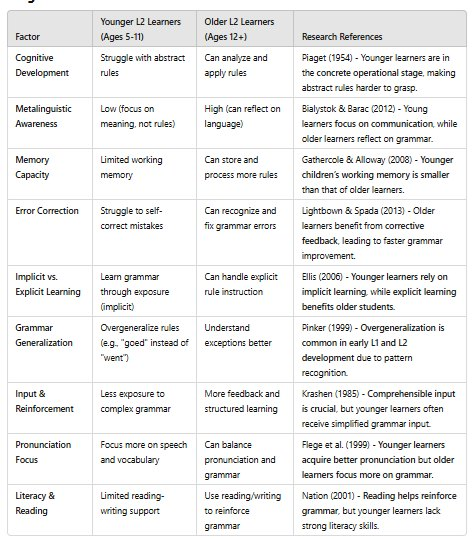
In considering the cognitive load posed by the target grammar structures in an attempt to sequence them in your curriculum in a easier to harder flow, it is key to consider the challenges posed by each of them, summarised in the table below, from my workshop on Grammar Instruction.

Why do younger learners find learning grammar challenging?

Younger second language (L2) learners often struggle with grammar acquisition due to cognitive, linguistic, and developmental factors. Unlike vocabulary, which they can pick up more naturally, grammar rules require abstract thinking, memory, and metalinguistic awareness, which are still developing in young learners. Below are the key reasons why younger L2 learners find grammar learning challenging:

1. Limited Cognitive development

1.1 Abstract Thinking is Not Fully Developed

  • Grammar rules involve abstract concepts (e.g., verb conjugations, subject-verb agreement, and tenses).
  • Piaget’s (1954) Cognitive Development Theory states that children under 11 operate in the concrete operational stage, meaning they struggle with abstract rules.
  • Older learners (adolescents and adults) use formal operational thinking (age 12+), making them better at understanding syntactic structures

1.2 Working Memory Limitations

  • Younger children have smaller working memory capacity (Gathercole & Alloway, 2008), meaning they struggle to hold and process multiple grammar rules at once.Older learners can store and manipulate grammatical structures more efficiently.
  • Older learners can store and manipulate grammatical structures more efficiently.

2. Lack of Metalinguistic Awareness

2.1 Younger learners do not consciously analyze language

  • Metalinguistic awareness is the ability to think about and manipulate language structures, which develops with age.
  • Studies (Bialystok & Barac, 2012) show that younger L2 learners focus more on communication rather than explicit grammar rules.

2.2 Struggle with Error Correction

  • Because of their lack of metalinguistic awareness and limited levels of LAA* (language analytical ability), younger learners do not benefit much from error correction
  • Older learners can self-correct grammatical mistakes by applying rules.
  • Younger children often repeat mistakes without realizing why they are incorrect.

3. Implicit vs. Explicit Learning Differences

  • Younger learners rely more on implicit learning (unconscious absorption of rules), while older learners benefit from explicit instruction. That is why using EPI, which relies heavily on structural priming (subconscious learning of grammar) is so powerful at primary.
  • Grammar requires explicit learning (Ellis, 2006), and young children struggle with rule-based learning since they primarily learn through exposure and repetition rather than conscious analysis.

4. Difficulty Generalizing Grammar Rules

4.1 Overgeneralization of rules

  • Younger L2 learners tend to overgeneralize grammatical patterns (e.g., saying “goed” instead of “went”).
  • This happens because they rely on patterns rather than understanding exceptions, which is common in early L1 and L2 learning (Pinker, 1999).Grammar Rules Change Based on Context

4.2 Grammar Rules Change Based on Context

  • Some grammatical structures vary depending on context (e.g., past tense in regular vs. irregular verbs).
  • Young learners struggle to apply rules flexibly in different contexts.

5. Limited Input and Reinforcement

5.1 Grammar exposure in early L2 learning is inconsistent

  • Young learners often hear simplified language (e.g., teachers and caregivers speaking in basic sentences).
  • Without frequent rich input, grammar structures take longer to acquire.

5.2 Grammar Rules Change Based on Context

  • Young learners struggle to apply rules flexibly in different contexts.
  • Some grammatical structures vary depending on context (e.g., past tense in regular vs. irregular verbs).

6.6. Pronunciation and Phonological Constraints Affect Grammar Learning

Syntax and morphology take longer to develop, especially in languages with complex word order (e.g., German, Russian).

Younger learners focus more on pronunciation and vocabulary, delaying grammar acquisition.

7. Limited Literacy Skills

Reading and writing skills support grammar acquisition

  • Older learners benefit from written reinforcement (e.g., textbooks, grammar exercises).
  • Younger learners, especially pre-literate children, lack exposure to written forms of grammar.

Conclusions

Younger L2 learners acquire vocabulary naturally but struggle with grammar because it requires abstract thinking, rule analysis, and memory capacity.

Older learners are better at learning grammar explicitly due to stronger cognitive abilities and metalinguistic awareness.

Young learners need repeated exposure, interactive learning, and implicit reinforcement rather than direct rule-based teaching. The exposure must be as multimodal as possible and .cognizant of the TAP (transfer appropriate processing) phenomenon, i.e. the context-dependency of memory (e.g. a grammar rule learnt through rehearsing a song many times over is not likely to be transferred to other contexts and tasks, but is going to sty confined to that song).

The grammar content needs to be light and informed by the learners’ readiness to acquire the target structures.

The students should not be asked to produce language too soon and in the contexts of tasks that challenge them beyond their current level of competence. This applies to learners of any age, but it is particularly true of primary-age students, as they are low monitors of grammar accuracy.

EPI (Extensive Processing Instruction) is very powerful in this respect as it capitalizes on subsconscious learning through syntactic priming, i.e. where exposure to a specific sentence structure increases the likelihood of using the same structure in subsequent speech or writing. It occurs in both first (L1) and second language (L2) learning, reinforcing grammatical patterns through repetition. For example, if someone hears “The cat was chased by the dog” (passive voice), they are more likely to later produce another passive sentence like “The book was read by the student.” Studies (Bock, 1986) show syntactic priming helps L2 learners internalize complex structures, aiding fluency and reducing cognitive load during sentence formation.

Here’s a summary of the above points:

*Language Analytical Ability (LAA) refers to the cognitive skill that enables learners to analyze, understand, and manipulate linguistic structures in a second language (L2). It is crucial for explicit grammar learning, problem-solving in language acquisition, and recognizing language patterns.