by Gianfranco Conti, PhD. Co-author of 'The Language Teacher toolkit', 'Breaking the sound barrier: teaching learners how to listen', 'Memory: what every teacher should know' and of the 'Sentence Builders' book series. Winner of the 2015 TES best resource contributor award, founder and CEO of www.language-gym.com, co-founder of www.sentencebuilders.com and creator of the E.P.I. approach.
Teaching language by topics in Instructed Second Language Acquisition (ISLA) is a common approach, but research shows both advantages and disadvantages. Here’s a breakdown of the pros and cons based on current findings in ISLA literature:
Pros of Teaching Language by Topics
Enhanced Motivation and Engagement
Research suggests that topic-based instruction increases learners’ interest, as it connects language learning to real-life contexts (Dörnyei, 2009).
Topics can be tailored to learners’ interests, making learning more meaningful (this is key!).
Improved Vocabulary Retention
Thematic instruction helps learners acquire and retain vocabulary more effectively because words are introduced in meaningful contexts (Nation, 2001).
Semantic clustering within a topic can aid memory recall (Schmitt, 2008).
Supports Communicative Language Teaching (CLT)
Topics provide a natural framework for discussion, making it easier to integrate speaking and listening activities.
Encourages real-world language use and pragmatic competence (Ellis, 2005).
Promotes Deeper Processing
Learners are more likely to process language at a deeper cognitive level when it is linked to a coherent theme (Swain, 2005).
Supports meaningful interaction and content-based learning.
Facilitates Cross-Curricular Learning
Topic-based learning allows integration with other subjects (e.g., history, science), which can lead to content and language-integrated learning (CLIL) benefits (Dalton-Puffer, 2011).
Cons of Teaching Language by Topics
Limited Grammar Focus
Topic-based teaching often prioritizes vocabulary and communicative skills over explicit grammar instruction, which may hinder grammatical accuracy (DeKeyser, 2007), an issue that can be easily tackled through careful planning.
Some structures may not naturally arise in certain topics, leading to gaps in grammar coverage. Another issue that can be overcome through careful planning.
Potential Overload of Semantic Clustering
Research suggests that presenting too many related words at once (e.g., all fruit names) may hinder learning due to interference effects (Waring, 1997). This issue can be mitigated by selecting the target words in such a way that words which are too similar in meaning (e.g. ‘truck’ and ‘van’ are not taught in the same set).
Mixed or spaced exposure might be more effective than strict topic-based learning (Webb, 2007). Nothing stops a teacher from revisiting and reviewing material learnt during Unit 1 on topic A when teaching Unit 2 on topic B, especially if you sequence topics which are semantically related (e.g. Unit 1 = Leisure, Unit 2 = Healthy living, Unit 3 = My daily routine).
Lack of Systematic Progression
If not carefully planned, topic-based instruction may lead to gaps in linguistic knowledge because it doesn’t always follow a structured progression of difficulty (Pienemann, 1998).
Learners may struggle with cumulative language development if topics do not build on each other in a logical sequence. This issue and the previous one can, yet again, be solved through careful planning.
Difficulty in Addressing Individual Needs
Some learners may need specific grammatical structures or language functions that do not fit into the selected topics.
Individualized learning paths might be harder to implement within a fixed topic framework.
May Not Align with Standardized Testing Goals
Topic-based approaches might not cover all the grammar and vocabulary required in standardized assessments (Alderson, 2005). This requires some creativity on the part of the curriculum designer, but can be solved by embedding such items in texts and tasks.
Test-oriented learners may feel unprepared if explicit instruction is lacking and the topics are not aligned with the tests.
Conclusion
Teaching by topics can be highly effective for engagement, vocabulary acquisition, and communicative competence. However, for a balanced ISLA approach, it should be supplemented with explicit grammar instruction, varied input, and opportunities for structured language practice.
A hybrid approach that combines topic-based instruction with form-focused activities (e.g., EPI, task-based language teaching or focus on form) may offer the best outcomes (Ellis, 2016). The devil is always in the detail; if you are working towards a specific exam, you can always embed in whatever topic you have chosen to teach texts and activities containing language items extraneous to that topic. All you need is a bit of creativity, but it can be done. By breaking down a topic in sub-topics centred around communicative function, it is fairly easy to cover specific grammar structures.
As far as motivation is concerned, it is key to select topics and sub-topics which are relevant to the target children, as relevance is key. When the topics are mandated by the examination boards, then it is crucial to at least teach words the students are likely to be interested in learning. And when these words fall outside the lists mandated by the examination board, as may happen with the new MFL GCSE in England, one has to heed the children’s wants and strike a balance by adding some vocabulary items in the mix for relevance and motivation’s sake.
When it comes to the important issue of grammar progression, the curriculum deisgner needs to heed learnability theory (see this post of mine) and sequence the topics in such a way that the challenge stays always within the zone of optimal development. This doesn’t always happen with UK-published textbooks, where the selection of the grammar is quite random.
With regard to the interference issue, i.e. words from lexical sets centred on a given topic interfering with one another, research shows that it is mostly at play when words sound similar (‘jaune’ and ‘jeune’ in French) or when they have similar meanings (e.g. ‘mignon’ and ‘joli’ in French). Also, the evidence that such interference occurs comes mainly from lab experiments where the target words are mostly taught out of context, and in lists. In my experience, if words are taught multimodally, including using unambiguous visual aids, in learnable amounts, in context and through the multiple encounters with the words suggested by research (e.g. 15 minimum through the receptive skills) the issue is easily overcome.
Finally, as long as interleaving of key structures and vocabulary is concerned, it can be done even when teaching thematically. It is just a matter of selecting and sequencing the topics carefully; using my cumulative texts and tasks strategy; having an intelligent retrieval practice schedule in which language items from the various units are interleaved at space intervals, etc.
References
Alderson, J. C. (2005). Diagnosing foreign language proficiency: The interface between learning and assessment. Continuum.
Dalton-Puffer, C. (2011). Content-and-language integrated learning: From practice to principles? Annual Review of Applied Linguistics, 31, 182–204.
DeKeyser, R. (2007). Practice in a second language: Perspectives from applied linguistics and cognitive psychology. Cambridge University Press.
Dörnyei, Z. (2009). The L2 motivational self system. In Z. Dörnyei & E. Ushioda (Eds.), Motivation, language identity and the L2 self (pp. 9-42). Multilingual Matters.
Ellis, R. (2005). Principles of instructed language learning. System, 33(2), 209-224.
Ellis, R. (2016). Focus on form: A critical review. Language Teaching Research, 20(3), 405-428.
Nation, I. S. P. (2001). Learning vocabulary in another language. Cambridge University Press.
Pienemann, M. (1998). Language processing and second language development: Processability theory. John Benjamins.
Schmitt, N. (2008). Review article: Instructed second language vocabulary learning. Language Teaching Research, 12(3), 329-363.
Swain, M. (2005). The output hypothesis: Theory and research. In E. Hinkel (Ed.), Handbook of research in second language teaching and learning (Vol. 1, pp. 471-483). Routledge.
Waring, R. (1997). A study of receptive and productive learning from word cards. Studies in Foreign Language Education, 12, 94–114.
Webb, S. (2007). The effects of synonymy on second-language vocabulary learning. Applied Linguistics, 28(1), 1-22.
Listening is widely recognized as one of the most challenging yet crucial skills in second language acquisition. Despite its importance, traditional listening instruction in many language classrooms remains product-oriented, focusing primarily on testing comprehension through questions and answers, rather than teaching students how to listen effectively. This approach often leaves learners feeling frustrated and demotivated, as they struggle to make sense of spoken language without the necessary strategies or skills to decode it. To address these challenges, a process-based approach to listening instruction has emerged, emphasizing the development of aural micro-skills, strategic listening, and metacognitive awareness.
In this context, effective listening instruction involves more than just exposing students to spoken language; it requires a systematic approach that empowers learners to actively engage in the listening process. This includes teaching vocabulary aurally in context, rather than through isolated word lists or digital flashcards, to enhance word recognition and retention. Furthermore, successful listening hinges on mastering a range of micro-skills, such as phoneme recognition, word segmentation, lexical retrieval, parsing, chunking, and meaning-building. These skills enable learners to process spoken input efficiently and accurately, paving the way for improved comprehension and fluency.
Moreover, motivating learners through engaging and interactive tasks is essential for sustained listening practice. Research consistently shows that motivation and self-efficacy are powerful predictors of success in listening. Therefore, this article advocates for a motivational framework that incorporates gamification, relevant input, and the PIRCO sequence—a structured approach that guides learners through pre-listening, while-listening, and post-listening phases to maximize comprehension and retention.
This article explores how a process-based approach, grounded in cognitive and metacognitive strategy instruction, can transform listening instruction from a passive activity into an active, strategic, and enjoyable learning experience. By shifting the focus from merely testing comprehension to teaching the process of listening, educators can better equip students to navigate the complexities of spoken language, ultimately leading to greater language proficiency and confidence.
Ten tips that will enhance your listening outcomes
Here are ten key tried-and-tested instructional strategies that will definitely enhance your listening oucomes.
1. Teach vocabulary through listening in the context of highly comprehensible input– Success at listening hinges largely on word recognition (72 % !). However, in order to be useful for listening tasks, words need to be acquiredthrough listening. This often doesn’t happen in the typical MFL classroom, where words are typically learnr through worksheets or apps like Quizlet, which do not provide much listening practice.
Note that learning vocabulary aurally requires more exposures than learning it through reading, so you need to factor in 10 to 15 meaningful exposure in context, not in isolation, at least. Practising words aurally, in isolation, is not very useful and totally unauthentic. Teaching vocabulary aurally ought to involve an initial phase involving listening-while-reading (see my previous post on this) with or without pictures followed by listening without a script.
Highly comprehensible input is key, of course, due to the very high cognitive that listening poses on language learners and the anxiety that exposure to a lot of unknown vocabulary can cause. Listening-specific anxiety is a phenomenon that has been widely documented by researchers and one which significantly hinder performance.
2. Develop the micro-skills of listening using a process-based approach (Field, 2009) – Too much listening instruction has traditionally been about top-down processing, i.e. asking students to predict the content of an aural text, to guess intelligently using content and critical thinking and other higher order cognitive skills which, whilst useful, should not dominate listening instruction, especially not at the early stages of second language instruction and not with low-ability L2 learners. The Pearson textbooks are notoriously bad in this respect.
To understand how difficult listening is: in the space of 2 seconds, your students must decode every sentence they hear executing the following skills:
– phonemes recognition
– recognition of syllables and intonation patterns
– word segmentation (identification of words boundaries)
– lexical retrieval (recognition of content words and lexical phrases)
– parsing (grammar, syntax, function words, etc.)
– chunking (as they do the above, the learners need to keep each sentence they hear firmly and comfortably in their phonological memory for as long as it takes for them to decode it)
If the execution of the above skills is successful, they will likely understand the meaning of each sentence they hear (the meaning building phase). If they are listening to a text longer then a sentence, they will use the information gathered from the sentence just decoded and mix it with the information in every new incoming sentence to gather a global understanding of the whole text (discourse building).
Due to the severe demands of the listening process, it is key that the students become fluent in the execution of the above micro-skills. Hence, in each listening lessons, you will stage tasks which engage the students in practice with above micro-skills. Here are some examples of mostly SCRIPTED LISTENING activities which practise the micro-skills of listening:
Aural micro-skills
Aural activities
Phoneme recognition
Faulty echo, Write it as you hear it, Spot the silent letters, Track the sound, Listen and correct, Musical chairs
Syllable and intonation patterns recognition
Syllable building blocks, Syllable bingo, Spot the stressed syllable, Cross out the intruder
Word segmentation
Break the flow, Spot the intruder, Spot the liaison, Faulty transcript, Word grab
Lexical retrieval
Sentence bingo, Faulty translation, Spot the nonsense, Tangled translation, Tick or cross
Parsing
Sentence puzzle, Fixy echo, Track the structure, Faulty echo, Rhyming pairs, Sorting tasks, Guess the next word
You will start using this approach from the early stages of secondary, gradually transitioning to more challenging texts, where you may implement the above activities as part of the PIRCO sequence (see below) both in the Pre-listening and in the Consolidation phases. This approach has been laid out in my best-selling book with Steve Smith, Breaking the sound barrier, teaching language learners how to listen.
3. Make it motivational by building self-efficacy, making it enjoyable and choosing interesting input – Motivation and Self-efficacy (one of the most important catalysts of motivation) are the strongest predictors of success at listening (Macaro, 2001).
Here are some important tips if you want to generate and maintain the motivation to listen:
– Make it as interactive as possible using mini-whiteboards. Most of the activities in the table above are interactive or can be made interactive with the use of mini-whiteboards. The teacher reads aloud a sentence with an intruder, for example, and the students need to spot it and write it on her miniwhiteboard
– Gamify it whilst keeping it meaningful and evidence-based (See activities in the the table above)
– Make it accessible to most of your learners (a meaty pre-listening vocab teaching phase is key with mixed ability classes)
– Make sure your students arrive at a text prepared and leave with the feeling that they have learnt something. Never let the students leave the task with very little learning and a meaningless grade (the ‘Empty hands’ + ‘I can’t do listening’ effect) as too often happens! To prevent this, you should embed listening within a carefullydesigned Input-to-Output sequence (see Rost, 2002; Conti and Smith, 2019) which aims at recycling the target vocabulary around 40 times across all four skills (that’s the minimal amount of exposure we need to commit a word to long-term memory across all four skills). Please note that for the vocabulary you will want your students to learn only receptively, you will need 6-10 exposures through reading and 10-15 through listening. Here’s an example of my favourite input-to-output sequence:
(1) a very substantive pre-listening phase where you teach key vocabulary, grammar and sound patterns. This should be longer than the one or two vocab-building activities usually done, and should include a mix of listening (including Scripted Listening ones) and reading activities.
(2) a while-listening phase in which the students gradually move to listening comprehension tasks – These should include very simple tasks allowing most students to succeed, e.g. word grab, and/or a set of very simple comprehension questions that most children can answer and then move to more challenging activities.
(3) a review phase where the transcripts are examined and the obstacles to comprehension are identified;
(4) a consolidation phase where (a) the reading-whilst-listening tasks are performed on the transcript (this should be as gamified as possible and target the key linguistic features in the text) and (b) the vocabulary in the text is solidified;
(5) a pushed-output phase where the key linguistic items are used by the students to translate and to communicate more creatively (role plays, interviews, monologues). This sequence, that I call PIRCO (see figure 1 below), is the most powerful I have ever implemented with my GCSE classes.
Do note that the post-listening phases, i.e. (3), (4) and (5) are key. As professor Rost, in his seminal 2002 article states: the “post-listening” stage of listening occurs in the few minutes following the actual attending to the text. This is probably the most important part of listening instruction because it allows the learner to build mental representations and develop short-term L2 memory, and increase motivation for listening a second time.
MPORTANT – When you stage the pre-listening phase, make sure that you do not give away the answers to the questions in the subsequent aural comprehension phase.
Figure 1: the PIRCO sequence
– Avoid ‘death by past-paper’ practice until you get closer to the exam, and even then, bearing in mind that cognitive fatigue sets in when we listen after barely 90 seconds of continuous listening, stage only specific tasks in the exam papers that you deem more useful.
– Make the input relevant. Students are keener to listen to something they are interested in. Before playing a text about a celebrity, play a song, video or film trailer to enhance their interest and curiosity
– Avoid grading every task – which brings me to the next point
(4) Delay awarding grades until is truly necessary. Focus on improving listening skills (listening to learn) not grades (listening to test), until you are close to the exams – Prioritizing a focus on the process of listening over a focus on the product of listening is essential in listening instruction, especially when transitioning from lower to upper school. Listening being the most challenging of the four skills and the one that causes the most anxiety amongst children, it is key to refrain from grading the students’ work every time you stage a listening activity. Remember the ‘empty hands’ effect, so common after a listening activity; do you really want to compound its negative effect on self-efficacy and motivation with a poor grade? Why would that student ever want to listen to another aural text again? By investing your efforts, instead, into working on improving student self-efficacy and listening skills you are more likely to forge more motivated and competent listeners who are not afraid to listen.
How about the exams? Remember the PIRCO sequence above? You will gradually phase it out as you draw close to the exam and move to PIR (pre-listening, in-listening and review) where the pre-listening phase will be mostly about imparting listening strategies. Bear in mind that according to research listening strategies need to taught regularly for a period of over three months. So, starting with PIR one term before the listening exams would work. Remember that teaching listening strategies when the students have a modest vocabulary repertoire can be counterproductive, according to some researchers (e.g. Renandya, 2022). Strategies cannot be a substitute for vocabulary and syntactic knowledge.
(5) Stage a Needs’ analysis when you first meet the students – At the beginning of year 10, I recommend a quick survey carried out using google forms aimed at finding out what the students experiences with listening were at KS3, what their attitude to listening is, as well as other data to do with their self-efficacy and self-confidence as listeners. This is imperative in departments where learner motivation to listen is low, the team have heterogenous/inconsistent approaches to listening instruction and/or use the listening materials and tasks in textbooks (which are horrendously designed and sequenced) and/or where listening is the ‘cinderella’ skill.
(6) Use Narrow Listening (possibly in combination with Narrow Reading) – Narrow listening, where two or three near-identical aural texts are used in an instructional sequence involving connected texts, is a powerful way to practise and reinforce vocabulary. With ChatGpT or other AI powered tools, this is very easy to accomplish in a matter of seconds; just ask the software to produce an identical text by changing an X number of words. Then copy and paste in a text-to-speech online tool and the job is done! Staging narrow reading prior to narrow listening with very similar texts to the ones that they will be listening to will, of course, be a great way to prime the students for the subsequent aural tasks.
(7) Before your students do any silent reading comprehension work, stage some Scripted Listening (aka reading-whilst-listening) activities – Activities such as Spot the intruder, Spot the missing detail, Faulty transcript, Spot the pronunciation mistakes, Add the missing endings, Track the sound, Spot the wrong word order, Disappearing text, etc. can easily be staged prior to reading tasks injecting some fun in what are often pretty dry tasks. The pedagogical rationale for this approach is two-fold: firstly, when students read silently they subvocalize automatically converting every written symbol they process into their dominant language – so you may want to prevent that; secondly, you have an extra chance to practise listening!
(8) Teach listening strategies when the students are ready – Listening strategies (see table below) can be useful, but are no substitute for vocabulary, grammar and phonological competence. Hence, teaching your students listening strategies ought to be done in the later stages of KS4, when the students have accrued a substantive vocabulary (between 1,000 and 2,000 high-frequency words) . The training should involve regular practice with the strategies, at least 15 minutes per week for 3 months, according to some research. Do remember that the research evidence on the effectiveness of listening strategy instruction is very scant and inconclusive and most studies have been carried out with older students, most at university or pre-university level.
(9) Develop their metacognition – Make them aware of the listening process since the very early stages of their language learning journey. Show they how we listen, what skills are involved in the process. Starting in year 7 do reading whilst listening games with the transcript of the aural texts they have just listened to, to inject some fun in the process and to make them aware of the obstacles they encountered whilst listening. In pre-examination times, make them aware of their most common affective and cognitive problems as they listen and provide them with tips on how to overcome or mitigate them.
(10) Do regular surveys of student self-efficacy – If in your Department there is a history of poor achievement in listening, do carry out regular surveys to find out whether the students (1) are enjoying listening; (2) feel they are learning from it (self-efficacy) ; (3) what concerns them the most; (4) what they suggest you could do to help them and (5) make it more fun. Do them every half-term with ‘at risk’ classes and use a 1(lowest) to 4 (highest) scale for them to rate each item, so that nobody sits on the fence. If you see lots of 1s and 2s very early on in the process, then you know it-s time to intervene drastically.
Concluding Remarks
In conclusion, effective listening instruction hinges on a process-based approach that goes beyond mere comprehension checks and emphasizes the development of essential aural micro-skills, vocabulary acquisition, and metacognitive awareness. This article underscores the necessity of teaching vocabulary aurally in context, recognizing that listening is primarily about word recognition and requires multiple exposures within meaningful contexts to ensure retention and application. By integrating vocabulary teaching with listening tasks, learners will be better equipped not only to handle GCSE exam tasks but also authentic listening scenarios, thereby enhancing their overall comprehension and confidence.
Furthermore, the process-based approach advocated here emphasizes the importance of developing the micro-skills of listening, including phoneme recognition, word segmentation, lexical retrieval, parsing, chunking, and meaning-building. These foundational skills are crucial for accurate decoding and meaning-making, ensuring that learners can efficiently process spoken language. This structured practice, combined with scripted listening activities tailored to each micro-skill, provides the necessary scaffolding for learners to build fluency and accuracy in real-time listening.
Additionally, this posts emphasizes the need to build motivation and self-efficacy by creating enjoyable and meaningful listening experiences. By using interactive tasks, gamification, relevant input, and the PIRCO sequence, teachers can foster a positive learning environment that encourages persistence and reduces anxiety associated with listening tasks. This motivational approach not only sustains learners’ interest but also cultivates a sense of achievement and progress, essential for long-term language acquisition.
Finally, this article emphasizes the key role of listening-to-learn, a methodology laid out in Conti and Smith (2019), where it is called LAM (or Listening As Modelling), whose key staples are summarised below:
Principle
Description
Prioritize Listening in Language Instruction
Listening is fundamental to language learning and should be emphasized in teaching.
Integrate Listening with Other Language Skills
Listening should be combined with speaking, reading, and writing to create a holistic learning experience.
Provide Comprehensible and Patterned Input
Use input that is understandable and follows predictable patterns to aid learning.
Focus on Process-Oriented Listening Instruction
Teach students how to listen effectively, rather than just testing their comprehension.
Develop Micro-Skills of Listening
Train students in specific listening skills, such as phonemic processing and segmenting.
Reduce Listening Anxiety and Build Self-Efficacy
Create a supportive environment to lower anxiety and boost students’ confidence in listening.
Use Teacher-Led Modeling
Teachers should actively model listening skills, rather than relying solely on audio recordings.
Implement Structured and Scaffolded Listening Activities
Design activities that gradually increase in complexity, providing appropriate support at each stage.
Encourage Active and Reflective Listening Practices
Promote strategies that engage students actively and encourage reflection on their listening processes.
Input Flood
Expose learners to a high frequency of target language forms (e.g., specific grammatical structures or vocabulary) within meaningful contexts to increase familiarity and recognition.
Input Enhancement
Make specific language features more noticeable through visual or auditory cues (e.g., highlighting, repetition, or changes in tone) to draw learners’ attention to them.
Repeated Processing
Encourage multiple exposures to the same input material through varied activities (e.g., listening for gist, detailed comprehension, or inferring meaning) to deepen understanding and retention.
Thorough Processing
Consists of techniques that force students to process the texts in detail, ensuring a deeper understanding of language structures, vocabulary, and meanings.
Please note that a new Language Gym GCSE workbook based on these and other effective instructional strategies will be out in March. It will implement the PIRCO sequence as applied to the new GCSE word lists. In addition to listening-to-learn tasks, it will also include listenint-to-test tasks based on the new GCSE exam papers.
In the 80s and 90s, metacognition – one’s awareness and regulation of one’s own thinking and learning processes – was a big deal in educational circles. L2 researchers like O’Malley and Chamot, Wenden, Cohen and, in England, Professors Macaro (my PhD supervisor) and Graham (my PhD internal examiner), advocated vehemently for the implementation of training in metacognitive strategies as a means to improve learning outcomes.
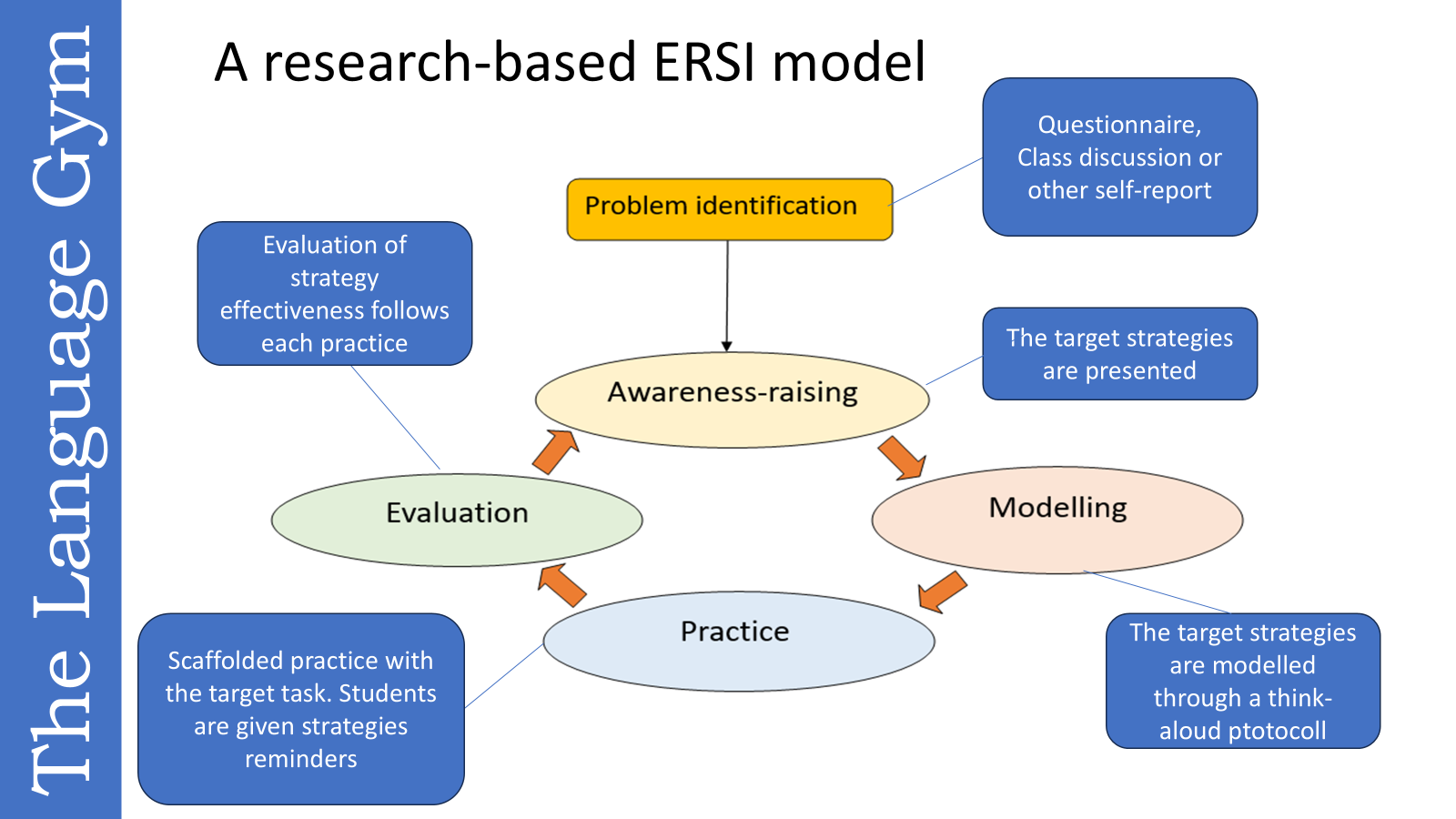
These advocates postulated, based on evidence from a handful of promising studies, that metacognition could be effectively taught following a principled framework (Explicit Strategy Training) which unfolded pretty much like the model in the picture below (ERSI = Explicit Reading Strategies Instruction), significantly enhancing L2 students performance across all four language skills.
Figure 1 – Explicit Strategy Training model
As often happens in our field, the interest fizzled out pretty soon, as language educators quickly realised that the time and effort they had to put in in order for metacognitive training (henceforth MT) to yield some substantive benefits was more than they could afford. There were other issues too, which I will explore below, to do with developmental readiness, teacher expertise and motivation, which deterred many language educators from buying into MT.
I experienced first-hand how time consuming, effortful and complex implementing an MT program is, during my PhD in Self-Monitoring strategies as applied to L2 essay writing. Mind you, the results were excellent: the training managed to significantly reduce a wide range of very stubborn errors in my students’ writing. However, the time and effort I invested in the process was something that I could have never been able to put in, had I been a teacher on a full timetable.
40 years on since its golden age, metacognition and MT are trending again in educational circles. Many schools are now implementing metacognition enhancement programs in the hope to increase learner planning, monitoring and self-evaluation skills. However, at least from what I have gleaned from my school visits, conversations with colleagues and other anecdotal data, many of these programs exhibit a number of flaws which seriously undermine their efficacy. Before delving into them, let me remind the reader of what metacognition and metacognitive strategies are about.
Metacognition and metacognitive strategies – what are they?
Having written about metacognition before, I will very briefly remind the reader of what metacognition entails.
Metacognition is the awareness and regulation of one’s own thinking and learning processes. It involves three key components:
(1) Metacognitive Knowledge—understanding how one learns best;
(2) Metacognitive Regulation—planning, monitoring, evaluating and adjusting learning strategies; and
(3) Metacognitive Experience—reflecting on past learning to improve future performance.
In language learning, metacognition helps learners set goals, choose effective strategies, and evaluate progress. It fosters independence, problem-solving, and long-term retention. Effective metacognitive strategy training enables learners to become more self-aware and adaptable, improving comprehension, speaking, and writing skills. Ultimately, metacognition transforms learners into active, strategic thinkers who optimize their own learning.
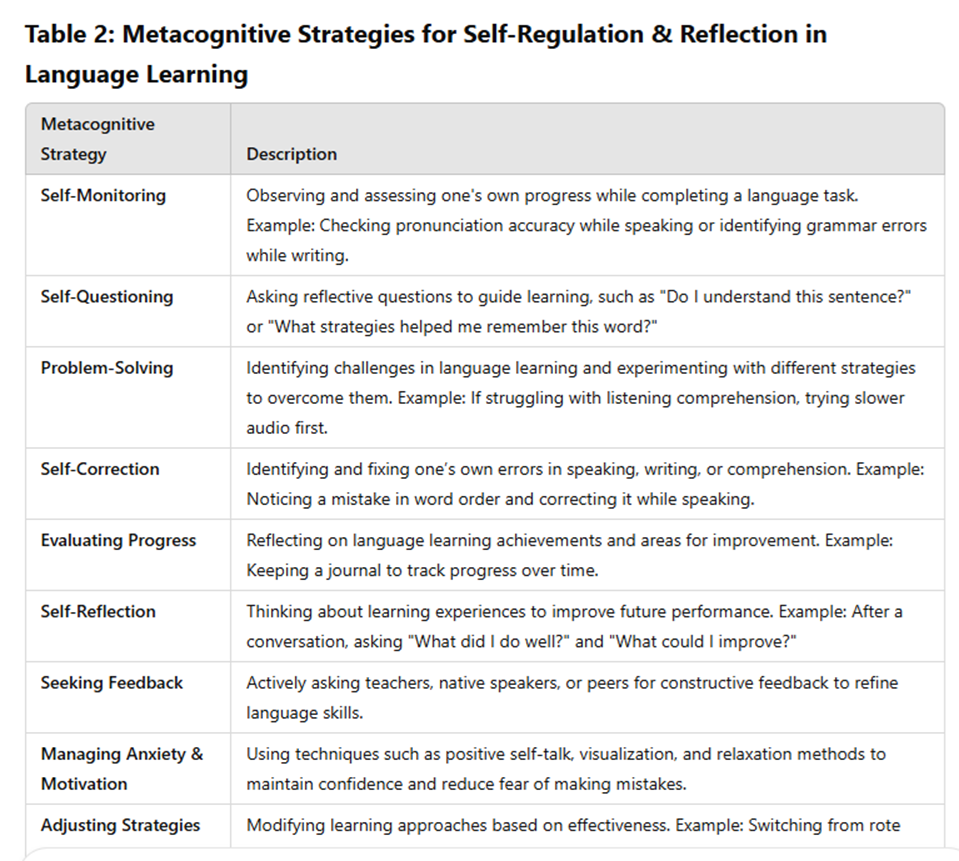
Metacognitive strategies include actions, mental operations and techniques that L2 learners undertake in order to improve their performance by planning, monitoring, self-evaluating and setting goals, Tables 1 and two below categorize metacognitive strategies into those that help with planning & monitoring and those that support self-regulation & reflection, making them easier to implement systematically.
Common shortcomings of metacognitive training programs
1️ Insufficient or Inconsistent Training Duration
Many programs do not provide enough time for learners to fully develop and internalize metacognitive strategies. Effective strategy use requires regular and long-term practice and reinforcement lasting 3 to 6 months or even longer, yet some programs last only a few weeks. This is the most common reason as to why MT programs fail according to the literature.
Example Issue:
🔹 A 4-week metacognitive training program may not show strong results because learners haven’t had enough exposure to develop automatic strategy use.
Solution:
✅ Longer programs with progressive scaffolding (e.g., training over an entire semester or year). ✅ Periodic strategy reinforcement instead of one-time instruction.
2. Lack of Explicit Training
Why It Matters
Some teachers assume that learners will naturally pick up metacognitive strategies just by being exposed to them. Implicit instruction (modeling, indirect feedback) can play an important role but on its own is often not enough—students need explicit training on how and when to use these strategies.
Example Issue:
🔹 A study where learners are simply given reading comprehension tasks but are not explicitly taught how to plan, monitor, and evaluate their reading may fail to show significant improvements.
Solution:
✅ Explicit strategy instruction with step-by-step guidance (e.g., teaching learners to pause, summarize, and predict while reading). ✅ Use of think-aloud protocols where instructors demonstrate metacognitive strategies.
3. Lack of Learner Awareness & Readiness
Why It Matters
Not all learners instinctively use metacognitive strategies. Beginners or low-proficiency learners may lack the cognitive capacity to focus on both language processing and strategy application at the same time.
Example Issue:
🔹 A program implementing high-level reflection strategies with beginner learners may find little impact because they struggle with basic comprehension, making strategy use overwhelming.
Solution:
✅ Gradual introduction of simple strategies first, then progression to more complex ones. ✅ Differentiated instruction based on learner proficiency.
4. Misalignment Between Metacognitive Strategies and Task Demands
Why It Matters
Some strategies may not be suitable for the specific language task the students are being training to perform. If the strategy does not align with the nature of the task, learners may misuse or underuse it.
Example Issue:
🔹 Testing metacognitive listening strategies (predicting, summarizing) on a phoneme discrimination task may not see much improvement because phoneme recognition relies more on cognitive than metacognitive skills.
Solution:
✅ Ensure the right strategies are taught for the right tasks (e.g., metacognitive strategies are most useful for reading, writing, and listening comprehension). ✅ Train students when to use which strategy effectively.
5. Limited Learner Motivation or Engagement
Why It Matters
Some students do not see the immediate value of metacognitive strategies and fail to engage with them actively. If students are not motivated, they are unlikely to consistently apply the strategies outside of training sessions.
Example Issue:
🔹 A study assumes that students will automatically use metacognitive strategies in their self-study time, but without motivation, many learners simply do not apply them.
Solution:
✅ Increase strategy relevance by linking them to real-world benefits (e.g., improving exam performance, fluency, or confidence). ✅ Use gamification and self-reflection exercises to keep learners engaged.
6. Failure to Account for Individual Differences
Why It Matters
Learners differ in cognitive styles, motivation, and prior strategy knowledge. Some learners naturally use metacognitive strategies, while others struggle even after training.
Example Issue:
🔹 A study may average the results across all learners without considering that some learners benefited while others did not.
Solution:
✅ Conduct pre-tests to determine baseline strategy use before training. ✅ Use personalized strategy training rather than a one-size-fits-all approach.
✅ Use multiple assessment methods (e.g., think-aloud protocols, task-based assessments, real-time monitoring). ✅ Measure language proficiency gains alongside self-reports.
7. Teacher Expertise & Implementation Issues
Why It Matters
Some teachers may not be adequately trained in metacognitive instruction, leading to ineffective delivery.
Example Issue:
🔹 A program on listening strategy training fails to show strong results because teachers do not provide clear modeling or feedback.
Solution:
✅ Ensure teacher training in explicit strategy instruction. ✅ Use standardized instructional methods across all participants.
8. Short-Term vs. Long-Term Impact Measurement
Why It Matters
Some program measure effects immediately after training, missing potential long-term benefits. Metacognitive strategies often require time to internalize before showing clear benefits.
Example Issue:
🔹 A program finds no significant impact after 4 weeks, but if measured after 6 months, the results might be different.
Solution:
✅ Conduct longitudinal follow-ups to check delayed improvements. ✅ Use delayed post-tests to assess strategy retention.
Conclusion: Why do many metacognitive training programs fail?
Many MT programs fail to show strong effects because of:
Too short training duration – Not enough time for mastery.
The students may not be cognitively ready – MT does require the application of higher order skills
The students may simply not be interested – they are there to learn a language and may not see the long-term benefits or what you are trying to achieve
Lack of explicit strategy instruction – Students don’t know how to use the strategies effectively.
Poor alignment of strategies with tasks – Wrong strategies for the wrong skills.
The teachers simply do not have the know-how to teach metacognitive skills
Any Language educator wanting to teach metacognition should bear the above issues in mind before embarking on an MT program. Following a trend can be a very perilous endeavour, especially in a field like L2 acquisition, in which the research evidence that MT programs actually work is very fragmented and inconclusive.
If you want to know more about Metacognition and metacognitive training, you can attend any of my workshops organised by http://www.networkforlearning.org.uk




 The Language Gym
You must be logged in to post a comment.