16 Reasons Why So Many Students Fail at Speaking and What We Can Do About It (Part 1)

Before anything else, a quick clarification.

This is Part 1, and its purpose is diagnosis rather than prescription. Part 2 will focus explicitly on classroom implications — what all this actually means for lesson design, routines and daily practice. Without that second step, this would simply be another complaint… and in my experience, teachers have heard plenty of those already.

Now, let’s address the elephant in the room.

In my experience, yes, a good chunk of students are lazy, disengaged and poorly motivated… and pretending otherwise helps no one. Some don’t revise. Some don’t practise. Some are content doing the bare minimum.

However laziness alone does not explain the scale and predictability of speaking failure. If it did, outcomes would be far more random. They aren’t. Speaking failure follows patterns, and it affects even motivated, conscientious students — the ones who listen, revise and genuinely try.

And that should make us pause… shouldn’t it?

As we say in Italy, la realtà è più testarda delle opinioni — reality is more stubborn than opinion.

So yes, demotivation exists. But in my opinion, the system itself still sets up far too many willing students to fail at speaking. That is the uncomfortable truth this first part sets out to unpack.

Why this post?

The second most important reasons for dropping languages in Year 9 (13 years of age for the non-UK readers) given by language learners to the Guardian in a survey the newspaper carried out ten years ago was that they didn’t feel confident speaking. It seems obvious then that, as teachers we need to make the enhancement of student self-efficacy (the feeling that they can do languages) as speakers one of our top priorities.

This requires, of course, the effective creation and implementation of instructional sequences in which highly comprehensible aural input is gradually converted into oral output through engaging activities, adequate scaffolding and, of course, tons of communicative practice.

Unfortunately, whilst many teachers do prioritize listening to comprehensible input and producing feasible output their top priorities, many more don’t…

16 reasons why students fail at speaking

Let us now explore the key reasons why so many students fail at speaking in secondary school settings. Once identified these, any program aimed at enhancing speaking will have to deliberately tackle each issue head on.

1. We often fail to develop the willingness to participate

This is the bit we don’t like admitting, largely because it forces us to look in the mirror not just as individual teachers but as departments and systems with habits that have quietly shaped student behaviour over time.

Research – e.g. MacIntyre, Clément, Dörnyei & Noels (1998) MacIntyre (2007) Dörnyei (2005, 2009) – shows that students don’t refuse to speak because they “can’t”, but because they won’t… and that reluctance, which is often labelled as attitude or apathy, is in fact learned through repeated classroom experiences where speaking has felt exposed, risky and socially costly.

If speaking is consistently associated with being put on the spot, with awkward pairings, with forced role-plays, with correction delivered at exactly the wrong moment — often with the best of intentions — then opting out becomes a rational act of self-protection.

Before we even talk about skills, we need to ask: have we made speaking emotionally doable? Have students experienced enough low-stakes success to feel that speaking is survivable… even routine

2. Students are asked to speak before they have enough language

In many classrooms, speaking is treated as something you “just do”, almost like a warm-up, despite the fact that it is one of the most cognitively demanding things we ever ask learners to do.

Students are asked to talk, role-play, improvise… before they have anything solid to draw on. And then we wonder why they freeze?

In my opinion, this is one of the most damaging practices, because it confuses exposure with readiness and activity with competence. Speaking is not practice — it is performance. You cannot retrieve what has not been stored. Or, as we say in Italy, non si può cavare sangue da una rapa.

3. They lack automatised sentence patterns

Students often “know” the language… but knowing is not the same as being able to use it under pressure, particularly when every sentence still has to be consciously assembled, monitored and corrected mid-flight.

There is only a very limited amount of items human working memory can juggle simultaneously as they speak and many students fail to produce fluent utterances because they are still assembling sentences word by word, like flat-pack furniture, while the clock ticks and the cognitive load rises.

Speaking does not allow time for that. Without automatised sentence patterns, everything feels effortful… and effort under pressure quickly becomes overload.

4. Vocabulary knowledge is shallow

This one is everywhere, and it often hides behind apparently decent test scores. Students recognise words on a page. They may even translate them accurately. But ask them to say those words, in a sentence, in real time — without preparation, without scaffolding — and suddenly nothing comes.

Why? Because much vocabulary knowledge remains receptive, not productive, and receptive familiarity creates an illusion of mastery that collapses the moment oral retrieval is required. Speaking exposes this gap brutally — and students feel it immediately.

5. Grammar exists as (declarative) knowledge, not as skill

I am sure you have all noticed this many times over: students can often explain a rule or complete an exercise successfully, yet fail to use that same structure when speaking, which can be deeply frustrating for both learner and teacher.

Grammar lives in their heads as something they know, not something they can do, and the transition from knowing to doing requires repeated procedural practice that is often under-engineered. Speaking requires fast, unconscious access. If grammar remains slow and explicit, it collapses under pressure. Again — perversus!

6. Cognitive load is simply too high

Speaking demands too much at once: vocabulary recall, sentence building, pronunciation, listening, anxiety management… all in real time, with no pause button.

If even one element is not automatised, the whole system buckles, often suddenly and dramatically.

This is why students “go blank”. Not because they are weak. In my opinion, it’s because their working memory is overwhelmed. Who wouldn’t struggle…?

7.Listening has been quietly underdeveloped — and this matters more than we think

Here’s an uncomfortable truth: many speaking problems are actually listening problems in disguise, even if they don’t present themselves that way.

If students cannot hear word boundaries clearly, or recognise familiar chunks at speed, how can they recycle them in speech? They can’t. But more importantly, listening is the primary model for speaking.

In my experience, high-quality listening provides language that is repeatable in the learner’s head — phrases they can rehearse mentally, rhythms they can internalise, and chunks that become familiar enough to surface later. When listening is frequent, rich and well designed, it floods the learner’s mind with target language, creating the raw material from which speaking eventually emerges.

When listening is reduced to “answer the questions and move on”, that modelling function is lost… and speaking later suffers accordingly.

8. Pronunciation, input engagement and the quality of listening

This is where pronunciation, listening and speaking collide — and where things often quietly unravel.

In my experience, listening only supports speaking when learners are actively engaged with how language sounds, not just with what it means, because emphatic pronunciation, clear stress and exaggerated intonation increase input engagement and help stabilise phonological representations. This kind of listening is replayable in the learner’s mind — students can “hear” the phrase again later, silently, because the sound-shape is strong.

Without this, pronunciation remains unstable, retrieval remains slow, and speaking feels risky. Poor pronunciation, then, is not merely an output issue — it is the delayed consequence of impoverished input.

9. Oral encoding of vocabulary and why transcripts matter

This links directly to how vocabulary is learned.

In many classrooms, vocabulary is still acquired largely through silent worksheet work, which means words are encoded visually but not orally, so students can recognise them instantly on the page yet struggle to retrieve them in speech. Yet vocabulary learning is faster and more durable when it happens aurally/orally and via interaction.

In my experience, listening done well, supported by the transcript, transforms this process: students hear the word, see it, rehearse it mentally, notice its pronunciation, and revisit it repeatedly in connected input. The transcript anchors sound to form, while repeated listening strengthens the phonological trace, making vocabulary genuinely speakable rather than merely recognisable.

10.Too little retrieval, too late

Speaking is a retrieval skill. Yet, in my experience, students do very little oral retrieval in low-stakes conditions. Then suddenly it’s the exam. High stakes. No safety net. In EPI we use oral retrieval practice through peer testing (e.g. Oral Ping-pong) as a pre-speaking activity for this reason.

What could possibly go wrong…?

11. Fear of making mistakes

This is not a personality issue. It is a classroom culture issue.

If mistakes are public, highlighted, or framed as failure, students quickly learn to play safe. They simplify. They limit themselves. They say less and less.

Fluency cannot survive in a culture of fear. Full stop.

12. Feedback that creates doubt, not confidence

Students are often told what went wrong, but not what went right, which leaves them unsure of what to trust in their own output.

Which sentences worked? Which patterns are safe? Which chunks can be reused confidently?

Without that clarity, students don’t build control — they build hesitation.

13. Speaking taught as an activity, not a skill

Pair work, role-plays, conversations… they look busy.

But activity does not equal development, and without modelling, rehearsal and recycling, speaking activities remain just that — activities. No durable skill emerges.

14. Exam speaking is a genre — and we rarely teach it as one

We tell students to “be natural”… yet the exam is anything but.

It is predictable, constrained and assessable. If we don’t teach it as a genre, students are left guessing. And guessing under pressure rarely ends well!

15. Fragile self-efficacy

After repeated negative experiences, students internalise a simple belief: I’m bad at speaking.

Once that belief takes hold, anxiety rises, working memory shrinks, and performance drops further… a vicious circle we see year after year.

16. Too much talking, too little fluency training

Ironically, there is often plenty of “speaking” in lessons — but very little deliberate fluency training.

Fluency does not emerge from random talk. It emerges from repetition, recycling and carefully controlled practice. Without that, progress is slow… if it happens at all.

A final sting in the tail: socio-cognitive load

One final layer we underestimate, in my experience, is socio-cognitive load.

Speaking drains cognitive resources not just linguistically, but socially: How do I sound? Who’s listening? Will I be corrected? Will someone laugh? All of this competes with language retrieval in real time.

So the load isn’t just linguistic. It’s social. Emotional. Relational. Exhausting.

Which is why the student who can write a decent answer may barely utter a sentence aloud… not because they don’t know it, but because the social cost feels too high.

And if we ignore that, we’ll keep designing speaking tasks that look great on paper… but fall flat in real classrooms, with real teenagers, on a rainy Tuesday afternoon…!

The uncomfortable conclusion

Some students are lazy and disengaged — absolutely, but in my opinion, far too many fail at speaking because they are expected to perform fluently with language that has never been made fluent… and then we act surprised!

At this point, it’s worth saying this explicitly: teachers working within EPI-informed approaches will already recognise the solutions to most of the issues outlined above, because those frameworks are designed precisely to address automatisation, oral encoding, input engagement and cognitive load. For colleagues working in more traditional, speaking- and listening-light pedagogical frameworks — often textbook-led or grammar-heavy — the solutions may be far less obvious, and it is those solutions that I will unpack carefully in the sequel.

If that sounds familiar, perhaps the issue isn’t the students after all…?

Part 2 will deal with what all this means for the classroom — and what to do instead.

Stop Teaching Word Lists: Webb’s Research Proves There’s a Better Way

Introduction

Vocabulary teaching is at the heart of every language classroom, yet most schools still teach words as items to memorise rather than meanings carried through communication. In 2023, Stuart Webb published a rigorous meta-analysis that, in my opinion, deserves every language teacher’s attention as it provides strong evidence that vocabulary is acquired most effectively through meaningful exposure – not memorised word lists or single-word drills. And the implications for modern language teaching are profound!

What Is Incidental Vocabulary Learning?

Incidental vocabulary learning refers to acquiring new words as a by-product of understanding messages. Learners are not studying words directly; instead, they encounter them naturally while reading, listening, watching, or having conversations. In this process:

Words are not learned as labels (e.g. dog = perro = chien).
Words are learned as components of meaning (e.g. je promène mon chien, sacar al perro, I walk my dog).

In other words, vocabulary grows not because students memorise lists, but because they track meaning in context repeatedly over time thereby reinforcing each lexical-item memory trace in long-term memory, building new associations with other lexis and contexts and deepening word knowledge. The learner’s brain forms a memory link between:

  • sound
  • written form
  • position in a phrase
  • real meaning in context
  • emotional/cultural associations

Incidental learning builds usable language instead of mere translatable labels.

What Webb (2023) Found: The Evidence

Webb’s (2023) meta-analysis examined a large collection of studies looking at vocabulary learning through reading, listening, dual reading–listening, and viewing (e.g. video with captions). Here are the core findings, which in my view, every teacher should be aware of:

1) Incidental learning is real, measurable, and substantial

Learners gain vocabulary automatically through meaningful input—provided they encounter words repeatedly.

2) Listening + reading together beats listening or reading alone

The strongest learning happens when input is dual-modality: e.g. reading along with audio

3) Viewing + captions supports the best recognition gains

Captions help learners match sounds and forms, especially for high-frequency vocabulary.

4) Repetition of the same vocabulary matters more than text difficulty

Learners need many encounters with words. Repeating texts is more valuable than simplifying content

5) Incidental learning is strengthened by post-input tasks

Explicit follow-up boosts retention dramatically (e.g. dictation, retellings, shadowing).

Implications for the Language Classroom

What teachers should avoid

Webb’s findings undermine several common practices:

Traditional PracticeWhy It Fails
Single-word listsNo meaning, no memory trace
“One text per week, new topic each time”Not enough repeated encounters
Teaching listening without transcriptsCannot see word forms → no retention
Simplifying texts to avoid “difficult words”Eliminates repetition of valuable language

Vocabulary does not grow through exposure to many different texts.
Vocabulary grows through recycling meaningful language in a few carefully chosen texts.

What Teachers Should Do Instead

Principle from WebbClassroom Response
Dual-modality input works bestAlways pair listening + text (transcript, subtitles)
Repetition builds memoryUse the same resource 3–5 times with varied tasks
Input + follow-up = optimalAlways do a deep-processing task after listening/reading
Captions support mappingUse subtitles intentionally, not casually
Tasks should focus on meaningDon’t ask students to hunt for words, but for ideas

Practical Classroom Tasks Aligned with Webb (2023)

Below are tried and tested research-driven activities that turn incidental exposure into lasting acquisition.1) Shadow-Read

Students read and speak along with the audio of a text (story, dialogue).

Why it works: Links sound + meaning + printed form, strengthening long-term memory.

2) Micro-Retell with Constraints

Students retell a short text using only key phrases (e.g. je voudrais…, me gusta…, era muy…).

Why it works: Forces retrieval of chunks with meaning, not isolated words.

3) Partial Dictogloss

Students listen and reconstruct parts of the text using memory + collaboration.

Why it works: Builds deep processing + syntactic awareness without grammar lectures.

4) Captioned Video + Chunk Hunt

Learners watch a clip twice, first for meaning, then highlight repeated phrases.

Why it works: Focuses on high-frequency building blocks, not single words.

5) Repeated Text Cycle

Use the same text across 3–4 lessons with different activities:

DayActivity
1Predict → Listen + Read for gist
2Shadow-Read + Chunk Identification
3Dictogloss + Micro-Retell
4Fluency Role-Play using the chunks

Why it works: Provides multiple encounters, transforming incidental learning into stable, usable vocabulary.

How Webb’s research Supports the EPI Approach

Webb’s conclusions sit squarely behind the EPI methodology. Extensive Processing Instruction insists that students need deep recycling of comprehensible input, not single-exposure topic teaching. Webb shows that vocabulary only sticks when:

  • it is encountered many times in meaningful input
  • listening + reading occur together
  • follow-up tasks reprocess chunks, not words
  • repetition happens across lessons, not within a single session

This is exactly the design principle behind sentence builders, narrow listening, narrow reading, and multimodal phonology work in EPI. The model does not “teach vocabulary”; it engineers repeated encounters with communicative chunks. EPI, therefore, is not simply a teaching style: it is a curriculum response to what Webb’s data demonstrate. It prioritises recycling, retrieval, multimodal exposure, and deep processing, which are the precise conditions Webb identifies as drivers of durable vocabulary acquisition.

Conclusion: From Word Lists to Meaning-Driven Input

Webb’s (2023) research proves that vocabulary thrives when language is encountered repeatedly in meaningful contexts, not memorised as isolated items. The future of MFL teaching is not in bigger word lists, but in smarter recycling, deeper processing, and multimodal exposure.

Don’t teach words. Teach experiences containing words.

The 17 Most Common Mistakes Made by Heads of Language Departments

Introduction: Confessions of a very Imperfect Head of Department

Before I go any further, let me say this very very clearly: I have made several of the mistakes I am going to write about. Not in theory, not in a textbook sense, but in my very own department, with my own colleagues, with real children sitting in real classrooms!

When I first became a HoD nobody sat me down and said: “Here’s how you lead people while also protecting a fragile subject that…half of school already thinks is optional.” Like many of you, I was promoted because I was “good at teaching languages”, which, as I always reiterate on this blog, is not remotely the same thing as being trained to be a middle manager. Nobody showed me how to handle that colleague who quietly undermined everything I said or did in corridor chats, or how to stand up to senior leadership when their latest data “initiative” quadrupled everyone’s workload overnight!

So I did what a lot of us do: I improvised. Copied what I’d seen other HoDs do. I fired off late-night emails. I avoided potentially challenging conversations. I designed curriculum as though everyone on team had my experience, my fluency, my personal obsessions with chunks, listening-for-learning communicative language teaching and fluency. And yes, when I now visit language departments all over globe, I see so many of same patterns played out again and again, often by really good, really well-intentioned people who are often times just trying to keep their heads above water.

In this post, I want to walk through 17 of most common mistakes I see MFL Heads of Department make and unpack what they look like in real life. You may recognise yourself in some of these; I certainly do! Nobody’s perfect, and no language teacher is truly trained sufficiently to become a middle manager on day one.

If you find yourself wincing at a few of these, you’re in good company. I still wince when I look back at some of my early emails.

Let’s dive in.

1. Avoiding difficult conversations

This is, as I always reiterate on this blog, one of things I witness most when I visit languages departments all over globe. And, to be absolutely honest, it was one of my worst habits as a new HoD.

I remember a colleague who never used target language beyond the first five minutes of lesson. I knew it. They knew it. Students definitely knew it. I watched from back of classroom… worksheets full of isolated word lists, random bits of vocabulary that didn’t quite link to anything else, and I walked away thinking, “I’ll bring it up next time, when they’re less stressed…”.

Guess what? Next time…never came.

When we avoid these conversations — about weak practice, poor TL use, unprofessional habits, that colleague who “forgets” to set homework week after week — those behaviours don’t just continue, they slowly become culture. In MFL, that often means every student is essentially studying a slightly different subject depending on who their teacher is, with wildly different expectations for TL use, for speaking, for writing, for basic accuracy.

2. Acting like a ‘mini-SLT’ instead of a subject leader

Another mistake which is commonly made – especially by the more ambitious amongst us – is to imitate senior leadership rather than to lead the subject. In my case, at the early stages in my career, it felt, at times, like “proper leadership” meant repeating whole-school messages, tightening compliance, checking everybody’s exercise books three times a term, and sending out yet another “reminder” that mocks looked “non negotiable”.

When a HoD spends more energy enforcing whole-school rules than deepening subject pedagogy, you slowly end up with a polite, obedient team that has stopped thinking. You get staff who know exactly what colour pen to mark in, but can’t articulate why a particular sequence of TL input is more effective than another. Policy starts to matter more than language learning, and department drifts into bureaucratic rule-following instead of linguistic growth.

I knew I’d tipped over into “mini-SLT” when one colleague joked, “You sound just like deputy head.” It was meant as a compliment. It made me feel slightly sick.

3. Poor soft skills in communication (especially tone, volume, and timing of emails)

Sadly, this is an area where even very kind, very caring leaders do huge damage without realising it. I still remember one Sunday night, exhausted, sitting with my laptop open at 10:43 pm, typing an email that began, “Final reminder:” in subject line. I hit send. On Monday morning, a colleague walked in looking like they’d been hit by a truck and said, “I saw your email and thought I’d forgotten something massive.” I hadn’t meant to create anxiety; I was just trying to “get things done”. That’s the last time I have ever sent such e-mail. But sadly, many of my own HoDs or HoFs did subsequently send them to me or other colleagues in the years that followed.

Sharp messages, late-night urgency, or a constant stream of micro-instructions erode morale far more than we admit. This can look like:

  • Cold, transactional phrasing: “Final reminder. Data due tomorrow.”
  • Late-night or weekend emails with implied urgency — sent when we are finally catching up, of course, but landing in someone else’s only quiet moment.
  • Instructions with no greeting, no context, no appreciation, just a list.
  • Using ALL CAPS or aggressive formatting to show frustration.
  • Firing off three follow-up emails instead of just walking down corridor for a five-minute chat.

Over time, staff begin to dread inbox more than they dread 9Y on a Friday. That’s not a great sign.

4.Confusing ‘being busy’ with being strategic

Once upon a time, in the very early stages of my career, the department I was working in was drowning in trackers , sheets, meetings, and colour-coded spreadsheets. Everyone looked extremely productive. Yet, if you’d asked a simple question like, “Are year 8s actually understanding basic word order?” the room would have gone quiet.

In our subjects it is frighteningly easy to lose hours to vocabulary graphs, elaborate marking rubrics, TL target documents, assessment matrices, “distance from grade” trackers, and all sorts of beautifully formatted artefacts that, when you look honestly, make absolutely no measurable difference to listening, speaking, or long-term retention.

I once created a very sophisticated assessment overview with twelve different data points per student. We spent days on it. At end of term, I realised: it hadn’t changed my teaching with even one single class!

Being busy is not same as moving curriculum forwards.

5.Over-focus on exam results at expense of curriculum and learning

I understand exactly how and why this trap happens, because I have fallen into it more than once — especially after a bad results year, especially in the listening skill. Pressure comes down from above, governors want explanations, SLT wants action plans, and suddenly everything narrows to that spreadsheet in August.

When results dominate, learning sadly becomes a short cut. Soul killing! In our subject, that’s when you start seeing:

  • Grammar cramming in year 11 without proper conceptual understanding behind it.
  • Memorised paragraphs that students cannot adapt or understand, but can faithfully reproduce under timed conditions.
  • Rehearsed speaking answers that sound fluent until you ask one unscripted follow-up question.
  • Exam “hacks” that game reading papers instead of building genuine reading skills in language.

I remember a bright student who got a very high grade after months of intense rehearsal. A year later, I bumped into them and they said, “I can’t really say anything in language now, I’ve forgotten it all.” The grade remained. Language did not.

6. Micromanaging planning and resources

At one point, one of my HoDs was so desperate for consistency that they tried to control everything: lesson formats, fonts on slides, order of activities, even suggested jokes. It looked incredibly neat. It was also slightly dead. Over-controlling how lessons must look kills ownership, creativity, and sense that teacher is a professional making live decisions with real learners in front of them. In languages, this often takes form of:

  • Rigid scripts that nobody dares deviate from, even when class clearly needs something else.
  • Compulsory task types every lesson (“there must be a retrieval quiz, then a drilling task, then a listening…”).
  • Strict formatting rules for resources that turn planning into an exercise in graphic design rather than pedagogy.

Result? Lifeless delivery instead of meaningful interaction in TL. Students learn how to survive structure, but not necessarily how to communicate. This often happens in Depts which buy in my approach and apply it in a very rigid and prescriptive way, failing to grasp that EPI proposes a pedagogical evidence-based framework (MARSEARS) which is about scaffolding not stifling learning. Teacher creativity is encouraged every step of the way. What is prescriptive is the imperative to scaffold intelligently from modelling to spontaneity, to allow for masses of exposure to high quality input through effective and engaging activities and to allow for tons of retrieval practice.

7. Making decisions without involving staff

This one is painfully common, and I say that as someone who has absolutely been guilty of it in my more “efficient” phases. You’re under time pressure, SLT wants a new KS3 curriculum, exams are changing, you’ve got three meetings this week, so you think, “I’ll just sort it myself and present it neatly.”

Top-down decisions produce compliance, not commitment. In MFL, this often looks like:

  • New sentence builders landing in inbox with no discussion of why structures were chosen.
  • Marking symbols changed overnight.
  • Homework routines transformed because “SLT wants more independence”.
  • KS3–KS4 transition redesigned without asking those teaching most of KS3.

I once introduced new assessment system that I was extremely proud of. It was elegant. It was logical. It was also utterly disconnected from daily reality of two part-time colleagues juggling four year groups each. They did what I asked, but they never owned it — and it quietly withered after a year.

8. Giving feedback without classroom or subject context

I’ve sat in line management meetings where someone said to a languages teacher, “You need to use more TL” and then moved on to next agenda item as if they’d just given life-changing development. I’ve probably done a version of this myself, earlier on.

Generic advice is cheap; contextualised modelling is hard. Vague phrases like:

  • “Use more target language.”
  • “Improve pronunciation work.”
  • “Challenge more able learners more.”

mean almost nothing unless they are grounded in subject-specific routines, co-teaching, or at very least concrete examples.

The few times I actually went into classroom with colleague, modelled a high-TL routine, then sat down afterwards and said, “Did you notice how I…?” were honestly far more powerful than all those airy bullet points on performance management documents.

9. Ignoring workload impact when introducing change

Often, in my experience, this isn’t malice. It’s just that leaders (again, I include my past self here) are living in a slightly different reality from classroom-heavy colleagues. You have one fewer class, maybe, or more PPA, or simply the illusion that an extra 15 minutes here and there isn’t a big deal.

Burnout, however, is rarely caused by teaching alone! It is usually created by poorly costed initiatives. In MFL, this might mean:

  • New vocab sequencing that doubles prep time for every unit.
  • Assessment cycles that require marking every single written task in excruciating detail.
  • Phonics routines added “on top” of everything else, rather than built into what already exists.
  • KS3–KS4 transitions redesigned with beautiful intent, but no training or time allocation.

I remember introducing a new homework system which, on paper, looked wonderfully consistent and rigorous. In practice, it meant my NQT was spending Sunday evenings creating and uploading materials instead of sleeping. Improvement had turned into punishment.

10. Substituting policy for culture

There was a year when our department handbook could have doubled as a doorstop. It had everything: TL expectations, marking codes, assessment calendars, behaviour protocols. It was, in many ways, an impressive document.

And yet, if you’d walked into some classrooms, you wouldn’t have seen half of it happening.

Paperwork doesn’t create habits; people do. In languages, we often write policies that look very rigorous — TL use percentages, minimum marking frequencies, beautifully spaced assessment points — but if we haven’t invested in modelling, habits, and supportive culture, they stay on paper.

I still remember a new colleague saying, “I tried to do everything in handbook for a week and I thought I was going to die.” That was a sobering moment.

11. Allowing toxicity to build within the team

This one is uncomfortable, but it is crucial A department can look perfectly functional on timetables and spreadsheets yet be slowly poisoning itself from the inside. Toxicity often hides behind linguistic identities or personal histories: the “native speaker” vs “non-native speaker” divide, the grammar purist vs communicative enthusiast, the EPI vs traditional teaching supporter, the “I did year abroad” vs “I learned later” status game. Warning signs include:

  • Whisper networks and cliques forming around language choices or teaching styles
  • Sarcasm, eye-rolling, private mockery of colleagues who struggle or dare to try something new
  • Passive-aggressive behaviour, like quietly withholding resources or only sharing them with favourite people or not replying to emails
  • Public compliance but private resistance — running down agreed routines in corridor chats
  • Favouritism, where more fluent or more charismatic teachers seem exempt from accountability

I once convinced myself that a particularly sharp-tongued colleague was “just being honest”. It took me far too long to realise their constant negativity was making newer staff think they were failing every day.

12. Designing curriculum around strongest teacher (or themselves)

This is a very easy trap when you are , yourself, flamboyant, very fluent or confident in language and command great classroom discipline. You build schemes that you would love to teach, with dense texts, subtle grammatical twists, and organic TL improvisation — and then you hand them to a non-specialist, or a new colleague, and quietly wonder why it isn’t working.

A curriculum that relies on expert improvisation is a curriculum that will collapse in real classrooms. In our subject, this often looks like:

  • Sequences that only make sense if you are comfortable going off-script in TL.
  • Grammar explanations that assume encyclopaedic knowledge of exceptions.
  • Listening tasks that “work” because you ad-lib half of instructions.

I remember sitting in on a cover lesson where a non-specialist was trying to deliver one of my brilliantly “rich” lessons. It was painful. They weren’t bad; my curriculum was simply not built for reality of most teachers.

13,Creating double standards

Nothing destroys credibility faster than inconsistency. I wish I had grasped that earlier in my career.

In many Languages departments, some teachers quietly get away with:

  • Very little TL use.
  • Bare minimum (or less) marking.
  • Missing deadlines again and again.

while others — often those who are conscientious, reflective, and possibly younger in career — are held tightly to every rule. It is human. Every leader has their favourites and cheerleaders on the team. But this is possibly the one of the most harmful behaviours I have witnessed in my career.

I remember one colleague saying to a HoD of mine, “It’s fine, I know [X] will never be challenged, so why am I knocking myself out?”. The HoD later came to see me asking if that was the generally feeling amongst the team. I said I wasn’t sure. She then said that hearing that complain from my colleague had felt like a punch in the stomach but didn’t do anything about it. That colleagues who had complained left at the end of that year.

14. Confusing kindness with rescue

This one often comes from a genuinely good place. You see someone struggling, you’re worried about students and want to be protective. So you step in. That might mean:

  • Planning lessons for weaker teachers “just this once” — which turns into half a term.
  • Creating assessments on their behalf, every time.
  • Handling parents’ emails for them because “it’ll be quicker if I do it.”

I have absolutely done this many times over, and initially it felt virtuous, almost heroic. Over time, I realised I was creating dependency. Those colleagues never quite developed muscle to handle things themselves, and I became silently resentful while telling everyone I was “just being supportive”. There is no harm co-planning and co-teaching lessons, but as happens with everything, you must act like a scaffold which gradually build self-efficacy and competency until it is finally removed.

True kindness is helping someone grow, not doing their professional work for them.

15. Rewarding compliance over professional thinking

If we’re honest, many systems in schools make it easier to reward the person who always nods and says yes rather than the person who thoughtfully challenges what is potentially a flawed idea – especially when it refers to a schoolwide initiative which does not apply to language learning. In the short term, compliant people make your life easier. In the long term, they can stall progress. As you might expect, I have often be that teacher who challenged such flawed initiatives.

This often results in:

  • Sidelining the colleague who questions exam-obsessed, short-term fixes.
  • Ignoring the teacher who points out that a certain marking policy is all cost, no impact.
  • Praising those who uncritically follow ineffective routines because they are “so reliable”.

I can think of at least one colleague whose awkward questions annoyed me at time but, looking back, were absolutely spot on. I didn’t so much shut them down as fail to properly listen. That was my loss, and department’s.

16.Driving improvement without modelling or co-teaching

Expectations without demonstration are, frankly, wishful thinking. Yet we do this all the time.

In languages, it often sounds like:

  • “We need much more TL use across department.”
  • “Everyone must embed phonics more explicitly.”
  • “We want to see more spontaneous speaking.”

all announced in meetings, perhaps with a handout, and then… nothing. No modelling, no co-teaching, no “come and see this in my lesson next Tuesday”.

The most powerful shifts I’ve seen were when a HoD said, “Come and sit in my room for 20 minutes; watch how I handle this,” or even better, “Let’s teach this bit together.” I didn’t do that nearly enough in first years; I relied far too much on bullet points.

17. Forgetting their emotional impact on teachers and subject uptake

This last one is both the most subtle and, in some ways, the most important. Leadership is not just a set of actions; it’s an emotional climate.

A HoD can often

  • Make a nervous newly qualified teacher feel like languages is the most exciting subject in the building.
  • Make a whole school fall back in love with idea of learning another language.
  • Or, sadly, make an entire year group decide that languages are joyless, high-stress, and best avoided at options time.

I remember speaking to a student who said, “Languages just feels like something teachers are stressed about all the time.” That sentence has stayed with me. It wasn’t about curriculum or assessment; it was about emotional temperature we had created.

Our reactions to mistakes, our tone in meetings, the way we talk about exams, how we respond to SLT pressure — all of that seeps into staff, then into classrooms, then into students’ long-term relationship with language.

Conclusion: MFL Leadership Is a Human Curriculum

A language department doesn’t thrive because it has perfect progression-tracking documents or beautifully aligned schemes of work. They are useful, don’t get me wrong, but if that were true, some of the most impressively documented departments I’ve seen would also be the happiest, and they often are not. It thrives when teachers feel trusted, supported, challenged, and genuinely part of a shared linguistic culture rather than isolated technicians delivering pre-packaged lessons. When leaders invest in people, they quietly protect curriculum. When leaders model habits, those habits become normal. When leaders grow trust, subject grows with it.

Effective MFL leadership is not about control — it’s about culture. It is not about emails — but relationships. It is not about short-term grades — but long-term linguistic growth and confidence.

And if, as you’ve read this, you’ve realised you are making some of these mistakes right now, you are not alone. Every leader slips into at least a few of them when they are tired or under pressure. The point is not to be perfect; the point is to notice, to adjust, and to remember that, ultimately, we are not just curating schemes of work. After all, we are curating human beings’ experience of language — staff and students — and that is, in every sense, a human curriculum.

From Panic to Precision: The Science-Backed Micro-Skills That Dominate High-Stakes Listening Tests (PART 1)

Introduction

If we are honest, most teachers still treat listening as an assessment tool rather than a teachable skill. We press “play,” provide a set of questions, and call it “practice.” Then—when the real paper comes—students freeze, panic, and guess. We insist that we “taught them the vocabulary,” and yet the marks vanish into thin air.

The painful truth is this: listening success in listening exams has almost nothing to do with being able to recall words in silence. It hinges on dozens of micro-skills that operate in real time, under cognitive pressure, with incomplete information, unpredictable pronunciation and messy discourse. The candidates who survive are the ones who can decode, infer, track, and emotionally self-regulate.

This article breaks down those micro-skills into 10 clusters. Each cluster has a short explanation and a crystal-clear mini-table you can use in lessons, CPD, revision banks, or student training.

If you do want to know more on each of the above points and on how to implement instruction in every single one of the micro-skills listed in this post, join my brand new workshop on this topic here: https://www.networkforlearning.org.uk/courses/2026-01-25/epi-ks4-phonics-1-jul-2024-dudley

1. Perceptual Skills (Bottom-Up Decoding)

As John Field and other prominent researchers have evidenced, listening begins at the ear, not at the memory. No amount of grammar teaching or vocabulary drilling can compensate for a student who cannot segment the sound stream! When the brain receives speech, it needs to ‘chop’ it into meaningful parts—phonemes, syllables, chunks—and match them to stored representations. Fail here and everything else collapses like dominoes. These skills are not remedial; they are the neurological foundation on which higher comprehension sits. This is, of course, a recurrent theme on this blog and in my book “Breaking the sound barrier’.

Table 1

Micro-SkillWhat It MeansWhy It Matters
Phoneme discriminationRecognising minimal sound differences (/u/ vs /ou/, /é/ vs /è/)Avoids lexical confusion: mermère. Small sound errors trigger wrong interpretations.
Syllable segmentation & stressHearing rhythm, breaks and prosodyEnables chunking; prevents “audio soup” in languages with compressions (e.g., French).
Coarticulation decodingRecognising liaison, elision, reduction (j’sais pas)Real speech ≠ orthography; failure blocks comprehension even with known vocabulary.
Phonological→lexical mappingMatching sound to stored word form automatically“Nearly recognising” words collapses meaning; automation preserves working memory.

2. Lexical Access Skills

Unfortunately, students do not have the luxury of pausing a speaker – not in most exam tasks, at least. The exam demands instant recognition. When the brain needs two seconds to recall “samedi,” the next six seconds of input are already gone. Skilled listeners know that listening is not about individual words; it’s about clusters of meaning. Chunks, paraphrases, contextual interpretation—they allow students to retain speed and control.

Table 2

Micro-SkillWhat It MeansWhy It Matters
Rapid high-freq retrievalInstant recognition of everyday vocabularyListening is speed-based; slow retrieval = missing subsequent segments.
Chunk recognitionRecognising multi-word units (il y a, c’est pour)Cuts cognitive load; improves resilience to accent and speech rate.
Semantic flexibilityAccepting paraphrase / approximate meaningExams rarely match textbook wording; prevents panic.
Sense disambiguationChoosing correct meaning via contextAvoids false friends (e.g. stage, coin).

3. Grammar-in-Listening Skills

Grammar here is not a worksheet. It is auditory navigation in a ridiculous narrow time window (2 seconds per sentence!). In spoken language, tense, person and agreement are lightning-fast signals which in our first language we interpret in a few milliseconds. They tell you who is acting, when it happened, and how ideas connect. A listener who cannot hear tense markers or subordinate clauses spends the exam chasing nouns and building wrong timelines.

Table 3

Micro-SkillWhat It MeansWhy It Matters
Tense recognition by soundDetecting time reference in speechTimeline answers hinge on morphology, not vocabulary.
Pronoun identificationTracking je/tu/il/elle/nous/vous/ilsCorrect agent = correct interpretation; mistakes spread through the entire item.
Adjective agreement (audio)Hearing gender/number cuesReveals who is being described; essential in dialogues.
Subordination cuesparce que, quand, si, bien queMarks clause boundaries; filters essential vs padding.

4. Information-Processing Skills

Real listening is messy! People talk in tangents, change topics, contradict themselves, and correct what they just said. The new GCSE (16+ English examination) exploits this. It throws lexical echoes, decoys and story fragments at students. Those who hunt for every word…drown. Those who track meaning—the communicative core—surf.

Table 4

Micro-SkillWhat It MeansWhy It Matters
Key idea extractionUnderstanding core messageNew GCSE prioritises communicative comprehension.
Selective attentionFollowing one thread amid noiseProtects working memory; prevents narrative derailment.
Rejecting irrelevant detailIgnoring lexical echoes & decoysExaminers deliberately plant traps.
Listening through ambiguityContinuing despite unclear segmentsFuzziness tolerance = expert listener behaviour.

5. Discourse & Pragmatic Skills

Students who treat listening as word matching will always be outplayed by students who listen like humans. Inference, tone, speaker stance—these are quietly assessed. A teenager talking about school, a grandma describing her holidays, a customer complaining about a delayed bus—each has a different pragmatic fingerprint. The exam rewards those who can read it.

Table 5

Micro-SkillWhat It MeansWhy It Matters
Topic boundary detectionSpotting shifts in topic/timePrevents cross-segment contamination.
Speaker intention inferenceDetecting stance: complaint, praise, ironyMany tasks ask “What does the speaker think?”
Register recognitionFormal vs casual vs politeContext and tone shape meaning.
Pronoun reference resolutionWho is “they/her/him/it”?Multi-speaker texts require correct referents.

6. Top-Down Knowledge Activation

Expert listeners don’t walk into an audio blind. They predict.
Holiday → transport, accommodation, activities.
Restaurant → ordering, prices, complaints.
School → homework, teachers, schedules.
These schemas filter noise and create a safety net when perception falters.

Table 6

Micro-SkillWhat It MeansWhy It Matters
Scenario predictionAnticipating typical content from topicShrinks semantic space; speeds matching.
Schema useUsing real-world scripts (shop → price)Filters noise; stabilises comprehension.
Cultural inferenceInterpreting norms, politeness, understatementPrevents literal mis-translation of speaker intention.

7. Metacognitive Skills

Metacognition is the secret weapon of powerful listeners.Students who plan before listening, who monitor while listening, and who evaluate afterwards learn from every exposure. Students who just “sit and hope for clarity” never improve. The new GCSE favours candidates who regulate themselves.

Table 7

Micro-SkillWhat It MeansWhy It Matters
PlanningPrepare vocabulary & mindset pre-listeningPre-activation reduces processing cost.
MonitoringTracking comprehension during audioPrompts recovery rather than panic.
EvaluationPost-audio reflectionBuilds procedural memory; reduces repeated errors.
Strategy switchingPivot between bottom-up and top-downExperts adapt; novices stay fixed.

8. Numeracy & Quantification Skills

The examiners adore numbers. Not because they’re difficult, but because they are unforgiving. A single misheard digit, a misinterpreted 24-hour clock, or an unspotted discount instantly annihilates otherwise perfect work.

Table 8

Micro-SkillWhat It MeansWhy It Matters
Cardinal & ordinal decodingvingt-et-un, trois cents, premierSingle-digit mistakes kill entire answers.
Time & scheduling24h clock, timetablesCore authentic domain; fast and unforgiving.
Prices & currency2,50€, réduction, moitié prixCommon exam ambush; requires rapid accuracy.

9. Resilience & Cognitive Control

The hardest truth when it comes to high-stake examinations: good listeners are emotionally stable listeners. In my experience – not merely as a teacher, but as a language learner too – when average students miss a sentence, they panic. Markers stop, attention collapses, and everything becomes a blur. High performers, instead, simply keep going. They don’t need perfection; they need enough cues to maintain coherence.

Table 9

Micro-SkillWhat It MeansWhy It Matters
Noise toleranceContinue processing despite uncertaintyMirrors native listening; prevents collapse.
Decoy resistanceIgnoring lexical baitProtects against superficial matching.
Global coherence trackingHolding the big pictureLocal errors matter less when global meaning remains.

10. Task-Handling Skills

Finally, listening is not just hearing—it is scoring. Understanding is useless unless students can map it correctly into exam answers. Most students who “understood” still lost marks because they listened for the audio, not the question.

Table 10

Micro-SkillWhat It MeansWhy It Matters
Mapping input → answerConverting understanding into mark formatStudents often “understand” but don’t score.
Scanning (listen for X)Filtering by target infoReduces working memory overload.
First vs second passPass 1 = gist, Pass 2 = precisionProfessional listeners layer comprehension.

Conclusion

Listening exams have – fortunately – quietly moved beyond “hear the keyword → tick the box.” They test the way real people listen, not the way textbooks pretend they do. Students who cram vocabulary lists and stare at worksheets will drown. Students who build automatic decoding, flexible interpretation, cultural competence, number sense and emotional resilience will thrive.

The message of this post is quite simple: Train micro-skills explicitly and repeatedly. And most importantly—teach your learners to stop hunting for words and start listening for meaning.

In the second part, which I will publish over the next few days, I will deal with the tasks you can stage in order to practise the above skills.

PLEASE NOTE: If you do want to know more about each of the points above and on how to implement them in the classroom, join my brand new workshop on this topic on 10th December here: https://www.networkforlearning.org.uk/courses/2026-01-25/epi-ks4-phonics-1-jul-2024-dudley. If you are in the Coventry area, you can join me at President Kennedy School on 5th December for a whole-day workshop on Listening (morning) and Metacognition (afternoon).

The 10 Behaviour Hotspots in the Language Classroom — And What to Do About Them

Introduction

In 28 years of teaching Modern Foreign Languages, I’ve noticed something both astonishing and depressingly predictable: misbehaviour does not explode randomly; it clusters in certain hotspots where the cognitive, social, emotional and organisational load of our subject crashes headlong into teenage psychology. When these elements align, behaviour unravels quickly. Even relatively “good” groups can become difficult in a matter of seconds, especially when there is ambiguity, downtime, or a loss of teacher presence. If I’m honest, most classroom disasters I’ve lived through didn’t come from bad content… they came from bad conditions, which is something we don’t often want to admit to ourselves because it feels like accepting a personal failure rather than recognising the structural mechanics at play in the adolescent brain.

Here are ten such hotspots and the solutions that I have devised and applied in my classrooms over the years.

1. Transitions — The Bermuda Triangle of MFL Lessons

Transitions are the pedagogical equivalent of leaving the front door open. For 20–40 seconds, the scaffolding that was holding the lesson together suddenly disappears and students enter a strange limbo where the “rules” feel suspended. They haven’t started the new task yet, and the old one is no longer active, so behaviour pours into the void. Because your attention is divided, you simply don’t have the bandwidth to micro-manage thirty teenagers simultaneously. In my observation, they smell this gap instantly… and once the domino falls, who stops the chain, especially when the task change was poorly framed and three students decide to interpret “put your boards away” as “take a tiny social holiday”?

Solutions

  1. Script the transition with short, clear commands.
  2. Front-load instructions before any movement happens.
  3. Rehearse transitions early in the year so it becomes muscle memory.
  4. Keep transitions under 30 seconds — slow transitions invite chaos.
  5. Pre-position resources so nobody needs to move unnecessarily.

2. Pair Work — Mini-Social Experiments With Real Behavioural Consequences

Pair work seems innocent on paper, but in reality it exposes hierarchies, insecurities and alliances. One pupil becomes the “boss,” the other the follower; one speaks, the other disappears into the wallpaper. The loud students dominate, the timid ones vanish, the middle ones negotiate roles instead of doing the task. If I’m honest, half of what looks like “bad behaviour” in pair work is really survival behaviour — “I’d rather be quiet than wrong.” In my observation, this is the moment where the socially skillful child thrives, effortlessly controlling the conversation while the anxious or less confident one retreats, and that retreat isn’t just verbal but cognitive: they stop engaging altogether, and you’ve lost them for the next 10 minutes.

Solutions

  1. Keep pairs stable to remove constant renegotiation.
  2. Assign roles explicitly (speaker, listener, note-taker).
  3. Use micro-tasks with strict limits so there’s no time for drama.
  4. Circulate from the moment students begin to signal presence.

3. Speaking Tasks — Where Anxiety Meets Opportunity

Speaking tasks are emotional minefields. Students know their pronunciation is imperfect, their grammar uncertain, and their fluency patchy. Hence, they preemptively protect themselves from embarrassment. They become silly, adopt jokey accents, or hide behind “I don’t know” because it is safer than trying. In my experience, the “clown” is often the most terrified student in the room… they just wear a different armour. In my observation, the student who does the fake accent is not trying to be clever—he is trying to distance himself from the vulnerability of being judged, because if it’s “just a bit of fun” then nobody can accuse him of actually trying and failing, which is a fate worse than death in the teenage social economy.

Solutions

  1. Start with choral repetition to diffuse spotlight anxiety.
  2. Give sentence starters so students don’t start from nothing.
  3. Let them rehearse in pairs first before you invite the whole class.
  4. Praise approximations, not perfection, to normalise risk-taking.

4. Listening Tasks — Cognitive Overload = Behaviour Dip

Listening is brutal for many students because it combines decoding, memory, concentration, prediction and note-taking. Their brains juggle too many things at once, and the first wobble hits hard: “I didn’t get it.” The second wobble hits even harder: “Everyone else probably did.” That’s when avoidance starts — not because students are malicious, but because their nervous system is overloaded. In my experience, behaviour in listening tasks isn’t rebellion… it’s embarrassment wearing invisibility. And in my observation, it is often the quietest students who suffer the most, because they freeze internally before they ever act externally, and by the time you notice, their motivation has already slipped out of the room and is waiting by the corridor door.

Solutions

  1. Pre-teach key chunks so students aren’t decoding from zero.
  2. Gist first, detail second — don’t drown them in precision immediately.
  3. Use micro-listening activities that isolate tiny skills.
  4. Keep audio segments short so students never hit panic mode.

5. Resource Distribution — The MFL Olympics

Movement is behavioural lighter fluid. The moment pupils stand up, the room becomes a social space, not a learning space. Eyes meet; gossip restarts; objects travel; boundaries weaken. In my experience, even “well-behaved” groups fall apart during handouts — because handing out sheets isn’t just giving paper, it’s activating a dozen micro-interactions. And the worst bit? It happens quietly and slowly, so you don’t notice until it suddenly becomes noisy and you realise that you have managed to create, without intending to, a miniature bus station with zero supervision. The result is always the same: chaos that takes twice as long to fix as it took to create.

Solutions

  1. Put all materials on desks before students arrive.
  2. Use resource monitors, so you don’t become the distribution bottleneck.
  3. Minimise the number of paper items, because loose sheets invite mischief.

6. L1 vs L2 Use — The Great Escape Route

Students use L1 not because they hate the subject, but because it’s a refuge. When comprehension falters, they flee to where identity is intact. Once they start chatting in L1, the linguistic risk evaporates — and so does your task. In my observation, a single whispered joke in the dominant language can wipe out ten minutes of careful preparation, especially if the joker is a high-status student. And if you try to fight it with brute force, you loose the room, because you’ve turned a linguistic struggle into a power struggle, and that’s a battleground you will definately regret stepping into.

Solutions

  1. Use the target language strictly for routines, not for complex instructions.
  2. Dual-code instructions (spoken + visual) so students truly understand.
  3. Model the desired behaviours, practise them, then ask for independent performance.

7. Mini-Whiteboards — High Engagement, Higher Risk

Students love MWBs because they’re informal, reversible, playful. That same informality is also why they often get abused if you let them. Once the “boards up / boards down” protocol slips, MWBs become shields, sketchpads, punching bags, or theatre props. And the moment someone draws an eyebrow, a sword, or a meme, you’ve not just lost the task — you’ve created a performative object ! – and the entire row will now compete to produce something “better” and more amusing, because adolescence thrives on humour-as-escape. In my experience, this is the hotspot teachers always underestimate.

Solutions

  1. Create simple, fixed signals (“boards up”, “boards down”).
  2. Limit response time to 10 seconds so boards don’t become canvases.
  3. Use MWBs for micro-tasks only
  4. Keep the pace as high as possible, without excluding ‘slower’ learners

8. Group Work — Democracy at Its Noisiest

Group work reveals power structures immediatly. One pupil becomes moderator, another critic, another retreats, and someone else turns into the entertainer. Once emotional energy rises, the task becomes irrelevant. In my observation, group work isn’t collaboration unless it is tightly framed — otherwise it’s a miniature parliament with no speaker. And because each student thinks someone else is responsible, nobody feels personally accountable. The result? The task becomes theatre, and you become the reluctant observer of a social experiment no textbook warned you about.

Solutions

  1. Never exceed three students per group.
  2. Assign roles clearly, otherwise everything becomes “someone else’s job.”
  3. Use timed challenges, which compress focus and limit drift.

9. Retrieval Tasks — The Confidence Cliff

Retrieval is a form of exposure. The confident student sees competence; the insecure student sees humiliation waiting to happen. When they don’t know the answer, the protection behaviours activate: humour, sabotage, indifference, refusal. In my experience, “I don’t care” almost never means “I don’t care”… it means “I’d rather be seen as stubborn than stupid.” And in my observation, this is strongest in mid-range ability students, because they sit between high performers they admire and lower performers they fear being compared to… a perfect storm of insecurity.
One strategy that works wonders is turning retrieval into peer-testing games: two students quizzing each other quietly, privately, score kept between them, not projected to the class — because suddenly retrieval isn’t a public performance, it’s a partnership, and students laugh together at mistakes rather than at each other; the social shield becomes collaborative rather than adversarial.

Solutions

  1. Present retrieval as low-stakes so errors are normalised.
  2. Use paired correction so students fail privately, not publicly.
  3. Keep the format predictable, because predictability lowers anxiety.
  4. Integrate peer-testing games where partners quiz each other, swap roles, and keep their own mini-scores — this reframes retrieval as cooperation, not exposure.

10. Teacher Turned Away — Goodbye, Withitness

I strongly believe that behaviour control is profoundly visual. The moment your gaze leaves the class—loading audio, fixing the projector, adjusting a cable—the social contract between you and your students evaporates! Whispering begins, objects migrate, and the illusion of adult supervision collapses. In my experience, students don’t need freedom to misbehave; they need the belief that they are unobserved. And when they feel unseen, even if only for five seconds, the fragile web of attention and authority collapses like a poorly built card tower trying to accomodate one extra card.

Solutions

  1. Prepare tech in advance, before pupils enter.
  2. Maintain visual scanning, even while managing devices.
  3. Move physically around the room during setup.
  4. Give students a clear “setup task”, so dead time disappears.

Conclusion

Behaviour in MFL is not a seperate issue from teaching; it is teaching. Our lessons contain more social, linguistic and organisational transitions than almost any other subject, which is precisely why routines must be rehearsed, transitions scripted, instructions dual-coded, and tasks predictable.
If we treat behaviour as “something that happens to us,” we are forever reacting; if we treat it as something that is engineered, anticipated, designed for, we stop firefighting and start teaching.

Because what’s the alternative???
More chaos, more interruptions, more students performing avoidance, and more teachers quietly asking themselves why their meticulously prepared linguistic activities keep crumbling mid-lesson.

When we plan behaviour as deliberately as we plan input, practice and output, everything changes: the room calms, cognitive load drops, and—almost inevitably—students start learning.

Managing Transitions in MFL lessons: A Language Teacher’s Most Important “Survival” Skill

Introduction

One of the most under-discussed sources of disruption in MFL (Modern Foreign Languages) classrooms is not the listening exercise, not the dialogue drill, not even the grammar explanations (which, if I’m honest, can test even the saintliest patience!). It’s the transition — those fragile 20–40 seconds when students glide (or stumble…) from one activity to another.

Emmer & Evertson (2013) suggest that up to 25% of classroom misbehaviour occurs during transitions!, and I must confess, having survived nearly 30 years of lively MFL rooms, I’d say that in languages itsometimes feels more like 40%. Why? Because unlike other subjects, MFL lessons are transition-packed ! : book → sheet, sheet → mini-whiteboard, whiteboard- device, pair → whole class, listening → oral rehearsal, and so on.

And each of these tiny shifts, if not tightly handled…becomes an invitation for things to go, as my grandmother used to say, a ramengo.

1. Transitions create behavioural “grey zones”

During a transition, the whole structure of the lesson, which a second earlier felt solid enough, suddenly dissolves into a sort of temporary void: no immediate task, no strong focal point, and—crucially—your attention is split between giving instructions, loading audio, locating the right slide, and wondering where that worksheet has vanished to…arggggggh!

This is what I often refer to (half-jokingly, half-traumatically) as the behavioural vacuum where disaster can happen. Why? Because vacuums get filled quickly—with chatter, shuffling, “accidental” pencil tapping, partner-related negotiations, and… the occasional tango-style manoeuvre in the aisles.

I remember once, in a tough school in Bedfordshire, during what I thought was a perfectly innocent “move to your new speaking partner” transition, one of my Y8s decided—completely spontaneously—to stop on the way to inspect another pupil’s pencil case collection. Ten seconds later half the class was involved! All because I’d left a 3-second clarity gap.

Implication for MFL:
If transitions aren’t scripted like micro-routines, students will improvise. And their improvisation rarely matches ours.

2. Ambiguity is the enemy

Transitions force pupils to juggle quite a few thoughts:

  • What do I put away?
  • What do I take out?
  • Where do I sit?
  • Who’s my partner now?
  • Have I lost my pen again?
  • And (inevitably): “Sir, is this due in today?”

If instructions are drip-fed (“Take out your whiteboards… no, don’t write yet… wipe them first… actually, swap with your partner… wait, sit down…”), students are likely to fill those blanks with disruptive behaviour.

In my experince, ambiguity during transitions is rocket fuel for misbehaviour. Pupils aren’t misbehaving because they’re malicious; they’re misbehaving because the situation invites too much choice.

Implication for MFL:
Give complete, front-loaded instructions.
Say it once, say it clearly, check it.
Visual cues help massively—a tiny icon in the corner of the slide can do miracles.

3. Slow transitions invite trouble

A 40-second transition feels short, but multiply that across a lesson and you’re looking at four or five minutes of semi-unmanaged time. Enough to fit in:

  • three whispered conversations
  • two desk rearrangements
  • the great pen-lid hunt
  • and, on particuarly bold days, a semi-philosophical debate about why they have to do listening at all.

In my experience, the slower the transition, the more some students interpret it as “down time.” And once they’ve slid into that mindspace, recovering them is like trying to herd caffeinated cats.

Implication for MFL:
Aim for 30-second, high-clarity transitions.
Use timers, model what “fast” looks like, celebrate improvements.
Speed is structure.

4. Teacher presence weakens during transitions

Here’s the uncomfortable truth: during transitions, we often turn our backs at the exact second when we should be most present. Loading the listening track… switching worksheets… pulling up the next slide… and bang—your withitness evaporates.

Students are masters at sensing microscopic shifts in teacher attention. If they sense you’re half-occupied, they fill the gap.

I vividly remember a class in which I simply turned to plug in my laptop charger. Five seconds, tops. When I turned back, one pair had built a tiny Eiffel Tower out of glue sticks. Slow transitions create opportunities; reduced presence magnifies them.

Implication for MFL:
Move through the room as the transition unfolds.
Narrate what you see: “Table 1 is ready… fantastic… back row almost there…”
This creates presence without confrontation.

5. MFL has inherently more social transitions

Because MFL is built around interaction—pair work, role swaps, dialogue practice—our transitions are naturally social, which makes them, of course, inherently much riskier than other subjects, especially if you are big on Communicative tasks. More talking, more movement, more negotiation = more chances for distraction.

Implication for MFL:
Reduce unnecessary movement.
Keep pairings stable for whole phases, not for micro-tasks.
Train “instant roles”: Partner A speaks first; Partner B listens; swap on the signal.

So what should language teachers actually do?

Below are the high-yield practices that, over the decades, have kept my lessons more or less sane—even on those days when the behaviour gods were in a particularly mischevious mood.

1. Script transitions like micro-routines

“Books closed → pens down → eyes on me.”
Practise the routine separately. Yes, it feels silly. Yes, it works.

2. Announce transitions before they begin

“In a moment, you’ll switch to listening. You’ll need your book closed and pen ready.”
Pre-cueing reduces anxiety and faffing.

3. Use clear, affirmative language

Not “Don’t talk while you set up.”
But: “This transition is quick and silent. Start now.”

4. Reduce the number of transitions full stop

Chunk tasks. Have everything on desks already. Every avoided transition is a behaviour win!

5. Keep transitions fast

Use a countdown.
Show what a “good transition” looks like (literally model it—kids love the absurdity).
Make it a class norm.

6. Maintain visibility and movement

Presence prevents escalation.

7. Practise transitions deliberately

One minute of practice in September saves ten headaches in March. And trust me, I’ve paid the price of not doing this often enough.

Conclusion: Transitions are where MFL lessons win or lose the behaviour battle

In my experience and according to research, misbehaviour during transitions isn’t merely a sign of “difficult students”, it’s also a sign of unstructured space. When transitions are scripted, predictable, fast, and well-rehearsed, behaviour stabilises—not because students magically become better, but because the environment leaves them little room for drift. This has always been my greatest concern in the challenging schools I worked at.

In languages, where we transition far more often than most subjects, mastering transitions is—not to exagerate— close to a survival skill. It protects pace, it reduces cognitive load, and it creates the calm, purposeful atmosphere in which acquisition can actually happen.

My upcoming November-December speaking engagements in the UK

27th November – Face-to-face course at the James Hornsby School, Basildon (Essex) MFL Conference: a deep dive into Dr Conti’s Extensive Processing Instruction. Enroll here: https://www.networkforlearning.org.uk/courses/2025-12-26/epi-conference-1-jul-2023

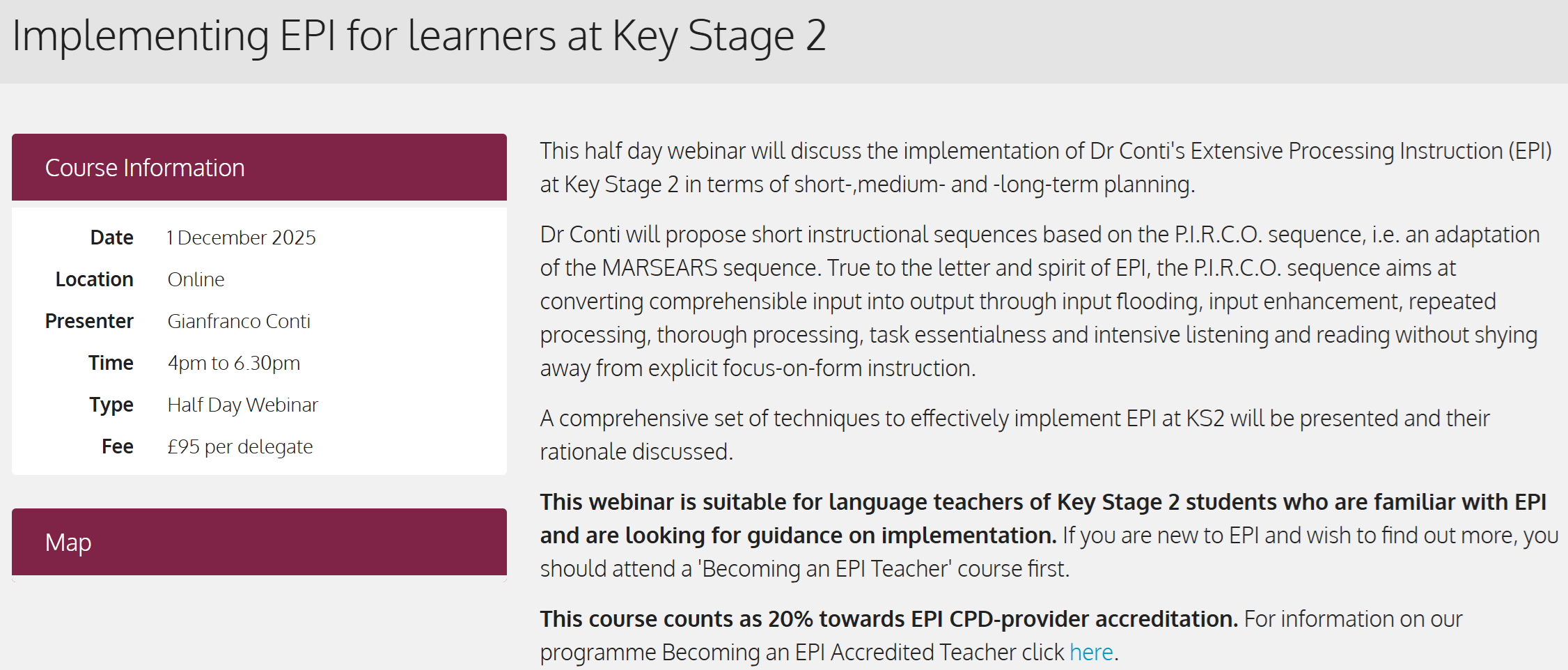
1st December – Online: Implementing EPI at Key Stage 2. Click on the following link to enroll: https://networkforlearning.org.uk/courses/2026-02-04/epi-ks2-4-jul-2024

3rdst December – St Colman’s College Newry (Northern Ireland) – Becoming an EPI teacher.

5th December –Listening and Metacognition (Coventry) at Futures Education Institute. Enroll by contacting Nick Mort on Nicholas.Mort@futuresteachingalliance.org.uk

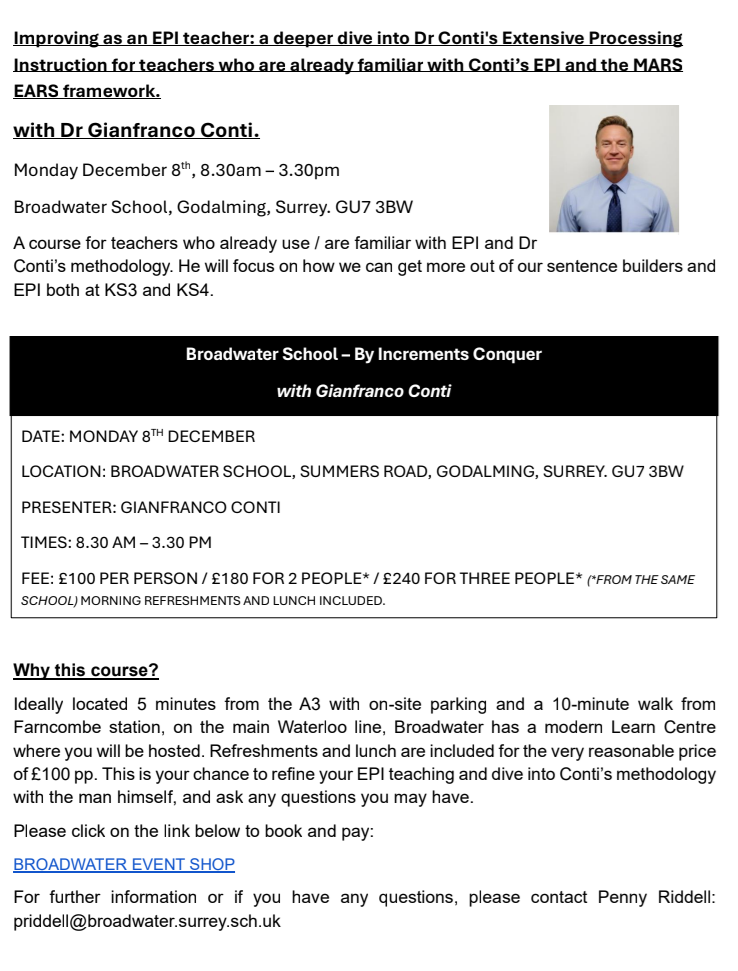
8th December – Broadwater School, Godalming, Surrey. See details below.

10th December – Beaconsfield High School, Buckinghamshire. Contact Lauren Manney (see details in image below).

9th December – Star Salford Academy (Manchester) – See details in flyer below

What Makes a Language Teacher Charismatic?

Introduction

Every teacher knows one: that colleague who walks into a room and instantly changes the atmosphere. Students sit up, smiles appear, and somehow learning feels lighter, faster, and more human. We call it charisma, and too often we treat it like magic — something you’re either born with or doomed to envy.

In my experience, charisma in teaching isn’t mystical at all! It’s a skillset disguised as personality — a mix of warmth, competence, emotional intelligence, and authenticity, all wrapped in professional purpose. It’s the invisible glue that binds classroom relationships and turns mere instruction into genuine communication.

Research in psychology and education consistently shows that learners engage more, remember more, and persist longer when they feel emotionally connected to their teacher. In other words: how you make them feel shapes how well they learn. So, charisma isn’t decoration, it’s pedagogy. It’s the difference between a lesson that merely ticks boxes and one which transforms .

Here’s what, in my opinion and observation, defines the truly charismatic MFL teacher — the one students listen to, laugh with, and remember forever.

1. Warmth + Competence = Magnetic Presence

Social psychology is remarkably clear — and I rarely say that. The people we perceive as “charismatic” consistently score high on warmth (they are approachable, caring, genuinely human) and on competence (they clearly know what they’re doing and they exude what I call ‘quiet mastery’). Charismatic teachers manage to strike that elusive equilibrium between the two. Simple in theory, mega difficult in practice.

This isn’t just my observation. Fiske, Cuddy & Glick’s Stereotype Content Model (2007) demonstrates that ‘perceived warmth and competence together predict influence and emotional connection’. In education, both dimensions are pivotal. Patrick, Hisley & Kempler (2000) found that teacher enthusiasm and perceived care dramatically enhance students’ intrinsic motivation and engagement.

What this looks like in the classroom, in my experience:

  • Smiling not only with the mouth, but unmistakably with the eyes — students pick up on this instantly!
  • Remembering tiny, seemingly trivial personal details about students (“How was your futsal tournament?”).
  • Offering crystal-clear explanations and then engineering tasks that virtually guarantee success for every learner without dumbing things down.
  • Radiating, in posture and tone, the unspoken but powerful message: “Don’t worry — I’ve got you. You can do this.”

Warm incompetence is endearing but ineffective. Cold competence is respected but never loved. Warm competence — that rare blend of skill and humanity — is charisma incarnate.

And yes, I’ve inhabited all three categories at different points in my career. The real magic begins the day warmth and skill cease to live in separate rooms of your teaching personality.

2. Emotional Contagion: your energy is the room’s energy

Let’s be brutally honest — you are the emotional thermostat of your classroom. Students reflect your mood like mirrors. Hatfield, Cacioppo & Rapson (1994) called this emotional contagion: the subconscious mimicking of another’s affective state. In practice, it means that your tone, your pace, and your posture set the collective temperature.

Hargreaves (2000) demonstrated that teachers’ emotional display has a direct and measurable impact on students’ engagement and classroom climate. Sutton & Wheatley (2003) later showed that teachers who radiate positivity foster greater student motivation, enjoyment, and persistence.

And it’s not about acting like a clown or putting on a performance — it’s about animated authenticity:

  • Modulating your voice to reflect enthusiasm and curiosity.
  • Varying your pacing to keep the energy fluid rather than monotonous.
  • Showing visible, contagious enjoyment when a student nails a tricky phrase.
  • Laughing openly when you make your own mistakes in L2 — because you will.
  • Being playfully human when monitoring: “Muppets, what did I just say about inversion?”

A flat, monotone teacher equals flat, disengaged cognition. A vibrant, expressive teacher triggers higher dopamine release — which research by Howard-Jones (2010) links directly to improved memory formation.

In my experience, we underestimate how physiological this is. You don’t just teach with your voice or mind; you teach with your nervous system. Dopamine is the brain’s way of saying, “This matters — remember it.”

3. Storytelling

Stories are language’s natural habitat. They are how human brains are wired to think. Charismatic teachers don’t simply explain; they narrate, dramatise, and embellish. They inhabit mini-stories that give abstract grammar or vocabulary emotional weight. These aren’t long epics — they’re micro-narratives that humanise content:

  • “When I was living in Madrid…”
  • “My friend Pierre always does this ridiculous thing…”
  • “Guess what happened to me in the lift this morning?”

Bruner (1991) and Willingham (2009) both remind us that narrative structures activate more brain regions than plain exposition. They promote connection, empathy, and retention.

Even a fabricated story beats a sterile explanation – and trust me, I have fabricated many over the years. No one checks your autobiography at the door — and the brain doesn’t care if it’s true, as long as it’s vivid.

4. Humour (especially self-deprecating)

Humour, as I have observed again and again, is the oxygen of an engaging classroom. Without it, interaction suffocates under the weight of correctness and pressure. Research (Wanzer & Frymier, 1999; Garner, 2006) repeatedly shows that appropriate humour enhances motivation, attention, and affective learning.

The charismatic teacher therefore:

  • Makes gentle fun of themselves — never of students.
  • Uses playful exaggeration to make a dry concept memorable.
  • Employs sarcasm sparingly, for comic effect only, never to wound.
  • Turns common mistakes into shared moments of amusement rather than embarrassment.

Laughter breeds rapport. Rapport lowers Krashen’s (1982) affective filter.
Lower affective filter equals more intake and better processing.

In my experience, a class that laughs with you will tolerate almost anything — from dodgy accent to malfunctioning speakers — because you’ve already earned their emotional trust.

5. L2 Presence: you “live” the language (strategically)

Charismatic MFL teachers inhabit the target language — but crucially, they do so strategically and sensitively, not dogmatically. They make the language feel alive and meaningful, yet they also recognise when a brief switch to L1 clarifies, reassures, or saves valuable time.

Research fully supports this nuanced stance. Macaro (2001, 2009) demonstrated that judicious use of the first language reduces cognitive overload and increases clarity, while Turnbull & Dailey-O’Cain (2009) warned that absolute avoidance of L1 can, ironically, impede learning.

So the goal is not linguistic purism — it’s purposeful communication.

They don’t “use French” mechanically; they breathe French with intention and rhythm — but always calibrated to the class’s proficiency and confidence.

For some groups, that might mean 80–90% TL use. For others, a gentler, scaffolded 60%. The aim is never 100% — it’s maximum comprehension, maximum authenticity.

Students feed on that authenticity:

  • Natural fillers and reformulations.
  • Gestures synchronised with prosody.
  • Genuine emotion expressed through L2 intonation.

This creates what I like to call identity contagion — learners begin to feel they belong inside that linguistic universe.

In my opinion, the true art lies in modulation: knowing when immersion empowers and when it overwhelms. The most charismatic teachers I have observed over the years, sense this instinctively and adjust with grace rather than guilt.

6. Boundary-setting with warmth (‘benevolent authority’)

Charisma isn’t synonymous with being “nice.” It’s the artful marriage of kindness and firmness. Students crave structure more than they’ll ever admit, especially children from less fortunate backgrounds. Baumrind’s (1967) authoritative parenting model — high warmth, high control — translates beautifully into classroom dynamics. Marzano & Marzano (2003) confirmed that warm, consistent discipline correlates strongly with academic achievement and lower behavioural disruptions.

The charismatic teacher therefore:

  • Establishes tight, predictable routines
  • Corrects behaviour swiftly but calmly, without drama or ego.
  • Uses proximity, quiet authority, and eye contact instead of shouting
  • Praises effort with surgical precision (“That reformulation you just made? That’s exactly what a fluent speaker would do.”).

Such consistency builds safety. Safety breeds trust. And trust, in turn, cultivates charisma.

In my experience, students tolerate strictness — even appreciate it — but they rebel against chaos. “Benevolent authority” is your golden balance point: firm boundaries wrapped in genuine care.

7. A Signature Style

Every charismatic teachr has — and should unapologetically cultivate — a signature style. It’s their calling card, their behavioural fingerprint, the thing students associate uniquely with them.

Examples include:

  • The catchphrase that echoes across corridors
  • The exaggerated gesture that signals comprehension.
  • The infamous timer
  • The beloved coloured pens.
  • The ritual (“3-2-1, eyes on me.”).
  • The infamous Conti eyebrow when someone tries to bluff through a listening task.

Cognitive psychology explains this phenomenon beautifully. The distinctiveness effect (Hunt & Worthen, 2006) suggests that unique cues aid both memory and emotional bonding. Students don’t just remember what you teach; they remember how you made them feel while teaching it.

Over time, these quirks become affectionately mimicked, referenced, even immortalised in farewell cards. That’s not ego — that’s emotional imprinting.

8. Authentic Passion (not generic, but specific)

“Passionate about languages” is a cliché. Real charisma comes from specific passion — that electric, personal fascination that makes your subject vibrate with meaning!

Charismatic teachers don’t say, “I love French.” They say:

  • “I love how Italian uses rhythm to express emotion — it’s like music.”
  • “I adore the way Spanish handles the past — it’s so elegantly layered.”
  • “French syntax is an engineering masterpiece — logical yet lyrical.”
  • “German syntax feels like craftsmanship — sturdy, intricate, and surprisingly elegant.”

Research supports this wholeheartedly, e.g. Keller et al. (2016) and Frenzel et al. (2009) found that subject-specific enthusiasm strongly predicts students’ motivation, engagement, and enjoyment.

Specificity equals sincerity.
Sincerity equals charisma.

In my view, this sort of linguistic passion transforms you from a curriculum deliverer into a cultural ambassador. Students don’t just learn a language — they borrow your obsession, and that obsession propels them forward long after the test.

9. Students Feel Seen

Charisma is not fundamentally about projection; it’s about perception. It’s not how dazzling you appear but how validated and capable people feel in your presence.

Carl Rogers (1969) would have called this unconditional positive regard. His research demonstrated that empathy and acceptance build trust, resilience, and self-worth — precisely the emotional foundation of deep learning.

Charismatic MFL teachers therefore make students feel:

  • Clever even when they err.
  • Capable even when they doubt.
  • Safe even when speaking haltingly.
  • Noticed in ways that feel personal, not performative.
  • Valued not as grades, but as growing linguists.
  • Connected to something larger than themselves — a linguistic tribe.

This is why charismatic teachers hear that immortal line:

“She made me believe I could actually speak the language.”

And let’s be honest — there is no higher professional compliment. Not a glowing inspection report, not a pay raise, not even a sold-out CPD tour compares to that moment of human confirmation.

10. You’re Consistently YOU

Consistency, in my view, is one of the most underrated forms of charisma. Predictability may sound dull, but in teaching, it’s emotional oxygen. Research by Marzano (2003) and Stronge (2018) found that teacher predictability, fairness, and emotional stability are among the strongest predictors of both achievement and satisfaction. Students thrive on knowing what kind of energy awaits them when they walk into your room. They are not drawn to mercurial inspiration and unpredictability – as some MFL gurus often argue. They are drawn to:

  • Predictably good mood.
  • Predictably clear routines.
  • Predictably high expectations.
  • Predictably fair judgement.

Charisma rests on emotional stability and psychological safety.You can be fiery, gentle, boisterous, introverted — it doesn’t matter. What matters is that it’s you, consistently and unapologetically.

As I often tell trainee teachers: “Don’t play teacher — become one.” When your classroom persona is nothing more than your authentic self turned up a notch, students sense it immediately. They exhale. They lean in. They learn!

In Conclusion

A charismatic language teacher radiates warmth, competence, emotional energy, and authenticity — making students feel safe, joyful, and capable — while wrapping everything in humour, clarity, and a distinctive sense of identity.

Or, to put it less poetically but more truthfully:

“Be the kind of teacher whose vibe makes kids forget it’s Monday first period.”

No, You Don’t Need Sentence Builders to Teach the EPI Way

1. A myth that refuses to die

In my workshops over the years, one myth just refuses to die… the idea that teaching the EPI way means using Sentence Builders. Some individuals even call it ‘The sentence builders method’!

Let me tell you — it’s simply not true.

Sentence Builders are a tool. A very powerful one, sure — maybe even revolutionary in the hands of a reflective teacher — but still just that: a tool!

EPI (Extensive Procesing Instruction) isn’t about grids or colours or boxes. It’s about how learners process language… how they encode meaning, notice form, consolidate memory traces, and build fluency through repeated, meaningful, deliberate rehearsal of language.

You could teach the EPI way perfectly well using listening sequences, classroom interactions, cue cards, or even a few well-designed slides — if you understand and apply its underlying principles.

In this post I intend to debunk this myth and to propose viable alternatives for those EPI teachers who may want to start the modelling phase in different ways. These alternative techniques do not necessarily rule out the use of sentence builders if one is still keeon on using them, of course.

2. EPI as Process-Based Instruction

At its heart, EPI is a process-based instructional model — and that’s not a slogan, it’s a paradigm shift. It means focusing less on what learners produce and more on how they process input on the way there.

Over the past ten years of EPI advocacy, I’ve seen that the best teachers are those who work deliberately on the micro-skills of each language domain:

  • Listening: discriminating sounds, chunking meaning units, predicting what comes next, reconstructing messages.
  • Reading: decoding, inferring, processing chunks, integrating information across sentences.
  • Speaking: retrieving and adapting chunks rapidly, automatizing pronunciation and syntax patterns, monitoring accuracy of output online.
  • Writing: planning, retrieving, sequencing chunks, reformulating, expanding structures with increasing complexity, monitoring accuracy.

In my observation, great teachers don’t leave those micro-skills to chance. They design activities that deliberately recyle and rewire those mental proceses. Every listening, reading, speaking, or writing task becomes a laboratory of cognitive rehearsal. As my co-author, Dylan Vinales, once said: “The EPI classroom is, in essence, an ecosystem of automatisation — not a collection of worksheets”.

3. The MARS EARS framework — with or without Sentence Builders

The MARS EARS sequence is where EPI becomes visible. It takes learners from exposure to spontaneity through a very deliberate chain:

  1. Modelling – Rich, meaning-bearing input (spoken, written, visual).
  2. Awareness – Learners notice and connect form with meaning.
  3. Receptive Processing – Intensive listening or reading tasks demanding discrimination and recall.
  4. Structured Production – Controlled oral and written manipulation of chunks. In this phase, Sentence Builders should be used only to ‘warm up’ the students before retrieval practice tasks, to support the weaker ones or to check whether the answers are correct.
  5. Expansion – Explicit grammar teaching, Recombination and Extension of what’s been learned.
  6. Autonomy/Assessment – Low-stake assessment, diagnosis and consolidation.
  7. Review & Spontaneity – Recontextualised recycling leading to automatizion.

Nowhere in that process does it say “use a Sentence Builder.”
You can model, prompt, and scaffold language through a dozen other means — as long as the sequence keeps its cognitive gradient from receptive to productive.

4. The power of chunks and structural priming

EPI draws heavily on usage-based linguistics — the idea that language emerges through repeated procesing of meaningful lexicogrammatical chunks.

Chunks are the brain’s way of simplifying life. They allow fluent speech and comprehension by bundling grammar and lexis together into reusable units.
When learners repeatedly encounter patterns like “I’m going to…”, “Can I have…?”, or “On the weekend I usually…”, something powerful happens: structural priming.

As Bock (1986) and Pickering & Branigan (1998) showed, exposure to a structure increases the likelihood that we’ll use it. That’s why, in my experience, students who are bombarded with the same high-frequency patterns in different contexts start producing them effortlessly. It’s not magic — it’s cognitive economy at work.

But in EPI grammar is also taught explicitly, through deductive teaching or inductive learning, as the teacher feels fit, in the Expansion phase of the MARSEARS sequence. No sentence builders is necessary in this phase either, unless you want to make it easier for the students, that is…

5. Listening as modelling: the interpersonal gateway

One of the things I’m proudest of in my work on EPI is the idea of interpersonal listening-as-modelling.
Traditional listening exercises test comprehension — “Did you catch the right answer?” — and that’s it.
EPI flips that.

In my approach, learners don’t just listen; they use what they hear as a model for their own output.
They mirror, adapt, and reuse the same structures almost instantly.

For example, after a short teacher–student exchange about weekend routines, I might ask students to replicate it with a small twist — change the activity, the day, or the person.
This transforms listening from a passive test into a productive rehearsal — the most efficient form of input processing I’ve seen in decades of teaching.

6. The engine of learning: repeated and varied processing

Every teacher knows that repetition matters… but not all repetition is equal.
Research from Craik & Lockhart (1972) to Webb (2021) confirms that depth and variety of processing are what truly consolidate learning.

In EPI, repetition is not parroting. It’s a cycle of re-encoding: hearing, noticing, matching, reformulating, expanding.
Each re-encounter engages a different network in the brain, reinforcing long-term memory traces and reducing cognitive strain.

Unfortunately, many classrooms stop too soon. They introduce a structure once, practise it briefly, then move on.
But language doesn’t work like that.
In EPI, we recyle chunks over multiple modalities and days — always slightly recontextualised, always processed anew.

7. How You Can Present and Model the Target Chunks Without Sentence Builders

Modelling is where it all begins. And no, you don’t need a grid. You just need clarity, intention, and a bit of creativity.
Here are some of my favourite ways to model chunks without ever touching a Sentence Builder:

1. Flashcards for rapid retrieval and noticing

Create flashcards with the target chunks on one side and visuals or translations on the other.
Start with teacher-led modelling: flash a card, say the phrase aloud, and have learners repeat with rhythm and gesture.
Then move to pair quizzing: one learner shows the card, the other produces the chunk aloud, swaps roles, and times each other.
Later, combine several flashcards into quick oral chains (“On Saturday I go swimming + with my friends + in the morning”), encouraging fluency through speed and combination.
Flashcards keep retrieval active, reduce cognitive load, and strengthen form–meaning mapping through constant low-stakes practice.

All these approaches maintain what EPI values most: clarity of modelling, deliberate recycling, and deep engagement with meaning… and not a single Sentence Builder in sight.

2. Listening-based visual anchoring

Display simple visuals — icons, pictures, emojis — while reading or playing short dialogues aloud.
Ask learners to match what they hear, spot faulty descriptions, or order the visuals.
The picture set becomes your “invisible Sentence Builder.”

3. Guided micro-dictations

Deliver short, chunk-rich dictations like “On Saturdays I go to the gym.”
Learners reconstruct, translate, and underline patterns like “time phrase + verb + place.”
Simple, effective, memorable.

4. Cued oral modelling with substitution

Use cue cards with categories (time, activity, place).
Model examples while changing one cue at a time:

“On Saturday I play football.”
“On Saturday I play tennis.”
“On Sunday I go swimming.”

Learners repeat and adapt — automatisation through meaningful variation.

5. Listening-as-modelling chains

Play a short recording or give a live model. Learners shadow, then reproduce it with one altered detail.
This keeps listening and speaking intertwined — a direct substitute for the Sentence Builder grid.

6. Faulty-translation and reformulation games

Project slightly wrong English translations of accurate TL sentences.
Learners spot and fix them — deep procesing guaranteed.

7. Collaborative classification

Give learners printed chunk strips.
Ask them to group by meaning (activities, times) or syntax (verb + infinitive / verb + noun).
The tactile act of sorting helps internalise structure — cognitive learning by touch and sight.

All these approaches maintain what EPI values most: clarity of modelling, deliberate recycling, and deep engagement with meaning… and not a single Sentence Builder in sight.

8. Interactive oral modelling

Start with a natural class exchange.

“Do you go out on weekends?”
“Yes, I usually go jogging.”
“You usually go jogging? Great! Who with?”
“With my friends.”

Each question–answer pair repeats the target chunks in meaningful variation. The teacher subtly primes the syntax while keeping communication real.

Please note: none of the above excludes the use of Sentence Builders as chunk organisers, scaffolding tools, or as a means to reinforce and consolidate the initial modelling achieved through the techniques described above.

8. EPI as a mindset — and why Sentence Builders still matter

Now, let me be very clear. EPI is a mindset, not a method locked into a specific tool.
It’s about cognitive design, not graphic design.

What defines an EPI teacher, in my experience, is not the slide they show but the mental operations they induce in their learners.
Sentence Builders can do that — but so can good listening chains, reformulation tasks, and carefully scaffolded dialogues.

That said, there is a very solid theoretical reason I’ve advocated Sentence Builders for years.
They work because they align beautifully with John Sweller’s Cognitive Load Theory, particularly his concept of worked examples. Sweller (1988, 1994) showed that novices learn faster and more efficiently when given clear, structured models to study — reducing extraneous cognitive load.

Sentence Builders are, in essence, linguistic worked examples. They make syntax and lexis visible, freeing up working memory so learners can focus on meaningful processing rather than rule-hunting or guessing.

As I often say, they are not crutches — they are cognitive prosthetics, temporary but invaluable.
Once the learner’s brain has internalised the patterns, the scaffold can — and should — fade.

In ten years of EPI advocacy, I’ve seen this countless times: teachers who overuse Sentence Builders create dependency… those who understand their cognitive purpose create fluency.

Concluding remarks

So, no — you don’t need Sentence Builders to teach the EPI way.
What you do need is a deep understanding of:

  • Process-Based Instruction: deliberately targeting micro-skills and scaffolding processing across all four skills.
  • Chunk-Based Learning: building fluency through patterned input and structural priming.
  • Interpersonal Listening-as-Modelling: making listening the springboard for output.
  • Repeated, Varied Processing: recyling language across contexts until it becomes automatic.
  • MARS EARS: a flexible yet principled roadmap for cognitive sequencing.

If these are in place, you are already teaching the EPI way — Sentence Builder or not.

Because in the end, the true magic of EPI doesn’t lie in the layout of a grid…
but in the architecture of the mind it helps construct.

From Exposure to Ownership: Deep Processing Techniques That Make Vocabulary Last

Introduction

In my experience working with teachers and observing classrooms around the world, one pattern emerges again and again: students appear to “know” a great deal of vocabulary, and yet they struggle to actually use it when speaking, writing, or responding under time pressure in reading and listening tasks. They recognise words — sometimes lots of them — but cannot retrieve or manipulate them fluently.

In 20+ years of classroom observations as a middle manager, I noticed how way too often vocabulary teaching becomes a matter of exposure and rehearsal rather than mental engagement and meaning-making. Correct me if I am wrong but usually students copy lists, drill flashcards, complete gap-fills, and score highly on vocabulary quizzes, but the knowledge remains fragile — it evaporates when cognitive load increases. In other words: they have met the words, but they do not own them.

Over the last three decades, research in cognitive psychology and applied linguistics has shown very clearly that what determines whether vocabulary becomes available for fluent use is not merely how many times learners encounter it, but how deeply they process it.

In my opinion, this is the heart of the matter.

What Deep Processing Means — and Why It Matters

The concept, which I first came across during my MA TEFL and forever changed my teaching, originates from Craik & Lockhart’s (1972) Levels of Processing Framework, which demonstrated that memory durability depends not on repetition or exposure, but on the depth of mental engagement.

  • Shallow processing (copying, matching, reading aloud, memorising lists) → weak traces → rapid forgetting.
  • Deep processing (comparing, associating, evaluating, personalising, explaining, transforming) → strong traces → durable recall and flexible use.

This aligns with Laufer & Hulstijn’s (2001) Involvement Load Hypothesis, which states that vocabulary retention depends on how much a task induces:

  1. Need (motivation or communicative purpose),
  2. Search (effort to locate or retrieve meaning),
  3. Evaluation (choosing, comparing, justifying meaning).

Tasks high in involvement load → deeper encoding → longer retention.

Likewise, Webb (2007) shows that words processed through generative use (i.e., used in new contexts) are remembered better than those practiced in familiar or repetitive contexts.
Recognition → weak memory
Use in familiar frame → moderate memory
Use in new meaningful context → strong memory

In short:
Vocabulary becomes usable when learners have to make an effort learning it, i.e. must think with it, decide with it, and adapt it.

Students don’t remember what they repeat.
They remember what they process meaningfully.

How to Teach for Deep Processing (with Beginner / GCSE / Advanced Variations)

1) Categorisation & Classification

Why it works: Grouping requires the learner to consider meaning and function, strengthening connections between chunks.

BeginnerIntermediate (GCSE)Advanced
Sort into like/don’t like or positive/negativeSort by tense, connective function, or purposeClassify by register, pragmatic function, nuance strength

More activities:

Visual cluster map: Project a word/phrase bank and ask students to draw branching clusters on mini whiteboards grouping by meaning, tense, tone or function; then ask them to explain their grouping choices.

Taboo-category race: Give pairs a category (e.g., “expressing obligation”) and a set of phrases; they must race to place each phrase into their category, and then swap boards and justify the placements.

Reverse classification: Present categories only (e.g., cause / contrast / opinion) and challenge students to create or hunt additional examples from previous texts or their own output to fill those categories.

2) Odd One Out (with justification)

Why it works: The learning is in the justification — distinguishing meaning requires deep comparison.

BeginnerIntermediate (GCSE)Advanced
Clear contrastsSubtle tense/aspect differencesEmotional / pragmatic nuance (e.g., triste / déprimé / blasé)

More activities:

Teacher-made set of 5 phrases, where 4 follow a pattern and 1 doesn’t; students mark the odd one and must verbally justify their choice (e.g., tense mismatch, wrong connective effect).

Peer-swap odd set: Each student writes their own 5-phrase set, swaps with a partner who must pick the odd one out and explain why (via mini-presentation).

“Why could this not fit?” variant: Give students 5 phrases and ask them to justify why each one could not be the odd one, forcing them to evaluate all options, not just the obvious odd item.

3) Similar but Different

Why it works: Builds semantic precision and prevents typical GCSE mistranslation errors.

BeginnerIntermediate (GCSE)Advanced
Je veux vs J’aime; Il y a vs C’estJe pense que vs À mon avis; J’ai vu vs J’ai regardébien que vs même si; depuis / pendant / pour

More activities:

Contrast carousel: Students rotate in pairs through stations: each station has two very similar phrases (e.g., je vais vs j’ai l’intention de), and students must note differences in use, tone, register, typical contexts. Then whole‐class share.

1-minute micro-explanation: Individually, students pick one pair of “similar” phrases and record themselves (or orally in class) giving a one-minute explanation: when I’d use A vs B, and why.

Error challenge: Present slightly erroneous versions of both phrases (e.g., wrong person, wrong tense) and students must spot the error and explain which phrase it mimics and how it mis-loads meaning.

4) Personalisation

Why it works: Meaning is remembered best when it relates to self.

BeginnerIntermediate (GCSE)Advanced
Complete simple frames5 true + 1 false statementsUse chunks to position identity / argue stance

My chunk snapshot: Students pick 3 new target chunks and write short diary entries: “This weekend I … using this chunk because …” Then swap with a partner who asks three “Why did you choose that chunk?” questions.

Identity swap*: Students interview each other: they ask their partner “What would you do if … (use chunk X)?” and then report back to the class about their partner’s response, emphasising use of the chunk and how it ties into that person’s life.

Challenge-Plus version: Learners reproduce the target chunk in a personal statement that also contradicts the chunk (e.g., “Bien que je veuille voyager, je ne peux pas”) forcing them to adapt the chunk and link it to personal reality.

5) Retrieval + Variation

Why it works: Retrieval strengthens memory; controlled variation deepens structural representation.

BeginnerIntermediate (GCSE)Advanced
Pronoun substitutionRecombine & modify tenseParaphrase or change register

More activities

Flash-variation sprint: In pairs, one student says a chunk in L1, the other retrieves in the TL; then they must change one variable (tense/person/place) and re-produce it in a new sentence.

Time-pressure swap: Use an online timer (30 seconds). Student must retrieve as many uses of the same target chunk as they can (e.g., “on peut” + 4 contexts); then partner must swap one chunk to a new person/tense.

Paraphrase relay: They begin with a target chunk, then each student in a group must paraphrase in TL (change voice, person, tone) until it returns to the origin but transformed. Then reflect: which retrieval was hardest and why?

6) Evaluation & Decision-Making

Why it works: Choosing between alternatives strengthens long-term retention through meaning-based judgement.

BeginnerIntermediate (GCSE)Advanced
Rate phrases for usefulnessEvaluate appropriacy by contextCompare pragmatic impact across options

More activities:

Ranking discussion: Provide 6 target phrases and ask learners to rate them for usefulness in an upcoming topic (e.g., holidays, future career), then justify their ranking.

Context-match debate: Give contradictory short contexts and pairs must choose which chunk fits better, then debate the decision: “Why or why not?”

Adaptation task: Provide one chunk and ask students to adapt it so it is more formal/informal/persuasive. Then they peer-review: Was the adaptation still acceptable? Why/why not?

7) Controlled Creative Production

Why it works: Creativity within scaffolding enables safe spontaneity.

BeginnerIntermediate (GCSE)Advanced
Scaffold expansion3-part sentences; chunk-based picture descriptionsStructured monologues; rewrite in different tense or voice

More activities:

Chunk storyboard: In groups, build a 4-frame storyboard using 3 target chunks. Each frame uses one chunk; students then orally narrate the story using all chunks, adapting tense/person/setting.

Twist rewrite: Provide a scaffolded text (80 words) using target chunks. Students rewrite it from the perspective of a different character or setting (e.g., holiday → career interview) — forcing deep adaptation of vocabulary.

Micro-debate: Give a statement and ask students (in pairs) to prepare a 2-minute argument using at least 4 target chunks. After one round, swap sides and ask them to reverse the argument (challenging them to adapt chunks to opposite stance).

A Daily Fluency Routine (8 Minutes)

TimeTaskPurpose
1–2 minChoral recyclingAutomaticity
3–4 minCategorisation or Odd One OutSemantic depth
5–6 minRecombination / transformationProductive fluency
7–8 minPersonalised micro-outputOwnership

Deep Processing Through Oracy: Listening and Speaking

It is often assumed that vocabulary is acquired mainly through reading and memorisation, and that listening and speaking simply test what has already been learned. In reality, oracy is one of the most powerful drivers of vocabulary acquisition, because it forces learners to retrieve, select, adjust, and justify language choices in real time.

When learners listen deeply, they:

  • Test meaning hypotheses against input
  • Detect mismatches between expected and actual meaning
  • Notice functional roles of chunks (opinion / time / reason / contrast)
  • Form predictions and revise interpretations

When learners speak deeply, they:

  • Choose between alternative formulations
  • Justify lexical decisions
  • Adapt phrasing to tone, audience, stance
  • Reformulate ideas rather than recall rehearsed scripts

This is the cognitive work that drives vocabulary from recognitionretrievalspontaneous use.

Oracy Deep-Processing Task Table

LevelListening (Deep Processing Tasks)Speaking (Deep Processing Tasks)
BeginnerFaulty Descriptions: Spot and correct mismatches.

Faulty Translation: Identify and correct translation errors.

Categorisation Listening: Sort heard sentences into meaning categories.
Repetition with Variation (change who/when/where).

Chunk Substitution.

Mini Roleplays with prompts.

Picture Description with chunk bank.
Intermediate (GCSE)Narrow Listening cycles.

Reorder transcript lines.

Marker spotting (time / opinion / justification).
3-part sentence production.

Opinion exchange with justification.

Speaking ladders.

Chunk-grid improvisation.
AdvancedDiscourse move tracking.

Nuance listening across synonyms.

Meaning summary rather than wording recall.
Extended monologues with constraints.

Paraphrase & reformulate.

Perspective-shift retelling.

Collaborative oral story-building.

Conclusion: From Knowing to Owning

According to much research, most learners do not struggle because they lack vocabulary.They struggle because they have not processed vocabulary deeply enough to retrieve and use it fluently.

Deep processing:

  • Builds retention
  • Speeds retrieval
  • Enables flexible, fluent use
  • Turns chunks into language behaviour

Less copying.
More comparing.
More evaluating.
More adapting.
More thinking.

This is how we move students from exposure to ownership. On http://www.language-gym.com, we apply every single one of the above transformational principles and techniques.