
Are you looking to revolutionise your language teaching practice with a proven, evidence-informed approach? Join us on the 29th and 30th of April for a comprehensive workshop on Extensive Processing Instruction (EPI), delivered by me, the creator of the approach.
Hosted on networkforlearning.org.uk, this exclusive online training opportunity will give you both the theoretical foundation and the practical tools to design and deliver lessons that build strong, lasting linguistic competence. Whether you’re a classroom teacher, a department lead, or a curriculum designer, this course offers invaluable insight into how to create sequences of instruction that lead to genuine, long-term language acquisition. You can enrol here.
Why EPI
EPI is a pedagogical approach that places processing at the centre of language learning. Steeped in sound SLA tehory and research, it promotes deep, repeated exposure to meaningful input and structured output activities designed to progressively build fluency.
Rather than rushing into production, EPI sequences learning through carefully scaffolded stages that support long-term acquisition. It has been widely adopted across classrooms in the UK, Australia, and beyond for one key reason: it works.
With EPI, learners:
- Build automaticity through repetition with variation
- Develop grammatical competence in context
- Gain confidence before being expected to speak or write
- Experience success in manageable, motivating steps
- Engage meaningfully with tasks that match their level and cognitive maturity
EPI also represents a meaningful shift away from shallow, performance-driven tasks towards activities that promote depth of processing and long-term retention. The approach encourages students to notice language features, retrieve vocabulary with support, and gradually move from supported rehearsal to spontaneous communication.
Theories and Research Behind EPI
My model is not only intuitive—it’s deeply rooted in some of the most influential theories in second language acquisition. EPI draws strength from a confluence of research traditions in cognitive psychology, applied linguistics, and educational neuroscience. What makes EPI particularly distinctive is the way it operationalises these theories into teachable routines and sequences that address both comprehension and production.
At the core is the skill-acquisition theory (Anderson), which posits that language knowledge must be proceduralised through repeated, meaningful practice. This principle is echoed in the carefully graduated steps of the MARS EARS cycle, which begin with heavy scaffolding and gradually foster autonomy and spontaneity.
EPI also incorporates elements of VanPatten’s input processing theory, which highlights the cognitive limitations learners face when trying to process form and meaning simultaneously. In EPI, both listening and reading are approached as modelling experiences — not comprehension tests — allowing students to absorb form-function relationships through repeated, comprehensible input.
John Field’s process-based approach to listening adds further support, positioning listening as an active, trainable skill. EPI’s Listening as Modelling phase aligns with this view by focusing on decoding, segmentation and phonological pattern recognition rather than mere gist-taking.
The Noticing Hypothesis (Schmidt) is reflected in the inclusion of awareness-raising tasks that follow the modelling phase. These tasks draw learners’ attention to specific grammatical or lexical patterns they have already encountered in context, preparing them for more autonomous production later.
From a cognitive angle, working memory theory (Baddeley) justifies EPI’s emphasis on recycling, repetition, and low cognitive-load activities in the initial stages. Tasks are carefully designed to optimise processing and retention by staying within learners’ cognitive capacity.
The approach also draws on Michael Hoey’s Lexical Priming theory, which underscores the role of repeated, context-rich exposure in vocabulary acquisition. EPI ensures high-frequency items and chunks reappear across lessons in familiar but varied linguistic environments.
Krashen’s comprehensible input hypothesis informs the initial modelling and receptive phases of EPI. However, unlike approaches that stop at input, EPI builds systematically toward output, ensuring that learners are prepared to speak and write with increasing spontaneity.
Significantly, EPI integrates Swain’s concept of pushed output by incorporating activities that challenge learners to stretch their language resources. Structured and semi-spontaneous tasks gradually reduce support while increasing communicative demands.
Finally, Paul Nation’s fluency training principles are central to the final phases of the MARS EARS cycle. Repetition with variation, time constraints, and the use of familiar language all serve to automate recall and build processing speed.
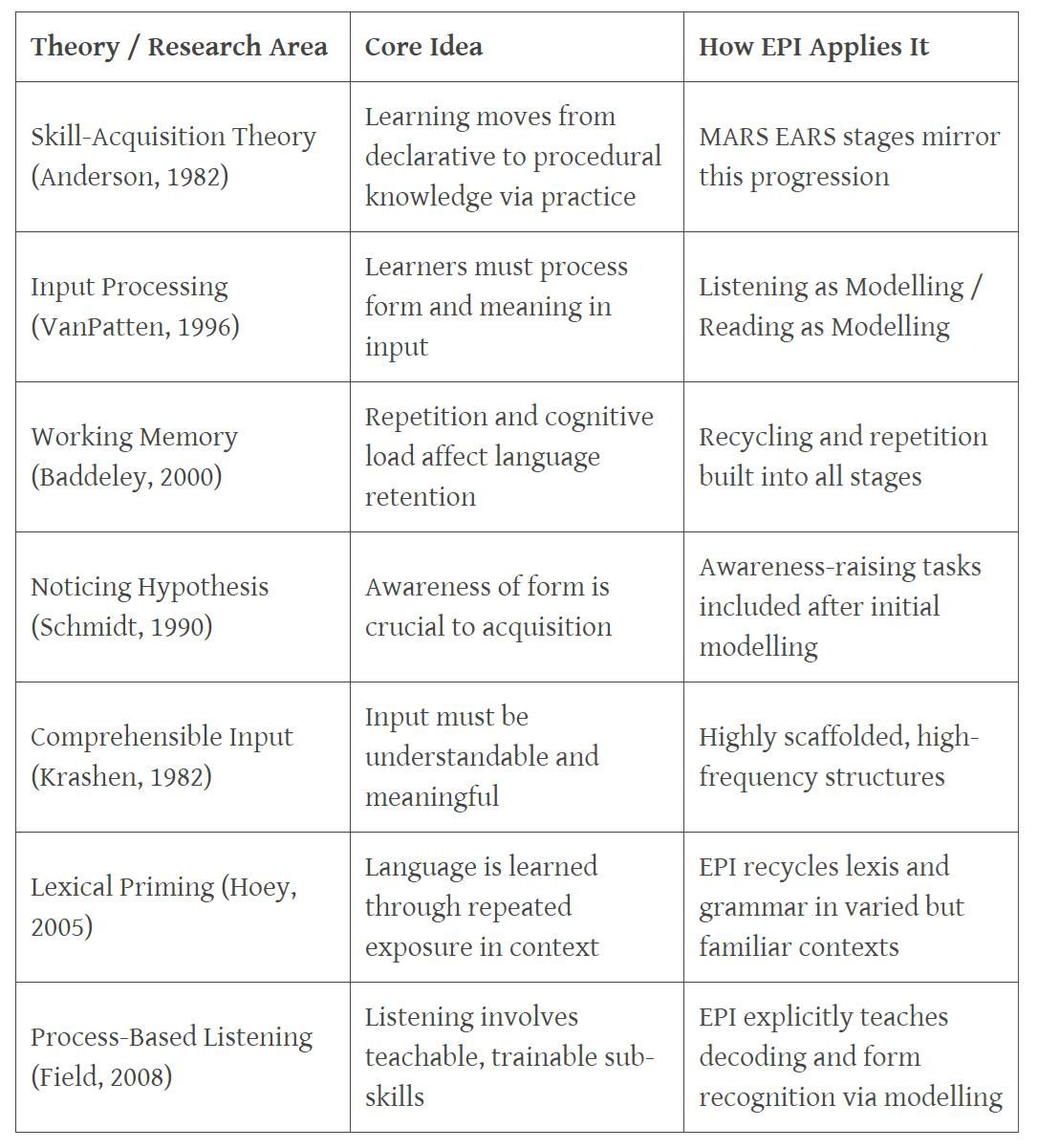
Here is a breakdown of the major research foundations EPI draws upon:
| Theory / Research Area | Core Idea | How EPI Applies It |
|---|---|---|
| Skill-Acquisition Theory (Anderson, 1982) | Learning moves from declarative to procedural knowledge via practice | MARS EARS stages mirror this progression |
| Input Processing (VanPatten, 1996) | Learners must process form and meaning in input | Listening as Modelling / Reading as Modelling |
| Working Memory (Baddeley, 2000) | Repetition and cognitive load affect language retention | Recycling and repetition built into all stages |
| Noticing Hypothesis (Schmidt, 1990) | Awareness of form is crucial to acquisition | Awareness-raising tasks included after initial modelling |
| Comprehensible Input (Krashen, 1982) | Input must be understandable and meaningful | Highly scaffolded, high-frequency structures |
| Lexical Priming (Hoey, 2005) | Language is learned through repeated exposure in context | EPI recycles lexis and grammar in varied but familiar contexts |
| Process-Based Listening (Field, 2008) | Listening involves teachable, trainable sub-skills | EPI explicitly teaches decoding and form recognition via modelling |
Workshop Overview: What You’ll Learn
🗓 Dates: Monday 29th & Tuesday 30th April
🕐 Time: 5pm–8pm AEST / 8am–11am UK time
🖥 Location: Online via networkforlearning.org.uk
This one-day course, delivered over two evenings, offers a step-by-step guide to designing and implementing an EPI-based curriculum.
Session 1: Planning and Priming
- How to design a coherent EPI unit
- Choosing and sequencing high-frequency content
- Introducing Modelling, Listening as Modelling and Reading as Modelling
- Priming techniques that activate prior knowledge and prep for success
Session 2 & 3: Grammar, Production, and Fluency
- Structured production activities that boost accuracy and confidence
- Grammar teaching aligned with processing principles
- Tasks to promote fluency, spontaneity, and automaticity
- A full walk-through of the MARS EARS cycle:
MARS – Modelling, Awareness-Raising, Receptive Processing, Structured Production
EARS – Expansion, Autonomy, Routinisation, Spontaneity
Throughout, I will link every activity to its pedagogical rationale, ensuring that you not only know what to do but also why.
This course counts towards EPI CPD-provider accreditation and provides an ideal foundation for those wishing to become an EPI Accredited Teacher.
👉 For more on becoming an accredited EPI teacher, visit the course portal at networkforlearning.org.uk.
Conclusion
Whether you’re new to EPI or looking to deepen your understanding of its application, this workshop offers the perfect opportunity to engage with the pedagogy in a practical and research-informed way. You’ll leave with a clear, actionable roadmap for designing units, delivering instruction, and supporting learners through every phase of the MARS EARS cycle deeply steeped in SLA theories and research (see table below)
More than just a methodology, EPI is a mindset—one that places meaningful input, scaffolded output, and cognitive development at the heart of language learning. If you’re ready to move away from traditional textbook routines and start building confident, spontaneous language users, I look forward to welcoming you to this highly interactive, energising two-part training.
 The Language Gym
Hello
I came across this blog page when searching for EPI training courses and looks like I just missed it. The links don’t work any more and I would like to know where I can find the next course, to understand what EPI is and how to use it? In the mean time, I will be on Amazon buying the books!
LikeLike
Hi the courses are constantly updated on http://www.networkforlearning.org.ul
LikeLike