
Introduction
Helping learners hear—and then repair—their own pronunciation is one of the most powerful ways to build both accuracy and confidence. ‘Best Recording’, an activity I have magpied and adapted from the great Paul Nation, turns a simple text into a mini-cycle of metacognitive training. Across a single lesson pupils plan, monitor and evaluate their speaking, using recordings and peer feedback to make their progress visible.
It begins with a teacher model and a short phoneme focus, then moves into paired preparation, where a “ planner” spots tricky sounds and a “coach” suggests fixes.Pairs identify their three biggest hurdles before making a first individual recording. Partners then swap recordings, give two positives and one next step, and listen again as the teacher re-models key sentences. Armed with a personal mini-goal (“I will emphasise the final ‘r’ in hiver”), pupils re-record, then carry out a self- and peer-evaluation using a simple pro-forma. Finally, each learner saves a best version and writes a short reflection and next target—closing the loop from planning, through monitoring, to evaluation. The result is a lively, structured activity that blends pronunciation practice with the development of independent, metacognitively aware language learners. Below, is how the activitty unfolds in detail in my version of this activity.
Best recording, step by step
Teacher model + phoneme focus
Teacher reads the text once while pupils shadow-read. Teacher highlights 2–3 key pronunciation targets (e.g. nasal vowels, silent final consonants).
Paired preparation with roles
Pair a stronger and a weaker reader. Give each pair 8–10 minutes:
- Planner role – notes tricky words/sounds.
- Coach role – listens and suggests fixes.
Identify hurdles (Planning)
Each pair lists their top 3 pronunciation challenges and how they might tackle them (e.g. “liaison in les‿amis—slow down before vowel”).
First recording (Baseline)
Students record a first attempt individually.
Focused peer feedback (Monitoring)
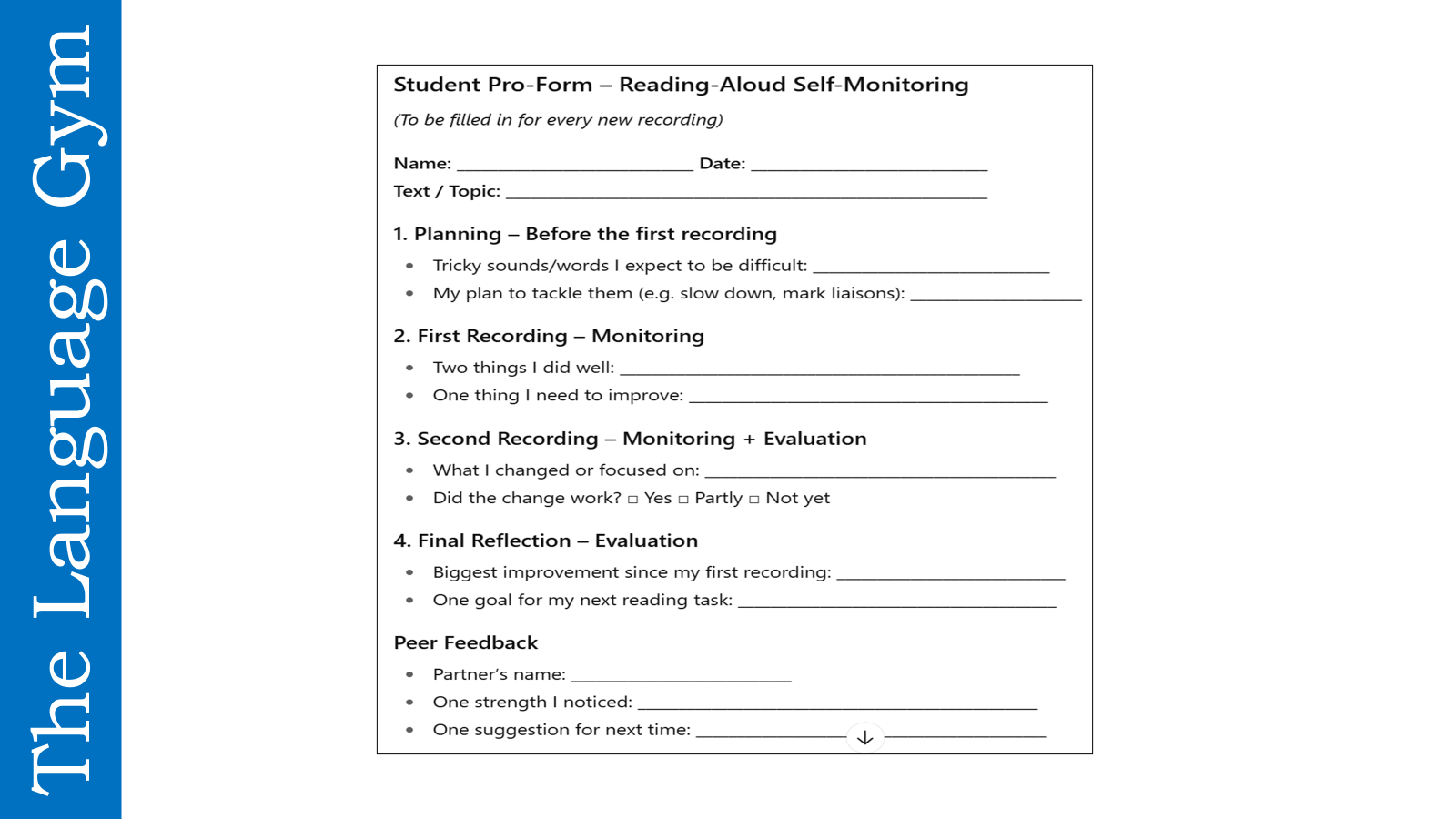
Partners listen to each other’s recordings and write 2 positives and 1 “next step” on the sheet below (see picture 1)
Teacher re-reads key sentences so pupils can re-check sounds.
Picture 1 – Pro-forma to be used by the students during the activity
Strategy tweak + second recording
Pupils set a mini-goal (“I will emphasise the final ‘r’ in hiver”) and re-record.
Self- and peer-evaluation (Monitoring + Evaluation)
Students listen back to both their own and their partner’s second recordings.
They complete the pro-forma, noting improvements and remaining issues.
Best version + reflection (Evaluation)
When satisfied, students save a “best recording”.
They write a brief reflection and one target for next time. This can be guided by prompts like the ones below:
•Compared with my first recording, what has improved the most?
•Which sound or word is still not as accurate as I’d like?
•How well did my strategies (slow down, mark liaisons, practise phonemes) work?
•What feedback from my partner was most useful?
•What is one specific goal for my next reading-aloud task?
•Which practice activity will help me reach that goal?
The benefits
1. Strong Metacognitive Design
- Follows the full Planning–Monitoring–Evaluation (PME) cycle: pupils plan (identify phoneme hurdles), monitor (peer feedback, self-recording), and evaluate (self/peer reflection).
- Makes metacognition explicit, not just implicit: pupils talk about strategies and record their own progress.
2. Evidence-based Pronunciation Practice
- Teacher’s initial phoneme focus ensures targeted input on specific sounds.
- Repeated listening–speaking–recording gives distributed, deliberate practice—known to improve phonological accuracy.
3. Peer-Learning and Cooperative Roles
- Pairing a stronger with a weaker reader plus Planner/Coach roles encourages peer modelling and scaffolded support.
- Builds collaborative skills and makes every pupil both a learner and a helper.
4. Use of Technology for Immediate Feedback
- Recording and replaying allows pupils to hear themselves objectively, often catching errors they can’t detect while speaking.
- Provides tangible evidence of improvement between recordings, which boosts self-efficacy.
5. Clear, Repeatable Structure
- Step-by-step routine is easy to reuse with new texts; once pupils know the sequence it runs with minimal teacher input.
- The pro-form captures progress over time and supports formative assessment.
6. Motivation and Ownership
- “Best version” at the end and visible progress from first to final recording give pupils a sense of achievement and control over their learning.
- Reflection tasks help them set personal pronunciation goals, fostering long-term independence.
7. Integration of Language and Learning Skills
- Combines phonological accuracy, listening discrimination, peer feedback, and metacognitive awareness in one coherent activity—addressing both linguistic and learner-strategy development.
 The Language Gym
You must be logged in to post a comment.