MARSEARS at a glance: how it unfolds, strengths and weaknesses, tweaks and fixes

What MARSEARS is (at a glance)

M–A–R–S–E–A–R–S =
Modelling → Awareness-raising → Receptive processing → Structured production → Expansion → Autonomous recall → Routinization (fluency) → Spontaneity.

At KS3, I typically plan a term as ~20–24 lessons split into five sub-units: the first four run MARSEA with new material, and the fifth is RS to consolidate/automatise and interleave old with new. This creates repeated encounters, steadily shifts the load from input to output, and culminates in unplanned speech under time pressure.

How a term typically unfolds (macro view)

  • Sub-units 1–4 (MARSEA): new sentence patterns taught and practised (input-heavy → pushed output → brief grammar focus → quick checks).
  • Sub-unit 5 (RS): fluency training and spontaneous tasks that recycle the whole term’s “universals” (core phonics, lexis, grammar) plus items from earlier terms.

Please note: average-attaining groups usually need 1.5–2 lessons for the Structured production phase, not just one.

The 8 stages (micro view)

1) Modelling

Goal: Establish clear sentence patterns with high comprehensibility.
How: Present with Sentence Builders (optionally preceded by flashcards to wake up prior lexis/grammar, e.g., auxiliaries for a French perfect tense unit). Keep input tightly controlled and meaning-rich.

You do: brief, lively teacher modelling; choral/individual echo of whole chunks, not isolated words.

2) Awareness-raising

Goal: Make learners notice the key features they’ll need to hear/see again.
Focus:

  • SSC (sound–spelling mappings), phonotactics/liaison, intonation, grammar/syntax—all as short pop-ups embedded in modelling.

You do: 30–90-second “pop-up” moments while modelling: “Listen for the /ʒ/; spot the clitic; where’s the boundary?”

3) Receptive processing

Goal: Turn models into robust decoding and parsing skills before output.
Two parts (especially Y7–Y9):

  1. Sentence-level work: rapid, enjoyable listening/reading tasks that target phoneme/syllable decoding, segmentation, lexical access, parsing and meaning.
  2. Connected texts: narrow listening/reading (near-identical texts), 90%+ comprehensible input, input flooding + input enhancement (acoustic/visual) so the target forms recur and “pop”. I call this Listening-As-Modelling (LAM) and Reading-As-Modelling (RAM)—input that is deliberately teaching you how to speak/write later.

You do: scripted listening (audio + text) for decoding, chunk-highlighting, quick gist/detail cycles, micro-dictations, “find the boundary,” etc. Teacher keeps explicitly pointing at the target features so implicit and explicit learning work together.

4) Structured production (pushed, but highly scaffolded)

Goal: Bridge from recognition → retrieval and production while keeping accuracy, willingness to speak, and inclusion high.
Two parts:

  • Chunking-aloud games (e.g., Sentence Stealer, Sentence Chaos, Mind-Reading, Lie-Detector) to build articulatory fluency and keep attention on form and meaning.
  • Guided communicative tasks: tightly-framed role-plays, info/reasoning/opinion gaps; lots of retrieval practice; many tasks are peer-managed so the teacher can roam and give formative feedback. Plan ~1.5–2 lessons for average groups.

5) Expansion (explicit grammar focus)

Goal: Now that learners have processed the pattern many times, make the rule explicit (if you wish) and practise it.
Approach: Deductive (brief teaching), guided discovery, or inductive from examples; reuse earlier tasks but make the target rule task-essential to succeed.

6) Autonomous recall (quick checks)

Goal: Low-stakes, fast achievement tests to see if at least receptive mastery is there (earlier checks receptive; later ones may be productive). These are short and easy to mark.

7) Routinization (fluency training)

Goal: Speed up retrieval (what I call “making known language easier and faster to access”).
Design principles (after Nation):

  • Repeated processing, task repetition, pre-task priming/planning, increasing time pressure.
    Tasks: e.g., Messengers, Dictogloss, Five, Detectives & Informants, Secret Sentences, View-and-Recall race; also form-oriented sprints like Chain Reading/Dictation, Tongue-Twisters, Fast & Furious, Puzzle Race. Use only familiar lexis/grammar here—fluency automates what’s already learned.

8) Spontaneity (real operating conditions)

Goal: Unplanned output under time constraints—pictures, interviews, role-plays—mirroring exam-style pressure/real use. One task can serve as an assessment. For lower attainers, allow some planning/priming time.

Where recycling sits

Across the term, RS phases interleave current items with previous units and earlier years’ “universals” (core phonics, lexis, grammar) to fight forgetting and build durable networks— I always stress the importance of curriculum-wide recycling, not just within a unit.

What you’ll see in a planner (example pattern)

  • Weeks 1–7/8: Four MARSEA sub-units on new patterns.
  • Weeks 8–10: RS sub-unit for fluency + spontaneity checks on the combined content.
  • Assessment moments: quick Autonomous recall mini-checks near the end of each MARSEA sub-unit; a Spontaneity performance in the RS block. Structured production often spans ~1.5–2 lessons each time.

Why this longer arc (not PPP)?

Short, textbook-style PPP cycles can’t reach proceduralization/automatization; slower, input-heavy sequences with staged output are more inclusive at KS3 and save reteaching at KS4. The aim is durable learning and self-efficacy, not speeding to a rule table.

Strengths and Potential Pitfalls

Strengths

  • Input → output with purpose. Modelling → heavy receptive work before speaking/writing fits how learners actually build representations; fewer fossilised errors, better confidence.
  • Listening first, properly. Explicit decoding/segmentation tasks, narrow input, and cue-noticing are usually the missing middle in curricula; MARSEARS puts them center stage.
  • Recycling at scale. The RS block (routinisation + spontaneity) is essentially spaced retrieval + task repetition under time pressure—exactly what sticks learning.
  • Assessment moments that are humane. Quick Autonomous Recall checks keep stakes low but surface gaps fast.
  • Inclusion. Average and lower-attaining classes benefit from the additional time in Structured Production; the sequence reduces the “I can’t” barrier.

Where it can misfire (and how to guard against it)

  • Time pressure vs syllabus velocity. If you try to cover the same number of topics at MARSEARS depth, you’ll feel “behind.” Fix: trim content, teach less but better; map 4 MARSEA sub-units + 1 RS per term and stay disciplined.
  • Resource load. It lives or dies on good, narrow texts/audio. Fix: build a reusable bank (3–5 texts per sub-unit), record quick teacher audio, and recycle across years.
  • Over-scaffolding risk. Some classes get comfy in Structured Production and never leap. Fix: schedule the RS block like a deadline; add visible time-pressure ramps each cycle.
  • Teacher talk creep in Modelling. Enthusiasm can turn into mini-lectures. Fix: keep pop-ups to 30–90 seconds; move explanation to the Expansion stage or the debrief.
  • Assessment alignment. If your school only values last-minute exam drills, MARSEARS can look “slow.” Fix: track second-listen gains, cue-detection rates, wpm in fluency tasks and show that graph.

What Makes an Aural Text Challenging? – The Eight buckets of listening difficulty and their implications for listening instruction

Introduction

When we teachers pick a listening text, it is easy to go with our gut feeling: “This one sounds a bit harder,” or “It is slower so the pupils will understand it.” But in truth, the reasons why a listening text is difficult are many and often not very obvious.

In this post I want to share—very simply—what the research tells us. My hope is that it helps you, as it helped me over the years, to see clearly what makes a text tricky so you can choose or create materials that truly suit your learners. I will first describe the main factors, then give my own thoughts on what this means for how we teach listening.

Eight Buckets of Listening Difficulty

1. The Sound of the Message: Acoustic and Signal Factors

The first challenge is, of course, the sound itself – the sound barrier that Steve and I allude it in the title of our book (Conti and Smith, 2019). If the speaker talks quickly or suddenly speeds up, pupils have very little time to process what they hear (Griffiths, 1992; Field, 2008). And even when the speed is not high, connected speech—liaison, elision, assimilation—can make the words melt together (Brown & Kondo-Brown, 2006).
Weak vowel sounds, unexpected stress patterns and unfamiliar accents add, of course, more work for the ear (Rost, 2016). Poor recording quality or background noise can be as damaging as a strong accent. Small hesitations, laughter or sudden changes of emotion in the speaker also catch pupils off guard.

2. Following the Conversation: Interactional Factors

Texts with several speakers are naturally harder for obvious reasons: the listener must keep track of who is talking, manage overlapping voices and cope with quick turn-taking (Buck, 2001; Wagner, 2010). I often notice even strong pupils lose the thread when two people talk over each other.

3. Words and Meaning: Lexical–Semantic Factors

The vocabulary load of a text is, of course, one of the strongest predictors of how well pupils will understand it, since, as I often reiterate in my blog, 70 to 90 % of success at listening tasks hinges on word recognition. When a passage is packed with content words (nouns, verbs, adjectives and adverbs) —what researchers call high lexical density — working memory is quickly stretched (Vandergrift & Goh, 2012).

Equally important is lexical coverage, the percentage of words the listener already knows. Studies show that learners generally need to know around 95 % of the running words for basic comprehension and close to 98 % for comfortable, detailed understanding (Laufer, 1989; Nation, 2006, 2013). If coverage drops below that threshold, even confident pupils spend so much effort guessing unknown words that the overall message slips away.

Topic familiarity is another key factor: when the theme is new, pupils cannot draw on background knowledge to predict meaning (Chiang & Dunkel, 1992). And of course the usual culprits remain: low-frequency words, idioms, false friends, numbers, dates and proper nouns are classic stumbling blocks (Field, 2008; Nation, 2013).

Finally, some languages add an extra twist—rich morphology can blur word boundaries, which in my opinion is one of the hardest elements to teach explicitly (Rost, 2016).

4. Grammatical Complexity: Syntactic Factors

Texts containing subordinate clauses, embedded structures, long noun phrases, multiple negatives or unusual word orders are more challenging as these features all increase the mental effort needed to hold information while the sentence continues (Buck, 2001; Field, 2008).

5. How the Text Is Organised: Discourse and Genre

Different genres—narrative, interview, public announcement—signal meaning in different ways. When discourse markers are weak or missing, pupils can easily miss topic changes or elliptical references (Flowerdew & Miller, 2005). I often see this when students listen to authentic interviews where speakers jump from one idea to another.

6. Culture and Pragmatics

Irony, humour, politeness formulas and culture-specific references call for more than vocabulary; they rely on shared cultural knowledge and pragmatic inference, which, in my experience are rarely explicitly taught (Rost, 2016; Vandergrift & Goh, 2012). Even a simple sentence can mislead when this knowledge is absent.

7. The Listener’s Own Resources

Not all the difficulty is in the text. Working-memory limits, tiredness or anxiety often explain a poor result more than the audio itself (Macaro, Graham & Vanderplank, 2007).
Learners who have not developed metacognitive habits—planning, monitoring, evaluating—will struggle even with familiar topics (Graham & Macaro, 2008; Vandergrift & Goh, 2012). From my own classroom I can say that a calm, confident pupil usually hears more than a nervous one.

8. The Task and the Assessment Frame

Finally, the way we test or exploit the text matters. If the question order does not follow the text, if there is no visual support, or if distractors and negative wording are used, the task itself raises the level of challenge (Buck, 2001; Field, 2019). The new GCSE listening papers often include exactly these features.

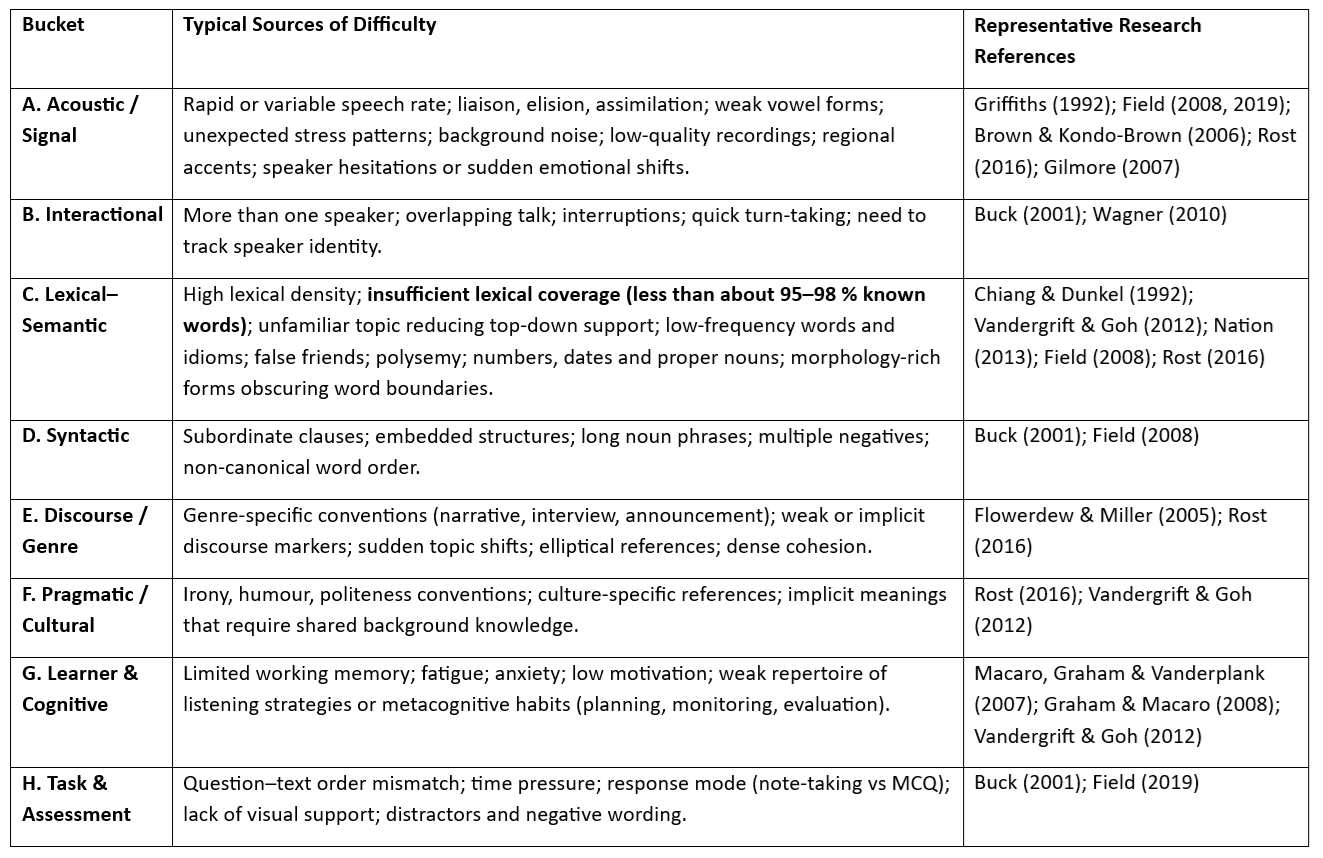
Table 1 – Summary

From KS3 to KS4: Why This Matters

The step from lower secondary (KS3) to the new GCSE is not only about “more difficult vocabulary”. Exam papers deliberately increase multi-speaker interactions, speed up delivery, broaden topics and remove many visual cues (Ofqual, 2021). Pupils who have grown used to carefully graded KS3 recordings can suddenly face a much heavier cognitive load.

Implications for Listening Instruction

1. Audit and Anticipate

Use the eight buckets as a difficulty checklist whenever you select or write a text. Decide which factors will probably trip up your learners and plan support in advance—perhaps pre-teach key chunks (Webb & Nation, 2017), run a short phonology warm-up, or model turn-taking signals.

2. Teach Listening for Learning, Not Only for Testing

Field (2008, 2019) argues that listening lessons should build skill, not simply rehearse exams. Give pupils several purposeful listens—prediction, gist, detail—then use diagnostic listening: show the transcript, ask them to mark what they misheard and discuss why. After that, I like to run quick “Fix & Re-train” tasks such as minimal-pair drills or shadow-reading of the lines they found hardest.

5. Check or estimate lexical coverage

When selecting or writing a listening text, it is key to check or estimate lexical coverage. Sadly, this is not commonly done If your learners know far less than 95 % of the words:

  • Pre-teach the most useful new chunks before the first listen (Webb & Nation, 2017).
  • Or simplify the text so that unknown items fall within that 2–5 % “tolerable” window.

This small step often makes the difference between a frustrating and a genuinely instructive listening lesson.

Don’t rely on the fact that some of the unknown vocabulary consists of cognates, as research consistently finds that roughly a third of obvious cognates go unrecognised in L2 listening – see Weber & Cutler (2004) and Broersma & Cutler (2011) – a gap teachers should address when preparing pupils for real-world or GCSE-style listening tasks

4. Place Listening Inside an Input→Output Sequence

Comprehension rises when key vocabulary is taught before the first listen (Webb & Nation, 2017). This is the Input-Plus condition described by Krashen (1985): input just above the learner’s level, paired with meaningful focus.
My PIRCO cycle puts this into practice:

  • P – Priming: model key lexis and sounds, use a short reading text,
  • I – Input: three purposeful listens,
  • R – Review: quick reflection on strategies,
  • C – Consolidation: diagnostic listen and Fix & Re-train,
  • O – Output: structured speaking or writing tasks.

5. Let PIRCO Grow with the Learners

  • KS3: keep PIRCO strong—plenty of priming and a full diagnostic stage.
  • Year 10 and early Year 11: move to a medium version—priming in one lesson, a shorter diagnostic phase, grammar and structured output follow quickly.
  • Exam run-up (Year 11 Term 2): switch to PIR—quick priming and exam-style listening; most consolidation and output happen elsewhere.

6. Build Metacognitive Habits

Encourage pupils to plan, monitor and evaluate (PME) their listening (Vandergrift & Goh, 2012). Even a short checklist—“Before I listen I will… During I will… After I will…”—can help them become more independent. In my opinion, this small routine pays off far more than an extra comprehension exercise. PME, too is routinely and seamlessly built in the PIRCO cycle.

Conclusions

Fast speech is only the tip of the iceberg. The real challenge of aural texts lies in a network of factors: the sound signal, the way speakers interact, the words and grammar they choose, and even the test format itself.

By recognising these eight areas and by scaffolding listening through a PIRCO-based input–to–output sequence, we can select or create texts that fit our classes much more precisely. In my own experience, this careful matching—together with clear metacognitive routines—helps students cross the KS3→KS4 bridge with far greater confidence and prepares them not only for the new GCSE but for real communication beyond the exam hall.

Key References

Buck, G. (2001). Assessing Listening. Cambridge University Press.
Chiang, C. & Dunkel, P. (1992). TESOL Quarterly, 26(2).
Field, J. (2008). Listening in the Language Classroom. Cambridge University Press.
Field, J. (2019). In The Cambridge Handbook of Second Language Acquisition.
Flowerdew, J. & Miller, L. (2005). Second Language Listening: Theory and Practice.
Graham, S. & Macaro, E. (2008). Language Learning, 58(4).
Griffiths, R. (1992). Studies in Second Language Acquisition, 14(3).
Krashen, S. (1985). The Input Hypothesis.
Macaro, E., Graham, S. & Vanderplank, R. (2007). Language Teaching, 40(2).
Nation, I. S. P. (2013). Learning Vocabulary in Another Language (2nd ed.). Cambridge University Press.
Rost, M. (2016). Teaching and Researching Listening (3rd ed.). Routledge.
Vandergrift, L. & Goh, C. (2012). Teaching and Learning Second Language Listening. Routledge.
Webb, S. & Nation, P. (2017). International Review of Applied Linguistics, 55(1).
Wagner, E. (2010). TESOL Quarterly, 44(4).

Best recording – enhancing reading aloud and metacognition through a fully student-centred task

Introduction

Helping learners hear—and then repair—their own pronunciation is one of the most powerful ways to build both accuracy and confidence. ‘Best Recording’, an activity I have magpied and adapted from the great Paul Nation, turns a simple text into a mini-cycle of metacognitive training. Across a single lesson pupils plan, monitor and evaluate their speaking, using recordings and peer feedback to make their progress visible.

It begins with a teacher model and a short phoneme focus, then moves into paired preparation, where a “ planner” spots tricky sounds and a “coach” suggests fixes.Pairs identify their three biggest hurdles before making a first individual recording. Partners then swap recordings, give two positives and one next step, and listen again as the teacher re-models key sentences. Armed with a personal mini-goal (“I will emphasise the final ‘r’ in hiver”), pupils re-record, then carry out a self- and peer-evaluation using a simple pro-forma. Finally, each learner saves a best version and writes a short reflection and next target—closing the loop from planning, through monitoring, to evaluation. The result is a lively, structured activity that blends pronunciation practice with the development of independent, metacognitively aware language learners. Below, is how the activitty unfolds in detail in my version of this activity.

Best recording, step by step

Teacher model + phoneme focus
Teacher reads the text once while pupils shadow-read. Teacher highlights 2–3 key pronunciation targets (e.g. nasal vowels, silent final consonants).

Paired preparation with roles
Pair a stronger and a weaker reader. Give each pair 8–10 minutes:

  • Planner role – notes tricky words/sounds.
  • Coach role – listens and suggests fixes.

Identify hurdles (Planning)
Each pair lists their top 3 pronunciation challenges and how they might tackle them (e.g. “liaison in les‿amis—slow down before vowel”).

First recording (Baseline)
Students record a first attempt individually.

Focused peer feedback (Monitoring)
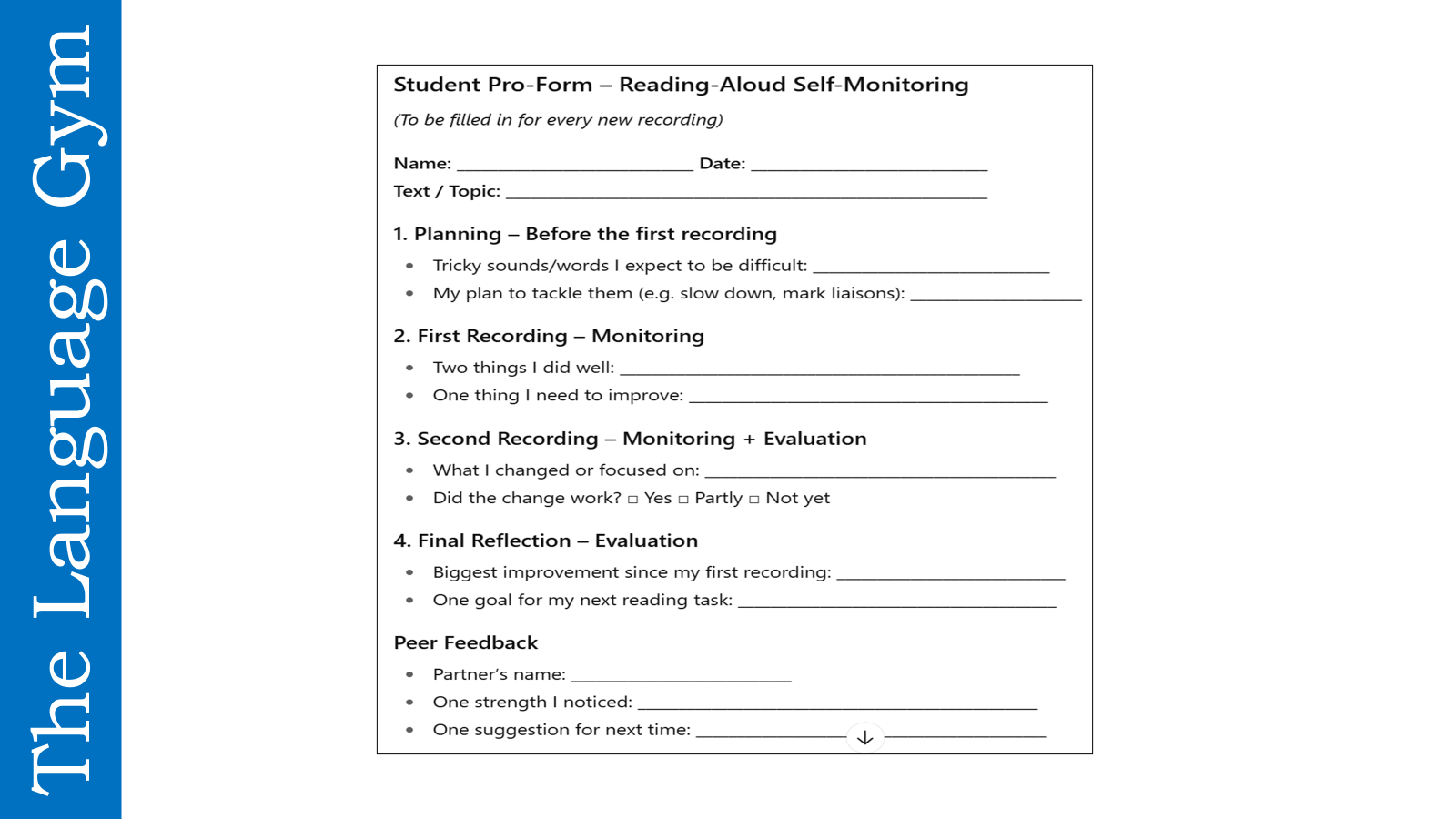
Partners listen to each other’s recordings and write 2 positives and 1 “next step” on the sheet below (see picture 1)
Teacher re-reads key sentences so pupils can re-check sounds.

Picture 1 – Pro-forma to be used by the students during the activity

Strategy tweak + second recording
Pupils set a mini-goal (“I will emphasise the final ‘r’ in hiver”) and re-record.

Self- and peer-evaluation (Monitoring + Evaluation)
Students listen back to both their own and their partner’s second recordings.
They complete the pro-forma, noting improvements and remaining issues.

Best version + reflection (Evaluation)
When satisfied, students save a “best recording”.
They write a brief reflection and one target for next time. This can be guided by prompts like the ones below:

•Compared with my first recording, what has improved the most?

•Which sound or word is still not as accurate as I’d like?

•How well did my strategies (slow down, mark liaisons, practise phonemes) work?

•What feedback from my partner was most useful?

•What is one specific goal for my next reading-aloud task?

•Which practice activity will help me reach that goal?

The benefits

1. Strong Metacognitive Design

  • Follows the full Planning–Monitoring–Evaluation (PME) cycle: pupils plan (identify phoneme hurdles), monitor (peer feedback, self-recording), and evaluate (self/peer reflection).
  • Makes metacognition explicit, not just implicit: pupils talk about strategies and record their own progress.

2. Evidence-based Pronunciation Practice

  • Teacher’s initial phoneme focus ensures targeted input on specific sounds.
  • Repeated listening–speaking–recording gives distributed, deliberate practice—known to improve phonological accuracy.

3. Peer-Learning and Cooperative Roles

  • Pairing a stronger with a weaker reader plus Planner/Coach roles encourages peer modelling and scaffolded support.
  • Builds collaborative skills and makes every pupil both a learner and a helper.

4. Use of Technology for Immediate Feedback

  • Recording and replaying allows pupils to hear themselves objectively, often catching errors they can’t detect while speaking.
  • Provides tangible evidence of improvement between recordings, which boosts self-efficacy.

5. Clear, Repeatable Structure

  • Step-by-step routine is easy to reuse with new texts; once pupils know the sequence it runs with minimal teacher input.
  • The pro-form captures progress over time and supports formative assessment.

6. Motivation and Ownership

  • “Best version” at the end and visible progress from first to final recording give pupils a sense of achievement and control over their learning.
  • Reflection tasks help them set personal pronunciation goals, fostering long-term independence.

7. Integration of Language and Learning Skills

  • Combines phonological accuracy, listening discrimination, peer feedback, and metacognitive awareness in one coherent activity—addressing both linguistic and learner-strategy development.

Why Do L2 listeners Struggle? Watching the Difficulties Evolve from Beginner to Intermediate level

Introduction

Reflecting on my twenty-eight years of teaching listening in French, Spanish and Italian—from primary through lower and upper secondary—I notice one thing very clearly: the problems my students faced whilst listening did not simply disappear as they advanced; they changed their shape. Research has found the same (Field, 2008; Vandergrift, 2007): the beginner’s obstacles usually evolve into more subtle, but equally tricky, intermediate ones. In this post I intend to discuss how each area of difficulty typically develops.

Phonological decoding: from “all a blur” to “I hear the words, but…”

At the beginning, students often say things like: “When I listen to Spanish it is just a river of sound.”
They are right: in many languages vowels are reduced or run together; in French, liaison and elision swallow syllables (a phenomenon called ‘assimilation), and beginners cannot yet segment the stream.
By the intermediate stage, they can pick out many individual words but still mis-hear rapid speech or regional accents. Think of a learner who recognises il y a on paper but misses it when it contracts to y’a.
The challenge evolves from total blur to fine-grained perception.

Lexical processing: from panic at unknown words to distraction by low-frequency ones

Beginners often freeze when they meet a single unknown item, as if that one gap blocks all meaning. In other words, their tolerance for ambiguity threshold is very low.
In my experience, they rarely exploit context or cognates—for instance, not noticing that información in Spanish is transparently ‘information’.”

Later, with a larger vocabulary, they stop panicking at every unknown term, yet a new trap appears: they waste time puzzling over rare, low-frequency words and lose the thread of the message.
Research has found that moving from “every word matters” to “ignore the unimportant” is a key milestone in listening fluency (Goh, 2010).

Grammatical / syntactic parsing: from word-by-word decoding to complex-clause confusion

At first, learners decode each word separately and often miss function words or tense endings.
Ask a beginner after a French listening task, “Did you hear the passé composé marker?” or the preposition ‘pour’ and you will likely get a blank look
By intermediate level, they can follow simple sentence patterns, but longer sentences with embedded clauses still derail them.
Even strong B1 students, in my experience, can misread a Spanish relative clause and misunderstand who is doing what.
The struggle moves from basic recognition to higher-level parsing.

Use of top-down knowledge: from little prediction to overconfidence

Beginners rarely activate background knowledge before listening.
Prediction simply does not occur to them.
Intermediates, however, often swing to the opposite extreme: they do predict—sometimes too eagerly to the point that they often hear words they predict where they do not exist…
They often cling to their first hypothesis and ignore evidence that contradicts it, a classic confirmation bias.
So the evolution is from underuse to over-reliance.

Metacognitive control: from passivity to late monitoring

In my experience, novices tend to treat listening as a test: press “play” and hope for the best.
They cannot say where or why they lost meaning.
With experience, learners begin to monitor, but often notice problems only after the key moment has passed.
Research has found that modelling the plan–monitor–evaluate cycle (Vandergrift & Tafaghodtari, 2010) is what gradually turns late monitoring into timely self-regulation.

Strategic behaviour: from bottom-up obsession to risky guessing

Beginners typically chase every single word—classic bottom-up trap.
Intermediates, perhaps tired of that strain, sometimes lean too heavily on top-down guessing, risking mis-hearing when their predictions are wrong.
The difficulty morphs from not seeing the forest for the trees to trusting the forest and missing a tree that matters.

Affective factors: from anxiety to overconfidence

Anxiety at the start is high: “If I miss one word, I fail.”
Confidence grows with competence, but at intermediate level another danger appears: complacency.
Learners overestimate their comprehension and stop refining strategies.
Research has found that both extremes—fear and overconfidence—interfere with progress (Graham & Macaro, 2008).

Interaction and negotiation: from silence to hesitant repair

In interactive tasks—say, a role-play in German or an information-gap in Italian—beginners rarely ask for clarification; they fear looking incompetent.
Intermediates begin to use repair moves (for example Come scusi? or ¿Cómo?), but may hesitate or choose awkward phrasing.
The growth is visible, yet the skill is still fragile: from no repair to imperfect repair.

Table 1: Typical Mistakes in MFL Listening at Beginner and Intermediate Levels (Sources: Field 2008; Vandergrift 2007; Goh 2010; Graham & Macaro 2008)

Conclusions

To my Italian eyes, the path from beginner to intermediate in French, Spanish or German is like climbing a mountain: the scenery changes, but the effort does not lessen.
The first part of the climb demands strength just to keep moving—decoding sounds, catching words.
Higher up, the air is clearer but the rocks are trickier: confirmation bias, complex syntax, and a dangerous touch of complacency.
Our job as teachers is to guide learners through each new landscape and help them understand that progress brings new, different challenges, not an end to difficulty.

Twelve MFL Teacher Habits that Support Strong Classroom Management

Introduction

Classroom management in Modern Foreign Languages is not only about discipline — it is more about creating the right situation where learning can really happen. Because MFL lessons usually have speaking, interaction, and the use of the target language, they are often more lively compared to other subjects. This liveliness is like a double-edged sword: it brings a lot of energy, but it also opens the door to distraction if routines, clarity, and pace are missing. Research from general pedagogy and also from language teaching shows time and again a set of habits that good MFL teachers normally use. What follows is a discussion of these habits, showing how small and steady actions may help classrooms to be calmer, more engaging, and productive places.

1.Establish Clear and Steady Routines


Habit: Greeting at the door, same starter(s) each lesson (retrieval task, drill, listening warm-up). This is something that all of my mentors at the beginning of my teaching career always emphasized the importance of and they were right. The few times I didn’t do that because I was busy setting up the computer or dealing with a student, it did impact negatively the beginning of my lessons.
Why it works: Reduces uncertainty, creates order, and cuts downtime where misbehaviour can creep in.
Research: Marzano & Marzano (2003) found that when teachers are consistent with routines, lessons run more smoothly and students’ behaviour problems are reduced.
When it’s missing: Mr Patel once skipped his usual retrieval starter and let students settle themselves, and within minutes half were chatting and looking lost! In my experience, routines may save much more time than they waste, because they prevent the chaos that always takes longer to fix. Isn’t it better to spend two minutes on a starter than ten minutes calming things down later?

2. Use Target Language Purposefully and Simply


• Habit: High but comprehensible TL use with clear non-verbal scaffolds (gestures, visuals, sentence frames). If what you are saying in the target language and too complicated to convey through gestures or other visuals, simply use the students’ L1. Remember: no students should be left behind, confused or irritated by the target language explanation. Not even one.
Why it works: Keeps students engaged in “doing languages” rather than “doing discipline,” and predictability reduces worry and resistance.
Research : Macaro (2018) shows that when teachers use the target language in a clear and supported way, students pay attention better and stay motivated.
• When it’s missing: Ms Dupont tried a full French-only lesson without scaffolds. Students stared blankly and whispered “I don’t get it,” and by the end even she felt very frustrated, since the lack of support left them adrift. In my view, scaffolds are what may turn TL use into success rather than confusion… as I have often said in my blogs. Could we really expect teenagers to cope without support when even adults would struggle?

3. Maintain Pace and Flow


Habit: Rapid transitions, chunked activities (no long dead time), visible countdowns, and planned variety. This has always been my greatest strength. It can be exhausting but it pays enormous dividends. In my lessons the students simply didn’t have the time to misbehave.
Why it works: Idle time is the enemy of behaviour, since “momentum” reduces chances for distraction.
Research: Evertson & Emmer (2013) showed that lessons where teachers kept up a steady pace had fewer behaviour issues and students’ focus was stronger.
When it’s missing: Mr Jones handed out a long reading without clear timing. Students drifted into side-conversations while he fiddled with the projector, and he saw that energy may drain very quickly when pace dips, which convinced him that momentum is as important as content. In my experience, it’s momentum more than anything else that protects behaviour.

4. Give Clear, Short Instructions (in TL or L1 as needed)


Habit: Brief, step-by-step instructions, often backed with visuals or gestures are gold, especially when you have students with special needs. Instructions needn’t be in the target language, the most important thing is that the task is.
Why it works: Unclear instructions invite off-task chatter, whereas clarity gets students working faster.
Research: Ellis (2009) explains that when instructions are clear and broken down, students understand more easily and are less likely to go off task.
When it’s missing: Ms Ahmed once gave a five-minute grammar lecture before a task, and although she thought she was being thorough, students weren’t sure what to do and copied the wrong exercise. Since then she has found that keeping instructions short and visual works best. In my view, nothing may derail a class faster than muddled instructions!

5. Balance High Expectations with Warmth and Respect


Habit: Combine firm insistence on participation (“everyone speaks”) with friendly relational warmth, always showing respect for students and their space. Respect here means listening, allowing thinking time, noticing effort, and treating students’ contributions with fairness. If you disrespect a student, you will get disrespect back – often many times over.
Why it works: Students are much more likely to cooperate when they feel respected and supported. High standards matter, but they only work when learners also feel safe and valued.
Research: Muijs & Reynolds (2011) show that classrooms where teachers combine warmth with high expectations have fewer discipline problems, and Pianta (1999) adds that respectful teacher–student relationships are central to students’ behaviour and learning.
• When it’s missing: Mr Williams wanted to be “the nice teacher” and didn’t insist on TL answers. Gradually, students stopped trying, and he later saw that warmth without challenge breeds low effort — and that respect without clear boundaries can quickly slip into indulgence. In my experience, the best classes are both strict and friendly, with respect running both ways. Isn’t that what we would want if we were in their shoes? And how would you feel as a student if no one really listened to your answers?

6. Actively Watch the Room


• Habit: Circulate, make eye contact, use proximity, and point out positive behaviour. Nothing worse than a teacher sitting behind the desk for most of the lessons.
• Why it works: “Withitness” (Kounin, 1970) reduces misbehaviour before it builds.
Research: Kounin (1970) showed that when teachers scan the room often and move around, misbehaviour drops because students know the teacher is aware of students’ actions.
• When it’s missing: Ms Rossi stayed rooted at the front with her laptop, and a group at the back began sharing headphones, so by the time she noticed, focus was gone. In my experience, the teacher who never leaves the front is the one who loses control.

7.Maximise Student Talk, Cut Teacher Talk


Habit: Structured pair work, sentence-builder scaffolds, choral response, micro-interactions.
Why it works: Engagement rises when learners feel ownership, and boredom drops when interaction is constant.
Research: Swain (2000) shows that when students have to produce language regularly, they stay more focused and are less likely to drift off task.
When it’s missing: Mr O’Connor explained grammar for twenty minutes without pause, and although he felt he was being clear, students switched off and when it was time to speak the energy was flat. In my experience, the more students talk, the less likely it is for behaviour to become an issue.

8.Use Positive Framing and Praise


Habit: Notice effort (“Very fluent !” – in the case of a student who has managed to speak fluently despite a few mistakes) more often than punishing errors.
Why it works: Builds much stronger motivation and a culture of effort rather than fear.
Research : Hattie (2009) found that praise and encouragement have a bigger effect on students’ learning and behaviour than punishment or criticism.
When it’s missing: Ms Green corrected every mistake bluntly, and although she thought she was helping accuracy, over time volunteers dwindled. Once she switched to praising effort first, students bounced back. In my experience, classrooms thrive when effort is noticed more than errors.

9. Embed Predictable Classroom Signals


Habit: Consistent cues for silence, transitions, attention (hand signals, countdowns, TL phrases).
Why it works: Students respond faster when cues are automatic, reducing friction.
Research : Simonsen et al. (2008) showed that when teachers use the same signals consistently, students follow instructions more quickly and lessons run more smoothly.
When it’s missing: Mr Chen had no fixed signal — sometimes clapping, sometimes waiting — and students took longer each time to respond, which wasted time and caused frustration. A simple countdown solved it. A predictable signal is worth ten shouted reminders! After all, how can students concentrate if the rules of attention keep changing?

10. Reflect and Adjust Practice


Habit: Regularly check which activities trigger drift (e.g., too much copying, too open-ended) and change them.
Why it works: Flexibility prevents repeating the same “behaviour traps.”
Research: Farrell (2015) argues that teachers who reflect regularly improve classroom control because they see what doesn’t work and adapt it.
When it’s missing: Ms Lopez set up a free discussion in Spanish, and within minutes it was all in English, which showed her that it needed scaffolds and sentence frames — and next time, it worked. In my experience, reflection is the difference between repeating mistakes and turning them into learning… as I have often said in my blogs.

11. Plan for Smooth Transitions Between Activities


Habit: Signal changes clearly, prepare materials in advance, and keep movement purposeful.
Why it works: Transitions are “danger moments” when chatter and off-task behaviour start, so smooth handovers reduce downtime.
Research : Stronge (2018) shows that teachers who plan transitions carefully waste less time and prevent flare-ups in students’ behaviour.
When it’s missing: Mr Ahmed handed out worksheets one by one, and the class slowly lost focus, so he decided to prepare resources on desks before the lesson and behaviour stayed very steady.

12. Model the Behaviour and Language You Expect


• Habit
: Show enthusiasm for the TL, model politeness, and show how to stay on task. Respect also has to be modelled: when teachers consistently show courtesy and fairness, students copy that behaviour.
Why it works: Students copy teacher behaviour, and modelling sets the standard without confrontation.
Research : Bandura (1977) showed that students copy what teachers do, so if we model language and respectful behaviour, students’ responses are likely to follow.
When it’s missing: Ms Carter told students to use Spanish greetings but never used them herself, and unsurprisingly within days the class had dropped them too. Once she modelled consistently, the routine stuck!

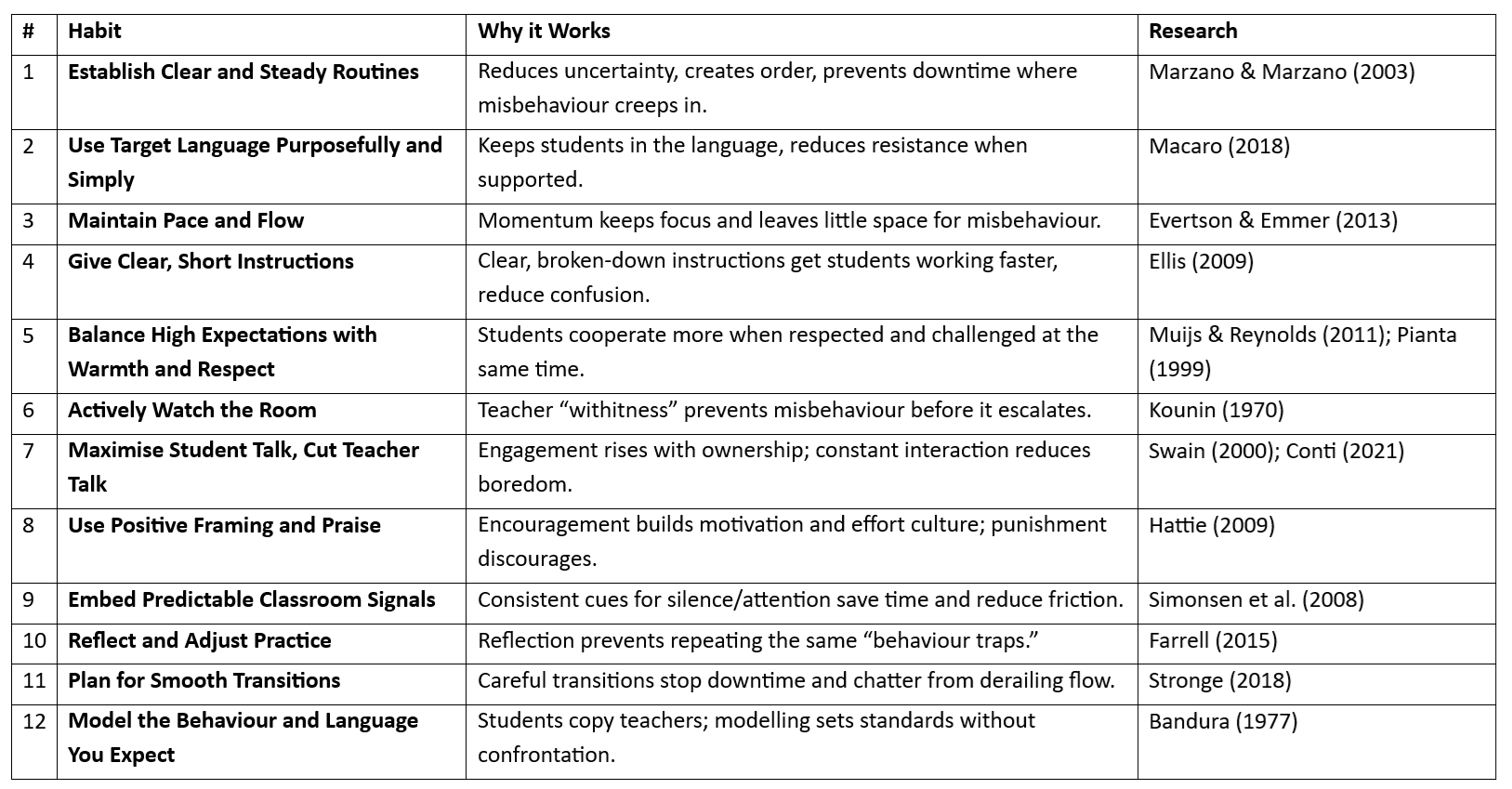
Table 1 – Summary

Conclusion

Effective classroom management in MFL is not about quick fixes or charisma — it is about small, research-backed habits used steadily. In my experience, predictable routines, clear instructions, structured TL use, high pace, smooth transitions and positive reinforcement together can create a purposeful climate where students focus on learning and not on disruption. By building these habits — including showing respect for students and their space, modelling expectations, and planning transitions with care — teachers may discover that they reduce the stress of discipline and free up energy to do what is most important: helping learners build much greater self-efficacy, confidence, fluency, and joy in using the language. And in the end, is this not the real aim of MFL teaching?

References

  • Bandura, A. (1977). Social learning theory. Englewood Cliffs, NJ: Prentice-Hall.
  • Ellis, R. (2009). Task-based language teaching: Sorting out the misunderstandings. International Journal of Applied Linguistics, 19(3), 221–246. https://doi.org/10.1111/j.1473-4192.2009.00231.x
  • Evertson, C. M., & Emmer, E. T. (2013). Classroom management for elementary teachers (9th ed.). Boston, MA: Pearson.
  • Farrell, T. S. C. (2015). Reflective language teaching: From research to practice. London: Bloomsbury.
  • Hattie, J. (2009). Visible learning: A synthesis of over 800 meta-analyses relating to achievement. London: Routledge.
  • Kounin, J. S. (1970). Discipline and group management in classrooms. New York: Holt, Rinehart & Winston.
  • Macaro, E. (2018). English medium instruction. Oxford: Oxford University Press.
  • Marzano, R. J., & Marzano, J. S. (2003). The key to classroom management. Educational Leadership, 61(1), 6–13.
  • Muijs, D., & Reynolds, D. (2011). Effective teaching: Evidence and practice (3rd ed.). London: Sage.
  • Pianta, R. C. (1999). Enhancing relationships between children and teachers. Washington, DC: American Psychological Association.
  • Simonsen, B., Fairbanks, S., Briesch, A., Myers, D., & Sugai, G. (2008). Evidence-based practices in classroom management: Considerations for research to practice. Education and Treatment of Children, 31(3), 351–380.
  • Stronge, J. H. (2018). Qualities of effective teachers (3rd ed.). Alexandria, VA: ASCD.
  • Swain, M. (2000). The output hypothesis and beyond: Mediating acquisition through collaborative dialogue. In J. P. Lantolf (Ed.), Sociocultural theory and second language learning (pp. 97–114). Oxford: Oxford University Press.

Thirteen Things Senior Leaders Need to Know About Language Teaching

Introduction

Stepping into leadership often means overseeing subjects you’ve never taught. When it comes to Modern Foreign Languages (MFL), this can create blind spots for many. Even the most supportive senior leaders in my experience sometimes misinterpret what effective practice looks like in our subject. It’s not surprising — many leaders’ own school memories of French or German lessons involve verb tables, copying exercises, writing essays and the dreaded “listen twice, answer the questions” routine. But these misconceptions matter. They shape decisions about timetabling, curriculum design, assessment, staffing, and resourcing — and those decisions have a direct impact on teacher morale, student learning, and long-term uptake. We have all been there.

This post draws on suggestions made by members of the Facebook group I co-founded, Global Innovative Language Teachers, in their comments on a recent thread on this very topic. Many thanks to them for sharing their insights and experiences, which inspired the points below. Many more useful suggestions were made, too many to include.

What follows are thirteen realities of language teaching that senior managers need to bear in mind, illustrated with common classroom scenarios a grounded in instructed second language acquisition (ISLA) research.

1. Curriculum Time is Key

What leaders assume: “One long lesson a week is better than nothing.”

The reality: Language learning is uniquely dependent on frequency and regularity. Unlike subjects where knowledge can be crammed and retained for exams, languages rely on daily rehearsal to move words and structures from short-term to long-term memory and from awareness and understanding (declarative knowledge) to fluency (procedural knowledge)

Cognitive psychology has shown that forgetting begins almost immediately (Ebbinghaus, 1885), and SLA research confirms that distributed practice — shorter, more frequent sessions — is far more effective than a single long session (Lightbown & Spada, 2013).

In some schools in Australia, languages are timetabled as a single two-hour block per week. It may look efficient on paper, but in practice is counterproductive: students face a six-day gap between exposures, during which most of the learning has already faded. By the time the next class begins, teachers spend much of the lesson reteaching, and learners rarely achieve fluency.

Common Scenario: A school reduces Year 7 MFL to one hour a week. Pupils make negligible progress, disengage, and GCSE uptake declines. Teacher skill cannot compensate for insufficient time but the MFL team takes the blame.

Implication: Protect regular, frequent MFL slots in the timetable. Two or three shorter lessons a week are far more effective than one long block.

2. Assessment Data Doesn’t Tell the Whole Story and overdoing it hampers motivation and progresss

What leaders assume: Frequent tests are reliable indicators of learning.

The reality: Language acquisition is NOT linear. Students may “know” a structure one day and forget it the next, only to rediscover it later (Ellis, 2003). Formal assessments often capture surface-level memorisation, not automatised competence and only give us the ‘illusion’ that something has been learnt (I have written extensively about this over the years). Research stresses the importance of triangulation: combining test scores, classroom observation, and, above all, spoken performance. Over-reliance on numbers alone risks distorting teaching priorities. And frankly, many of the tests I review when I visit schools when I do consultancies, are flawed in terms of construct and internal validity

Another important issue related to assessment is overdoing it. This is a common scenario in many schools and is counterproductive, especially with younger and more vulnerable learners because it misunderstands how languages are acquired.

As already mentioned above, progress in second language learning is rarely linear: learners may seem to “get” a structure one week, forget it the next, and then rediscover it later as their interlanguage gradually stabilises. Testing this zig-zag development too frequently makes normal fluctuations appear as failure.

Moreover, every test consumes time that could be spent on rich input, practice, and interaction — the activities that actually drive acquisition forward.

Finally, when assessment dominates the experience, motivation suffers: pupils begin to see language study as endless mini-exams rather than a living skill to be rehearsed and enjoyed, which can discourage persistence and uptake in the long term.

Common Scenario: A school demands half-termly vocab tests. Pupils cram and achieve high marks, but forget the material within a week. When teachers slow down to rebuild secure knowledge, scores appear to dip, creating unnecessary pressure.

Implication: Treat assessment data as just one piece of evidence. Oral ability, listening skills, and long-term retention must also count in evaluating progress.

3. Written Evidence is Not Proof of Learning

What leaders assume: If it isn’t in pupils’ books, it hasn’t been taught.

The reality: Languages live in the ear and mouth as much as on the page. Research highlights that oral interaction and listening are central to acquisition (Swain, 1995; Field, 2008). Insisting on constant written outcomes risks skewing teaching towards copying and extended writing at the expense of fluency and spontaneity. What matters is not how much ink fills a book, but whether students can understand and produce the language independently.

Common Scenario: During a book scrutiny, a head of year complains that Year 8 books look sparse. In reality, pupils had spent lessons practising role-plays, songs, and spontaneous speaking. Their progress was real but invisible on paper.

Implication: Quality assurance should value what cannot be captured in exercise books. Oral performance, recordings, and observation are vital evidence.

4. Consolidation is Not Coasting

What leaders assume: “If a lesson looks easy, pupils aren’t being stretched.”

The reality: Language learning requires overlearning — lots of practice with familiar material until it becomes automatic. Research on fluency building (Nation, 2001; Gatbonton & Segalowitz, 2005) shows that fluency grows through repeated encounters with language, not by racing to new content. Consolidation lessons often look “low challenge” on paper, but in fact they demand intense cognitive effort, as pupils must produce language quickly and confidently without relying on written prompts. This is how students move from knowing a rule to actually using it in real time.

Common Scenario: A teacher deliberately plans a lesson with familiar verbs and sentence frames, focusing on speed drills and spontaneous speaking. An observer marks the lesson down, commenting that “there wasn’t enough challenge.” The result? The teacher feels pressured to skip vital consolidation, and students move on with shaky foundations that collapse later.

Implication: Leaders should understand that consolidation is a form of challenge. It is not a lack of ambition but a necessary stage for fluency and long-term retention.

5. Languages Are Learned More Like Sports Than History

What leaders assume: Languages are acquired by memorising facts, like history.

The reality: Language learning is skill-building. It requires proceduralisation (DeKeyser, 2007) — the ability to use structures automatically under pressure, much like practising a musical instrument or sport. Knowing the rules is not enough; students need repeated practice in authentic contexts.

Common Scenario: Pupils can chant verb endings but freeze when asked to speak spontaneously. Their knowledge remains theoretical rather than usable.

Implication: Support practice-heavy lessons that move learners from knowing to doing. Repetition and rehearsal are the bedrock of fluency.

6. Chasing Popular Languages Isn’t Always Wise

What leaders assume: Offering the “right” fashionable language will boost uptake.

The reality: While some languages may be in vogue, research shows that long-term success in MFL depends more on continuity and curriculum coherence than on chasing trends (Lanvers & Coleman, 2013). Constantly switching languages undermines staff morale, wastes resources, and disrupts learners’ progression.

Common Scenario: A school abandons its well-established German programme to introduce Mandarin. After three years, uptake hasn’t improved and pupils lack a clear progression route. Staff morale dips as expertise is sidelined.

Implication: Involve subject specialists before making language-offer changes. Prioritise stable, well-sequenced provision over short-term popularity.

7. Feedback Needs to be Targeted, Not Constant

What leaders assume: Every mistake should be corrected immediately.

The reality: Effective feedback is selective and encourages learner self-repair (Lyster & Ranta, 1997). Overcorrection overwhelms students and discourages risk-taking, while under-correction fails to push them forward. Research shows that prompts — nudges that guide learners to notice and fix their own mistakes — are particularly effective (Ellis, 2009).

Common Scenario: An observer praises a teacher who interrupts pupils constantly to correct minor slips. In reality, the constant interruptions shut down learners’ willingness to speak, reducing opportunities for meaningful practice.

Implication: When observing lessons, look for how feedback is given, not simply whether errors are eradicated. Productive mistakes are essential to learning.

8. Metacognitive Skills Need to Be Taught, Not Assumed

What leaders assume: Learners naturally know how to study languages.

The reality: Many pupils don’t know how to listen effectively, organise vocabulary, or practise retrieval. Research (Vandergrift & Goh, 2012) shows that explicit strategy instruction — teaching learners how to predict, monitor, and evaluate their own listening — significantly improves outcomes. Helping pupils become reflective, self-regulated learners is crucial for long-term success.

Common Scenario: A student admits they revised for their French test by “reading the list once the night before.” Unsurprisingly, their scores collapse later, leaving them demoralised.

Implication: Encourage departments to integrate strategy instruction into their teaching. Leaders can also support parents to promote good study habits at home, even without knowing the language.

9. Oracy Is Central, Not Peripheral. Writing is…

What leaders assume: Writing tasks yields the main evidence of progress.

The reality: Oral communication is the ultimate goal of most language learning. SLA research shows that meaningful interaction and pushed output are critical (Swain, 1995; Ellis, 2003). If leaders equate rigour with extended writing, teachers may feel obliged to neglect speaking practice. Yet the ability to hold a real conversation is often what students value most.

Common Scenario: A leader questions why a Year 9 lesson includes role-plays instead of long writing tasks. Pupils, however, leave buzzing with the confidence that they can actually chat in another language.

Implication: Value oracy as highly as literacy when evaluating MFL teaching. A class where students speak a lot is not “easy” — it is doing the core work of language learning.

10. Managing Teacher Workload Requires Subject-Specific Awareness

What leaders assume: Marking and planning in MFL is no different from other subjects.

The reality: MFL teachers face unique demands. Every written task involves checking both content and form; resources often need to be created or adapted because authentic, engaging input is not easily available “off the shelf.” Research on teacher workload (Borg, 2015) shows that generic marking policies can disproportionately burden language teachers.

Common Scenario: A school introduces a whole-school marking policy requiring a detailed written response to every error. An MFL teacher spends hours correcting every mistake in a Year 8 essay, leaving them demoralised and exhausted.

Implication: Work with MFL leaders to adapt feedback policies, ensuring they balance workload with pedagogical effectiveness. Provide access to high-quality resources to ease preparation demands.

11. Non-Specialists Struggle to Deliver Languages Effectively

What leaders assume: Any teacher can deliver an MFL lesson with a textbook.

The reality: Language teaching requires deep subject knowledge — in grammar, phonology, and acquisition processes. Even teachers of other languages are not easily interchangeable (a French teacher cannot simply switch to teaching German). Without training, non-specialists often default to superficial tasks such as vocabulary copying or translation (Borg, 2006; Graham, 2006).

Common Scenario: A PE teacher is assigned a Spanish class. Despite their best efforts, the lessons become word-list copying with minimal speaking. Pupils conclude that languages are boring and irrelevant.

Implication: Protect MFL staffing where possible. If non-specialists must teach, invest in training, mentoring, and clear guidance.

12. Mixing Heritage Speakers with Beginners Creates Inequalities

What leaders assume: Placing native or heritage speakers with beginners will raise everyone’s attainment.

The reality: Heritage speakers often have oral fluency but weaker literacy. Beginners need slow, structured input. Research (Carreira, 2016) shows that putting them together can frustrate both groups: heritage speakers feel unchallenged, while beginners feel overshadowed and lose confidence.

Common Scenario: In a Year 8 Spanish class, two native speakers dominate discussions. Other pupils stay silent, intimidated, while the heritage learners become bored with basic grammar.

Implication: Consider differentiated pathways or tasks for heritage learners. Equity and motivation should take priority over administrative convenience.

13. Culture is Not an Optional Extra

What leaders assume: Cultural topics are “nice-to-have add-ons.”

The reality: Culture is not decoration — it is central to MFL. Byram (1997) and Norton (2013) emphasise that intercultural learning fuels motivation, fosters empathy, and gives languages purpose. Reducing culture to trivia or dropping it entirely narrows students’ horizons.

Common Scenario: A department is told to cut cultural content to focus on “exam technique.” Students disengage, wondering why they are learning a language if it has no meaningful link to real people or contexts.

Implication: Encourage departments to integrate cultural knowledge throughout the curriculum. This isn’t an optional extra but a core entitlement.

Conclusions

MFL teaching is not just about grammar rules or test scores — it is about building a skill slowly, through constant exposure, practice, consolidation, and meaningful communication. Senior leaders who understand these realities are better placed to support their teams, defend curriculum time, and champion languages in their schools. Most importantly, they help create a culture where teachers can focus on what matters most: nurturing confident, motivated, and culturally curious young linguists.

For those who want to explore these challenges in more depth — and find practical strategies for addressing them in the classroom — I explore them with Steve Smith in Breaking the Sound Barrier: Teaching Learners How to Listen (Conti & Smith, 2019) and in The target Language Toolkit (Smith and Conti, 2023)

Why do people find some languages more attractive than others?

Teachers often notice it: a student hears French and sighs that it sounds “beautiful,” while another finds Japanese “fascinating” or German “powerful.” These reactions are more than whims — they stem from a rich blend of brain wiring, personality, culture, and lived experience. Just as people develop strong preferences for certain kinds of music, they also form emotional bonds with particular languages. Let’s unpack the main factors at play.

1. The Sound and Rhythm of Language

One obvious reason lies in phonological aesthetics. Some languages are syllable-timed (like Italian, Spanish, Japanese), others stress-timed (like English, German). Research shows that listeners tend to find rhythmic familiarity appealing — the cadence that “fits” with their native speech patterns (Cutler & Mehler, 1993).

But there’s also novelty value. Languages perceived as smooth and melodic (French, Italian) often get rated as “romantic,” while harsher consonantal clusters (Czech, German) are described as strong or forceful. These perceptions, of course, are subjective — but they influence preference powerfully.

2. Personality and Identity

Studies in psychology suggest that personality traits predict music and language preference alike. Rentfrow & Gosling’s (2003) work on music taste shows that high “openness to experience” correlates with a love of complex, unfamiliar sounds. Greenberg et al. (2016) extended this by showing that openness also predicts preference for unfamiliar musical systems and foreign languages.

In other words, some learners are drawn to languages as a way of exploring new identities. French might feel elegant, German efficient, Korean cosmopolitan. A language can become a “second skin,” allowing people to inhabit a different cultural persona.

3. Cultural Associations and Symbolism

We never just hear a string of sounds; we also hear the culture they conjure. Italian carries associations of opera, art, food, and romance. French evokes fashion and philosophy. English brings with it Hollywood and pop music. Mandarin might signal economic power and global connectivity.

These cultural cues shape taste. Giles & Niedzielski (1998) found that attitudes towards a language’s speakers (prestige, status, warmth) heavily influence whether listeners judge the language itself as pleasant.

4. Early Exposure and Familiarity

Even passive contact matters. Studies with infants (Moon, Cooper, & Fifer, 1993) show that babies recognise and prefer the rhythm of the language spoken by their mother during pregnancy. Later in life, people often find languages they heard as children (through neighbours, relatives, TV) somehow “natural” or appealing, even if they never learned them.

5. Relationships and Emotional Connections

Languages carry emotional weight when tied to people we love or admire. If someone’s first crush spoke Spanish, or a favourite teacher used German, the language can acquire a lifelong glow. Conversely, negative associations (a harsh schooling experience, political conflict) can make a language feel unattractive. Social psychologists call this affective conditioning — when emotional experiences transfer to neutral stimuli (De Houwer et al., 2001).

6. Practicality vs. Romance

For some learners, attraction is about utility: English for global reach, Mandarin for career prospects, Spanish for travel. For others, the pull is more aesthetic or romantic: Icelandic for its mysterious isolation, Gaelic for cultural heritage, Tibetan for spiritual depth. Research in motivation theory (Dörnyei, 2005) shows that both instrumental motives (practical gains) and integrative motives (identity and belonging) drive language preference — and often in complex interplay.

Drawing the Parallel with Music

Like music, language preference arises from a mix of biology, psychology, culture, and memory. Some brains are wired to savour rhythmic or tonal novelty, others crave familiar cadences. Personality feeds into the search for identity, while cultural prestige and early exposure anchor taste. Above all, both music and language become powerful markers of who we are and who we want to be.

References

  • Cutler, A., & Mehler, J. (1993). The periodicity bias. Journal of Phonetics.
  • Rentfrow, P. J., & Gosling, S. D. (2003). The do re mi’s of everyday life: The structure and personality correlates of music preferences. Journal of Personality and Social Psychology.
  • Greenberg, D. M. et al. (2016). Personality predicts musical sophistication. Journal of Research in Personality.
  • Giles, H., & Niedzielski, N. (1998). Italian is beautiful, German is ugly. Language attitudes and ideology.
  • Moon, C., Cooper, R. P., & Fifer, W. P. (1993). Two-day-olds prefer their native language. Infant Behavior and Development.
  • De Houwer, J., Thomas, S., & Baeyens, F. (2001). Association learning of likes and dislikes: A review of 25 years of research on human evaluative conditioning. Psychological Bulletin.

Choral repetition: pros and cons and implications for teaching

​Potential benefits

Having searched high and low and I couldn’t locate much credible research evidence on the benefits of choral repetition. Here is what I found:

1.1 Pronunciation Improvement:

Engaging in choral repetition has been shown to enhance learners’ pronunciation skills in a handful of studies. A study by Trofimovich and Gatbonton (2006) demonstrated that repetition can lead to improved pronunciation accuracy – this resonates with my experience. They found that learners became more sensitive to phonological information through repeated exposure to the target words, suggesting that repetition aids in pronunciation development. Furthermore, Shao, Saito, and Tierney (2022) found that robust auditory-motor integration plays a crucial role in acquiring advanced-level L2 pronunciation proficiency, suggesting that choral repetition can significantly improve pronunciation accuracy. Another study conducted by Poejilestari (2018) investigated the effectiveness of using choral drill techniques to improve students’ English pronunciation. The research, carried out at SMK Karya Bahana Mandiri Bekasi, Indonesia, found that the practice had a significant enhancing effect on pronunciation as well as on the students’ participation and motivation.

1.2 Enhanced Phonological Memory:

​While direct research on choral repetition specifically strengthening phonological working memory is limited, several studies suggest that vocal practice and repetition can positively influence this cognitive function. For instance, a longitudinal study investigated the effects of vocal practice on phonological working memory in children. The findings indicated that engaging in vocal exercises improved the children’s ability to retain and manipulate speech sounds, suggesting a positive impact on their phonological working memory (Portnoy et al, 2010)

Morevore, choral repetition encourages students to vocalize words, facilitating their entry into the phonological loop—a component of working memory responsible for storing and rehearsing verbal information. This process aids in the retention and recall of new vocabulary. ​

Finally, an fMRI study examines the influence of verbal repetition and imitation on network configuration during second language word learning. The results indicate that repetition and imitation can enhance neural integration within language networks (through Phonological Memory), suggesting that these techniques may improve language learning efficiency and learner motivation.

1.3 Increased Learner Engagement:

Incorporating choral repetition through into lessons may elevate student participation and motivation according to handful of studies. The collective nature of the activity may foster a sense of community and encourages learners to actively engage with the material. Schnabel et al (2024) found increased engagement by involving learners in choir practice in the target language. This finding echoes similar findings by Cardoso et Li (2023) who found that singing in a language-responsive choir can encourage productive second language use and enhance listening skills. These two studies’ findings suggest that integrating language learning with choir practice not only improves pronunciation but also increases student engagement and motivation.

Caveat: choral repetition, like anything else, can be made into a fun activity, but it can also be boring (see point 2.4 below).

1.4 Development of Auditory Discrimination Skills:

Choral repetition aids in refining learners’ ability to distinguish subtle differences in sounds, which is essential for accurate pronunciation and listening comprehension. This practice enhances their overall auditory discrimination capabilities. ​The same study quoted above by Schnabel et al (2024) evidences marked improvements in their subjects in this crucial area of L2 acquisition.

1.5 Facilitation of Automaticity:

Regular practice through choral repetition can lead to automaticity in language production, allowing learners to use common phrases and structures more fluently without conscious effort. This automaticity is vital for achieving conversational fluency. ​Big caveat, however: it can also lead to automatizing errors!

2. Potential drawbacks

While choral repetition may potentially offer the above benefits, language educators should be mindful of its potential drawbacks, which I have observed in my own teaching practice and in numerous lessons observations:

2.1 Passive Participation:

Students may appear engaged during choral repetition but might not be actively participating. This passive involvement can limit individual learning outcomes.

2.2 Fossilization of error and limited Individual Corrective Feedback:

The collective nature of choral repetition makes it challenging for instructors to identify and correct individual errors. If the same error goes unheeded and untreated several times over, this is likely to lead to its fossilization (irremediable entrenchment). Hence, the practice of repeating a new lexical item containing challenging sounds, that have not yet been acquired immediately, after a teacher can have harmful consequences.

Errors are not uncommon as some of your students will not hear the sound as you

2.3 Lack of Authentic Communication:

Choral repetition focuses on mimicking language patterns rather than promoting spontaneous language use, which may not effectively prepare learners for communication under real operating conditions (e.g. in a spontaneous conversation or an oral assessment).

2.4 Potential for Boredom:

Repetitive choral activities can lead to student disengagement if not varied or contextualized, reducing their effectiveness. ​Unless gamified, choral repetition can quite boring. Activities like ‘Ghost reading’, ‘Orchestra Director’ or ‘Disappearing text’ can be a fun way to make choral repetition more fun.

2.5 Overemphasis on Accuracy:

Focusing heavily on precise repetition can create anxiety among learners, potentially hindering fluency development.​

Conclusion

Choral repetition remains a double-edged pedagogical tool.
Used imaginatively and alongside opportunities for spontaneous communication, it can sharpen pronunciation, strengthen phonological memory, and build classroom cohesion.
Used mechanically, it risks boredom, fossilised errors and a narrow focus on accuracy at the expense of fluency.
As always in language teaching, the difference lies less in the method itself than in the quality of its design and the skill of the teacher who employs it.

When Listening Feels Like a Blur: How to Train Learners to Hear Word Boundaries

Introduction

When beginner and intermediate students tell us that listening in the target language feels like “a blur of sound,” they are not exaggerating. Research has long shown that one of the biggest hurdles for developing listeners is simply recognising where one word ends and the next begins. In written text, boundaries are clear: spaces mark word separation. In speech, however, the listener must rely on phonological, prosodic, and contextual cues. For second language learners, this is a minefield.

The Illusion of “No Gaps”

Native speakers perceive words effortlessly, but not because speech offers obvious gaps. In fact, continuous speech is acoustically seamless. Cutler and Butterfield (1992) demonstrated that in English, there are almost no reliable pauses between words. Learners must infer boundaries based on cues such as stress, rhythm, and coarticulation patterns.

For beginners, these cues are unfamiliar. Goh (2000) found that novice learners often described speech as “one long word,” unable to separate even familiar lexical items. This is not a vocabulary issue per se; it is a segmentation problem. Even when students “know” the word, they cannot recognise it in connected speech.

Why Beginners Struggle More

Several factors converge to make word-boundary recognition especially difficult for beginner-to-intermediate learners:

  1. Coarticulation and Reduction – fluent speech erases clear markers through assimilation and weak forms (going to → gonna). (Field, 2008)
  2. Different Prosodic Systems – segmentation cues differ across languages; L1 prosody often misleads learners (Vandergrift & Goh, 2012).
  3. Cognitive Overload – beginners’ working memory collapses under the strain of decoding + boundary detection simultaneously.
  4. Lexical Knowledge Thresholds – below ~95% coverage, learners cannot use top-down knowledge to assist segmentation (Stæhr, 2009).
  5. Lack of Strategy Awareness – learners often listen passively, without techniques to catch boundaries (Graham, 2006).

What This Means for Teachers

Segmentation must be taught explicitly. Below are eight activities (from the many included in our 2019 book, Breaking the Sound Barrier: Teaching learners how to listen) that target boundary recognition directly, each with a pedagogical rationale grounded in research.

1. Word Count Listening (Field, 2008)

Learners hear a short sentence (4–8 words). Their task is to guess how many words they heard.

Rationale: Trains attention to prosodic cues (stress, pauses, rhythm) rather than meaning. Field (2008) notes that even when learners cannot recognise words, they can begin to “hear” boundaries as units of rhythm, building sensitivity to segmentation patterns.

2. Chunk Dictation (Micro-Dictogloss) (Field, 2008)

Learners transcribe only short bursts (3–5 words), not whole passages.

Rationale: By focusing on micro-chunks, learners sharpen their bottom-up decoding skills. Goh (2000) showed that reconstructing short phrases helps learners perceive coarticulated forms and trains the phonological loop of working memory without overwhelming it.

3. Spot the Intruder (Conti and Smith, 2019)

Learners see a transcript with an extra word not in the recording. They must detect and cross out the “intruder.”

Rationale: Forces learners to synchronise sound with text, noticing what is not there. This builds precision and discourages over-reliance on top-down guessing. It cultivates a match-mismatch awareness central to Schmidt’s (1990) noticing hypothesis.

4. Spot the Missing Word (Conti and Smith, 2019)

The transcript omits a word that is in the recording. Learners listen and fill in the blank.

Rationale: Trains learners to notice weak and unstressed words (e.g. at, of, to) that often vanish in connected speech. Research shows that learners tend to skip function words (Field, 2008). This task makes those invisible boundaries audible.

5. Break the Flow (Conti and Smith, 2019)

Learners are given transcripts where common reductions (gonna, wanna, lemme) appear. They listen and identify them in fluent speech.

Rationale: Cauldwell (2013) calls this exposing learners to the “messy” reality of authentic input. Learners realise that “known” words do not always sound like their dictionary form. This training helps them map phonological variants to mental lexicon entries and forces them to track segmentation in speech that does not align with orthographic expectations.

6. Formulaic Sequence Training (Wray, 2002)

Learners practise listening for and repeating chunks such as at the end of the, il y a, ¿qué tal?.

Rationale: Wray (2002) shows that processing formulaic sequences as units reduces cognitive load and supports segmentation. Learners “hear” a whole chunk rather than trying to cut it into individual words, which is how natives process speech fluently.

7. Write It As You Hear It (Vandergrift, 2007)

Learners write down a sentence exactly as they perceive it on first hearing, even if spelling or segmentation is wrong. Then they compare their version to the correct transcript.

Rationale: This activity externalises the learner’s perceptual errors — they see where they failed to hear a boundary (e.g. writing “Idontknow” instead of “I don’t know”). Vandergrift (2007) argues that reflecting on listening processes is as important as practice itself; here, the mismatch fosters awareness of weak points in segmentation.

8. Guess what comes next (Conti & Smith, 2019)

The teacher pauses the recording just before a likely word boundary. Learners predict the next word or phrase, then listen to confirm.

Rationale: This combines bottom-up segmentation with anticipatory processing. Learners practise recognising where one unit ends while also engaging top-down knowledge to guess what might follow. Vandergrift & Goh (2012) highlight this as a way to integrate segmentation skills with prediction, two core processes of fluent listening.

9. Using Sentence Builders Orally

Sentence builders, when used orally rather than purely visually, offer an additional route into segmentation training. Typically, teachers use them to scaffold speaking and writing, but they can be equally effective in developing listening, especially at the beginner and intermediate stages.

Why it helps:

  1. Controlled, high-frequency input – Sentence builders recycle a limited set of words and structures. Hearing these in oral practice exposes learners repeatedly to the same lexical items in connected speech, helping them recognise recurring word boundaries more reliably.
  2. Clear-to-blurred progression – In the early stages, teachers articulate model sentences slowly and clearly from the builder. Gradually, speed and natural reductions can be introduced, mirroring how authentic listening becomes less “coursebook-like” over time.
  3. Form-meaning mapping in context – Because sentence builders generate meaningful sentences, learners don’t just hear isolated words but see how boundaries work within authentic syntax.
  4. Dual coding of visual and aural channels – When sentence builders are projected while the teacher models orally, learners receive visual segmentation cues (the spaces and blocks on the builder) aligned with the aural stream.
  5. From scaffold to autonomy – Oral sentence builder work eventually transitions into learners generating their own sentences at speed, but only once perception has stabilised.

Example classroom flow (beginner-safe):

  1. The teacher models 5–6 sentences (one at a time, slowly) from the sentence builder while the students write their meanings on their mini whiteboards.
  2. Then, the teacher rereads each sentence omitting a word each time (Spot the Missing Detail).
  3. Next, the teacher starts each sentence but pauses halfway through to play Pause and Predict.
  4. Now, the sentence builder is removed and a Break the Flow activity is played, forcing learners to catch boundaries without visual scaffolding.
  5. Finally, a delayed dictation can be staged, consolidating perception and reinforcing segmentation.

This flow avoids pushing learners into premature choral repetition. Instead, it treats the sentence builder primarily as a listening scaffold, gradually training learners to segment and notice before any attempt at oral production.

Table 1 – Suggested Segmentation-focused activities

ActivityTargeted SkillWhy It Works (Pedagogical Rationale)
1. Word Count ListeningSensitivity to prosodic boundariesForces learners to attend to rhythm, stress, and segmentation cues instead of meaning.
2. Chunk Dictation (Micro-Dictogloss)Short-span segmentationFocuses on short bursts, helping learners process coarticulation without overload.
3. Spot the IntruderSound–text synchronisationNoticing mismatches sharpens segmentation and discourages top-down guessing.
4. Spot the Missing WordDetecting weak/unstressed wordsTrains learners to notice reduced function words that often disappear in connected speech.
5. Break the FlowRecognition of reduced formsConfronts learners with “messy” authentic reductions and builds tolerance for non-dictionary pronunciations.
6. Formulaic Sequence TrainingChunk-based processingReduces cognitive load: learners hear multi-word units rather than isolated words.
7. Write It As You Hear ItAwareness of segmentation errorsMakes learners’ misperceptions visible, supporting reflection and correction.
8. Pause and PredictAnticipatory segmentationCombines bottom-up boundary recognition with top-down prediction.
9. Oral Sentence Builder WorkScaffolded segmentation in contextProvides high-frequency, visually scaffolded input before free listening; aligns visual and aural cues.

Conclusion

For beginner-to-intermediate learners, listening is not only about vocabulary or grammar. It is also about learning to hear the spaces that aren’t really there. The difficulty of word-boundary recognition lies at the intersection of phonology, prosody, and cognitive load.

If teachers systematically target this skill — through word-count listening, micro-dictogloss, intruder/missing word spotting, Break the Flow training, formulaic chunk practice, write-it-as-you-hear-it diagnostics, pause-and-predict drills, and oral sentence builder work — learners begin to perceive the rhythm and segmentation cues that natives take for granted.

As Field (2008) reminds us, listening should be taught, not tested. And for many learners, that teaching begins not with comprehension questions, but with training the ear to hear where one word ends and the next begins.

References

  • Cauldwell, R. (2013). Phonology for Listening: Teaching the Stream of Speech. Birmingham: Speech in Action.
  • Conti, G., & Smith, S. (2019). Breaking the Sound Barrier: Teaching Learners How to Listen. London: Independently Published.
  • Cutler, A., & Butterfield, S. (1992). Rhythmic cues to speech segmentation: Evidence from juncture misperception. Journal of Memory and Language, 31(2), 218–236.
  • Field, J. (2008). Listening in the Language Classroom. Cambridge: Cambridge University Press.
  • Goh, C. (2000). A cognitive perspective on language learners’ listening comprehension problems. System, 28(1), 55–75.
  • Graham, S. (2006). Listening comprehension: The learners’ perspective. System, 34(2), 165–182.
  • Nation, I. S. P. (2001). Learning Vocabulary in Another Language. Cambridge: Cambridge University Press.
  • Schmidt, R. (1990). The role of consciousness in second language learning. Applied Linguistics, 11(2), 129–158.
  • Stæhr, L. S. (2009). Vocabulary knowledge and advanced listening comprehension in English as a foreign language. Studies in Second Language Acquisition, 31(4), 577–607.
  • Vandergrift, L. (2007). Recent developments in second language listening comprehension research. Language Teaching, 40(3), 191–210.
  • Vandergrift, L., & Goh, C. (2012). Teaching and Learning Second Language Listening: Metacognition in Action. New York: Routledge.
  • Wray, A. (2002). Formulaic Language and the Lexicon. Cambridge: Cambridge University Press.

Teaching Listening Strategies – When It Actually Works

Introduction

If there is one mantra I always repeat in every single CPD session of mine, it is that listening is the neglected skill. Many students find it opaque, many teachers often dread teaching it, and too many GCSE classes still treat it as a “test of memory under duress.” For several decades, strategy instruction has been hailed as the silver bullet—but is it?

Whilst research is now fairly consistent in evudencing that teaching learners how to plan, monitor, infer, and evaluate (PME) during listening tasks does improve comprehension, there’s an important catch—it only works if it is sustained over a long period of time), carefully structured, and balanced with language growth (i.e. the students have accrued a sizeable L2 vocabulary and substantive mastery of the L2 grammar). Below, I unpack what that actually means in practice.

Duration: the Long Game, Not the Quick Fix

One of the most common mistakes I have observed over the years in KS3 and KS4 classrooms is treating training in listening strategies as a one-off lesson or a half-term experiment. We know from studies such as Graham & Macaro (2008) that significant gains only show after a 10–12 week well-structured programme. By the same token, Liu, Zhang & Vandergrift’s (2024) meta-analysis showed that longer interventions inequivocably outperformed shorter ones – the effect sizes moving from “small” to “moderate-to-large” when the programme ran for a full term or more.

It is a bit like going to the gym: a few session won’t build much muscle. To embed metacognitive listening habits in the students’ modus operandi, students require repeated and sustained practice in the planning–monitoring–inferencing–evaluation ( PME) cycle until it becomes second nature.

Consistency: From Occasional Tips to Embedded Routines

Another common trap I have observed over the year is the “strategy tip of the week” approach—helpful reminders like “listen for cognates”, “skip what you don’t understand”, “search for key words”, etc. These are surface-level hints which may yield short-term gains, but not deep training which brings about durable change. What works is consistency: every listening lesson should include the same reflective prompts, nudging students through the process of predicting, checking, and evaluating. In my experience, this is rarely done. This consistency builds long-lasting metacognitive muscle. When students can anticipate the teacher asking “What did you predict you’d hear?” or “How did you verify that answer?”, then you know that they are beginning to internalise the target strategy sequence rather than seeing it as a bolt-on exercise of little consequence.

Structure: Scaffolding, Gradual Release, Feedback

In my experience, the most effective strategy training occurs when it is carefully thought out in terms of scaffolding. In the above-mentioned Graham & Macaro’s study, for instance, high-scaffold classes initially made greater progress: (1) first, the teachers modelled the steps ; (2) they then prompted the learners to articulate what they were doing; (3) they provided practice with the support of strategy lists; (4) finally, they provided feedback on both process and outcome. Later, a “low-scaffold” group which had not been initially supported and was consequently doing less well, caught up precisely because they were evebtually pushed to regulate themselves.

This suggests that effective instruction must start with heavy scaffolding but must gradually release responsibility in order to result in autonomous use. Without structure, weaker listeners flounder; without release, stronger listeners stagnate. The art is in balancing both.

The Graham & Macaro (2008) Programme: What It Was, and Where It Came From

This study is often cited by strategy training advocates but is less frequently explained. Hence, it may be worth pausing on the details of what it involved. Conducted with 107 lower-intermediate learners of French in English secondary schools, the programme lasted 10 weeks and involved a highly structured cycle of planning, monitoring, inferencing, verification, and evaluation.

  • Foundation: the programme was based on work of Larry Vandergrift (1997, 2003), who developed the metacognitive sequence model for listening underlying the intervention, and on O’Malley & Chamot’s (1990) research into learning strategies.
  • Two versions: One group received high-scaffold training, with the teachers explicitly modelling and guiding student reflection. Another group received low-scaffold training, with prompts but less teacher input.
  • Findings: Both groups outperformed the control group, with statistically significant effects on listening comprehension at both immediate post-test and six months later. It is notable that self-efficacy in listening improved, and the delayed post-test showed that the “low-scaffold” group actually surpassed the high-scaffold group—suggesting that initial support followed by learner independence is key.

This study is one of the most credible classroom-based demonstrations that listening strategy training can work in real secondary school conditions, not just in small-scale experimental set-ups.

Vocabulary and Grammar: The Hidden Bottleneck

What the advocates of strategy training often neglect to point out is that it cannot compensate for students who simply do not recognise enough words, collocations, or grammatical cues. John Field (2008) and Vandergrift & Goh (2012) both emphasise that listening success is severely constrained by bottom-up decoding. At KS3 and KS4, this means that vocabulary teaching, phonics, and grammatical automatisation are not “add-ons” but essential prerequisites without which listening comprehension fails. Learners need sufficient lexical coverage (at least 95%) and enough grammatical familiarity to parse clause boundaries and verb endings in real time (2 seconds per sentence!). Otherwise, strategies risk becoming merely elaborate ways of guessing.

How Many Words Are Enough?

A key question is: how many words does a learner need to know before listening strategies can genuinely help?

Much research in L2 vocabulary suggests that 95% lexical coverage of a text is the minimum required for reasonable comprehension, with 98% coverage allowing for comfortable, confident understanding (Nation, 2006; Stæhr, 2009).

In practice, this means that learners need at least 2,000–3,000 high-frequency word families in the target language for strategy training to be truly beneficial. Below that threshold, the sheer density of unknown words makes it very arduous if not impossible to apply planning, monitoring and inferencing effectively—because there is simply too little known language to work with.

For KS3 and KS4 learners, this has two implications:

  • Vocabulary building isn’t optional – it’s a must. Without it, strategy training collapses under the weight of unknown lexis.
  • Strategy gains are enhanced by lexical development. The more words one knows, the more powerful strategies like inferencing or verification become.

In short: listening strategy training is no substitute for vocabulary knowledge; it is a way to leverage that knowledge more effectively.

So, When Does It Work?

Pulling the threads together, listening strategy instruction works best when:

  • It lasts long enough (a term or more) to form habits.
  • It is consistent across lessons, not sporadic.
  • It is scaffolded, modelled, and then gradually released.
  • It runs in tandem with vocabulary, phonics, and grammar growth.
  • It is introduced once learners have a critical mass of high-frequency words.

In other words, strategy training is not a magic fix for listening difficulties; it is a multiplier. It amplifies what students can already do with their lexicon and grammar. It also builds confidence: learners report feeling less like “victims of the tape” and more like active problem-solvers.

Conclusion

As teachers, we owe it to our students to move listening beyond “press play and pray.” Strategy instruction is powerful, but only when is is carried out as part of interventions which are well-planned and highly scaffoled, not merely one-off sessions or sporadic reminders or tips . If we commit to that, we turn listening from the most feared skill into one of the most empowering.

References

  • Graham, S. & Macaro, E. (2008). Strategy instruction in listening for lower-intermediate learners of French. Language Learning, 58(4), 747–783.
  • Liu, Y., Zhang, J. & Vandergrift, L. (2024). A meta-analysis of listening strategy instruction effects. Language Teaching Research, advance online publication.
  • O’Malley, J. M. & Chamot, A. U. (1990). Learning Strategies in Second Language Acquisition. Cambridge: CUP.
  • Vandergrift, L. (1997). The comprehension strategies of second language (French) listeners. Foreign Language Annals, 30(3), 387–409.
  • Vandergrift, L. (2003). Orchestrating strategy use: Toward a model of the skilled second language listener. Language Learning, 53(3), 463–496.
  • Vandergrift, L. & Goh, C. C. M. (2012). Teaching and Learning Second Language Listening: Metacognition in Action. New York: Routledge.
  • Field, J. (2008). Listening in the Language Classroom. Cambridge: CUP.
  • Nation, I. S. P. (2006). How large a vocabulary is needed for reading and listening? Canadian Modern Language Review, 63(1), 59–82.
  • Stæhr, L. S. (2009). Vocabulary knowledge and advanced listening comprehension in English as a foreign language. Studies in Second Language Acquisition, 31(4), 577–607.