
Introduction
If I have learnt one thing throughout 28 years of teaching, is that there is no such thing as “teaching SEN pupils” in the abstract. SEN profiles are so diverse, messy, and contradictory! However, research from cognitive psychology, SLA, and special education converges on a clear set of principles that consistently make MFL more accessible to learners with additional needs.
What follows are ten key things to bear in mind when teaching languages to SEN students, grounded in research and translated into classroom practice and materials design. Rest assured that none of these are gimmicks. Most are uncomfortable because they require us to slow down, simplify, and rethink what we mean by “progress”.
Finally, do note that I have included in this post a section dedicated solely to teaching dyslexic children, as research indicates that up to around 10 % of the UK population are estimated to have dyslexia — meaning a significant proportion of MFL learners may struggle with reading, processing and recall in ways that traditional materials and assessments do not adequately support
1. SEN pupils struggle more with retrieval than understanding
One of the most persistent myths in MFL – one that I always try to debunk in my posts – is that if a pupil cannot produce language, they do not “know” it. Research on working memory and retrieval (Gathercole & Alloway; Hulstijn) shows that recognition and recall are different cognitive processes.
Classroom implication
A pupil who can match la piscine to a picture but cannot spell or say it is not failing ! — they are operating at a different stage of acquisition.
Materials implication
Design tasks that separate recognition from production:
- matching before recall
- word banks before blank pages
- partial dictation before full dictation
If your material jumps straight from exposure to free writing, SEN pupils fall off a cliff. In my approach (EPI) this translates into having a robust Receptive Processing phase (the first ‘R’ in the MARSEARS framework).
2. Cognitive load kills learning faster than lack of ability
Cognitive Load Theory (Sweller) is, of course, brutally relevant to SEN learners. Overloaded working memory doesn’t result in slower learning — it results in no learning at all.
Classroom implication
If a task requires pupils to simultaneously:
- read instructions
- decode new vocabulary
- apply grammar rules consciously step by step
- and write accurately
…you are not teaching language; you are testing executive function.
Materials implication
Reduce load by design:
- one linguistic focus per task
- minimal text per page
- predictable task formats (this is key! Don’t be afraid to be repetitive)
- visual consistency
- 98% comprehensible input (note: 98% comprehensible input does not mean simplified content, but content made accessible through scaffolding, repetition, and chunking)
A “busy” worksheet is often inaccessible before the pupil even starts!
3. Listening must be the engine, not the afterthought
Many SEN pupils (especially dyslexic learners) process language far more effectively through sound than print. SLA research consistently supports the primacy of input — yet textbooks still privilege reading and writing – and not the accessible sort either!
Classroom implication
Listening should dominate early sequences:
- teacher modelling
- choral repetition
- narrow listening
- listening with purpose, not just “play and answer”
Materials implication
Design materials where:
- listening precedes reading
- texts are short, repeated, and recycled (e.g. the EPI’s narrow listening)
- audio is exploited multiple times in different ways (e.g. the EPI’s thorough processing techniques)
If listening is just “activity 3”, SEN pupils are already excluded.
4. Patterns must be made visible
SEN pupils are less likely to infer grammatical patterns implicitly. This is not laziness; it’s a cognitive difference. Research on explicit instruction (Norris & Ortega; Spada & Tomita) shows that guided noticing matters. However, research also shows that complicated grammatical explanations are less accessible by students with a lower IQ or less developed executive function.
Classroom implication
Do not assume pupils will “pick it up”. Show them:
- colour-coded structures
- sentence frames (e.g. EPI’s sentence builders)
- chunked patterns
Materials implication
Avoid presenting:
- vocabulary lists without structure
- grammar rules without exemplars
Instead, design lexico-grammatical chunks:
voy a + infinitive
me gusta + noun
Patterns first. Labels later. The greatest applied linguists on the planet agree that teaching chunks should come first and explicit grammar explanation should come later – Ellis & Shintani (2014), N. Ellis (2015), Nation (2013), VanPatten (2015), Webb & Nation (2017), etc. In EPI, this is reflected by having a short and snappy Awareness-raising phase (the first A in MARSEARS) immediately after the initial modelling through sentence builders and visual aids and a more robust explicit grammar teaching phase (the E in MARSEARS) after three or for lessons of receptive and productive retrieval of the target chunks.
5. SEN pupils need overlearning, not coverage
Forgetting curves are much steeper for many SEN learners. What looks like “they’ve done this already” is often they’ve seen it once.
Classroom implication
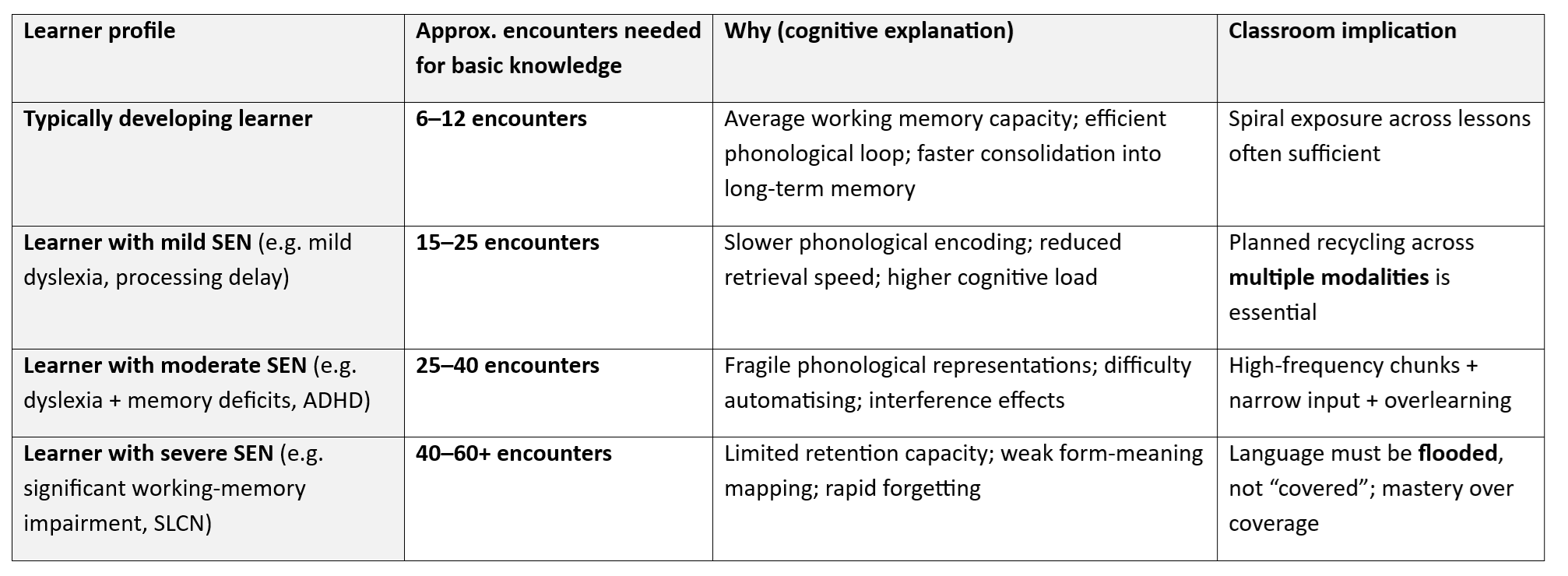
Hence, Recycling is not revision — it is core instruction. If the average child requires
Materials implication
Good SEN-friendly materials:
- reuse the same language across lessons
- vary tasks, not language
- return to the same chunks in different contexts
If your scheme introduces new language every lesson without revisiting old material, SEN pupils are permanently behind. This is one of the biggest shortcoming of the textbooks currently in use in most UK schools, e.g. Stimmt, Viva, Mira,, Dynamo, Tricolore, Studio. Possibly the worst ones are the recently published textbooks based on the new GCSE – often by no fault of the authors, in my opinion, who are constrained by the number of pages set by the publishers and by the ridiculous high volume of content they need to cover.
Table 1 –Encounters with a lexical item required by learners of different abilities (from the average ability ones to those with severe SEN) to develop a BASIC knowledge of it
Key clarification (important)
- These encounters must be meaningful, not just visual exposure
- Repetitions work best when they are:
- spaced (not crammed)
- multimodal (listening, reading, speaking, matching)
- embedded in chunks, not isolated words
6. Independence must be earned, not demanded
Textbooks often assume pupils can work independently after one model despite decades of research suggesting otherwise! Sociocultural theory argues that learning happens most reliably in the Zone of Proximal Development—i.e., when pupils can succeed with structured guidance that is then gradually withdrawn (Vygotsky, 1978). Reviews of scaffolding research emphasise that effective support is not “help for the weak”, but a deliberate design feature that enables learners to process language they only partially control and to internalise procedures over time (Malik, 2017; Ertugruloglu, 2023). In the UK MFL context, the Teaching Schools Council’s MFL Pedagogy Review also warns—implicitly for exactly this reason—that textbooks should be chosen for how well they support planned teaching of vocabulary/grammar/phonics and should often be supplemented rather than relied on as the sole engine of learning, because many published materials don’t provide enough structured practice and guided attention to detail for all learners to access them independently. Read this article if you want to know more on this topic: https://www.tandfonline.com/doi/full/10.1080/2331186X.2017.1331533
Classroom implication
Remove scaffolds gradually, not suddenly as we do in EPI, where students arrive at production only after a highly structured journey from input to output which gradually moves from receptive retrieval at sentence-level to more challenging work with connected text in the Receptive phase and then scaffolds the progression from easier productive retrieval at sentence level (e.g. Oral Ping-pong) to harder information-gap tasks (e.g. ‘Back-to-back’ or ‘Ask the experts’) in the Structured Production phase.
Materials implication
Build tasks that move from:
- full support → partial support → no support
Not:
- support → (nearly) nothing
For SEN learners, the “blank page” is often the point of collapse. This is another major pitfalls of currently available textbooks, even when a lower-ability specific version of the textbooks does exist. The scaffolding is so bad, that the Listening and Reading activities are not logically linked with the ensuing Speaking and Writing activities! Bizarre, of course, as the former are meant to scaffold the latter. Hence, do ensure that, as we do in EPI, the receptive activities are carefully designed and implemented in a bid to ensure that speaking and writing skills emerge seamlessly and organically from the listening and reading activities staged at the beginning of your instructional sequences.
7. Writing is the hardest output — treat it as such
Writing combines:
- recall
- spelling
- grammar
- motor skills
- working memory
For SEN pupils, this is the highest-load skill. Even higher than speaking! The typical textbook expects students to read one or two texts, do a reading comprehension tasks or two on each and then write something similar. This is not going to help the average learner, let alone an SEN child!
Classroom implication
Do not use writing as your default proof of learning. This is the most commonly made mistakes with SEN pupils. Do plenty of scaffolding (see the previous point) ! Give them highly structured 100% feasible output.
Materials implication
Before extended writing, include:
- sentence completion
- sentence manipulation
- ordering tasks
- easy sentence-puzzle games
- copying with attention
If the first time pupils write independently is for assessment, you’ve set them up to fail. Delay writing assessment with SEN pupils as much as humanly possible
8. Pace matters more than enthusiasm
Fast-paced lessons are often praised — but for SEN pupils, speed frequently equals panic.
Classroom implication
Calm, predictable pacing reduces anxiety and improves retention.
Materials implication
Design sequences with:
- repeated task types
- familiar routines
- clear expectations
Surprise is motivating for some pupils; it is destabilising for others.
9. Differentiation should be built in, not bolted on
SEN pupils should not always be working on “the easier sheet”. Research on inclusive design stresses universal design for learning.
Classroom implication
Design tasks with multiple entry points, not multiple worksheets.
Materials implication
A good task allows:
- all pupils to start
- some to go further
- no one to be exposed as “different”
Ramped difficulty beats personalised worksheets every time.
10. Progress for SEN pupils is often invisible unless you know where to look
Traditional assessments privilege speed, accuracy, and written output. SEN progress often shows up first in:
- faster recognition
- reduced hesitation
- improved pronunciation
- willingness to attempt
Classroom implication
If you only value what you can mark, you will miss most progress.
Materials implication
Include low-stakes checks:
- oral responses
- mini whiteboards
- matching and sorting tasks
- listening discrimination
These reveal learning long before writing does.
Specific advice for teaching MFL to dyslexic children
Table 2 – Teaching strategies specifically aimed at dyslexic children
| Teacher Strategy | Why this Matters Specifically for Dyslexic Learners | Research Basis |
|---|---|---|
| Explicit teaching of sound–spelling correspondences (as we do in EPI) | Dyslexia is strongly associated with phonological processing difficulties; learners do not reliably infer grapheme–phoneme links implicitly | Snowling (2000); Hulme & Snowling (2016) |
| Overt phoneme segmentation and blending in the target language (as we do in EPI) | Dyslexic learners struggle to segment spoken words into phonemes, which directly affects spelling, decoding and pronunciation | Goswami (2008); Ziegler & Goswami (2005) |
| Slow, exaggerated modelling of pronunciation (as we do in EPI) | Reduced phonological sensitivity means fast or “natural” speech often collapses into noise | Szenkovits & Ramus (2005) |
| Consistent font, spacing and visual layout across materials (as we do in EPI) | Visual stress and reduced visual tracking make dense or changing layouts disproportionately difficult | British Dyslexia Association (2018) |
| Avoidance of copying from the board as a learning activity (in EPI this is done sparingly after much modelling) | Copying overloads visual processing and working memory without strengthening language representations | Elliott & Grigorenko (2014) |
| Teaching spelling as pattern-based, not word-by-word (as we do in EPI) | Dyslexic learners do not retain arbitrary orthographic forms well but benefit from rule-based generalisations | Seymour (2014) |
Why EPI is particularly suitable for SEN learners
Many of the principles outlined above are not incidental features of Extensive Processing Instruction (EPI); they are foundational to its design. EPI is particularly well suited to SEN learners because it systematically removes the very barriers that traditional MFL materials create.
First, EPI places input before output. SEN learners are not rushed into premature production; instead, they are given repeated, highly comprehensible exposure to language through listening and reading before being expected to retrieve it independently. This aligns closely with what we know about the recognition–recall gap in SEN profiles.
Second, EPI actively controls cognitive load. Sentence builders, chunked input, and tightly staged activities mean that learners are rarely asked to process multiple new elements simultaneously. The linguistic focus is narrow, explicit, and sustained over time, which allows SEN pupils to build secure mental representations without overload.
Third, EPI makes patterns visible and reusable. Grammar and vocabulary are not treated as separate pillars but as interlocking parts of lexico-grammatical chunks. For SEN learners who struggle with abstraction, this concreteness is critical: they are not asked to infer rules from sparse examples but are immersed in recurring, meaningful structures.
Fourth, EPI is built around recycling and overlearning. The same language appears again and again across different tasks and modalities, reducing forgetting and increasing automaticity. This is precisely what SEN learners need, yet what textbooks rarely provide.
Finally, EPI embeds scaffolding as a progression, not a crutch. Sentence builders, guided tasks, and structured production phases allow learners to move gradually towards independence. Support is not removed abruptly; it fades as confidence and competence grow.
In short, EPI does not “adapt” to SEN learners after the fact. It is inherently inclusive by design, and what makes it effective for SEN pupils is exactly what makes it effective for everyone else.
Conclusion
Teaching MFL to SEN pupils is not about lowering expectations. It is about changing the route.
When we slow input, reduce cognitive load, foreground patterns, recycle relentlessly, and scaffold intelligently, SEN pupils do not merely cope — they often outperform our expectations. The uncomfortable truth is that many of the practices we label as “SEN strategies” are, in fact, good language teaching full stop.
If SEN pupils struggle in our classrooms, the question is not whether they are capable of learning a language, but whether our materials and sequences are capable of teaching one.
Design for the margins, and the centre takes care of itself.
 The Language Gym