
Eleven intervention strategies for underachieving L2-listeners

(Co-authored with Dylan Vinales of Garden International School)

0.Introduction

Your students have not done well in their listening mocks. They are demotivated and lacking confidence in their listening skills. With only a few months to go before the actual exam you are panicking. What to do? Past-paper practice? It did not really solve the problem in the past, in fact it further demotivated a big chunk of your class… If this is you, here are eleven strategies that might just do the trick.

1. Caveat: No quick fix

For your students’ listening skills to improve substantially you will need three to four months of systematic work of the kind envisaged below. Listening skills are notoriously slow to develop because they require the mastery of a vast array of challenging micro-skills that must be executed at very high speed in the brain (words lingering in working memory for only about 2 seconds). Hence, you need to be systematic, patient and resilient, mindful of the fact that the improvements your students will be making will be invisible for several weeks to come but will definitely show up in the end.

2.Daily exposure to substantive amounts of aural input

You need to ensure that your students practise listening on a daily basis. One of the likely reasons why your students are underachieving is because they are not processing aural input often enough and/or not in a way that is conducive to learning. Hence you must:

  • Increase the amount of target language use both on your part and on your students’. Some minimal-prep teacher-led activities: every beginning and/or ending of the lesson, utter sentences for students to translate on the spot (on mini whiteboards or iPads) ; ask the class questions to answer in writing on mini-whiteboards; give them a gapped text and read out to them the full-text version; do (very short) dictations on mini white boards; radically increase the amount of questions you ask, especially closed questions aimed at modelling (e.g. ‘Is it X or Y? questions) ; Some minimal-prep- student-led activities: oral pair-work activities such as survey, role plays, find-someone-who or speak-and-draw activities ; short paired reading-aloud sessions (student A read short paragraph whilst student B translates orally or summarizes the gist of it);
  • Plan tasks which aim at teaching language through listening (L.A.M. = Listening As Modelling). This means less test-like tasks and more tasks of the sort described below (see points 5 to 10 below) which actually focus on developing the core listening micro-skills

Remember: with listening, task variety is key in order not to bore the students but also so as to allow you to recycle the target vocabulary over and over again. Also, keep each task short and sweet and ensure marking is quick and easy.

3.A holistic approach

In order to improve your students’ listening skills you shouldn’t see listening-skills building as separate from reading, speaking, writing and grammar instruction. By ‘holistic’ I mean two things.

Firstly, make sure each listening task does not occur randomly in the instructional sequences you stage in your lessons. For instance, ensure that before the listening comprehension on text ‘X’ the students have received plenty of practice in the unfamiliar language items which occur in that text through plenty of word recognition and pattern recognition tasks. This way your students will come to the listening comprehension tasks more prepared and will have more chances to be successful – this is crucial.

Secondly, focus students on pattern recognition both at word level (e,g.. prefixes and suffixes) and at sentence level (e.g. word order, verb constructions, subordinate clauses) , not only through listening but also through other skills, such as reading.


4.Confidence / self-efficacy building

A language learner’s sense of efficacy (i.e. their perception that they are successful at a given task) is one of the most powerful predictors of success in MFL learning. To enhance your students’ chances of succeeding at listening you need to scaffold success in every lesson so as to build their confidence in themselves as successful listeners as much as possible. Give them plenty of opportunities to succeed by (a) pitching the tasks carefully to their level: (b) as mentioned above, by prepping them adequately for each listening comp.; (c) by letting them listen to the texts as often as they request; (d) after playing the track a few times read the transcript to them at a slower speed than in the original recording in order to give them another final chance to get it right.

Remember: you can only truly enjoy what you are good – or perceive yourself to be good – at. There is no chance of getting your students to enjoy listening unless they experience some degree of success at it.

5.Ability to convert letters into sounds and viceversa

Start all over again from the most basic listening micro-skillset : decoding skills, i.e. the ability to convert letters into sounds and viceversa. Focus on the sounds that cause the most serious comprehension issues to your students (e.g. word-endings or ‘eu’ vs ‘u’  in French). Minimal pairs (i.e. identifiying differences between two words that are very similar in sound, such as ‘vous’ and ‘vu’, ‘ship’ or ‘sheep’), rhyming or onset pairs and spot-the-foreign or -silent letters tasks are minimal preparation activities that do work (see this post for more on these tasks). Make sure these sounds are then recycled in any subsequent input they will process (e.g. listening comp) and output (e.g. tongue twisters; role plays) they will produce in the rest of the lesson.

6.Ability to break down the speech flow

This is a very important set of micro-skills. Without the ability to break down the speech flow, your students will never be able to ‘slow down’ the aural input in their heads. So you need to train them on a daily basis in the art of identifying the boundaries of the words they hear. A low prep task: get a set of sentences or a very short text and eliminate the gaps between the words. Then read each line out to the class at slower-than-native-speaker speed asking them to draw the boundaries between the words. Finally show them the original version for marking.

Spot-the-intruder is another favourite of mine. Doctor the lyrics of a song or the transcript of an L2-recording by inserting a few extraneous words of your choice, then play the song and ask them to identify the ‘intruders’. The purpose is to get them to listen and focus on phonemic level of the text. The students really enjoy this activity.

7.Teaching vocabulary aurally and in high-frequency chunks

Teach them lots of vocabulary but do it aurally/orally and in phrases/sentences in which they occur more frequently in TL speech. Make sure the students hear each of the words/phrases you explicitly aim to teach in a lesson at least five times. If you do frequent vocabulary mini-tests, as I do, make sure they involve listening.

When testing vocabulary uptake do not simply stage isolated word or chunk recognition; make sure you include the target lexical items in longer sentences, too.

8.Focus on parsing skill

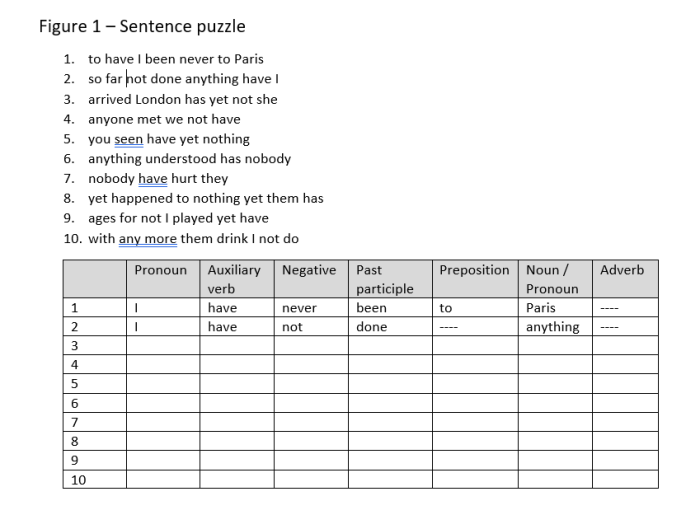
As explained in my post ‘Teaching grammar through listening’, the ability to effectively recognize aurally the patterns that bind words together is crucial to comprehension. Hence, training students in this skill is paramount. Sentence puzzles are a minimal preparation activity which does wonders in this respect (see examples below). I do sentence puzzles or the other similar activities described in this post every day.

sentence-puzzles-english

9.Inference and predictive skills

I am not very fond of this approach, but training students in the art of guessing intelligently from context has yielded positive outcomes in a number of research studies. Inference: use written texts  for training first and move on to audio texts only when you think they are ready – as applying inference strategies to reading comprehension is easier and less threatening. Model the process to the class in think-aloud demonstrations of how one can use grammar, syntax, key words and knowledge of the world to guess meaning (think-aloud = verbalise your thoughts as you execute the task). Then provide practice by giving them texts with a set number of words for them to infer the meaning of using surrounding context. Prediction: demonstrate approach by think-aloud, then give students jigsaw puzzles or do ‘guess what comes next’ tasks (i.e. students read the beginning of a narrative and have to guess what comes next).

  1. Lots of short low stake assessments

Rather than getting the students to sit through a whole past exam paper – which can be tedious and daunting – do only one task at a time with them as often as possible. As I said above, prep them thoroughly beforehand aiming at them coming to the task with a mastery of around 90 to 95% of the words in the target text.

  1. Retrospective reports

At the beginning of your intervention programme you may want to elicit as much information as possible as to the problems that your students experience in performing listening tasks. One method that usually yields useful data involves retrospective reports carried out immediately after task completion. Ask the students, as part of a classroom discussion or in writing (e.g. on a google doc) to describe what they found difficult about the task. Do this with more than one task, if time allows it, in order to get as clear a picture as possible of what gaps you need to address. Your findings will inform your subsequent planning. I have always found this a very useful exercise.

  1. Task familiarity and task-specific strategies

This is obvious: once identified the exam tasks your students usually lose the most marks in, invest some time going through the past exam papers and identify their most typical features, such as the format, the register, the typical comprehension questions asked, the kind of vocabulary and grammar structures they contain, the syntax (e.g. Is there a lot of subordination? Are they rich in adjectives, adverbs or idioms you do not normally teach?). Your findings will inform your short, medium and long term planning

Conclusion

Anyone aiming at improving the listening skill of a group of underperforming students needs to  plan their intervention in a multi-layered, holistic and eclectic way in the context of an approach which provides extensive practice in the micro-skills which render comprehension possible. This entails addressing all the levels involved in the comprehension of aural input in a systematic way day in day out over a period of at least three to four months before one can see significant results. Finally, drastically increasing the exposure to ‘smart’ aural input which models language use and pattern recognition and recycles high-frequency vocabulary and grammar at will rather than ‘quizzing’ students is key to the enhancement of learner listening skills.

To find out more about my ideas about teaching do get hold of ‘The Language Teacher Toolkit‘ the book I co-authored with Steve Smith of http://www.frenchteacher.net


How many new words should you teach per lesson?

Introduction – The wrong question

The question in the title is one of the most common ones I am asked by colleagues from all corners of the globe. And whenever I have googled that question in the past ten years I have always invariably found the same answer crop up in EFL and MFL forums, blogs and websites: 8 to 10 words per contact hour. I have always wondered where those numbers came from as there is no consensus amongst researchers as to what constitutes an ideal number of new words to teach per lesson. Unsurprisingly so. As I will argue below, it is impossible to answer the question with a precise figure unless we define clearly what we mean by ‘teaching’ and ‘learning’ new words and have a 360-degree awareness of the target learning contexts with their unique interaction of affective and cognitive factors as well as other important individual variables such as the methodology in use, available resources, logistics, timelines, socio-economic factors, etc.

I personally ‘teach’ 20 to 25 words minimum per lesson, but what the word ‘teach’ means to me may not be what other colleagues take it to mean.

The good news 

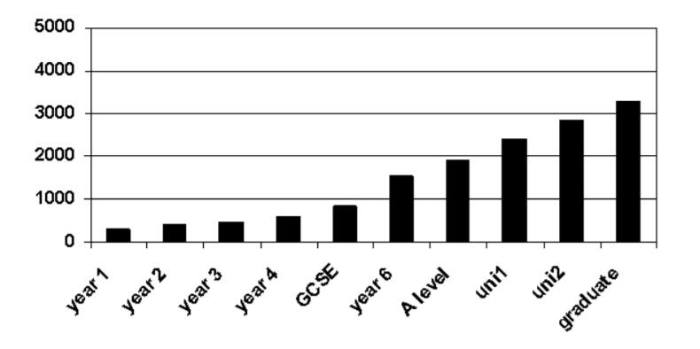
The good news for MFL teachers in England and Wales is that by the end of a typical GCSE course the estimated vocabulary size of a successful MFL student should be 2,000 words at GCSE Higher and 1,000 at GCSE Lower (Milton, 2006). If we divide that number by 5 years of learning French (from yr 7 to yr 11) two hours per week, that would equate with, 5.2 words per lesson, in truth a very manageable burden. In 2006, however, the national average showed that GCSE students in English state schools had accrued a vocabulary amounting to less than 1,000 words each (see picture, below, from Milton, 2006).

15871946_10154012995161744_3389240941719708110_n.jpg

Why the title question is the wrong question to ask yourself

In deciding how many words to teach per lesson one has to take into account a number of contextual factors which play a decisive role in vocabulary acquisition and, more importantly, the depth and range of one’s learning intentions. The question ‘How many words should I teach?’ cannot be answered unless we first consider the following :

(1) Depth of knowledge – Knowing a word entails knowing many things about the word: its literal meaning, its various connotations, its spelling, its derivations, collocations (knowing the words that usually co-occur with the target word), frequency, pronunciation, the syntactic constructions it is used in, the morphological options it offers and a rich variety of semantic associates such as synonyms, antonyms, homonyms (Nagy and Scott, 2000). How deep one intends to go will entail spending more time hence teaching fewer words.E.g., if I teach a set of French irregular adjectives in terms of how they change from masculine to feminine, rather than just focusing on their main meaning and pronunciation of the masculine form, I will evidently have less time which will in turn limit the amount of words I can teach.

(2) Receptive vs Productive knowledge – as Nation (1990) notes vocabulary items in the learners’ receptive vocabulary might not be readily available for productive purposes, since vocabulary reception does not guarantee production. In other words, students may learn to recognize words whilst not being able to use them in speech or in writing. This difference is often overlooked whilst is crucial in planning a vocabulary lesson. If one is planning to simply teach new words for receptive use, they can teach, in my experience, as many as 40 with an able group, as recognition – especially through the written medium – is easier than production.

Moreover, although they are both receptive modalities, learning vocabulary through listening and reading obviously require providing students with two different types of extensive training which means that if you really aim to thoroughly develop the two skill sets – as you should – you will inevitably have less time available.

(3) Speed of recognition and production and degree of contextualisation – When we talk of recognition and production we need to consider (a) the element of speed and  (b) the ability to understand the target words in unfamiliar contexts as markers of mastery . The faster a student recognizes a word (in familiar and unfamiliar contexts) as heard or read will tell us to what degree it has been automatized. The same applies to written and oral production (the hardest to automatize).

A vocabulary item can only be said to be fully acquired when it can be produced spontaneously (and correctly) within the context it was taught as well as unfamiliar contexts. With this in mind, to say ‘I taught ten words in yesterdays’ lesson’ is flawed. I may have presented those words and got the students to practise them and maybe they could recall them in isolation at the end of the lesson or even in one or more sentences. However, that does not mean the words have been learnt, because words are never used in isolation and not simply in two or three sentences learned by rote. Moreover, acquiring a vocabulary item takes weeks and in certain cases even months of practice in context.

(4) Word learnability – the learnability of the target word places further constraints on the number of words one decides to teach. ‘Learnability’ refers to the level of challenge a word poses to the learner. For instance:  long polysyllabic words with unfamiliar phonemes will be harder for beginners to retain; abstract and connotative words are  usually more difficult to acquire than concrete and denotative lexis; cognates are easier to recognize, etc. When deciding how many words to teach, the learnability factor is crucial.

(5) Shallow vs Deep processing –  the method you use will also play an important role in deciding how many words you aim to teach. The deeper the degree of semantic processing the more likely the students are to recall them in the future. Deep processing includes activities such as: establishing association within new and old words, categorizing them; finding opposites and synonyms; writing the definition; inferencing their meanings from context; creating mnemonics to enhance future recall); odd one out; etc. Shallow processing involves little cognitive effort (e.g. learning by repeating aloud; the www.linguascope.com games). Teacher with effective vocabulary teaching methods are usually more successful at teaching larger amounts of words.

(6) Time, recycling opportunities and learning habits – the numbers of words you can teach will also depend on how many chances you can find in your lesson to recycle them. Do you have enough time, resources or activities in your repertoire for you to recycle each word you set out to teach a minimum of 5 to 8 times (through deep processing tasks) within the lesson? Do you have resources to ensure the recycling of the same items in subsequent lessons?

It takes me a lot of time and effort to create resources that allow me to effectively recycle all the target words I set  out to teach in lesson 1, as well as all the subsequent lessons in which I revisit them. The more words you aim to teach, the more the effort you will have to put in follow-up lessons to create recycling opportunities. This is something you have to factor in when you decide on the number of words to teach in a given lesson or your teaching will have been in vain.

Connected with this is the issue of homework and learning habits and strategies. Are your students the kind of learners who do your homework consistently? If you flip vocabulary learning to them, will they actually do it? What the students do at home and how effectively their learning strategies are will have an impact to on how many words you plan to teach. In the case of one of the two year 9 groups I currently teach the amount of work they do outside the classroom – not their aptitude – profoundly affects the number of words I plan to teach each day.

(7) Chunks –  The memorization of chunks is productive and powerful. It serves two objectives: it enables the student to have chunks of language available for immediate use and it also provides the student with information that can be broken down and analysed at later stages. Chunks allow you teach more words in one go as Working Memory can process chunks made up of 7+/- 2 items (Miller, 1956). Moreover, in real life we rarely process words in isolation.

The main advantage of the use of lexical chunks is that they build on the fluency of the language learner as they facilitate clear, relevant and concise language and are stored as ready-to–use units that can be retrieved and used without the need to compose on-line through word selection and grammatical sequencing. This means that there is less demand on cognitive processing capacity.

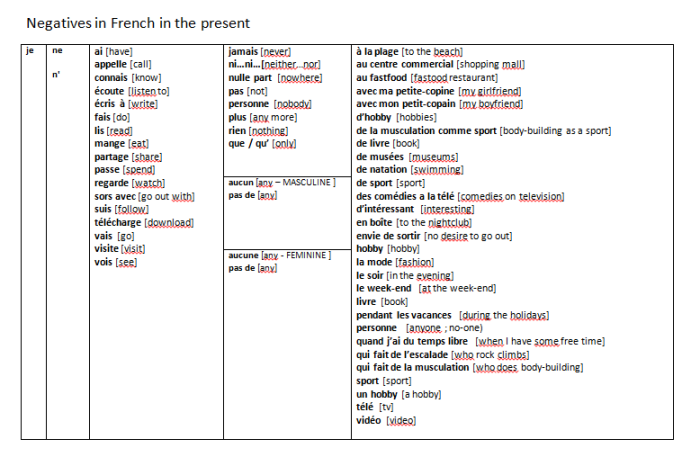
I hardly ever teach vocabulary in isolation, unless I am focusing on speed of recognition, decoding/pronunciation or spelling (e.g through the www.language-gym.com games). I always present vocabulary for the first time either through texts containing comprehensible input which allows easy inferencing from context or through sentence builders (see figure below). Teaching in chunks and short sentences allows me to recycle old material whilst presenting new material but also to include more vocabulary.

sentence-builder-negativs

(8) Chunking and word awareness – Chunks have another important impact on how many words you will be able to teach. Once you have unpacked each chunk you taught, made the students notice the underlying grammatical pattern (e.g. I want you to go to the cinema) and got them to use that pattern over and over again with new lexical items, you will have enhanced the generative learning power of that chunk. The more morphological (e.g. prefix, suffixes) and syntactic patterns (rather than grammar rules) you teach your students the greater the chances for them to learn new words by ‘hooking’ them to those patterns. This process, known as ‘chunking’ happens in the brain at incredibly high speed in L1 acquisition and plays a crucial role in L2 vocabulary acquisition; hence, the more automatized the ability to recognize those patterns in aural and written input will be in your students, the more likely they will be to learn more words in your lessons.

Word awareness refers to a learner’s ability to ‘unpack’ the way words work both in relation to other words (synonyms, antonyms, collocations, etc.), their word class (adjectives, nouns, etc.) and how they are formed (prefixes, suffixes, etymology, similarities with mother tongue words, etc.). Word awareness promotes chunking, hence, acquisition. Creating a culture of word awareness in your classroom does not require much preparation, just asking lots of questions such as: Is it an adjective or a noun? Does this go before or after the verb? Does it remind you of a word in our language? Why does this word end in ‘-ly’?, etc. Research in word-awareness (also referred to as word-consciousness) it is still pretty scant, but many scholars believe that a strong emphasis on it in the classroom can greatly impact vocabulary acquisition. The more word -aware your students are the greater the amount of words you will be able to teach them in lessons.

(9) The students – last but not least. This is self-evident. Your students are the best source of evidence that you are gauging the amount of vocabulary input correctly. Regular low stakes assessment will tell you how much of what you have taught gets retained or lost along the way as the term advances. Online surveys through google forms or the likes will allow you to find out in a few minutes how they feel about their vocab learning, if you are being too ambitious or spot on. They can also help you find out about their learning habits.

Not all students have the same ability to learn vocabulary. Students who are low in any of the crucial components of language aptitude, especially Working Memory span and Phonemic sensitivity will be particularly disadvantaged and their presence in your class will have to be taken into account as they will be more prone to cognitive overload. Differentiated instruction will be a must in mixed ability classes.

The students’ current level of proficiency will also be an important variable to consider. The more advanced the learner is the easier for them will be to use conscious and subconscious learning strategies to acquire vocabulary. Hence you will be able to teach way more new words per lesson to your advance level students than to your GCSE ones.

Motivation is obviously another crucial factor. I am not going to discuss it as it is beyond the scope of this post. It will suffice to say that motivation enhances cognitive and affective arousal which in turns increases Working Memory span and the chances to memorize words. Hence, the more fun and relevant to your students’ lives and interests your vocabulary teaching is, the more words you will be able to teach effectively.

Concluding remarks

The issues above refer to but a few of the many factors one needs to consider in deciding how many words to teach per lesson. The most important thing I would like the reader to take home from this post is that vocabulary acquisition being a long process, planning a successful vocabulary lesson is about zooming out and thinking about the bigger picture and the longer term: what matters is not how many words you teach in a given lesson but how your subsequent teaching is going to ensure that those words will be automatized both receptively and productively by your learners across a wide range of contexts, both familiar and unfamiliar. In order to do so, the language instructor must master effective vocabulary teaching strategies, know the students well and implement skillful and systematic recycling never losing sight of the challenges that words and the contexts those words are taught in pose to the learner. A culture of word awareness that you build in day in day out through regular questioning, both metalinguistic and metacognitive in nature, will also facilitate your task and allow you to teach an increasingly larger amount of words per lesson, as your students become more alert to the morpho-syntactic properties of the target language words.Ultimately, it will be student feedback and regular low stake assessments that will tell you whether you are teaching the correct amount of words per lesson.

Ten things I did in 2016 that have significantly enhanced my teaching

The year just gone was one of the best I have ever had in terms of professional development as a teacher, researcher, writer and CPD provider. In this blog I share ten things that I have tried out in 2016 that, in my view, have significantly enhanced teaching and learning in my lessons.

 1.Doubled the exposure to receptive processing and delayed production

One major change to my teaching has involved massively increasing my students’ exposure to comprehensible input before engaging them in production. Thus, on introducing a new phoneme, grammar structure, communicative function and/or vocabulary set, I now ensure my students process the target items receptively through as wide as possible a range of listening and reading tasks which recycle them to death (narrow reading being one of my favourite reading/listening tasks).

In order to enable my students to learn from the aural and written input provided, as illustrated in the texts in figure 1, I make sure it contains lots of patterned repetitions, cognates and familiar language and contextual clues which facilitate inference (so that 95 % would be accessible without resorting to guessing or dictionaries). I also usually provide a gloss in the margin and use typographic devices to draw their attention to items I want them to notice.

Figure 1 – narrow reading texts including comprehensible input with lots of patterned repetitions and cognates

sin-titulo

I found that massively increasing receptive processing and delaying production – often to the second lesson on a new topic – has greatly benefitted my students, both in terms of confidence and understanding of the target items, especially when the tasks carried out on the aural and written texts involve lots of pattern recognition (see point 2), recycling and, most importantly, modelling. It is important to reiterate again the distinction between reading and listening aimed at modelling and reading and listening aimed at quizzing (i.e. the typical listening/reading comprehension). In my approach, listening and reading comprehension tasks are staged only at the end of the whole process.

2.Grammar and pattern recognition through listening

The extensive research I have carried out this year has made me aware of a gap in traditional explicit grammar instruction methodology: grammar is rarely taught regularly and systematically through listening and very few – if any – published materials purporting to do that exist. In my instructional model (MARS), exemplified in this post, grammar instruction nearly always begins with modelling of target grammar use through a L.A.M. (Listening-As-Modelling ) activity such as a sentence-builders, sentence puzzles or cognitive comparison tasks.

Figure 2. Sentence puzzles

sentence-puzzles

This approach to grammar instruction addresses two important skillsets involved in listening comprehension, i.e.: decoding and parsing skills. As I detailed in one of my most widely read posts. ‘Teaching grammar through listening’, the latter skillset is paramount in the Parsing phase of comprehension, when Working Memory attempts to interpret what it hears using the grammar of the language (by fitting the words identified to the surrounding linguistic context).

3.Inductive Grammar teaching

The adoption of the approach touched upon in the previous paragraph has led me to abandon deductive grammar teaching and the traditional PPP sequence (Presentation, Practice, Production). Unless I am pressed for time, I now involve the students in problem solving activities which requires them to figure out the target grammar rule(s) by themselves based on the Listening-as-Modelling activities staged. Example: I may start with a sentence puzzle modelling how the negatives are used in French; after many examples, I would ask the students, working in groups of two or three, to work out the rule and explain it on a google document or padlet wall shared with me and the rest of the class.

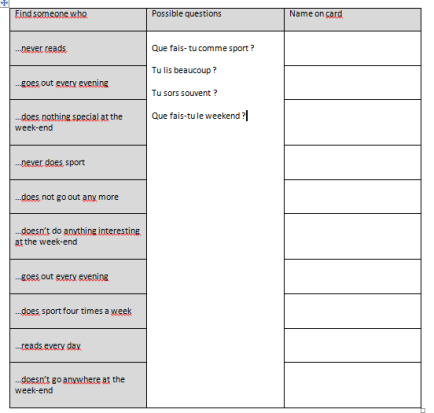
After this student-led discovery phase, intensive receptive processing practice will ensue through listening and reading tasks (e.g. narrow reading), grammar quizzes and puzzles, and oral interaction (find your match or find someone who with cards). Since in my approach automatizing grammar is the main purpose of grammar instruction, this receptive phase is followed by structured oral practice – see next paragraph.

Figure 3 – Find-someone-who with cards. Grid to fill in (above) and Cards (below)

listen-to-your-teacher-and-rewrite-the-sentences-below-accordingly-in-the-spacefind-your-match

4. Communicative oral drills and closed questions

In the past year I perfected and intensified the use of CDs and closed questions in an attempt to routinize the target grammar structures and vocabulary.

4.1. Communicative drills (CDs)

Communicative drills, as the figure below show, are very short and highly structured tasks which ‘force’ the students to deploy the target items as many times as you feel fit, over and over again, in the context of real-life-like situations. Unlike audiolingual drills, CDs typically include lexical items (words and chunks) of high surrender value (e.g. high frequency words or formulaic language) which are very useful in real life communication and are contextualised in the topic-at-hand.

In the teaching sequence I typically use in my lessons, M.A.R.S. (Modelling, Awareness-Raising, Receptive processing, Structured production), CDs occur in the end-phase, after lots of receptive processing as occurred which exposed the students frequently to the same language included in the CDs. I usually stage three or four different types of CDs per session.

Figure 4. 2 type of Communicative Drills I use in my lessons. Translation into French (above) and Illustrated cards game in the past tense (below)

cd-1

CD 2.png

4.2 Closed questions

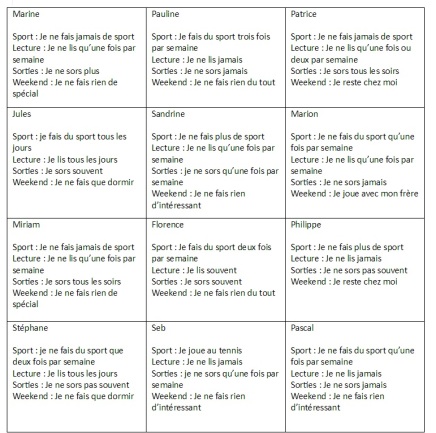
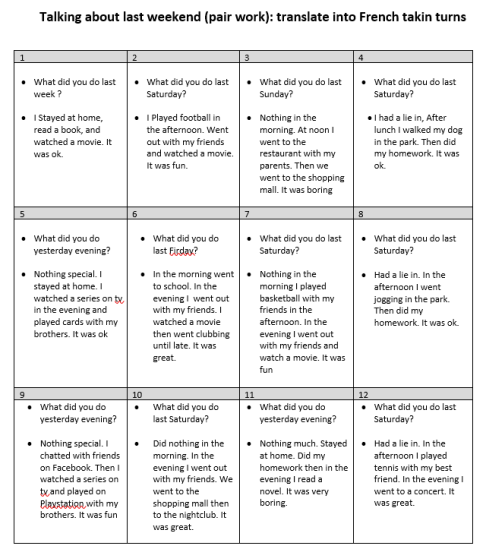
I have also massively increased the amount of closed questions I ask my students as, unlike some language teaching ‘gurus’ advocate, I believe that closed questions – not open questions- are key to the development of spontaneity. By the way, by ‘closed questions’ I do not simply mean ‘true or false’ or ‘Yes or No’ questions, but also questions such as ‘What is your name?’, ‘What sport do you like?’, ‘What did you do last weekend?’ – as opposed to open questions such as ‘Talk to me about yourself’.

But, why more closed questions? Firstly, because by prioritising open questions students are not pushed to diversify their vocabulary. Secondly, they do not learn much vocabulary from the questions themselves (and questions are powerful modellers of new language). Thirdy, because ‘spontaneous speakers’ are first and foremost ‘spontaneous comprehenders’. The comprehension dimension of ‘oral spontaneity’ is often neglected, although is by all accounts as important as the production dimension.

Imagine asking the open question ‘What do you do in your free time?’ the student can get away with the usual ‘I play football and go to the cinema’. However, asking students a wider range of closed questions such as ‘What sport do you do?’, ‘What tv shows do you watch?’, ‘What movies do you watch?’, ‘What social media do you use?’, ‘What do you read?’, ‘What music do you listen to?’ allows you to tap into specific areas of their vocabulary and grammar knowledge, as well as developing their Listenership. Students who are asked a lot of closed questions get constant stimulation thereby learning more language both receptively – as they decode the questions – and productively, as they retrieve the specific vocabulary needed to answer (I usually ask them to pack at least three details in each answer, however close the questions is).

Both the intensive communicative oral drilling and the use of closed questions have greatly enhanced my grammar teaching whilst allowing me to recycle old and new vocabulary.

5.Hyper-questioning and Listenership

Not only have I increased the amount of closed questions I ask in class, but I have actually made a conscious and systematic effort in every single lesson to ask more questions overall, both open, closed and yes/no or true/false ones. This has entailed:

(1) More modelling of new language in the presentation stage through questioning techniques such as ‘Either / or’ (e.g. pointing at a picture on screen: ‘Is he doing ‘X’ or ‘Y’?) Substitution, etc.;

(2) Work on increasing speed of student response to questions;

(3) Learning about question formation through modelling (e.g. question puzzles) and explicit grammar study (e.g. studying word order and hyphenation in French questions);

(4) Reading comprehension tasks which involve understanding of questions rather than statements set;

(5) Widening the questions repertoire I expose the students to;

(6) Designing oral tasks and assessments which lay more emphasis on asking questions.

Why? In order to develop the area of oral spontaneity that is usually less focused on by teachers: ‘spontaneous comprehension’ or ‘Listenership’ as it is known amongst Applied Linguists.

A regular zero-preparation activity that I have staged regularly in lessons  has involved asking questions to my students who, equipped with mini-boards, respond in writing under time constraints. Another frequent minimal preparation starter or plenary has consisted of giving my students a statement and asking them to write on mini whiteboards a possible question that statement could be the answer to.

6.My recycling tool

Last year I also created a simple recycling tool (in the figure below) that has allowed me to recycle the core grammar items more systematically over the whole school year. It consists of a spreadsheet on which I keep track of how often I practise a given grammar structure. In selecting the items on the tracking sheet and assigning them a priority I have used another strategy, discussed in the next paragraph.

ticket

7.Error-informed curriculum design and delivery

Irritated by the disproportionate emphasis lain by English schools on very time-consuming and largely ineffective dialogic corrective practices (e.g. students respond to feedback and teacher respond to student response, etc.), last year I decided to tackle learner errors from three different angles.

Firstly, as discussed in paragraph 1, by delaying production in order to pre-empt errors stemming from unfamiliarity with the target structure (as errors are often made by rushing production); secondly, as discussed in paragraph 4, by engaging students in as many structured tasks as possible before venturing in less structured ones; thirdly, by monitoring my students’ mistakes, keeping a tally of their most frequent ones and using my findings to inform my teaching.

So, whenever I went through their books or recordings or listened in as they interacted with one another during oral activities, I noted down day in day out on a google doc their more common and serious mistakes and modified my schemes of work accordingly making sure that I would tackle those issues in the lessons to come. It was not very time consuming; it reduced the time I spent writing in their books (as I was going to deal with them in class anyway) and has made me become a better observer and listener of my students’ output.                                                                        

8.The 4,3,2 technique

This technique consists of getting a student to answer the same open question (e.g. ‘What did you do last weekend) three times. At time one you will ask them to answer the question in two minutes; at time two, in one minute and a half (i.e. 3/4 of the time employed at time 1); at time three in one minute. This technique, which I reserve to discuss in a forthcoming post, has been proven to significantly enhance L2 learner oral fluency not only within the topic in which the students use the technique but in terms of overall speaking spontaneity and proficiency.

Although I have been using it with my GCSE students only for three months, it has already paid good dividends. The rationale for its success is that it helps the students – after much practice – to automatize sub-routines thereby speeding up Working Memory processing.

9. Experiments with pronunciation of problematic French endings

As part of my on-going research on decoding-skill instruction in the last part of 2016 I endeavoured to enhance my year 8 students’ ability to pronounce French word endings; more specifically I worked on the pronunciation of silent word endings (e.g. ‘s’, ‘t’, ‘e’) in French using the Micro-Listening Enhancers detailed in this PPT (put together with my colleague Dylan Vinales for a conference we delivered recently). After a baseline assessment in which identified the problematic endings I carried out instruction as follows : 10 minutes session per lesson, contextualizing the decoding-skill work within the teaching of the vocabulary-at-hand. After a whole term of such instruction, the students’ ability to pronounce the endings which were problematic at pre-test increased by an average of 70 %, with 2 of the 17 students in the class making only a couple of mistakes.

10.‘Spot the intruder’ and ‘Spot the error’ listening tasks

These tasks have been regular features in my lessons for the last nine months or so. They focus students on listening for detail like nothing else, thereby developing their bottom-up processing skills. They require very little preparation, all one has to do is doctor the lyrics of a target language song by inserting a few extra words here and there (usually small ones) or errors; students then listen to the song tasked with identifying the items planted in the text. Here is an example by Dylan Vinales which cleverly combines a number of my micro-listening enhancers including ‘Spot the intruder’ and ‘Spot the mistake’. Here is a video of Dylan and Ronan Jezequel rehearsing the song the tasks are based on in one of our classrooms at Garden International School.

To find out about my ideas on reading instruction, get hold of ‘The Language Teacher Toolkit’, the book Steve Smith and I co-authored .


The ugly truth about school-based Modern Language teaching

images-4

(with Steve Smith)

I was recently criticised by some of Stephen Krashen’s fans for something that to me and many other teachers is a sad given : MFL teachers operating in secondary schools have simply no time to teach languages the way they should ideally be taught. Time and syllabus constraints force teachers to extremely tight schedules which do not allow for the extensive listening and reading practice that it is evident from much research that every language learner benefits from before engaging in real-life-like speaking.

If I had five hours contact time a week I would teach entirely differently from the way I teach now.  This would be my recipe: lots of daily receptive exposure to compelling aural and written input ; plenty of oral interaction through fun and challenging communicative activities (even more than the 30 minutes per lesson I do now);  engaging multimedia project-based learning ;  drama and art activities ; cultural awareness-raising through videos and realia ; exciting enquiry-based grammar learning.

The problem is, for teachers working in England to effectively prepare their students for GCSE and A-Level examinations, all of the very desirable above simply cannot be done as often as one would like. We all know that. Hence, effective teaching in our context is not merely about applying what we know best benefits language acquisition ; but it is first and foremost how to make the most of the time we have available to build our students’ linguistic competence, self-confidence and motivation adapting what we know about human language acquisition to the context we operate in.

The American army knew this all too well when they had to prepare their troops linguistically for the Normandy invasion in 1945. Surely they could not afford to put their soldiers through hours and hours of receptive learning through engaging stories in the belief that languages are best learnt subconsciously through exposure to comprehensible input (as many Americans in Dr Krashen’s camp – my critics – believe). Hence they devised an approach which was drill-based ; lots of repetition through controlled tasks aimed at practising phrase after phrase to death until they were so embedded in their soldiers’ memory that they became spontaneous. In this approach, grammar was taught through robotic repetition and manipulation of small parts of sentences, e.g. I play tennis, my mother plays tennis, my father doesn’t play tennis, we play tennis.

Although ideologically I do not agree with this method at all, and it is not the way I learnt the seven languages I am fluent in and the other seven I speak less well, I see the merit of aspects of this approach in the beginning phase of every learning, the parroting stage of classroom-based acquisition. Lots of drilling does help embed the core vocabulary and grammar structures, it is undeniable. And it can be made fun, too, with a bit of imagination – e.g. my receptive drills in the game room at http://www.language-gym.com/#/game-room  or my oral communicative drills. And if the phrases and words we embed in the drills consists of lexical items and sentences which can be very useful in the real world and are taught and practised within typical real-life communicative contexts, all the better still !

The truth is that every method language researchers and educationsts have come up with in the last fifty – sixty decades or so is effective in its own way, each of them addressing one different stage or facet of the complex process that language acquisition is. To say my method is better than yours is preposterous. Yet proponents of each method do, sometimes inspired by a genuine passion for and belief in the validity of their approach, more than often driven by a business or political agenda.

We, as school-based teachers, have been historically the victims of this state of affairs, decade after decade. Subjected to fads which were not a faithful reflection of each new method,but rather the botched-up adaptation of often-sound theories and methodologies by governments and their consultants, which reshaped them to fit the target cultural, political and socio-economic context, mindful less of our needs or our students’ than of their own agendas.

The result is a teaching profession whose pedagogic beliefs – whether we are aware of it or not- are often a hybrid of all the methodological approaches it has been exposed to in the last forty years or so  – whether through word of mouth, readings, CPD, government policies, etc. So many of us are advocates of the Communicative approach whilst teaching grammar like the Romans or the Greeks used to 2,000 years ago ; believe that reading extensively for pleasure will subconsciously result in learning whilst we train our students to teach towards reading comprehension tests that teach little ; advocate the importance of oral interaction and listening but most lessons are about reading and writing – or  embrace enquiry-based learning tasks where students barely ever speak; say one should tolerate error and that mistakes are ‘good’ (as CLT preaches) but then make a huge fuss about them by excessively focusing students on correction (through D.I.R.T., stamps and time-consuming dialogic practices).

Eclecticism or pedagogic hypocrisy ? Neither, in my opinion. The ugly truth is that a lot of us are confused and disoriented ; overloaded with government and school policy requirements which change way  too often and quickly ; overflooded with information coming from different camps ; misinformed by CPDs which squeeze years of researching and theorizing in one or two Powerpoint slides ; galvanized by keynote speakers who excite us with great ideas which are difficult to translate into our classroom practice.

Hence, as I always ‘preach’ in my posts, the need for (a) having a clear understanding of modern language pedagogy so as to be able to understand the state of the art of educational pedagogy beyond the different factions and fads’ political agendas ; (b) having a basic reference framework based on that understanding that will enable us to approach lesson and curriculum planning, assessment and feedback in a no-nonsense, practical and principled way.

Having such an understanding and such a framework  – which in my case is MARS + EAR ( see my blogposts on this) – has made my everyday lesson planning much easier and hassle-free and when questioned by my superiors it has allowed me to provide them with a clear rationale for my pedagogic strategies and choices rooted in Skill-Theory and neuroscience. Maybe not perfect, but working well for me. Incidentally, it was interesting to see how Rachel Hawkes and others – who had never publicly advocated Skill theory principles before – have recently published a paper which reflects all of the views I have expressed in my blog in the last year or so. It means that after all, some English MFL ‘influencers’ have finally decided to embrace neuroscience…

The path to becoming a better teacher does come through reflectivity, as most of todays’ CPD gurus preach. But understanding the basic neuroscience facts about language acquisition and developing your own framework fuels and structures that reflectivity and significantly reduces the occurrence of the cognitive block that many teachers who contact me through social media tell me they often experience when they plan lessons. It also reduces the likelihood that your planning is driven by the activities/resources you find rather than the much healthier opposite scenario, i.e.: you choosing the activities/resources to best serve your planning.

Steve Smith and I wrote our book ‘The Language Teacher Toolkitto provide our colleagues with such an understanding of Modern Language pedagogy  and with such a principled teaching framework. Interestingly, we came to it from totally different camps, Steve being a believer in the importance of comprehensible input, whilst I am a Skill-theory fan ; still we could come to an agreement of what constitutes a useful, pragmatic, ‘fadless’ and hassle-free approach to language teaching. Other bloggers, such as Sara Cottrel of www.musicuentos.com  and Justin Slocum Bailey of Indwelling languages have also been pursuing the same noble intent.

No, I am not merely trying to plug our book. My point is that once you have a clear understanding of the basic processes that regulate  human learning, are aware of the core research facts and regularly reflect on your classroom experience in the light of that understanding and that awareness, you will have a powerful pedagogic compass to orientate yourself through the jungle of bastardised pedagogic messages – like the ones I discussed in my previous post – which make our daily professional life so much more challenging and confusing.

In conclusion, the ugly truth that Modern Languages teachers have to contend to, day in day out is that time, logistics, syllabus constraints and government policies prevent them from teaching the way one ideally should. Educationists and researchers rarely recognize that, detached as they are from our world and more concerned with plugging their fads than with the often harsh reality of bog standard state schools. Curriculum designers, examination boards and textbook authors do attempt to incorporate the new methodologies and fads in their work but they often do so superficially at the detriment of sound pedagogy, giving rise to belief systems and practices which teachers often have to adhere to uncritically and which often clash with one another and with common sense. The result is the current state of affairs : an overloaded and overworked teaching profession that is often confused as to what constitutes best pedagogic practice disorientated as it is by mixed messages coming from multiple directions. This may affects teachers’ efficacy thereby eroding their self-confidence, motivation and, ultimately, their well-being.

The solution : getting a better understanding of pedagogy so that you can make an informed choice as to which method to apply where, when and with who ; so that you build instructional sequences based on a method rather than a hunch ; so that you do not let tasks and games you know or have found guide your teaching instead of your know-how; so that you can tell SLT why they got it all wrong.

The Language Teacher Toolkit is available here, on http://www.amazon.co.uk

How to enhance your students’ chances of succeeding at listening (part 1)

(co-authored with Dylan Vinales) 1.Introduction The present article is a sequel to the post ‘Eleven reasons why your students underperform in Listening’ published a couple of days a…

Source: How to enhance your students’ chances of succeeding at listening (part 1)

Three major shortcomings of SEN provision in modern languages teaching (guest post by Ian Young of BISHMC Vietnam)

Please note:  this is a guest post by Mr Ian Young, Head of Learning Support at B.I.S. (British International School Ho Chi Minh City)

Introduction

Mr Ian Young, the most talented  and passionate head of Learning Support I have ever come across in 25 years of teaching careeer. During his tenure at Garden International School he often shared with me his serious concerns with the often superficial and nonchalant way students with emotional and cognitive deficits are dealt with by us MFL teachers in schools. I often asked him to put his thoughts down in writing in an attempt to raise language-teacher awareness of the issues that in his opinion undermine LS provision in their subject. He has finally acquiesced and sent through this very concise but hard-hitting piece which definitely resonates with my own experience.

My immediate reaction in reading this was ‘guilty as charged’ and I would be very interested in hearing your reaction, so please do leave a comment below if you can spare a minute or too. Here it is.

SEN Coordinator: Three things that keep me up at night about MfL Departments…

by Ian Young

1. Not realising that SEN is the responsibility of ALL Teachers

MfL teachers, on average, get fewer students with significant SEN because it is where most students are pulled from for their additional support lessons (this is true in UK, American and Canadian schools). As a result there tends to be an undercurrent of “SEN matters do not apply to me and my department” and they are grouped with underachievers who may seem to have the same difficulty as many other students but for very different reasons.

Because of this potential for “blending”, it is crucially important for MfL teachers to confirm with their registers because these needs will likely cause a greater level of difficulty for many LS students (hence their need to often be withdrawn), and may impact SEN students differently than

2. Disregarding how specific learning disorders impact their subject

There are LDs (learning disorders) that impact students in MfL much more acutely that it may in other subjects. Specifically, students who are hearing impaired of have a receptive language difficulty will need a great deal of individual support. Students with Dyslexia will have the added challenge of accents or different alphabets altogether to contend with that can be indecipherable without appropriate support (e.g. blue or yellow paper, and use of a clear font that provides adequate space in between letters and accents).

In fact, there should be specific intervention planning – in coordination with the SEN Department – to address these needs.

It is even worthwhile to go deeper than the IEPs and Profiles, as Speech and Language Therapists and Educational Psychologists may have included in their written reports useful recommendations that did not get transcribed into the documents that are designed for all teachers.

3. Neglecting proper assessment planning for SEN students

There are a lot more listening exams in MfL that many departments often fail to plan for with SEN students.

This can often be unique to MfL and there are even specific regulations as it relates to topics such as additional time in listening exams (note: additional time is not granted in exams as replays of the audio, it is granted by pausing the audio and resuming as appropriate).

Many of these exams – listening in particular – will require additional equipment, staff, and a separate setting – all of which will need to be planned. Unfortunately, the end result in many cases is very last minute and incomplete or it is not done at all.

Therefore it is always a good idea to review access arrangements for students and get an idea which students are recommended for individual support on listening exams by your SEN Dept. They should also be able to assist with providing additional staffing and space, provided advance notice is given.

Concluding remarks

Overloaded as we are with lesson planning, marking and classroom management and student-behaviour issues, we do not always devote to SEN students the special attention they deserve, from carefully reading their IEPs and information about their specific learning disorders to effectively liaising with LS staff. I have been guilty of that in the past and I have only got better in recent years, after becoming a father and asking myself ‘What if my daughter was one of those kids?’. The emphasis MFL teachers lay on SEN provision is often a reflection, in my experience, of the whole-school attitude towards it; where SLT are sensitive to the needs of SEN students MFL departments tend to be more switched on and proactive. As Mr Young often said to me, it all starts with the powers that be; however, ultimately, we do have an important duty of care which must fulfil to our best.

Thanks, Mr Ian Young Head of LS at BISHMC for providing this very useful reminder that very child matters – the first guest blogpost on The Language Gym !

Spontaneous talk revisited – courtesy of Pearson…

download

Introduction

I thought I was in for a quiet and blogless Saturday evening until I came across this very slick and glossy pdf  document by Pearson entitled ‘Approaches to spontaneous speakingwhich represents in my eyes all that is wrong about the way teachers in England are trained to teach spontaneous talk. Hence this post, that I really did not want to write – as it is based on the work of someone I respect (Dr Rachel Hawkes) – but I felt compelled to.

Whilst I do agree with some of the points made – especially the fact that speaking is under-emphasized in most MFL classrooms and that student-to-student talk is grossly neglected – and I did find the activities listed useful (if limited in scope and variety)  I was very disappointed with the advice given in this article, especially the absolute absence of a useful framework for classroom practitioners on how to get from imitation to speech spontaneity. A pity, since the rationale given for laying more emphasis on speaking is excellent; the rest, however, simply felt like a dry list of speaking activities (speaking instruction classics) and facts based on very feeble evidence described in an uninspiring OFSTED- or GCSE-specification-like style.

Hence, the impression one gets from reading this is the overly simplistic persuasion that by merely staging such activities lesson in, lesson out the students would develop spontaneity. I wish it was that easy !

I wasn’t surprised, though, as this is the kind of stuff teachers taking part in much Egland-based CPD on speaking get – a list of activities, some reference to what OFTSED would like to see in lessons and very little reference to neuroscience and the research that really matters.

These are the main problems I have with the Pearson article in question.

  1. Spontaneous talk equates with spontaneous grammar

As I often reiterate in my blogs, there cannot be spontaneous talk without spontaneous grammar. Whereas in immersive or naturalistic input-rich environments (e.g international school ; the L2 country) the L2 learner can acquire grammar subconsciously, in input-poor ones with little teacher-student contact time this is impossible without explicit grammar instruction and work on the automatization of the target structures/morphemes.

Hence, before being able to cope with unstructured communicative tasks (describing pictures, unplanned conversation tasks, simulations, etc.) language students need to be first trained to automatize grammar by applying it in speech in highly controlled tasks, what DeKeyser calls ‘Communicative drills’ such as the following (on negatives), that I produced for my year 11 French lesson last Monday :

drills___negatives-with-hobbies

This controlled, highly structured stage is paramount as, if we just give students open questions and unstructured tasks, as the article suggests, the students might simply come out in their answers with the same words and phrases all the time and teachers would not have any control on their output.

Moreover, unless we structure the kind of output we want the students to produce, they might produce language which does not contain the target structures we want them to practise and re-practise over and over again. Hence, recycling being the key to grammar automization, spontaneity will not be achieved. We all now that. Open tasks will not guarantee such recycling. Highly structured communicative drills, will.

Open questions and unstructured tasks, contrary to what the article suggests  should occur much later on in spontaneous-speech development than the authors suggest -in what I call the  Autonomous phase. This phase, if you have not read my posts on the topic, refers to the stage in which the students do not need scaffolding or any kind of support any longer and can stand on their own two feet. Only at this stage, once much consolidation and practice has occurred through structured and semi-structured tasks, should the students be asked open questions and involved in unstructured communicative tasks.

What it is often forgotten or ignored  is that spontaneity is the equivalent of automatization of grammar and vocabulary use across a very wide range of contexts. Hence, to scaffold spontaneity, one needs to get the students to produce the target language fast and accurately across a wide range of contexts through tasks which involve systematic recycling and repetition of core language patterns (e.g. the same sentence stems applied to different vocabulary such as: je ne vais jamais au restaurant du coin; Je ne vais plus au restaurant chinois du coin; je ne vais jamais au bar du coin; etc.)

For example, going back to the negatives example, in the first phase of speech spontaneity-development (structured production) a teacher would make sure that the students practise the structure through controlled tasks on the topic in hand many times over.

Subsequently, the teacher will ensure that the students practise the structure across past and future topics (Expansion phase). Whilst in the Structured and Production phases support materials could still be used, in the subsequent phase (Autonomous phase), such materials are phased out. In the final stage of automization, the teacher will ensure that the students routinize the target structure through tasks which aim at developing speed (Routinization stage). In this final phase, communicative drills like the above one can come in handy again and can be used alongside more unstructured tasks eliciting the use of the target structure in real time conditions.

Being able to sequence instructional activities effectively and knowing at which proficiency stage to use them and for what purpose is what enhances one’s teaching, not random lists of tasks with a brief explanation of what they consist in.

In a nutshell, it is not clear from the article how on earth language students would ever be able to develop the all-important spontaneous grammar, as there is absolutely no mention of it. This is why a lot of the spontaneous talk one witnesses in English MFL classrooms is so ungrammatical and often contains many fossilised (automized) mistakes.

  1. Total absence of reference to receptive processing

The article does not mention the importance of listening in bringing about spontaneous speech – a shocking omission. Yet, how can one hope to develop spontaneous speech without listening ? The often unintelligible pronunciation and intonation patterns that language students exhibit in their speech is due exactly to this widespread and deeply engrained bad habit of teaching students to speak without adequate modelling through listening. Such modelling is imperative for spontaneous speech to happen. As long as the listening-speaking connection is not made explicit and emphasized by CPD providers and teacher trainers,speaking and language instruction will stay inadequate.

Another dimension of receptive processing vis-à-vis spontaneous talk which is grossly neglected in the article refers to Listenership, i.e. the ability of being able to respond to an interlocutor in real time (someone talking to us) in order to stay in the conversation. This is a very important component of spontaneous speech – unless we talk to ourselves, that is. No student training in this important skill is mentioned, yet, it is fundamental. That is why we have in England entire cohorts of language learners who do not comprehend impromptu questions in the target  language .

In sum, students need to have speaking modelled to them through aural input day in day out and need to become expert ‘spontaneous comprehenders’ as well spontaneous speakers as one cannot produce an effective response without understanding the question or stimulus that would prompt it in the first place.

  1. No mention of pronunciation and decoding instruction

As most current models of speech production clearly posit, there is no way a language learner can produce fluent speech without developing fluent pronunciation and decoding skills. The reason for this being that for spontaneous speech to occur, cognitive control over the articulators (responsible for speech production) must occupy subsidiary awareness (i.e. must occur subconsiously). Without pronunciation practice how can students develop correct and fluent pronunciation? Emphasizing the importance of this dimension of speaking instruction is imperative as , sadly, nobody teaches pronunciation these days…

  1. No explicit framework provided

As mentioned above and discussed in section 1, the article provides no framework whatsoever on how to take the students from novice to expert speech production. Not only it advances the preposterous notion that we should start teaching spontaneous speech by asking open questions – which goes contrary to how children acquire languages, which is exclusively through masses of caregiver modelling through the aural modality (listening) and closed questions, at the initial stages ; but it does not even remotely show how a teacher should structure and map out the evolution of spontaneous speech. Hence, it is of no use to any classroom practitioner who may want to design a curriculum or even an instructional sequence aiming at developing spontaneous speech.

A random list of tasks without any recommendation as to how should be sequenced in the process of automatisation of speech production is of no use whatsoever.

  1. Spontaneous and accurate and intelligible talk ? Or simply spontaneous ?

Another gross omission is the reference to an important aspect of spontaneous speech – intelligibility. There is no use in forging spontaneous speakers if these cannot produce intelligible speech. Again, in reading this article the impression one gets is that all teachers have to concern themselves with is spontaneity. And how about accuracy, comprehensibility and appropriateness vs ungrammaticality, unintelligibility and inappropriateness ? For spontaneous talk to be fluent as well as accurate and comprehensible, there must be a skilful mix of speaking tasks focusing on accuracy and tasks focusing on fluency. No mention of this is made in the article and again one is left with a sense of ‘randomness ‘ and amateur nonchalance in the approach to spontaneous talk put forward in this article.

  1. Contain the conversation with students through implicit recasts

The article invites teachers to keep the conversation going through implicit recasts when students make mistakes (in teacher-student conversation), ignoring to consider the fact that implicit recasts usually go unnoticed and are of no use in terms of modelling and learning. There is plenty of research evidencing that (Macaro 2007).  No alternative means of providing effective feedback strategy which may scaffold spontaneity are offered – yet, spontaneity can and must be coached (e.g. through critical listening)

    7. Where do they get the answers from?

Another classic of English-based CPD: showing a task without telling the teacher where the students are going to learn the answers from and how – convenient, as this is the hardest bit of all. In the article there is a picture task with lots of questions in different tenses listed next to it. Do I need to read a document by Pearson to learn that I can get my students to ask questions about a picture? I was taught that on the second day of my PGCE and the GCSE photo-card task is basically that. What teachers need to know is: how do I get the students to comprehend and answer those questions fast and reasonably accurately? That is what a teacher needs to be told.

Concluding remarks

As it often happens with articles and CPD workshops attempting to enhance teacher competence in the development of spontaneous speech, this document by Pearson merely provides a random list of speaking activities without suggesting any approach rooted in sound cognitive or even mentalist theory as to how teachers can use those activities to take our students from A to Z. A teacher reading this article is left with the misleading impression that by simply staging the tasks listed in lessons day in day out they will magically develop spontaneous talk. A highly disappointing piece, coming as it does from a publishing giant.

12 strategies for enhancing intermediate language students’ writing

(Co-authored with Steven Smith and Dylan Vinales)

1.Introduction 

In this post I suggest strategies for enhancing modern-language students’ chances to succeed at writing, based on cognitive models of L2 written production and skill acquisition.

I will start by outlining the processes which underlie writing, as laid out in Hayes and Flowers’ (1980) model of essay writing and Cooper and Matsuhashi’s (1983) account of the Translating processes. Both models will provide us with extremely useful insights in the issues that undermine written performance thereby cueing us to the instructional approaches that may help us ‘fix’ or ideally prevent those issues.

It should be noted that whereas in a previous post I discussed the implications of these models for advanced-level students, here I will concern myself with students preparing for the England and Wales GCSE examination, who typically fall into the Lower to Upper Intermediate proficiency bands. Please note that Steve Smith and I have dealt more thoroughly with this topic in our book, ‘The Language Teacher Toolkit’ (here).

If you are not interested in the theory behind my approach, go straight to paragraph 4, where I lay out the suggested twelve minimal-preparation/high-impact instructional strategies.

2.Understanding higher order writing processes: Planning, Organising, Goal-setting and Editing

The Hayes and Flower model concerns itself mainly with the higher order writing processes. It posits three main components:

(1) the Task-environment, which includes the Writing Assignment (the topic, the target audience, and motivational factors)and the text one is producing;

(2) the Writer’s Long-term memory (LTM), which provides factual knowledge and skill/genre specific procedures;

(3) the Writing Process, which consists of the three sub-processes of Planning, Translating and Reviewing and occurs in Working Memory.

Figure 1: The Hayes and Flower Model of writing

images

The Planning process sets goals (e.g. I need to write about the pros of using the car) based on information drawn from the Task-environment (e.g. the essay title: Discuss the pros and cons  of using the car ) and Long-Term Memory  (our background knowledge and our previous experience with similar essay titles).

Once the goals have been established, a writing plan is developed to achieve those goals. More specifically, the Generatings sub-process retrieves information from LTM through an associative chain in which each item of information or concept retrieved functions as a cue to retrieve the next item of information and so forth. (e.g. cars use fossil fuels > fossil fuels cause CO2 emissions> CO2 emissions pollute, etc.)

The Organising sub-process selects the most relevant items of information retrieved and organizes them into a coherent writing plan.

Finally, the Goal-setting sub-process sets rules (e.g. ‘keep it simple’,’avoid long lists of nouns’, ‘add in more tenses and opinions’, etc.) that will be applied in the Editing process.

The second macro-process, Translating, transforms the information retrieved from LTM into language. This is necessary since concepts are stored in LTM in the form of Propositions (‘concepts’/ ‘imagery’), not words – a language that some refer to as ‘Brainese’. Flower and Hayes (1980) provide the following examples of what propositions involve:  [(Concept A) (Relation B) (Concept C)] or {Concept D) (Attribute E)], etc.

Finally, the Reviewing processes of Reading and Editing have the function of enhancing the quality of the written output. The Editing process checks that grammar rules and discourse conventions are not being flouted, looks for semantic inaccuracies and evaluates the text in the light of the writing goals. The Editing process checks that grammar rules and discourse conventions are not being flouted, looks for semantic inaccuracies and evaluates the text in the light of the writing goals.Two important features of the Editing process are: (1) it is triggered automatically whenever a fault is detected; (2) it may interrupt any other ongoing process.

Editing is regulated by an attentional system called the Monitor. This system seems to be more active in certain individuals than others, a phenomenon that has led Stephen Krashen to categorize language learners in ‘High monitors’ and ‘Low Monitors’. In my PhD study I identified a number of factors that appeared to render my subjects more sensitised to form accuracy than others; the most decisive of them were  personality, motivation and previous history as learners. In particular I found that students who had been taught in learning settings where attention-to-form had been emphasized were generaly higher and more effective monitors.

Hayes and Flower’s model is useful in providing teachers with a framework for understanding the many demands that essay writing poses to students. In particular, it helps teachers understand how the recursiveness of the writing process (i.e. the fact that the writer goes back and forth reviewing and editing) may cause those demands to interfere with each other causing cognitive overload and error. For instance, it suggests that if a student’s attention is constantly absorbed by the lower demands of written production, such as dealing with spelling or grammatical concerns, her higher order processes will suffer, and vice versa, with potentially catastrophic consequences for both levels of the text. This is one major reason why so many sixth formers underperform – unsurprisingly so, as how can one plan and write an essay effectively when one is still worrying about basic grammar issues such as agreement and word order, vocabulary choice and even spelling?

Hence, the first implication for teaching is that the lower order processes must be routinized as much as possible through a specific instructional focus on core micro-skills (e.g. spelling, agreement, word-order, ect.)

3. Understanding lower order writing processes : Translating ‘brainese’ into the target language

To truly understand the problems that the students experience in translating the propositional content (the ideas) into the target language we need to look elsewhere, e.g. at Cooper and Matsuhashi (1983)’s account below, which has more important implications for teaching. Cooper and Matsuhashi (1983) posit four stages, which correspond to Hayes and Flower’s (1980) TranslatingWording, Presenting, Storing and Transcribing.

In the first stage, the brain transforms the propositional content into vocabulary. Although at this stage the pre-lexical decisions the writer made at earlier stages and the preceding discourse limit vocabulary choice, Wording the proposition is still a complex task: ‘the choice seems infinite, especially when we begin considering all the possibilities for modifying or qualifying the main verb and the agentive and affected nouns’ (Cooper and Matsuhashi, 1983: 32).

Once she has selected the lexical items, the writer has to tackle the task of Presenting the proposition in standard written language. This involves making a series of decisions in the areas of genre, grammar and syntax. In the area of grammar, Agreement, Word-order and Tense will be the main issues for L1-English learners of target languages like French, German, Italian or Spanish.

The proposition, as planned so far, is then temporarily stored in Working  Memory  while Transcribing takes place. Propositions longer than just a few words will have to be rehearsed and re-rehearsed in Working Memory for parts of it not to be lost before the transcription is complete – which will require a substantial amount of attentional capacity.

The limitations of Working Memory create serious disadvantages for unpractised second language writers. Until they gain some confidence and fluency with spelling, their Working Memory may have to be loaded up with letter sequences of single words or with only 2 or 3 words (Hotopf, 1980). This not only slows down the writing process, but it also means that all other planning must be suspended during the transcriptions of short letter or word sequences. This will also make it hard for the brain to deal with words that are grammatically related but are located quite far from each other in a sentencee.g. ‘Mi madre es inglesa pero parece más italiana que mi padre que es alto y rubio’; with sentences like this one, Working Memory will struggle, as it will be able to deal with only chunks of two or three words at the time, which entails that by the time it gets to process the end-part of the sentence it might miss the fact that ‘italiana’ has to agree with ‘madre’.

The physical act of transcribing the fully formed proposition begins once the graphic image of the output (i.e its spelling) has been stored in Working Memory. In L1-writing, Transcribing occupies subsidiary awareness, enabling the writer to use focal awareness for other plans and decisions. However, this is not the case for the unpractised L2 writer in that she has a limited amount of attention to allocate and that whatever is taken up with the lower level demands of written language must be taken from something else.

This means that linguistic features perceived by the brain as less salient, such as function words, word-endings and copulas (e.g. ‘is’) are likely to be the first victims of Working-Memory loss as caused by divided attention as they are not essential for communication. This is a widely documented phenomenon amongst Novice-to-Intermediate L2 writers.

In sum, Cooper and Matsuhashi (1983) posit two main stages in the conversion of the preverbal message into a speech plan: (1) the selection of the right lexical units and (2) the application of grammatical rules. The unit of language is then deposited in STM awaiting translation into grapho-motor execution. This temporary storage raises the possibility that lower level demands affects production as follows:

(1) causing the writer to omit material during grapho-motor execution (i.e. the physical act of writing) – the most typical mistake in this phase is when students omit copulas (e.g. ‘is’);

(2) leading to forgetting higher-level decisions already made. Interference resulting in WSTM loss can also be caused by lack of monitoring of the written output due to devoting conscious attention entirely to planning ahead, while leaving the process of transcription to run ‘on automatic’.

4. Challenges and implications for the teaching of writing

As the above model clearly suggests, there is much more to writing than meets the eye and it is only through exploring the students’ cognitive processes through Think-aloud procedures that Hayes and Flower could produce the above-discussed model.

The most glaring challenge refers to the many demands that the L2-student writer’s Working Memory must juggle simultaneously as she produces written output, as most performance deficits will stem from inadequate ‘juggling’. Working Memory having very limited cognitive ‘space’ to process all these demands at the same time, teachers need to ensure that as many of these processes as possible are gradually routinised throughout the course in preparation for the exam. The more routinised the processes are, the less cognitive space they will require as they will be carried out subconsciously with negligible cognitive demands on the writer’s attention system.

To tackle the above challenge teachers should:

 – address each of the above processes and the skills/strategies needed to master them;

– (due to the time constraints imposed by the course) prioritise the processes and skills needing more attention (Planning based on a correct understanding the task brief? Idea generation? Lexical search? Syntax? Spelling?) in their Long-/Medium- and Short-term planning based on the identified needs of the target students;

– ensure they create opportunities for practising those skills/strategies over and over again throughout the two years of the GCSE course.

These are, for example, the priorities I have identified with my current group of year 11 students and have been addressing in my teaching, as listed in ascending order of importance:

(9) Understanding the exam brief (accurate interpretation of exam briefs)

(8) Performing noun-adjective agreement accurately

(7) Conjugating irregular verbs accurately across all target tense

(6) Selecting the correct tense

(5) Retrieving the target vocabulary rapidly and accurately in production (an important aspect of fluency)

(4) Using connectives and other discourse markers effectively to organize discourse coherently and cohesively

(3) Monitoring production of small function-words (the least visible item to the editing eye of the L2 student)

(2) Building complex and accurate sentences under time constraints (i.e. under Real Operating Conditions such as an exam)

(1) Self-monitoring (ability to edit based on knowledge of their most common production issues)

Prioritising (a must!) and keeping in my focal awareness the above in my planning has improved my teaching substantially, as some of the above skill-sets, especially (1) to (5), are the most important with the group of students I am currently teaching. Once identified my 5 top priorities, I structured my teaching  accordingly and addressed them systematically in every unit of work I planned in the last year and a bit.

Here are twelve  minimal prep / high-impact instructional strategies that worked for me

4.1 Practise understanding task briefs – First and foremost, as it is obvious, students must be given plenty of practice in understanding writing tasks briefs. At the early stages of preparation for the exams, this is better done by divorcing this activity from the actual essay writing. Give students a series of briefs and help them tackle the task by (a) modelling top-down inference strategies (e.g. using key-words); (b) teaching them the core vocabulary typically occurring in briefs alongside the topic-specific lexis that you will teach anyway as part of the course. When you run out of past-exam task briefs in the target language (e.g. French), translate the ones found in exams in other languages (e.g. German, Spanish, Italian).

4. 2 Increase task familiarity – Task familiarity has a number of major positive effects on students’ performance, some pertaining to the affective and some to the cognitive spheres. Firstly, from a cognitive point of view familiarity with the task will speed up the planning and organizing sub-processes as by practising the same task-type over and over the brain will identify and ultimately acquire schematas (cognitive patterns) which it will be able to apply to those tasks in the future. Secondly, as it is obvious, increased familiarity results in higher levels of expectancy of success and lower anxiety levels.

Many teachers increase task-familiarity by getting their students to practise with as many target writing tasks as possible; e.g. if the students have to write 140 words essay titles containing a 4-bullet-points exam brief, they will get their students to write many essays of this sort. However, this approach can be greatly enhanced by providing as many opportunities to process receptively as many model essays as possible across as many topics as possible. Producing model essays of this sort can be quite time consuming but pays enormous dividends – please note: by model essays I mean high quality essays containing linguistic material with high surrender value.

Obviously, simply asking the students to read model essays will not be enough. The students must be encouraged to notice specific desirable features, such as use of connectives; the deployment of specific idioms or set phrases, etc.. This can be done (a) through metalinguistic questions on the texts (e.g. why is the imperfect use in line 10?; how many adjectives can you spot in paragraph two?; etc.). Using model essays with their translation alongside (i.e. parallel texts) can be particularly useful when purporting to engage students in metalinguistic analysis of the text. (b) by asking the students to translate specific ítems in the text you want to draw their attention to.

Another dimension of task-familiarity pertains to knowing the evaluative criteria set by the Examination Board. The students ought to know in as much detail as possible how the examiner is going to mark their essay and what their baseline at the beginning of the course is as benchmarked against those criteria. This will start their process of self-monitoring vis-à-vis the identified deficits. The model essays alluded to above will be used to set aspirational goals based on the desirable features they will contain, whilst less ‘good’ essays will be shown to enhance student awareness of common pitfalls of ineffective writing. To further enhance such awareness a range of A*, A, B, C, D and E grade essays may be shown to the students who, working in groups, will rate them using the Examination Board criteria. Groups compare each other’s grading and discussion ensues – an AFL classic.

4.3 Increase the students’ planning efficiency – At GCSE level, organization is not a major issue; however, planning the essay before writing by brainstorming what is known and structuring it accordingly will lighten the cognitive load, especially with less proficient learners.

In the course of an interventionist study carried out with Professor Macaro in six Oxfordshire comprehensive schools with year 10 students of French, we used the following planning strategy: once understood the brief, the students were asked to brainstorm as many words, phrases and sentences associated to the various points in the brief as they could recall off the top of their head – any. They would then use the brainstormed items to generate ideas and plan the composition.

This strategy correlated with higher levels of success at post-test, especially with weaker students. The rationale for its success: the brainstorming starts a series of associations which stimulates idea generation; the words and phrases retrieved whilst brainstorming give the student a sense of reassurance that they can write something about each sub-topic and in many case all the students have to do is connect the various bits on their mind map into to produce meaningful and cohesive whole.

4.4 Practise smart coverage – Of course teaching masses of vocabulary is a must ; however, with the little time available it is impossible to cover the whole of the syllabus in the time allocated by the course. By practising smart coverage you will optimize vocabulary teaching. To achieve this you may:

(a) teach high surrender value items and structures. This means: (1) Identify  as many words, phrases and sentences as possible, that can be used whatever the essay title might be (e.g. connectives;  high frequency adjectives such as those expressing like and dislikes and emotions; high frequency verbs such as modal verbs; key tenses; key phrases/idioms such as ‘there are’, ‘to top it off’, ‘what I like/dislike’, ‘the best thing is’ and core structures such ‘after doing something’, ‘I think/don’t think it is’ etc. ); (2) recycle them to death in every single unit of work you are teaching; (3) create opportunities for practising those  items and structures across all four skills day in day out.

(b) recycle as much of the core vocabulary listed by the examination board in their specification as much as possible in your schemes of work. I have a box in every single unit/sub-unit I will teach this year, called ‘Recycling opportunities’ in which I list the words and structures processed in previous units  which I will recycle in the present unit and explain how it can be done.

(c) Focus on verbs much more than you currently do– Whilst nouns are the most important word class in terms of survival communicative skills, verbs significantly increase an L2 speaker/writer’s  autonomous communicative competence and expressive power in academic settings. Students are usually equipped with a very limited range of target-language verbs, partly because teachers are afraid their students will not be able to conjugate them. Teach your students the infinitive of the core verbs as you would teach any other lexical item; once your students know how to conjugate the modal verbs (want, can and must)or any other verbs requiring the infinitive (e.g. il faut in French or Hay que in Spanish) across the main tenses, the students will be able to use those infinitives across a wide range of contexts.

4.5 Masses of ‘smart’ receptive processing – As I reiterated in every post of mine, bombarding students with lots of listening and reading is fundamental to enhance students’ acquisition. However, when using receptive processing to enhance essay writing, whether we use model essays as suggested above or other written or aural texts, we need to ensure that we direct the students attention to the items we want them to incorporate in their writing. In paragraph 3 I discussed two strategies we can use to achieve that.

But what is even more important is that we give them opportunity to use whatever vocabulary or structures we expose to in the receptive input in student-generated productive output after they have processed it. So, if after two or three receptive activities we have encouraged them to notice the use of the pattern ‘After doing something’ we will ensure that they practise it productively afterwards in two or three subsequent tasks. Way too often, this does not happen; all that remains is a few examples scribbled on the whiteboards.

4.6 Address the core micro-skills- According to much research into the acquisition of French and Spanish as L2s, noun-adjective, subject-verb, article-noun and any other form of agreement are acquired (i.e. highly routinized) quite late in the language learning process. Hence, they require much more practice than is currently done in ML classrooms. In view of what we said in terms of the limited storage capacity of working memory, these skills ought to be practised day in day out. The minimal preparation way of dealing with this is devoting five minutes of your lesson to (a) receptive processing activities, such grammaticality judgement quizzes (three or more options are given, e.g. ‘ un chat blanc  / une chat blanc / une chat blanche’ and students to choose the right answer explaining why), partial dictations (students is given ‘Ma souris est ________’ and teacher utters’ ma souris est blanche’); (b) productive ones such as gap-fills (e.g. une souris_____ (blanc)) and  mini-white-board translations (teacher utters sentence in English and students to translate into target language).

Sadly, because agreement and conjugations are not perceived as salient by the anglo-saxon brain, when experiencing cognitive overload, they are usually the first thing to be overlooked by novice L2 student writers.

Ideally, practice in these micro-skills should occur in Primary or at least in the early years of Secondary. Students who have acquired such skills will be more fluent as they will have more cognitive space available in Working Memory to devote to higher order decisions regarding syntax, lexical selection and even planning and content organization.

4.7 Focus on small function words – small function words such as prepositions, conjuctions and articles are not semantically salient, hence they are another frequent victim of cognitive overload. Sadly, they are also one of the items in the syllabus that teachers and textbooks neglect. This is a problem if we consider that prepositions are usually the one set of items that even advanced learners struggle with as they often escape the rule of thumbs we teach them, most of them are polysemic and their usage frequently differs across languages and is not always based on common sense.

Solution: (a) when you do your miniwhiteboard translation practice make sure your sentences include prepositions; (b) when you model grammar/syntax through sentence builders, have a column which include pepositions; (c) do partial dictations where the missing items are function words; (d) use typographic devices to highlight the occurrence and interesting use of a small function word; (e) raise their awareness of the fact that they are likely to overlook this words in the editing phase of their essay writing and of the importance of having a run-through before handing in their piece which focuses solely on them; (f) last but not least: teach them how to use prepositions in context.

4.8 Work on students’ syntax – The students must be taught explicitly how to construct sentences; they will not just acquire it subconsciously through reading – as some ML teachers seem to believe – or by redrafting an essay incorporating their instructor’s corrections.

The best and easiest way to model sentence building is through carefully designed sentence builders like the one in the picture below. I teach grammar and syntax through them all the time thereby providing aural and visual input and presenting the grammar/syntax in context. This synergy between reading and listening truly is key to the success of this technique.

Figure 2 – Sentence builder

sentence-builder-negativs

The following cognitive-comparison activity also models syntax through listening. Example: the teacher provides a syntactically incorrect L2 sentence resulting from literal L1-to-L2 translation); she then utters the correct L2 version; students to rewrite the wrong version of the sentence correctly.

Another useful task is ‘sentence puzzles’ – or any other task that requires students to rearrange sentences whose elements have been misplaced back into the correct syntactic order (intended meaning is provided). Such tasks enhance learner awareness of the importance of correct word order and can be used by instructors for inductive teaching by modelling correct syntax through the feedback given at the end of the task. A great follow-up to sentence builders.

Transformational writing techniques like the one described and discussed here, are immensely useful, too. My favourite one is sentence recombining. Example: students are given the sentences ‘My brother is annoying’  / ‘He talk too much’ /’He can be helpful at times’  and is given the following three words to merge the three sentences in one: although, because, also. Possible solution: Although my brother is annoying because he talks too much, he can also be helpful at times.

This is part of an exercise I gave yesterday to my year 10 Spanish class: merge the  following sentences into one ‘Mi barrio es ruidoso’ ‘Mi barrio está sucio’ ‘la gente es simpática’. Solution given by one student: Mi barrio es ruidoso y está sucio, sin embargo la gente es muy simpática’

Sentence recombining activities are useful because they involve reading comprehension, modelling, train students in the manipulation of syntax and focus them on form and word order whilst involving a degree of creativity, i.e. deeper processing of information (which enhances retention).

4.9 Forge fast and accurate spellers – spelling can require focal awareness in novice writers thereby undermining the accuracy of higher levels of their output. Hence, the importance of forging fast and accurate ‘spellers’ cannot be overemphasized if we are addressing deficits in our students’ writing performance. When the accuracy issues pertain to the spelling of agreement and conjugation ending the above problems are compounded by grammatical flaws in the output.

Minimal preparation activities include: old school dictations (keep them frequent but short), both full and partial; anagrams and gapped words from which the problematic letters/letter combinations have been omitted.

Daily low-stake spelling challenges (I avoid calling them tests) can be useful in enhancing the students’ focus on this level of writing if you are dealing with particularly sloppy or careless individuals.

4.10 Improve your students’ fluency – Fluency refers to the speed rate at which students can produce accurate writing. Get students used to writing under time conditions in response to an image or a brief similar to the bullet points found in the exam tasks. You may ask them to use a set number of tenses, connectives or opinions as you feel fit. Tell them that the more words they write and the wider their variety, the better. When you stage this kind of activities, grammar accuracy should not be a concern as the main focus is speed and variety of vocabulary exactly as you would do in speaking activities. Do correct their main errors if you believe they will benefit from it, but do not penalize them for making them.

4.11 Do more interactive speaking in class – At GCSE level the linguistic content and register of the students’ oral output will not be different from the written one, unless they are writing a formal letter. Hence, if their spelling is good enough, any work on their speaking fluency will result in gains in written fluency.

4.12 Promote effective editing and self-monitoring – Errors are often context-dependent. It is not by telling a student he has made a mistake and asking to self-correct or by providing a correction with rule explanation that they will not make that mistake again. If the mistakes relate to item ‘X’ (that they know the rule for) in context ‘Y’, they will only eliminate that mistake by practising the use of ‘X’ in context ‘Y’ time and again. What we can do, however, as an alternative to training them not to make recurrent mistakes again, is to train them to Self-monitor effectively by raising their awareness of the mistakes they make more often and by asking them to create a personalised checklists of mistakes to look out for in each and every essay. The students should be taught to review the essay (not ‘read’ it) by going through it several times, each time looking for a different issue so as to avoid cognitive overload. Example: noun-adjective agreement first, small function words second, omissions of verbs third, word order fourth, verb endings fifth, etc.

To sensitize students to the important of editing and bringing the issue of accuracy in their focal awareness, teachers will also stage frequent short and snappy error hunts whereby students need to find errors in model sentences provided by the teacher. A fun way of doing this is to write correct and incorrect model sentences on post-its that you will number and scatter around your classroom or the MFL corridor. Students will be given a set amount of time (I usually give them 10-15 minutes) to spot the post-its with the mistakes and correct them. The student with the most successful corrections wins.

Much more could be said about how to use feedback on error but I will abstain as I have already written way too much on this issue. The reader is invited to read previous blogs on error correction (here) if they want to know more – or our book, of course.

5. Concluding remarks

As I always reiterate on this blog, an understanding of the cognitive processes which underlie students’ performance in given contexts and skills is crucial if we want to address their deficits. In this post I have outlined those processes in their broad lines and suggested ways in which instruction can address them through a systematic and repeated long-term effort.

The main message is that we have to help our student-writers to automatize as many of the processes involved in the writing task as possible, especially those unfolding in the Translating phase so as to enable them to operate with  as light a cognitive load as possible. This will reduce divided attention freeing up more space in their Working Memory to deal with the aspects of production they find more challenging.

Ideally, most of the strategies I discussed above would be carried out from the very early stages of instruction. However, this happens rarely in English-based ML instruction, the result being very sloppy KS4 (KS4) and even KS5 (16+) students who have not been effective trained in writing fluently and accurately and exhibit little cognitive control and flexibility.

A final note: I do not believe that writing should take much of our classroom learning time; most of it should be flipped, unless we are modelling important writing strategies or we are carrying out one-on-one feedback/feedforward activities with our students. In my approach, however, as outlined in this post and, in greater detail, here, much modelling of writing and syntax can and should be done through listening-as-modelling activities as well as reading and interactive speaking. The key, however, for enabling receptive processing to effectively feed into student writing is to explicitly and vigorously foster Noticing.

Promoting learning-to -learn: 12 top tips for effective vocabulary learning

images

1.Introduction

Once a month I stage one-to-one conferences with my students in which we address the issues in their language learning  brought up in their reflective journals and/or any other concerns they may have (e.g. a recurring error that is annoying them or a grammar rule they cannot seem to grasp). Last week a couple of my students asked me what they could do to improve their retention of words. My first answer was that they could use my website (www.language-gym.com ) or others like Quizlet or Memrise. ‘But what if I do not want to use any language learning websites or online games, sir?’ they replied.

Although I was puzzled and disappointed to learn that my website was not seen as a useful or stimulating means to learn vocabulary, it was refreshing to find that some students are not dependent on language websites for their learning but are eager to find autonomous ways to propel their language acquisition further. After all, the best learners are those who seek self-direction and autonomous mastery.

Personalizing one’s learning experience pays enormous dividends as it involves more cognitive and affective involvement on the part of the learner. But when the learner draws entirely on her cognitive and emotional resources without the help of specialised websites, her effort and investment are likely to be even greater as she is being totally self-directed in her language learning management, without following a pre-determined instructional path dictated by others.

As a result, these very pedagogically sound requests prompted me to set up a little workshop on vocabulary learning strategies which I will deliver to my students next week and which I intend to follow up every so often with short and snappy reminders to use those strategies. This post was written whilst brainstorming the vocabulary learning strategies to include in my workshop. In selecting the tip-top strategies I largely drew on the techniques I myself used as a learner of English, French, Spanish, German, Swedish, Latin, Greek and Malay.

2. 12 tips for self-directed vocabulary learning

The following are the tips I am planning to give my students in the workshop (in more simplified language). They are but a few of the vocabulary learning strategies available in the literature; the reason why they were chosen over others is because (a) they require minimum preparation in terms of resources; (b) do not involve any financial commitment; (c) have high surrender value; (d) for most of them there is plenty of research pointing to their effectiveness; (e) I use them on a daily basis and they have helped me learn 7 languages.

        1.Phonological hooks

Jot down the to-be-learnt words and associate (drawing a mind-map) them with as many words starting or ending with the same sounds. These do not necessarily have to be words in the target language; you may use words in your L1 or L3, too. The retentive power of this technique can be enhanced by creating logical sentences using the rhyming words. Example: target word ‘fair’ – my hair is fair; target word:  ‘hired’ – he was hired then fired.

This tip is based on the principle that words in the brain are more closely connected with words they alliterate, chime and rhyme with. So, on learning a word, give yourself a time limit and brainstorm as many words as you can recall that rhyme with the target items. You can turn this into a competition with your classmate(s).

  1. The Key-Word Technique

This is a memory strategy that has never failed me and that I have been using over the years with all of the language I have learnt.  It involves using synergistically phonological and/or graphological hooks  along with visual imagery to creatively come up with a mnemonic (memory device). Example:  in Malay, the official language of Malaysia, the word ‘sedia’ means ‘ready’. To remember it I hooked it phonologically to the Italian word ‘sedia’ meaning ‘chair’ in my first language whilst associating it with the  image of one of my students ‘Balaj’ who is always ready to leap up out of his chair whenever I ask a question, super eager to answer it. At the early stages of learning ‘sedia’ I would think of Balaj ready to leap out of the chair to answer my questions and never failed to retrieve the correct meaning of the word.

This technique is especially useful when one is dealing with long words . Example: the word jidohanbaiki  (‘vending machine’ in Japanese) could be anchored to the three words ‘judo on bike’ whilst one would visualize a massive bright red drinks vending machine dressed up in a judo outfit on a bike. I learnt this word  through this imagery twenty-five years ago and still remember it .

This technique is effective because it engages the brain through  visual (the imagery and the spelling) and auditory (the phonological  hook) processing whilst at the same time involving the brain in higher order thinking (creativity) and deep processing through elaboration (i.e. establishing complex semantic connections between two or more items). Another learning principle at play here is Distinctiveness – the more we make a word or concept stand out in our memory, the more we increase working memory span and its likelihood of retention.

  1. Emotional associations

When you are learning new words try to associate them with people or objects that are very meaningful to you. So, for instance, on learning about physical or personality attributes in English, use them to describe people that mean a lot to you and whose personality has deeply affected you – possibly by virtue of those very attributes. If your father has often argued with you over pocket money issues you would make up sentences like: ‘My dad is tight or stingy’. If your younger brother is always unwilling to do his chores: ‘My brother is lazy’, etc. You can do this using celebrities, too (e.g. Kim Kardashian is annoying).

This strategy’s effectiveness is based on the principle that an emotional investment in learning any information increases its distinctiveness and consequently the chances of its retention.

  1. Categorizing by meaning and word-class

Sort the words you are attempting to memorize in as many categories based on their meaning as possible, using your imagination as wildly as possible. Do as many rounds of categorizations  with the same words as you can; by doing more rounds you will force yourself to process the words semantically over and over again from different angles therefore following different neural pathways each time. Remember that (1) the heading of each category can be in your first language; (2) there is no right or wrong, as far as the categories make sense to you.

Example (adjectives again): you are trying to memorize the words ‘stingy’, ‘argumentative’, ‘noisy’, ‘talkative’, ‘lying’, ‘poor’, ‘lazy’, ‘active’, ‘toned’, ‘smart’, ‘hard-working’, ‘petty’, ‘cheerful’, ‘amusing’, ‘bright’, ‘well-built’, ‘slim’, ‘stunning’, ‘overweight’, ‘bad-tempered’, ‘treacherous’, ‘unstable’, ’dodgy’(slang),  ‘choleric’, ‘fit’, ‘affluent’, ‘muscular’, ‘depressed’, ‘elated’, ‘underprivileged’, ‘sneaky’(slang); frustrated’, ‘vindictive’, ‘ecstatic’

In the first round you may simply divide them into 2 categories: Positive and Negative; in the second round into Physical Appearance, Personality, Emotional states; in the third round you may want to narrow it down further, as follows:

(a) Physical fitness: toned, fit, well-built, muscular

(b) Uplifting emotions:  elated, cheerful, ecstatic

(c) Money: poor, affluent, rich, underprivileged, stingy

(d) Dishonesty: sneaky , dodgy, treacherous, lying

(e) Negative emotions: vindictive, frustrated, bad-tempered, choleric

Etc.

The reason why this approach works is because it requires cognitive investment; creates connections between the words you are processing whilst at the same time involving creativity, all of which results in deep processing  of the target items.When the words do not belong to the same word-class but you have a mix of nouns, adjectives, verbs, prepositions, etc. a further type of classification you can perform is by grammatical categories. This metalinguistic activity is much more important than teachers give it credit for, as  (a) words belonging to the same word class seem more strongly linked in the brain (as studies of aphasic patients have shown) and (b) because when we try to comprehend target-language input via listening the brain uses its knowledge of the grammar to analyze it (a process called by psycholinguists ‘parsing’).

  1. Ordering, arranging by size, weight, length, intensity, etc.

During evolution, assessing the dimensions of things and the intensity of phenomena has played a crucial role in our survival. Hence any operations involving sorting people, objects and their attributes are perceived by the brain as important and distinctive; moreover, since they involve evaluation they elicit a fair degree of cognitive investment and higher order thinking. Example: in learning the following adjectives ‘ugly’ , ‘unattractive’, ‘horrible’, ‘cute’, ‘beautiful’, ‘disgusting’, ‘stunning’, ‘pleasant looking’; you may arrange them in ascending order from least attractive to most attractive. Another example: in learning geographical terms, you may arrange them in ascending order of size: pebble –  rock – cliff  – mountain – mountain chain – planet.

  1. Building semantic associations with existing material in Long-term memory

Every learning is highly enhanced the more associations you build between the to-be-learnt information and any information currently existing in your brain. For every new L2 word you intend to learn, search your brain for any L2 words you have already learnt which you may associate with them in terms of meaning – any! . If you know words in other languages that relate in meaning to the target words, add those in too. To enhance the effectives of this technique, explain (even in your own language) how the existing words relate to the new words.

Example:

New word: affluent

Related words I already know: (1) money (an affluent person has lots of money)

                                                             (2) rich (an affluent person is rich)

                                                              (3) poor (an affluent person is not poor)

                                                              (4) Taylor Swift (she is very affluent)

A way to make such associations even stronger is to connect the target words with their antonyms and synonyms (if you know any).

The learning principle at play here is that the neural connections between words which are closely associated in meaning are stronger.

As a younger learner, either alone – yes, geeky me ! – or with friends learning the same language I would do a word-chain challenge. This consisted in connecting two words very distant in meaning by connecting them through a chain of words logically associated with each other.

Example: link ‘old lady’ and ‘pollution’

Word chain: old lady – pet – kitten – cat – canned food – alluminum – non biodegradable waste – pollution

If you do this with friends as a competition, give yourselves a time limit and the person who will have come up with the longest word-chain will be the winner.

The potential for learning of any semantic association is strengthened when it is reinforced by sound; hence, as already suggested above, try to find words which alliterate and rhyme or chime as well as having semantic connections.

  1. Word activation in context

If you do not process receptively or use a word/phrase within the first week of learning it is likely to be lost for ever. Hence, try and use it as often as you can. The best way would be with native speakers in face-to-face or phone conversations or online chat. What I used to do when no native speaker was available, was to make up meaningful sentences using the new words – as many as possible – then get a native speaker or one of my teachers to give me some feedback.

To keep the memory trace of the new words alive and kicking over the weeks and months to come until it is fully acquired, you will need to practise over and over again at spaced intervals. Read the next point.

  1. Be mindful or memory decay

As you can see from the curve of forgetting rate below, the time where most of the forgetting occurs is within the first 24 hours from first processing it. Hence, this is when most of the memorization work has to be done; use as many of the above strategies as you can! During the remainder of the first week you should go over the target words over and over again, a few minutes for word-set. Better a few minutes per day than one hour once a week.

ebbinghaus-graph

  1. Get the pronunciation of the word as close to right as possible from the beginning

Words are activated in the brain by their sound, even when we are processing them silently, as we read. This entails that we must try and get their pronunciation right from day one or you may confuse them in the future with other words that sound similar with harmful consequence for your processing ability even for reading comprehension !. You could learn the IPA (the international phonetic alphabet) as this will allow you to work out the pronunciation of any lexical item you are learning by interpreting its phonetic transcription in the dictionary. I did and it was the best thing I have ever done for learning languages. There are plenty of free websites listing the IPA alphabet characters and recording of how each of them is pronounced. What is important is that you do a lot of independent listening  – don’t simply learn words through the written medium.

  1. Have a storage space for key vocabulary

What I do when I learn a language is creating a vocabulary booklet which I divide in as many sub-topics as I can think of. Whenever I encounter a word or phrase I think is worth remembering I write it down in as many sections of the booklet I feel it may belong to. Example: the word ‘flight’ would fit in the ‘transport’ section as well as in the ‘holidays’ section. Once I have chosen the section(s) I will select one or more existing  words in that section that  I associate the target word most closely with and write it next to them, explaining why the two words are associated. So, for instance, ‘flight’ would go next to ‘plane’ (a flight is a journey by plane) and next to ‘to fly’ (they sound similar and a flight is the result of flying) – again, the connections can be written out in the first language.

  1. Google search the target words

If you are a die-hard vocabulary geek, like me you may  want to find out alongside which other words the target lexical items are most frequently used. The quickest way is to place the word in google search which will result in the search engine giving you a range of predictions, as shown in the picture below. This will give you an insight in some of the most frequent collocations that word is associated with and teach you a new word or two

google-search

  1. Use songs

There are beautiful songs in every single world language. The beauty of the Internet is that there are plenty of websites with the translation of those songs in your own language(s).  Songs are extremely useful in terms of vocabulary learning as they repeat key words several times over and the music – especially when it is catchy – provide distinctive, memorable and recurring sound patterns which promote memorization.

What I do is focus on the refrain as it is the part of the song I am most likely to retain by virtue of its ‘catchiness’ and repetition in the song. Moreover, refrains typically contain ‘cool’ and ‘interesting’ words or phrases which often have high surrender value.

4. Concluding remarks

Training the students to learn autonomously is ideally what we should do day in day out. However, it is not always easy nor viable in view of the time constraints imposed by the courses we teach on. The above strategies do have high surrender value, though, and are mostly ‘no brainers’. If we plan to impart them effectively, however,  we must be mindful of the importance of not limiting our input to a one-off session. If we do not, we will have simply raised our students’ awareness of their existence but not developed their intentionality to adopt them, their expertise in their deployment and their self-efficacy as strategy users. Hence, we must keep them ‘alive’ in our students’ focal awareness by embedding them in our daily teaching; by reminding the class to use such strategies in preparation of a mini-vocabulary test you are staging next week; by eliciting their use in class every so often; by providing them opportunities to experience success in the deployment of as many as possible of those techniques,etc. Thus, my workshop is but the beginning of a longer process that will unfold on and off over the next three o four months at least. For  a principled framework on how to implement learner training (learning-to-learn), please refer to this blog.

It goes without saying that all of the above strategies can be used by teachers and material designers in their lesson planning and in creating instructional materials. I always do and I have based my whole website http://www.language-gym.com and most of my most popular vocabulary revision resources (e.g. here)  on the above principles.

How to enhance your students’ chances of succeeding at listening (part 1)

(co-authored with Steve Smith and Dylan Vinales)

images (2)

1.Introduction

The present article is a sequel to the post ‘Eleven reasons why your students underperform in Listening’ published a couple of days ago. I ended that post stating that in a follow-up article I would suggest practical ways to address the issues in the provision of listening instruction identified as common causes for L2-learner underperformance. Here it is. Please note, however, that since the original version of this article was quite long  I have decided to split it up in two. Hence this post only concerns itself with six of the issues listed below. I reserve to post the second part of the article over the next few days.

2. The issues

Here is a reminder of the issues identified in my previous post:

  1. Teachers are not sufficiently aware of the cognitive challenges that L2 learners face when they try to comprehend L2 aural input;
  2. Listening skills are only a peripheral concern; consequently,
  3. not sufficient time is devoted to listening practice in the classroom;
  4. Teachers do not teach listening skills, they quiz students through listening comprehensions, which are tests through and through;
  5. They usually do not train students in the mastery of bottom-up processing skills (decoding, parsing, etc.);
  6. They often do not teach students effective top-down processing strategies;
  7. Students do not perceive Listening as crucial to their learning;
  8. Teachers do not usually actually plan listening activities, and how they would best fit in the instructional sequence they are implementing. They typically follow the textbook or play recordings haphazardly at random points in the lessons;
  9. Many of the listening texts adopted do not contain comprehensible input, which makes listening become sheer guesswork;
  10. Students do not enjoy listening tasks;
  11. Students are not self-efficacious, i.e. their expectancy of success at listening tasks is low. Teachers do not plan for or scaffold success in listening adequately;

In the present post I will lay out my approach to listening instruction discussing the ways in which I addressed the above issues with my KS3  (1 to 13) and KS4/IGCSE (14-16) students.

2. A skill-based approach

Being based on Skill-theory, my approach is based on the principles below:

(a) Listening is a form of expertise which is acquired like any other skills, e.g. driving, playing chess, tennis or boxing;

(b) becoming an expert requires extensive practice in important processes so that they become more and more automatic;

(c) achieving any type of expertise requires the novice to adjust their performance slowly but steadily to the way in which an expert listener behaves. Hence, teachers needs to understand expert-listener behaviour if they are to induce it in novices.

This brings us to the first issue.

3.1 Teachers are not sufficiently aware of the cognitive challenges that L2 learners face when they try to comprehend L2 aural input (issue 1)

For listening instruction to be successful one needs to be fully aware of and/or consider in one’s planning the cognitive challenges that processing aural input poses to the novice-to-intermediate learner. Let us look at what makes Listening difficult:

  1. Listening is transitory; any sound stays in the brain (in Working Memory’s Phonological store) for one or two seconds and any incoming information will overwrite it;
  2. Hence, students have a very short time-window in which to analyse anything they hear and make sense of it and to carry forward what they understood in the mind in order to understand what comes next;
  3. When listening to a recording, the speech rate is not under the listener’s control (one cannot say ‘speak slower’ as one would do in real life to an interlocutor).

If we consider what a listener needs to do in order to comprehend any speech signal and build meaning, the picture becomes even more complex; comprehension of aural input goes through the following phases (Field, 2014):

  1. A decoding phase, in which she needs to ‘translate’ input into the sounds of the language
  2. A lexical search phase, in which she searches her brain (Long-term memory) for words which match or nearly match these sounds. This helps her break the speech flow she hears further and make sense of it (in a movement that goes from phoneme to syllable to word to phrase)
  3. A parsing phase, in which she must recognize a grammar pattern in a string of words and fit a word to the linguistic context surrounding it
  4. A meaning-building phase in which, having ‘broken’ the speech flow, identified the words she heard and how they fit grammatically in the sentence she finally makes sense of it
  5. A discourse-construction phase, in which the understanding of each unit of meaning (e.g. sentence) is connected to the larger context of the narrative. In this phase, one’s background knowledge will help enhance comprehension by using (a) using world knowledge; (b) knowledge of the speaker; (c) experiences of similar speech events; (d) knowledge of the topic; (c) what has been said so far. For less competent listeners this phase is very important as it compensates for gaps in understanding.

To make things harder, research evidence indicates that listeners do not wait until the end of an utterance before working out its meaning. They appear to analyse what a speaker is saying at a delay of only about ¼ second, or the length of an English syllable (Field, 2014). This means that listening is an on-line process which relies on automatic predictions by the brain which occur at very high speed in the brain.

Because listening is on-line, test-takers often form a first-pass hypothesis and cling to it – difficult to blame them in view of the very limited time-window they have to interpret the input. This entails that if one or two key words at the begining of a sentence or other important meaning unit are misunderstood, the knock-on effect on what follows may be disastrous and unlikely to be corrected during the second take when the audio is re-played.

Implications for teaching and learning – Firstly, effective listening instruction must concern itself with the mastery of each and every one of the above processes, with a special focus on Phases 1 to 3.

Secondly, although all of the above is crucial to effective comprehension, Decoding skills are obviously the most important set of skills, as without the effective identification of the boundaries of the words we hear, the aural input we process will sound as an unintelligible speech flow and the whole comprehension process could not even start. Ironically, though, this is also the most neglected set of skills in L2 instruction.

Since they are so important, Decoding Skills should be addressed explicitly in  any long-, medium- and short-term curriculum planning. I will  discuss how in section 3.4, below.

Thirdly, students must be taught masses of vocabulary through the aural medium, not as isolated items but across as wide a range of linguistic contexts and topics as possible. Important: no point teaching vocabulary only through the written medium as the lexical search phase is activated by its sound. Students must hear the words many times over whether through (a) peer read-aloud sessions; (b) jigsaw listening; (c) dictations (keep them short and snappy not to bore them); (d) gapped dictations; (e) songs or texts with gapped transcripts; (f) narrow listening and any other L.A.M. (listening-as-modelling) activities discussed here.

I feature three or four L.A.M. activities in every single lesson of mine and it has paid enormous dividends in terms of enhanced aural comprehension, decoding skills and pronunciation.

Fourthly, students must be trained in recognizing words fast, under time pressure. This will involve lots of practice which starts with the students being exposed to  aural input uttered at a slower speech rate and gradually increasing in speed of delivery.

For instance, at the beginning of a unit of work you may utter model sentences (for students to translate or transcribe on mini-whiteboards) at a moderate speech rate; as the unit progresses and students will have processed those or similar sentences several times aurally, you will increase the speed of delivery until their listening fluency will allow them to understand near-native talk.

Similarly, do use past exam papers for practice, but at the early stages of the GCSE course you will read them out to them at a slower rate pitched to the level of listening fluency of your students; as the year progresses you will gradually increase the speed until they will be ready for the exam recordings. During the early stages of this process, do repeat chunks of texts if the students ask you to do so – these requests will provide you with a valuable insight into their decoding and parsing issues.

Fifthly, limited grammar is not an option, as it is crucial for the parsing phase. Consequently, to begin with, one must ensure that the core grammar points in your Examination Board’ syllabus are covered thoroughly; secondly, students must process each grammar structure through the aural medium as often as possible – this is the most neglected dimension of L2-teaching and one of the main reasons, in my opinion, why students often struggle to acquire grammar.

Why? Firstly, because part of the challenges that L2 grammar poses to L2 learners refer to pronunciation and or to decoding skills. Secondly, because modelling and practising how grammar works solely through the visual modality clashes with the way our brain is wired. Thirdly, it is evident that learning the same concept through a synergy of modalities (listening + reading + speaking + writing) is likely to be more effective than simply doing it through one or two as usually happens. Finally, whilst listening the students need to focus harder and recruit more attentional resources which may result in greater cognitive arousal and increased Working Memory span

A zero preparation activity to achieve this consists in simply uttering sentences containing the target structure and ask them to translate on mini-boards – I do this in the first and last part of every single lesson of mine, uttering model sentences with high surrender value, i.e. sentences which can be used across several topics, contain core vocabulary and key grammar structures. Another very useful minimal preparation activity involves: (1) showing the students a sentence in which the target structure has been used incorrectly, then (2) uttering the correct version of that sentence and finally (3) asking to notice the difference and amend the initial sentence.

An activity requiring more preparation that I carry out in every single lesson of mine involves the use of sentence builders and sentence puzzles like the ones in the pictures below. I read out sentences putting together the different chunks in the sentence-builder/ sentence-puzzle to model the use of the grammar structure in context and students write translation on mini-board. This activity kills several birds with one stone because it addresses the decoding, lexical and parsing level all in one go and creates connections between a specific grammar structure and several lexical items. Figures 1 and 2 shows 2 sample activities. More techniques for enhancing parsing skills are suggested  below, in section 3.4.

Fig.1 Sentence puzzle : teacher pronounces  the jumbled-up sentences below in the correct order as the students re-write them in the table

sentence-puzzles

Fig. 2  – Sentence builder.  (Typo in column 4 – it should read ‘à present’)

sin-titulo

3.2 Listening skills are only a peripheral concern (issue 2); consequently not sufficient time is devoted to listening practice (issue 3) and students do not perceive the importance of listening (issue 7)

In most Modern Language classrooms listening is grossly neglected, despite the fact that it is the most crucial skill in first language acquisition, as it is through the aural medium that humans learn to speak in the first place. According to a number of studies in naturalistic/immersive environments around 45% of language competence is obtained through listening, 30 % through speaking, 15% from reading and 10% only from writing (Renukadevi, 2014).

The human brain is wired to learn languages through listening; hence, by not using the aural medium to teach, we miss out on a daily basis on an extremely important opportunity to enhance our students’ learning. Both my article here and in Smiths and Conti’s (2016) – the Language Teacher Toolkit –  I suggest a range of minimal preparation / high impact listening-as-modelling activities which teach language through listening.

Moreover, even when we read we activate L2 words phonologically, which means that even when interpreting written texts we use the way it sounds to make sense of it. This means that if students do not distinguish clearly between words that sound similar their reading comprehension may be impaired.

Teachers need to recognize that Listening must be a priority not just because 25 % of the exam includes listening, but because learning a language through Listening greatly enhances acquisition. The teaching and learning in my lessons has been hugely enhanced by increasing my focus on listening in the last three years or so.

Finally we need to consider that, in view of the importance of Listening in the language learning process, by not emphasizing it in our lessons we are sending our students the message that listening is not important; this perception is unlikely to motivate them to work on it in class and to pursue it autonomously at home.

Implications for the classroom – First of all, I strongly recommend investing 40 to 60 % of each and every lesson into: (1) listening activities which consist of Listening-as-modelling activities or L.A.M. (this may include work on decoding skills); (2) oral interaction tasks (which includes listening); (3) critical listening (student listening to a peer’s oral output to evaluate or translate it) and (4) listening comprehension. I usually devote around 30 % of a typical lesson to listening, 30 % to speaking, 30 % to reading (mainly as a follow-up to the listening tasks) and only about 10 to writing (of the interpersonal sort).  As for vocabulary learning, I mainly flip it  (students do it at home in the run-up to the lesson as homework) unless we do vocab games or builders as a pre-reading or speaking task.

A culture of listening ought to be created in the classroom whereby (1) the students understand the importance of listening for their development as language learners; (2) they learn new language items from it; (3) they experience listening to appreciate the culture of the target language country (e.g. through videos, songs, movie trailers); (4) they are encouraged to practise listening autonomously (e.g. for personal, enrichment, fun, consolidation work).

Carrying out directed-critical-listening activities three or four times per term, in which the students evaluate oral output from their peers with a focus on specific sounds, intonation patterns or the correct deployment of a grammar structure helps me foster this culture of listening by bringing a metacognitive edge to the process.

An even more effectve way to bring Listening skills into the students and teachers’ focal awareness is by exploiting the exam ‘washback effect’. In other words, give more weighting or prominence to Listening in the exams so that you and your colleagues will be putting more effort into it and the students will focus on it more actively. I reckon that if Examination boards did this, the quality of teaching and learning in the UK will greatly improve.

Finally, another important implication for teachers is that they should not limit their listening activities to comprehension tasks – which brings me to the next point.

3.3   Issue 4: the vast majority of the listening activities staged in lessons consist of comprehension tasks

Listening tasks should be considered as tests through and through and, as I argued here, students do not learn much from them. Tasks like these do not explicitly train your students in decoding skills, do not teach new vocabulary or foster the noticing of new grammar/lexical structures – as the students are focusing on picking out details or establishing if certain statements are true or false and are not encouraged to focus on other levels of the text.

Implications for the classroom – Think about the five phases of listening outlined in paragraph 2.2, i.e.:

1.Decoding

2.Lexical search

3.Parsing

4.Sentence Meaning-construction

4.Whole Discourse construction

When teaching a specific topic or sub-topic, (1) ensure you have first trained your students to handle each of the above levels, especially the first three. (2) Do a lot of work on the decoding/pronunciation of the target vocabulary in that sub-topic, especially the words containing the most challenging phonemes (see in the next point how); (3) provide them with plenty of opportunities for processing the target vocabulary and the target grammar aurally. (4) When you are confident that they are ready to understand most of the text in the listening comprehension and all they need is a bit of inference and guesswork using context and their knowledge of the world, then, and only then, carry out one or more challenging comprehension tasks.

One useful tip: before you and/or the class mark the listening comprehension, put up on the screen the transcript and ask the students to explain why they gave the answer they came up with; it is a bit time consuming but will give you an insight into how much they really understood and into what they found most problematic. If you can, as a follow-up task, gap the transcript where the most interesting words and grammar structures are and do a partial dictation.

3.4.  Teachers do not train students in the mastery of bottom-up processing skills (decoding, parsing, etc.)

This is a point I have touched in paragraph 2.3 above and made in many previous posts of mine (e.g. here, here an here), so I will go straight to the implications for teaching.

Implications for teaching and learning

1.Decoding skills – Your Schemes of Work ought to include work on pronunciation and decoding skills (how to turn letters and combination of letters into sound) from the very early stages of instruction. Primary is the place where this is systematically done for the first language – why is not systematically done for the second language too?

So, first of all brainstorm with your colleagues the decoding issues which in your experience (both as a learner and a teacher) hinder your students’ understanding of the target language. In French, for instance, you will focus on things like liaison, the difference between ‘e’ and ‘é’, ‘je’ vs ‘j’ai’  and any other words or phrase that may sound similar (e.g. ‘mere’ and ‘maire’). When you have identified the core items, embed micro-listening enhancers (MLEs) like the ones below in your long-, medium- and short term planning. Make sure you recycle the core items across all units.

MLEs take little time to prepare, the students like them and learn a lot from them.

  1. Minimal pairs – two near homophones (e.g. ‘mere’ and ‘maire’) are provided in writing but you will pronounce only one of them; student to identify the one you uttered. This is a very useful activity because of what we said about listening being processed online, at very high speed; students lack flexibility in their interpretation of what they hear, hence, once they interpret a word wrongly they are not likely  to change their mind (Field, 2014). Since many weaker learners will often base their interpretation on one or two key words they hear to build meaning, they can be easily misled by near homophones;
  2. Focus-on-word-endings activities – these are  very useful when it comes to highly inflected languages like German, Spanish, Italian and French. Minimal prep activities: (1) gap the ending of words, utter the words and ask students to fill the gaps; (2) Write five or six words you are teaching as part of the current unit and utter five or six words you taught previously that rhyme with them; students to match the rhyming words; (3) Write 3 or 4 set of letters or combinations of letters (in French: ent, in, ont, ant) and utter ten words which contain those letters in their endings; students to identify which words contain the target letter-set.
  3. Spot the error – Give the students a list of sentences containing a given target item that you have just practised through minimal pairs (e.g. em). Then read them out loud making sure that you read the target item wrongly.
  4. Spot the liaison (in French) – write 8 sentences containing instances of liaison, read them out loud and ask students to identify where the liaison occurs
  5. Spot the intruder – Write a sentence on the board but when you read it out loud add in an extra word or sound. Students to write the extra word on mini-board or repeat the extra sound.

For more tasks of this sort, read here or here .

2.Parsing skills – First of all, make sure than when you introduce and practise a new grammar point you do so through the oral/aural medium; in my post on grammar teaching (here) I have given many examples of how this can be done. In sum, make sure that through sentence builders, partial dictation, L2-to-L1 translation on mini-white-boards (as you utter sentences containing the target grammar structures) the students ‘hear’ the grammar structure and process it orally.

A low prep/ high impact activity involves directed attention to specific grammar features. Whilst listening to the recording (or you) the students need to identify the occurrence(s) in the text of specific items (e.g. how many irregular adjectives/ perfect tenses/ if clauses did you spot? Songs add a bit of enjoyment to this type of activity ; get the lyrics from www.lyricsmania.com and identify any interesting grammar features you may want to direct your students’ attention to.

Inductive learning activities through listening are also very useful in this respect. For instance, provide the students with ten sentences in the first language containing the new grammar structure(s), e.g. the use of ‘rien’ in French. Then read out to them the translation of each sentence and ask them to infer the rule in groups of two or three.

Another task requiring minimal preparation involves giving students a first language sentence and then utter two translations of it, one grammatically correct and one wrong. Students to tell you which one is correct and why.

All of the above activities direct students’ attention to grammar through the listening medium training their ear to process grammar aurally and not simply through the visual (reading) or grapho-motor (writing) modality as far too often happens in the ML classroom.

Moreover it is also important to make sure that in every grammar lessons students employ the core grammar structures in the context of oral interaction. Stage work on decoding skills prior to the interaction and ask them to pay particular attention to specific sounds involved in the production of the grammar structure (e.g. Spanish: do not pronounce ‘h’ in pronouncing ‘Hacer’ ; French: focus on pronunciation of ‘je’, ‘ne’ ‘me’ as opposed to ‘j’ai’, ‘n’ai’, ‘mais’).

3. Lexical recognition skills – As already mentioned above, you ought to ensure that students process the core vocabulary over and over again through the aural medium and across as many linguistic contexts and topics as possible. Sentence builders come handy in this respect because they present words in several combinations with other parts of speech.When you are dealing with high frequency words which in your experience occur often in the listening exam papers, make sure the students can distinguish them clearly from their homophones or near homophones. Use minimal-pair activities to reinforce such differences.

4. Concluding remarks

Listening instruction and sound curriculum design ought to always keep in sight the full scope of the processes involved in the comprehension of aural input, the challenges they pose to the L2 learners and the abilities exhibited by expert listeners as they make sense of what they hear. In the above, I have outlined the main challenges and suggested ways in which teachers can address them in the classroom through minimal preparation / high impact activities. The main points I made:

  • Listening must be given more prominence in ML lessons;
  • Teachers must see the development of listening skills as a core concern in their practice and pass on this perception to their students whilst encouraging them to practise listening autonomously;
  • Listening activities should be used to model new language not simply to test students;
  • Decoding and parsing skills should be focused on in every lesson, especially at the early stages of instruction;
  • Listening instruction based solely on listening comprehension tasks is likely to be ineffective and to engender disaffection is less-able-to –guess students.

In the second part of the article I set out to explore how we can promote top-down processing skills (e.g. predictive strategies and using context to infer meaning), plan effective instructional sequences as well as affective issues referring to motivation and self-efficacy