Using translation as a language-proficiency-enhancing technique – A teaching sequence

Please note: this post was co-authored with Steve Smith of http://www.frenchteacher.net with some input from Dylan Vinales of GIS Kuala Lumpur

download (5)

In a previous post Gianfranco provided the rationale for using translation in the MFL classroom rooted in common sense and cognitive theory. In that post the point was made that translation, a ‘legacy method’ frowned upon by many language educators for several decades, it is not simply a useful but a truly must-have skill if we are to prepare our students for life in the real world. Why?

Good translation skills can help you get scores of well-paid jobs and language knowers translate for other people on a daily basis. In the Internet age, possessing effective translation skills has become all the more important as (a) sources of information are often not entirely faithful to the original version and things get often lost in translation; (b) reading for gist can get us in trouble – even legal ‘troubles’ – when sharing something on social media or executing an online transaction; missing a crucial detail, such as failing to notice the negative nuance of a word or being misled by a false-friend cognate (e.g. ‘disposable’ which in Italian evokes ‘disponible’, ‘available’) a double negative, an unknown idiom or an obscure cultural reference can cause us to misunderstand the important part of a text.

Someone might object: doesn’t (b) above refer to effective reading skills? Yes and no. Research (as reported by Macaro, 2007) shows that less proficient readers (like the ones we teach at GCSE level in Britain) do often translate into their mother tongue when grappling with more complex and challenging text, rehearsing it in their working memory as they reconstruct meaning. I am a near native speaker of English and French and still find this strategy very useful when dealing with very complex literary texts. It eases the cognitive load and the processing of more challenging concepts.

As far as the benefits of translation for language learning please refer back to Gianfranco’s previous blog: https://gianfrancoconti.wordpress.com/2015/07/12/translation-part-1-the-case-for-translation-in-foreign-language-instruction/ . Here’s a concise summary of the ways translation can benefits the novice-to-intermediate foreign language classroom:

  1. Benefits of L2 to L1 translation (with dictionary)

– learning of new vocabulary in context;

– focus on detail – reading comprehensions do not require students to understand each and every word. Translations do. This often sparks off the use of a wider range of learning strategies (including dictionary use) than reading to answer comprehension questions does;

– because of the focus on detail translation is more likely to bring about the Noticing  of new L2 structures than reading for comprehension would. Noticing is posited by many cognitive researchers as the starting point of the L2 acquisition process (see Schmidt’s, 1980,Noticing hypothesis)

– greater cognitive investment in the processing of L2 texts than reading. This is not necessarily always the case, but often, due to the necessity of having to translate each and every word, the learner will invest more time and effort processing the target text;

– the greater cognitive investment just mentioned above may lead to deeper learning than reading for comprehension would bring about;

– practice in the use of dictionaries, a lifelong learning skill;

– requires minimum preparation but can have high impact if used adequately.


  1. Benefits of L1 to L2 translation (with dictionaries)

– enables teacher to ‘force’ students to focus on language items that other less structured writing tasks may allow students to avoid;

– allows teachers to recycle at will vocabulary and language structures that may not be used spontaneously by the students in other types of writing tasks;

– oral and written translations under time constraints are invaluable instruments for the assessment of oral/written fluency and constitute minimum-preparation starters/plenaries.

– elicits the use of lots of useful learning strategies and dictionary use;

– encourages greater focus on accuracy and on grammar and syntax – when it goes beyond word level;

– differentiation is easy.

The drawbacks are that some students do find translations boring, especially when they are long; some students may found it daunting; assessment is not always straightforward; there are not many examples in the current literature of how to use translation for teaching.

Rationale for this post

This post is motivated by the many queries Steve Smith (www.frenchteacher.net ) and I have received in the last four weeks by readers of our blogs asking how we would prepare students for GCSE level translation tasks. Steve has already written a great post listing a vast array of ways in which translation can be used to enhance language learner proficiency. This post should be seen as complementary to Steve’s in that it purports to provide a teaching sequence based on various L1-to-L2 translation tasks rather than a list of discrete activities.

The teaching sequence

When using translation, like any other learning technique we have to ask ourselves the all-important question: what is it for? Is it to drill in new vocabulary or consolidate ‘old’ language items? Is it to assess students’ oral or written fluency? Is it to teach dictionary skills? Is it to impart learning strategies/translation skills? Or is it to focus on connotative language and its nuances?

The sequence below can be used to enhance/consolidate vocabulary, grammar, fluency and translation strategies across all four skills. More translation-task-based sequences will follow in future posts. It should be noted that the sequence does not necessarily have to take one lesson.

Please note that this sequence presupposes that the students have declarative knowledge of most of the grammar structures included in the target translation task and of part of the vocabulary.

Step 1 – Planning

(a) Prepare or select the translation task. Make sure it is not too long. It should not take more than 20-25 minutes maximum for your average student to complete.

(b) Prepare/select four-five texts very similar in length and linguistic content to the target translation task with some comprehension questions. This is basically, what I call a narrow-reading task (see this example on https://www.tes.com/teaching-resource/ks3-4-french-narrow-reading-on-hobbies-11098035  ), i.e.: a series of comprehension tasks based on texts that are extremely similar to each other (see my post on narrow reading and listening on this blog). Make sure the tasks include finding in the texts the L2 equivalent of L1 words.

(c) (Optional) If you have the time, prepare three or four more (shorter) texts with the same features for listening comprehension (narrow listening). It seems like a lot of work but it isn’t. All you have to do is to slightly modify the texts you produced for reading comprehension purposes by changing two or three details here and there. Five minutes’ work.

(d) Identify the words/structures you expect the students will have problems with and prepare a set of sentences in the L1 and one in L2 which feature them. Important: make sure the sentences are as similar as possible in grammar/syntax to the kind of sentences found in the translation task. Gap or cut in half the sentences in the target language by removing the key items you want the students to focus on. The gapped sentences in the L2 will be for aural processing; the ones in the L1 for written translation purposes.

Step 2 – Word level teaching

This can be flipped. Using Quizlet, Memrise, www.language-gym.com  , etc. prepare a series of activities which drill in most of the key unfamiliar lexical items and the grammar structures included in the translation task.

Step 3 – Modelling of target language items through narrow reading

The modelling of the target language items occurs through narrow reading first as it is easier. Dictionaries are allowed. Narrow reading allows for recycling of the key target lexical and grammar items.

Step 4 – Eliciting selective attention to key items through listening with gap-fill

Use the gapped/cut-in-half sentences in the L2 that you prepared in Step 1 (d). You will utter the sentences at moderate speed (the purpose is modelling so speak clearly) to draw the students’ attention to the unfamiliar words/phrases you will have removed when you gapped them.

Step 5 – Reinforcing modelling through narrow listening

Same as Step 3 except that it is through the aural medium.

Step 6 (OPTIONAL) – Paying selective attention to the key target grammar items through grammaticality-judgement quizzes

Here you can stage a ‘Sentence auction’ whereby the students are presented with a number of sentences, some right, some wrong, containing the key items found in the target translation task. Each sentence has a price. Working in groups, the students must decide whether to buy or not the sentence the teachers wants to ‘sell’. If they refuse to buy when the sentence is wrong they win the equivalent of the sentence price; the same happens if they buy a sentence when it is correct. Conversely, if they buy a wrong sentence or refuse to buy a correct one they will lose money. The aim here is to focus the students on the kind of grammar mistakes that, in your experience, they are more likely to make in executing the target translation task

Step 7 – Sentence level translation

You can do this as a whole-class activity or in groups, turning it into a competition. Students translate the L1 sentences you prepared in Step 1 (d) under time conditions. The student(s) making fewer mistakes in each round win(s).

Step 8 – Translation task

You can go about this in two ways. 8a. If you want to assess fluency, you will do it under time constraints. You will break up the text in sentences and you will utter one sentence at a time.Equipped with mini white boards, the students will translate them into the TL in the time you allocated. 8b. If you are not bothered about their ability to operate in exam conditions, you will allocate the time you deem necessary for them to complete the task. Dictionaries allowed.

Step 9 – Follow-up

It would be ideal if you could set as homework a text which is extremely similar to the one done in Step 8.

Conclusion

This sequence does require some preparation time – about 45-60 minutes. However, we are confident the reader will see the advantages of the kind of recycling and selective attention to the key target items that this sequence brings about. The most important outcome of this sequence is that students, in our experience, get to the target task confident and prepared and usually do well. If a series of follow-ups of the kind envisaged in Step 9 occur, the gains obtained will become consolidated. The reader should note this is a ‘no-frills’ sequence, so to speak, devoid of fancy or flashy games; deliberately so, to be as low-effort as possible. However, we are sure there are ways to ‘spice it up’ and make it more engaging.

10 common shortcomings of secondary curriculum design and textbooks in the UK

lessonplanner

Please note: this post was written in collaboration with Steve Smith of http://www.frenchteacher.net. Many thanks to Dylan Vinales of Garden International School, too, for the thought-provoking discussion we had on the topic prior to writing this.

Introduction

In this post I will concern myself with issues in typical secondary school MFL curriculum design as evidenced by the schemes of work – and the textbooks these are often based on – which in my view seriously undermine the effectiveness of foreign language instruction in many British secondary schools.

Effective curriculum design is as crucial to successful MFL instruction as effective classroom delivery is and must be based on sound pedagogy and skillful planning. As I intend to discuss in this post, much curriculum planning and textbook writing flouts some of the most fundamental tenets of sound foreign language pedagogy and neglects important dimensions of language acquisition. Although Steve Smith of www.frenchteacher.net – with whom I am currently writing ‘The MFL teacher handbook’ – noted in his blog that the new editions of some British textbooks are actually addressing some of the issues I am about to discuss, there is still much scope for improvement.

Issue n 1 – Coverage vs Time available

Schemes of work are typically over-ambitious as they often reflect the structure of the textbook adopted; they usually aim to cover a given topic (i.e. a chapter / module in the textbook) in 6-7 weeks. This does not allow the students to truly acquire the target material, especially when it comes to grammar structures. As I have showed in a number of previous posts, the acquisition of grammar structures which involve ending manipulations/agreement and differ substantially from their L1 equivalent may take months to internalize. Another problem is that schemes of work – when based on textbooks – often devote only one or two lessons to each of the five or six sub-topics that make up the unit-in-hand and then move on to the next sub-topic. This does often not allow for sufficient recycling.

Solution – obvious: teach less but in greater depth; recycle more.

Issue n 2 – Fluency: the neglected objective

In previous blogs I pointed out how effective foreign language teaching ought to aim at developing fluency across all four skills and especially into areas where speed of processing is paramount to be an effective communicator: oral interaction and interpersonal writing (e.g. instant messaging). Fluency was defined in previous post as the ability to produce intelligible oral or written speech in response to a stimulus at high speed. This is a crucial skill for students to develop if we want to enable them to use the target language in the real world, especially in the workplace. Yet, fluency rarely – if ever- features expicitly as a goal in UK MFL departments’ schemes of work. Hence, teachers neither plan for fluency development nor are allocated adequate resources and training to teach fluency. Nor do they formally assess fluency.

Moreover, the issue highlighted in the previous paragraph often works against the attainment of fluency as rushing through a unit entails neglecting horizontal progression. Without sufficient horizontal progression fluency cannot be obtained.

Solution – Plan for the attainment of fluency. Include activities to develop speech automatization and opportunities for its assessment.

Issue n 3 – Topic compartmentalization / Lack of recycling

Schemes of work – even those that are not based on textbooks – rarely recycle adequately. Many colleagues – obviously not language teachers – ask me why I have uploaded over 1,600 teaching resources in two years on http://www.tes.com  and why I created a whole website devoted mainly to vocabulary teaching (www.language-gym.com). The answer is that textbooks and schemes of work usually compartmentalize teaching; term 1a one teaches topic X, term 1b topic Y, term 2a topic Z etc. Each time a topic or structure is covered, it is rarely consciously and systematically recycled in later units. I have had to produce my own worksheets and online resources to guarantee the necessary recycling; it has paid off, but teachers, as overloaded with work as they already are, should not have to do this.

Solution: include in the schemes of work a section in each unit headed ‘recycling opportunities’ and include activities aiming at consolidating old material. Also, make sure that each end of unit assessment tests students on material covered in previous units – or even previous years.

Issue 4 – What about communicative functions?

Most UK textbooks and MFL departments more or less explicitly adopt a weak communicative notional/functional syllabus with a variable focus (i.e. functions/notions + grammar). However, they usually patently neglect to focus adequately on important communicative functions. A glance at Finocchiaro and Brumfit’s (1983) classification of communicative functions (at http://www.carla.umn.edu/articulation/polia/pdf_files/communicative_functions.pdf ) will clarify what I mean. Much typical British secondary school teaching focuses mainly on Referential communicative functions and on only a few interpersonal functions. However, many Interpersonal and Imaginative functions are hardly touched on. Moreover, many important Personal functions are grossly neglected, too – although, I am sure you will agree,  they are crucial in daily life.

In PBL-based schemes of work this issue is worsened by the nature of the approach adopted which focuses on the attainment of a product rather than interpersonal communication.

Communicative functions are pivotal to effective target language proficiency. They are way more important than many other things textbooks teach.

Solution: use Finocchiaro and Brumfit’s taxonomy to fill the gaps in this area that you will identify in your schemes of work. Make sure that you recycle functions over and over again throughout the year.

Issue 5 – The 2 neglected word-classes

Textbooks, schemes of work and specialized websites focus mainly on nouns and –tragically – neglect verbs and adjectives – and hence adverbs from which adjectives are obtained. Verbs, as I pointed out in previous blogs, are essential in order to acquire a high level of autonomous speaking competence (spontaneous talk). One of the reasons for this neglect, I suspect, is that state-school English learners are notoriously bad at conjugating verbs; hence, textbooks dumb down their comprehensible input and target vocabulary by including only few essential and often more ‘learnable’ verbs.

Solution: include lists of target verbs in the schemes of work. Using quizlet or memrise to create your own online activities to drill them in (in the infinitive). You could use my verb trainer at www.language-gym.com – the pictures help the students learn the verb meaning as they conjugate – or my Work-outs.

Issue 6 – How about improvisation?

Schemes of work are usually planned around specific topics, which, in England, repeat themselves every year – how boring! However, autonomous speaking competence (spontaneous talk) is about being able to talk ‘across topics’ so to speak; to be able to have a ‘natural’ conversation with a speaker of the target language which is not bound to a specific topic or sub-topic but touches different aspects of human life and experiences. MFL departments – at least to my knowledge – never really plan for this. Yet, nearly everyone these days states that spontaneous talk is high on their agenda.

Solution: plan for one or two lessons every now and then – maybe in between half-terms? – which are entirely dedicated to talking, reading, listening and writing in the target language without being tied down to a specific topic. A very easy-to-set-up task is a general conversation task where the students ask each other a wide variety of questions covering several topics, including some that have never been covered before – but that the students possess the linguistic tools to talk about.

Issue 7 – Grammar, the ‘poor sister’

This point is so obvious that I will not dwell too long over it. British textbooks devote a ridiculously small amount of space to grammar and to its recycling. Teachers have to toil on a daily basis to resource grammar teaching.

Solution: teach more grammar and recycle it to death (see my previous post: 16 tips for effective grammar teaching’.

Issue 8 – Intercultural competence

Textbooks and schemes of work often include sections about ‘La Francophonie’ or other facts about the target language civilization. However, one very important dimension of cultural awareness is nearly always missing: how to avoid culture shock or other ‘faux pas’ and, more generally, how to train students to deal with target language native speakers in a way which is culture-sensitive and can foster effective integration. In an era where the labour market is so globalized, intercultural competence has become an important lifelong learning skill which our students need to be equipped with.

Solutions: Cultural awareness teaching should be more about the (cross-cultural) skills than the facts.

Issue 9 – Variety of topics

Every year, from year 6/7 to year 11, English teenagers keep learning about the same blocked topics, often relearning the same words. Here again, textbooks play an important role. As I tweeted earlier on today, most English textbooks seem to replicate the Metro textbook blueprint.

Solution: try new topics or combinations of topics. Prioritize topics teenagers are really interested in like relationships, entertainment, gadgets, social media, fashion, etc, rather than house chores or pets…

Issue 10 – Teaching sequences

The ‘Metro textbook blueprint’ is evident in all its successors not only in terms of the topics which receive more emphasis, but also in the way they sequence grammar structures. In a future post Steve and I will propose how we believe grammar structures should be sequenced and the rationale for it. There are many things we believe textbook writers and curriculum designers in the UK should change. One thing that springs to mind, for instance is modal verbs (e.g. Vouloir, Pouvoir, Devoir in French). One wonders why they are always introduced quite late when they are so important in everyday communication and have very high surrender value. Imagine how ‘handy’ they can be to a beginner learner, before they even start conjugating verb, followed as they are by infinitives. Moreover, their acquisition earlier on would partly address issue 5 by enabling the students to use many verbs at will quite easily.

Solution: Consider the surrender value and learnability of the target grammar structures. Would learning them earlier or later facilitate acquisition in your opinion? If so, don’t wait for the textbook sequence to teach them.

Conclusion

Some of the shortcomings in the typical secondary school MFL curriculum and course-book design I have just discussed are much more important than others. My pet hates are the lack of recycling, the insufficient focus on oral fluency, the neglect of verbs and adjectives and the sketchy and superficial approach to grammar. The reader should note that I have deliberately not dealt with the teaching of lifelong learning skills as I do believe that MFL teacher contact time being so limited, most of them are best taught explicitly as separate from the foreign language curriculum – unless, of course they overlap with the aims of the course (e.g. independent enquiry skills, problem solving, intercultural communication, effective communication, empathy, resilience).

Your greatest priority as a curriculum designer – and every teacher to a certain extent is one – should definitely be the systematic recycling of the target vocabulary, grammar and communicative functions and the allocation of sufficient time for deep encoding to occur. This will entail doing away with the one chapter per half-term approach, a tragic legacy of the Metro-based Schemes of Work.

Resilience and perseverance in the foreign language classroom – Inhibitors and catalysts

  download                              

Please note: this post was written in collaboration with my colleagues Dylan Viñales as part of the Garden International School PLA’s (personal reflection afternoons) 

Academic resilience is defined as the ability to effectively deal with setback, stress or pressure in the academic setting. Resilience is related to the notion of Perseverance, the persistence in a course of action; the ability, that is, to stay on course despite adversities. These are two of the core generic life-long learning skills that many educators rightly posit as fundamental for academic success, across all subject areas, including languages. Yet, in my experience, as I will argue below, a lot of the language teaching carried out in many MFL classrooms works against the development of these pivotal skills. Why?

The main reason is the spoon-feeding that a lot of MFL teachers do in their classrooms, afraid as they are that their  students might get bored or lose motivation. Lots of modelling, lots of scaffolding, lots of support material, lots of word-lists, lots of praise, lots of rewards. What about developing learner resourcefulness, one of the most important attributes of a resilient autonomous language learner?

Another reason is the over-‘gamification’ of language learning. Don’t get me wrong, there is room for games and ludic activities in MFL learning, but there is a marked tendency, in many settings, to gamify everything, to make every learning activity into a game. This has the danger of creating a perception of the MFL classroom as a place to go to in order to have fun and play games; of language learning as a ‘playful’ less ‘serious’ or less ‘academic’ subject.

And what about the over ‘cartoonization’ of language learning? The overuse of cliparts, cartoons and animations in the illustration of the target language items on posters, PPTs, websites, iMovies, etc.? This, in my view, does contribute to a small extent in terms of engagement, but much more so serves as a distraction, thus often ending up hindering learning.

Finally, the misuse of emerging technologies by some MFL practitioners has made things worse in a number of important respects. Firstly, the use of apps like Tellagami, Yakit kids, Chatterpix which are basically the digital version of old school colouring and drawing on paper, with juvenile voice-over; more acceptable for some teachers because associated with the digitally-assisted-learning hype. Secondly, the overuse of websites which not only gamify learning but also, in our opinion, tragically unambitiously focus on the ‘easy’ bits of language learning: word level learning (e.g. www.linguascope.com). Thirdly, the general focus on the ‘wow’ effect that a lot of digitally assisted learning involves in order to grab student attention; such an approach, when overdone, does create wow-dependent engagement that is too ephemeral to result in a strong life-long learning ethos.

Getting our learners used to this kind of spoon-fed, ludic, gamified, fun, wow-mongering type of learning since a very early age can result in creating a generation of overly reliant language learners who lack the two very skills this post is about, perseverance and resilience, for the obvious reason that these skills do need to be practised in order to be learned. In order to learn to stay on task in the face of adversities one has to practise overcoming obstacles, such as boredom, task complexity, mistakes, cognitive deficits and failure in general.

Therefore, exposing our learners to the boring, dull and ‘painful’ aspects of language learning becomes a must; and it is our duty as teachers to equip students with the metacognitive, cognitive and affective strategies which will help them cope.

Hence, from the very early days instruction ought to include:

  1. Inductive learning;
  2. Challenge and risk-taking in a safe and non-judgmental environment (see point 6, below)
  3. Activities fostering autonomy and resourcefulness;
  4. Awareness-raising of the rationale for each learning activity – especially the boring and dull ones; that is, how it can enhance learning;
  5. Praise for each observed instance of resilience and perseverance;
  6. A positive attitude to error-making – students must be made to accept error as a necessary and valuable by-product of learning which propels language acquisition further; not something to be afraid of. A lot of care must be taken in order to ensure that corrections are perceived by the students as non-judgmental as possible
  7. Self-efficacy enhancement (see my post on self-efficacy for this) – teachers must develop ways to heighten their learners’ expectancy of success, i.e. their sense of being able to succeed at specific language tasks and at MFL learning in general.
  8. Cognitive and affective coaching by the teacher– students must feel that their teacher is going to support them every step of the way should they get ‘stuck’; not by doing the work for them, of course, but by pointing them in the right direction through effective questioning and/or cueing;
  9. Role-modelling – research on resilience shows the importance of the input of ‘charismatic adults’ in developing young learner resilience. If the teacher or other adult in the classroom is perceived as a resilient and tenacious individual, this may inspire their student to follow in their footsteps. Older students, too, may serve as role-models if the target pupils can identify with them across a range of attributes (e.g. gender, age, sub-culture, ability range. family circumstances, etc.); the fact that someone perceived as similar to them was successful, may enhance their perseverance and resilience.
  10. The establishment of a culture of empathy and mutual respect and support in the classroom, so that when students do make mistakes or experience setbacks, they will have empathetic peers who will provide affective scaffolding.
  11. Affective strategies modelling – strategies like inner talk or self-relaxing techniques can be modelled to the students through think-aloud techniques or videos to help them enhance their coping skill. Modelling the use of motivational quotes (like the ones that you will have posted on your classroom walls) as a strategy to ‘push’ oneself forward when feeling down can be of a great help, too.
  12. Last but not least: some ‘boring’ activities (e.g. old-fashioned translation, verb drills and conjugations), provided that the students are told why they are important and relevant to their learning.

In conclusion, MFL language learning (in the classroom) should be an enjoyable and stimulating experience. However, if we do want to forge perseverant and resilient learners we must be mindful of the effect of overly spoon-feeding and entertaining them with games, wow-inducing app-smashing and other gimmicks which encourage a misconception of what language learning is really about. In order to become resilient our students must be made aware of and experience the challenges and inevitable setbacks that language learning entails whilst feeling part of a safe, supportive and empathetic learning environment where errors are tolerated or even encouraged.

Five useful things many MFL teachers don’t do

images

  1. Teach word structural analysis

As I argued in my previous post ‘Why foreign language teachers may want to rethink their approach to reading instruction’, effective reading comprehension results from the successful use of Top-down and Bottom-up processing. In that post I did not provide an exhaustive list of all the bottom-up comprehension strategies L2 teachers can model to their students, but I did underscore the importance of enhancing learner word recognition skills.

One strategy that can be taught to our students in order to enhance their chances to comprehend unfamiliar words is a powerful strategy called Structural Analysis which is not often taught in the typical mainstream UK classroom and has literally ‘saved my life’ in many situations.

This consists in training students in analyzing the morphology of the unfamiliar words they encounter in the written input they are exposed to by dividing them into parts, i.e. separating the root word from its prefixes and suffixes. Instruction in Structural analysis will include teaching

  1. what the most common prefixes in the target language mean (see: http://www.myenglishteacher.eu/blog/prefixes-suffixes-list/ for fairly comprehensive lists of prefixes meaning in English);
  2. what the most common suffixes are and mean (see: http://takelessons.com/blog/french-vocabulary-prefixes-and-suffixes-z04 for a very exhaustive list of suffixes and prefixes in French); and,
  3. with the help of web-based resources, the most useful root words and how to use them in order to infer the meaning of unknown lexis (e.g. https://www.learnthat.org/pages/view/roots.htmlhttp://www.readingrockets.org/article/root-words-roots-and-affixes ).

Learner training in Structural analysis may be carried out using the following framework:

Step 1 – Rationale for the training (i.e. to enhance students’ ability to comprehend unknown words)

Step 2 –  Raising awareness of what Prefixes, Affixes and Root words are;

Step 3 – Modelling strategy use (e.g. through think-aloud: teacher shows examples of how applying one’s knowledge of a prefix/suffix/root word as well as the context one can correctly infer the meaning of a word)

Step 4 – Extensive word-meaning-inference practice with written (or even spoken texts) preferably in the context of the unit-of-work topics. Also, the target words should not occur in isolation but in short texts;

Step 5 – Recycling the same strategy in three or four subsequent lessons in the context of 10 -15 minutes word-meaning-inference activities relevant to the topic-in-hand;

This kind of activities develop important compensation strategies, which are essential life-long language learning skills; they involve a high degree of creativity thereby tapping in high-order thinking skills. They may also have the very positive effect of enhancing our learners’ self-efficacy as readers as they will feel equipped with a new powerful tool for comprehending TL text without having to resort to the dictionary. This effect will only be brought about if the teacher plans the activities carefully, providing lots of initial ‘small wins’.

2. Train learners in oral compensation strategies

If the main aim of our language teaching is to develop our learners’ ability to cope with the linguistic demands of target language interaction, it should be imperative for us to train them regularly and systematically (not the one-off tip or session) in the effective use of compensation (communication) strategies – an important life-long survival skill. These strategies refer to the ways in which an individual creatively makes up for the expressive limitations of his target language competence (e.g. lack of vocabulary). Here are four useful compensation strategies to teach MFL learners:

  • Coinage – i.e. the individual makes up a word that does not exist using a related lexical item in their repertoire. For instance: a learner of French does not know the French verb ‘Nourrir’ (=to feed) but knows the noun ‘Nourriture’ (=‘Food’). He then makes up the word ‘Nourriturer’, which is wrong, but conveys the meaning;
  • Approximation – i.e. to go back to the above example, instead of saying ‘Nourrir’ the learner says ‘Donner de la nourriture’ (to give food), which is not exactly the best translation, but it is very close in meaning, conveys the idea and is acceptable French;
  • Paraphrasing – i.e. the students do not know a given word so they explain it, a bit like a dictionary definition would do;
  • Simplification – i.e. instead of using the same complex sentence structure he/she would use in his/her native language, the learner simplifies it so as to be able to convey the basic meaning.

The same framework outlined in the previous paragraph can be applied here, except that step 4 would include productive rather than receptive practice.

Compensation strategies are a very important skill and just like any other skill they must be practised extensively and regularly in order to be learnt. Some teachers may frown upon this type of instruction on the grounds that it may lead to sloppy L2 output or pidginization. Nonetheless, these strategies are powerful learning tools; for example when you produce a wrong but intelligible word through coinage, a native or expert TL interlocutor will understand you and usually provide you with the correct L2 form. This lexical transaction is more likely to lead to retention than looking up the same word in the dictionary.

3. Explain how the brain works

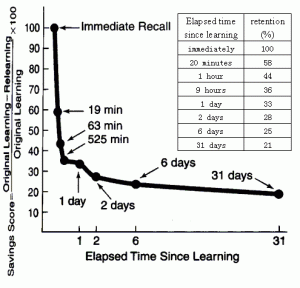
Foreign language learners, especially the more committed and metacognitive ones, do, in my experience, enjoy knowing more about how their brain works when they learn the target language. This does not mean that one should spend a whole lesson talking about neuroscience…However, showing them the diagram below, that maps out how the brain retains vocabulary over time and involving them in devising a personalised schedule based on that diagram would not take too much of your lesson time; would not require scientific jargon and would foster metacognition (thinking about and planning one’s learning).

With some of my groups I also venture in brief and concise explanations of (a) how Working Memory operates in an attempt to hammer home the importance of concentration, good pronunciation and associative strategies; (b) how forgetting is often cue-dependent; (c) why performance errors occur. Whenever one teaches about the above it is important to keep it as brief and visual as possible; not to over intellectualize and to relate the discussion to your students’ learning whilst showing them clearly why and how the knowledge you are imparting on them will benefit them in the short- and long-term.

4. Implement attitude-changing programs

In every class there are students who are less engaged, disaffected or even hostile. After a few pep-talks, disciplinary measures, referrals to pastoral middle-managers, things may get a bit better but there is rarely much change. This is often due to the fact that these scenarios are not handled through a structured, principled, well though-out attitude change program.

It is beyond the scope of this post to delve into the ins and outs of attitude-changing-programs implementation; here it will suffice to point out how for any attitudinal change to work, it must start by identifying the issues at the root of the negative attitude one wants  to change vis-a-vis the following metacomponents of attitude identified by Zimbardo and Leippe (1991):

  • Behaviours (what students do in their daily approach to languages)
  • Intentions (what their short-/medium-/long-term objectives are with the language)
  • Cognitions (their beliefs about languages)
  • Affective responses (how much they enjoy language learning)

The picture below (from: http://sites.hamline.edu/~./psunnarborg/attchange.htm)  illustrates where the most positive and committed of our students usually are in terms of these four attitudinal components:

The principles I outlined in my post on motivation (“Eight motivational theories and their implications for the classroom”) can then be applied to address the four areas one by one. For instance, one may want to start by inducing a level of cognitive dissonance to address learner beliefs (cognitions); by identifying what students excel at and enjoy so as to cater for their preferences in lessons and enhance their sense of fulfillment and enjoyment; to set short-term manageable goals in order to increase their sense of self-efficacy; etc.

Of course, most teachers are busy and over worked and may object that they do not have the time to do all this. My main point here is that, if one does wish to turn around a disaffected student or group of students, one should at least first try to ascertain what the actual roots of the problem are, through a structured and deep inquiry process based on the above framework.

5. Ask older language students to observe you

We often have our colleagues or senior teachers observe us. A recent trend in some schools in the UK is also to have students to observe us using checklists where they tick or cross things they see us do or not do. A strategy I have used in the past and that has paid huge dividends was to ask older A2 language students ( around 18 years old) to observe one or more lessons of mine and give me feedback on one or more specific areas of my teaching in which a younger person’s perspective may be more useful than an adult’s, e.g. motivation, empathy towards students, levels of pupils’ engagement, etc. What I find useful about having an older language student observe me is that students of this age are more in sync with adolescent-learner mentality and affective responses than my colleague’s whilst being still fairly mature and cognizant of what language learning entails; moreover, being former students of mine, these individuals are usually more able to relate the observed students’ experiences to their own when they were indeed taught by me and provide even more useful feedback as a result.

The best lesson planning ever…really? – Of the perils of educational sensationalism

As I was ‘snooping around’ the Internet I bumped into a title that attracted my attention: “9 ways to plan transformational lessons – Planning the best curriculum unit ever” (on the Edutopia site) .  At first I thought the author may have been a tad arrogant but when I read that the article had been shared 4.9K times on various social media I said to myself “Let’s read this”. And I did. After reading I felt immediately compelled to write this post as I got worried:  were the language teachers amongst the 4.9 K people who shared that article and/or the people who shared them with going to do what the article advises in the belief they will, by so doing, plan the best lessons ever?

The following are the points in the article that I had the most issues with:

  1. A… ‘transformational’ lesson??!!

This was the first – but not the greatest of my worries. Transparent learning; Visible learning; Dynamic learning; Collaborative learning; Positive education; and now…Transformational learning? For real? Another label thrown upon teachers by educational consultants wanting to create a brand? Yet another trendy category that if you do not belong to you are not up-to-date and feel left out? EVERY SINGLE LESSON where a student learns something you taught them is a transformational lesson, as you add new cognition to their brains. Even if you do not do any fancy stuff, any backward design or pedantically follow pseudo-scientific learning rubrics.

  1. For the best lessons ever shift from solo to collaborative design…really?

Whilst I do enjoy working collaboratively with my colleagues, especially doing long-term planning with them (e.g. preparing a unit of work), I am definitely at odds with the statement that in order to plan the best lessons ever I need to plan them with another teacher. When I plan my lessons I have every single student of mine in mind and the vocabulary and grammar structures they learnt with me in our last lesson as well as the mistakes and problem areas I want to address in their output; I know what strategies and learning activities keep them focused and motivated; my colleagues would not know that. Also, not all of my colleagues share the same theory or approach to language learning as me and often use or sequence the very same activities differently.

  1. Create the assessment before developing content… the Wiggins and Tighe curse

There is nothing less educational in language teaching than the adoption of Wiggins and Tighe’s backward design approach to MFL lesson planning – whist I can see its merits in the planning of longer units of work. There is nothing more straight-jacketing than teaching a language lesson with the assessment in mind. Whereas I do agree that one must have aspirational learning outcomes to work towards in a lesson and sequence of lessons, to set these in stone and let them drive the way we teach language is not only unethical, but counter-productive in terms of language acquisition; unless, that is, we are willing to sacrifice sound cognitive and psycholinguistic development in the name of a trendy curriculum design principle. Unless we teach robotically to our schemes of work and we are not willing to adapt our plans when we feel that our students need more practice.

A good L2-classroom practitioner teaches adaptively, creatively and should not teach with a specific test in mind; learning a language structure or function is a process which may need more time than planned. A good teacher must be prepared to change their plans if needs be. Teaching is not simply about planning and assessing.

  1. Don’t forget the introverts…

Quoting work by Susan Cain, the author points out how introverts enjoy working autonomously and how currently a lot of teaching includes group work. Is the implicit recommendation for the best lesson ever not to involve introverts in group-work? If it is so, I do not agree; whilst there has to be a balance of individual and collaborative work  in most lessons, I deliberately encourage students who do not enjoy working collaboratively to do team work so as to get them out of their comfort zone and learn a major lifelong skill; also, learning a language is about communicating with others!

Then the author goes on to say that increasing wait time to seven seconds – when asking a question in front of the classroom – will play to the strengths of introverts. Really? I give any of my students, regardless of their personality as long as they need unless they say ‘pass’… I would be interested to know why seven seconds is the ideal wait time as for some of my students it would not be enough, and I would rather wait a bit longer than dent their self-esteem.

Integrate Productive struggle in the curriculum

This is a direct quote from the article:

Don’t lower the expectations of your next lesson plan. Instead, scaffold instruction and check to see that you are challenging students appropriately with Hess’ Cognitive Rigor Matrix.

In other words, in order to plan progression and challenge in the best lesson ever, teachers ought to refer to Hess’ Cognitive Rigor Matrix one of many Bloom taxonomy surrogates… Speechless!

In conclusion, I apologize to the author of the article for sounding a bit too harsh. The article does contain some sound recommendations (e.g points 7 and 8); however, the harshness was elicited by the sensationalist title which clearly alludes to outstanding – the best ever – practice. When one is passionate as I am about teaching and learning one can only find it unacceptable and even ‘dangerous’ for the pedagogic recommendations made in this article to be divulged as ‘the best ever’ practice, especially when they are endorsed by a very authoritative educational website as Edutopia followed by a vast number of teachers from all over the world.

What does the message sent by the author and Edutopia to novice teachers about what best teaching practice is entail? A fixed wait time of seven seconds? Planning challenge in language learning based on Hess’ Matrix (please read my article on the Bloom Taxonomy and you will understand my ‘fury’)? Teaching a lesson based on a set-in-stone piece of assessment? Or that best lessons must be planned collaboratively? Whilst many of this recommendation can be useful, they should not be presented as evangelical truths, the pre-requisites for the best ever practice.

Edutopia should know better and put ethics before sensationalism.


‘Growth mindset’ – Panacea or double-edge weapon?

The principles embedded in Carol Dweck’s Growth mindset theory have played a great role in my life, especially in recent years. They are inspiring, motivating and reassuringly universal. However, they are nothing new. Every single one of Tony Robbins or Eric Thomas’ motivational videos disseminate exactly the same ideas. In the realm of social learning theory, Bandura’s (1994) produced very similar findings and his self-efficacy theory overlaps with Dweck’s work in many ways. Another psychologist, Herman (1980), codified in his resultative hypothesis very similar principles, too. Finally, at the risk of trivializing the present discussion, Rocky Balboa’s famous ‘motivational’ speech to his son, in Sylvester Stallone’s movie, could be seen as a forerunner of many of Dweck’s principles…

So why all the fuss now? Why is ‘Growth mindset’ all the rage in the business and education world at this moment in our history? Why do, these days, so many diagrams displaying Carol Dweck’s commandments pop up in so many Tweets and Facebook posts day in day out? Why is it that nowadays every business and educational establishment prides themselves in adopting a growth mindset? Does it mean they did not before? Why is everyone jumping on the ‘Growth mindset’ bandwagon all of a sudden?

The answer to the question is manifold. The fact that Dweck is a Stanford professor obviously helps, to start with, rendering it more credible than the aphorisms of a motivational guru of the likes of Eric Thomas. Secondly, the label ‘Growth mindset’ is much more intelligible and appealing to the masses than the obscure jargon used by other psychologists (e.g. ‘Self.-efficacy theory”, ‘Resultative hypothesis’). Thirdly, Dweck’s theory is clearly packaged and presented; it is very inspirational and versatile in its application. But, most importantly, it comes at the ‘right time in our history – a time of deep global societal and financial crisis; a time in which every single one of us needs to believe that hard work, grit, positivity and the will to succeed can pull us through the frightening uncertainty and precariousness of today’s world. In this, lies the main reason for the success of Dweck’s theory and its resonance with so many of us.

Of course, there is another, more sinister interpretation of Dweck’s success, which verges on conspiracy theory, but cannot be totally discounted. This interpretation has less to do with the author’s theory than with its opportunistic use by businesses and educational establishments. Whereas Growth mindset has great potential for motivating and inspiring staff, it can also be used to support a more autocratic/ top-down leadership style. For instance, the notion that ‘if one cannot accept negative criticism’ exhibits a fixed mindset is one that I could not agree more; however, what if the criticism is ‘incorrect’, not constructive, biased, badly formulated, in other words, bad criticism. Does it mean that if one does not accept this kind of criticism one exhibits a ‘fixed mindset’? It is easy to see how this can be easily used by a manager to silence any ‘dissonant’ voices amongst their staff.

The same goes for not being open to new challenges – another marker of a fixed mindset. Excellent to ‘silence’ anyone who is against a given innovation in a business or educational establishment. What if there are valid reasons to speculate that a new initiative will not be more effective – despite major time and financial investment by all the stakeholders – than the to-be-replaced existing practice? Should one be silent for fear of being ‘dubbed’ a ‘fixed mindset employee’?

My argument here is basically that, at a crucial time in the lives of many businesses and educational establishments, when transformational change is rampant and cost-effectiveness is a must, Carol Dweck’s theories can be a powerful double-edge weapon by constituting a great source of inspiration, motivation and resilience which pushes people to work beyond their comfort zone whilst – when used unethically – being very effective in silencing criticism or any resistance to change, even when they are legitimized by common sense, objective evidence and/or ethical considerations. Is it why the Growth mindset principles have become so popular?

In conclusion, Dweck’s ‘Growth mindset’ theory provides an excellent reference framework for self-improvement which can have many productive and motivation-enhancing applications in business as well in the foreign language classroom and education at large. It sends a positive and inspirational message which has an intuitive cognitive and affective appeal for anyone. However, one should be concerned when the people who use a ‘minimalistic’ application of Dweck’s theory – like the ones crystallized in the fancy diagrams circulating on Twitter-  ‘learnt’ through two or three CPD sessions, rather than through extensive and ‘deep processing’ of Dweck’s publications, as a means to pre-empt healthy criticism and constructive debate.

Of the ‘curse’ of tense-driven progression in MFL learning

download (7)

For too many years the UK National Curriculum posited the ‘mastery’ of tenses as the main criteria for progression along the MFL proficiency continuum. A learner would be on Level 4 if s/he mastered one tense + opinions, on Level 5 if s/he mastered two, etc. This preposterous approach to the benchmarking of language proficiency has always baffled me and has caused enormous damage to MFL education in the UK for nearly two decades. Not surprisingly I felt relieved when the current British government ‘scrapped’ the National Curriculum Levels. Sadly, this approach to progression is so embedded in much UK teaching curriculum design and practice that it will be very difficult to uproot, especially considering that some Examination boards still place too much emphasis on tenses in their assessment of GCSE examination performance.

But why am I so anti- tense-driven progression? There are two main reasons. First and foremost, the expressive power of a speaker/writer in any language is not a function of how many tenses s/he masters; it is more a function of – in no particular priority order:

  1. How much vocabulary (especially verbs, nouns and adjectives) s/he has acquired;
  2. How flexibly s/he can apply that vocabulary across context;
  3. How intelligible his/her output is;
  4. How effectively s/he can use time- markers (which will clearly signpost the time dimension we are referring to in communication);
  5. How effectively s/he masters the various functions of discourse (agreeing, disagreeing, evaluating, etc.) which will hinge on his/her knowledge of discourse markers (however, moreover, etc.) and subordination;
  6. How effectively s/he masters L2 syntax; etc.

In fact, in several world languages tenses do not really exist. In Bahasa Malaysia, for instance, one of the official languages of the beautiful country I live in, tenses – strictly speaking – do not exist. The past, the present and the future are denoted by time adverbials, e.g. one would say ‘Yesterday I leave my wallet in the hotel room’. Sentences like this one, would convey more meaning than the more accurate ‘I left my wallet in the hotel room’, since it is perfectly intelligible and more useful if one needs to tell the owner of the hotel one stayed in last week, when the wallet was left behind. Yet, according to the former National Curriculum Levels the second sentence would be a marker of higher proficiency…

Placing so much emphasis on the uptake of tenses skews the learning process by channeling teachers and students’ efforts away from other equally or even more important morphemes and aspects of the languages, which somehow end up being neglected and receiving little emphasis in the classroom and textbooks. It also creates misleading beliefs in learners about what they should prioritize in their learning.

This is one of the main problems with tense-driven progression, but not the main one. The most problematic issue refers to the pressure that it puts on teachers and learners to acquire as many tenses as possible in the three KS3 years. This is what, in my view, has greatly damaged British MFL education in the last 20 years, since the UK National Curriculum Levels were implemented. Besides resulting in overemphasizing tense teaching, such pressure has two other very negative outcomes.

Firstly, many teachers end up neglecting the most important dimension of learning – Cognitive Control. This occurs due to the fact that not enough time is devoted to practising each target tense; hence MFL students often learn the rules governing the tenses but cannot use them flexibly, speedily and accurately under communicative and/or time pressure. The pressure to move up one notch, from a lower level to a higher level – often within the same lesson – reduces the opportunities for practice that students ‘badly’ require to consolidate the target material, unduly increasing cognitive overload.

Secondly, often students are explicitly encouraged or choose to memorize model sentences which they embed in their speech or writing pieces in order to achieve a higher grade, learning them ‘ad hoc’ for a scheduled assessment. This would be acceptable if it led to acquisition or if it were supported by a grasp of the tenses ; but this is not always the case.

In conclusion, I advocate that the benchmarking criteria that UK teachers adopt explicitly or implicitly, consciously or subconsciously to assess progression in MFL learning should be based on a more balanced approach to the measurement of proficiency; one which emphasizes discourse functions, range of vocabulary (especially mastery of verbs and adjectives) and pronunciation, much more than it currently – a year since the National Curriculum Levels were abolished –  still does. As I have often reiterated in my posts, teaching should concern itself above all with acquisition of cognitive control rather than with the learning of mere rule knowledge. Progression should be measured more in terms of speed and accuracy of execution under real-life-like communicative pressure, width of vocabulary, functions and structures mastered as well as syntactic complexity. Tenses are important, of course, but they should not take priority over discourse features which are more crucial to effective communication.

What is the most effective approach to foreign language instruction? – Part 1

download (6)

Introduction – Of metaphors teachers live by and pedagogy ‘evangelists’

Every single one of us lives by metaphors, behavioural templates which we acquire through our interaction with the environment we grow up and live in. The language learning metaphors that are at the heart of our teaching come to a large extent from our experiences as language learners. These images of learning are so strongly embedded in our cognition that according to researchers it takes years of training and teaching practice to replace them with new templates; in certain cases, they are even impervious to  ‘conditioning’, despite the demands of teacher trainers, course administrators or students – I have observed this phenomenon first-hand time and again in most of the schools I have worked at.

Our beliefs about L2 learning play an enormous role in determining what teachers we will become and our response to any new methodology that we are asked to adopt. Some individuals will reject new instructional approaches in the belief that if they are such good linguists and their teachers’ approach worked so well for them, why should it not work for their own students? Some others – like I did, for instance, during and after my PGCE – will integrate elements of their existing belief system with the new methodology (-ies) to create a sort of personalized ‘hybrid’ – a ‘syncretistic’ approach. Others, instead – what I call the ‘radical converts’ – will espouse the new methodology with some kind of fanaticism often becoming zealous evangelists of their new pedagogic ‘dogmata’

It is the third attitude that one must be wary of: the blind allegiance to any approach that claims to have found a universal pedagogical fit for every learner. Any such claim will be unfounded because every learner brings to bear on the learning process a range of genetic and acquired individual variables that play an important role in language aptitude as well as in the cognitive/emotional response to teachers and their methodology. Whilst some guiding principles may be ‘universal’ in that they refer to general mechanisms that regulate human cognition across age, race, gender, G.I. factor and language aptitude, their implementation will ALWAYS be conditioned by contextual variables.

Consequently, I am not going to play the ‘know-all L2-pedagogue’, here, and tell teachers what the best approach is. After all, if your students are happy, motivated and learning lots, you have found the best approach already. You may want to enhance and vary your repertoire of teaching strategies, but after all, if the vast majority of your students are getting where you want them to be in the time and with the resources that you have been allocated by your course administrators, you do not need anyone to tell you how to teach; unless someone throws the spanner in the works, that is, and tells you that you must ‘integrate’ new technology, life-long learning skills, etc. into your healthy and balanced teaching echo-system…

Psychology, however, does give us some clear indication of how humans acquire cognitive skills. So, if one believes, as it is logical to presume, that language acquisition involves the same processes and mechanisms involved in the acquisition of any other cognitive ability, it is possible to identify some core pedagogical principles as crucial to any form of explicit foreign language instruction. Moreover, there is some sound research empirical evidence out there that should inform our teaching; to claim that it is conclusive and irrefutable would be preposterous, but to ignore it because it is not would be irresponsible. After all, what teachers must do with research evidence is to make an informed choice and ask themselves the questions: do these findings resonate with me and my past experiences? Is it worth trying this out? And, after trying it out: did it work? And if it didn’t, you can modify it or reject it altogether and look elsewhere.

Thirteen pedagogic principles rooted Cognitive psychology

The following are the pedagogical principles rooted in Cognitive psychology theory and research that worked for me. I am no evangelist, thus I am not positing them as the Gospel’s truths: these are merely some of the beliefs I formed in more than 2 decades of primary, secondary and tertiary MFL teaching, researching and, most importantly, reflecting on my own practice and listening to my students.

I am not concerning myself explicitly with the most important issue– motivation. It goes without saying that no methodology will ever be effective unless the teacher brings about a high level of his/her learners’ cognitive and emotional arousal and develops their self-efficacy.

Finally, let me reiterate that the principles below are based on the epistemological assumption that language skills are acquired in the same way as any other cognitive human skill.

  1. Practice makes perfect – Every language skill and item, in order to be acquired, is subject to the ‘Power Law of Practice’ (Anderson, 2000). Hence Listening, Speaking, Reading, Writing, Translation/Interpreting, Grammar and any other skills must all be practised extensively. This entails that any instructional approach (e.g. Grammar Translation and PBL) which does not emphasize all four skills in a balanced manner is defective. Instruction can be successful only through extensive practice and recycling of the kind envisaged in the next two points.
  1. Recycling must start from day one – forgetting starts occurring immediately after a given item has passed into Long-term Memory (Anderson and Jordan,1998). As the diagram below clearly shows, after 19 minutes one loses 40 % of what was recalled at time 0; after 9 hours, 56 % and after 6 days, 75 %. Recycling is imperative and must be of the spaced, distributed kind (a bit every so often) not of the massed kind (a lot of it once a week). Moreover, recycling must start on the same day something has been learnt. Instruction must model independent vocabulary learning habits which focus on autonomous recycling; it must also be mindful of human forgetting rate and provide for consolidation accordingly.

ebbinghaus-graph

  1. Effective language learning = high levels of cognitive control – A language item can be said to be acquired only when it can be performed accurately and efficiently (with little hesitation) under real time conditions in unmonitored execution (e.g. spontaneous conversation). This means that acquisition occurs along a conscious to automatic continuum; it starts from a declarative stage where the application of the knowledge about a specific language item is applied slowly under the brain’s conscious control and it ends when the execution of that item is fully automatic and bypasses working memory (Johnson, 1996). Instruction must involve extensive practice which starts with highly structured tasks (i.e. gap-fill or audiolingual drills) which become increasingly less structured with time and aim at developing cognitive control (the ability to perform effectively in real operating conditions).
  1. Production should always come after extensive receptive processing – Humans learn languages by imitating others’ linguistic input. Instruction should engage learners in masses of receptive practice before engaging them in production. Thus, ideally, extensive listening/reading practice (in the way of comprehensible input) should always precede speaking/writing practice. This rules out reading or listening comprehension tasks as valuable receptive practice, as these are tests, not effective sources of modelling; reading/listening for personal enjoyment or enrichment would be more conducive to learning in this regard.
  1. Cognitive overload should be prevented and controlled for – cognitive overload occurs when learners are engaged in tasks that pose challenging demands on their working memory. Teachers ought to prepare their students for a given task by facilitating their cognitive access to each level of challenge posed by that task. Thus, before reading a challenging text, the learners should be taught the key vocabulary and grammar points it contains and effective strategies to tackle it. Moreover, the text could be adapted to incorporate more contextual clues that may facilitate inference of unfamiliar lexis.
  1. Focus on micro-skills as much as you do on the macro- ones – To execute any task in the L2 (e.g. an unplanned role-play) effectively, the brain must acquire effective cognitive control over both the higher meta-components (e.g. generating meaning) and the lower order skills involved (e.g. pronunciation and intonation). By automatizing lower order language skills, the brain frees up space in learner Working Memory thereby facilitating processing efficiency and cognitive control and, consequently, performance – this is like learning to drive a car whereby a driver automatizes the basic skills such as changing gear or accelerating so that s/he can focus on the road. Instruction must identify and systematically address every set of macro- and micro-skills that typical language tasks involve. Following on from (2) such micro-skills must be practised extensively, too.
  1. Learning is enhanced by depth of processing, distinctiveness of input and personal investment – Learning of any language item does not simply involve practice, but also depth of processing. Instruction must engage learners in semantic analysis and association in order to strengthen the memory trace and to increase the range of context-dependent cues at encoding which will enhance the recall of any target item. The distinctiveness of instructional input (how outstanding and memorable it is) is also an important learning enhancing factor. Personal investment, how much the learning taps into an individual’s emotions and personal background increases retention, too. Hence, in choosing topics and learning materials learner opinions and tastes should always be taken into account (e.g. personalized reading-for-enjoyment activities).
  1. Grammar taught explicitly can be acquired – On condition that it is practised extensively, in context, and through masses of communicative practice which starts from controlled tasks and progresses through increasingly challenging unstructured ones. The process is a lengthy one so it may require training students to work on it independently, too. Implications: recycling is imperative and must occur mostly through the cognitive-control enhancement dimension, i.e. less gap-fills and written translation and more oral semi-structured and unstructured tasks. To enhance grammar acquisition the exceptions to the rule governing an ‘X’ structure should be taught before the dominant rule, e.g. irregular before irregular forms (see my article ‘Irregular before regular…’ for the psycholinguistic rationale for this approach).
  1. Corrective feedback is important, especially at the early stages of instruction – However, in order to be effective it must be processed by the brain long and deeply enough for it to be rehearsed in Working Memory and stored permanently in Long-term memory. Hence, any feedback practice on an erroneous executed ‘X’ item must :
  • Be distinctive;
  • Engage learners in deep processing;
  • Recycle the corrective feedback;
  • Be carried out through various means in order to provide more contextual cues for its recall;
  • Not limit itself to treating the symptom (i.e. the error) but also and more importantly the root cause (whether lack of knowledge, processing inefficiency, etc.)
  • Bring about learner intentionality to eradicate the error (i.e. motivate them to address the error in the future in a sustained effort to eliminate it).

(Conti, 2004)

  1. Learning strategies can be taught – On condition that a persuasive rationale for their instruction is provided; that they are modelled and scaffolded effectively and are practised very extensively through a variety of contexts (Cohen, 1998; Macaro, 2007)
  1. Metacognition should be modelled regularly – enhancing learner metacognition is imperative as a learner who knows how to learn and perform best is a learner who is bound to be more successful. Research shows clearly that highly metacognizant individuals are more successful at L2 learning (Macaro, 2007). Ideally, teaching should regularly scaffold holistic and task specific metacognition by prompting students to monitor and evaluate every level of their language learning and performance. The same approach concisely outlined in point 9 applies here.
  1. Individual variables must be assessed at the beginning of instruction – Learner individual factors may inhibit or facilitate learning. Ideally, at the beginning of instruction it may be helpful (but not always viable, I know…) to obtain as much information as to the following students’ characteristics
  • Previous history as language learners;
  • Personality traits;
  • Learning strategies;
  • Learning preferences (NOT learning styles – but rather how one enjoys learning)
  • Language proficiency across all skills;
  • Language aptitude;
  • Personal interests;
  • Processing efficiency (e.g. how well learners process language);

    This is very time consuming and does require quite a lot of resources and expertise.

  1. Sources of divided attention must be controlled for – This is the most obvious learning principle (Eysenk, 1988); that is why I placed it last. In a lot of UK state school classrooms to expect every student to be focused 100 % of the time is unrealistic. However, in settings where behavior management is not an issue, teachers should endeavour to minimize any distraction stemming from any sources which are directly under their control. One of them is the excessive manipulation of digital media (e.g. app smashing) which hijacks learners’ finite attentional resources away from language processing. Digital media can be effective target language learning enhancers, but must be used judiciously to expand not shrink learning.

In conclusion, as already stated above, the above list is by no means exhaustive. It only includes some of the many pedagogic principles which, in my opinion, ought to underlie any instructional approach regardless of the educationl setting and espoused theory. Unfortunately, something important is missing: how should one implement the above principles in curriculum design, lesson planning and across all four macro-skills? Some of the answers can be found in the other articles on this blog. More answers will be provided in the sequel to this article in the very near future, in which I will concern myself with how those principle should inform pedagogy vis-à vis the four macro-skills, grammar, translation and learning strategy instruction.

Nine interesting foreign language research findings you may not know about

images (5)

In  this post I am going to share with the reader a very succinct summary of 9 pieces of research I have recently come across which I found interesting and have impacted my classroom practice in one way or another. They are not presented in any particular order.

  1. Green and Hecht 1992 – Area: Explicit grammar instruction and teaching of aspect

Green and Hecht investigated 300 German learners of English. They asked them to correct 12 errors in context and to offer an explanation of the rule. Most interesting finding: the students could correct 78 % of the errors but could not provide an explanation for more than 46 % of the grammar rules that referred to those errors. They identified a set of rules that were hard to learn (i.e. most students did not recall them) and a set of easy rules (the vast majority of them could recall them successfully). Their implications for teaching: the explicit teaching of grammar may actually not work for all grammar items. For example, the teaching of aspect (e.g. Imperfect vs Preterite in Spanish), would be more effectively taught, according to them, by exposure to masses of comprehensible input (e.g. narrative texts) rather than through the use of PPTs or diagrams on the classroom whiteboard/screen – in fact Blyth (1997) and Macaro (2002a) demonstrated the futility of drawing horizontal lines interrupted by vertical ones to indicate that the perfect tense ends the action.

My conclusions: I do not entirely agree with Blyth and Macaro that explicit explanation of grammar in the realm of aspect does not work and I do like diagrams (although they do not work with all of one’s students). However, I do agree with Green and Hecht (1992) that the best way to teach aspect is through exposure to masses of comprehensible input containing examples of aspect in context. The grammar explanation and production phase may be carried out at a later stage.

  1. Milton and Meara (1998) – Comparative study of vocabulary learning between German, English and Greek students aged 14-15 years.

197 students from the three countries studying similar syllabi for the same number of years were tested on their vocabulary. The findings were that:

1.The British students’ score was the worst (averaging at 60 %). According to the researchers, they showed a poor grasp of basic vocabulary ;

2.They spent less time learning and were set lower goals than their German and Greek counterparts;

3. 25 % of the British students scored so low (after four years of MFL learning) that the researchers questioned whether they had learnt anything at all.

The authors of the study also found that British learners are not necessarily worse in terms of language aptitude; rather, they questioned the effectiveness of MFL teaching in the UK.

My conclusions: this study is quite old and the sample they used may not be indicative of the overall British student population. If it were, though, representative of the general situation in Britain, teachers may have to – as I have advocated in several previous blogs of mine – consciously recycle words over and over again, not just within the same units, but across units.

Moreover a study of 850 EFL learners, by Gu and Johnson (1996), may indicate an important issue underlying our students poor vocabulary retention; they found that students who excelled in vocabulary size were those who used three metacognitive strategies in addition to the cognitive strategies used by less effective vocabulary learners : selective attention to words (deciding to focus on certain words worth memorizing), self-initiation (making an effort to learn beyond the classroom and the exam system) and deliberate activation of newly-learnt words (trying out using that word independently to obtain positive or negative feedback as to the correctness of their use) . Teaching should aim, in other words, at developing learner autonomy and motivation to apply all of these strategies independently outside the classroom.

  1. Knight (1994) – Using dictionaries whilst reading – effects on vocabulary learning

Knight gave her subjects a text to read on a computer. One group had access to electronic dictionaries whilst the other did not. She found that those who did use the dictionary and not simply guessing strategies, actually scored higher in a subsequent vocabulary test. This and other previous (Luppescu and Day, 1993) and subsequent studies (Laufer & Hadar, 1997; Laufer & Hill, 2000; Laufer & Kimmel,1997) suggest that students should not be barred from using dictionaries in lessons. These findings are important for 1:1 (tablet or PC) school settings considering the availability of free online dictionaries (e.g. www.wordreference.com).

  1. Anderson and Jordan (1998) – Rate of forgetting

Anderson and Jordan set out to investigate the number of words that could be recalled by their informants immediately after initial learning, 1 week, 3 weeks, and 8 weeks thereafter. They identified a learning rate of 66%, 48%, 39%, and 37% respectively. The obvious implication is that, if immediately after learning the subjects could not recall 66 % of the target vocabulary, consolidation should start then and continue (at spaced intervals – through recycling in lessons or as homework) for several weeks. At several points during the school year, I remind my students of Anderson and Jordan’s study and show them the following diagram. It usually strikes a chord with a lot of them:

ebbinghaus-graph

  1. Erler (2003) – Relationship between phonemic awareness and L2 reading proficiency

Erler set out to investigate the obstacles of learners of French as a foreign language in England. She studied 11-12 year olds. She found that there was a strong correlation between low level of phonemic awareness and reading skills (especialy word recognition skills). She concluded that explicit training and practice in the grapheme-phoneme system (i.e. how letters/combination of letters are pronounced) of French would improve L1-English learners’ reading proficiency in that language. This find corroborates other findings by Muter and Diethelm (2001) and Comeau et al (1999). The implications is that micro-listening enhancers of the like I discussed in a previous blog (e.g. ‘Micro-listening skills tasks you may not do in your lessons’) or any other teaching of phonics should be performed in class much more often than it is currently done in many UK MFL classrooms.

Please note: teaching pronunciation and decoding skills instruction are not the same thing.  Pronunciation is about understanding how sounds are produced by the articulators, whilst teaching decoding skills means instructing learners on how to convert letters and combination of letters into sound. Also, effective decoding-skill instruction occurs in communicative contexts (whether through receptive or productive processing) not simply through matching sounds with gestures and/or phonetic symbols.

  1. Feyten (1991) – Listening ability as predictor of success

Feyten investigated the possibility that listening ability may be a predictor of success in foreign language learning. The researcher assessed the students at pre-test using a variety of tasks and measures of listening proficiency. After a ten-week course she tested them again (post-test) and found that there was a strong correlation between listening ability and overall foreign language acquisition, i.e.: the students who had scored high at pre-test did better at post-test not just in listening, but also in written grammar, reading and vocabulary assessment. Listening was a better predictor of foreign language proficiency than any other individual factor (e.g. gender, previous learning history, etc.).

My implications: we should take listening more seriously than we currently do. Increased exposure to listening input and more frequent teaching of listening strategies are paramount in the light of such evidence. Any effective baseline assessment at the outset of a course ought to include a strong listening comprehension component; the latter ought to include a specific decoding-skill assessment element.

  1. Graham (1997) – Identification of foreign language learners’ listening strategies

This study investigated the listening strategies of 17-year-old English learners of German and French. Amongst other things she found the following issues undermining their listening comprehension. Firstly, they were slow in identifying key items in a text. Secondly, they often misheard words or syllables and transcribed what they believed they had heard thereby getting distracted. Graham’s conclusions were that weaker students overcompensated for lack of lexical knowledge by overusing top-down strategies (e.g. spotting key words as an aid to grasp meaning).

My implications are that Graham’s research evidence, which echoes finding from Mendelsohn (1998) and other studies, should make us wary of getting students to over-rely on guessing strategies based on key-words recognition. Teachers should focus on bottom-up processing skills much more than they currently do, e.g. by practising (a) micro-listening skills; (b) narrow listening or any other listening instruction methodology which emphasizes recycling of the same vocabulary through comprehensible input (N.B. not necessarily through videos or audio-tracks; it can be teacher-based, in absence of other resources); (c) listening with transcripts – whole, gapped or manipulated in such a way as to focus learners on phoneme-grapheme correspondence.

  1. Polio et al. (1998) – Effectiveness of editing instruction

Polio et al. (1998) set out to investigate whether additional editing instruction – the innovative feature of the study – would enhance learners’ ability to reduce errors in revised essays. 65 learners on a university EAP course were randomly assigned to an experimental and a control group who wrote four journal entries each week for seven weeks. Whereas the control group did not receive any feedback, the experimental group was involved in (1) grammar review and editing exercises and (2) revision of the journal entries, both of which were followed by teacher corrective feedback. On each pre- and post-tests, the learners wrote a 30-minute composition which they were asked to improve in 60 minutes two days later. Linguistic accuracy was calculated as a ratio of error-free T-units to the total number of T-units in the composition.

The results suggested that the experimental group did not outperform the control group. The researchers conjectured that the validity of their results might have been undermined by the assessment measure used (T-units) and/or the relatively short duration of the treatment. They also hypothesised that the instruction the control group received might have been so effective that the additional practice for the experimental group did not make any difference.

The implications of this study are that editing instruction may take longer than seven weeks in order to be effective. Thus, the one-off editing instruction sessions that many teachers do on finding common errors in their students’ essays to address the grammar issues that refer to them, are absolutely futile, unless they are followed up by extensive and focused practice with lots of recycling.

  1. Elliott (1995) – Effect of explicit instruction on pronunciation

Elliott set out to investigate the effects of improving learner attitude toward pronunciation and of explicitly teaching pronunciation on his subjects (66 L1 students of Spanish). He compared the experimental group (which received 10-15 minutes of instruction per lesson over a semester) with a group of students whose pronunciation was corrected only when it impeded understanding. The results were highly significant, both in terms of improved accent and of attitude (92 % of the informants being positive about the treatment). The experimental group outperformed the control group.

Implications: this study , which confirms evidence from several others (e.g. Elliot 1997; Zampini, 1994), confirms that explicit pronunciation instruction is more effective than implicit instruction whereby L2 learners are expected to learn pronunciation simply by exposure to comprehensible input. Arteaga’s (2000) review of US Spanish textbooks found that only 4 out of 10 Spanish textbooks include activities attempting to teach pronunciation. I suspect that the figure may be even lower in the UK. In the light of Elliott’s findings, this is quite appalling, as the mastery of phonology not only is a catalyst of reading ability but also of listening and speaking proficiency as well as playing an enormous role in Working Memory’s processing efficiency in general (see my blog: ‘ Eight important facts about Working Memory’).

Things learners do not enjoy about their foreign language lessons

images (4)

In the last two years or so, I have carried out short interviews with around 150 year 8 and 9 MFL students of various ability which I ranked as very able (38), able (72) and less able (40) based on their (Midyis) test results. I asked them the question: “Which 3 things about your language lessons do you neither enjoy nor find conducive to learning? Why?”. Although there was a high degree of idiosyncrasy and variation across the informants’ answers in terms of individual preferences, seven ‘things’ stood out as being disliked and found ‘not very productive’ by at least 40 % of the students. Here they are:

  1. Tasks they do not feel prepared for – 52 % of the students found demotivating and not very productive to be required to carry out tasks they felt were beyond their linguistic competence level. Unsurprisingly, most of the students in this category included the less able ones. However, some of the more able students complained about this issue, too, possibly because, being perfectionists, they hated not being able to be 100 % accurate.
  2. Long sessions of writing in lessons – 65 % of the students stated they disliked or even ‘hated’ doing writing in class for 15-20 minutes or more, most of them feeling that it was boring and should be done at home when one would have more time and focus to learn from it. Not surprisingly, here, too, the less able students were those with the strongest negative feelings about long writing sessions.
  3. Listening comprehension tasks from course-books– 55 % of the students mentioned this as a motivation inhibitor and as an activity they did not feel they learnt much from because they felt that the actors on the course-book audio-tracks went either too slow (in the lower level activities) or too fast (in the higher level ones). They enjoyed listening to the teacher speaking to them in the target language as they felt it was a more natural context for practising listening.
  4. Target setting / Being given targets – 45 % of the students felt they did not learn much from this process because after the target-setting session they would not look at the targets often enough to do something about them. They found the process tedious and unproductive.
  5. Very long sessions on the iPad – 60 % of my informants reported generally enjoying using the iPad in class but not for the whole lesson. They felt that they needed a mix of activities. 40% mentioned tiredness and/or boredom as the reasons why using it for the whole lesson resulted in less focus and interest.The more able students seemed to be the ones who objected more strongly against the overuse of the iPad. The suggestion made by the students was that each session should not be longer than 15-20 minutes maximum.
  6. Lack of group-work – 45 % of the students reported disliking lessons where they had to work alone from beginning to end. These students (mainly belonging to the able and less able group) said that there had to be some form of group work in every single lesson. 25 % of these students mentioned movement around the classroom as a desirable feature of such group-work activities.
  7. Learning verb conjugations – 40 % of the students reported disliking learning verb conjugations through drills, gap-fills and even online conjugators (this was painful considering that I created one at www.language-gym.com). Most of the students who mentioned this belonged to the less able group and a minority to the more able groups. These learners found learning conjugations challenging and said they learnt them more effectively at home as they felt less under pressure and had more time to focus on them.

The above findings are hardly generalizable, as they are situated in a very specific educational and cultural setting and the sampling was not randomized. Hence, it would be interesting to see if colleagues working in different contexts would obtain similar or divergent findings.

Of course, the fact that students do not dislike something does not entail that we should not do it, if we do believe those things are actually highly conducive to learning. For example, although it is true that learners do not particularly enjoy verb conjugation drills, I have noticed remarkable improvements in terms of verb/tense awareness (not necessarily ‘acquisition’) since I started to regularly use online verb conjugator trainers (5-10 minutes at a time); hence, I will keep using them as short homework and/or warm-up/follow-up activities in the context of grammar learning sessions.

Ultimately, however, I do believe that we should try and heed our students’ preferences as much as possible and be ‘brave’ enough to ask them if they truly enjoyed and learnt from specific activities we stage in class. You will be very suprised at how mistaken some of our assumptions often are.