How to boost your students’ vocabulary whilst creating a positive learning environment

IntroductionVocabulary teaching and affect _ teaching words through emotion.png

The validity of Stephen Krashen’s Affective-filter hypothesis as a theory has been discounted by many a scholar, mainly due to its unfalsifiability. However, it is undeniable that a positive and enjoyable learning environment in which the students feel safe, respected, validated, liked and listened to by their teacher and peers, benefits language acquisition in many ways, both in terms of motivation and in reducing learner anxiety – the number-one inhibitor of language learning according to much research. To create such an environment is a pedagogic imperative, whatever methodology or theory of L2 learning one espouses.

Moreover, we know that linguistic input that is perceived by our students as emotionally salient, is more likely to be retained. Hence, the importance of inducing high levels of emotional arousal in the classroom (e.g. through competition) and of relating as much as possible every lexical item we teach to our learners’ affect, both in terms of present and past emotions they associate with those words and/or their meaning(s).

Here are five strategies I use in my classroom to create a positive and enjoyable learning environment based on mutual trust and respect whilst expanding and/or consolidating my students’ lexical and even grammatical repertoire. I usually scaffold the process by providing lists of phrases with translation which I gradually phase out after a few weeks.

1.Taking the emotional temperature

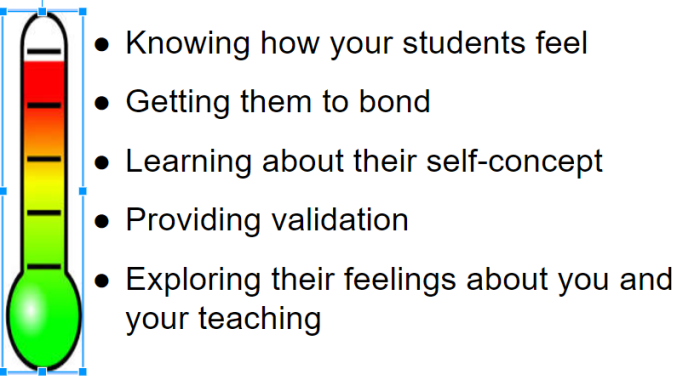
Knowing how each of your students feels at the beginning of your every lesson is crucial, especially at the early stages of teaching a specific class, in helping you set up a positive and enjoyable environment and teach with empathy.

As you call the register at the beginning of a lesson, ask each of your students how they feel and ask them to respond by using a specific set of words or phrases (like the ones in the sentence builder below (for English-speaking learners of Italian), which you will display on the classroom screen (or share with them on Google classroom as I do).

Vary the words/phrases ever so often ,thereby expanding their lexical repertoire as the year advances. So if during the first four-five weeks you used adjectives such happy, angry, annoyed, stressed, bored, sad, excited, sleepy, worried and calm, in the subsequent four-five weeks ask them to use synonyms or widen the pool or emotions or ask them to make up more complex sentences explaining why they feel the way they do (if they feel comfortable, of course), e.g. I feel tired because I have not been sleeping well recently or I didn’t sleep well last night.

Vocabulary teaching and affect _ teaching words through emotion.png

Staging this activity day in, day out, has helped me teach and recycle new vocabulary and even grammar (past and future tense) obtaining excellent levels of student retention with relatively little effort and saving valuable curriculum time (as I do not have to devote a series of lessons on adjectives expressive emotions, for instance)

2.Learning about your students’ self-concept

An insight in your students’ self-concept is extremely useful in building an idea of who you teach. Students who are less confident and/or have a lower self-esteem are usually more vulnerable to anxiety’.

‘If I were…I would…’ tasks are a subtle and creative way to get students to tell you something about the way they view themselves whilst at the same time practising ‘if-clauses’ in the context of each vocabulary set you teach. Examples:

(whilst teaching adjectives) – If I were a car, I would be a Ferrari, because I am sporty, fast and noisy

(whilst teaching fruit) – If I were a fruit, I would be a cherry, because I am small and round

I stage a ‘If I were…I would’ task with every new set of nouns or adjectives I teach. It is far from being as accurate as a personality test, of course, but gives me quite a few clues as to the personality and mood of my students whilst eliciting their creativity with language and adding a bit of fun to the lesson.

How I do it: (1) I give them a prompt (e.g. If I were a car…); (2) they write the whole sentence down on a mini-board; (3) I ask a  few students at each round to read their sentences out and to some of their peers to translate them in the L1.

3.Creating a bond through peer validation

Encouraging the students in your classes to bond with each other is important from day one. Getting them to compliment each other in the target language is an obvious activity to help you achieve this, which students truly enjoy.

Ask them to write the compliment(s) for one or more of their peers anonymously on a post-it to put it in a box; then you or a student will read them out to the class or you will ask each student in the class to pick up one or more post-its and deliver them to the people they describe. Make sure you write a few yourself for those students who are less likely to get any compliments from their classmates.

This can also be an oral activity whereby the students go around the classroom and compliment their peers orally.

The scope of this activity in terms of application to the topics one usually teaches seems limited to appearance, e.g.  adjectives describing personality and appearance (e.g. I think you are nice and generous), nouns referring to personality traits (e.g. I appreciate your generosity); clothes (e.g. I like the shirt you are wearing because it is really trendy); nouns referring to physical features (e.g. I like your hair).

However, this activity can also be used to express appreciation, lesson in lesson out, for something a peer has done, e.g. You have done really well today because…, Thanks for helping me out during the translation task, I really enjoyed working with you today. Giving them a set of phrases on the screen (or on a sheet to stick in their books) to scaffold the process obviously facilitates the task.

Everyone enjoys being praised. If during the process the students pick up new useful language, as in my experience students do, it is truly a win-win situation for all.

4.Linguistically ‘smart’ praise

Praising students in a way which is commensurate to their effort and/or achievement is something most teachers do. However, what you do not often see teachers do is use praise in a deliberate way to impart specific linguistic input (e.g. to recycle a specific grammar structure or set of words).

Yet, because of its emotionally salient nature, students are more likely to pay attention to praising input and try harder to make sense of it. Hence, instead of simply uttering the usual ‘great’, ‘fantastic’ etc. plan the linguistic content of the positive comments you write or impart orally so as to include useful new vocabulary or structures or to consolidate old ones.

So, if you want to recycle the perfect tense, write your two/three-line comment in that tense: ‘You have produced an excellent piece of work. I have really enjoyed reading it. You have included a wide range of vocabulary. Etc.’ If your aim is to recycle adjectives, write your comment in the form of adjectives: your work is informative, concise, well-presented and thorough. And so on. Ask them to translate your feedback to ensure they have actually understood what you wrote.

In other words, don’t waste this opportunity to use something the students (hopefully) value affectively and cognitively – your feedback – to enhance their vocabulary and grammar

  1. Listening to your students’ voice

Learning how the students feel about your lessons straight from the horse’s mouth is useful in order to gauge their level of enjoyment in your lessons and satisfaction with your teaching. In addition, you show your students that you value their feedback on your performance and that they are not merely the passive recipients of your teaching, but they play an active role in it.

At the end of each lesson ask them to anonymously write on one or more pieces of paper how they feel about your lesson and, if they are linguistically ready, to add in a piece of advice on how you could improve.

Again, since this is not merely a way to get formative assessment that will inform your future practice, but also a linguistically enriching experience, do select the input smartly. So ask them on one occasion to simply use adjectives; example:

The lesson was funny, boring, exciting, interesting, engaging,…

On another, to make sentences containing past tenses. Example:

Today I have learnt a lot, I haven’t learnt much, It was a bit boring,..

Or, with more advanced learners, if-clauses sentences. Example:

If you had done more listening…, If you had talked more slowly…, If you had explained that better…

Or questions. Example:

Next time, could you please do more games, go slower, let us speak more….?

Or superlatives. Example:

the best thing, the worst thing, the funniest thing, the most boring thing was…

As usual, you will provide your students with a bank of words, phrases or sentences as a scaffold to help them in the process. Once all the pieces of paper have been put in a box, you will fish some out and, if you feel comfortable with it, you will read them out to the class and ask somebody to translate for the rest of the class.

Conclusion

The above are minimal preparation strategies to simultaneously help creating a positive atmosphere whilst enhancing your students’ L2 vocabulary and even grammar acquisition. Exploiting the emotional saliency of the contexts these activities create facilitates retention. The secret is carrying out such activities as often as possible, five- ten minutes per day, so as to systematically recycle the target vocabulary and/or structures. This is a great way to consolidate old material and to plant the seeds for items you are planning to teach in the future.

Implementing Listening-As-Modelling in the classroom – a report on a 20-week experiment with my year 8 French classes and its impact on their aural comprehension skills

(Co-written with Steven Smith and Dylan Vinales)

1. Introduction

This post describes the broad lines of a twenty-week long instructional programme in listening skills (a pilot study) Gianfranco carried out with two Year 8 French classes as part of his performance management.

We’ll discuss its main findings and implications for teachers. We hope to include reference to this study in the book we are preparing about teaching listening called Breaking the Sound Barrier.

The study investigated whether extensive L.A.M. (Listening-as-modelling) instruction focusing on the enhancement of micro-listening skills would be more effective than the traditional textbook-like approach (i.e. doing topic-based listening comprehension tasks).

The preliminary findings of the study suggested that the L.A.M. programme was more effective than traditional instruction and significantly enhanced the students’ ability to:

  1. read non-words with correct pronunciation in isolation and in short sentences (including mastery of liaison)
  2. transcribe French texts under dictation conditions;
  3. identify parts of speech in aural input and
  4. comprehend aural texts.

One important caveat: being a pilot study, it was not designed and carried out with the rigour of a ‘proper’ research study. Also, its small scale and the opportunistic sampling (Gianfranco simply chose two classes he teaches) means that the findings are hardly conclusive and generalisable. You may find them interesting nevertheless and we’ll mention at the end some of their possible implications.

Also, it should be borne in mind that all the activities below were fully integrated with the other three skills and grammar teaching. So,for instance, the micro-listening and aural vocabulary activities were always staged prior to communicative oral tasks. This required considerable planning effort – another crucial caveat.

2. The rationale and aims of the study

The main rationale behind this study was the hypothesis that MFL teachers may be able to substantially improve their students’ listening comprehension skills through explicit training in the five skill sets below:

  1. Decoding skills, i.e. ability to match letters and letter patterns to L2 phonemes (also known as GPC: grapheme-phoneme correspondence).
  2. Speech-segmentation skills, i.e. the ability to identify word-boundaries.
  3. Lexical retrieval skills, i.e. the ability to recognize words and retrieve their meaning in real time.
  4. Parsing skills (ability to recognize patterns in aural input).
  5. Alertness to and localisation of sound.

To test this hypothesis a L.A.M. instructional programme was devised and implemented as laid out below.

3. Research and instructional methodology

3.1 Setting and participants

The study was carried out at Garden International School, with two mixed-ability groups of (mostly Asian) Year 8 students of French of more-or-less equivalent number, gender distribution and ability (as measured through a T-test performed on the results of the three baseline assessments). Group A (the experimental group) received the L.A.M. training, whilst Group B (the comparison group) was taught the traditional way.

3.2 Baseline assessment

At the beginning of the study, the students were assessed as follows:

  1. Listening comprehension test: the students listened to a text covering vocabulary studied in Year 7 and primary school and answered questions listed in increasing order of difficulty.
  2. Decoding test: students were required to read out nonsense words in isolation and short sentences containing instances of liaison.
  3. Dictation test.
  4. Questionnaire asking how confident and motivated the students were in listening.

3.3 Baseline assessment findings

Listening Comprehension. The students performed reasonably well at the listening comprehension tests in both groups (75 being the mean score for Group A and 74 for Group B).

Decoding test. Students’ ability to pronounce non-words was poor, less than 50 % of the words correct for both groups (Group A 45.4 %; Group B 43.1 %). No student could accurately perform liaison. Issues were identified with the pronunciation of word endings (e.g. es, et), diphthongs (ou, eu, u) and the ability to differentiate between  le/de and les/des, un and une and other words of similar spelling but different pronunciation.

Dictation. Accuracy below 50% for both group (Group A 47 %; Group A 44 %)

Questionnaire. Both groups displayed average levels of motivation and self-efficacy, most of the students choosing the mid-point of the five-point scale adopted.

T-tests were performed on the results of all the four measures the baseline assessments and showed the two groups were equivalent on all measures  (A T-test assesses whether the averages of two groups are statistically different from each other.)

Let’s look next at the tasks done with the LAM group (group A), then the ‘traditional’ group (Group B).

4. The Listening- As-Modelling Programme 

Here is the instructional approach carried out with the experimental group

4.1 Enhancing alertness and localisation of sounds. A student who is alert is more likely to pick up details in the aural input. This skill is often taken for granted by teachers. In this case students’ level of alertness was raised through:

4.1.1 Spot the intruder;

4.1.2 Track the sound / word;

4.1.3 Spot the mistake;

4.1.4 Faulty echo (teacher reading a sentence twice and asking students to spot the mistake deliberately made in the pronunciation the second time).

4.2 Improvement of speech-segmentation skills. Segmentation is the most important skill in listening comprehension. The programme aimed to enhance segmentation skills by:

4.2.1 Aural/writing synergy.  Presenting new language items always in short sentences through a combination of aural and written input. Hence, I chose substitution tables or sentence builders, in the belief that visually processing the gaps in between words in a sentence whilst hearing that sentence being uttered would enhance students’ sensitivity to segmentation. Other tasks through which I attempted to realise this synergy were: (the word synergy may confuse some teachers)

4.2.1.1 Oral ping-pong (see here for explanation)

4.2.1.2 Paired reading aloud sessions of short texts.

4.2.1.3 Break the flow’ tasks – fairly long sentences written without spacing. (The teacher reads the sentence aloud and students separate the words)

4.2.2 Pattern recognition tasks – effective pattern recognition skills facilitate segmenting in that it is easier to assign roles to the words one recognises in the input. Sentence builders, substitution tables, sentence puzzles and other tasks described (here) were used to focus students on patterns.

4.2.3 Sound-discrimination tasks. This is another crucial skill, as often misinterpretation of speech signals stems from misunderstanding similar sounding words (e.g. the classic ‘ship’ vs ‘sheep’). Tasks used in this area were:

  • Minimal pairs. (students must discriminate between two similar sounding words)
  • Spot the rhyming words (students are given three words containing different sounds and must match them with the words the teacher utters)
  • Spot the mistake (students are given a text which the teacher reads aloud; they must spot the words the teacher is mispronouncing)

4.2.4. Parallel text dictations with L1 parallel text. A short text was dictated. To help students segment, the English version of text was provided.

4. 2.5. Gapped texts dictations. Note that gapped words were not chosen randomly; they contained problematic sounds.

4.3 Improvement of decoding skills. The teaching of decoding skills occurred in every lesson for about ten minutes and focused on the following:

  • Silent versus voiced word endings (weeks 1 to 4), through tasks such as ‘spot the silent letter’ or syllable completion tasks.
  • Discrimination between the sounds un, in, en, an (weeks 5 to 10) using ‘minimal pairs’ or ‘spot the rhyme’.
  • Discrimination between oi, ou, eu and u (weeks 11 to 15).
  • Discrimination between eu(x), é, è  and e (weeks 16 to 20).

As already mentioned above, the tasks typically used in this area were:

  • M.L.E. (Micro-Listening Enhancers) such as minimal pairs and syllable-completion tasks and others (see here ).
  • Critical listening tasks were also used before any production tasks (student A reads aloud whilst student B is briefed to pay selective attention to a target sound and provide feedback on its pronunciation).
  • Short dictations.
  • Highly structured oral Interactional activities which elicited production of the target phonemes (e.g. communicative oral drills and find-someone-who with cards ).

Please note: instruction followed my M.A.R.S. approach, i.e.: Modelling/Awareness-raising first, followed by receptive processing, then structured production. In other words, students only produce the sounds in structured tasks after much aural exposure to the target sounds.

4.4 Improvement of memory for words and speed of lexical retrieval. Four sets of aural tasks were used:

4.5 Improvement of parsing skills. Besides the tasks described in 2.2 above, listening tasks requiring the students to categorize words by word-class/part of speech or by tense were carried out in order to enhance their grammatical sensitivity through the aural medium.

5. The comparison group (Group B)

Besides the typical textbook-like listening comprehension activities non-treatment group the comparison group performed full dictation tasks with the same frequency as the experimental group, in order to ensure that they would not be at a disadvantage at post-test, where the four assessment tasks would include a dictation task.

6. Post-test (final assessment)

At the end of the experiment the students were assessed through the same tasks used at pre-test, plus an aural vocabulary matching task:

– Reading out non-words in isolation and in short sentences.

– Dictation.

– Listening comprehension (done how?)

– Vocabulary recognition (20 words uttered at 5 seconds interval to assess speed of retrieval).

7. Findings

  1. Enhanced alertness to sounds – the students have unanimously reported paying much more attention to sounds, putting it down to the baseline test and the micro-listening activities.
  2. Improvements in decoding skills and pronunciation. Statistically significant improvements in decoding skills were observed from pre-test to post-test (from 45.4 % to 83.4). The results were statistically significantly superior to the comparison group (83.4 % accuracy vs 60.5%). The students put them down to the masses of aural input, to the emphasis the lessons put on phonemes and the micro-listening activities, which they did not always enjoy but significantly enhanced their awareness of the differences between similar-sounding phonemes and words.
  3. Improvements in transcription skills under dictation. Statistically significant improvements were found for this task too. The ratio correct to incorrect words rising by nearly 40% for the experimental group (Group A) and only by 20 % for Group B.
  4. Listening comprehension task. The score of the listening comprehension task too showed a statistically significant advantage for the experimental group, although not as marked as in the other two tasks (group A’s mean score 89.2; group B’s 80.3)
  5. Word matching lexical task. The experimental group very significantly outperformed the comparison group (group A’s mean score 88.4; group B’s 69.7). Interestingly, some comparison group students reporting knowing most of the words they heard but being overwhelmed by the time pressure.
  6. Can-do attitude and motivation vis-à-vis listening. The questionnaire investigating this area has not been administered as yet (planning to do it next week). However, from my conversations with my students throughout the process it emerges clearly that they felt much more confident than at the beginning of the process and that they saw a causality between the L.A.M. activities and their enhanced can-do attitude.

Do note that the effect size was high (i.e. the gains were evenly distributed amongst the students in Group A).

Finally, it is worth pointing out that the students reported finding sentence-builders, substitution tables and sentence puzzles as the most useful activities. The activity they enjoyed the most were spot the intruder, spot the mistake oral repetition sparring and find-someone-who with cards. They did not enjoy dictations but they reported learning a lot from them.

8. Concluding remarks

The study concisely outlined in this post is a small-scale pilot with lots of limitations. Having used the same approach with various classes in the last three years, it does however confirm my observation that students do feel more confident and become substantially more competent at decoding L2 graphemes, transcribing and comprehending of L2 input as a result of this sort of training.

The observation can be made, of course, that students get better at what they practice, so it is little surprise that phonological and spelling skills improve when you spend more time on them. More significant, perhaps, is the fact that listening comprehension improved somewhat along with decoding and transcription. An interesting question to ask is: to what extent would comprehension alone improve if an experimental diet without any transcription was tried, i.e. in this case, if Group B had done no dictation?

However, it is entirely plausible that improving decoding and transcription skills does have the added pay-off discovered in this experiment. Even common sense might predict such an outcome.

Does this suggest that teachers should give more time to the types of tasks done with Group A above? Almost certainly. We would suggest that this is particularly the case with beginners and near-beginners. For intermediate and advanced students such tasks can still play a role, e.g. advanced level transcription, gap-filling and reading aloud. At higher levels, however, it is likely that most listening will focus to a greater extent on comprehension and the ability to participate in more sophisticated discussion.

Of note in the study was the fact that not all decoding skill tasks were enjoyed by the students for long periods of time. How significant is this? Well, on the one hand students vary and do not always like the same things. In addition, we would argue that if students become competent at a skill it increases their confidence (‘self-efficacy’) and makes them enjoy learning in the longer term.  Self-efficacy is a key determinant of success. On the other hand, it may make sense to acknowledge the potential limitations of some tasks by working on micro-listening skills in short burst of, say, 10 minutes, preferably incorporated within other meaningful, communicative, two-way activities so that lessons do not become overtly focused on the form of the language at the expense of meaning. There is a potential danger that too much ‘focus on form’ becomes tedious for some students. Games such as the ones described by Gianfranco here may be used as motivational tools to make the focus on decoding skills less tiresome.

One final point: we are aware that some of the skills described above, e.g. segmenting the sound stream, lexical knowledge and transcription skill are developed by other, non-listening tasks. This is a reminder that listening cannot be taught in isolation and depends on the effective development of speaking, reading and writing.

10 minimal preparation games to enhance phonological awareness and decoding skills

fluent-english-speech

(Co-authored with Steven Smith)

Introduction

Here are a few zero-preparation activities language teachers can use to enhance their students’ phonological awareness, decoding skills and alertness to sounds and aural input. Although they are especially suited for younger learners, they can be used with older students too.

1. Word Mind-reading

After presenting one or more phonemes and doing much receptive work (like the one envisaged here), the teacher writes a number of words (10-12?) containing that (those) phoneme(s) on the board. After warming the students up, the teacher writes one of those words on a mini-board (making sure the students can’t see it) and asks the students to have a go at guessing the hidden word. This elicits a lot of production of the target sound as the students volunteer their guesses, whilst giving the instructor plenty of chances of providing feedback by teacher echo. Younger learners love it and get very competitive. Of course, if you are practising ‘liaison’ in French you may want to use ‘chunks’ rather than isolated words.

2. Faulty echo

Write a sentence on the board containing one or more phonemes you have practised recently. Then, repeat the sentence twice, once correctly and the second time making one or more mistakes. Reward the person or team (if you split the class into groups) who spot the mistake(s) by uttering the sentence correctly.

3.Track the sound

Read a text and tell your students to clap their hands, put their hand up or make a silly noise every time they hear a specific sound. An alternate version: you read a text and tell them to note down every word they hear containing the target sound (it doesn’t matter if the word’s spelling is incorrect).

Another version the students enjoy, involves telling the students at the outset of the lesson that you will reward any instance of them  spotting the target sounds in the teacher’s input, at any point in the lesson.

This game helps enhancing L2-learner alertness to sound, a pivotal skill in listening skill acquisition.

4.Oral ping pong

Pair students up. Give them a list of sentences each,  which contain one or more of the sounds you have been practising with your class. The game: partner 1 reads out a sentence  from his list once, partner 2 needs to repeat it correctly. Make sure the sentences become increasingly longer as the students proceed down the list. Also, the sentences ping-ponged at each round should, out of fairness, always contain the same amount of items for each player and similar syntactic patterns. Finally, the words should be mono or disyllabic and the students should be familiar with them.

This game is not simply about pronunciation but also about training working memory to hold as many L2 items as possible simultaneously.

5.Say the next word or sound’

For near beginners or low intermediates. Simply read aloud a text you have been working on. When you pause, either at the end of a word, or in the middle of one, the students have to call out or whisper the next word or sound. Make sure that you pause before the target sound(s) or a word containing the target sound(s).

This technique is a very simple and effective way to enhance students’ alertness to aural input whilst practising decoding skills and pronunciation.

6. Memory game

Write on the board 8 to 10 words they know, each containing a different sound that you have been practising recently. Tell the students, divided in teams, that they have 2 minutes to memorize them in preparation for a memory game. When the time is up, erase the words, then utter a sound (e.g. French /u/) and ask the students to recall the word you rubbed out which contained that sound.

7.Disappearing words

Write on the board/classroom screen as many words as you can think of containing some of the sounds you have practised so far. Divide the class in two teams. Pronounce a sound and the first person to put their hand up will get the right to go to the board and erase the word(s) containing that sound; one point per word will then be awarded to their team.

This game is particularly suitable for younger learners – who get very competitive playing it.

8.Letter/Word maths

Write on the board sums such as, in French, ‘Travaille + use = ? ’ and, as you write, pronounce each item in isolation; then ask for someone – or a member of a team if you made it into a competition-  to volunteer the pronunciation of the resulting word (‘e.g. ‘travailleuse). Better if the words you create were not learnt before.

This game enhances the learner’s awareness of the combinatorial patterns in L2-phonology, i.e.  how words / letter clusters affect each other phonologically when they are combined with each other .

9.Non-word auction

Make a powerpoint. On each slide put one or more non-words containing the target phoneme. Make sure the non-word is moulded on one or more target language words they have learnt before, e.g. Paussures (moulded on ‘chaussures’ = shoes ). Divide the students in teams of three or four and give them a fictitious amount of money (e.g. 1,000 dollars). Each word has a price (e.g. 100 dollars). After you pronounce or mispronounce a word, ask them to write on their group’s mini-whiteboard ‘buy’ or ‘reject’. If they buy the word but it was mispronounced, they will lose the amount marked on the slide; if, conversely, the word was indeed pronounced correctly, they will gain that amount. The team with the highest amount of money at the end of the game win.

Of course, you can auction real words, too; but if you do, try and select words the students have not encountered before to see if they are applying decoding skills rather than rote memory.

10.Spot the intruder                          

Version 1: play a song whose lyrics you have doctored by inserting a few extra monosyllabic words here an there containing the target sound(s). Tell them how many ‘intruders’ you added in and to spot them. Of course, you can do this task without necessarily using a song, but simply altering any written text.

Version 2: you can also play the same game in reverse, so to speak, by reading out a text or play a song (if you can sing and play an instrument like some of my current colleagues do), adding to the version you read or play some extra words (not included in the students’ version) and asking the students to spot them as they listen.

Students love this game (especially the second version) and it really enhances they alertness to sound whilst recycling the target phoneme(s).


Why you should change your approach to Grammar Instruction

Introduction

In most MFL and ELT classrooms grammar is usually taught deductively following a PPP (presentation, practice, production) model. A typical PPP sequence unfolds as follows:  (1) the target grammar rule is explained through a few examples (Presentation); then, (2) the structure is practised in a controlled manner, e.g. through gap fill exercises, substitution drills, sentence transformations, reordering sentences, or matching a picture to a sentence (Practice); finally, (3) students engage in controlled activities such as, surveys, interviews and other information gap activities which will elicit the application of the target structure in real time. During this process, the instructor provides the learner with one or more grammar rules, occasionally supplemented with a heuristic (a rule of thumb), which will guide them in the application of the related structure in tasks that require increasingly higher level of processing.

In this post, I will argue that such model should be abandoned or at least integrated with an approach which (a) is more consistent with the way we process and acquire grammar in SLA (second language acquisition); (b) prepares our learners for language learning in the real world, i.e. equips them with the cognitive ‘tools’ which will facilitate effective autonomous learning when teachers or grammar books are not around. More specifically, I will advocate that:

(1) the PPP model be replaced by a PCPP sequence, where the ‘C’ refers to a ‘Comprehension Phase’ to be staged immediately after the initial input phase;

(2) the deductive approach be replaced by or integrated with an inductive approach which explicitly promotes noticing and pattern recognition;

(3) grammar instruction should include, especially at the early stages, a substantive GSE (grammar sensitivity enhancement) training component, which aims at enhancing learner awareness of the role/function words play in L2-sentences and

(4) a strong emphasis on pattern recognition skills, taught through the aural as well as the written medium;

(5) in designing the grammar curriculum and delivering grammar lessons, instructors should take into consideration Working Memory processing limitations to a much greater extent than they currently do, in order to avoid cognitive overload;

(6) as a corollary to the previous point, grammar instruction must aim at the automatization of the target structures, so as to speed up processing in Working Memory (a point that I have laboured to death in previous blogs so I will not concern myself with here)

1.From D.G.I. (deductive grammar instruction) to I.G.I. (Inductive Grammar Instruction)

As briefly mentioned above, D.G.I. consists of the traditional teacher-led approach in which the students are the recipients of an explanation of the target rule. I.G.I., on the other hand, is learner-centred; the students are given a number of sentences / texts containing instances of target structure use and are charged with the task of extracting the rule(s) governing that structure.

Scholars and researchers are divided as to which method is more effective in facilitating acquisition. I.G.I. involving more personal investment and deeper levels of cognitive processing, would seem, at least in theory, more likely to result in better retention; however, it is more time-consuming, requires more planning and resources and it is more cognitively challenging, which may result in ‘losing’ some students along the way.

The issue, though, is not so much which method brings about a better understanding or retention of the target grammar structure; rather, it refers to what we are ultimately aiming to accomplish through grammar instruction. If our goal is simply to ‘teach’ our students the L2-grammar system, then it makes absolutely no difference whether we use D.G.I. or I.G.I.; however, if our goal is to forge more effective and more autonomous learners we ought to opt for I.G.I. Why?

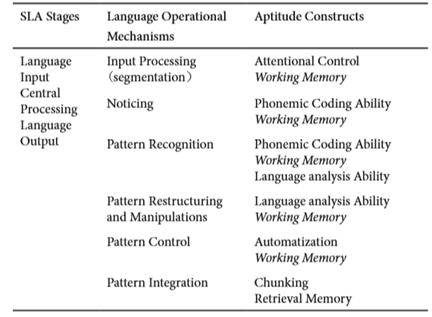
The answer refers to the Language Aptitude Construct of ‘Inductive language learning ability’, as conceptualised in Carroll’s Four-Factor Aptitude Model (see figure 1, below), which correlates with a stronger predisposition for L2 learning according to much research.

Figure 1. (from Dorniey and Skehan, 2003)

revised carrol table


As Figure 2 below shows, Inductive language learning ability (or Language Analysis ability) is involved in two cognitive processes which play a central role in L2 acquisition, Pattern Recognition and Pattern Restructuring and Manipulation. With this is mind, it is only logical that L2 teachers provide as much practice as possible in this aspect of their linguistic competence. After all, we want our students to be able to apply these skills as effectively as possible in immersive L2 environments or when accessing L2-input on the internet when we are not around to help them, don’t we?

Fig. 2 (from Skehan and Wen, 2011)

revised SLA cognitive.png

Personally, I alternate D.G.I. and I.G.I purely due to time considerations. If I had more time I would definitely only stick to I.G.I. The way I use I.G.I is to provide a series of sentences or short texts mostly using subsitution tables /sentence builders – with the L1 translation provided aside for less proficient groups or individuals. I get my students to work in pairs and to write up their rule-extraction process on a Google Doc or Padlet. When the time is up, we then discuss our findings and I clarify any doubts.

2. From rules to patterns; from step-by-step rule-application to chunking

For students to proceed to the most important stage in the acquisition of a grammar structure, chunking, the students must

(1st) identify a pattern (French example: « Je suis plus/moins/aussi grand que Marc ». Pattern : plus is followed by adjective + que + Noun)

(2nd) be able to manipulate that pattern autonomously but chunking in the new pattern pre-existing language ( « Je suis plus beau que Pierre » ; « je suis plus moche que lui »)

(3rd) restructure it, i.e. adapt the rule to new meanings or exceptions to the rule ( « J’ai plus d’argent que Marc »  – Plus can be followed by ‘de’ + noun + que + noun)

(4th) acquire control over it through extensive practice (to achieve automatization)

(5th ) integrate it in their L2 system by chunking it to Long-term memory

Chunking, in point 5, means that the learner at this stage does not apply the rule step by step any more; rather, has actually automatized the target pattern which s/he applies automatically at very high speed. This allows for more cognitive space to be freed up in Working Memory and to concentrate on meaning building/discourse construction.

Obviously, to get to that stage, the learner will have processed the target pattern in a wide range of contexts both receptively and productively. Every stimulus the target pattern has been extensively used in response to, is likely to automatically activate that pattern whenever it occurs – a phenomenon called ‘priming‘.

The Chunking phenomenon has the following major implications for grammar teaching.

Firstly (as already discussed above) we must focus our students on Pattern Recognition through I.G.I. in both the aural medium (Listening) and the written one (Reading).

Secondly, focusing on teaching patterns means reconsidering what we mean by teaching a ‘grammar rule’. I have often observed lessons in which the teacher sets out to teach a grammar structure whose usage requires the mastery of several rules, like the bullet-list below taken from www.languagesonline.org.uk  which details the use of the Imperfect Tense in French through a seven-point list. It is not uncommon to see teachers impart all of the below in their first lesson on the imperfect.

Figure 3 – Seven rules to form the imperfect tense in French

Untitled

Yet, a teacher who aims at automatizing patterns would take a different course of action from an instructor who is focused on passing on to their students the intellectual knowledge encapsulated in those bullet points and examples.

First of all,  he would focus on one or two patterns per lesson rather than the whole rule-set in order to avoid cognitive overload ; secondly, he would present the students with ready-made high frequency chunks containing the target pattern, rather than lists of isolated words ; thirdly, after the initial I.G.I. task (PRESENTATION PHASE), he would provide masses of receptive (aural and written) exposure to those very chunks through tasks such as narrow listening / reading (COMPREHENSION PHASE),  followed by plenty of opportunities for controlled oral production such as through communicative drills, like the ones in figure 4 below  (PRACTICE PHASE); moreover, to enhance retention of the target pattern, he would ensure that the latter is associated, through substitution drills, to previously learned vocabulary (still in the PRACTICE PHASE); finally, the patterns would be used in freer communicative interactional activities such as information gap tasks (PRODUCTION PHASE).

Figure 4 – Communicative drills

cd-1

(3) An emphasis on patterns entails as far as Listening and Reading practice are concerned, using texts containing lots of repetitions of the target construction(s); this may entail ‘ditching’ authentic material at lower levels of proficiency in favour of texts which sound more artificial but more conducive to retention. By the same token, in the controlled production phase, the output the teacher would want to ‘push out’ of his students would be highly patterned, too.

(4) Since in attempting to make sense of any L2 grammar pattern, learners usually use their own existing L1 patterns, it is useful in my experience to provide examples of target structure use alongside parallel texts (their L1 translation) and to get them to notice and discuss the differences. I use parallel texts a lot in the initial phases of practising any grammar structure to encourage cognitive comparison. Figure 5, below, illustrates a typical listening I.G.I. cognitive comparison activity I carry out with my students. The students are given a sentence in the target language containing incorrect use of the target structure modelled on the L1 of the student (the translation is provided in brackets). The student listens to the correct version of that sentences and writes it down below the erroneous version. Then he draws a comparison and infers the rule.

Figure 5 – Aural cognitive comparison task

sin-titulo-4

  1. From PPP to PCPP

As mentioned in previous blogs, in my experience, supplementing the PPP sequence with a range of listening and reading tasks (I usually stage 5 or 6) which allow for extensive processing of the target patterns significantly enhances understanding and retention. Of course, the texts should contain Comprehensible Input, i.e. input which is 95% understandable by students with little effort. The rationale for the addition of a Comprehension phase is rooted in scores of psycholinguistic research that shows clearly that the role of input has a significant effect on acquisition of all levels of L2 proficiency” . In the words of N. Ellis et al. (2009):

‘input frequency affects the processing of phonology and phonotactics, reading, spelling, lexis, morphosyntax, formulaic language, language comprehension, grammatical sentence production and syntax […] These frequency effects are thus compelling evidence for usage-based models of language acquisition, which emphasize the role of input’

Another reason for adding in a Comprehension phase, lies in the fact that receptive processing (especially reading) is easier than oral or written production (as it causes lower cognitive demands on Working Memory).

4.Focus on Grammar Sensitivity

Grammar sensitivity refers to the ability to work out the role that words fulfil in a sentence. Hence it is linked to and helps in pattern recognition. Grammar sensitivity is recognized by research as an important determinant of Language Aptitude, in other words, the more able an L2 learner is to recognize the word-class (e.g. adjective) and function (e.g. direct/indirect object), the more likely  s/he is to be successful at language learning. Several studies (e.g. Piraud, 2008) have indicated that grammar sensitivity can be enhanced. Hence, unlike what happens in the typical MFL/EFL communicative classroom, more emphasis must be given to this aspect of grammar competence, i.e. metalinguistic knowledge and parsing skills.

Old school training in word awareness, i.e. the ability to recognize words’ function and word class based on their roots, prefixes and suffixes should be implemented from the very early days of instruction. Metalinguistic tasks whereby students need to assign words to categories or track down the occurrence of a specific word class in a text are very easy to prepare and, if used day in day out a few minutes at a time, do pay dividends in the long run.

5. Consider Working Memory limitations

I will only briefly touch on this issue as it has been dealt with extensively in several previous posts of mine. The main point to bear in mind is that Working Memory is very fragile and limited in storage. It can only process 4 items simultaneously (hence the important of chunking as much language as possible) and phonological storage only lasts two seconds without rehearsal.

Figure 6 – Working Memory

m_27

Hence, when teaching grammar we have to minimize the cognitive load our students need to handle as they grapple with the target structure(s). This means embedding examples for I.G.I. in linguistically accessible sentences; providing aural and written texts containing Comprehensible Input; ensuring that where they are asked to perform tasks in which the target construction requires mastery of a previously learnt grammar structure in order to be executed, this has been routinized sufficiently. Example, no point in teaching your students patterns such as (French) ‘Si je pouvais choisir, je vivrais au Canada’ if they have not routinized the imperfect or the conditional (where ‘routinized’ means close to spontaneity). This is the most common pitfall I have come across in my career.

6. Automatization

I have laboured this point to death in previous posts, hence I will only touch briefly on this: the ultimate goal of grammar instruction is automatization, i.e. accurate execution of a target structure at native speaker speed. Hence, practice with a specific grammar item must be recycled at spaced intervals over a long period of time. Going back to the imperfect example, I usually recycle the imperfect over a period of two years at least before I can consider it ‘learnt’.

With the above in mind, it is clear how traditional forms of grammar testing, e.g. cloze tests/gap-fills, do not assess grammar-structure acquisition, but only intellectual (declarative) knowledge and are therefore invalid. Accurate grammar testing assesses grammar-structure execution in real time, under R.O.C. (real operating conditions).

Concluding remarks

In conclusion, in this post I have argued in favour of an approach to grammar instruction which is mainly inductive in nature, in order to enhance our students’ language-analysis ability and their preparedness for acquisition in immersive or high L2-input contexts. I have also advocated the move from a PPP instructional sequence to a PCPP model where the ‘C’ refers to an intensive and possibly extensive Comprehension phase (i.e. the ‘R’ in my M.A.R.S. instructional model), in which the students are provided masses of receptive exposure to the target structure. Thirdly, I have emphasized the importance of focusing more on the modelling, analysis and automatization of patterns, rather than the intellectual explanation of rules. Finally, I have argued for the importance of going back to the basics of word-awareness, especially in terms of sensitizing our students to the role words have in sentences, as this skill is a strong facilitator of L2 acquisition.

If you would like to know more about my grammar teaching approach which incorporates the ideas discussed above and more, please read this discussion of the MARS model and this lesson plan centred on the same approach.


Why we have been teaching Listening wrongly for decades

Please note: this is the introduction to my latest article on http://www.tes.com (full article, at link below)

Introduction

Listening is often described as the ‘cinderella skill’, as it is by far the area of language instruction that language teachers neglect the most. The reasons for this neglect are manifold. First and foremost, as much research has shown, listening is the skill MFL teachers understand the least and consequently do not feel confident teaching. Add to this the fact that instructional materials are often uninspiring, poorly designed and usually under-exploited by course-books. To cap it all, possibly as a result of all of the above, many MFL students fail at listening tasks, with serious consequence for their self-efficacy as listeners and their motivation in general.

https://www.tes.com/news/blog/why-we-have-been-teaching-listening-skills-wrongly-decades

Seven minimal-prep/high impact techniques to focus students on function words and less salient morphemes – Teaching grammar through listening (part 2)

images (2)

(co-authored with Dylan Vinales of Garden International School and Steve Smith)

In a blogpost I published two months ago, ‘Teaching grammar through listening’, I discussed the benefits of teaching grammar through L.A.M. (Listening-As-Modelling) tasks I devised. In a more recent article, ‘They can’t learn what they can’t notice’ posted last week, I concerned myself with the issue of salience, discussing how the extent to which an L2 item or morpheme is ‘noticeable’ will affect its acquisition, making the point that L2 students are less likely to learn what they can’t perceive or hear clearly. I concluded that post suggesting a few activities that may enhance student perception of less salient items such as determiners, prepositions, discourse markers and suffixes (e.g. those indicating gender and number in nouns and adjectives in French, German and Spanish).

In this post, I suggest more minimal-preparation /high-impact L.A.M. tasks which focus L2-students on the grammar (e.g. morphology, function and syntactic behaviour) of such items through listening. I have been using the tasks discussed below mostly with French, Spanish and German, but can be applied to TEFL too. Please note that L.A.M. tasks are more likely to have an impact when they are practised regularly and in a logical instructional sequence – not haphazardly.

  1. Track the word

Imagine you want to focus the students’ attention on a set of less salient function words (e.g. prepositions). You read to the students a text at less-than-native speed and ask them to track as many instances of that word-set as they can. For example, last week I used this activity to focus my Year 5 students on the difference in pronunciation between ‘un’ and ‘une’ in French. The students truly enjoyed the challenge and reported finding it very useful.

  1. Faulty ‘echo’

This is another activity my younger students appear to enjoy. The teacher utters or plays a pre-recorded sentence; then he repeats it with a mistake or omission. The students are tasked with identifying the omitted word and write it out on their mini-whiteboards or iPads. Example:

Time 1: ‘I am driving at one hundred miles per hour’

Time 2: ‘I am driving one hundred miles per hour’

The omission usually involves short and less salient items. Recently I have used it to enhance my students’ awareness of the use of French prepositions in the pattern ‘I go to + country’ and how they vary based on the gender and number of the noun designating the country (e.g ‘je vais en France’ as opposed to ‘Je vais au Japon’).

  1. Faulty transcript

This activity requires a bit more preparation as you have to modify a text by planting mistakes which focus the students on specific less salient items you want to draw their attention to. You will read the original (correct) version, whilst the students are given the ‘faulty one’. As you read out the students are tasked with spotting the incorrect items and put them right.

Last week, I used this activity to draw the students’ attention to the different auxiliary French verbs required in the formation of the Perfect Tense; so I replaced the auxiliary of verbs requiring ‘avoir’ with ‘etre’ and viceversa and read the text. Usually I cue the students in advance as to the number of mistakes contained in each text.

  1. Find the spot

This activity is suitable when you want to focus students on word order and, more specifically, on the position of specific items (e.g. adverbs) within the sentence. Take adverbs like ‘often’, ‘never’, ‘always’, etc., one could use this activity to show how they ‘behave’ across tenses. The task is as follows: the students are given a set of simple sentences such as ‘I go to the cinema’, ‘I play tennis’ etc.. Then, if he is teaching adverb usage, the instructor reads the sentences adding in an adverb per sentence, while the students are tasked with indicating where each adverb was located. After this activity the students are asked to work out the rule governing adverb usage and any exceptions to it. This is the typical lay-out of use for the sentences I give to my students prior to the dictation.

Students get : ____  I   _____ go _____ to the cinema__

Teacher reads out:  I never go to the cinema

Students write: _____ I _never_ go to the cinema

  1. ‘Gapped relations’

‘Gapped relations’ is a partial dictation technique I use in my French and Spanish primary lessons to direct my students’ selective attention to the grammatical relations between two items in a sentence, a determiner and an adjective. For example the sentence, ‘La cuisine est très grande mais le salon est petit’ (the kitchen is very big but the living room is small) is gapped as follows: ‘____ chambre est tres ______ mais ______ salon est  _______. Emphasizing the gapped items to underscore the gender obviously helps directing student attention to the gender of the determiners, nouns and adjectives involved.

This activity, when carried out frequently serves three purposes: firstly, it focuses students on determiners, items which students of French and Spanish usually find hard to acquire, because of their low salience; secondly it builds, day in day out, a stronger awareness of the of gender of nouns; thirdly, it encourages the students to pay more attention to gender and number agreement – to the point that my students claim that now, after three months of practising with this technique, as soon as they write or utter a determiner they automatically think of the gender of the related noun and adjective(s).

  1. Cued gapped-word dictation

I originally devised this technique a few years ago for a group of English learners of French who really struggled with word endings which appear in the written form of words but are not pronounced (e.g. ils regardent). It consists of cueing the students as to the number of words in the sentences you are about to read out to them whilst providing the endings you want them to focus on. For example, the lay out of the task for the sentence “Ils ne regardent jamais la télé’ would be:

____s  ne _____________ent ________ais ______ _________

Since this lay-out made the above endings more salient, this activity enhances the students’ decoding skills whilst focusing them on two important morphemes (the ‘s’ and ‘ent’ endings in positions 1 and 3).

In my TEFL past, I have used this activity with South-East Asian learners of L2 English who struggled with hearing and producing dental sounds at the end of words and consequently kept mispronouncing past participles and other key morphemes

  1. Minimal-pair partial dictation

I use this technique mainly with French students but it can be adopted to other languages too. The teacher reads aloud sentences, the gapped version of which is given to the students who are provided with two (or even three) options to choose from. This is what it looks like in a French sentence I used in the past with my year 8 French class :

Je ne vois pas la/le/les batiment (I can’t see the building)

As the example above illustrrates, the options provided are items or morphemes (e.g. word-endings) which are near-homophones. Recently, I have used this task successfully to reduce the erroneous use of the partitive article after quantifiers with year 9 students who would say ‘beaucoup du monde’ or ‘plus de l’argent’ instead of ‘beaucoup de monde and ‘plus d’argent’.

Concluding remarks

I believe teachers striving to enhance their students oral and written accuracy cannot overlook the importance of less salient items such as determiners, prepositions, discourse markers and suffixes.  In languages like French and English, in which these items’ low semantic salience is compounded by phonological barriers, enhancing their salience through engaging the aural modality can have a significant enhancing effect on their noticeability with beneficial consequences for their acquisition.


They can’t learn what they don’t notice – on the role of salience in language learning

The extent to which a target language structure is salient (i.e. is noticeable, stands out) is likely to affect its chances to be acquired by a learner. This is consonant with Schmidt’s (1990) Noticing hypothesis which states that noticing a given grammar structure is the starting point for its acquisition.

A number of factors concur to making certain items more salient than others; some refer to frequency and regularity of use, some to their semantic importance, some to how easy it is to hear or perceive them, some to the challenges that the items themselves or the linguistic context in which we process them pose to our working memory.

Why should this be of interest to language teachers? The answer refers to a point that I reiterate to death in my posts: effective teaching is not just about classroom delivery, but also about the way we structure the linguistic input we provide our students with and the way we plan its recycling in our medium- and long-term planning. A teacher who is fully aware of the factors that make certain L2 items s/he sets outs to teach less salient than others and uses such awareness to implement strategies to make those items more noticeable is more likely to secure his learners’ uptake of those items than a teacher who isn’t.

Take prepositions, discourse markers,  word suffixes and pronouns. They are not semantically salient, i.e. they do not provide essential cues to the meaning of a sentence one is reading or hearing; hence, when we read or hear a sentence, especially a complex one, these items will occupy only peripheral awareness in our working memory (meaning: the brain does not pay much attention to them) hence, they will be less likely to be noticed and learnt. This happens in our first language and even more so in a foreign language, especially if we are novice-to-intermediate learners.

Add to this the fact that these words are usually quite short and don’t carry stress and are consequently less easy to perceive. A French example: on hearing the French sentence ‘J’y suis allé hier soir après l’école’, as pronounced by a native speaker, a novice is unlikely to perceive the ‘y’ (there). An English example: on processing aurally the sentence ‘Which one of them would you like?’, a novice is very likely not to clearly hear the preposition ‘of’. Unsurprisingly, articles, prepositions and pronouns are amongst the items that L2 learners of French notoriously find the hardest to learn and are usually acquired late in instructed (non-immersive) settings.

In this post I will concern myself with:

(a) the factors which determine the salience of L2 morphemes /grammar structures;

(b) the implications such factors have for teaching, materials design and curriculum planning ;

(c) the strategies we can implement to counteract those factors and make them play in our hands in our attempt to enhance our learners’ acquisition.

Factor 1 – Perceptual salience

As Goldschneider and DeKeyser (2001) posit, salience refers to how easy it is to hear or perceive a given structure. This was briefly touched upon previously and pertains to a number of dimensions of processing in instructed L2 acquisition. One common context refers to phonological processing; if the learner does not hear an L2 item clearly s/he is less likely to learn it. Think about the gender of definite articles in French, ‘le’, ‘la’ and ‘les’ and how difficult it is for a novice learner to distinguish them from one another, especially when they are uttered by a French native speaker at native speed or by a non-native speaker with incorrect aperture and protrusion of the lips.

Perceptual salience is the root cause of many issues that hinder our students’ target language acquisition. To go back to the definite articles example, for instance, their perceptual ‘fuzziness’ not only affects the acquisition of articles both in terms of gender and usage (which differs greatly from English) but also affects the acquisition of noun gender and pluralization because articles usually indicate to the listener if the noun they precede is masculine or feminine, singular and plural.

The fact that phonological salience of some L2 items can seriously hinder acquisition of pivotal grammar structures constitutes one of the most powerful arguments for ensuring that our learners acquire effective decoding skills (the ability to turn letters into sounds) from the very early stages of language learning.

Another common context refers to items that are not salient in one’s mother tongue and therefore one’s brain is not ‘wired’ to pay attention to. A classical example is desinences (word endings) for English learners of highly inflected languages such as French and German. The Anglo-saxon brain is less used to handling the endings of words, as in English desinences are not so important. In French, however, and more so in German, word-endings (suffixes) play a major role in signalling relationships between the various constituents of a sentence or utterance (gender, number, case). The result: the students, even when told time and again – mostly through correction – to pay attention to agreement, keep omitting the required feminine and/or plural desinences.

A third all-important context refers to processing efficiency, i.e. the brain’s ability to juggle the various tasks a novice-to-intermediate must perform in processing an utterance/sentence. Our Working Memory having only limited attentional resources to devote to production, when a sentence or utterance we process is very challenging, the brain will prioritize the items that are more salient (i.e. crucial for conveying the intended meaning) and will neglect those that are less so – a sort of survival mechanism.

As a result, novice learners processing a challenging sentence will be more concerned with its meaning than with the minute details of the grammar (e.g. whether the endings are masculine or feminine; whether an adjective is regular or irregular) and will hardly notice them. Obviously, time pressure and other interferences from the environment are likely to exacerbate processing inefficiency.

Factor 2 – Semantic weight

I have already touched on this. Content words (e.g. nouns, adjectives, most verbs) are semantically more salient than function words (prepositions, determiners, conjunctions) and affixes and suffixes; hence, they are usually noticed and eventually acquired earlier than the latter. Amongst function words, the ones that are less essential to the understanding of meaning – e.g. determiners – are more likely to be neglected by the novice-to-intermediate learners. This is one of the main reasons why your students find learning article usage so difficult to acquire.

Factor 3 – Frequency

The frequency in which an item is processed and produced by a learner makes it more salient, too. This is the strongest argument in support for extensive recycling, especially in the case of items which are intrinsically less salient.

Factor 4 – Regularity

Structures which are regular are more easily noticed than irregular ones, because of their consistency and frequency, and are consequently more salient. That is why irregular forms, unless they occur frequently in the input the learner receives, are usually acquired late and even more advanced students struggle with them.

Factor 5 – Affective response

This refers to the affective response an L2 item evokes in the learner. For instance, a student may be interested or uninterested in learning vocabulary which refer to a topic relevant to its personal interests. Or, a specific set of items is necessary in order for him to pass a test or exam or achieve a personal goal (e.g. getting by in a country is planning to visit in the immediate future).

Factor 6 – Teacher and curriculum focus

The emphasis a teacher and the materials he uses lay on specific features of the language will to a great extent determine their degree of salience. For instance, if the teacher day in day out focuses the students on the phonological qualities of L2 words, or on a specific morpheme (e.g. adjectival agreement) she will evidently render them more salient and noticeable. For example, because of the requirements of the examination board we use in our school, CIE, verb accuracy has become one of my daily foci in lessons, inevitably enhancing their salience in my students’ perception. Unsurprisingly, their attention to and mastery of verbs has increased greatly as a result. In conclusion, we, as teachers are very much responsible for what our students perceive as salient.

Implications

The issues discussed below have huge implications for teaching and learning. The salience of an L2 structure priming its acquisition, it is evident that teachers ought to try as much as possible to enhance the noticeability of less salient items.

The most important implication for teachers is to keep the salience principle in their focal awareness as they plan to teach less salient items, considering all the possible barriers to their noticeability and learnability.

Secondly such items should be recycled more frequently and systematically than one would normally do with more salient linguistic features (e.g. by using my recycling ‘tool’ in the picture below). As I wrote in an old post of mine, one of the greatest shortcomings of current MFL instruction in the UK is the lack of systematic and regular focus on the automization of agreement (both noun-to-adjective and subject-to-verb) at the early stages of instruction.

Figure 1 – Recycling tool

ticket

Moreover, since less salient items are more likely to be affected by error – as they occur less frequently – they may fossilize (become automated) earlier; hence, at the early stages of their teaching, instruction ought to be intensive.

Also, at the early stages of exposing our students to target L2 items that are less salient, these should not occur in linguistically challenging contexts, so as to avoid cognitive overload. So, for instance, in teaching and drilling in prepositions, discourse markers (e.g. connectives) or any other function words, it will be more effective to present them in simple texts, in conjunction with cognates or other words the students are strongly familiar with.

Furthermore, tactics should be devised to enhance their perceptual salience. Thus, in the case of items that are difficult to hear clearly (e.g. ‘le’ vs ‘les’ or ‘je’ vs ‘j’ai’ in French) frequent contrastive work, exaggerating sounds (e.g. through over-aperture or protrusion),  emphasis on decoding, and heuristics (e.g. a mnemonic) could be used to ensure that the students form and consolidate a clear phonological representation.

Other strategies refer to activities which, regardless of the topic-at-hand focus students on less salient items. One such activity is ‘Track the word(s)’, whereby the students whilst reading or listening to a text has to note down as many occurrences as possible of one or more linguistic features (e.g. French: track as many instances as possible of ‘un’ and ‘une’ as you can hear in the recording).

Partial dictations and Cloze reading tasks in which only less salient features are removed is another strategy I often use to focus students on these items. I have recently found partial dictations where word-endings are removed particularly effective in focusing my novice students of French and Spanish on the gender and number of adjectives and nouns – notoriously less salient features.

Typographic (e.g. highlighting word-endings; dotting or underlining letters) or graphic devices can also be very effective in drawing student attention to less salient items if used regularly and consistently. For instance, in the sentence builders I typically use to introduce new syntactic patterns I make sure that a column is reserved to the prepositions, connectives, determiners or pronouns the students are less likely to notice.

Last but not least, the salience of less noticeable L2 items can be enhanced through teacher focus and exam washback effect. I personally try to enhance my students’ focus on smaller function words not only by recycling them more frequently, but also by rewarding their recognition and correct use both in low- and in high-stake assessments . Lists of desirable linguistic features can be given to the students for them to use for reference in drafting essays – telling them that the occurrence of n correct instances of such structures will result in n extra points.

Conclusion

The perceptual and semantic salience of the items we set out to teach contributes massively to acquisition. In full-immersion contexts, where the L2 learner acquires the language through exposure to naturalistic input, less salient items are acquired relatively late.

However, in instructed settings, where they have total control over L2-input, teachers have a massive opportunity to speed up and enhance the acquisition of such items by encouraging their noticing, by increasing the students’ exposure to them through frequent recycling and by ensuring that the students form a correct phonological representation in order to disambiguate as early on as possible decoding and coding problems that can have disastrous consequence for the acquisition of important morphological features.

In my experience – and that is why I wrote this piece – the principle of salience does not generally guide MFL teachers’ curriculum planning and materials design as much as it should. Evidence of that is the lack of FLE and ELE published resources that focus on function words and noun/adjective/verb desinences practice.

Poor L2 learner mastery of less salient features does not often impair communication; it does, however, often impact the clarity and cohesion of learner output and gives a sense of ‘sketchiness’. Not to mention the fact that research clearly shows that when mistakes with some of these features occur frequently they can highly irritate less sympathetic L2 native speakers.

I have personally found that keeping the barriers to salience constantly in my focal awareness in my teaching has made a world of difference to my students’ learning. In my long-term planning I now constantly look for opportunities to recycle less ‘noticeable’ items (e.g. prepositions, pronouns, discourse markers, affixes and suffixes), especially at the early stages of instruction. In my materials design I try as much as possible to minimize potential for cognitive overload and to proactively direct student attention to those features.

In conclusion, we, as teachers are very much responsible for what our students perceive as salient and have the power to bring less salient items into their focal attention through little daily zero-preparation gestures such as the questions we ask and more incisive, ‘invasive’ and long-term measures such as our material design and curriculum planning.


En route to spoken fluency via task repetition – the ‘4, 3, 2 technique’ and ‘Market place’

(this post was co-authored with Dylan Vinales of Garden International School Kuala Lumpur)


fluent-english-speech

Introduction

In this post I will concern myself with two  fluency-enhancing techniques that I got acquainted with 15 years ago during my MA TEFL through this very useful article by Nation (1989) but I have only started using regularly last year, after reading  de Jong and Perfetti’s (2011) fascinating report on their experimental study which persuaded me of the potential of such techniques.

As I discuss below, these techniques, have not only benefitted my students linguistically by impacting their fluency and aspects of their grammar accuracy, but also affectively, by enhancing their sense of self-confidence as L2-speakers. What I like the most about both techniques is that they require minimum preparation and my Intermediate and Upper Intermediate classes – the only groups I have used it with – truly enjoy it.

I shall first discuss how the techniques work, then concisely present some research evidence which supports their effectiveness as fluency-enhancers and finally explain why they work and you may want to use them in your classroom, especially with more advanced exam classes.

The 4,3,2 technique

How and why it works

The version of this technique, as found in Nation (1983), de Jong and Perfetti (2011) and in the other articles I read differs slightly from mine. Let us start with Nation’s version: the students work in pairs.  They are given a few minutes to prepare a 4-minute talk on a specific event or topic (note: they are not allowed to write anything down). They then deliver the talk to another student in the 4 minutes originally allocated. After that they are asked to deliver the talk to another student in 3 minutes and to another one still after that in 2 minutes. In their experiments, both Nation and de Jong Perfetti (2011) found that this activity enhanced their students performance. Nation (1989) identified the following improvements in his subjects:

  1. FLUENCY. Firstly, there was an increase in the rate of speaking from the first to the third delivery. For example, one of his subjects went from 86 words per minute in the first delivery, to 100 in the second and 127 in the third – an increase of 48 % in total. Secondly, there was a mark decrease in the number of false starts, hesitations and repeated words decreased significantly.
  2. ACCURACY. Nation noticed increases in grammar accuracy in certain aspects during the activity, particularly for errors not involving inflections, where the speaker repeated the same grammatical context.
  3. CONTROL OF CONTENT. The speakers reduced the amount of words from time 1 to time 3 in certain cases by as many as 100 words, but without making important omissions and negatively impacting complexity:

Analysis of the talks showed that in all except one case omission was the major reduction strategy. In most cases the omitted information was not important. In each of these talks two or more changes of construction resulted in increase in complexity. The increase in complexity was the result of embedding a finite or non-finite clause.

de Jong and Perfetti (2011)’s findings were very similar. In addition they identified three very important benefits in terms of fluency for their subjects that were not shown in previous research. Firstly, they found that the beneficial impact of regular practice with the technique was long-lasting. Secondly, they found that the improvements in fluency were transferred to new topics, not simply to the ones under study. Thirdly, they found that it was not merely speed of retrieval of the vocabulary items they used in their speeches that enhanced fluency, but rather automatization in the production of longer chunks of language and sentence structures through repeated use. They concluded that the 4,3,2 technique can promote automaticity.

Why it works

There are several reasons why this technique is so effective, some less obvious than others. The more obvious ones refer to the short terms gains from Time 1 to Time 3. Fluency development is encouraged from time 1 to 2, firstly, at the semantic level, because the students generate the content during the planning time and the first round of talk; so during the second and third round they do not have to think about the content anymore, which means that the planning does not interfere with other aspects of production and more attentional resources can be freed up. This means that more attention can be focused on monitoring the accuracy of the output or on the retrieval of items that could not be retrieved the first time because of cognitive overload. Secondly, whilst time pressure may cause some mistakes, it may also decrease the pauses and hesitations thereby increasing speed of delivery. Thirdly, when the same structure or chunk is used across all three rounds, the technique allows the speaker to monitor and refine its representation at each time; thus, a structure or chunk one might struggle with at time 1, might be refined at time 2 and perfected at time 3.

The reasons why regularly practising this technique has long-term effects which transcend the boundaries of specific topics or contexts are more complex and beyond the scope of this article. It will suffice to say that they refer to the automatization of processing mechanisms which underlie production and are more morphological and syntactic, rather than lexical in nature. To find out more, read here .

How I use it in my lessons

My experience with this technique leads me to concur with Nation and de Jong and Perfetti’s findings and therefore it will remain one of my oral-fluency-enhancing activities of election par excellence. The way I use it, though, is slightly different from the above.

First of all, I put students in groups of three rather than two. Student 1 speaks, Student 2 notes down the main points in the speech and Student 3 is the critical listener charged with giving feedback on specific features I want him/her to pay attention to (e.g. handling of verbs, use of connectives, range of vocab) – normally no more than two sets of features in order not to cause divided attention. The feedback session at the end of each round is brief, around 2 minutes.

Secondly, I usually give students four bullet points such as the following that I used with my students as a prompt two days ago.

Talk to me about

  • a past holiday;
  • a holiday you are planning to go on in the near future;
  • your ideal holiday;
  • what you usually do during the holidays when you don’t travel anywhere.

Thirdly, during the planning time I allow the students to write down notes, ask me questions or use online resources for help.

The rationale for having three students instead of two is : (1) if you have only one student listening and noting down the main points in the speaker’s speech there would be no critical listener to provide him/her with feedback on performance; (2) if you only have one critical listener attending to the content and the linguistic level simultaneously their attention would be divided. Also, rotating the students across all the three roles widens the pedagogic scope of the activity; the hope is that, as they listen, they will notice and possibly learn new linguistic features from their peers’ output. Throughout the activity, the speeches are recorded on iPads. The students will view the recordings at home and do some self-evaluation in their reflective journals.

Some of my more motivated student have found this activity so beneficial that they actually do it at home alone and send me the recordings – a teacher’s dream !

Market place

This technique, too, involves repetition and a change of audience. Differently from the 4,3,2 technique, however, Market place has not been the object of experimental studies. Based as it is on the same principles, though, is it fairly safe to infer that it would benefit students in much the same way.

In Marketplace, the learners are divided into buyers and sellers.  The teacher briefs the sellers as to what they are going to sell and each of them is allocated some time to prepare their own sales talk while the buyers are given receptive practice in the sort of vocabulary they are likely to hear from the sellers. For instance, two weeks ago, I told my students they had to sell a holiday to the South of France; the brief was:

Talk your customers through the following:

  • the accomodation
  • the facilities
  • the activities offered
  • the excursion to nearby towns/resorts
  • the nightlife

Each seller is given a stall (a desk) and the buyers circulate around the marketplace going from seller to seller listening to the sales talks and jotting down on their iPad or book the main points. I usually give a seller a set amount of time so that every round of ‘sales’ ends at the same time. At the end of the activity the buyers will decide on the holiday they will buy explaining in writing– in the target language – why they opted for that specific package.

This activity provides lots of repetition and chances to perfect delivery. The students love it and it requires minimum preparation.

Concluding remarks

There is plenty of research evidence that repeating the same tasks several times enhances fluency. The 4,3,2 techniques and Market place make repetition a bit more fun and the fact that students talk to a different audience each time makes it a little more interesting. The students’ feedback on them has always been positive; they learnt a lot both as listeners and as speakers and, most importanty, it enhanced their can-do attitude or self-efficacy as L2 speakers. I use it mostly with fairly homogeneous intermediate and upper intermediate groups, as I am not sure it would work with mixed ability classes. It works well with my classes because our examination board requires them to converse with the examiner about two topics in five minutes, hence cutting down hesitations and false starts is paramount, as well as speed of delivery. Giving the rationale for the 4,3,2 technique and telling them that there is research evidence that it works definitely helped to get the students to buy into it in the run-up to their oral exams. I strongly recommend both activities if developing your students’ fluency is high on your agenda.

For more on my ideas on improving speaking fluency, get hold of the book I co-authored with Steve Smith ‘The language teacher toolkit’ available on www.amazon.co.uk

Are we raising a breed of ‘dyslexic’ foreign language learners?

All teachers who have taught dyslexic children at some point in their career will know how challenging it can be to keep them engaged and motivated, how low their self-confidence as language learners usually is, how frustrated they often get as they struggle to make sense of what they read. But hang on, doesn’t this description also apply to quite a few of the language learners we teach?

Well, in fact, one may argue that many of our students do exhibit a form of deficit in their foreign language competences akin to a disorder called ‘Phonological dyslexia’, described by Ellis (1984) as the inability ‘to read unfamiliar words or non-words aloud, suggesting impairment of grapheme-phoneme conversion and/or phonemic assembly’. In other words, ‘Phonological dyslexics’ are individuals who are not able to sound unfamiliar words out. This inability to convert graphemes (letters) into phonemes (sounds) – unsurprisingly – seriously impairs these individuals’ reading comprehension skills.

Erler (2004) is highly indicative of this state of affairs. In her study of 359 year 7 students of French (from two middle-achieving English comprehensive schools) she found that after one year of instruction (with two contact hours a week) their knowledge of spelling-sound rules was poor, both schools obtaining the same mean score at the rhyming-word test she administered, i.e. 2.75 correct choices out of 14. She concluded:

The results seem to indicate that, with a few exceptions, pupils had little idea after one year of learning French about spelling-sound rules for principal vowel sounds in the language and for the general rule of silent final consonants. These are key rules for being able to decode from print to sound, and are essential for reading comprehension (p. 5)

What is equally interesting – and tragic – is that only 7.6% of Erler’s informants reported they felt ‘happy’ when reading French aloud in lesson; the vast majority of the students felt negatively about decoding and spelling written French.

Another interesting finding by Erler was that 75 % of the total sample Year 7s thought that it was indeed useful to know pronunciation and 63% stated that they were aware of subvocalizing to sounds when reading in French, confirming what we know about automatic phonological loop activation in working memory during reading (in simpler words: whether we are aware of it or not, the brain automatically converts letters into sounds as we read, even when we are not reading aloud).

These findings are dispiriting for several reasons. Firstly, because, as much L1 and L2 research clearly indicates (e.g. Stanovich, 1980; Bryant and Bradley, 1983; Sprenger and Casalis, 1995; Gathercole and Baddeley, 2001) decoding skills are crucial to comprehension of written texts and poor readers often exhibit serious deficits in their deployment. Heaps of research indicate that a child’s early knowledge of phonological awareness is a strong predictor of their fluency in later years (Stanovich, 1986). Muter and Diethelm (2001) found that students of French as a foreign language who were able to tell where syllables in a word begin and end were more proficient readers than those who didn’t.

Secondly, as I have argued in many of my posts and will write about more extensively in my forthcoming book ‘Breaking the sound barrier’ (Conti and Smith, 2017), phonological awareness is crucial in listening comprehension in that it helps the brain make sense of the speech flow by identifying word-boundaries, intonation patterns, etc.

Thirdly, and more tragically, as Erler’s concluded, the students she investigated exhibited decoding deficits (in French) comparable to those symptomatic of dyslexic reading impairment. Now, students who are de facto dyslexic are less likely to have high levels of can-do attitude and self-confidence in language learning, both strong predictors of success in language learning (Macaro, 2007). Could this be one of the reasons why many of our students don’t enjoy learning languages? Could addressing this major deficit enhance their motivation? I believe so.

Erler’s findings chime with my own experience as a veteran MFL teacher with over 20 years’ experience at primary, secondary and tertiary level. Decoding skills – also referred in the literature as GPC (grapheme-phoneme correspondences), spelling-sound rules or Phonological Awareness  – are not duly emphasized in British schools and, when they are indeed embedded in the curriculum, instruction is undermined – in my opinion – by the following shortcomings which serious limit its effectiveness:

1.Decoding skills instruction is not given sufficient prominence in the curriculum;

2.It is often an add-on; it is not fully integrated with the curriculum content and goals;

3.As per Dr Rachel Hawkes’ approach, phonics are often taught through gestures and tongue twisters, but the target phonemes are rarely consciously and systematically recycled in the lesson through listening, reading and speaking tasks which aim at their organic acquisition. This approach limits the acquisition of the target phonemes as it is divorced from fluency across all four skills and from real-life-like communication. In my approach the target phonemes are consciously recycled in every single task (both receptive and productive) I stage to teach the topic-at-hand (be it grammar, communicative function or vocabulary);

4. Instruction rarely ventures beyond word-level practice, which is not conducive to acquisition – the input we process and the output we produce usually contains more than one word…;

5.The target graphemes are usually sequenced randomly without considering (a) the level of challenge they pose to the learner; (b) how their teaching contributes to facilitate other aspects of L2 acquisition, such as grammar – for instance: (in French) a focus on letters that are silent earlier on in the instruction process will serve the purpose of assisting the acquisition of present tense forms. Instructional sequences ought to be based on a (possibly evidence-based) rationale;

6.Each target phoneme is not usually focused on for sufficiently long periods of time and recycled consistently and extensively across the curriculum;

7.Phonemic awareness skills (see picture below) are not focused on explicitly in the early years of L2 instruction, yet I have found that primary and year 7 students benefit greatly from practising them and research shows clearly that they prime the connection of sound to print.

Figure 1 : the Phonemic awareness development continuum (Courtesy of University of Oregon)

 pa_continuum

8.Students with poor phonemic sensitivity are not identified at the beginning of the course, yet I found it extremely useful to have a good idea from day one as to who was less gifted in this area of language aptitude (the natural predisposition to decode letters and repeat and manipulate sounds);

9.Students are rarely – if ever – tested on their decoding ability or phonological awareness (to assess progress in these areas). This is a serious shortcoming considering how pivotal this set of skills is for language learning effectiveness and success; I found that including opportunities for assessment (e.g. old school dictation or short transcription tasks) has increased my students’ focus on decoding skills and their motivation to learn them.

These and more common shortcomings of decoding skill instruction will be dealt with in greater depth in my next post.

Conclusion

Many foreign language students in England appear to have poor decoding skills. This hinders the development of their reading and listening fluency whilst seriously denting their confidence. As I have written in my forthcoming TES article ‘Enhancing MFL learner motivation – the road less travelled’, one of the most important reasons why our students lack confidence and motivation may relate to their inability to make sense of the target language, be its grammar or its decoding/pronunciation.

One of the group of students I have been trialling my decoding-skill training program with reported to me the other day that they were so much happier to be finally able to read out written French following a set of specific spelling-to-sound rules. They felt empowered by the decoding pinciples they had been taught, as the constant -often random – guessing frustrated them. I do believe that in languages like French and English, where spelling-sound correspondence can be challenging, a students’ sense of efficacy as a decoder can substantially enhance their motivation.

In conclusion, much more effort and thought should be put into effective decoding-skill instruction, which should go beyond the teaching of sounds through gestures, a few tongue twisters and listening or singing along to song; a principled framework should be arrived at, which integrates phonics instruction organically and systematically with the teaching of grammar and vocabulary and extensive practice across all four skills to ensure long-lasting retention and automatization.

To find out more about our ideas on decoding skills instruction get hold of our book, The Language Teacher Toolkit,  ww.amazon.co.uk/Language-Teacher-Toolkit-Steven-Smith/dp/1523214821

Why marking students’ books should be the least of a language teacher’s priorities

TES3

1. Introduction

Never, as in this day and age, secondary schools in the UK have made such a big fuss about the importance of marking student books and never has giving feedback been so tiresome and time-consuming for teachers. Based on the intuitively compelling notion – supported by recent research claims by the likes of Hattie – that a more cognitively demanding student involvement in the feedback-handling process significantly enhances learning, Modern Language teachers are now asked in many cases to place marking at the top of their priorities and engage in elaborate corrective approaches.

The trending remedial methodology prescribing a conversation-for-learning approach to marking, whereby the feedback unfolds in the form of a dialogue between corrector and correctee, book-marking has become a very taxing process for both parties but especially for teachers. Chilling horror stories of teachers forced to three to four-hour book-marking marathons per day using 3 different ink-colours or stamps (a different one for each stage in the feedback dialogue) to the detriment of their family life, keep resurfacing on online teacher forums and Facebook pages. SLT’s frequent book checks obviously adding to teacher stress.

This article was written in response to dozens of messages I have been getting from UK-based colleagues distressed by this state of affairs and asking invariably the same question: is the time and effort I put in book marking justified? In the below I intend to answer this question by drawing on thirty years of error-correction research, my personal experience as a learner of 14 languages and teacher of five and, more importantly, neuroscience and common sense. I will also suggest alternative remedial approaches to MFL learner errors which are as or even more effective than the trending methodologies.

2. What L2 error-correction research says

  1. Surveys of students and parents’ opinion have consistently indicated that they want books to be marked (Ferris,1999);
  1. Students often find teacher corrections confusing and unhelpful, hence do not learn much from them (Hedgcock and Lefkowitz, 1998);
  1. Students do not possess effective feedback-handling strategies and have a very superficial attitude to teacher corrections. They simply look at the mark or comments on their work, make a mental note of them but invest very little – if any – cognitive effort in processing teacher corrections (Cohen, 1987; Cohen and Cavalcanti, 1990; Conti, 2004). My PhD study (Conti,2001) found that students writing an essay per week and regularly and timely receiving detailed corrective feedback on the latter are clueless as to what the most common errors in their written work are and can only recall about 10% of the errors corrected by the instructor in their latest piece.
  1. Many errors appear to be impervious to error correction (Truscott, 1996). Despite repeated corrections, the vast majority of errors, especially the ones which refer to more complex grammatical points or less salient features (e.g. article, prepositions, word endings) keep re-occurring.
  1. Intensive grammar and editing instruction targeting specific errors has also shown to be largely ineffective (Polio et al, 1998).
  2. Once errors are automatized (or ‘fossilised’ as psycholinguists say) nothing can be done to completely eradicate them (Mukkatesh, 1988). Hence preventing students from automatizing mistakes seems to be more effective than treating them.
  1. An excessive concern with error treatment may affect students’ motivation negatively (James, 1998).
  1. An excessive concern with error treatment can also lead to error avoidance which stifles creativity with the language by inhibiting risk-taking (Krashen, 2000).
  1. Both direct and indirect correction do not impact students’ accuracy more effectively than no correction at all. Indirect correction has negatively impacted students’ motivation in some studies (Semke, 1984, Robb et al, 1986, Kepner, 1991).
  1. In studies in which the writing of students whose essays received only feedback on content was compared to the writing of students whose work was corrected, the former condition had a better impact on certain aspects of their writing proficiency (the no-correction group producing more higher order propositions than the correction group). These studies concluded that error correction may actually damage the development of written proficiency.
  1. Extensive strategy training in self-monitoring and feedback-handling strategies occurring over a long period seems to enhance essay-writing accuracy in the areas of grammar, vocabulary and spelling in university contexts . My study (Conti, 2001), which pioneered a feedback technique aimed at enhancing student involvement in the corrective process (a more elaborate version of what today is referred to as D.I.R.T. = Dedicated Improvement Reflection Time) obtained impressive gains in writing accuracy and even proficiency; however, it required a huge diagnostic effort, many hours of learner training and high levels of expertise on the part of the instructor (I spent countless hours of research and piloting before implementing the program).
  1. Students who are more motivated and have higher levels of self-regulation are more likely to benefit from correction (Conti, 2001; 2004)
  1. For errors to be reduced or eradicated, students need to engage in a conscious and sustained long-term effort (Conti, 2004)
  1. Errors are more likely to be eradicated when they refer to structures our students process frequently both receptively and productively (Loewen, 1998).
  1. Some errors are caused by lack of knowledge. Others by processing inefficiency or cognitive overload (i.e. the brain cannot juggle all the demands of the writing process successfully because they are simply too many and some errors slip through). The latter mistakes are usually self-correctable by the students.
  1. It is useless to correct errors which refer to structures the learners are not developmentally ready to acquire as they do not have the cognitive maturity to internalize them.

3. Should we stop correcting then?

The obvious answer is ‘No’ as students and parents do demand we correct. Moreover, as a language learner I have personally benefitted greatly from correction, so I do know it can work. The above research findings and what we know about how the human brain acquire languages cannot be ignored, though, and should inform our pedagogy.

What the 16 points above tell us is that to simply highlight a few errors and ask students to self-correct or do some research on the erroneously applied grammar rule is not going to enhance accuracy or language acquisition. This is because the acquisition of a grammar item is a complex process that takes months or even years of practice; it does not happen as a sudden revelation resulting from a correction. If the mistakes are made in speaking they will require extensive speaking practice; if they are made in writing, extensive writing practice. Simply telling a student you made mistake ‘X’ and asking them to self-correct it, do research on it, have a conversation with their teacher about it, or even all of the above,  will not be enough; it will only be the beginning phase of a very long process.

Thus, if I correct a student at the beginning of term 1 on item ‘X’ I will have to consistently keep that item in their focal awareness for the months to come, whilst providing spaced practice in the usage of that item week in week out until the end of Term 3. This is because learning a language is about acquiring automaticity in the execution of a specific set of skills which are acquired through masses of extensive (not intensive) practice. Note that I said ‘in the months to come’, not in a one-off remedial lesson

Other subjects, such as the Humanities or the Sciences, are less about automaticity and more about intellectual retention of knowledge and facts, hence they require a different type of corrective intervention. So, whereas in such subjects one can write in a book ‘it is fact X not Y’ and all the students will have to do is memorize that fact, in languages this will not be enough. The acquisition of a given grammar rule will require masses of spaced practice across a wide range of contexts coupled with positive or negative feedback on each and every application of that rule.

In football coaching, one cannot hope to improve a player’s dribbling skills by telling them what they are doing wrong, asking them to think about what they can do to improve and hope that just because they have understood the suggestions they are (a) going to take them on, (b) implement them and (c) act them out often and skilfully enough to automatize them. The player will first need to WANT to heed the advice and then practise it over and over again, even when the coach is not there to support him, and, only when it has worked many times over, he may finally internalize it. This example encapsulates all the challenges that effective error correction poses to teacher and learner alike, i.e.:

(1) the student must understand the correction;

(2) must want to learn from it (intentionality – the most important factor in the success of error correction);

(3) must practise it consistently over a long period of time at spaced intervals;

(4) must receive feedback that tells him/her that s/he is performing it correctly every time.

Can an overworked teacher even remotely hope to be able to successfully take each individual student in the classes s/he teaches through all of the above four stages with every single problematic item they target? Not really, that is why error correction, whether through D.I.R.T. or any other form of error correction is bound to have little impact on students’ proficiency.

And often it is not even an issue of time or resources; the greatest obstacle to the success of error correction relates to the issue of intentionality (the desire to act on one’s problems). The fact that a student engages in a dialog about error and responds effectively to the teacher’s corrective prompts does not mean that s/he will have the desire to eradicate the target mistake(s) which is essential for him/her to succeed. Cognitive engagement without intentionality rarely yields proficiency gains in language acquisition, because without intentionality the learner is unlikely to autonomously seek the opportunities for practice that lead to acquisition.

Not to mention another issue pertaining to the affective impact of an overemphasis on error correction: it skews learning towards remediation, towards ‘fixing’ rather than ‘creating’, towards form rather than content. Obsession with correction usually engenders fear of making mistakes, not a healthy catalyst of language learning.

4. Conclusions and implications for teaching and learning

What are the conclusions to be drawn and most importantly, what is the way forward?

The most important conclusion to be drawn, a huge U-turn from the recommendations I gave in the final chapter of my PhD study 12 years ago, is that book-marking should be kept to the minimum. What is much more important and more impactful in terms of teaching and learning is how the problem areas the teacher identifies in their students’ output inform our future short-, medium- and long-term planning. Thus, on finding that in doing homework ‘X’ or essay ‘Y’ most students made a given set of mistakes, it will be much more effective to focus on those mistakes in whole class activities through extensive practice over the weeks to come (at spaced intervals), rather than writing the same comments and corrections in every student’s book.

Secondly, students of similar linguistic background typically make by and large the same mistakes at various levels of proficiency. Instead of focusing on those mistakes in the remedial phase of teaching (correction) why not concentrating our efforts on pre-empting those errors by teaching the areas they refer to more effectively in the first place. In planning a lesson, for instance, I always try to predict the errors my students are likely to make and devise tactics and support materials to pre-empt or reduce their occurrence. Let us not forget that many of our students’ mistakes are caused by L1 transfer as well as by misleading explanations and/or examples, the materials we use and the translations we provide (e.g. J’ai 16 ans means literally ‘I have 16 years’ but by translating as ‘I am 16’ we lead the students to assume that ‘J’ai’ means ‘I am’). By the same token, scaffolding learning more carefully so as to gradually build up mastery rather than immediately throwing the students in the deep end can prevent many errors; for instance, as I always maintain in my blogs, teachers often go way too quickly from the presentation of a grammar point straight to production, missing out the all-important receptive phase (e.g. reading) which models target structure use in context. Last, but not least, let us ensure that we cover those problematic areas more thoroughly and extensively in our curriculum planning (more recycling and less coverage!).

Thirdly, instead of marking student output a few hours or days after the error has occurred, by focusing on the product, why not marking it as things happen as much as possible, focusing on the process? This approach, known as ‘live marking’ means going around the classroom as students grapple with a new language structure monitoring their output as they read, speak or write and intervene as soon as a serious mistake takes place by asking questions which promote self-correction such as ‘are you sure about this?’ and maybe probe into the causes of that error if it does not disrupt the task-at-hand.

Fourthly, the motivation to take an active and more responsible role in the feedback process can be fostered through L.I.F.T. (learner initiated feedback technique) whereby the students ask the teachers for feedback themselves. E.g., in writing an essay, a student unsure about the use of a grammar structure may ask in the margin of the essay ‘ should I use the perfect tense or the perfect tense continuous here?’.  By so doing, it is the student who is initiating the feedback process. The teacher is merely responding. The fact that the student chooses item ‘X’ himself, as the focus of the teacher’s intervention, may enhance the students’ depth of engagement in the learning of that item.

Personalised editing checklists to be used by the students in the editing phase of their writing prior to handing in their work, may also help enhance learner responsibility and the accuracy of the final product; if applied consistently over a long period of time they might even end up improving their self-monitoring skills – not necessarily written proficiency though.The students make a list of a few mistakes that keep cropping up in their work which they elect to eliminate from their writing. The list may grow as the year progresses, of course. They will then use that list to go through each new assignment when they review their drafts, one item at the time. Useful with exam classes in my experience. Better for the list to include only 5 to 6 items at a time, although more keen and able students may include more. I tend to use editing checklists in synergy with L.I.F.T. (students apply checklist and ask questions in the margin when they have doubts).

There are other strategies that can be implemented to tackle errors that are more effective than the trending dialogic and/or D.I.R.T.-based corrective approaches as they are usually applied in many foreign language classrooms. But I reserve to deal with such tactics in my next blogpost, for reasons of space.

In conclusion, by all means, if you are a teacher on a very light timetable and teach small classes, as I was when I carried out my PhD experiment, do carry on with D.I.R.T. and/or conversing with students in writing in their books using three or different pen colours. It might pay dividends at least with some of your more motivated students.  However, if you are a snowed-under practitioner in a busy state school, you may want to heed my advice and spend more time planning and working out ways to teach more effectively, as that is more likely to advance your students’ learning.

The problem is that school-wide policies are rarely drafted by language experts or educators who understand how language acquisition occurs so you may have to carry on as you are told… For many non-language specialists MFL learning is about memorising grammar rules and vocabulary lists – a purely intellectual endeavour. As current accounts of L2 learning posits, though, language acquisition is not about accruing intellectual knowledge and errors are more often than not the result of ineffective performance linked to working-memory executive function than lack of understanding or knowledge gaps. And performance deficits can only be addressed through practice, not reflection.

As Mark Solomon and Keith Netcher, the facilitators of a very useful workshop on feedback I attended last Friday at my school said, one should only provide feedback if it is likely to have an impact. If not, it is simply a worthless box-ticking endeavour.

Do get hold of the book I co-authored with Steve Smith ‘The Language Teacher Toolkit‘ to find out more about our ideas on error correction and smart book-marking