Professional development series (2) – How to make the most out of lesson observations

Please note: this post was written in collaboration with Steve Smith of ‘The Language Teacher Toolkit’.

TES3

1. Introduction – The why of lesson observations

Lesson observations serve a range of purposes. Whatever the intended outcome, in my experience, very few people truly look forward to them and even fewer find the process to significantly impact their teaching practice, not in the long-term anyway. The reasons? Firstly, the fact that more than often the people involved – both observers and observes – carry out lesson observations more because they have to than because they actually attach any significant learning value to them – “Time is tight and there are more important issues to attend to!”. Secondly, because of the way the process is structured. Thirdly, because of the frequently inadequate follow-up. Fourthly, the lack of training in coaching skills essential in some of the scenarios I will discuss below. Finally, other factors undermine the effectiveness of the process, ranging from the culture and micro-cultures of a specific school or Department to affective issues involving the relationships between the people involved.

From personal experience I do believe that lesson observations, especially peer-observations, can indeed enhance one’s teaching craft, provided that a number of important cognitive and affective variables are controlled for and that the protagonists of the process – observer(s) and observee –  engage in a long-term collaborative effort characterised by (1) mutual trust and respect, (2) intellectual honesty and (3) openness to change.

One major factor in the success of the process is its orientation, i.e. the final goal (Performance management? Learning from a colleague? Both?) as it will inevitably shape the whole process, from beginning to end. In this regard, let me note that by and large I am against using lesson observations to assign a score to teacher performance, not in the way it is commonly done in this day and age, anyways. Why? It is short-sighted; it is carried out using evaluative tools (the observation checklists) and procedures (e.g. there is usually one rater only) which lend themselves to strong subjective bias; their impact on teaching and learning does not justify the anxiety, stress and time investment they cause in many observees and often the observer-evaluator does not know enough about language acquisition to be able to pontificate on what constitutes effective language teaching and learning. Not to mention the fact that many teachers often put on a one-off show to impress the observers,  performing in the observed lesson way beyond the level of organization, creativity, commitment and zeal of a typical lesson of theirs. We all know that.

After all, if the culture of a department is one of transparency, openness, mutual trust and practice-sharing every Head should be aware of what their colleagues’ strengths, areas for improvements and teaching styles are, anyway. Hence, besides the fact that associating numbers to performances through measurement scales of ludicrous invalidity is futile, one should not need to have to sit through a lesson to know how ‘well’ their colleagues teach.

In conclusion, I believe lesson observations should be used solely to enhance teaching and learning. However, even if  they were indeed to be used to evaluate teaching, they should still have a positive wash-back effect on teaching and learning. Moreover, unless they are carried out as part of a principled, carefully-structured and positive process with plenty of support from the course administrators they are absolutely useless exercises which do little for teacher well-being, self-efficacy and professional development. An open-door policy as well as regular collaborative lesson-planning, team-teaching and  conversations with peers on teaching and learning are much more likely to impact professional development that a one-off observation per term followed by feedback.

2. The aim of the present post

In this post I make a few suggestions on how to enhance the positive impact of lesson observations, based on the teacher development literature I have reviewed, on my own experience of what has worked well for me and my colleagues in the past, on social cognitive theory principles and, last but not least, common sense. Below, I envisage the following three lesson-observation scenarios:

  1. The observer as a coach
  2. The observer as a learner
  3. The observer as an assessor

The suggestions below presume that the working  environment one is operating in is not a highly dysfunctional one but rather one with a reasonable degree of mutual trust and professional respect. Establishing trust, transparency, and a caring and non-judgmental atmosphere is pivotal. Moreover, it is presumed that the team share fairly homogenous views on language teaching methodology.

  1. General principles

3.1. Teachers should be provided with a reference framework which clearly details what constitutes effective Modern Language teaching and learning . As I often reiterate in my posts, a Department should agree on a common set of guiding pedagogic principles which would underpin its teaching and learning practices; ideally, they would also develop a common language to refer to those practices. This will warrant cohesion and coherence across the Department both in terms of teaching practices and of evaluation procedures.

3.2 The evaluation of a lesson cannot limit itself to the assessment of the producti.e. the lesson as it unfolds before our eyes.  The lesson one observes  is but the end-result of a process. Hence, effective coaching on and/or valid assessment of a lesson should start before the to-be-observed lesson actually occurs! This entails that the observer and the observee should actually meet to discuss the to-be-observed lesson at least  a day or two before it is actually implemented.

In an observer-as-an-evaluator scenario, the observer may want to limit  their  intervention to asking questions about the  observee’s lesson plan to elicit the why of his / her choices as they may want to stay as neutral and objective as possible.

In an observer-as-a-coach scenario the observee’s input may be more interventionist in nature and invite the observee to reconsider aspects of their lesson plan by asking more or less open questions; in this case, the observer will attempt to bring potential issues with the observee’s  lesson to their conscious awareness and collaboratively come to solutions. S/he may also want to restructure the observee’s cognition vis-a-vis teaching methodology issues which emerge from the discussion

In an observer-as-a learner scenario, the roles are reversed; the observee becomes the coach, but the questions will be more or less the same as the ones asked in the previous scenario. Ideally, the observee will plan the lesson in the form of a think-aloud protocol, verbalising his thoughts as the observer listens and occasionally interrupts to seek clarification or expansion.

Whatever the approach, it must be clear at every single moment of the interaction between observer and observee that the focus is as much on the process of teaching (the lesson planning) as it is on the product (the lesson teaching), as (1) many issues undermining the effectiveness of a lesson have to do more with the planning and sequencing of activities than with the classroom implementation and (2) because, over-emphasizing the product and suggesting a few things here and there that a teacher could have done differently in a specific lesson may give the observee the impression that merely ‘tinkering’ with their existing performance may be enough; whilst this may be sufficient in certain cases, in others the changes needed may entail deeper cognitive restructuring (e.g. addressing misconceptions about language acquisition; filling gaps in their competence;  reconsider the approach to short-term and/or medium-planning or to material design; etc.).

It is noteworthy that I have rarely come across in a post-observation discussion and/or evaluation document an item that focuses on this very important aspect of a lesson: the how and why of its conception. The focus is always solely on the product, thereby potentially failing to identify some of the root-causes of ineffective teaching and limiting itself to the observable.

3.3. Whatever the context, any observed lesson must be considered as part of a teaching and learning curricular sequence. One cannot consider a lesson in a vacuum, as disjointed from what happened before and after. Hence, in the pre-observation meeting, a substantial part of the discussion should centre on the curricular context both in terms of what came before and of the follow-up. An effective teacher is also an effective curriculum planner; I have come across  many teachers who had a greater impact on their students’ learning than others who were more effective than them in terms of classroom delivery, purely by virtue of their superior medium- and long-term planning.

Long-term planning requires greater attentional capacity and a more organic approach to teaching ; lesson observations that focus on the product and on the here-and-now always fail to spot this and a great teacher attribute goes often neglected in the lesson evaluation.

In this case, too, it is interesting to note that lesson-evaluation documents regularly fail to include this crucial aspect of lesson planning.  What they do always include, on the other hand, is the item: ‘Evidence of learning’, despite the fact that 40 % of whatever is taught in a given lesson will be forgotten one hour later and that 80 % is forgotten a week later without reinforcement of the distributed (rather than massed) kind. Whilst I do agree that by the end of the lesson there will be some tangible evidence of learning, lesson observers and course auditors should concern themselves much more on long-term retention than they do on the here-and-now (as argued here). In coaching/modelling scenarios, this important skill is often neglected, too.

3.4 The lesson observation must be part of a LONG-TERM process aiming at enhancing the professional developments of all parties involved.

Lesson observations are usually followed by a feedback session at end of which targets for improvement are set for the observee. These targets are at best revisited at the end of the academic year or performance-management cycle. However, several decades of research in teacher development have shown that this practice is highly ineffective as a way to enhance teacher competence.

As Cognitive psychology posits, skills are acquired through masses of practice, highly scaffolded at the beginning of the process and increasingly less structured until autonomy has been attained. Frequent formative feedback from an expert plays an important role, too. This implies that the observer or other expert associated with  the process must commit themselves to a long-term coaching of the observee for any area of development to be effectively addressed. This, in my experience, rarely happens, usually because course administrators do not provide busy classroom practitioners with the time and resources that such a process requires in order to bring about transformational change. Other reasons refer to the lack of training in effective coaching skills, lack of peer-support and self-complacency.

Any follow-up ought to focus only on one major area of development at time, in order to pre-empt divided attention.The follow-up process may include:

  • Teacher-led research on the to-be addressed issue(s)
  • Some sort of coursework which encapsulates the finding of such research and envisages/documents the application of those findings in the teacher’s classroom practice;
  • Collaborative planning and/or teaching with an expert;
  • Subsequent observations focused on the target area of competence;
  • Learning discussions with peers.

3.5 (In the lesson-evaluation scenario) Use subject-specific lesson-evaluation documents:  Many secondary  schools use the same lesson-discussion / evaluation documents across all subjects. This fails to consider the unique nature of language learning. Departments ought to come up with a documents which integrates the evaluation of generic skills with that of more subject-specific ones. This is one of the most common and most serious shortcomings of lesson evaluations in English secondary schools.

3.6. (In the lesson-evaluation scenario) Ensure that lesson observations are conducted by two subject-experts : Any evaluative process of a teacher’s performance, especially when it is related to their professional appraisal and/or a pay-rise, should control for subjective bias as much as possible. The reliability of the process can be  enhanced by having two experts ; from an affective point of view, it would be better if the observee could pick one of the observers.

Evidently, having two  observers poses a number of logistical challenges; in my view, however, this makes the process much more accountable and objective and, from a learning point of view, the observee will be more likely to learn more from two experts than from one.

Conclusion

Commonly, in many schools the run-up and follow-up to lesson observations are not carried out in a way which is conducive to significantly enhancing teacher professional development. One reason is the inadequate focus on the observee’s actual lesson-planning process and on the why of their instructional choices (e.g. sequencing of activities). Secondly, much of the lesson observation focus is on the here-and-now, which does not capture the long-term intentions, implications and effects of teacher performance on student learning. Thirdly, lesson observations are rarely  followed-up with a serious and systematic attempt to address the identified area(s) of development through a long-term plan, mainly for lack of support and effective coaching. Finally, lesson-evaluators often use inadequate assessment procedures  whose main shortcomings are the short-term focus, the use of whole-school  multi-traits scales and no inter-rater reliability procedures.

For more on my views on teacher development please read the following post: “Why teachers teach the way they do”.

10 commonly made mistakes in vocabulary instruction

Please note: this post was written in collaboration with Steve Smith of http://www.frenchteacher.net and Dylan Vinales of Garden International School. In this post I will concern myself with ten very comm…

Source: 10 commonly made mistakes in vocabulary instruction

Professional Development Series (1) -Three questions every  teacher wanting to improve their teaching practice should ask themselves

download

1.Intro

One of the buzz-words in the Professional Development circles these days is ‘Reflective practice’. Teachers are told on a daily basis that being a ‘reflective practitioner’ is a must if they are to build on their craft and enhance the quality of teaching and learning in their classrooms. Teachers are encouraged to work in dyads and triads  to work collaboratively on lesson plans , to carry out peer-observations and read research together… Excellent stuff! I have done it myself during my school’s professional-development afternoons with my insightful and creative colleague Dylan Viñales and it has indeed benefitted my teaching whilst triggering ideas for the blogposts I publish on The Language Gym.

But I do have a teacher-training background and a PhD in Applied Linguistics  on top of 25 years language teaching experience. Would my learning discussions with Dylan be as fruitful were I simply to rely on the input on language teaching methodology I received during my PGCE in Hull 30 years ago?  What my PGCE tutors and my school-based mentors taught me about language teaching methodology was a random mix of tips borrowed from various – often contrasting – schools of thoughts, often discounted by current research findings and cognitive psychology acquisitions. So, for instance, I was taught to teach speaking pretty much in the audio-lingual way whilst being told that my teaching was meant to be absolutely CLT-based. I was told that not talking in the target language was anathema whilst research indicated clearly that code-switching does not do any harm to the students in terms of L2 acquisition. Tragically, many of such misconceptions still persist nowadays in the teaching profession.

So the question is: do most teachers possess sufficient know-how in terms of knowledge of theories and research in second language teaching and learning? The ugly truth, in my experience, is that most language teachers have not received adequate training in this area of their teaching competence and, sadly, many do not often have the time – busy as they are marking and planning lessons – to spend hours reading articles or blogs on L2 teaching methodology. Hence, professional development sessions which encourage practice-sharing and collaborative reflection can be beneficial but only to a certain extent; in order to improve one’s teaching it is imperative, in my view, to have an understanding of how the brain processes and acquires languages, of how language competence evolves and of what constitutes valid assessment, as such an understanding enables one to design the curriculum in a more principled and consistent fashion; to sequence learning activities more effectively and more adaptively; to create tests that are as objective and fair as possible and actually measure what they purport to measure.

So, why this post and its extremely pretentious title…? Because the three questions the title alludes to should be, in my view, the essential starting point of any reflective process on one’s own teaching practice. When I was asked the most important of those questions (“How are language learnt?”) by Professor Ron White – an Applied Linguistics legend – on my MA TEFL course 20 years ago I felt as disorientated as I did after my first parachute jump as a young recruit. I felt I should have known the answer, as I had been teaching for over five years prior to that course! Yet, I could not actually articulate it.  It was only after three months of Language-Learning-Principles lectures and much individual and collaborative reflection with fellow MA-TEFLers that I felt I was starting to nail it.

In my experience and in that of many of the readers that contact me in the social media, not many teachers find it easy to articulate their beliefs as to how languages are learnt; in fact, many of them do not really espouse a specific view of language acquisition or do not have a given principled pedagogic reference framework.

But “Do teachers actually need one?” – the best teacher and head of faculty I have ever worked with – Gillian Bruce – once asked me. “I know many teachers who do not have any knowledge of SLA theory and still get excellent results!”. My come-back to that was: “Would those teachers who get excellent results do even better if they knew more about Language Acquisition theory and research?” My hunch is that they would.

Here are the three questions I think every teacher who wants to improve their own practice should ask themselves  . These questions should be pondered over and answered way before Departments venture in the typical development-time discussions on what the elements of a great language lesson are; on what constitutes best classroom practice; on how to best provide corrective feedback (a highly controversial area of teaching which is massively affected by one’s espoused L2 acquisition theory);  on how to best integrate emerging technologies in the curriculum etc.. How can a language department even remotely hope to tackle the above issues effectively when they have not addressed the three questions below?

  1. The three questions

(1) How are foreign  languages learnt ?

In my opinion this is the most important question a teacher should ask themselves and I encourage every PGCE student /Probationary teacher to do so at the very beginning of their teaching practice. Trainee teachers should ask this question to their PGCE tutors and school-based mentors, too. This is paramount as any long-/medium- and short-term planning should be based on the answer.

In my case, finding the answer to that question and using it to frame my classroom approach was fundamental in enhancing my teaching- a true professional breakthrough for me. It meant sacrificing and adapting much of what I had been doing until then, but it paid enormous dividends. Cognitive models of language acquisition (especially Skill-based theories and Connectionism) provided the basis for my espoused theory of learning and shaped much of what you read in my blogs and of what I have been doing in the classroom for the last 20 years.

Can someone hope to answer that question without reading books or articles on second language acquisition? I believe so, if one has been teaching for a fairly long time, has been an assiduous reflective practitioner over the years and thinks long and hard about their own language learning experiences (what worked and what didn’t).

What matters is not to come up with a universal truth but with a set of guiding principles which are not written in stone – as future experiences or learning discussions with peers might end up restructuring them- but can provide a reference framework which will warrant consistency and cohesion to our approach. As professor Macaro, former Head of the Oxford University Education Department, wrote in his review of our book ‘The Language Toolkit’ :

it’s all very well saying there are no ‘methods’ for teaching a foreign language any more but it can’t then be a free-for-all with teachers doing exactly what they want to do. As much as I believe in teacher professional autonomy, language teaching is so complex that you have to have a series of guiding principles.

Ideally, as a Head of Department you will compare your reference framework/guiding principles with those of your staff and come to a sort of agreement – hopefully through democratic consensus-  as to what the espoused theory of the department is and on how it should shape teaching and learning. This will hopefully bring about consensus amongst the team as to what constitutes desirable and less desirable practice and possibly prevent controversy during post-lesson observation discussions and lead to fairer performance evaluations.

It is very important for the answer to this question to be as unambiguous as possible if you are working as a Department. For instance, in many Department handbooks I have come across lines to this effect: the Department endorses a Communicative Language teaching approach to MFL instruction. What does this entail in practical terms? A set of guiding principles , whilst not being overly prescriptive, should state roughly  how much TLU (target language use) is desirable; roundabout what ratio of receptive-skills-to-productive skills ; suggest possible approaches to listening, reading, speaking, writing, vocabulary and grammar instruction; a framework for the implementation of PBL work; how it is believed that Information technology should be best used to enhance learning etc.


(2) What are the implications of the answer to question (1) for language teaching and learning ?

As hinted above, the answer(s) to the first question will inevitably shape teaching and learning in your classroom, from the emphasis you will give to comprehensible input to the prominence of speaking and auracy/oracy, from teacher-centred to student-centred approaches, from all-out traditional feedback methodology to selective or no error correction, etc.

If you are doing this exercise as a whole Department, this process is bound to cause some controversy and has to be handled with much sensitivity and respect for other colleagues’ views. Having come up with a very clear set of guiding principles in answering question (1) above will definitely help.

My answers to this question are laid out in my blog posts  and I am glad that they are, as the process of writing about them has embedded them even deeper in my cognition . I do advice colleagues to answer this and the other questions in writing; it will impact your practice more.

 (3) Is the answer to (2) truly reflected in your own teaching practice? If not how can you make sure that it is in the light of the existing curriculum, resources and other logistic constraints (e.g. contact time)?

Chances are – as many research studies show – that your practice is not fully aligned with your beliefs. Partly because of your previously acquired metaphors of learning (which you formed throughout your own language learning experiences) which subconsciously shape the way you teach; partly because of the (often textbook-based) curriculum adopted by the school/institution you work at and the exam requirements; finally, the micro-cultures in your department will play an important role in the way you teach.

Will you’ have the guts’ to be true to yourself and find ways to teach the curriculum content in a way which reflects your beliefs? In my experience, teaching in a way which is consistent with one’s beliefs leads to greater satisfaction and self-fulfilment. Sadly, compromise will be necessary as your bosses’ pedagogic dogmata and the exam requirements will indeeed limit the scope of your freedom to a certain extent. In my case, for instance, I have had to adopt feedback-to-writing strategies that are not aligned with my espoused language learning theory and beliefs – despite having researched error correction in second language writing as part of my PhD study.

If you are doing this as a Department, this can be an exciting opportunity to rewrite the dull Schemes of Work that you have (not) been using so far in a way which is much more conducive to effective and productive curriculum design. You might finally come up with schemes of work that people will actually use, not frozen icons on your computer screen for OFSTED inspectors or your line managers to open as part of checklist-ticking exercises.  

Concluding remarks

Reflecting on one’s teaching practice does contribute to making us better teachers. Without a doubt. However, the self-reflection whether conducted alone or in dyads and triads needs to be framed adequately and needs some background knowledge – even fairly basic –  of teaching methodology and acquisition theory. There are many blogs that provide valuable pedagogic know-how, some of my favourites are listed in this post by Steve Smith.

In the absence of an espoused theory of language teaching and learning, I suggested classroom practitioners start the reflective process from the three framing questions discussed above, the most crucial one aiming at identifying the core sets of beliefs we hold about how languages are learnt. Once identified such beliefs one can then lay out the guiding principles which will warrant their classroom practice consistency and cohesion.

To find out more about my views on language teaching and learning do get hold of the book I co-authored with Steve Smith: ‘The Language Teacher Toolkit‘ 

The seed-planting technique: how it has enhanced my teaching and may enhance yours

planting-seeds jpg

1. Introduction – ‘Seed-planting’ or ‘Anaphoric recycling’: a differerent way of recycling


“Don’t judge each day by the harvest you reap but by the seeds that you plant”

                                                                                                                          (R.L.S Stevenson)

A few years back I came across the above line by Robert Louis Stevenson, so true of any teaching/learning experience, but especially relevant to second language acquisition. This is because many of the gains our students make day in, day out are invisible and even though they may not yield any tangible outcomes in the here and now they do often silently contribute to those sudden and ground-breaking ‘light-bulb moments’ they will suddenly experience a week, a month or even a year down the line, which often mark the beginning of acquisition.

Also, just like any other skills, language learning is not about recalling the ten target words, the grammar rule,or learning stategy the teacher taught by the end of a 50-60 minutes lesson ; it is about being able to understand/produce those words as close as possible to native-speaker accuracy and speed long after the end of that lesson. In other words, language instruction should concern itself with the long-term implications of what happens in each and every lesson we teach.

Yet, too much language teaching concerns itself with the short-term, the here-and-now. Consider lesson observations, for instance : how futile is the item ‘evidence of learning’ on the observer’s checklist. Evidence of learning at the end of a sixty-minutes lesson ? Really ? And what about the fact that humans forget more than 40% of what they ‘learn’ at a given time one hour later ? And does being able to recall a list of words at the end of a lesson constitute evidence of language acquisition ? That is the easy bit; one can say those words have been actually learnt only when the students will be able to recognize those words whilst listening to a near-native-speaker audio recording or be able to use them in production – which will probably take many more lessons down the line.

How many lessons on the Perfect Tense have been rated as outstanding by lesson observers – shown lots of evidence of learning, yet a few months later you will have heard the very teachers who taught those lessons complain that the students keep making the same annoying mistakes with the same tense in their speaking and writing? And the explanation : the students are being careless, lazy, dumb,…really ? How about the seeds sown during those fantastic lessons not being watered and looked after properly in the days, weeks and months after their occurrence ?

Any approach to evaluating language learning based solely or mostly on the tangible outcome one observes at the end of a lesson or short cycle of lessons is flawed because it fails to consider that L2 acquisition is less about learning the meaning of word X or the way grammar rule Y operates and more about how the brain speeds up the processing of that word and that grammar rule across a wide range of different linguistic, semantic and cultural contexts. [Please note, incidentally, totally out context, that I am against lesson evaluation of the sort that assigns scores to classroom performance as they are flawed in their purpose and because – based on my experience- way too many observers know too little about language acquisition to be able to pontificate as to what constitutes effective teaching and learning].

I remember, at the end of a lesson observation – in which I had been the observee – my observer telling me that she was concerned about two of my students who had struggled during a mini-board translation task as they were listening to my oral input (short sentences). Unlike the other students in the class, these two boys had not completed every single translation in the time I had allocated ; hence ‘you ought to differentiate better’ was the advice. Yet, two months down the line those boys caught up with the rest of the class at the same task. My observer had focused on the here-and-now, the immediate product of learning, not the process, failing to consider that the two students were refining the skill of processing my oral input and writing every single time they wrote on the miniboard, even if they had not completed the whole translation the first, second or third time around. They knew the meaning of the sentences I uttered ; they simply needed to speed up their ability to process those sentences ; subsequent practice of the same kind lesson in, lesson out allowed for that to happen. The most important thing was not the product, the words on the mini-board, but the process, training their ability to process my input faster. You only learn to hit the ball harder and faster by practising hitting the ball, regardless of the many failures.

In a nutshell, as I often reiterate in my posts, effective teaching and learning cannot happen without effective curriculum design – yes, the Department Schemes of Work that most language teachers don’t look at ! A well-designed language curriculum plans out effectively when, where and how each seed should be sown and the frequency and manner of its recycling with one objective in mind : that by the end of the academic year the course’s core language items are comprehended/produced effectively across all four language skills under real life conditions (or R.O.C.=real operating conditions). The biggest challenge : time constraints – which brings me to ‘why’ I applied the Seed-planting technique in my teaching.

  1. Optimizing contact time through ‘seed-planting’

The greatest obstacle to effective L2 acquisition in most school  settings is definitely time constraints. Hence, teachers must find ways to maximize the use of the time available to them. One way to do this is obvious : if accurate fluency across the listening, reading, speaking and listening modalities is the main objective of instruction, the first and foremost imperative is not to waste too much time on activities which do not promote fluency (e.g. lengthy grammar explanations ; making posters or iMovies in lessons ; masses of Kahoot quizzes).

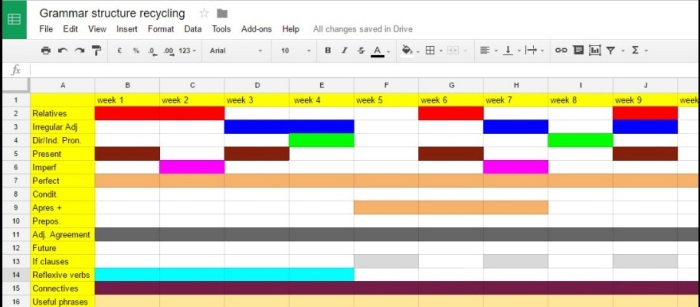
Another , less obvious approach – the Seed-planting technique or Anaphoric recycling – involves smart curriculum design, by planning in your schemes of work, as meticulousy as possible, the systematic recycling of vocabulary or grammar structures as peripheral-learning items throughout the run-up to the lesson/cycle of lessons in which they are to be taught as core items. Example : if I am planning a set of irregular perfect tense forms in term two, I may want to systematically ‘plant’ them as often as possible in any comprehensible input I will expose my students to throughout term one. I will use typographic devices (e.g. highlighting, underlining or writing in bold/italics) in order to help my students notice each occurrence of the target verb forms. I will also provide some support in the way of translation (e.g.in brackets ; a help vocabulary list).

By so doing, the students will have the opportunity to process any ‘planted’ lexical items or morphemes several times over before the lesson in which you will explicitly present them. This will give the students a significant advantage as they will have many previous instances of encountering those items (through aural and written exposure) to relate to ; lots of dots to connect. It will also allow you to use a more inductive approach to grammar instruction as the students will not get to the target structure as totally ‘clean slates’.

Evidently, for this technique to work at its best, the ‘seed-planting’ ought to occur in both aural and written input (i.e. listening and reading) in the context of texts which contain comprehensible input (i.e. input that the students do not need much guesswork or dictionary use to understand ).

Seed-planting can obviously occur through the speaking and writing media too, by providing the students with unanalysed chunks/set phrases / whole sentences to learn by rote which the teacher will ‘unpack when the students are developmentally ready to grasp their constituents.

Many teachers do indeed say they ‘seed-plant’; however the issue is how, how often, how systematically, how meticulously. How they promote the noticing of the target ‘seeds’. How they support the students as they process them. How explicitly and regularly seed-planting is embedded in the Schemes of Work.

A final point: effective anaphoric recycling (seed-planting) does not mean less emphasis on cataphoric recycling (i.e. recycling after explicit teaching).

  1. Benefits of Seed-planting

How this technique has benefitted my teaching practice:

3.1 Greater focus on my short- / medium- and long-term planning

When you have been teaching for as long as I have been you don’t look at the course’s Schemes of Work as much as you should – especially when the curriculum is based on the textbook with little or no alterations. ‘Seed-planting’ has had three positive outcomes in this respect: (1) it has made me reflect much more on both anaphoric and cataphoric recycling and how vocabulary and grammar structures were taught throughout the year. This has enhanced the quality of my recycling, thereby improving the Schemes of Work and my curriculum designing skills; (2) I have actually been using the Schemes of Work more because they finally have some use for me; (3) I have always been meticulous about the linguistic content of my lessons, but this process has made me focus on it in even greater detail.

3.2 More work on receptive skills and comprehensible input

One of the greatest influences on my teaching this year has definitely been Steve Smith’s advocacy of the importance of comprehensible input in L2 acquisition – a view that I was unconvinced before meeting him but that I now espouse. The seed-planting technique has forced me to do more receptive work, especially listening (I highlight the ‘planted’ items in the gapped or whole transcripts I give my students or in the body of the text if I we are doing a jigsaw listening task). The technique has crept into my classroom TLU (Target Language Use) too, making it become a vehicle for the deliberate and systematic seed-planting on a daily basis,

All of the above has greatly benefitted my students

3.3 Less time spent on explicit grammar teaching

Because of the frequent encounters the students have with the target structures prior to their explicit teaching, I have had to do less explicit teaching and/or the students seemed to pick them up more quickly. All in all, grammar teaching felt easier.

3.4 More opportunities for differentiation

Seed-planting has provided me with more opportunities for differentiation. How? Example: if a student completes a reading task earlier than the rest of the class, the ‘planted seed’ can constitute a springboard for a learner-led investigation on the web (possible in my case, because our students are equipped with iPads – 1:1). In fact, the gifted and talented in my lessons are one set of students who has benefitted greatly from this technique as it has propelled them ahead of the topics-in-hand sparking off more independent work on their part.

3.5 Enhanced acquisition(?)

In my perception, hardly a scientific truth, this technique has indeed facilitated the acquisition of the core vocabulary and of the grammar structures I ‘planted’, not simply as a direct result of the greater exposure to the target items, but also because of the benefits listed in the previous points

  1. Drawbacks

The main obstacle to the implementation of this technique is that it requires more work on the part of the curriculum designer(s). It is quite a painstaking process, as it does require fairly detailed planning. If you are a Head of Department you will hear comments like: “But we do it anyway”. Truth is that many teachers do it in some shape of form – but that the devil is in the detail and most importantly in how frequently and deeply the planted items are processed; and in what contexts.

4. Concluding remarks

The acquisition of a word or grammar structure is largely a function of how often the L2 learner processes it across a range of contexts. The more the encounters with a given L2 item and the wider the range of contexts in which those encounters occur, the more successful acquisition is likely to be. Obviously, as I have often reiterated in my blogs,  the ‘how’ of those encounters and what students do with it are very important factors too.

Seed-planting maximises the opportunities of recycling by exposing L2 learners to the set of words or grammar structures you are planning to teach on a given date over several weeks or even months prior to that date promoting through various means the noticing of those items.

Noticing is crucial to acquisition (Schmidt, 1990) and may prompt more inquisitive students to find out more about those items autonomously. Other, less keen and curious students, will benefit from processing those new items in familiar contexts placed in the comprehensible aural or written input they are exposed to, provided that the teacher offers some support (e.g. by glossary or translation in brackets) and guidance. In either case the process will give the learners a useful head-start, which, in my experience, often propels their acquisition of the ‘planted seeds’ further

Many teachers claim they practise seed planting. Truth is many do; however, let me reiterate this, the effectiveness of this technique lies in how systematically and meticulously it is applied in curriculum design.

To find out more about my ideas about language learning, get hold of the book I co-authored: “The Language Teacher Toolkit’


Listening instruction (PART 1) – How the brain processes aural input, instructional challenges and implications for the L2-classroom

Please note: this post was written in collaboration with Steve Smith (co-author with Gianfranco Conti of ‘The Language Teacher Toolkit’ ) and Dylan Viñales (ML teacher at Garden International School)

fluent-english-speech

1. Introduction – The least practised, understood and researched language skill

Since posting my three articles on listening ( ‘Listening  – the often mis-taught skill’, ‘So…how do we teach listening?” and “Micro-listening tasks you may not be using often enough in your lessons”) I have been flooded with messages from Modern Language teachers worldwide, all asking me invariably the same question: “So, how do I improve my students’ listening skills ?”.

This has brought home to me the realization that many L2 teachers – and not simply those working within the English-and-Wales educational system –  are unsure and anxious about what constitutes effective listening instruction practice. This is not surprising; as Professor Weir and his co-workers (in Weir et al., 2013) point out, of the four language skills listening is by far the “least practised in the language classroom, the least researched and the least understood.” To-date, Listening is not fully integrated in L2 curricula (Macaro, 2003)

Yet, listening is the most crucial skill in first language acquisition, as it is through the aural medium that humans learn to speak in the first place. According to a number of studies in naturalistic/immersive environments around 45% of language competence is obtained through listening, 30 % through speaking, 15% from reading and 10% only from writing (Renukadevi, 2014) – ironic how the two top skills on this list are also the most neglected by British-trained teachers…

As a teacher trainee – both at Uni and during my teaching practice – and even on my MA TEFL (where Professor Weir was ironically one of my lecturers)  I was taught close to nothing on how to teach listening; for many years I simply taught listening as I had been taught it myself at school or as prescribed by the course-book in use. CPD on listening was pretty useless and centred on facilitating student guesswork, rather than providing teachers with guiding principles on how to enhance learner listening skills. This is, to my knowledge, what most teachers do and that is why Steve Smith and I devoted an entire chapter of ‘The Language Teacher Toolkit’ to aural skills in an attempt to address some of the most important challenges posed by Listening instruction.

1.1 A ‘trilogy’ about Listening Instruction: goals and expected outcomes

This is the first in a ‘trilogy’ of posts written in collaboration with MFL guru Steve Smith and Garden International School colleague Dylan Viñales. The objectives of these posts are to (1) Discuss the mechanisms underlying the way humans process and interact cognitively and affectively with aural input and listening instruction (in PART 1); (2) identify the shortcomings of much current Listening instructions (PART 2 – to be published next week) and (3)Examine the implications for the classroom (more superficially in PART 1 and in much greater depth and detail in PART 3) and discuss the approach that I have undertaken (not always succesfully) in my own classroom practice in collaboration with some colleagues at Garden International School (Kuala Lumpur).

PART 1 – Identifying the challenges listening-skill instruction poses to teachers and learners

In this post I will narrow down the focus and concentrate on novice-to-intermediate learners discussing how, based on Skill-acquisition models of language learning and my own classroom experience teachers may be able to enhance their students’ proficiency. I will start with a concise reminder of how L2 learners interact with L2 aural input both cognitively and affectively

2. Some important facts about how human interact with and process aural input

2.1 Top-down and Bottom-up processing

There is a general consensus amongst researchers that the human brain comprehends aural input by applying synergistically two types of processing: Top-down and Bottom-up. Top-down processing involves applying our knowledge of the world (schemata), all we know about a specific subject, topic, situation or group of people in the understanding of input which relates to that subject, topic, situation or group of people (Macaro, 2013). For instance, in listening to a love song in a foreign language we have a whole set of expectations about what it is going to be about and we can make educated guesses about what line is going to come next even if we do not understand each and every word – purely based on our previous experiences of listening to love songs.

Brown (2007) identifies the following Top-down skills which he labels Listening macro-skills (for conversational discourse):

  1. Recognize cohesive devices in spoken discourse.
  2. Recognize the communicative functions of utterances, according to situations, participants, goals.
  3. Infer situations, participants, goals using real-world knowledge. (pragmatic competence)
  4. From events, ideas, etc., described, predict outcomes, infer links and connections between events, deduce causes and effects, and detect such relations such as main idea, supporting idea, new information, given information, generalization, and exemplification.
  5. Distinguish between literal and implied meanings.
  6. Use facial, kinesic, body language, and other nonverbal cues to decipher meanings.
  7. Develop and use a battery of listening strategies, such as detecting key words, guessing the meaning of words from context, appealing for help, and signaling comprehension or lack thereof. (p.308)

Bottom-up processing, on the other hand, involves interpreting the aural input by analysing basic linguistic features such as recognizing word boundaries, stress and intonation, grammatical word-classes (nouns, verbs, etc.), systems (tenses, agreement, pluralisation, etc.).Below is Brown’s (2007) list of listening comprehension micro-skills (for conversational discourse) (p. 308)

  1. Retain chunks of language of different lengths in short-term memory
  2. Discriminate among the distinctive sounds of [the target language]
  3. Recognize English stress patterns, words in stressed and unstressed positions, rhythmic structure, intonational contours, and their role in signaling information.
  4. Recognize reduced forms of words.
  5. Distinguish word boundaries, recognize a core of words, and interpret word order patterns and their significance.
  6. Process speech containing pauses, errors, corrections, and other performance variables.
  7. Process speech at different rates of delivery.
  8. Recognize grammatical word classes (nouns, verbs, etc.), systems (e.g., tense, agreement, pluralization), patterns, rules, and elliptical forms.
  9. Detect sentence constituents and distinguish between major and minor constituents.
  10. Recognize that a particular meaning may be expressed in different grammatical forms. (308)

The two processing modes ‘work’ together, concurrently and synergistically to help making sense of what we hear.  Going back to the love song example, for instance, my previous experience of listening to love songs by singer ‘X’, will give rise, in listening to one of her songs, to a set of expectations about what the song is about (top-down processing). The song’s title and the video-clip that accompanies it will expand the set of predictions I am building. My predictions will be confirmed or discarded by the words I will be able to identify (bottom-up processing) whilst at the same time helping me make sense of the words I do not understand. It should be noted that, in my attempt to identify a challenging word I may use its sound (phonological level), its word-class (morphological level), its position in the sentence (syntactic level) – amongst other cues- in order to recognize or make sense of it.

Skills 1, 5 and 7 on the above micro-skills list (in bold) are particularly important as skill 1 speeds up processing, freeing up cognitive space for our brain (working memory) to focus on meaning and skill 5 helps us make sense of what we hear by segmenting the aural input. Without segmentation aural input is perceived by the students as an unintelligible fast-running flow. The inability to segment input, linked with poorly developed decoding skills, is the greatest obstacle to understanding for many novice-to-intermediate learners and the main reason of learner disaffection and low self-efficacy vis-à-vis listening. Hence the need that I reiterate ad nauseam in my blogs for systematic and extensive decoding-skill instruction (i.e. the ability to transform graphemes into phonemes, letters into sounds) from the very early days of L2 instruction (read my post here:Micro-listening tasks you may not be using often enough in your lessons”).

As for skill 7, it is paramount for students to get used to different speeds of delivery in order to train their aural-input processing skills – reading the same text several times at different speeds, from slower to nearnative speed or viceversa pays dividends in this regard, in my experience.

As I will point out in PART 2, very few – if any at all – of the skills identified by Brown (2007) are explicitly and systematically addressed by curriculum designers and course-books in use in most UK educational settings. Yet, they provide teachers with a very useful blueprint for listening instruction by isolating the core macro- and micro-skills; a much needed framework, considering that much L2 listening instruction is currently designed and conducted in an unstructured and in same cases, haphazard fashion. I strongly believe that by integrating the core skills amongst those identified by Brown (2007) in our curriculum and explicitly teaching them to our students we can significantly enhance the impact of listening instruction.

2.2 Processing capacity

Working Memory (WM) Processing capacity is a very important determinant of how effectively and efficiently our students comprehend aural input. As Cornell professor Morten Christiansen and his Warwick Univeristy colleague Nick Chater put it   in a recent ground-breaking paper (Chistiansen and Chater, 2016):,“the ability to quickly process linguistic input […] is a strong predictor of language acquisition outcomes from infancy to midde childhood.”

This is because Working Memory having very limited cognitive space available for the processing of any incoming information, if it is performing too many tasks at the same time it will experience overload and that information will be lost due to divided attention. In order to create more cognitive space, the brain tends to automatize lower order skills (e.g. decoding skills; segmenting aural output; recognizing grammatical word class) so that it has more processing capacity to devote to higher order cognitive skills such as analyzing meaning, building inferences, etc. Hence, without enabling our students to automatise the micro-skills on Brown’s (2007) list, their brain will never manage to have sufficient cognitive space to process higher level listening tasks.

2.2.1 A few important facts about Working Memory 

As concisely laid out in my post on Working Memory (here), WM is a buffer between the world and Long-Term Memory; a ‘device’ in our brain which processes any incoming information and, should the rehearsal of such information be successful, commits it to Long-term Memory (where it will be stored for ever). As you read this post, your WM is processing my words interpreting them based on the existing information in your Long-Term Memory. WM activates information through chains of association triggered by the sound, meaning, grammar, etc. of whatever input it processes. So, for example, if I hear the word ‘dog’, everything to do with the notion of dog will receive electrical impulses along the brain neural network; the language items more strongly connected in our personal processing history will receive the greatest activation and will be easier to recall.

Models of Working Memory posit a system made up of two slave systems, the Visio-spatial Scratchpad which stores images (including language characters from ideographic languages, e.g. Chinese) and a Phonological loop which stores the sounds we hear and consists of two parts: the phonological store (inner ear) and the articulatory control process (inner speech). A third component, the Central Executive, is in charge of orchestrating the functioning of the two slave systems and of managing the flow of data to and from Long-Term Memory.

Much of our students’ success at comprehending L2 aural input will hinge on how efficiently and effectively Working Memory processes such input. This is because:

  1. Working memory storage is fragile – it takes a minimum distraction for the information being processed to be lost (forgetting from divided attention);
  2. Working memory storage capacity is very limited: 7+/- 2 digits only according to Miller (1965), less according to others (Christiansen and Chater, 2016). The Phonological Loop (more precisely: the phonological store or inner ear) can only store only about 1 to 2 seconds of speech at any one time (some say even much less – 100 milliseconds). This has three important implications: (a) that individuals genetically endowed with a larger working memory span will have an advantage; (b) that the ability to store language will be a function of how effectively the students can decode and pronounce the sounds they hear (since the faster they can reproduce the sounds the smaller the space in the phonological store they will occupy) – the argument for ultra-emphasizing decoding-skills instruction; (c) whatever information ‘X’ students hold in Working Memory as they process aural input will be lost when new incoming information ‘Y’ arrives, which means that students have an extremely short time frame to process what they hear before it is overwritten by new input. As Christiansen and Chater (2016) posit, the brain speeds up language processing by ‘chunking’ linguistic material into a hierarchy of increasingly abstract representational formats, from phonemes to syllables, to words, phrases, sentences, discourse. ‘Chunking’ prevents the information held in Working Memory from being erased for ever from our brain (to learn more about chunking read here
  3. The brain works like Google – A given language item’s processing history will determine (a) how easily it will be processed and comprehended and (b) the extent to which it will facilitate or slow down comprehension. Why? An analogy with Google search will help illustrate what I mean: this morning I as I was typing into the Google search box ‘we don’t’ a number of options appear in a hierarchical arrangement: ‘ we don’t talk any more’, ‘we don’t want another hero’, etc. In other words Google statistically predicted the sentence I was looking for based on Google users’ behaviours to-date or, when I searched through my own Google account, based on my own searching history to-date. The brain operates similarly, based on our individual processing history with specific language items; so, just like Google, on hearing the words ‘ we don’t’ our Working Memory will automatically activate any words , phrases, sentences containing those three words that we have heard more frequently; the ones heard most frequently will receive the strongest activation, the ones processed least frequently, the weakest. Other cues/constraints from the environment (e.g. the topic we are talking about, the facial expressions of our interlocutor, etc.) will affect the activation of those words/phrases/sentences too, to a certain extent. (Macaro, 2003).

The most important implications of the above are that:

(a) learners need to practise a lot more listening than they typically do at present, day in, day out. This is fundamental. Ideally, teachers would put a lot of effort in promoting independent listening outside lesson time for pleasure or at least through homework;

(b)  again: listening micro-skills, especially decoding skills, must be taught (I will deal with this point more extensive in my next post)

(c) the core language items must be recycled extensively through listening/speaking across as many contexts as possible -not simply reading and writing – for the reasons outlined in point 3 above (ease of retrieval depending on an individual’s processing history of each language item acquired).

2.3 Differences between audio-recording-based listening comprehension and real-life listening

In real-life conversation and whilst watching audio-visual material paralinguistic features such as visual expressions and other gestures render aural comprehension easier as compared to listening to a recorded text. Moreover, in conversational listening the listener benefits from  repetitions, redundancies, hesitation and pauses in the input which easify comprehension. The typical listening comprehensions we give our students do not offer these facilitative features in their input. This brings into questions the validity of audio-recording-based listening comprehensions (especially in high stake tests and national examinations) as they do not necessarily prepare students for real-life communication. These isssues bring us to the next point.

2.4 Listenership

Listenership refers in the literature to the ability to comprehend our interlocutor(s)’ input and respond to it in real time in the context of a conversational exchange. As it is obvious, it requires the acquisition of an altogether different set of skills to the ones we deploy in ‘passive listening’ activities such as the execution of a listening comprehension task). Listenership thus refers undoubtedly to the most important set of language skills an autonomous L2 speakers requires in the real world, whether as a tourist finding their way around Paris or as a businesswoman negotiating a deal in a video-conference. Listenership can only be acquired through masses of oral communicative practice

2.5 The Listening-as-modelling vs the Listening-to-test-comprehension approaches

In the early stages of L1 acquisition new language items are picked up through highly simplified aural input which is produced by parents/caregivers at a slower speech rate than in normal native-speaker-to-native-speaker communication; repetition and use of gestures to facilitate comprehension are frequent too. Caregiver speech rate increases significantly as the child’s processing ability increases.

The same often happens when,say, an English Native/Expert speaker interacts with a much less proficient L2 speaker. For instance, yesterday, as I was talking to an L2 Italian speaker I found myself talking to them pretty much in the same way as I used to talk to my daughter when she was two, repeating key words several times with greater emphasis, exaggerating facial expressions, pointing at objects around me and often producing ungrammatical utterances to facilitate understanding on their part (e.g. leaving the verb unconjugated and using discourse markers only to indicate the future).

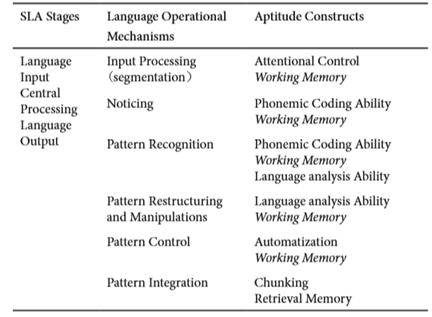
A slower speech rate, lots of visual cues (whether through images and gestures), simplified (comprehensible) input, lots of repetition and translation (yes- translation!) facilitate the new-language modelling function that aural input performs in the early phases of language acquisition; it provides speakers with poor aural-input processing ability with more time and greater chances to notice new linguistic features as segmentation (identifying the boundaries of words) is easier to perform. This is important, as noticing a new phoneme, word or morpheme is thought to mark the beginning of its acquisition (Schmidt, 1990, 1993,1994,1995).

Smith and Conti (2016) drew a clear distinction between the Listening-as-modelling and the Listening-for-testing-comprehension or ‘Quiz approach’ to listening-skill instruction. The former concerns itself with ensuring that L2 students learn through every single aural activity staged; the latter, sadly the more common approach in the typical UK classroom, concerns itself with providing practice in picking out details in order to answer a few questions on a recorded text heard two or three times – hardly an effective way to model new language. As I will discuss in the sequel to this post, to be published next week, the predominance of the ‘quiz approach’ remains to-date the root cause of the inefficacy of much listening instruction; as I shall argue there, listening-comprehension tasks can indeed play an important role in listening-skills acquisition, but only provided that much listening-as-modelling as occurred before.

By listening-as-modelling I do not simply mean the very common practice of asking the students to repeat a word or short phrase a couple of times after the teacher utters them since, as mentioned above, speech stays in working memory for too short a time for that sort of repetition to lead to acquisition. Also such practice models short phrases, not sentence building or more extensive and complex discourse.

Reading aloud is one example of listening-as-modelling that is indeed practised in a number of UK learning settings. In our book (Smith and Conti,2016) Steve and I provide a strong rationale for using it and there is mounting evidence (e.g. Seo, 2014) that even a few minutes per lessons can significantly impact speaking proficiency and willingness to communicate.

And how about the teacher using the target language in most of the lessons? Not an uncommon occurrence in UK classrooms, after all…Well,  it may be argued that teacher fronted talk in the target language does constitute Listening-as-modelling when the target language is used to explicitly model and recycle new language and to deliberately promote noticing (as in the example Steve Smith provides in our books in the section on target language use). However, in 25 years of lesson observations in British schools, I have indeed seen target-language teacher talk being used effectively to facilitate comprehension, but not to explicitly model specific language items through systematically recycled ‘patterned’ input. The teacher’s aural input is usually spontaneous – not a bad thing; however, when teacher contact time is limited (one or two hours a week), this kind of aural input is unlikely to substantially enhance acquisition – at least in my experience. I do believe, however, that in immersive or other input-rich L2 environments such practice can indeed significantly impact learning.

As I reserve to discuss in greater depth in my next post, Listening-as-modelling includes instructional activities which focus the learners on pronunciation and decoding skills, in an effort to facilitate phonological processing and segmentation; on predictive strategies; on the identification of word-classes and systems; on the understanding of syntax and sentence building; on the development of aural-input processing; on building metacognition vis-à-vis the listening process. Listening comprehension is built in such activities but in a way that scaffolds the modelling.

2.6 The affective response

So far we have looked at the way learner cognition responds to aural input. How about the affective response? In my experience, the ‘quiz’ approach, especially in the absence of adequate training in inference strategies and differentiation (difficult when all students listen to the same track at the same pace from the same input source) has led to a generation of disaffected listeners. This is tragic considering the wealth of L2 audio-visual material available on the web. However, as long as listening instruction limits itself to quizzes it will elicit guesswork and guesswork will rarely build learner self-efficacy, a crucial precursor, as Smith and Conti (2016) argued, for the development of intrinsic motivation.

For self-efficacy vis-à-vis aural-input-processing to be fostered in the classroom, the learners must be adequately prepped for any listening task which may be perceived as a test (e.g. a listening comprehension) by a few listening-as-modelling activities which recycle very similar lexical material and phonetic, grammatical and syntactic patterns so as to scaffold success. In the sequel to this post (PART 2) I will explain how I attempt to do it.

3. Conclusions to Part 1: first set of implications for teaching and learning and issues to be tackled in Part 2

The above discussion has huge implications for listening-skills instruction. Please note that each of the point below will be treated more extensively and with several examples in my next post.

(1) students need tons of listening practice which aims at speeding up processing (i.e. automatising ‘chunking’) – I will discuss how in the sequel to this post. A culture of listening-for-learning as opposed to listening-for-testing must be established in the classroom since the very early days of instruction through a variety of activities which aim at modelling comprehensible input and elicit a positive affective response (e.g. jigsaw listenings using songs; sentence building mats,  watching short movies with subtitles; story-telling with visuals). Moreover, speed of delivery should be reduced and varied (in a formative way) and linguistic content should be simplified with repetitions added in if necessary to facilitate comprehension. Transcripts and translations (e.g. parallel texts) could be used to scaffold the modelling process (this, too, will be discussed in my next post).

(2) students need EXTENSIVE practice in pronunciation and decoding skills from the very beginning of their L2 learning experience (e.g. through listening-micro-skills enhancers , partial transcription tasks and even short dictations ). I use them a lot in my lessons and students find them useful and fun. The set of new phonemes and corresponding graphemes taught should not, in my experience, amount to more than three or four per lesson.

(3) listening practice must recycle the target lexical material as much as possible in order to facilitate ‘chunking’ and future ease of retrieval from Long Term Memory. This may call for strategies like narrow listening, i.e. the administration of a series of listening texts which are very similar in terms of lexical, grammatical and syntactic content, thereby requiring increasingly less inferences on the part of the student-listener. At this link you will find an example of L2-French Narrow Reading texts which can be used for Narrow Listening, too. Again, narrow listening is something I used a lot in my lessons, usually preceded by a  battery of narrow reading texts containing the same linguistic material

(4) the target words and set phrases (especially if they are part of an Examination Board core vocabulary) must be recycled through the aural medium in as many different semantic, grammatical and phonetic contexts as possible in order to create a processing history which will facilitate comprehension in the long run (see 2.2.1 above).

(5)  The development of listening-skills, especially those underlying the ability to listen and respond to aural input (listenership) goes hand-in-hand with the development of oral communication skills. Hence, oral communicative activities (e.g. student-to-student conversations) should feature as often as possible in lessons. In order to ensure the type of recycling envisaged in point 3 and 4 above, such oral activities should include a substantial amount of structured activities ‘forcing’ learners to produce the target material (e.g. oral translations; role plays with prompts; cued picture tasks).

(6) listening comprehension tasks should be used almost exclusively as ‘plenary’ activities or tests to be carried out after much modelling of the linguistic material they contain has occurred. This will be perceived by the learners as much fairer than being asked to perform guesswork on an aural text containing lots of unfamiliar language and will enhance their chances to experience success, which will feed into their self-efficacy as L2- listeners. Teachers with good pronunciation may want to read the transcripts themselves rather than play the recording with less adept student-listeners, to facilitate processing. Please note that the Listening-as-modelling I envisage does include a comprehension component.

(7), curriculum planners may want to explicitly and systematically address in their long-/medium- and short-term planning the existing listening macro-skills and micro-skills taxonomies (e.g. the one by Brown, 2007, above). This would provide the curriculum  (e.g. Schemes of Work) with a structure and a specific set of objectives to focus on – surely a massive improvement over the haphazard way in which listening instruction is currently carried out. I use pre-listening tasks mainly as a vehicle for the modelling of the inference/predictive strategies envisaged by Brown’s (2007) and decoding skills (e.g. by reinforcing challenging sounds contained in the target text which may impair comprehension). I tend to use tasks involving focus on micro-skills in the in-listening activities I stage (three or four per task), jigsaw listening, segmentation tasks (identifying word boundaries) and patterns/system identification tasks (identifying word classes, tenses etc.), being my favourites. I use post-listening tasks, instead, for metacognitive reflection or critical listening (see my next post).

(8) Finally, as part of the Listening-for-learning approach, teachers ought to exploit any given recording much more than it is currently done by course-books. Carrying out three or four different activities with the same texts plus a pre-listening and a post-listening one will enhance the chances that the target vocabulary and linguistic features in the listening piece will be retained.

In a nutshell, the current teaching of listening skills does, in my opinion, need a drastic shake-up. The most important change language educators ought to implement is one of mindset, from a culture of listening-for-testing to one of listening-as-learning. This entails more Listening-as-modelling practice as well as more focus on Listenership, which in turns implies more oral interaction in the classroom.This change in orientation – which does not rule out using listening comprehesion tasks, as I hope it is clear from the above discussion – is fundamental if we want to equip the 21st century L2 learners with the skill set required to become effective autonomous listeners.

3.1 What I will write about in PART 2

In my next post I reserve to  delve deeper into the above implications and to discuss the ‘how’ I implement them as part of my daily classroom practice. I shall also point out the most common shortcomings of typical listening-skills instruction in the UK as identified by Steve, Dylan and myself, discussing the way we have addressed them (not always successfully) throughout the last academic year in our classroom practice (at Garden International School, Kuala Lumpur).

Part 2 and 3, the next posts in the ‘trilogy’, will concern itself with the following shortcomings of listening instruction, delving in much greater depth into the day-to-day strategies I have implemented in my classroom practice to address them in collaboration with my colleague Dylan Vinales at Garden International School (Kuala Lumpur):

  1. Insufficient aural/oral skills practice
  2. Poor curriculum design/lesson planning
  3. Ineffective sequencing and integration with other skills
  4. Insufficient ‘patterned’ recycling
  5. Inadequate exploitation of listening resources
  6. Lack of differentiation
  7. The ‘quiz approach’
  8. Insufficient use of listening-as-modelling
  9. No systematic and explicit focus on the development of aural-input processing ability
  10. Insufficient practice in listenership skills


Please note: To find out more about Steve Smith and Gianfranco Conti’s ideas on the above, get hold of their book ‘The Language Teacher Toolkit’


References

Brown, D. H. (2007). Teaching by principles: An interactive approach to language pedagogy. White Plains, NY: Longman.

Christiansen, M.H. & Chater, N. (2016). Creating language: Integrating evolution, acquisition, and processing. Cambridge, MA: MIT Press.

Macaro, E (2003). Teaching and Learning a Second Language A Guide to Recent Research and Its Applications. London:Continuum.

Richards, J. C. (1983). Listening comprehension: Approach, design, procedure. TESOL Quarterly, 17, 219-239.

Rukadevi, D. (2014). The Role of listening in language acquisition; the challenges and strategies in teaching listening. International Journal of Education and Information studies, 4, 59-63  http://www.ripublication.com/ijeisv1n1/ijeisv4n1_13.pdf

Seo (2014) Does reading aloud improve foreign language learners’ speaking ability. GSTF International Journal on Education (JEd) Vol.2 No.1, June 2014

Smith and Conti (2016). The Language Teacher Toolkit. Amazon.

Weir, C J, Vidakovic, I and Galaczi, E D (2013). Measured Constructs: A history of Cambridge English language examinations 1913-2012. Studies in Language Testing 37

Nine commonly made errors in L2- grammar instruction and how to address them

Please note: this post was co-authored with Steve Smith of The Language Teacher Toolkit and Dylan Vinales of Garden International School

images (7)

  1. Introduction: Why grammar instruction is often ineffective – a Skill-building perspective

Based on my professional eperience and on my readers’ accounts, much ML and EFL grammar instruction in the UK and, I suspect, across the world, is undermined by a number of shortcomings that stem from a misunderstanding of grammar acquisition and/or ‘sketchy’ curriculum design. In this post I discuss nine of the most serious shortcomings I have observed in 25 years of ML and EFL teaching. Please note that each of the points I make below is valid only if one espouses Skill-theory based theories of L2 language acquisition (also referred to in the literature as Skill-building or Cognitive Code approaches). If you operate within the C.I. / T.P.R.S. paradigm, you are very likely to disagree with every single one of the points I raise below.

  1. The starting-from-zero approach

More often than not, the teaching of a given grammar structure occurs ‘from scratch’, so to speak, with the students having had no previous exposure to it. However, learning – any kind of learning – is much more effective when the students can relate new input to past experiences. This is true of language learning too. That is why the ‘planting the seed’ technique or ‘anaphoric recycling’, facilitates and enhances grammar learning.

‘Planting the seed’ refers to planning the curriculum in such a way that, if you aim to teach, say, the present perfect in week 7 of term 2, the students will have come across several instances of its usage in aural and written texts throughout the preceding six weeks or even earlier – as ‘peripheral’ items. These previous encounters will have provided you and the students, in week 7, with plenty of past experiences of handling the target structure to draw upon and, in many instances, all you will have to do is help the learner connect the dots.

This technique works best when the students are – on each previous encounter – encouraged to notice the ‘seeds’ you are ‘planting’ and are provided with cognitive support when processing them. This does not mean that the ‘seed’ must become the main focus of the lesson – not at all. Nor does this mean that you are going to explain in detail how the structure works every time the students come across it; that would entirely defy the purpose of seed-planting. What I mean is that the unknown structure should not constitute a challenging obstacle to learner comprehension/execution of the task-at-hand. So, for instance, if you are ‘planting the seed’ of the present perfect, you may want to underline, write in bold or colour-code every instance of the present perfect in the written texts you give your students – to promote ‘noticing – whilst providing the translation in brackets or in a ‘help’ box.

You can do this with listening too, through jigsaw listening activities, for instance, in which the ‘planted’ structure is made to stand out through one of the above typographic devices so as for the students to pay more attention to it as they process the aural input.

  1. Minimal receptive practice and the ‘PPP-in-one-lesson obsession’

This refers to one of the greatest shortcomings of grammar instruction. Most grammar lessons unfold through a PPP (presentation, practice, production) sequence which goes way too quickly from the explanation of a grammar point to production. However, a very important stage, which plays a decisive role in grammar acquisition is nearly always missed out: receptive practice through the aural and written medium.

This hyper-neglected stage is very important, especially for the less confident of our learners, for the following reasons; (a) receptive processing is less cognitive challenging than production, especially when effective support/scaffolding is provided; (b) if the texts in use contain language the students are familiar with, they provide old material to hook the new items to, which may facilitate retention; (c) it models the application of the target structure in context, not in a communicative vacuum (as the sentences used by teachers and course-books as examples do); (d) reading allows more time for students to process the new information – production puts much more cognitive and emotional pressure on them; (e) aural modelling through listening – when the transcript of the track is visible to the learners- can be valuable in preventing many decoding/pronunciation errors which may impede acquisition – going back to the English present perfect scenario: think of the pronunciation of ‘I have read’ as opposed to ‘I read’; of ‘I have written’ versus ‘I write’. In French, I have significantly reduced the voicing of ‘-ent’ in the third person plural of the present indicative (e.g. ils parlent) by extensive modelling through listening practice.

Often teachers feel they have to get students to apply the target structure in production before the end of the same lesson in which they first introduce it. It is seen as evidence that ‘progression’ has occurred. However, the learning of any grammar structure – intended as its full automatization – requiring months of practice (see my article on grammar acquisition here), whether students ‘go productive’ or not by the end of the first lesson is not important. The more receptive practice the students actually get, the better. Having every single student leave the room feeling they have fully understood how the target structure works is better than having half of them go out having experienced problems using it in writing or speaking.

In conclusion, give the students lots of modelling of contextualized target-structure usage through receptive practice through lots of reading and listening activities, grammaticality judgment tests and metalinguistic tasks (e.g. Why is X used here and Y there? How many irregular forms can you spot here? Based on the text, how are adverbs used with the present perfect?). Let them experiment with the target structure in oral production in the next lesson.

  1. Building knowledge – not skill

If you were a football coach you would not teach someone how to dribble by simply explaining verbally to them how to do it, right? You would want them to try it out in front of you, give them some feedback on their performance and then get them to try again and practise extensively until you are sure they got it right.More importantly, you would not expect them to do it rightly the next time around – unless they are particularly gifted. You would know from your own experience, that it will take lots of practice before they will finally crack it – if they crack it at all. Finally, you would not assess whether they learnt what you taught them through a quiz at the end of a training session; you would want to see them play a match!

Yet this is what many teachers do when they teach their students grammar. They explain how a grammar rule works; give them a few examples and practise it through a few gap-fill exercises and maybe translations. Another classic is to get them to apply the target structure in some form of written production (e.g. to describe pictures or to write a creative or discursive essay). However, by and large, the typical way they assess uptake will be through a cloze test or a multiple choice quiz – Kahoot being the plenary of election in the UK, these days. A comparison with the football coaching scenario outlined above will clearly show how futile and ineffective this way of teaching grammar is; how little validity assessment carried out through quizzes and gap-fills is. Yet nearly everyone does it.

What this kind of teaching does is working on declarative knowledge of the language; on the understanding of the rules of the L2-system, but it does not bring about acquisition. Acquisition of a grammar rule can only occur through extensive practice across all four skills: Listening, Reading, Speaking and Writing. All four of them. And we may only say a grammar rule is acquired when it can be performed rapidly and correctly under Real Operating Conditions (i.e. in real life situations, whilst performing a real life task). Hence, grammar teaching needs to involve students in activities promoting fluency. But how do we achieve this?

Exactly like a football coach teaching his students how to dribble; first by modelling the use of the target structure to the learners through numerous contextualised examples (the receptive phase discussed above). Then by getting them to practise it in highly structured tasks (e.g. verb drills, gap-fills, easy written and oral translations, role plays). When the students are ready, the teacher will require them to carry out tasks which become less and less structured and pose greater cognitive challenge (e.g. oral picture tasks; solving a real-life problem based on a given scenario and prompts). The process will culminate in the performance of unstructured oral or written interaction under serious time constraints (e.g. an impromptu conversation with questions designed to elicit learner deployment of the target structure).

As one can imagine, this process involves lots of real-life oral and written communication aiming at building skill as opposed to creating knowledge – which sadly accounts for most of the grammar teaching I have witnessed in 25 hours of classroom observations.

Only extensive skill-building practice can bring about acquisition, not a few quizzes and gap-fills or corrections scribbled out in our students’ books or a list of targets. I was disappointed recently at seeing a great grammar lesson packed with oral communicative practice I observed end with a Kahoot; the answers to a multiple choice quiz will not tell us anything about the extent to which a grammar structure has been acquired.

  1. Compartmentalized learning

When the language curriculum is based on the course-book, grammar teaching is often ‘compartmentalized’, so to speak. The teaching of a specific structure is confined to a given unit or sub-unit of the course-book and then virtually forgotten. Although the students may encounter it here and there in future units, there is never evidence of systematic recycling of the target structure(s). Yet it is this systematic recycling that leads to acquisition.

It is paramount when putting together the Curriculum/Schemes of work for a given year group/ proficiency level to identify the core grammar structures you want the students to have acquired by the end of the year and plan for opportunities to recycle them in every single unit of work at receptive and/or productive level. In my career I have never come across Schemes of Work which systematically do this – the greatest flaw of all!

Effective teaching is not simply about good classroom teaching and resources; what it is often forgotten is that curriculum design is nearly as important as the ability to deliver it. This is because of the nature of language acquisition. A well-planned curriculum being a curriculum which aims at ‘making things stick’, an effective curriculum designer never loses sight of any of the target structures; through systematic recycling s/he ensures that every memory trace ‘stays alive and kicking’ and becomes stronger and stronger as the course progresses.

This is relatively easy to accomplish and definitely pay dividends – all teachers need is regular reminders to go back to the structures previously taught every so often. Homework can play an enormous role in this respect by incorporating, say, in the week-8 assignment a section on a grammar structure covered in week 3.

  1. The often-unflipped flippable

Much – not all – grammar learning can be flipped, especially when it comes to less cognitive challenging grammar points and automatization work. Inductive tasks whereby the students are given a number of sentences modelling the use of the target structures (e.g. relative pronouns) and are asked to work out by themselves (by analyzing the sentences and through internet-based research) the rule governing their usage, can be given as assignments prior to the lesson.

Moreover, let us not forget that much of the grammar-learning work that leads to the acquisition of a target structure involves actively processing and/or using it. This can be flipped too. Think about the tiresome mechanical grammar drills that you may not want to do in class for fear of boring the daylight out of your students. Ask them to do this sort of stuff at home and – as I mentioned in the previous point – ensure that the assignments include new and old material.

  1. The tense obsession

In the modern-language-teaching world, less so in EFL instruction, tenses (and moods) dominate grammar teaching, as language-proficiency assessment has been tense driven for decades. Preposterous as this is, this tendency to identify grammar learning with tense-learning still persists even after the old English National Curriculum Levels have been scrapped. In schools where NC levels have not as yet been abolished, students are still being told that tenses are the key to progression along the acquisition continuum. This leads L2 instructors to overemphasize tense-learning at the detriment of other very important grammar structures which play a more important role in the execution of communicative functions.

By so doing, we convey to our students ‘bad’ metaphors of language learning, which they will live by in the years to come should they pursue language learning to higher levels. This is a very likely scenario when you hear students as young as 11 or 12 asking you obsessively “what tense do I need to get to level 5a? And 6b?”. But what about the ability of producing complex sentences, performing communicative functions effectively and accurately or the all-important ability to express oneself fluently under real operating conditions?

  1. Unrealistic expectations

As discussed above, coursebook-based curriculum design, when it comes to grammar instruction, is based on the unrealistic expectation that a given structure is acquired in six to eight weeks or even less. Nothing could be more preposterous. Acquisition meaning that students can perform the grammar structure accurately at (near) real-life speed, it will take way longer than that for students to routinize the application of a grammar rule. Allow more time in your Schemes of Work. The authors of the textbooks you use are not eminent second language acquisition researchers nor experienced curriculum designers – they do not necessarily know much more about teaching and learning than you do. The pace they set is more often than not, in my experience, flawed and unfair to the students; it does not take into account developmental constraints and never allows sufficient time for consolidation.

  1. Flawed assessment

The other day I was shown a grammar test that consisted of a series of gapped sentences to fill in with the present tense of verbs provided in brackets. A classic! I was all but surprised. This practice has been going on for a century or more and nearly everyone does it. Yet, how does that assess L2 students’ acquisition of the present tense? It assesses, at best, their ability to conjugate some regular and irregular verbs in the present tense, in a vacuum, totally divorced from communication. They do not even need to understand the all-important linguistic context surrounding the gaps.

My students conjugate verbs every day on the www.language-gym conjugator (for no more than 5-10 minutes!) often scoring 90 -100 %. Does that mean they have acquired present verb conjugations? Far from it. It is like saying that a five-year-old who has learnt how to kick the ball around his bedroom is fit to play a Premiere League match.

  1. Over-correcting but under-remediating

Based on my discussion above, it will be now pretty clear why spending a lot of time correcting surface level errors in our students’ written pieces is not an effective way to go about improving student grammar proficiency – unless you are prepared to invest a considerable amount of time in the remediation process, that is. Error correction is only the starting point, the awareness-raising ‘bit’ of the error-eradication process.

Let us go back to the football-coaching analogy. If you simply confine your intervention to providing the correction or coding errors and asking the students to self-correct you will be doing the equivalent of the coach telling his student that he should kick the ball differently and showing him how to do it – awareness-raising and modelling. Pretty much the equivalent of telling an alcoholic that drinking is bad, explaining why it is harmful and telling them not to drink again. But what about the all-important extensive practice needed for the student to re-learn how to kick? What about the rehab time and therapy needed by the alcoholic to stay away from drinking?

Unless teachers are prepared to spend hours and hours helping the students re-learn grammar structures, they’d better limit their marking to errors that are common to a fair number of students in the same class and ‘remediate’ them in lessons day-in day-out through regular recycling. A much more efficient and effective use of teacher time.

Here is a simple tool I use to ensure I recycle grammar over and over again across the areas of student structural competence I have identified over the years as the most problematic in French:

Ticket.jpg

Concluding remarks

Grammar instruction still occurs, in many quarters, through outdated practices which defy neuroscience and, more importantly, common sense. From what we know about how the brain acquires cognitive skills, the way grammar is still taught and assessed in many school settings is highly ineffective. The most important message that I would like any teacher reader to take away from the above is that grammar teaching must be more skill -than knowledge-orientated and that without a carefully planned curriculum design (Schemes of work) which consciously aims at the routinization of the core target structures and strives to recycle them as much as possible throughout the course, across all four skills, effective L2 grammar acquisition cannot occur. Far too often grammar teaching and error correction stops at awareness-raising – the result being children that at best know how grammar rules work but cannot apply them correctly in spontaneous speech and under exam constraints for lack of R.O.C. practice.

To find out more about my views on grammar instruction and acquisition do read the book ‘The Language Teacher Toolkit’ I co-authored with Steve Smith.

How to teach pronunciation


download

0.Introduction

In this article I will concern myself with the teaching of pronunciation and decoding skills (i.e. the transformation of L2 graphemes into sounds) within a typical secondary school setting where teacher contact time is limited (e.g. 2-3 hours per week). The present post should be considered as a sequel to a previous blog (‘Nine research facts on the teaching of L2 phonology teaching and learning’) in which I discussed the theoretical background to what I will propose below. Hence, the reading of that post is recommended if you want to have a better grasp of some of the points made below.

  1. Approaches to pronunciation instruction

I could not locate much research on the teaching of pronunciation as integrated within a typical primary or secondary Modern Foreign Language curriculum. This is possibly due to the fact that the Communicative Language Teaching approach does not lay much emphasis on pronunciation and, consequently, many teachers see as the least useful of language skills (Elliott, 1995). In fact, the typical French, Spanish, German or Italian textbooks currently in use in the UK or US hardly deal with the teaching of the L2 phonology system; when they do concern themselves with pronunciation or decoding instruction, they do so superficially never going beyond the mere awareness-raising of key features and providing very limited practice -if any at all –  in the oral production of the target phonemes. Recycling of the target phonemes is also a very rare feature.

In deciding on how to integrate the teaching of pronunciation in the curriculum language instructors ought to consider which one of the following approaches best suits their learning context:

2.1 Accuracy vs Intelligibility – This is the most important decision to make at the very outset of a language course. Curriculum designers must decide what degree of pronunciation/decoding accuracy they aim at. Is it just for students to be understood by an empathetic native speaker? Is near-native accent the aspirational goal? Or are we aiming at a level of mastery somewhere in between? The answer to these questions will determine the emphasis L2 instruction will lay on pronunciation.

In most secondary schools, as far as I know, curriculum designers do not often ask themselves the above questions; yet, in view of the effects that bad pronunciation can have on effective oral communication, listening and reading comprehension and language acquisition in general (Walter, 2008), they really should.

2.2 Intensive vs Extensive instruction – teachers may decide to teach the pronunciation of a specific set of L2 phonemes intensively over a period of a few weeks or whether to do it extensively (a little bit every day) over a period of several months. Whereas I am inclined to opt for the latter approach based on what we know about L2-phonology acquisition, one may want to implement the former in the run-up to a high-stake examination as part of a remedial program (e.g. on realizing that the pronunciation of specific phonemes may seriously impair the students’ performance).

2.3 Deductive vs Inductive – Deductive teaching involves the traditional approach whereby the teacher presents and explains the phoneme(s) to the students – often in a PPP instructional sequence. Inductive approaches (e.g. guided discovery), on the other hand, are student-led; the students are in charge of describing and/or analyzing the target L2 phoneme(s) and/or discriminating between them and similar L1 sounds. The teacher acts as a facilitator, guiding the students with open questioning as they ‘work out’ how the pronunciation of the target sound(s) works . The latter approach has the merit of eliciting greater cognitive investment on the part of the learner, but it is also more time-consuming. I personally like to alternate both.

2.4 Spontaneous vs Planned – A planned approach implements pronunciation instruction in a systematic way, considering the way the target phonemes could be recycled across the various units of work. In this approach the teaching of the target phonemes is carefully embedded in the schemes of work, which is a more pain-staking process, but one that allows for more effective integration within each topic covered.

Spontaneous instruction, on the other hand, is less time-consuming and is based on a ‘if ain’t broke don’t fix it approach’; in other words, if a teacher notices that their students are making mistakes with a particular L2 phonemes in a given lesson, they will impart instruction on that phoneme ad-hoc, on the spot. This approach can work quite well with more advanced classes which generally display good pronunciation and may occasionally exhibit minor flaws here and there. In this approach, the teacher must have an in-depth knowledge of the target language phonology so as to be able to improvise. Ideally they would also have a readily available bank of resources to drawn upon impromptu.

I personally prefer a planned approach with a very prompt start from the very early days of instruction. But do not refrain from spontaneous instruction when the need arises.

2.5 Contextualised vs Discrete – Another decision to be made is as to whether the teaching will be carried out through (1) stand-alone pronunciation lessons; (2) lessons in which pronunciation instruction is embedded within the teaching of other linguistic content; (3) a mix of both. In view of the curricular and time constraints of typical secondary school courses, I suggest following the third approach using the framework I will outline below, as it allows for systematic recycling but also with some degree of flexibility.

2.6 Awareness-raising vs Automatisation – A lot of the pronunciation teaching I have seen in 25 years of career did not consciously aim at automatization, but rather at awareness-raising. Typically, the teacher shows presentations through which they model the pronunciation of the target phonemes first in isolation and then within words; the students repeat the sounds and words aloud. In the best-case scenario they practise the words through tongue-twisters or other drills, and that’s it!

The problem is that the acquisition of L2 pronunciation requires the automatization of at least three sets of skills: (1) being able to discriminate between the L2 target phoneme and the similar L1 sounds in the receptive phase; (2) being able to reproduce the target phonemes accurately in isolation and (3) in combination with other phonemes at word/phrase level in the context of spontaneous oral communication. With this in mind, it is clear that the approach I have just described will never result into acquisition.

In order to develop the three sets of skills just alluded to, pronunciation/decoding instruction should include the following phases:

  • A modelling phase in which the teacher models the target phoneme and/or how to transform the target graphemes into sound;
  • (when necessary) A description and analysis phase in which the differences between similar (but not identical) L1 and L2 phonemes and/or the L1 and L2 allophones of specific graphemes are clearly explained (or arrived at inductively). For instance, when teaching the differences between the Spanish and English pronunciation of ‘t’ the teacher will show how the Spanish ‘t’ is not a plosive sound and how the tongue hits the tooth in Spanish and the pre-alveolar area in English, etc.
  • A receptive awareness-raising and discrimination phase in which the learners receive practice in: (1) matching the target L2 phonemes with letters/combination of letters (i.e. that the sound /uah/ matches the letter cluster ‘oi’); (2) discriminating between the L2 target phonemes and the similar L1 sounds (for instance: students listen to the word ‘bonjour’ first uttered by a French native speaker and subsequently by a non-native speaker pronouncing ‘J’ the English way. The task: to identify the difference). The micro-listening-skills enhancing tasks I described in detail in two previous posts of mine can be used here. Transcription tasks, short dictations on MWBs and songs with transcript can be used, too.
  • A productive phase involving controlled practice in which the target phonemes (pronunciation) and/or related graphemes (decoding) are practised in the context of drills designed in such a way as to elicit a narrow focus on the target sounds (e.g. short and easy role plays and simple tongue twisters).
  • A productive communicative practice phase. This is crucial in bringing about automatization as it is all very well to know how to pronounce sound /decode letters in isolation; but, ultimately, it is the ability of doing that under Real Operating Conditions in the context of words, phrases and sentences that matters. Semi-structured communicative tasks such as surveys, interviews, role-plays, ‘find someone who’, ‘find out what’ , ‘fill in the information gaps’ or oral picture tasks are invaluable ways to train students in pronunciation and decoding. Before engaging the students in the communicative task, the teacher will focus her attention/feedback and her students’ on the target phonemes.

As I will point out below, for the acquisition of L2 pronunciation to occur, the teaching of pronunciation cannot stop at modelling sounds through a few minutes of choral repetition and some tongue-twister practice. Whatever the target phoneme is, it must be practised extensively in the context of oral production tasks which are at the highly-controlled end of the spectrum first and become incrementally more unstructured.

  1. Factors to consider

In implementing pronunciation instruction as embedded in a typical secondary curriculum, instructors must consider a number of important contextual factors (e.g. contact time; examination board assessment criteria; methodology espoused by the institution you work at) and individual and affective variables (e.g. age of learners; levels of motivation; relevance of pronunciation accuracy to their personal goals; ability).

  1. What we know about the acquisition of L2 pronunciation and decoding skills

4.1 The brain ‘hears’ sounds using the L1 phonological filter; hence, an L2 learner will match the L2 sound they hear to the closest approximation they find in their Long Term Memory. For instance, a French or German native speaker will hear the English word ‘thirsty as ‘sirsty’) whilst an Italian will hear ‘Tirsty’ (this phenomenon was discussed at length in my previous post on pronunciation).

4.2 L2 graphemes automatically activate the L1 phonological system in the L2-leaner’s Long-term Memory (also discussed in my previous post). So, words should be taught using visuals or gestures before they are presented in their written form.

4.3 It is better to start teaching pronunciation when the articulators are more ‘plastic’, before puberty. Some research would suggest starting learning pronunciation before the age of 7 (Lennenberg, 1967).

4.4 Pronunciation errors are difficult to correct when they are fossilized (Ellis, 1996) – L1 transfer in pronunciation is a major threat to the acquisition of accurate L2 pronunciation for the reasons alluded in 4.1 and 4.2 above. Hence, pronunciation instruction should be particularly intensive an extensive in the first two or three years of language learning. Students should receive feedback on their pronunciation from the very early stages of instruction in order to avoid fossilization.

4.5 As already discussed above, L2 phonemes require masses of distributed practice in order to be automatized. Learners’ acquisition of the target phonemes usually follows a U shaped developmental curve with a backsliding phase half-way through the process (Pech et al., 2011)

4.6 Working memory resources are limited both in terms of capacity and duration of storage. For instance, we know that words are phonologically stored in working memory for only a few seconds (Walter, 2008). Hence, unless we focus students on the importance of accurate pronunciation and place it firmly in their focal awareness, most of them will not be able to consciously invest their attentional resources long and deeply enough to notice and learn L2 phonemes.

4.7 Pronunciation and decoding skills must be automatized if we want our students to acquire effective speaking and reading skills. Moreover, better pronunciation and decoding skills result in better acquisition of grammar and syntax. As already discussed in my previous post, more effective pronunciation and decoding skills enhance reading and listening comprehension. Finally, as it is obvious, an L2 speaker who struggles to pronounce L2 words for lack of knowledge of the L2 phonology system and pronunciation/decoding practice is likely to experience serious processing inefficiency issues in L2 oral production.

4.8 Some L2 students are genetically more predisposed than others to notice and acquire foreign language sounds (Nardo et al, 2009).

4.9 A positive orientation towards the target language and the target language culture(s) seem to correlate positively with better pronunciation.Marinova-Todd et al. (2000) posit that motivation may play an even more important role than age in the acquisition of native-like pronunciation.

  1. My tips for pronunciation teaching

The following tips are based on my review of the existing literature on the subject, Skill-theories of language acquisition and most importantly, on my classroom experience. Here they go.

5.1 Start pronunciation instruction very early – in Primary – not only because the learners are more developmentally receptive to it, but also so that you will not have to deal with it any longer later on, when you need to focus on higher order skills. It is also crucial to sensitize the students to the importance of accurate pronunciation at this stage so as to place it firmly into their focal awareness and forge sound learning habits. Students should be given examples of how inaccurate pronunciation can lead to communication breakdown, embarrassing misunderstandings and stigmatization.

5.3 In order to prevent cognitive overload adopt a narrow focus. Select only one phoneme or maximum two per lesson and dwell on it/them for several lessons, whilst recycling the ones you will have taught before in order to keep them in the students’ peripheral awareness at all times. Before any oral communicative activities do ask and frequently remind the students to pay selective attention to the pronunciation of the target phonemes both in production and peer- feedback.

5.4 Integrate pronunciation and decoding instruction in the topic-at-hand using the five-step framework outlined above (Paragraph 2.6). The adoption of a narrow-focus approach means that whilst the first lesson on a given phoneme will be a bit longer, the reinforcement of the same one/two target phonemes over a period of three or four weeks will be much shorter, five to ten minutes every day. The most important thing will be, as suggested in the previous point, to keep the students’ focus on the target phoneme(s) during any oral communicative activities staged in class during the entire reinforcement/recycling period.

5.5 Plan integration opportunistically but judiciously. By this I mean that whilst planning a unit of work, you may find that the vocabulary or grammar structure you intend to teach lends itself beautifully to the teaching of specific sounds. For instance, in teaching animals in French, a few weeks ago, the words ‘chat’, ‘chien’, ‘cochon d’Inde’ and ‘cheval’ prompted me to decide to teach that ‘ch’ is pronounced ‘sh’ in French. However, opportunism should not be the only criterion to be used in selecting the target phonemes: intelligibility impact (the extent to which the sound may affect understanding); learnability (how ready the students are to pick it up) and frequency (how often they are likely to come across that sound) should also be taken into consideration.

5.6. Prefer extensive distributed practice (a little every day over a longish period of time) over massed practice. Extensive practice which recycles the target sounds for a few minutes every day is crucial to the success of pronunciation instruction as L2 phoneme acquisition requires a lot of time and contextualized practice. I keep a chart, on a google doc, in which I tally all the phonemes I teach so as to have an overview of how many times I have recycled each sound.

5.7 Model through detailed description and analysis. In the modelling phase take the learners, possibly using audio-visuals, through every single step involved in the production of the target L2 phoneme. There are plenty of charts available online showing how the different sounds are produced in various languages. Remember: effective modelling and analysis require good knowledge of the target language phonology system. Heads of Depatment ought to provide staff with adequate specialised training.

5.8 Stage critical listening activities with narrow focus. These can be modelled in class and then flipped. They consist of getting students to listen to a peer reading aloud (if the focus is on decoding) or talking in the L2  whilst one or more peers focus their attention and provide feedback on two or three phonemes. Alternatively, you can get the students to record themselves and each other. Critical listening fosters collaborative learning, social strategies and metacognition whilst bringing about deep cognitive investment.

5.9 Alternate inductive and deductive approaches for the sake of variety, but also to foster healthy inquiry skills.

5.10. Prevent automatic activation of L1 sounds as much as possible. Keep pictures on the walls which refer to words containing the key L2 phonemes and most students know very well (e.g. numbers); it is important that they did not learn to pronounce these words through the written medium in the first place. These pictures will be a valuable aid each time you will want to correct phonetic mistakes made by your students without providing them with a written example (as this would automatically activate the student’s L1 decoding system possibly causing L1 transfer issues). So for instance, when reminding a student of the decoding of the consonant cluster ‘oi’ you will point to the number ‘3’ on the wall, ‘trois’, which contains those letters.

5.11 Teach and practise the target phonemes in accessible linguistic contexts. When teaching new phonemes it is vital that the students have enough cognitive space available to focus on them. If the ‘drills’ or communicative tasks are complex, contain masses of new vocabulary, challenging L2 structures or even other difficult sounds they have not yet mastered, this will impact very negatively on learning. Some teachers give fun but very phonetically complex tongue twisters to novice L2 learners who do enjoy the challenge and often have a  real blast in the process, but frequently end up making a complete mess of it. When selecting tongue twisters or any other material for the initial modelling and controlled practice phases, choose texts which pose very little cognitive and phonetic challenge.

5.12 Correct judiciously. Feedback is very important in the teaching of pronunciation and may need to be more frequent than the correction teachers provide on other aspects of performance. This is because pronunciation mistakes tend to fossilize more easily. Hence, teachers need to monitor oral communicative activities very closely and step in – even interrupting – when errors made with the target phoneme(s) (1) are made publically and consequently may affect several students’ perception of what is correct/incorrect; (2) impede intelligibility; (3) are made frequently. However, do not overdo correction as it may affect motivation.

Concluding remarks

In this post I have attempted to provide some tips on the pronunciation of L2 pronunciation and decoding skills. The most important point is that teachers should sensitize their students to the importance of accurate L2 pronunciation from the very early days of instruction. A principled approach to the planning and classroom delivery of L2 pronunciation instruction should be devised which provides extensive distributed practice through a mix of inductive and deductive learning and adopts a narrow focus, i.e. one or two phonemes are taught each time. Last but not least, this approach, which integrates pronunciation instruction within most lessons (a few minutes per session) cannot lead to acquisition of the target phonemes unless these are practised in the context of structured and unstructured communicative activities.

In this post I have also recommended the following framework that I have used successfully over the years and integrates the teaching of pronunciation with communicative language teaching and serve the goals of the curriculum I am charged with delivering. This framework includes five phases

(1) A modelling phase

(2) A description and analysis phase in which the differences between similar (but not identical) L1 and L2 phonemes and/or the L1 and L2 allophones of specific graphemes are clearly explained;

(3) A receptive awareness-raising and discrimination phase;

(4) A highly structured productive  phase;

(5) A productive semi-structured to unstructured communicative practice phase.

It should be reiterated that in the fifth phase, crucial in bringing about automatization, the role of the teacher in monitoring and providing feedback on the phonological level of student output is crucial. Also pivotal is the level of student focus on pronunciation that the teacher will have generated; unless the students are encouraged and motivated to keep the importance of pronunciation in their focal awareness no pronunciation instruction will ever succeed. Unfortunately, these days, pronunciation is but a peripheral concern in most Modern Language classrooms.

You can find more on this in the book ‘The language teacher toolkit’ that I have co-authored with Steve Smith, available here

Oxford University ‘legend’, Professor Macaro, reviews ‘The Language Teacher Toolkit’

10369865_10153232628176744_6265467044143184835_n

Yesterday I found a new e-mail in my inbox which caused me much apprehension. It contained a review of the book Steve Smith and I published last month ‘The Language Teacher Toolkit’ in which we lay out our approach to language teaching and learning and practical tips on how to enhance classroom practice. The review was authored by an Applied Linguistics legend, Professor Ernesto Macaro of Oxford University.  

Professor Macaro is an inspirational teacher educator, innovative researcher and visionary language scholar who authored seminal work I often quote in my blogs and which has deeply impacted Modern Language Education all over the globe in the last twenty years or so (e.g. Macaro, E. ,2003, Teaching and Learning a Second Language: a guide to current research and its applications. London: Continuum; Macaro, E.,2001, Learning Strategies in second and foreign language classrooms. London: Continuum; and his latest book: Macaro, E. Graham, S. & Woore, R.,2015, Improving Foreign Language Teaching: Towards a Research-based curriculum and pedagogy. Routledge.)

Although all the reviews we have had  thus far have meant a lot to Steve and myself this is particularly important to me as Professor Macaro is not only one of the greatest authorities in the field of Applied Linguistics and a highly influential scholar; more importantly, he was my PhD supervisor and a true Mentor whose forward views on language teaching and learning (especially on learning autonomy) have ignited and shaped many of my beliefs.  What I write in my blogs is often the final  outcome of a process that started fifteen years ago when I was his doctoral student.

In the figure below: Professor Ernesto Macaro

Ernesto-profile-232x300.jpg

 I was nervous on  opening the e-mail as I know that Professor  Macaro is a very honest and frank man, ‘senza peli sulla lingua’ – as we say in Italian, and would not just write a ‘nice’ review to please a former student. In fact he was adamant in asking me not to change anything in his review without his approval. And nothing was changed. Here it is:

The Language Teacher Toolkit is a really useful book for language teachers to either read all the way through or dip into. What I like about it is that the authors Steve Smith and Gianfranco Conti are totally upfront about what they believe to be good practice but back it up with research evidence. So for example the ‘methodological principles’ on page 11 are supported by the research they then refer to later in the book and this approach is very similar to the one that we (Ernesto Macaro, Suzanne Graham, Robert Woore) have adopted in our ‘consortium project’ (http://pdcinmfl.com). The point is this: it’s all very well saying there are no ‘methods’ for teaching a foreign language any more but it can’t then be a free-for-all with teachers doing exactly what they want to do. As much as I believe in teacher professional autonomy, language teaching is so complex that you have to have a series of guiding principles.

 So “make sure students receive plenty of meaningful input in the L2” – absolutely! I’ve never come across a successful classroom that doesn’t provide plenty of that.

“make sure students have lots of opportunities to practice orally” again totally agree but I would go a step further and say that they have to take risks with saying things they are not sure are correct. Take a look at “Steve’s tips for developing spontaneous talk’ on page 85, he brings the notion of risk-taking in very nicely but it should be part of the actual principles in my view.

“be prepared to explain how the language works but don’t spend too much time on this” – this is really key! I always use the expression “at what cost?” At what cost, given the amount of teaching time you have,  are you explaining the difference between the perfect and imperfect tenses, in the L1, when they could be doing something much more skilled-based.

So I think the 12 principles are sound (is there some reason there are 12?). I think the last one about ‘a significant focus on the L2 culture’ needs some more unpicking. Exactly what culture are we talking about? Smith and Conti are teachers of French and Spanish I believe. Well ok we can have some notion of the culture of the people who speak those languages and it is possible to give learners some insights into them but we have to be careful a)not to trivialise the culture and b) not to centre it on some European (‘metropolitan’ as the French would say) idealised culture. And then of course if you are a teacher of English as an L2 the notion of culture enters a completely different theme park!

 Anyway take time to read Smith and Conti’s book. It’s packed with lots of interesting and not too ‘whacky’ ideas.

 Ernesto Macaro

Professor of Applied Linguistics, University of Oxford

Here is a link to Professor Macaro’s impressive academic biography and accomplishments

Six things I tried out this year which truly enhanced my teaching


10369865_10153232628176744_6265467044143184835_n

Here are six things that I have tried out this year which significantly enhanced my teaching and two which, whilst being much less successful, provided me with valuable insight in my students’ cognition and affect.

1. Six things that worked

1.1Teaching more verbs

The textbooks and the wordlists that one finds in published instructional materials and on language learning websites traditionally tend to mainly focus on nouns, occasionally throwing the odd adjective here and there. Verbs are usually grossly underrepresented in the published vocab lists. However, when we talk about things and people in our daily lives we  do use a fair range of verbs.

Without verbs the communicative power that we provide our students with is seriously limited. It is all very well to teach students the English, French or Spanish words for dog, cat and other house pets; however, if we only teach them how to say ‘I have’ , ‘I like’ and ‘s/he is’ in the target language, we will equip them with very few contexts they can use those nouns with. How about: ‘I walk the dog’, ‘I play with my cat’, ‘I feed my hamster’, ‘I groom or ride my horse’, ‘I look after my guinea pig’, etc.

Moreover, by widening the range of verbs we also provide a larger number of cognitive ‘hooks’ for the target nouns, contextual cues that will facilitate future recall.

Another benefit of teaching more verbs is that the more our students use them the more they are likely to deploy adverbs – a highly under-taught word class.

Finally, the more our students are exposed to the inflected forms of verbs in the comprehensible input we provide them with, the more likely they will be to ‘pick up’ verb endings and conjugations. When one looks at the reading and listening texts found in UK published textbooks one cannot help notice how poor they are in terms of inflected verb forms. Could this be one of the reasons why English learners of modern languages notoriously lack mastery of verb conjugations?

1.2 Much more listening practice and more listening-for-modelling activities

Another substantial change to my classroom practice has involved the greater use of listening activities as a way to model new language to my students – not merely to test or enhance their comprehension skills. I have substantially increased the use of the following in my lessons:

(a) Speaking mats – I put writing mats or sentence builders up on the classroom screen and make up sentences which I utter aloud for students to write on mini-boards in English. I also use speaking mats with younger learner for micro-dictation (students writing sentences on MWBs in the target language)

(b) Working with gapped transcripts of audio-tracks, videos or songs;

(c) Micro-listening-skills enhancers (see my posts on these);

(d) Jigsaw listening activities;

(e) Story-telling to teach tenses and/or vocabulary (with or without images);

This has massively improved my students’ pronunciation and preparation for the communicative activities I usually stage after the listening-as-modelling activities. (see my blogs on listening for more).

1.3 More decoding-skills teaching and emphasis on pronunciation in general

Working on specific phonemes and combination of letters in a structured way in synergy with the activities listed in the previous paragraph has paid massive dividends, this year.

I have focused on one or two sounds per lesson recycling them over and over again for weeks. I have preferred to apply the principle of distributed over massed practice (i.e. a bit every day).

I have made a conscious effort to lay great emphasis on the importance of accuracy in pronunciation with all of my younger learners (year 5s and 7s) and we have a little pronunciation workshop lasting about ten minutes in every single lesson. We do a lot of work on micro-listening / decoding skills, minimal pairs, reflecting on how differently letters are sounded in the target language compared to their native(s) one(s), simple tongue twisters and paired critical listening. It really has paid off! (see my blog on decoding skills for more).

1.4 Vocabulary, Verbs and Speaking ‘flipping’

This year I tried to flip most of the following:

(a)Vocabulary drills – If I am planning to teach topic ‘X’ on Wednesday I flip the learning of the vocabulary related to that topic setting it as homework on Monday. I usually do this using www.language-gym.com. Students send me the screenshot of the page with the score they obtained;

(b) Verb drills – every week I get the students to practise verb conjugation at home using online verb trainers like the www.language-gym.com one

(c) (with my GCSE classes) Speaking practice – every week I ask them to record a dialog  with a partner on one of the GCSE topics using their iPads and forward it to me.

1.5 L.I.F.T

LIFT, or Learner Initiated Feedback Technique is something I have used for very many years. It consists of questions about linguistic items they are using in their written pieces that they annotate in the margin of the page they are writing on. For example, if they are not sure whether a clause requires  the subjunctive or  conditional mood, they will underline or circle the verb and write on margin: “Is this verb supposed to be in the subjunctive? Why/Why not?

This year, I have used it more consistently, extensively and, more importantly I have insisted on higher quality questions. It has made me enjoy giving feedback more and my students have reported benefitting from it. (See my blog on LIFT for more)

1.6 The personal learning afternoons

In my school (GISKL), on Fridays lessons finish one and a half hours earlier. The students leave the premises and teachers engage in a range of professional development activities organized by Jose Diez (Director of Professional Learning). Some write reflective journals; some read research and some, like me, reflect on their practice with other colleagues. This has been a God-sent for me as I conceive a lot of my blogs during these sessions, usually carried out with my very creative, talented and resourceful colleagues Dylan Vinales and Ronan Jezequel.

Brainstorming and bouncing off ideas with colleagues – often after reading a research paper – on a specific area of teaching and learning is a very useful experience. Writing about it a posteriori in a blog not only reinforces the outcome of the sessions, but often help me develop it a notch further.

These personal learning afternoons have deeply impacted my professional development, to a much greater extent than any other CPD I was involved in the past had ever done.

2.Things that worked less well

Two things I tried but did not work so well, were: (1) using retrospective verbal reports (RVRs) and (2) reflective journals (RJs). RVRs consist of short reflections on how a specific task went immediately after it has been performed. I did it a couple of times after essay writing or a speaking session and most of the students didn’t really seem to enjoy or learn from it. As for the RJs half of the students really enjoyed them, writing them every week and discussing at length their learning problems and successes and setting themselves targets; the other half either did not do them or, when they did, they did it very superficially and unenthusiastically.

Overall, less successful than expected.

3.Tips

If you want to have a go at trying any of the approaches described above do not implement them with every single class of yours. I chose to try each of the above only with one group at a time the first time around starting from the group that would pose fewer challenges and would benefit the most from it.

For more on the above strategies and approaches,read the book ‘The Language Teacher Toolkit’, co-authored with Steve Smith and available on http://www.amazon.co.uk.

10369865_10153232628176744_6265467044143184835_n

Five pronunciation and decoding issues in French-as -a-foreign-language instruction that seriously affect grammar learning and should be targeted as early on as possible

Please note: this post was co-authored with Steve Smith of http://www.frenchteacher.net

10369865_10153232628176744_6265467044143184835_n

As I explained in several previous blogs, our students’ ability to decode the target language sounds can seriously impact acquisition. And I am not simply talking of their ability to acquire vocabulary and pronunciation. I am also alluding to the learners potential to notice and internalize grammar. Why? Because receptive decoding, i.e. the way the human brain ‘deciphers’ the sounds we hear, can cue us to certain grammatical features of words (i.e. endings) we process aurally that lead us to noticing and making assumptions about their gender and/or number (for nouns and adjectives), person, conjugation and tenses (for verbs) and other ‘anomalies’ (e.g. ‘l’’ before nouns, the pronoun ‘y’ before a verb).

For instance, today, a student I help outside school, had still not grasped the phonetic difference between ‘ne’ (as it sounds in ‘ne’) and ‘n’ai’ (as in ‘je n’ai’). This has led her for many years to presume that ‘je n’ai pas vu’ was actually spelt ‘je ne pas vu’. This in turn affected her assumptions as to how the Perfect Tense is formed in French which resulted in the mental representation ‘Je + past participle’ (i.e. Je vu). I could not blame her as, evidently, her previous tutor must have not emphasized adequately the difference between ‘Je’ and ‘J’ai’.

In this post I will focus on five pronunciation/decoding issues in FLE (Français Langue Étrangère) instruction which do usually receive some emphasis but are not in my experience duly emphasized and practised in the typical L2-French classroom.

Issue 1: [ə] vs [e] in receptive decoding

This sound is one of the most important to learn in terms of receptive decoding, not only for the ‘Je’ versus ‘J’ai’ distinction alluded to above, but also because of the potential it has for cueing the students to the presence of a plural noun. Take for instance the sentences ‘ le fils de Marie étudie l’anglais’ et ‘les fils de Marie étudient l’anglais’. In this context the inaccurate perception of the sound [ə] as [e] (as in les) may easily cause confusion (is the subject ‘fils’ plural or singular?) – confusion that might exacerbated by the fact that the ‘s’ in ‘fils’ may lead the beginner French learner to believe that the noun is plural.

Another huge issue that novice teachers often overlook is the pronunciation of ‘é’ as [e] or [ə] in active decoding (when reading a word). This is particularly a problem when it comes to the Perfect tense. When a student pronounces ‘j’ai mangé’ same as ‘je mange’ unless there is a time marker (e.g. hier) the potential for confusion and communication breakdown is great.

The difference between the two sounds must be duly emphasized from the very early stages of instruction. Most often teachers do when it comes to the ‘je’ vs ‘j’ai’ dichotomy. I have often witnessed the very good practice of modelling the two sounds by over-emphasizing lip movement in an attempt to create a muscle memory of the articulatory process and through minimal-pair work. What I have not often seen, however, is the teachers recycling those through many other familiar and unfamiliar contexts until the acquisition of those sounds has occurred. To presume that one or two minimum-pair demonstrations will lead to the automatization of the phonemes is over-optimistic; for most students, acquiring the ability to discern between the two sounds in receptive decoding will take several weeks or even months.

As recommended in previous posts, teachers may want to engage students in micro-listening-skill enhancers reinforcing the distinction between the two sounds for a few minutes (10?) per lessons over a period of 4 to 8 weeks in order to obtain very good results.  For the rationale for this approach read my previous post ‘How to teach pronunciation’.

Issue 2: pronunciation of ‘t’ /’d’/ ‘p’ / ‘s’ at the end of words vs same letters + ‘e’ or ‘es’

Learning the correct (active) decoding of  the above consonants with and without ‘e’ or ‘es’ at the end of words from the very early stages of French instruction is of paramount importance. Why? The reason is two-fold. Firstly, if the students are not aware of the distinction ‘t’ vs ‘te’ / ‘tes’, they will not be able to distinguish between masculine and feminine nouns and adjectives – a distinction that many L1 English learners of French find very challenging. Secondly, the pronunciation of ‘t’ / ‘p’ etc. at the end of many words or nouns can cause serious misunderstandings in terms of meaning. Think about the nouns ‘point’ and ‘pointe’; ‘vent’ and ‘vente’; ‘coup’ et ‘coupe’.

Issue 3 – [z] vs [s] in liaison

This is another issue that it is not always tackled effectively. This can cause quite a few problems, the most frequent and important of which pertains to the famous cross-association elles/ils ont vs elles/ils sont. Since this distinction is not often ‘drilled in’ adequately, many learners of French end up confusing the two all the way to year 11 (when they are 16 yrs old). Often, this leads to ‘elles ont treize ans’ being interpreted as ’elles sont treize ans’ and the assumption that the French, too, like the English, use ‘to be’ when telling somebody’s age.

Confusing [z] and [s] is very common and can cause misunderstanding in many contexts, for example: ‘elles avaient beaucoup de choses’ was interpreted by one of my student as ‘elle savait beaucoup de choses’.

Issue 4 – ‘un’ vs ‘une’

The effects of decoding issues with these words on the acquisition of the French grammar are possibly the most obvious. If a learner is not clear about the differences in pronunciation between these two words, they will make incorrect inference as which nouns are masculine and which are feminine. This issue will affect, if unresolved, other more complex structures such as ‘aucun’ vs ‘aucune’.

After modelling the lip-movements through over emphasis of the sound articulation and contrasting English words such as untouchable and unsolvable (in which the two first letters ‘un’ are highlighted in red) with words like Unesco, tune, (where the key letters ‘une’ are highlighted) one may want to reinforce the differences through micro-listening -skill enhancers such as ‘Broken words’ whereby the teacher utters words such lune, lundi, rune, aucun, aucune etc. and the students have to complete the gaps in l__di, r____, auc___, auc____, etc.

Issue 5 –  voicing ‘ent’ at the end of verbs

This is a very common issue that in my experience receives some attention but not as much as it actually requires and deserves. When not acquired effectively, the wrong decoding of ‘ent’ in the third person plural of  the Present Indicative and Subjunctive of verbs can cause quite a lot of problems. In a class I observed recently, for instance, the belief that ‘ent’ is voiced, led to the students often confusing (in a listening activity centred on modal verbs)  ‘veulent’ and ‘veut’, ‘peuvent’ and ‘peut’, and ‘doit’ and ‘doivent’. In the past I have also witnessed issues in the pronunciation of the third person of the imperfect indicative and of the conditional. Another related issue pertains to adverbs (e.g facilement, lentement) which are occasionally mistaken for verbs.

Concluding remarks

Whereas most published course-books usually converge in the way they sequence the teaching of grammar (especially tenses), when it comes to pronunciation they use quite a random approach which does not appear to be principled in any way. I suggest that, pronunciation/decoding skills instruction should first deal with the easiest-to-acquire phonemes and then gradually concern itself with the more challenging ones, another criterion ought to be considered, too; the extent to which, that is, the ineffective mastery of those sounds can affect the acquisition of the grammar of the target language. The five sets of pronunciation/decoding issues discussed above are only but a few examples of the way in which phonological awareness and the ability to transform graphemes into sound can affect the acquisition of the target language grammar. Teachers ought to pay attention to this very important facet of language acquisition and devote sufficient time and effort to it using the research-based framework I outlined in previous posts.

You will find more on this issue in the book ‘The Language Teacher Toolkit’ that I co-authored with Steve Smith and is available for purchase at www.amazon.com

10369865_10153232628176744_6265467044143184835_n