by Gianfranco Conti, PhD. Co-author of 'The Language Teacher toolkit', 'Breaking the sound barrier: teaching learners how to listen', 'Memory: what every teacher should know' and of the 'Sentence Builders' book series. Winner of the 2015 TES best resource contributor award, founder and CEO of www.language-gym.com, co-founder of www.sentencebuilders.com and creator of the E.P.I. approach.
When I work with schools to improve their students’ vocabulary retention rates, one thing I consistently notice when observing Do-Now tasks is that they often feel like isolated islands, narrowly focused on the unit at hand.
A Do-Now task should instead recycle new/recent items alongside previously learnt language. For instance, if in Year 8 Term 2 you are teaching Unit 4, you should be deliberately bringing back items from Units 1 and 3 in Term 1—and ideally even from Year 7. This approach is vital not only for combatting the rate of forgetting but, more crucially, for fostering the lexical automaticity required for true spontaneity. By reducing the cognitive effort of retrieval, we free up the working memory for higher-order communication.”
If this is your modus operandi, you will find the Vocabulary Matrix extremely useful. This is a low-tech, high-impact retrieval strategy that forces students out of their comfort zone and into combinatorial thinking. Instead of simply “knowing” words, they begin to build language.
How the Vocab Matrix works: The 4×4 Mix
Draw a 16-square grid on the board (or handout). The secret sauce is interleaving.
Top 2 rows → “Old” Year 7 sets (high-frequency anchors)
Bottom 2 rows → “New” Year 8 sets (new grammar, concepts, opinions)
If you are as busy as I am, AI can help massively. Just give Chat Gpt or Gemini the right prompts and the grid will be ready in no time.
What students actually do
Students must build sentences by combining items from different rows.
For example:
Mis padres reciclan porque es importante → My parents recycle because it is important
Mi hermano malgasta agua y me molesta → My brother wastes water and it annoys me
Columna A
Columna B
Columna C
Columna D
Fila 1: Y7 (Familia)
Mi hermano
Mis abuelos
Mi hermana mayor
Mis padres
Fila 2: Y7 (Ciudad)
El parque
Mi instituto
El centro comercial
Las tiendas
Fila 3: Y8 (Medio Amb.)
Reciclar
Ahorrar energía
Malgastar agua
Usar menos plástico
Fila 4: Y8 (Opiniones)
Es preocupante
Me molesta
Me parece esencial
Es una lástim
The benefits
The rationale for this activity revolves around three key principles:
1. Strategic interleaving
It systematically forces the retrieval of Year 7 vocabulary alongside Year 8 structures. So, you are not just “mentioning” old words—you are making them the core building blocks of new language.
2. Collocation awareness
Students don’t just learn reciclar → to recycle. They also learn who or what can realistically recycle:
Mis padres reciclan → My parents recycle ✔
El parque recicla → The park recycles ✖
They begin to internalise the lexical behaviour of words, not just their meaning.
3. Deep processing
This is not passive work, since, in order to build a sentence, the learner must:
Retrieve meaning (Year 7 knowledge)
Select the correct form (Year 8 grammar)
Combine both into a meaningful message
This kind of effortful thinking—what Robert Bjork calls desirable difficulty—is precisely what makes learning stick.
Conclusions
The Vocab Matrix is an activity which tackles a problem which language teachers often have to contend with: the fact that students’ learning often develops in “Topic Silos.” They can talk about “The Environment” in Year 8, but they’ve “forgotten” how to talk about “Family” from Year 7.
The Vocabulary Matrix just like the Language Gym’s Rock Climbing game, Cumulative Writing and Spiral Sentence builders forces Synthesis. When a student has to use a Year 7 noun as the subject for a Year 8 verb, they are performing “Desirable Difficulty” (Bjork, 1994). This cognitive effort is what moves the language from short-term “recognition” to long-term “proceduralization.” In other words through activity like the Vocab Matrix you are engineering (in under five minutes, with zero technology):
Summary:This article outlines the 14 core staples of the Extensive Processing Instruction (EPI) approach, bridging cognitive science with what I call ’empathetic pedagogy’. It provides a research-validated roadmap for language teachers to move students from initial exposure to spontaneous fluency through a success-first model.The research basis for each ‘staple’ is provided alongside the full list of references.
0. The 14 Staples: A Universal Blueprint for the Heart and Brain
In the modern MFL landscape, I firmly believe that effective teaching must be a meticulous balance of cognitive engineering and human empathy. Hence, while the EPI approach is a research-informed instructional system designed to align classroom practice with the brain’s natural cognitive architecture, it is fundamentally driven by a commitment to the student’s emotional well-being and, in particular, to the development of self-efficacy as conceptualised by Bandura’s (1986) SCLT.
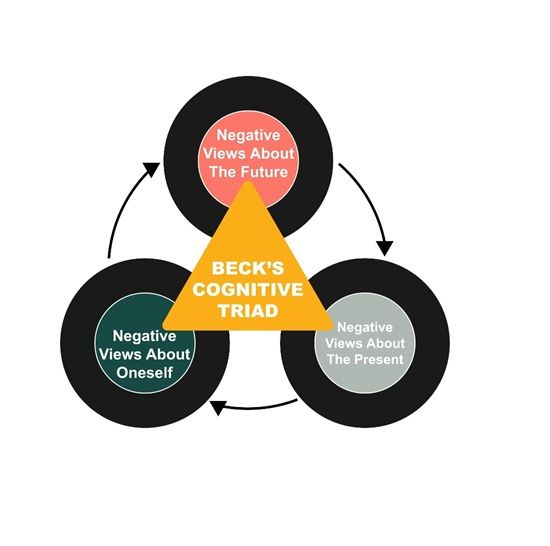
Fostering self-efficacy (a ‘Can-Do’ attitude) is in my view the primary safeguard against the ‘Cognitive Triad’—the psychological framework Aaron Beck identified as the catalyst for chronic disengagement and learned helplessness:
Negative Views of Self: The learner perceives themselves as linguistically ‘inadequate,’ often attributing temporary struggle to permanent personal deficits.
Negative Views of the Experience: Lessons, homework, and assessments are perceived as an unfair gauntlet of obstacles, leading to cognitive overwhelm.
Negative Views of the Future: The learner anticipates perpetual failure, viewing the path to fluency as hopeless—a mindset that inevitably triggers anxiety and withdrawal.
By prioritizing ‘successful processing’ and the ‘science of success,’ we do more than build linguistic competence; we dismantle the systemic anxiety that has plagued language classrooms for decades. We move students from initial exposure to spontaneous fluency not just through logic, but through the joy of achievement.
The principles below represent a universal blueprint for language acquisition because the biological constraints of human memory remain constant across all learners. Applying these staples globally ensures an inclusive pedagogy where fluency becomes a predictable outcome of a scientifically grounded process, rather than a lucky accident for a select few.”
Figure 1 – Beck’s (1960) Cognitive triad
1. The MARS EARS Cycle
This foundational instructional sequence respects the learner’s cognitive architecture by moving from MARS (Modeling, Awareness-Raising, Receptive Processing, Structured Production) to EARS (Expansion, Autonomy, Routinization, Spontaneity).
Research Basis: Rooted in Skill Acquisition Theory (DeKeyser, 2007) and Cognitive Load Theory (Sweller, 2011), which emphasizes managing working memory during the fragile initial stages of proceduralization.
2. Extensive Processing of highly comprehensible input before Controlled Practice
EPI prioritizes “depth over breadth,” favouring “input flooding” where students process a limited set of high-frequency structures hundreds of times across diverse, multi-sensory tasks. Crucially, this occurs within the context of highly comprehensible (>98%) and patterned input. Input flooding ensures repeated processing of target linguistic features; when engineered intelligently—integrating input-enhancement, opportunities for Language-Related Episodes (LREs), and process-based instruction—it facilitates both conscious and subconscious learning.
Research Basis: Grounded in Laufer and Hulstijn’s (2001) Involvement Load Hypothesis and Nation’s (2006) research on lexical coverage, alongside Swain and Lapkin’s (1998) work on the efficacy of Language-Related Episodes in consolidating formal accuracy.
3. Sentence Builders
Sentence Builders serve as the primary cognitive scaffold, presenting language in logical, horizontal “chunks.” This allows students to create complex, grammatically correct sentences immediately, bypassing the “grammatical bottleneck.” Consistently with Sweller’s Cognitive Load Theory, they constitute worked examples which provide a clear, step-by-step path to the final linguistic “product.” By explicitly laying out the combinatorial possibilities of the language, they significantly reduce the extraneous cognitive load that occurs when students are forced to search for words and rules simultaneously.
Instead of struggling with the mechanics of sentence construction (the “problem-solving” phase), learners can focus their finite cognitive resources on the mapping of form to meaning. This allows for the successful automation of these structures into long-term memory, effectively transforming a high-effort task into a low-effort retrieval process over time.
Research Basis: Supported by Usage-Based Linguistics (Tomasello, 2003) and modern interpretations of Scaffolding (Puntambekar & Hubscher, 2005), providing the frameworks necessary for learners to perform beyond their independent capacity. Also supported by Sweller (2006) on the “worked-example effect,” which demonstrates that learners perform better when they are shown a solution rather than being forced to discover it.
4. Lexical Chunks: The Unit of Acquisition
EPI treats the formulaic sequence or “chunk” as the fundamental building block of acquisition, rather than the individual word. By focusing on these pre-fabricated units, students bypass the high-effort process of assembly-on-the-fly, which is often the primary cause of cognitive overload when learners, who lack a robust mental lexicon, attempt to apply grammatical rules in real-time. This allows for “holistic retrieval,” where phrases are stored and accessed as single cognitive units, drastically reducing the burden on working memory and creating the “lexical agility” required for real-world interaction.
Research Basis: Supported by Wray (2002) and Schmitt (2010), who demonstrate that native-like fluency is the mastery of a massive repertoire of pre-fabricated chunks that allow the brain to focus on the message rather than the mechanics.
5. Narrow Reading & Listening
This technique involves exposing learners to multiple, highly similar texts that repeat the same target structures in slightly different contexts. Rather than overwhelming students with one taxing “authentic” document, narrow processing ensures a “flooding” effect that builds deep familiarity, even though the content remains diverse enough to sustain engagement, because the repetition occurs within varied but predictable contexts. This facilitates the incidental acquisition of syntax and vocabulary through high-frequency, comprehensible repetition.
Research Basis: Grounded in Lightbown (2014) and Nation and Webb (2011), which confirms that repeated exposure across predictable contexts is the most effective driver of structural “anchor points.”
6. Focus on Receptive Skills First
In EPI, “Input is King.” We prioritize the construction of a deep “receptive base” before demanding output to allow students to develop a robust mental representation of the language. While traditional methods often force premature production, which frequently results in fossilized errors and high anxiety, the EPI model delays output until the learner has internalized the phonological and syntactic code. This avoids performance anxiety and ensures the “depth of intake” is maximized.
Research Basis: Anchored in Marsden and Shintani’s (2022) meta-analysis on the superiority of Input-Based Practice (IBP) and Leow’s (2015) cognitive-pedagogical theory.
7. Listening as Modelling (Input Enhancement)
Listening is redefined as the primary vehicle for modeling, employing Input Flood, Input Enhancement, and Process-Based Instruction to explicitly train “listening micro-skills.” This ensures that students move from hearing a stream of noise to segmenting the sound into meaningful chunks, a process that is notoriously difficult for beginners unless the teacher provides structured decoding practice, which focuses specifically on bottom-up processing.
Research Basis: Based on Field’s (2008) work on decoding skills and Wong’s (2005) research on making linguistic features salient without interrupting communicative flow.
8. Structured Production: The Scaffolding Bridge
Oral activities are meticulously engineered to move from low-stakes chunking aloud to chunk retrieval and eventually to semi-structured tasks. By scaffolding challenging oral tasks with written priming and pre-planning, we ensure that students are never “thrown into the deep end,” since providing these cognitive supports allows them to focus on pronunciation and fluency, which would otherwise be compromised if they were simultaneously struggling to retrieve vocabulary.
Research Basis: Supported by Skehan’s (2009) Cognitive Approach to task design, which emphasizes planning time and task complexity as the dual levers for output quality.
9. Focus on Sound-to-Spelling Correspondence (SSC)
We place a primary emphasis on SSC through micro-listening and chunking aloud. By explicitly teaching the relationship between sound and script from the outset, we provide students with the “keys to the code,”which significantly reduces the likelihood of students mispronouncing written words, as they have been trained to recognize the phonological patterns that underlie the orthography. This builds the awareness necessary for fluent reading and confident speaking.
Research Basis: Draws on Ehri’s (2005) phases of sight-word learning and Woore’s (2009) research on the benefits of explicit phonics instruction for beginners.
10. The Cumulative Curriculum: Recycling & Interleaving
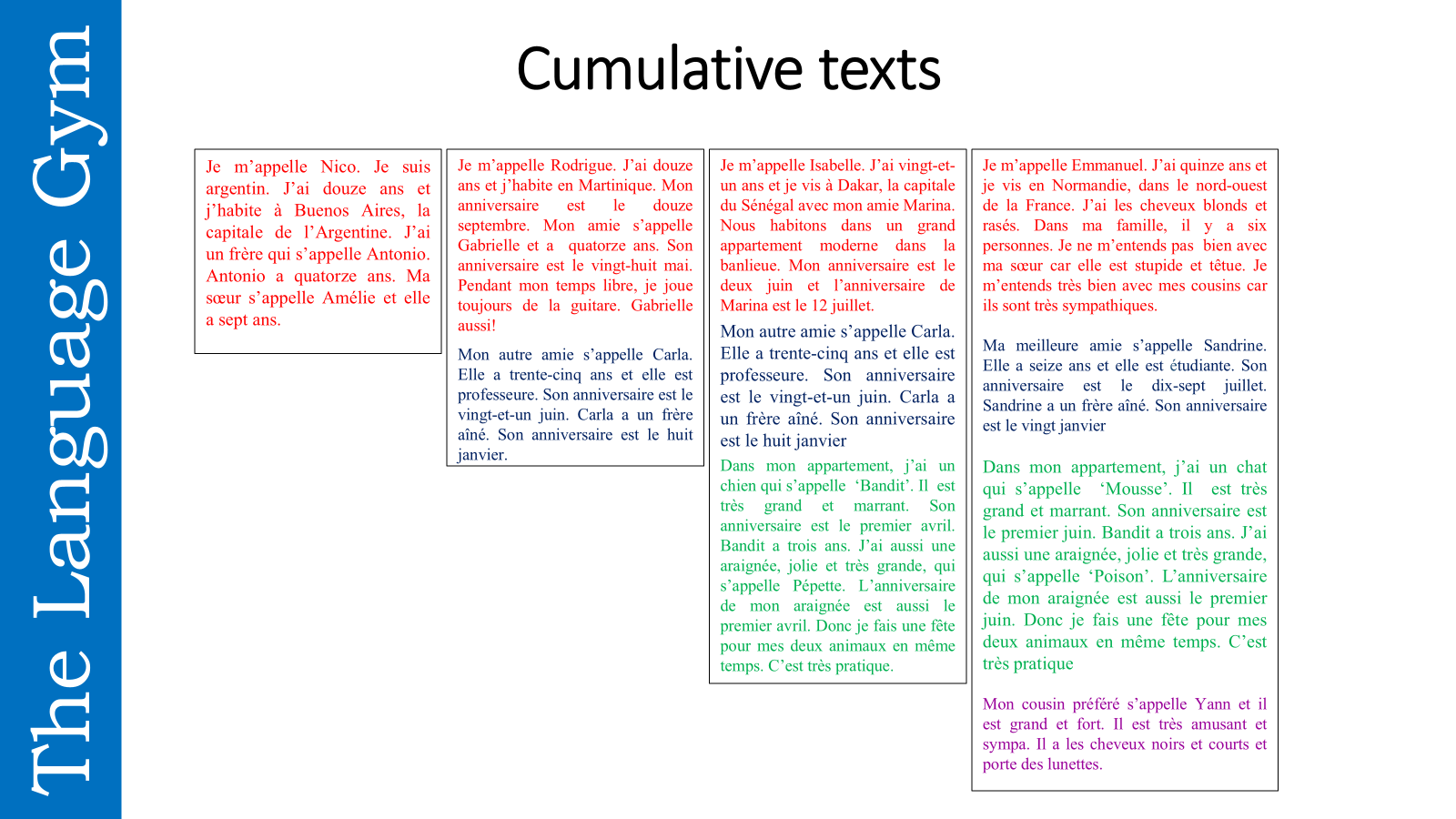
The EPI curriculum is a “spiral” where we use cumulative texts that intentionally embed material from all previous units. By building in “curriculum holes” and interleaving different topics, we force the brain to constantly retrieve language, which is essential for creating permanent neural pathways, because language that is not regularly re-activated during the learning cycle will inevitably be lost to the forgetting curve.
Research Basis: Supported by the Spacing Effect (Cepeda et al., 2006) and Interleaving Theory (Rohrer, 2012), proving distributed practice is superior for long-term memory.
Figure 2 – Cumulative texts
11. Routinized High-Efficiency Classroom Habits
A high-performance classroom requires high-efficiency habits, utilizing snappy, low-stakes assessments every 6–7 lessons. Consistent classroom routines and Do-Now tasks maximize “time on task,”ensuring that every second of the lesson is dedicated to linguistic processing, although the atmosphere remains supportive because the students find the predictable structure comforting rather than stifling.
Research Basis: Aligns with Rosenshine’s (2012) Principles of Instruction and Hattie’s (2009) meta-analysis on high-impact formative feedback.
12. Fluency Training (The Nation Influence)
Inspired by Paul Nation’s (2007) “Four Strands,” we incorporate timed activities to increase retrieval speed. By practicing known language under time pressure, we move to the “automaticity” phase, training the brain to access the lexicon with the rapid-fire speed required for conversation, even if the student is initially nervous about the time constraint.
Research Basis: Grounded in Nation (2007) and Segalowitz’s (2010) work, emphasizing that fluency must be practiced using familiar language.
13. Integrated Grammar: Proactive vs. Reactive
Grammar is Proactively housed within Sentence Builders and clarified through Reactive “Pop-up Grammar” moments. This approach ensures that the explanation addresses the “how” and “why” only once the students have developed a mental representation of the structure, a strategy that is far more effective than traditional deductive methods, where students are often taught rules for language they have not yet encountered in a meaningful context.
Research Basis: Supported by Macaro’s (2003) research, suggesting grammar is most effective when contextualized and tied to an immediate communicative need.
14. Low-Stakes Retrieval Practice
We use frequent retrieval tasks to pull language from long-term memory, strengthening the neural pathways. This creates a positive feedback loop where successful retrieval causes student anxiety to drop, especially when the tasks are gamified so that students forget they are being tested, which ultimately leads to a surge in self-efficacy and motivation.
Research Basis: Rooted in the Testing Effect (Roediger & Karpicke, 2006) and the “Desirable Difficulties” framework of Bjork and Bjork (2011).
Conclusion
To wrap this up, it is essential to remember that while the cognitive engineering of the EPI approach provides the framework, the teacher provides the lifeblood. We aren’t just teaching a language; we are rebuilding the learner’s belief in their own ability to succeed.
By grounding our practice in these 14 staples, we move away from the “hit-or-miss” nature of traditional instruction and toward a universal standard of excellence that respects the limits of the human brain while celebrating its potential. When we harmonize the science of the synapse with the empathy of the classroom, we don’t just create speakers—we create confident, global citizens who no longer view a second language as an impossible barrier, but as a bridge they are fully equipped to cross.
*any moment during a task when learners stop to think about language itself — its form, meaning, or use.
Selected References
Bjork, E. L., & Bjork, R. A. (2011). Making things hard on yourself, but in a good way: Creating desirable difficulties to enhance learning. Psychology and the Real World.
Cepeda, N. J., et al. (2006). Distributed practice in verbal recall tasks: A review and quantitative synthesis. Psychological Bulletin.
DeKeyser, R. M. (2007).Practice in a Second Language: Perspectives from Applied Linguistics and Cognitive Psychology. Cambridge University Press.
Field, J. (2008).Listening in the Language Classroom. Cambridge University Press.
Hattie, J. (2009).Visible Learning: A Synthesis of Over 800 Meta-Analyses Relating to Achievement. Routledge.
Laufer, B., & Hulstijn, J. (2001). Incidental vocabulary acquisition in a second language: The construct of task-induced involvement. Applied Linguistics.
Leow, R. P. (2015).Explicit Learning in the L2 Classroom: A Cognitive-pedagogical Theory. Routledge.
Lightbown, P. M. (2014).Focus on Content-Based Language Teaching. Oxford University Press.
Macaro, E. (2003).Teaching and Learning a Second Language. Continuum.
Marsden, E., & Shintani, N. (2022). Input-based practice, production-based practice, and the development of L2 proficiency: A meta-analysis. Applied Linguistics.
Nation, I. S. P. (2007). The four strands. Innovation in Language Learning and Teaching.
Nation, I. S. P. (2013).Learning Vocabulary in Another Language. Cambridge University Press.
Nation, I. S. P., & Webb, S. (2011).Researching Speaking. Heinle Cengage Learning.
Puntambekar, S., & Hubscher, R. (2005). Tools for Scaffolding Students in a Complex Learning Environment: What Have We Gained and What Have We Missed? Educational Psychologist.
Roediger, H. L., & Karpicke, J. D. (2006). The Power of Testing Memory: Basic Research and Implications for Educational Practice. Perspectives on Psychological Science.
Rosenshine, B. (2012). Principles of Instruction: Research-Based Strategies That All Teachers Should Know. American Educator.
Schmitt, N. (2010).Researching Vocabulary: A Vocabulary Research Manual. Palgrave Macmillan.
Segalowitz, N. (2010).Cognitive Bases of Second Language Fluency. Routledge.
Skehan, P. (2009). Modelling speaker performance in second language acquisition. Applied Linguistics.
Sweller, J. (2011). Cognitive Load Theory. Psychology of Learning and Motivation.
Tomasello, M. (2003).Constructing a Language: A Usage-Based Theory of Language Acquisition. Harvard University Press.
Wong, W. (2005).Input Enhancement: From Theory and Research to the Classroom. McGraw-Hill.
Woore, R. (2009).Investigating the development of beginner learners’ French pronunciation and sound-spelling knowledge. University of Oxford.
Wray, A. (2002).Formulaic Language and the Lexicon. Cambridge University Press.
Here is the complete list of sessions I’ll be leading for the University of Bath’s Network For Learning this term.
Note: This doesn’t include my (pretty hectic) international schedule for the Australia tour in May or the European tours running through June to September!
Many of you have reached out recently asking for strategies that “cut across” different teaching styles. While I’m usually deep in the world of EPI, we’ve listened to you and have included a new series of methodology-neutral workshops that provide universal instructional strategies—perfect for any teacher looking to sharpen their toolkit, regardless of their specific pedagogical preference.
For those interested in the EPI accreditation: go straight to the bottom of the page. Why should you be working towards the EPI accreditation? Here are some of the key reasons:
Why Join the EPI Accreditation Journey?
1. Join the Most Rapidly Growing MFL Community in the UK
The data speaks for itself. According to the recent British Council Language Trends survey, the EPI (Extensive Processing Instruction) framework is now the most widely used research-informed methodology in English secondary schools. By becoming accredited, you aren’t just learning a method; you are joining a professional movement that has redefined the national landscape of language teaching.
2. Master the “Science of Teaching” and Learning
EPI is more than just a collection of “fun activities.” The accreditation process dives deep into the cognitive science of how the brain actually acquires language. You will master the MARS EARS cycle, learning how to move students from initial awareness to spontaneous fluency by respecting the limitations of working memory and the power of “chunking” for long-term retention.
3. The “Direct from Source” Advantage
It is a poorly kept secret in the MFL world: many of today’s most prominent MFL bloggers and CPD providers have attended several EPI courses and/or have drawn heavily on its methodology and techniques. While they may have rebranded the strategies or called them by different names, their most successful techniques—from Sentence Builders to Narrow Listening—draw heavily and directly on the EPI framework. Accreditation allows you to bypass the “second-hand” versions and learn the original, high-impact principles directly from the creator.
4. A Blueprint for True Adaptive Teaching
With the removal of the EBacc and the rising diversity of learner needs, “one size fits all” no longer works. EPI accreditation provides a robust toolkit for adaptive teaching. You will learn how to scaffold complex linguistic tasks so that the weakest learners feel successful, while simultaneously providing the high-frequency “lexical agility” that pushes your most able students toward the highest grades.
5. Professional Authority in the New GCSE Era
As the new GCSE specifications move toward a focus on defined vocabulary and high-frequency structures, EPI-trained teachers are already ahead of the curve. Your accreditation proves that you possess the pedagogical “heavy lifting” skills required to deliver results in the current climate, making you a highly sought-after leader in the MFL community.
Here’s the full list with links you can click on for more information and to enroll.
Strategies for Effective Grammar Instruction 29 AprilFind out more 29 JulyFind out more __________________________________
From Rehearsed Answers to Exam-Ready Performance – GCSE Speaking Exam 8 June Find out more __________________________________
Writing that Scores – Preparing Students for new MFL GCSE Writing 11 JuneFind out more __________________________________
Becoming an EPI Teacher: A Deep Dive into Dr Conti’s Extensive Processing Instruction 17 June LondonFind out more 22 & 23 JuneFind out more 21 & 22 JulyFind out more ___________________________________
Implementing EPI at KS4 for the new MFL GCSEs 18 JuneFind out more __________________________________
Curriculum Design & Lesson Planning in MFL 29 & 30 JuneFind out more 25 & 26 AugustFind out more _________________________________
Becoming an Accredited EPI Teacher – Final Assessment Tutorial 8 July Find out more 16 September Find out more __________________________________
Applying Memory Research to L2 Vocab Instruction – Classroom & Curriculum Design Strategies for Long Term Retention 9 JulyFind out more __________________________________
Phonics in MFL 28 JulyFind out more ____________________________________
Implementing EPI for Learners in High School 15 SeptemberFind out more __________________________________
Becoming an Accredited EPI Teacher Program Gianfranco Conti | variousFind out more _______________________________________
Let’s start with a bit of honesty, because otherwise this becomes another polite CPD piece that changes nothing… do-now tasks are everywhere, they look good, they tick boxes but in many MFL classrooms they don’t actually move learning forward in any meaningful way… If that sounds a bit blunt it’s because, in my experience observing hundreds of lessons a year across WL, MFL and EFL learning contexts, what we often see is activity masquerading as learning
What are do-now tasks and where do they come from?
A do-now task is simply a short activity students complete as soon as they walk into the room, usually independently and without explanation, typically lasting three to five minutes; the idea was popularised by Doug Lemov in Teach Like a Champion, and it was originally about behaviour and efficiency, not learning in the deep cognitive sense. This is important because a lot of what we now attribute to do-now tasks was never part of the original design.
Only later did people start saying, “Ah, this is retrieval practice”, linking it to the work of Henry Roediger and Jeffrey Karpicke, or to activation of prior knowledge (Ausubel, 1968), and yes, in theory, it can do all of that, but – and this is th key point—only if it is designed with those principles in mind, which, in many cases, it simply isn’t! and this gap between theory and practice is where most of the damage happens…
What do-now tasks can do when they actually work
When they are done properly—and I stress properly, because this is where things usually go wrong—do-now tasks can be extremely powerful, precisely because they hit that moment at the start of the lesson when attention is relatively high and cognitive load is relatively low (Sweller, 2010), which makes them ideal for reactivating prior learning.
They can support retrieval practice, which we know strengthens memory (Roediger & Karpicke, 2006; Karpicke & Blunt, 2011), but only when retrieval is successful and followed by feedback (Butler & Roediger, 2008; Agarwal & Bain, 2019), they can enable spacing, which is critical for retention (Cepeda et al., 2006; Kang, 2016), and they can help students see learning as cumulative rather than a series of disconnected units, which is absolutely crucial in language learning where forgetting is the default state unless we intervene (Nation, 2013).
But there are a few other advantages that are often overlooked, and in my experience these are the ones that make a disproportionate difference when you get them right.
They create desirable difficulty at a low cost, in the sense that a well-designed do-now forces students to think just enough to engage memory without overwhelming working memory, which aligns with Bjork’s notion of “desirable difficulties” (Bjork & Bjork, 2011), and this matters because effortful recall, when it is successful, strengthens learning more than passive review.
They also provide a form of diagnostic assessment in real time, because within two or three minutes you can see very clearly what students can and cannot do, and this can inform the rest of your lesson in a way that end-of-unit tests simply cannot; in other words, they give you actionable data early, which is pedagogically far more useful than summative data late (Black & Wiliam, 1998).
Another benefit, which is rarely discussed but quite powerful, is that they help build fluency under low-stakes conditions, because students are asked to retrieve and produce language regularly without the pressure of formal assessment, and over time this repeated, low-stakes retrieval contributes to automatisation (DeKeyser, 2007), even if each individual task feels quite small.
They can also strengthen metacognitive awareness, because when students repeatedly encounter language they thought they knew but cannot fully retrieve, they begin—slowly, sometimes reluctantly—to recalibrate their own sense of what it means to “know” something, which is a key aspect of self-regulated learning (Dunlosky & Metcalfe, 2009).
And finally, they create lesson continuity, not just in the sense of revisiting content, but in signalling to students that what they learned yesterday, last week, or last term still matters today, and that learning is something that accumulates rather than resets, which, although it sounds obvious, is something many learners do not naturally perceive unless it is made explicit.
Let me give you a simple example of a do-now task that actually works.
Bad version (what I often see): “Translate: I play football / I watch TV / I go to the park” → all from yesterday’s lesson → easy, quick, forgotten in 10 minutes
Better version: “Translate: When I was ten I used to play football / Yesterday I went to the park / Tomorrow I will watch TV”
Now what’s happening?
multiple tenses
retrieval from different points in the curriculum
actual thinking
Even better: “Write one sentence about the past, one about the present, one about the future using these verbs: giocare, andare, guardare”
Now you’re getting:
retrieval
manipulation
transfer
Same time, completely different impact.
Why they go wrong in MFL (and they really do)
Now here’s where it gets slightly uncomfortable, because the issue is not the idea of do-now tasks, it’s how we use them… and, frankly, how casually we sometimes design them
1. They are too narrow
Most do-now tasks focus on the current unit, which makes sense superficially but is disastrous for retention; and this is why you get the classic situation where students can perform reasonably well in a unit test and then, three months later, that language has vanished as if it had never been taught, which is not a failure of teaching but a failure of retrieval over time (Cepeda et al., 2006; Kang, 2016).
Example of poor practice: “Translate: I eat pizza / I drink water / I like ice cream”
Better: “Translate: I ate pizza yesterday / I used to drink water every day / I will eat ice cream tomorrow”
Now you’re forcing:
interleaving
retrieval across time
2. Retrieval is introduced too early
This is a big one, and it links to recent discussions around the limits of retrieval practice (Carpenter, 2022; Nakatsukasa, 2023; Yang et al., 2021).
Teachers often ask students to retrieve language that has not been sufficiently processed, which leads to:
guessing
copying
fossilising errors
I’ve seen this countless times. Students are introduced to a structure, then imediately asked to produce it from memory, and the teacher thinks, “Great, they’re retrieving”, but what is actually happening is approximation under pressure, which is not the same thing (Sweller, 2010; DeKeyser, 2007).
If they can’t do it with support, they won’t do it without support…
3. They are disconnected from the lesson
This one drives me slightly mad.
The do-now happens, students finish it, it is checked quickly, and then we move on as if it never happened; and at that point you’ve wasted one of the most cognitively valuable moments in the lesson (Rosenshine, 2012).
If you retrieve something, you must use it again.
Otherwise:
it goes back into long-term memory
and stays there… unused
4. They are too easy (or too mindless)
A lot of do-now tasks are designed to be “quick wins”, but in doing so they become mechanical, and here is the uncomfortable truth:
Effort matters (Bjork & Bjork, 2011)
If students are not thinking, they are not learning.
How to fix them (without reinventing the wheel)
You don’t need to scrap do-now tasks. You need to upgrade them… and the good news is that the fixes are not complicated, they just require intention.
1.Interleave previously learned (secure) items
The aim is to mix language that has already been stabilised in long-term memory, not to force complexity for the sake of it; interleaving strengthens retrieval when items are secure (Cepeda et al., 2006), but if you mix unstable material you simply overload working memory and trigger guessing (Sweller, 2010)… in other words, don’t interleave fragility.
Think: “What is ready to be retrieved and recombined?”, not “How many tenses can I cram in?”
Year 7 (early KS3 – no interleaving yet, just stabilisation):
I play football
I watch TV
I go to the park
Same structure, high repetition → building form–meaning mapping
Year 8 (emerging interleaving – safe and controlled):
I play football every day
Yesterday I played football
I don’t play football
Mix:
present + past
affirmation + negation BUT only with high-frequency, well-rehearsed verbs
Year 9–11 (full interleaving — now it pays off):
When I was ten I used to play football
Yesterday I played football with my friends
Now I play basketball instead
Next week I will play in a match
Now you get:
multiple time frames
contrast
transfer because the language is secure enough to handle it
2. Control difficulty
Aim for:
~70% success (Rowland, 2014)
not guessing, not trivial
3. Recycle in the lesson
If the do-now includes: Quando avevo dieci anni giocavo a calcio
Then later: Ora invece gioco a tennis
That’s transfer.
4. Use partial support
Don’t go from full support → nothing.
Use:
sentence builders
prompts
partial translations
Where do they fit in MARS EARS?
Do-now tasks sit after modelling and processing, not before.
What they are: retrieval + structured production
What they are NOT: – initial exposure – blind production
In other words:
language must be seen, heard, processed first
THEN retrieved (VanPatten, 2015)
If you reverse that sequence, you are not doing retrieval practice, you are doing guessing practice…which will likely lead to fragile learning
Conclusion
Do-now tasks are not the problem. Poorly designed do-now tasks are. And if students forget what you taught them in Term 1 by Term 3, the issue is not that they are lazy or unmotivated, it is that the system has not forced that knowledge back into working memory often enough, and no amount of engagement or “fun” activities will fix that (Nation, 2013; Cepeda et al., 2006).
So next time you design a do-now, ask yourself: Am I just starting the lesson… or am I making memory work?
For the past decade or so, retrieval practice has enjoyed near-mythical status in education circles, often presented, somewhat uncritically, as a universal good : test more, retrieve more, and learning will automatically follow. And while the underlying principle is undoubtedly sound, recent research and, in my experience, classroom reality suggest that the picture is rather more nuanced than the slogan would have us believe.
Let us be clear from the outset: retrieval practice DOES work. A robust body of research shows that retrieving information strengthens memory more effectively than re-exposure alone (Roediger & Karpicke, 2006; Karpicke & Blunt, 2011), and in the context of vocabulary learning this has been repeatedly confirmed, with retrieval supporting long-term retention when used appropriately (Nation, 2013; Kang, 2016). However, what more recent syntheses in cognitive psychology and its application to SLA are beginning to emphasise is that retrieval is highly condition-dependent, and that when those conditions are not met, its benefits may be attenuated, or, in some cases, even reversed.
The following three variables, in particular, appear to be critical:
First, success rate: retrieval needs to be largely successful—typically in the region of 60–80%—for it to strengthen memory traces effectively, because repeated failure leads not to learning but to guesswork or disengagement (Karpicke, 2017; Rowland, 2014).
Second, prior encoding: the material must have been sufficiently processed before retrieval is attempted, since asking learners to retrieve poorly encoded information places excessive demands on working memory and often results in the reinforcement of incorrect hypotheses (Sweller, 2010; Baddeley, 2000). Hence the importance of input processing and effective elaborative rehearsal prior to retrieval, a tenet of the EPI methodology, which occurs in the MAR segment of the MARSEARS sequence.
Third, feedback quality: errors must be corrected promptly and clearly, otherwise retrieval risks consolidating inaccuracies rather than strengthening correct representations (Butler & Roediger, 2008).
And here, if one may pause for a moment, lies the pedagogical crux: in beginner and mixed-ability classroomwheres, learners’ lexical and grammatical representations are still fragile, and where processing capacity is easily overwhelmed, these conditions are not always present, and in my observation this is precisely when retrieval tasks become less a tool for consolidation and more an exercise in frustration; and is it not reasonable, therefore, to question whether what we are witnessing in such cases is retrieval at all, or merely the appearance of it?
From a cognitive load perspective, the issue becomes even clearer. Working memory is limited (Baddeley, 2000), and when learners are asked to retrieve language that has not yet been automatised, they must simultaneously search for forms, map them to meaning, and assemble them into coherent output. This operation, for novices, is often simply too demanding. Under such conditions, retrieval may not only fail to support learning but may actually impair encoding, because attentional resources are diverted away from processing input and towards struggling with output (Sweller, 2010; DeKeyser, 2007).
So what does this mean for classroom practice? Not, certainly, that retrieval should be abandoned—far from it—but rather that it should be repositioned within a carefully sequenced instructional framework, one in which learners are first provided with rich, comprehensible input, then guided through structured processing activities that stabilise form–meaning connections, and only then asked to retrieve and produce the language in question. In other words:
input → processing → rehearsal → retrieval
not the other way round, as often happens..
This is not a trivial adjustment. It represents a shift from viewing retrieval as the engine of learning to understanding it as a powerful consolidator of learning, effective precisely because it strengthens representations that are already in place, rather than creating them ex nihilo—an assumption which, though rarely stated explicitly, often underpins premature retrieval tasks.
In conclusion, retrieval practice remains one of the most valuable tools at our disposal, but like all powerful tools it must be used with precision; and if there is one lesson emerging from the most recent research—and, indeed, from careful classroom observation—it is that timing matters as much as technique, because learning is not simply a matter of doing the right thing, but of doing it at the right moment.
References
Baddeley, A. (2000). The episodic buffer: A new component of working memory? Trends in Cognitive Sciences. Butler, A. C., & Roediger, H. L. (2008). Feedback enhances the positive effects and reduces the negative effects of multiple-choice testing. Memory & Cognition. Carpenter, S. K. (2022).Retrieval practice. In J. Dunlosky & K. A. Rawson (Eds.), The Cambridge handbook of cognition and education (2nd ed., pp. 347–369). Cambridge University Press. DeKeyser, R. (2007). Practice in a second language: Perspectives from applied linguistics and cognitive psychology. Kang, S. H. K. (2016). Spaced repetition promotes efficient and effective learning. Policy Insights from the Behavioral and Brain Sciences. Karpicke, J. D. (2017). Retrieval-based learning: A decade of progress. Nakatsukasa, K. (2023).Retrieval practice in second language vocabulary learning: A research synthesis. Language Teaching Research, 27(4), 987–1008. Nation, I. S. P. (2013). Learning vocabulary in another language. Roediger, H. L., & Karpicke, J. D. (2006). Test-enhanced learning: Taking memory tests improves long-term retention. Psychological Science. Rowland, C. A. (2014). The effect of testing versus restudy on retention: A meta-analytic review. Psychological Bulletin. Sweller, J. (2010). Cognitive load theory: Recent theoretical advances.
Sentence builders—when used as carefully engineered, input-rich, reusable frames rather than mere substitution tables—offer a powerful convergence of cognitive and affective benefits; and, in my experience, when they are embedded within a coherent input→processing→production sequence rather than deployed as isolated artefacts, they become not just helpful supports but central drivers of acquisition, even if this runs counter to the somewhat fashionable preference for less structured approaches.
Before proceeding, however, I strongly believe it is important—especially for those familiar with my work—to dispel a common misconception: in EPI, sentence builders are not the method. They are, rather, a tool amongst several used to model language, to encourage noticing of key language features, to scaffold elaborative rehearsal, and to assist initial production; and while they play a crucial role within the broader architecture, they must be understood as one cog in the MARSEARS sequence, not the engine itself.
Indeed, and this is something I have observed repeatedly in classrooms where EPI is implemented with fidelity, the language contained within a sentence builder does not constitute the totality of what learners encounter, because during the receptive phases learners are exposed to aural and written input through narrow listening and narrow reading, which extends, enriches, and consolidates the core language, thereby ensuring that the builder functions as a springboard rather than a boundary—and is it not precisely this interplay between structured input and guided output that drives acquisition forward?
Cognitive benefits
1. Reduces cognitive load, frees up processing capacity
Sentence builders externalise part of the linguistic load (lexis, morphology, word order), which—given the limits of working memory (Baddeley, 2000; Sweller, 2010)—allows learners to focus on meaning-making and message construction rather than retrieval from scratch, and in my observation this is precisely what enables lower-attaining learners to remain cognitively engaged rather than overwhelmed, especially when the linguistic demands would otherwise exceed their processing capacity within seconds.
Example Instead of generating: “I went to the cinema with my friends because…” from nothing, learners select and combine pre-structured chunks → less overload, more successful processing.
Research: Sweller (2010); Baddeley (2000); Paas & van Merriënboer (1994)
By aligning chunks clearly (e.g. je vais + infinitive), sentence builders help learners establish accurate form–meaning connections, reducing reliance on faulty heuristics (VanPatten, 2015), and—this is key, and often underestimated—preventing the kind of mislearning that occurs when learners construct meaning from partial or misleading cues.
Example je vais regarder consistently mapped to “I am going to watch” across multiple sentences → stable mapping.
Research: VanPatten (2015); Wong (2004)
3. Promotes chunking and automatisation
Frequent exposure to patterned language encourages chunking (Ellis, 2002), and with repeated retrieval, these chunks become automatised (DeKeyser, 2007), which in turn reduces processing time and increases fluency; and one might say, perhaps a little unfashionably, that learners begin to operate through formulaic sequences which, far from being a limitation, constitute the very substrate of fluent language use.
Example I would like to + infinitive + non or prepositional phrase becomes a single retrievable unit rather than assembled word by word.
Sentence builders lend themselves naturally to recycling across lessons, supporting spacing effects (Cepeda et al., 2006) and retrieval practice (Roediger & Karpicke, 2006), both of which are strongly linked to durable learning; and in my experience, when the same builder is revisited across modalities—listening, reading, speaking, writing—the gains are not merely additive but multiplicative.
Example Monday: comprehension Wednesday: structured speaking Friday: written adaptation
Research: Cepeda et al. (2006); Roediger & Karpicke (2006); Kang (2016)
They provide a bridge from receptive processing to controlled production, ensuring that output is not random but principled and success-oriented, which aligns with skill acquisition theory (DeKeyser, 2007), where guided practice precedes freer use; and in my observation, skipping this stage is one of the most common causes of fragile, error-prone production. They are valuable tools in the elaborative rehearsal phase which should always precede retrieval, i.e. the phase in which students carry out activities such as sentence puzzles, gap-fill, odd one out, word subsitution and other deep processing tasks, etc. with the assistance of sentence builders.
Example Learners produce accurate sentences before being asked to improvise.
Research: DeKeyser (2007); Anderson (1982)
6. Enhances noticing of patterns (lexicogrammar)
By visually organising language, sentence builders make patterns salient, supporting noticing (Schmidt, 1990) and helping learners internalise colligations and collocations—what Halliday would call lexicogrammar—even if, to the learner, this remains largely implicit and only gradually becomes explicit through repeated exposure.
Example Seeing play + sport (no article) vs play the + instrument repeatedly.
Sentence builders lower the affective filter (Krashen, 1985) by giving learners a clear pathway to success; and in my experience, even students who would normally remain silent are willing to attempt production when they feel they are not operating in a vacuum but within a supportive structure.
Research: Krashen (1985); Horwitz et al. (1986)
2. Increases willingness to communicate
Because learners are not starting from zero, they are more likely to take risks and speak, which is essential for developing fluency (MacIntyre et al., 1998), even if the language is initially scaffolded rather than spontaneous in the purist sense.
Research: MacIntyre et al. (1998); Dörnyei (2005)
3. Creates a sense of control and clarity
Ambiguity is reduced: learners know what is expected, what is possible, and how to succeed, which—though it may sound somewhat antiquated—restores a degree of didactic transparency often absent in less structured approaches. A recent research by Kate Trafford (here) found that the use of sentence builders was highly instrumental in tripling her GCSE uptake. The main reason for the students liking sentence builders was that their use make them more confident for the control and clarity they provide.
Stronger learners can extend and manipulate, weaker learners can follow and succeed, and in my observation this dual accessibility is one of the few ways to maintain both challenge and inclusivity without fragmenting the class into separate tracks.
Research: Tomlinson (2014); Vygotsky (1978)
5. Builds momentum and motivation through success
Success breeds motivation (Dörnyei, 2001), and sentence builders provide frequent, visible success moments which gradually reshape learner self-perception—I can’t do languages becomes I can actually say things, and that shift, once achieved, is remarkably powerful.
Research: Dörnyei (2001); Bandura (1997)
The perils of using sentence builders badly
Let us not pretend that sentence builders are a panacea, because in my experience they can be misused in ways that are not merely ineffective but actively counterproductive, particularly when teachers—often with the best of intentions—shortcut the processing phase and move too rapidly into retrieval or production, thereby forcing learners to produce language they have not yet sufficiently internalised.
Common pitfalls include:
Going to retrieval too soon → learners guess rather than retrieve
Overcrowded sentence builders → excessive options increase cognitive load rather than reduce it
Lack of recycling → structures remain inert and unautomatized
Overreliance → learners become dependent if scaffolds are not gradually withdrawn
Poor sequencing → jumping from exposure to free production without intermediate stages
And here one might reasonably ask: if a tool designed to reduce cognitive load ends up increasing it, have we not misunderstood its very purpose?
Sentence builders are often criticised on several grounds, and it is worth addressing these explicitly rather than dismissing them, because some contain a kernel of truth even if the conclusion drawn is, in my view, misguided.
“They limit creativity”
This criticism assumes that creativity precedes control, whereas the evidence suggests the opposite: learners require a threshold level of automatised language before meaningful creativity is possible (DeKeyser, 2007; Skehan, 1998); in my experience, asking beginners to be creative without sufficient linguistic resources results not in creativity but in silence or error. As mentioned above, the language contained within a sentence builder does not constitute the totality of what learners encounter, because during the receptive phases learners are exposed to aural and written input through narrow listening and narrow reading and any other texts the teachers deem useful, which extends, enriches, and consolidates the core language, thereby ensuring that the builder functions as a springboard rather than a boundary—and is it not precisely this interplay between structured input and guided output that drives acquisition forward?
“They encourage rote learning”
All learning involves some degree of memorisation, and the question is not whether learners memorise, but what they memorise and how it is processed; sentence builders, when used properly, promote meaningful repetition, not mindless parroting.
Research: Nation (2013); Baddeley (2000)
“They are not communicative”
On the contrary, they enable communication earlier, because they provide the linguistic means to express meaning, even if within constraints; and is it not preferable for learners to communicate accurately within a frame than inaccurately without one?
Research: Long (1996); Ellis (2003)
“Students become dependent on them”
Only if scaffolding is not withdrawn; properly used, sentence builders are gradually faded as learners internalise patterns, much like training wheels on a bicycle—useful initially, unnecessary later.
Research: Vygotsky (1978); Wood, Bruner & Ross (1976)
“They make learning boring”
Only if the teacher doesn’t know how to use them in an engaging way or always uses them the same way.
Conclusions
Sentence builders work because they sit at the intersection of cognitive efficiency and affective support, reducing overload while increasing confidence, stabilising form–meaning mappings while enabling structured production; and in my experience, when they are embedded within a principled instructional sequence—rich input, guided processing, scaffolded output, and gradual release—they do not constrain learners but rather enable them to say more, sooner, and with greater accuracy.
The real question, therefore, is not whether sentence builders should be used, but whether they are being used well, because the difference between effective scaffolding and counterproductive crutching lies not in the tool itself but in its implementation, and that, ultimately, is where professional judgement must prevail. This shines through very evidently in the above mentioned research by Kate Trafford which details a flawless and engaging implementation of EPI, in which the sentence builders are used with great ingenuity and creativity. The result, as she write in the conclusion of her MA dissertation:
“Pupils expressed with enthusiasm their opinions on the use of SBs, particularly in relation to visual organisation, accessibility and clarity of sentence structure. Their opinions directly reflect literature surrounding grammar being taught in context, enjoying being able to use the language to communicate as posited by CLT and the importance of lowering stress on the working and intermediate memory as per Krashen’s comprehensible input theory.”
References
Anderson, J. R. (1982). Acquisition of cognitive skill. Baddeley, A. (2000). The episodic buffer. Bandura, A. (1997). Self-efficacy. Bjork, R., & Bjork, E. (2011). Making things hard on yourself, but in a good way. Cepeda, N. et al. (2006). Distributed practice in verbal recall tasks. DeKeyser, R. (2007). Practice in a second language. Dörnyei, Z. (2001). Motivational strategies in the language classroom. Ellis, N. (2002). Frequency effects in language processing. Ellis, R. (2003). Task-based language learning. Halliday, M. (1994). An introduction to functional grammar. Kang, S. (2016). Spaced repetition promotes efficient learning. Krashen, S. (1985). The input hypothesis. Long, M. (1996). The role of the linguistic environment. MacIntyre, P. et al. (1998). Willingness to communicate. Nation, I. S. P. (2013). Learning vocabulary in another language. Paas, F., & van Merriënboer, J. (1994). Instructional control of cognitive load. Roediger, H., & Karpicke, J. (2006). Test-enhanced learning. Rosenshine, B. (2012). Principles of instruction. Schmidt, R. (1990). The role of consciousness in SLA. Skehan, P. (1998). A cognitive approach to language learning. Sweller, J. (2010). Cognitive load theory. Tomlinson, C. (2014). The differentiated classroom. VanPatten, B. (2015). Input processing. Vygotsky, L. (1978). Mind in society. Wray, A. (2002). Formulaic language and the lexicon.
If I had a pound for every time I’ve heard “you must stay in the target language 100% of the time”, I’d probably be writing this from a beach somewhere rather than my desk; and yet, in my experience, as appealing as such slogans may appear—succinct, emphatic, and seemingly grounded in common sense—they tend, upon closer inspection, to unravel under the weight of empirical scrutiny.
Let me be clear from the outset: maximising target language (TL) use is pedagogically sound, and in my observation this is borne out both in the literature and in the classroom. A substantial body of research shows that frequent, meaningful exposure to the TL is essential for acquisition (Krashen, 1985; Nation, 2013; Ellis, 2015), since learners require rich input, repeated encounters, and opportunities to process language in context, all of which, when orchestrated judiciously, contribute to the gradual entrenchment of form–meaning mappings. In my own work with the EPI approach, I would argue that input is the engine of acquisition—and therefore the TL must dominate classroom discourse.
However—and this is the crucial point—“maximising TL” is not the same as “TL-only at all costs.”
In beginner, mixed-ability classrooms where all learners share the same L1, rigid TL-only policies can, in my experience, overwhelm working memory, reduce comprehension, increase anxiety, and ultimately disengage a significant proportion of learners, particularly when the linguistic demands exceed their current processing capacity and when no mediating support is available to stabilise meaning; and if that is the case, one might reasonably ask, what exactly are we maximising—exposure or confusion? In such contexts, the L1 is not the enemy of acquisition; it is a cognitive tool—a scaffold, a shortcut, and, dare one say (to use a slightly antiquated turn of phrase), a propedeutic aid.
Let’s unpack this properly, with the research in hand.
1. Comprehensibility: The Non-Negotiable Condition for Learning
One of the most robust findings in SLA is that input must be understood to be useful, a principle so well-established that it borders on the axiomatic. Nation (2013) and Hu & Nation (2000) suggest that learners need to know around 95–98% of the words in a text to process it effectively, which, in my experience, is rarely the case in beginner mixed-ability classrooms unless the input has been very carefully engineered.
In beginner classrooms, TL-only instruction often pushes learners well below this threshold, with the predictable consequence that comprehension falters and processing becomes superficial, fragmented, and at times illusory, as learners cling to isolated lexical items while failing to construct a coherent representation of meaning. The result?
Guessing
Shallow processing
Cognitive overload
Disengagement
A brief L1 clarification—ten seconds, no more—can restore comprehensibility and allow learners to actually process the TL input that follows, thereby ensuring that subsequent exposure is not merely auditory noise but cognitively tractable material.
As Nation (2013) reminds us, time spent not understanding is time not learning—and, if one may be permitted a rhetorical flourish, what conceivable virtue is there in incomprehension?
2. Cognitive Load
According to Cognitive Load Theory (Sweller, 2010), working memory is severely limited—typically handling around 4–6 elements at a time (Baddeley, 2000)—a constraint which, though often acknowledged in theory, is in my observation routinely underestimated in practice, particularly when teachers attempt to sustain extended TL-only discourse with novice learners.
Beginner learners are already juggling:
New phonology
New vocabulary
New syntax
When we insist on delivering instructions and explanations exclusively in the TL, we often add extraneous cognitive load, that is to say, processing which does not directly contribute to schema construction but instead taxes limited attentional resources, thereby impeding rather than facilitating learning; and is it not somewhat paradoxical that, in striving to immerse learners in the TL, we may in fact be diminishing their capacity to process it?
The irony is stark: in trying to increase exposure, we may actually reduce effective processing.
A well-timed L1 explanation reduces this extraneous load, allowing learners to allocate their limited cognitive resources to what actually matters: processing the TL input—a point which, though seemingly self-evident, bears reiteration in the current climate of methodological absolutism.
3. Preventing Mislearning
VanPatten’s Input Processing theory (2015) shows that learners rely heavily on default strategies, such as prioritising content words and neglecting morphological markers, particularly when processing capacity is strained; and in my experience, this tendency is exacerbated in TL-only environments where meaning is insufficiently anchored.
And here’s the problem: 👉 Incorrectly learned language is harder to unlearn than correctly learned language is to acquire.
When comprehension is weak, learners generate incorrect form–meaning mappings, which, once established, may fossilise and resist subsequent correction, thereby creating a pedagogical impediment that is far more onerous to address than the initial misunderstanding.
Strategic L1 use can:
Clarify meaning precisely
Prevent faulty hypotheses
Stabilise early representations
In other words, it acts as a quality control mechanism for input processing—an intervention not of indulgence but of prudence.
4. Efficiency and Time-on-Task
Macaro (2001) and Turnbull & Dailey-O’Cain (2009) both highlight that judicious L1 use increases efficiency, a finding which aligns closely with my own observation that time squandered on protracted TL explanations often yields diminishing returns, particularly in heterogeneous classrooms.
A concept that takes two minutes to explain in the TL may take ten seconds in the L1, and while some may argue that those two minutes constitute valuable exposure, one must ask whether such exposure, if only partially understood, is in fact pedagogically efficacious.
This is not about laziness—it is about optimising instructional time, or, to employ a somewhat recherché expression, ensuring economy of cognitive effort.
Every minute saved on clarification is a minute gained for:
Input flood
Processing tasks
Retrieval practice
Ironically, less rigid TL use can result in more total TL exposure—a conclusion which, though counterintuitive to some, is well supported by both research and classroom praxis.
5. Affective Factors: Keeping Students in the Game
Krashen’s Affective Filter Hypothesis (1985) reminds us that anxiety, confusion, and low self-efficacy can block acquisition, and in my experience this is particularly salient in mixed-ability classrooms where weaker learners, unable to access meaning, may withdraw cognitively even if they remain physically present.
TL-only approaches often:
Benefit the top 20%
Marginalise the rest
Lower-attaining learners, unable to follow, disengage—not because they are unwilling, but because they are locked out of meaning, and once this disengagement sets in, it can be remarkably difficult to reverse, especially if learners begin to perceive the subject as impenetrable.
Research by Macaro (2005) and Levine (2011) shows that appropriate L1 use can reduce anxiety and increase participation, particularly in lower-proficiency learners, thereby lowering the affective filter and facilitating engagement with the TL input.
6. The Power of Cross-Linguistic Comparison
Ellis (2006) and Hall & Cook (2012) highlight the value of explicit comparison between L1 and L2, a process which, in my observation, not only enhances noticing but also accelerates the consolidation of form–meaning relationships, particularly when learners are guided to attend to subtle differences that might otherwise escape their attention.
The L1 provides a powerful reference point for:
Noticing differences
Avoiding negative transfer
Deepening understanding
Example:
Mi piace il calcio → “to me pleases football”
Without L1 mediation, this structure can remain opaque for a considerable period, whereas a brief contrastive explanation can render it immediately intelligible—mutatis mutandis, the same principle applies across numerous grammatical structures.
Used well, the L1 is not a crutch—it is a cognitive lever.
7. Code-Switching and the Bilingual Brain
From a psycholinguistic perspective, bilinguals do not “turn off” one language to use another; rather, research shows that both languages are co-activated in the brain (Kroll, Bobb & Wodniecka, 2006; Green & Abutalebi, 2013), a phenomenon which has significant implications for classroom practice, even if it is sometimes overlooked in methodological debates.
This means:
The L1 is always present
Learners naturally draw on it
Suppressing it entirely is neither realistic nor cognitively optimal
Strategic code-switching:
Reduces processing effort
Facilitates meaning-making
Supports lexical access
In other words, using the L1 aligns with how the brain actually works, and to ignore this is, arguably, to disregard a fundamental aspect of human cognition.
8. The Mixed-Ability Reality
Let us not indulge in pedagogical idealisation: in real classrooms, ability is not evenly distributed, and any approach that fails to account for this heterogeneity risks privileging a minority at the expense of the majority.
TL-only instruction often results in:
Stronger learners inferring meaning
Weaker learners copying or withdrawing
In my experience, strategic L1 use allows us to maintain inclusivity while preserving cognitive challenge, ensuring that all learners can access meaning without diluting the intellectual demands of the task, which, after all, remains firmly rooted in the TL.
So Where Does This Leave Us?
The research does not support:
❌ TL-only dogma
❌ Excessive reliance on L1
Instead, it supports a principled middle ground, one which, though less rhetorically appealing than absolutist positions, is far more consistent with both theory and practice:
Maximise meaningful TL input
Use L1 strategically and sparingly for:
Instructions
Clarification
Contrastive explanation
Repair
Conclusion
The real question is not:
“Should I use the TL or the L1?”
But rather—if I may phrase it thus—
“At this precise moment, what will maximise comprehension, minimise cognitive overload, and lead to better processing of the TL?”
If the answer is ten seconds of L1, then refusing to use it is not principled—it is ideological; and ideology, as we know, is a very poor substitute for learning. Whenever a staunch advocate of TL-only starts giving me their spiel as to why it is so key that the teacher speaks solely or 99% in the TL and that teaching resources are solely or 99% in the TL, I always ask the very same question: is there a chance that one student in the class may be left behind? If so, then it is unethical. Period.
The L1 should be used as pedagogical capital, at the right time, in the right way, in order to scaffold TL use. In EPI, for instance, this is achieved through gradually phasing out the L1 after a substantive input-to-output sequence where English is not spoken, but helps maintaining input-processing comprensibile and retrieval feasible.



You must be logged in to post a comment.