by Gianfranco Conti, PhD. Co-author of 'The Language Teacher toolkit', 'Breaking the sound barrier: teaching learners how to listen', 'Memory: what every teacher should know' and of the 'Sentence Builders' book series. Winner of the 2015 TES best resource contributor award, founder and CEO of www.language-gym.com, co-founder of www.sentencebuilders.com and creator of the E.P.I. approach.
This June and July I will be delivering a ‘Teaching Lexicogrammar: from modelling to spontaneity’ workshop in London (17th June) and Manchester (1st July) focused on one of the biggest challenges in language teaching: how we help learners move from heavily scaffolded classroom performance to genuinely fluent and spontaneous communication. You can obtain the details of the workshops and information on how to enroll by contacting University of Bath Spa’s Denise Martin here: d.martin@bathspa.ac.uk.
Although the workshop is rooted in Extensive Processing Instruction (EPI), it is absolutely not “just for EPI teachers”. In fact, much of what I will discuss applies to any teacher who wants students to remember more language, speak with greater confidence, retrieve language faster and become less dependent on prompts and memorised scripts.
One important feature of the session is that participants will not simply hear about the activities theoretically. Throughout the workshop, teachers will experience many of the tasks first-hand exactly as learners would. Malay — a language unfamiliar to most participants — will be used extensively to model and practise activities so that attendees can directly experience what it actually feels like to learn, retrieve and produce unfamiliar language under varying levels of cognitive load.
The content
The session will unfold progressively, following the same input-to-output journey we ideally want our students to experience in the classroom.
We will begin with the WHY behind EPI.
• Why many learners fail to become fluent despite years of study We will look at what actually happens cognitively when students try to speak. Using simple teacher-friendly explanations of Levelt’s speaking model, I will show why speaking overloads so many learners: they must plan ideas, retrieve vocabulary, apply grammar, organise word order, pronounce accurately and self-monitor — all at speed.
At this stage, participants will experience short interactive activities in Malay designed to simulate the cognitive demands novice learners experience when attempting spontaneous production.
• Why “communicative activities” often fail weaker learners We will discuss why throwing students into spontaneous tasks too early frequently leads to hesitation, guessing, anxiety and fossilised errors. I will explain why fluency is not built through pressure but through carefully sequenced processing and retrieval.
Teachers will take part in interactive demonstrations showing the difference between unsupported performance and carefully scaffolded processing.
We will then move into the EARLY PHASES OF FLUENCY BUILDING.
• Building strong phonological representations through oral input Participants will explore how carefully structured oral work strengthens pronunciation, automatisation, listening accuracy and confidence whilst reducing cognitive overload.
A range of interactive Malay-language activities will be modelled at this stage so participants can experience how repeated oral processing gradually strengthens recall and fluency.
• Making repetition purposeful and engaging One of the major themes of the workshop will be how to recycle language intensively without lessons becoming mechanical or repetitive. We will discuss how retrieval, repetition and interaction can coexist successfully when tasks are designed around cognitive principles rather than entertainment alone.
Teachers will participate in a series of highly interactive retrieval routines in Malay in order to experience how repeated processing can remain cognitively engaging and motivating.
The workshop will then focus on TRANSITIONAL TASKS.
• How to bridge the gap between comprehension and independent production This is arguably the area where many language lessons break down. I will show how transitional tasks reduce cognitive overload whilst gradually increasing retrieval demand and learner independence.
Participants will work through staged Malay-language activities that demonstrate how learners can be guided progressively from recognition towards increasingly independent production.
• Helping learners proceduralise language rather than merely recognise it We will examine how carefully sequenced retrieval and reconstruction tasks help learners move vocabulary and grammar from short-term performance to longer-term automatised use.
Again, the activities will be modelled interactively so teachers can directly feel the difference between shallow familiarity and proceduralised control of language.
We will then move into STRUCTURED SPEAKING.
• How oral scaffolds and sentence builders support fluency I will show how oral scaffolds can be designed to balance challenge and accessibility, enabling students to speak successfully whilst gradually reducing support over time.
Teachers will complete scaffolded oral tasks in Malay that illustrate how effective support can increase confidence whilst still maintaining sufficient challenge.
• Moving from controlled production to freer communication Participants will explore how highly structured oral work can gradually evolve into semi-structured communicative interaction and eventually into spontaneous communication.
At this stage of the workshop, teachers will participate in fluency-oriented communicative activities that gradually remove support and increase spontaneity.
Finally, the workshop will culminate with FLUENCY TRAINING.
• How to engineer fluency systematically We will explore how cumulative retrieval, oral rehearsal and carefully sequenced communicative practice can build speed, confidence and automaticity over time rather than leaving fluency development to chance.
Participants will experience a sequence of fluency-training activities in Malay specifically designed to demonstrate how automatisation emerges through repeated successful retrieval and structured communicative practice.
Throughout the workshop I will continuously connect classroom practice to cognitive science and SLA research, but always in a very practical and teacher-friendly way.
Most importantly, teachers will leave with a much clearer understanding of how fluent performance develops and how classroom routines can be engineered to support that development more effectively, regardless of whether they identify as “EPI teachers” or not.
Why you may want to attend this workshops
Because many of us sense that there is often a gap between what our students can do with support in class and what they can actually retrieve and use independently under pressure. This workshop is about understanding why that gap exists and, more importantly, what we can do about it in practical classroom terms.
Whether you fully embrace EPI, partially draw on it, or do not use it at all, the session will provide a very large number of concrete, adaptable ideas rooted in cognitive science, skill-acquisition theory and real classroom practice. Above all, the workshop aims to help teachers build classrooms where students feel more successful, more confident and more fluent — not through gimmicks or unrealistic communicative demands, but through carefully engineered sequences that make language easier to process, retain and retrieve over time.
Importantly, one of the reasons EPI has attracted increasing attention internationally is that many teachers have reported substantial gains not only in fluency and retention, but also in student confidence, motivation and continuation rates. This aligns with research suggesting that learner self-efficacy — the feeling that “I can do this” — is one of the strongest predictors of sustained engagement and uptake in languages. By making input more comprehensible, reducing cognitive overload and allowing students to experience success earlier and more frequently, EPI seeks to create the conditions under which more learners remain motivated enough to continue studying languages beyond the compulsory years.
Guest post by Annelise Gill, German teacher of 14 years at a public secondary school in Adelaide, South Australia.
Introduction by Gianfranco
In this post, a very passionate and indefatigable German teacher working in a state school in Adelaide, details her experience with EPI, spanning a few years, working with large mixed ability classes. Her EPI journey has not always been easy, but has paid massive dividends, as the data Annelise reports below clearly evidence. I want to thank her for sharing her journey here with us and for being such a strong advocate for EPI over the years.
Annelise’s Post
I first met Gianfranco in September 2022, when he presented a joint session to the German and Italian language associations in Adelaide. I had never heard of him before and took advantage of the opportunity for some fully funded PD! I walked away from those 2 days thinking that this was how all language classes need to be taught. It seemed completely logical and so simple. I was ready to throw away textbooks and old-fashioned ROTE learning then and there.
But I knew I needed more training first. So, I enrolled for his online sessions and over the next two years completed all the modules for his ‘Becoming an EPI teacher’ course. Along the way, I implemented what I was learning as I learnt it, so the classes I was teaching progressively got more and more of the EPI method. I could see that, even with only a ‘half dose’ of the methodology, it was having a huge impact. Behaviour issues reduced. Engagement increased exponentially. And slowly, but surely, grades improved – even from those distinctly unwilling to try!
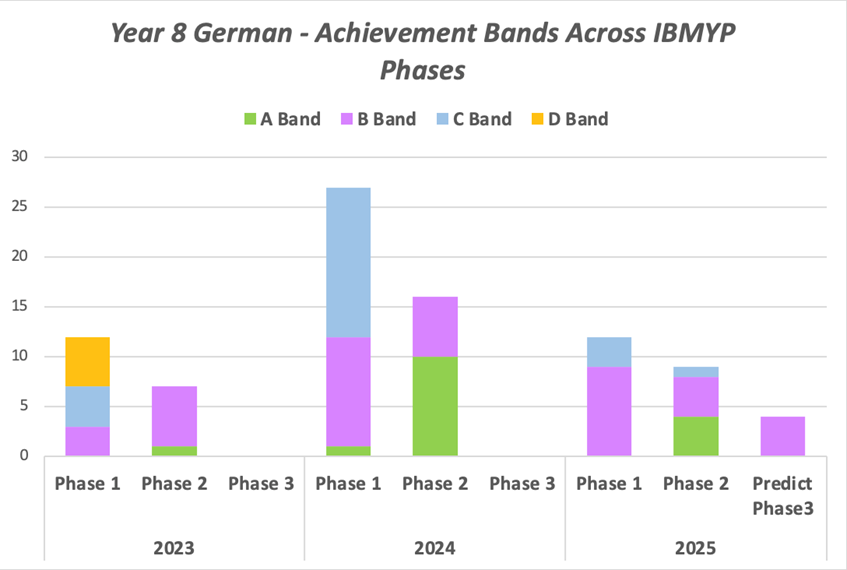
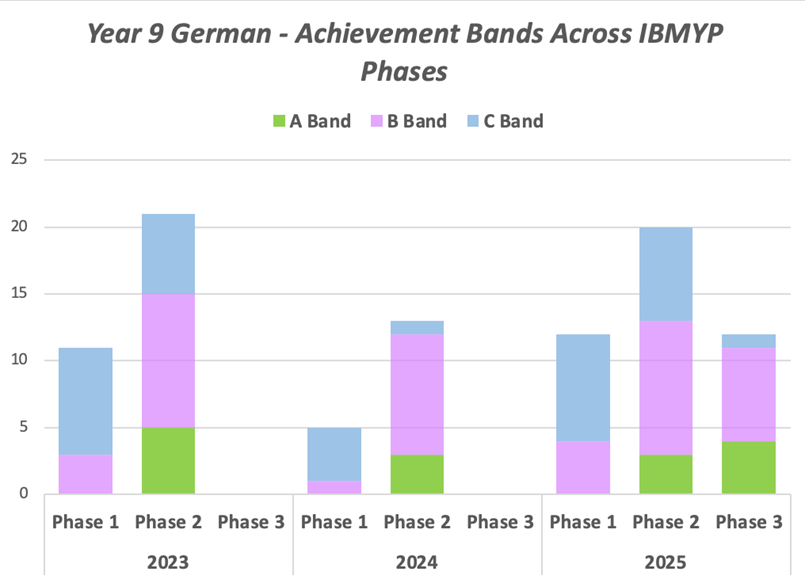
Halfway through having completed the modules, I began tracking data on my classes, with the goal to seeing them through all 3 years of middle school. I compared this with results from previous year levels and the improvement was astounding. The only students who failed were the ones who didn’t turn up to class. Even the most reluctant, unwilling learners were absorbing enough during lesson to earn pass grades on the end of term summatives. I have always regularly surveyed my classes for feedback, but the answers started to change. The kids started telling me they loved German, and that increases every year. Students with learning difficulties still felt successful because the learning was done in so many different ways, they could still access it.
Images show: Year 8 and Year 9 assessment data across three years, with definitive iprovement in grade bands across consecutive years. 2023 is pre-EPI. 2024 was partial EPI. 2025 was full EPI. In IBMYP – ‘A band’ = 7-8 grade, ‘B band’ = 5-6 grade, ‘C band’ = 3-4 band.
At a practical level, this method isn’t just better for the students – it’s better for the teacher as well. It definitely took some hard work and a lot of time investment to transform our 4 year levels of curriculum over to this format. Mostly that was because, as I am at an International Baccalaureate school, the pre-made units in the Sentence Builder books did not usually align with what we were teaching, and we had to make all our own resources. But now that that work has been done, teaching German has become infinitely easier for me. My PowerPoints have an accumulated wealth of activities built into them and it’s easy to pick and choose what to do on a given day, to match your own and your class’s energy level. There’s nothing left to prepare except printing out the sentence builders and occasional worksheets – generated for me each time by the SentenceBuilders and Text Activities websites.
Differentiation is also significantly easier. This whole process is designed to meet the lowest level students where they’re at, so that EVERYONE can be successful. There is no differentiating down for anyone. You only have to differentiate up – and personally, I’ve always found that much easier! The Language Gym books and resources have been great for this – they provide ready-made extension work that supports the higher level students so they are appropriately challenged. Still with minimal extra work for me, still giving the students what they need. It’s a win-win.
My biggest brag point for having made this change is that in just about every lesson, every student has practised reading, writing, listening and speaking skills, and received instant personalised feedback on their skills. Prior to changing to EPI, there is no way I could have said this with any confidence. Speaking was the last skill we spent time on because the student attitudes were just too hard to battle. Now it’s the first – they are listening and speaking before any writing happens.
I have to confess that I do use various prizes as additional motivation for many of the games! But making it clear when we are and are not using prizes has not been a problem, and students will still participate in the ‘practice only’ activities. Every class has their own favourites. But for me, in every subunit I teach, we play Quickfire Translation, Delayed Dictation and Sentence Stealer. I also really love Trapdoor, One Pen One Dice and Running Dictation/Translations, and we do these frequently! I love that the activities aligned with MARSEARS also address the range of physical needs students have – so they aren’t just sitting still, there is movement in different ways as well.
No new method is without its implementation challenges. The first and biggest was the time investment in making the transition. This workload would have been greatly reduced by using ready-made units by Language Gym, and only doing one unit of one year level at a time. Secondly, getting my language colleagues on board with these changes was not always easy. There were many discussions and compromises where I did the vast majority of the unit transformations so they would be more inclined to ‘follow me’. Some teachers of the other languages did observations of my classes to see how they ran and most have implemented at least some aspects of EPI into their teaching and are seeing positive change. Leadership was usually verbally supportive, but this hasn’t always translated to practical support. I completed most of the training modules at my own expense, outside of school hours and in addition to my usual workload. I have also privately funded most of the resources that EPI commonly uses, such as the whiteboards, textas, dice, (prizes), Language Gym books and even the website subscriptions at times – though some resource replacements and additional copies of books were eventually funded.
Each year we add a few more activities to each unit to increase the options available. We tweak sentence builders to align with the interests of the student cohort in front of us. I endeavour to try at least two new activities each term, to keep things fresh. I am most definitely still learning things as I do this, even though I’m more than 3 years into it. But the units now run smoothly and I am able to walk into a classroom with little forethought about the teaching plan, and have a full lesson of engagement with the language.
I have had many other preservice teachers and German colleagues from other schools come to observe, and they all walk away inspired and enthused because they see how the students feel about language and how involved they are in the lessons. I have now made many presentations at various conferences and professional development days about EPI – sometimes about using the method itself and making changes to your teaching, other times just showing groups more of the games and activities. One unexpected benefit was realising how easily this method and many of these activities are transferred to other subject areas entirely, and developing a PD session for my site about this, repeating it a number of times, has proven invaluable in gaining deeper support from leadership as well as other faculties at my site, as now this isn’t just ‘a languages thing’.
You don’t have to enrol and complete any of the EPI modules in order to start making this change. I highly recommend doing the first module, ‘Becoming an EPI teacher’, and you can easily get the ball rolling with just that one behind you (watch out – you’ll get hooked and want to keep going anyway!). But you don’t even have to do that. You can start implementing the activities and using sentence builders (that you’re probably already using in some format) in a MARSEARS process just by reading the many blog posts that he, and others like me, have written. No financial outlay required.
If you’re on the fence about making the change to EPI, just jump. You will not regret it.
Annelise’s bio
Annelise Gill is a long time German and EALD teacher in public education in South Australia. Having instilled the EPI approach firmly into the German curriculum at her site she has since been working on spreading the word and making this approach even more accessible to other languages and subjects. She makes regular presentations for sites, language associations, and professional development events on various aspects of EPI. She is passionate about teaching the students we have in front of us, and firmly believes that this is a fantastic method that easily caters to all students.
There is a persistent tendency in language teaching to explain listening failure almost exclusively in linguistic terms: students struggle because they do not know enough vocabulary, because their grammar is weak, because they have not had enough exposure, because they are not applying the “right” listening strategies, or because they supposedly lack resilience, concentration or motivation.
Often, of course, this diagnosis is correct. Vocabulary knowledge, grammatical competence and phonological familiarity remain the strongest predictors of listening success (Nation, 2013; Vandergrift & Goh, 2012), and without them there is no listening competence to speak of.
However, as I have repeatedly argued on this blog over the years, especially in my work on listening pedagogy, decoding and micro-listening, this explanation is incomplete, because listening in a second language is not merely a linguistic act. It is also a highly demanding cognitive activity which places considerable strain on working memory, attentional control, processing speed, inhibitory control and executive functioning, particularly when learners are required not only to process language accurately in real time, but to sustain that processing repeatedly over extended periods whilst simultaneously managing uncertainty, stress, partial comprehension and continual decision-making.
In other words, what listening exams frequently measure is not simply whether students know the language, but whether they can continue accessing and deploying that knowledge efficiently once cognitive fatigue begins to accumulate.
What Listening Actually Involves
I know I have repeated this ad nauseam, but let me say it once again: listening in a second language is arguably one of the most cognitively expensive things we ask novice and intermediate learners to do. Unlike reading, where learners can pause, re-read and control the pace of processing, listening unfolds in real time and disappears almost instantly, forcing the learner to process, interpret and integrate incoming information under severe temporal pressure.
The learner must:
decode the acoustic signal,
segment the speech stream into meaningful units,
retrieve lexical meaning,
interpret grammatical relationships,
suppress competing interpretations,
hold partial meaning in working memory,
integrate new information with previous clauses,
and construct a coherent mental representation of meaning,
all within fractions of seconds!
Research over the last two decades has shown repeatedly that these processes rely heavily on:
working memory (Baddeley, 2003; Andringa et al., 2012),
attentional control (Mackey et al., 2010),
processing speed (Segalowitz, 2010),
executive functioning (Miyake & Friedman, 2012),
and automaticity (DeKeyser, 2007).
Neurolinguistic research using fMRI and EEG methodologies has further demonstrated that L2 listening recruits substantially more frontal-lobe activity than L1 listening, especially in lower-proficiency learners, because processing remains effortful rather than automatised (Abutalebi, 2008; Perani & Abutalebi, 2005). In practical terms, this means that novice listeners must consciously allocate attentional resources to processes which, in expert listeners, occur automatically and below conscious awareness.
As I have often pointed out in earlier posts, what students know certainly matters, but how efficiently they can process what they know often determines whether performance remains stable under pressure. A learner with reasonably secure vocabulary but weak decoding or slow retrieval may perform far worse than expected simply because each listening decision costs too much cognitive effort.
The Nature Listening Exams
As we all know, exam listening papers are usually composed of:
multiple short extracts,
repeated cycles of listening and responding,
continual task-switching,
and sustained cognitive engagement across thirty to forty-five minutes.
This entails:
repeated high-load processing,
cumulative cognitive effort,
and fatigue accumulation over time.
Students are required to:
listen,
decode,
interpret,
infer,
decide,
and respond,
again and again, often with relatively little cognitive recovery time in between.
A typical exam listening paper may involve well over one hundred separate micro-decisions, each requiring rapid allocation of attentional and working-memory resources. Whilst any individual extract may appear manageable in isolation, the cumulative effect of repeated processing under pressure is far more substantial than many teachers realise.
Hence, the bottleneck is very often not the difficulty of the text itself, but rather the learner’s ability to sustain accurate processing across repeated listening events.
Cognitive Fatigue: What It Is and Why It Matters
Cognitive fatigue refers to the gradual decline in mental efficiency following sustained effortful processing (Borghini et al., 2018; Hockey, 2013). In listening contexts, this fatigue manifests itself through:
reduced attentional control,
slower processing speed,
weaker error monitoring,
diminished working-memory efficiency,
reduced inhibitory control,
and increasing susceptibility to distraction.
Crucially, learners do not suddenly “switch off”. Rather, because attentional resources become progressively depleted as processing demands accumulate, they gradually lose the ability to process accurately and efficiently, even though outwardly they may still appear focused and compliant.
Across the school day, this process is cumulative. A learner sitting a listening paper at 3pm is not cognitively equivalent to that same learner at 9am. Prior lessons, emotional stress, sustained concentration, social interaction, screen exposure and decision fatigue all consume cognitive resources, particularly in adolescents whose executive-control systems are still developing neurologically (Blakemore & Choudhury, 2006).
Within a listening paper itself, fatigue often evolves in a recognisable sequence:
early phase → relatively efficient processing,
middle phase → attentional drift and increasing effort,
later phase → greater reliance on guessing, partial cues and heuristics.
This aligns closely with research on attentional depletion and executive control (Kahneman, 2011; Miyake & Friedman, 2012), as well as with studies showing that sustained cognitive effort progressively reduces accuracy in tasks requiring rapid auditory discrimination and working-memory updating (Warm et al., 2008).
As I have often reiterated in previous discussions of listening instruction, the issue is rarely that learners stop trying. Rather, the cognitive system itself becomes less efficient over time.
Who Is Most Likely to Be Affected?
Not all learners are equally vulnerable to cumulative listening fatigue. Those most affected are usually the learners for whom each listening event already carries a high cognitive cost.
Learner profile
Why they are vulnerable
What it looks like in class/exams
Students with poor working memory
Cannot hold enough information online long enough to integrate meaning
“I understood the beginning but lost the rest”
Slow lexical retrievers
Lexical access is too slow for real-time processing
“I knew the word — but only afterwards”
Weak phonological decoders
Cannot reliably map sounds onto known words
Confusions such as fui/fue or je vais/j’ai
Poor segmenters
Struggle to identify word boundaries
Hear an undifferentiated stream
Fragile grammar processors
Miss small but crucial grammatical cues
Tense and negation errors
Low-automaticity learners
Processing remains effortful and conscious
Rapid fatigue accumulation
Anxiety-prone learners
Anxiety consumes working-memory resources
Performance collapses after mistakes
Learners with weak attentional control
Cannot efficiently reset after failure
One error destabilises several subsequent items
Students with limited vocabulary depth
Too much input remains uncertain
Heavy reliance on guessing
Students with auditory-processing difficulties
Speech processing itself is effortful
Need excessive repetition
Fatigued or overloaded learners
Reduced cognitive reserves
Stronger late-day decline
As I have often stressed on this blog, many of these learners are not weak in any simplistic sense. Rather, because the cognitive cost of each listening event is substantially higher for them than for more automatised listeners, fatigue accumulates earlier and more aggressively.
Listening Twice (or Three Times): Help or Illusion?
Most exam boards replay listening extracts twice, whilst Pearson uses three repetitions.
On the surface, this appears entirely beneficial, and indeed there are important advantages:
reduced immediate memory load,
opportunities to confirm interpretations,
greater support for lower-proficiency learners,
improved local accuracy (Vandergrift & Goh, 2012).
However, the situation is more nuanced than it first appears.
Repeated listens do not eliminate global cognitive fatigue. In fact, they may contribute to it! Why?
Firstly, some learners reduce attentional effort during the first hearing because they know another opportunity is coming, a phenomenon linked to effort-regulation theory (Hockey, 2013). Secondly, incorrect initial interpretations can become reinforcedrather than corrected, especially when learners engage in confirmation bias rather than fresh processing during subsequent listens. Moreover, whilst replay may reduce local task difficulty, it simultaneously extends the cumulative duration of high-load processing across the paper.
In other words: repetition helps locally, but it does not fully solve the broader problem of cumulative fatigue. In fact, it may exacerbate it!
Implications for Teaching
If listening performance reflects not only linguistic knowledge but also processing efficiency, cognitive stamina, decoding automaticity and attentional resilience, then classroom practice must address all of these dimensions explicitly and systematically.
As I have argued repeatedly in my CPD and writing, merely “doing more listening” is often insufficient if the underlying sub-processes remain weak, fragile and effortful.
1. Build Stronger Linguistic Foundations
Vocabulary breadth and depth remain the strongest predictors of listening success (Nation, 2013). However, vocabulary knowledge must become rapidly accessible, not merely recognisable, because listening does not allow learners the luxury of extended retrieval time. This means:
cumulative retrieval,
narrow recycling,
delayed retrieval,
frequent low-stakes reactivation,
and rapid retrieval practice.
For example:
“Write five verbs you can use with je vais”
“Past, present or future?”
“Translate rapidly: I used to eat / I ate / I am going to eat”
The goal is not simply memory, but speed and automaticity of access.
2. Develop Aural Competence Explicitly
As I have often emphasised in earlier posts, many listening failures originate not in comprehension but in perception. Learners therefore need systematic work on:
phonological discrimination,
segmentation,
reduced forms,
chunk recognition,
syllabic awareness,
and stress/rhythm perception.
Practical classroom examples include:
pero/perro discrimination,
je vais/j’ai contrast tasks,
chunk-marking exercises,
rapid dictation races,
syllable grouping activities,
shadow reading,
and selective dictation.
Even five minutes daily can significantly reduce future cognitive load because learners gradually begin to process these forms more automatically.
3. Increase Processing Efficiency and Automaticity
Automaticity matters enormously because the less effort each micro-decision requires, the more cognitive resources remain available for comprehension and inferencing. As I have repeatedly argued on this blog, speed of processing is not an optional extra. It is central to successful listening. Useful classroom routines include:
three-second sentence exposure,
rapid chunk reconstruction,
constrained listening retrieval,
timed sentence rebuilding,
rapid-fire tense identification,
disappearing transcripts,
and rapid-response mini-whiteboard routines.
For example:
Show a sentence for three seconds.
Remove it.
Play it aloud.
Students reconstruct it from memory.
Such activities force faster parsing, retrieval and integration.
4. Train Attentional Recovery
One of the biggest problems weaker listeners face is that one missed word destabilises subsequent processing, creating a cascade effect across multiple items. Students therefore need explicit practice in:
recovering after failure,
resetting attention,
tolerating ambiguity,
and continuing to process despite partial loss.
Teachers can train this by:
deliberately inserting unknown words,
interrupting extracts,
masking small sections,
or using “recover and continue” listening routines where students must keep processing despite uncertainty.
5. Reduce Cognitive Load Strategically
Research in Cognitive Load Theory (Sweller et al., 2011) strongly suggests that instructional design matters enormously.Teachers should therefore:
pre-teach essential lexical items,
reduce unnecessary task complexity,
sequence input carefully,
avoid overloading students with simultaneous demands,
and progressively increase difficulty.
Importantly, simplifying cognitive demands does not mean “dumbing down”. It means allocating attentional resources more intelligently.
6. Build Listening Stamina Indirectly
Importantly, stamina is not built simply by making students endure increasingly long listening texts.As I have consistently argued in my work on listening pedagogy, stamina improves primarily when processing becomes less effortful.This means:
stronger decoding,
faster retrieval,
better segmentation,
more automatised grammar recognition,
and greater attentional efficiency
In other words:students become more resistant to fatigue not because they “try harder”, but because each listening event gradually costs less cognitive effort.
The Role of Micro-Listening (MCL) Tasks
This is where micro-listening tasks — or MCL tasks, as developed extensively in my book Breaking the Sound Barrier — become particularly powerful. Those familiar with my work will now that MCL tasks consist of:
short,
highly interactive,
cognitively manageable listening cycles,
usually lasting between ten and twenty seconds. Each cycle typically involves:
listening,
making a rapid judgement,
responding immediately,
receiving corrective feedback.
As I have repeatedly maintained in my writing on listening pedagogy, these short cycles are far more aligned with the actual cognitive architecture of listening than the traditional “play a long text then answer comprehension questions” approach.
Those of you who are familiar with my book ‘Breaking the sound barrier: teaching learners how to listen’ (Conti & Smith, 2019) will know that MCL tasks are not random quick listening games. Each one targets a specific listening sub-process.
Listening sub-process
What the learner is training
Example MCL task
Student response
Phoneme discrimination
Distinguishing similar sounds
pero/perro
Choose correct word
Segmentation
Identifying word boundaries
jevaisaucinéma
Mark chunk boundaries
Morphological parsing
Detecting grammatical morphology
je mange/j’ai mangé
Identify tense
Negation processing
Detecting negation cues
je n’aime pas
Positive or negative?
Person identification
Recognising subject/person markers
hablo/habla/hablan
Identify speaker
Lexical retrieval
Rapid meaning access
Hear-and-match
Give rapid meaning
Syntax parsing
Understanding grammatical relations
“Who did what?”
Assign roles
Distractor resistance
Ignoring misleading lexical cues
Keyword trap task
Reject distractor
Working-memory updating
Holding and integrating meaning
Listen-hold-select
Retain then decide
Error detection
Monitoring linguistic accuracy
Correct vs incorrect version
Identify the change
Discourse integration
Linking clauses coherently
Cause-result matching
Identify logical relationship
Attentional reset
Recovering after missed input
Interrupted listening
Continue processing
Because the tasks are:
short,
interactive,
repetitive,
feedback-rich,
and cognitively manageable,
they reduce overload whilst simultaneously increasing engagement and attentional reset. Moreover, because processing becomes faster and more automatised over time, fatigue accumulates much more slowly.
This is one of the most important points to understand: students do not become resistant to listening fatigue because they “try harder”; they become resistant because processing gradually becomes less effortful.
Conclusion
Ultimately, listening performance reflects the interaction of:
linguistic knowledge,
aural competence,
processing efficiency,
attentional control,
working-memory capacity,
executive functioning,
and cognitive stamina.
Overemphasising any one of these variables inevitably produces a distorted understanding of why learners succeed or fail.
The danger in many classrooms is that we continue to interpret listening breakdown purely as a knowledge deficit, when in reality it is often the product of cognitive overload interacting with fragile processing systems, inefficient decoding, weak attentional recovery and insufficient automaticity.
If we genuinely want students to perform better in GCSE and A-Level listening exams, then we need to move beyond the simplistic notion that more listening practice alone is the solution. What matters is not simply how much learners listen, but how efficiently, accurately and sustainably they are able to process what they hear under pressure and across time.
And that, in my view, changes the pedagogical conversation quite profoundly.
If you want to find out more on this topic, read my book ‘Breaking the sound barrier: teaching learners how to listen’ (Conti and Smith, 2019)
Selected References.
Andringa, S., Olsthoorn, N., van Beuningen, C., Schoonen, R., & Hulstijn, J. (2012). Determinants of success in native and non-native listening comprehension: An individual differences approach. Language Learning, 62(1), 49–78. Wiley.
Baddeley, A. (2003). Working memory and language: An overview. Journal of Communication Disorders, 36(3), 189–208. Elsevier.
Blakemore, S.-J., & Choudhury, S. (2006). Development of the adolescent brain: Implications for executive function and social cognition. Journal of Child Psychology and Psychiatry, 47(3–4), 296–312. Wiley.
Conti, G., & Smith, S. (2019). Breaking the Sound Barrier: Teaching Language Learners How to Listen. Piefke Trading Singapore.
DeKeyser, R. (2007). Practice in a second language: Perspectives from applied linguistics and cognitive psychology. Cambridge University Press.
Field, J. (2008). Listening in the Language Classroom. Cambridge University Press.
Hockey, G. R. J. (2013). The Psychology of Fatigue: Work, Effort and Control. Cambridge University Press.
Kahneman, D. (2011). Thinking, Fast and Slow. Penguin Books.
Mackey, A. (2010). Input, interaction and corrective feedback in L2 learning. Oxford University Press.
Nation, I. S. P. (2013). Learning Vocabulary in Another Language (2nd ed.). Cambridge University Press.
Roussel, S., Joulia, D., Tricot, A., & Sweller, J. (2021). Learning subject content through a foreign language should not ignore human cognitive architecture: A cognitive load theory approach. Educational Psychology Review, 33, 1225–1249. Springer.
Segalowitz, N. (2010). Cognitive Bases of Second Language Fluency. Routledge.
Vandergrift, L., & Goh, C. C. M. (2012). Teaching and Learning Second Language Listening: Metacognition in Action. Routledge.
Wallace, M. P. (2020). Individual differences in second language listening: Examining the role of vocabulary knowledge, working memory, and personality. Language Teaching Research, 24(6), 707–727. SAGE Publications.
In recent years, many language teachers have noticed a striking overlap between classrooms informed by Rosenshine’s principles and those shaped by Extensive Processing Instruction (EPI). Both frameworks look structured, purposeful, and highly interactive. Students are engaged, teachers model clearly, and practice is carefully scaffolded. It is therefore tempting to conclude that the two are essentially the same thing. However, they are not.
What they share is a set of high-quality teaching behaviours. Where they diverge, on the other hand, is in the underlying theory of how learning—specifically language learning—actually happens over time. Barak Rosenshine distilled what effective teachers do across subjects; EPI, in addition, operationalises insights from second language acquisition and cognitive science to control how learners process, store, and retrieve language.
Where EPI and Rosenshine Align
Below, each shared principle is briefly unpacked—with concrete examples rooted in a typical English secondary school MFL curriculum (e.g. French/Spanish at KS3–KS4)—so that it maps directly onto the table that follows.
Structured teaching → Both rely on carefully sequenced instruction rather than ad hoc activity selection. Example: A Year 8 French lesson on future plans follows a clear arc: recap prior tense (je joue), introduce future meaning through input (je vais jouer), then structured micro-listening tasks followed by macro-listening followed by chunking aloud tasks followed by chunk-level written and oral retrieval practice followed by mini role plays, etc.
Small steps → New learning is broken down to manage cognitive load (John Sweller). Example: Instead of teaching the full future tense paradigm, the teacher starts with “je vais, tu vas, il/elle/on va + infinitive” only; whilst the other persons are postponed to the end of the instructional sequence.
Modelling → Both require clear models; however, in EPI this is primarily realised through Sentence Builders, not teacher exposition. In addition, these make language visible, selectable and processable before independent use. Example: A Sentence Builder such as: Le week-end, je vais + jouer au foot / regarder un film / sortir avec mes amis + parce que c’est… is used for listening, reading aloud, decoding, translation and choral response before students produce language independently.
Guided practice → Learners rehearse new material with support before moving towards independence. Example: Students manipulate the Sentence Builder to create sentences with controlled variation; moreover, the range of options is gradually expanded.
Checking understanding → Frequent formative checks prevent misconceptions from embedding. Example: Mini-whiteboards: teacher says “Je vais manger” → students write “future” or “present”; in addition, misconceptions are immediately addressed.
High success rate → Tasks are calibrated to ensure learners experience frequent success. Example: Listening tasks where only one variable changes (e.g. tense marker), thus ensuring high accuracy and confidence.
Active participation → Students are constantly engaged cognitively, not passively listening. Example: Whole-class choral translation or rapid-response tasks using Sentence Builders; furthermore, no student remains inactive.
Retrieval practice → Recall strengthens memory; however, in EPI it is most powerfully realised during Structured Production, where learners retrieve and recombine language under controlled conditions. Example: Students are prompted to produce sentences from partial cues: “tomorrow / play football / because fun” → Je vais jouer au foot demain parce que c’est amusant. This, in turn, forces retrieval from memory rather than reliance on full models.
Review and consolidation → Learning is revisited over time to secure retention. Example:Je vais + infinitive reappears weeks later in a holidays topic; moreover, it is embedded within new contexts.
Scaffolding → independence → Support is gradually withdrawn as competence increases. Example: Sentence Builder → reduced prompts → free GCSE-style writing; in addition, accuracy expectations increase.
Clarity of goals → Clear objectives and success criteria guide learning. Example: “Today you will understand and say what you are going to do this weekend”; furthermore, success is explicitly defined.
Teacher-led guidance → Novices benefit from explicit instruction rather than discovery (Paul Kirschner). It should be noted, however, that whilst explicit instruction is leveraged, it is used in synergy with implicit instruction, which has an equally if not important role in the EPI pedagogical cycle (MARSEARS) Example: Teacher provides structured input and modelling rather than asking students to infer rules independently; on the other hand, independence is gradually built later.
Commonalities Table
Dimension
Shared Principle
What it looks like in practice
Research anchor
Structured teaching
Learning benefits from clear, well-sequenced instruction
Lessons follow a deliberate progression, not ad hoc activities
Barak Rosenshine
Small steps
New learning should be broken down to reduce overload
Limited new material introduced at a time
John Sweller
Modelling
Learners need clear models of target performance
In EPI: Sentence Builders; in Rosenshine: teacher demonstration/worked examples
Rosenshine; Conti & Smith
Guided practice
Learners need supported rehearsal before independence
Scaffolded tasks before freer application
Rosenshine
Checking understanding
Misconceptions must be identified early
Frequent questioning, mini-whiteboards
Rosenshine
High success rate
Frequent success enhances learning
Tasks calibrated to avoid repeated failure
Rosenshine
Active participation
Students must be cognitively engaged
Constant response, no passive listening
Rosenshine
Retrieval practice
Recall strengthens memory
In EPI: intensified in Structured Production; in Rosenshine: review routines
Robert Bjork
Review and consolidation
Learning must be revisited over time
Spaced review, cumulative practice
Rosenshine
Scaffolding → independence
Gradual release is essential
Support fades as competence grows
Rosenshine
Clarity of goals
Clear aims support learning
Explicit success criteria
Instructional research
Teacher-led guidance
Novices need explicit instruction
Limited unguided discovery
Paul Kirschner
Where They Diverge Fundamentally
Again, each difference below is aligned directly with the table that follows, with examples grounded in an English MFL classroom.
Theoretical base → EPI draws on ISLA and psycholinguistics; Rosenshine, on the other hand, draws on general cognitive psychology. Example: EPI designs listening tasks to develop parsing (e.g. distinguishing hablo vs habló), not just comprehension.
Primary goal → EPI targets long-term language competence; Rosenshine, however, focuses on successful lesson outcomes. Example: EPI may delay speaking to ensure retention, even if it feels less “productive” in the lesson.
Unit of design → EPI sequences learning processes over time; Rosenshine structures individual lessons. Example: A Year 9 scheme ensures past tense reappears across multiple units, not confined to one topic; furthermore, recycling is systematic.
Core driver of learning → EPI prioritises input processing; Rosenshine prioritises explanation and practice. Example: Students spend extended time interpreting Sentence Builder content before producing; in contrast, Rosenshine would move more quickly to practice.
Role of input → Central and sustained in EPI; however, often brief in Rosenshine-informed teaching. Example: Multiple listening/reading exposures before any speaking task.
Nature of practice → EPI emphasises processing and retrieval; Rosenshine emphasises correct rehearsal. Example: Students decide meaning (now vs future), not just repeat sentences; in addition, they recombine language.
Timing of output → Delayed in EPI; early in Rosenshine. Example: No speaking until sufficient processing has occurred; on the other hand, Rosenshine encourages early guided responses.
View of early production → Risky in EPI; acceptable in Rosenshine. Example: Avoiding premature pairwork speaking to prevent incorrect automatisation.
Role of explanation → Minimal and delayed in EPI; central and early in Rosenshine. Example: Grammar explanation follows exposure, not precedes it; furthermore, it is brief.
Cognitive load management → Domain-specific and staged in EPI; more general in Rosenshine. Example: Limiting simultaneous novelty in vocabulary and structure.
View of grammar → Emerges from processing, then systematised in EPI; explained then practised in Rosenshine. Example: Students recognise patterns before seeing full conjugations.
Retrieval → Core engine in EPI; routine strategy in Rosenshine. Example: Frequent timed retrieval tasks driving fluency; in addition, embedded in structured production.
Fluency development → Explicitly engineered in EPI; less theorised in Rosenshine. Example: 4-3-2 speaking to build automaticity.
Curriculum design → Cumulative and interleaved in EPI; largely assumed in Rosenshine. Example: Structures recycled across topics over months; furthermore, deliberately interleaved.
Attention to form → Engineered through tasks in EPI; less explicit in Rosenshine. Example: Tasks where meaning depends on noticing verb forms.
Transfer → Explicitly built in EPI (Transfer Appropriate Processing); less foregrounded in Rosenshine. Example: Practising exam-style listening mirroring GCSE conditions.
Typical classroom → Input-rich and recycling-heavy in EPI; fast-paced and response-heavy in Rosenshine. Example: Longer processing phases vs rapid-fire questioning; however, both remain structured.
Differences Table
Dimension
EPI (Extensive Processing Instruction)
Rosenshine (Principles of Instruction)
Theoretical base
ISLA + psycholinguistics
General cognitive psychology
Primary goal
Develop implicit and procedural language competence
Ensure successful lesson learning
Unit of design
Learning processes over time
Lesson structure
Core driver
Input processing and form–meaning mapping
Explanation and guided practice
Role of input
Central and sustained
Often brief and front-loaded
Nature of practice
Processing + retrieval + recombination
Repetition of correct responses
Timing of output
Delayed
Early
View of early production
Risky (fossilisation, shallow encoding)
Necessary and beneficial
Role of explanation
Minimal and delayed
Central and early
Cognitive load management
Strongly staged and domain-specific
Managed via small steps
View of grammar
Emerges from processing, then systematised
Explained then practised
Retrieval
Core to automatisation
Routine review strategy
Fluency development
Explicitly engineered
Not explicitly theorised
Curriculum design
Cumulative, interleaved, recycling-driven
Largely assumed
Attention to form
Explicitly engineered in tasks
Not systematically targeted
Transfer
Built via Transfer Appropriate Processing
Less explicitly addressed
Typical classroom
Input-rich, delayed output, heavy recycling
Fast-paced, interactive, frequent responses
Conclusion: Same Tools, Different Logic
In conclusion there is a significant overlap between the two frameworks as they are both based on sound educational and theories and research. The overlap explains why both approaches often produce classrooms that look effective. However, the divergence, on the other hand, explains why outcomes—especially in language learning—can differ significantly over time.
Rosenshine gives us a powerful framework for instructional clarity and effective lesson delivery. EPI, in contrast, provides a model for how language learning unfolds cognitively over time, ensuring that teaching aligns with how memory and processing actually work.
Whilst Rosenshine help teachers structure how you teach EPI enables them to control how learning happens over time. If one gets that balance right, one will move from lessons that work… to learning that lasts.
You must be logged in to post a comment.