
Guest post by Annelise Gill, German teacher of 14 years at a public secondary school in Adelaide, South Australia.
Introduction by Gianfranco
In this post, a very passionate and indefatigable German teacher working in a state school in Adelaide, details her experience with EPI, spanning a few years, working with large mixed ability classes. Her EPI journey has not always been easy, but has paid massive dividends, as the data Annelise reports below clearly evidence. I want to thank her for sharing her journey here with us and for being such a strong advocate for EPI over the years.
Annelise’s Post
I first met Gianfranco in September 2022, when he presented a joint session to the German and Italian language associations in Adelaide. I had never heard of him before and took advantage of the opportunity for some fully funded PD! I walked away from those 2 days thinking that this was how all language classes need to be taught. It seemed completely logical and so simple. I was ready to throw away textbooks and old-fashioned ROTE learning then and there.
But I knew I needed more training first. So, I enrolled for his online sessions and over the next two years completed all the modules for his ‘Becoming an EPI teacher’ course. Along the way, I implemented what I was learning as I learnt it, so the classes I was teaching progressively got more and more of the EPI method. I could see that, even with only a ‘half dose’ of the methodology, it was having a huge impact. Behaviour issues reduced. Engagement increased exponentially. And slowly, but surely, grades improved – even from those distinctly unwilling to try!
Halfway through having completed the modules, I began tracking data on my classes, with the goal to seeing them through all 3 years of middle school. I compared this with results from previous year levels and the improvement was astounding. The only students who failed were the ones who didn’t turn up to class. Even the most reluctant, unwilling learners were absorbing enough during lesson to earn pass grades on the end of term summatives. I have always regularly surveyed my classes for feedback, but the answers started to change. The kids started telling me they loved German, and that increases every year. Students with learning difficulties still felt successful because the learning was done in so many different ways, they could still access it.
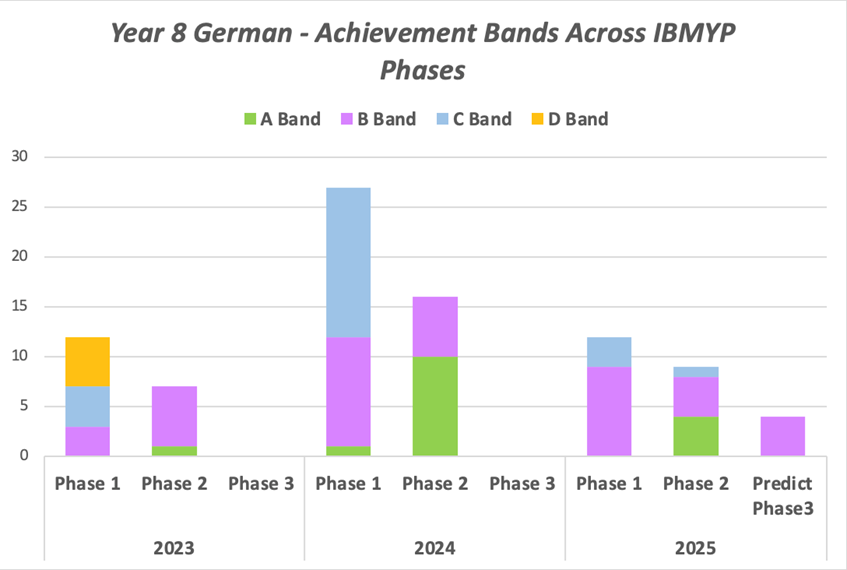
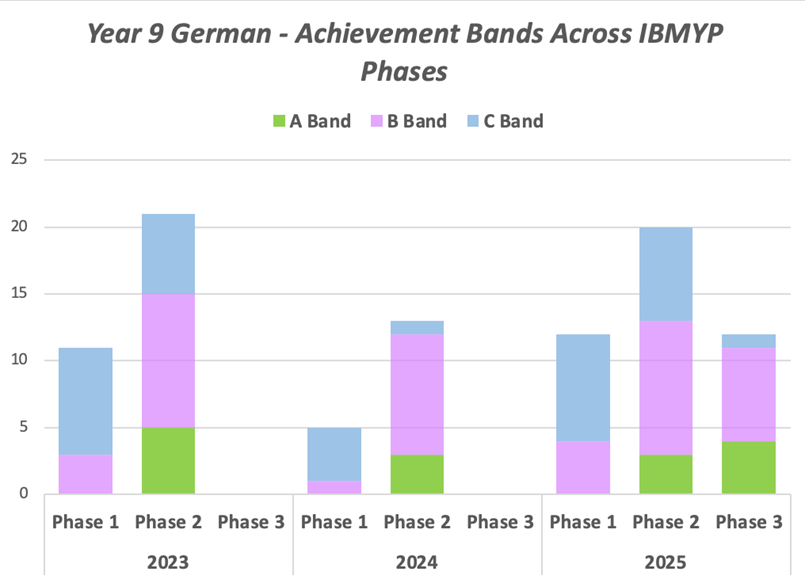
Images show: Year 8 and Year 9 assessment data across three years, with definitive iprovement in grade bands across consecutive years. 2023 is pre-EPI. 2024 was partial EPI. 2025 was full EPI. In IBMYP – ‘A band’ = 7-8 grade, ‘B band’ = 5-6 grade, ‘C band’ = 3-4 band.
At a practical level, this method isn’t just better for the students – it’s better for the teacher as well. It definitely took some hard work and a lot of time investment to transform our 4 year levels of curriculum over to this format. Mostly that was because, as I am at an International Baccalaureate school, the pre-made units in the Sentence Builder books did not usually align with what we were teaching, and we had to make all our own resources. But now that that work has been done, teaching German has become infinitely easier for me. My PowerPoints have an accumulated wealth of activities built into them and it’s easy to pick and choose what to do on a given day, to match your own and your class’s energy level. There’s nothing left to prepare except printing out the sentence builders and occasional worksheets – generated for me each time by the SentenceBuilders and Text Activities websites.
Differentiation is also significantly easier. This whole process is designed to meet the lowest level students where they’re at, so that EVERYONE can be successful. There is no differentiating down for anyone. You only have to differentiate up – and personally, I’ve always found that much easier! The Language Gym books and resources have been great for this – they provide ready-made extension work that supports the higher level students so they are appropriately challenged. Still with minimal extra work for me, still giving the students what they need. It’s a win-win.
My biggest brag point for having made this change is that in just about every lesson, every student has practised reading, writing, listening and speaking skills, and received instant personalised feedback on their skills. Prior to changing to EPI, there is no way I could have said this with any confidence. Speaking was the last skill we spent time on because the student attitudes were just too hard to battle. Now it’s the first – they are listening and speaking before any writing happens.
I have to confess that I do use various prizes as additional motivation for many of the games! But making it clear when we are and are not using prizes has not been a problem, and students will still participate in the ‘practice only’ activities. Every class has their own favourites. But for me, in every subunit I teach, we play Quickfire Translation, Delayed Dictation and Sentence Stealer. I also really love Trapdoor, One Pen One Dice and Running Dictation/Translations, and we do these frequently! I love that the activities aligned with MARSEARS also address the range of physical needs students have – so they aren’t just sitting still, there is movement in different ways as well.
No new method is without its implementation challenges. The first and biggest was the time investment in making the transition. This workload would have been greatly reduced by using ready-made units by Language Gym, and only doing one unit of one year level at a time. Secondly, getting my language colleagues on board with these changes was not always easy. There were many discussions and compromises where I did the vast majority of the unit transformations so they would be more inclined to ‘follow me’. Some teachers of the other languages did observations of my classes to see how they ran and most have implemented at least some aspects of EPI into their teaching and are seeing positive change. Leadership was usually verbally supportive, but this hasn’t always translated to practical support. I completed most of the training modules at my own expense, outside of school hours and in addition to my usual workload. I have also privately funded most of the resources that EPI commonly uses, such as the whiteboards, textas, dice, (prizes), Language Gym books and even the website subscriptions at times – though some resource replacements and additional copies of books were eventually funded.
Each year we add a few more activities to each unit to increase the options available. We tweak sentence builders to align with the interests of the student cohort in front of us. I endeavour to try at least two new activities each term, to keep things fresh. I am most definitely still learning things as I do this, even though I’m more than 3 years into it. But the units now run smoothly and I am able to walk into a classroom with little forethought about the teaching plan, and have a full lesson of engagement with the language.
I have had many other preservice teachers and German colleagues from other schools come to observe, and they all walk away inspired and enthused because they see how the students feel about language and how involved they are in the lessons. I have now made many presentations at various conferences and professional development days about EPI – sometimes about using the method itself and making changes to your teaching, other times just showing groups more of the games and activities. One unexpected benefit was realising how easily this method and many of these activities are transferred to other subject areas entirely, and developing a PD session for my site about this, repeating it a number of times, has proven invaluable in gaining deeper support from leadership as well as other faculties at my site, as now this isn’t just ‘a languages thing’.
You don’t have to enrol and complete any of the EPI modules in order to start making this change. I highly recommend doing the first module, ‘Becoming an EPI teacher’, and you can easily get the ball rolling with just that one behind you (watch out – you’ll get hooked and want to keep going anyway!). But you don’t even have to do that. You can start implementing the activities and using sentence builders (that you’re probably already using in some format) in a MARSEARS process just by reading the many blog posts that he, and others like me, have written. No financial outlay required.
If you’re on the fence about making the change to EPI, just jump. You will not regret it.

Annelise’s bio
Annelise Gill is a long time German and EALD teacher in public education in South Australia. Having instilled the EPI approach firmly into the German curriculum at her site she has since been working on spreading the word and making this approach even more accessible to other languages and subjects. She makes regular presentations for sites, language associations, and professional development events on various aspects of EPI. She is passionate about teaching the students we have in front of us, and firmly believes that this is a fantastic method that easily caters to all students.


You must be logged in to post a comment.