
Summary: This article outlines the 14 core staples of the Extensive Processing Instruction (EPI) approach, bridging cognitive science with what I call ’empathetic pedagogy’. It provides a research-validated roadmap for language teachers to move students from initial exposure to spontaneous fluency through a success-first model. The research basis for each ‘staple’ is provided alongside the full list of references.
0. The 14 Staples: A Universal Blueprint for the Heart and Brain
In the modern MFL landscape, I firmly believe that effective teaching must be a meticulous balance of cognitive engineering and human empathy. Hence, while the EPI approach is a research-informed instructional system designed to align classroom practice with the brain’s natural cognitive architecture, it is fundamentally driven by a commitment to the student’s emotional well-being and, in particular, to the development of self-efficacy as conceptualised by Bandura’s (1986) SCLT.
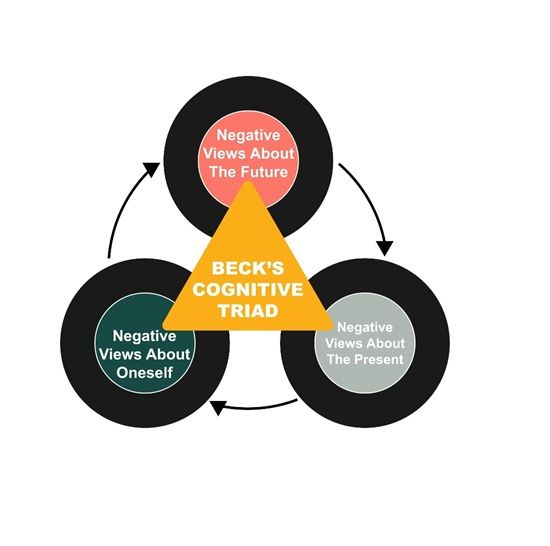
Fostering self-efficacy (a ‘Can-Do’ attitude) is in my view the primary safeguard against the ‘Cognitive Triad’—the psychological framework Aaron Beck identified as the catalyst for chronic disengagement and learned helplessness:
- Negative Views of Self: The learner perceives themselves as linguistically ‘inadequate,’ often attributing temporary struggle to permanent personal deficits.
- Negative Views of the Experience: Lessons, homework, and assessments are perceived as an unfair gauntlet of obstacles, leading to cognitive overwhelm.
- Negative Views of the Future: The learner anticipates perpetual failure, viewing the path to fluency as hopeless—a mindset that inevitably triggers anxiety and withdrawal.
By prioritizing ‘successful processing’ and the ‘science of success,’ we do more than build linguistic competence; we dismantle the systemic anxiety that has plagued language classrooms for decades. We move students from initial exposure to spontaneous fluency not just through logic, but through the joy of achievement.
The principles below represent a universal blueprint for language acquisition because the biological constraints of human memory remain constant across all learners. Applying these staples globally ensures an inclusive pedagogy where fluency becomes a predictable outcome of a scientifically grounded process, rather than a lucky accident for a select few.”
Figure 1 – Beck’s (1960) Cognitive triad
1. The MARS EARS Cycle
This foundational instructional sequence respects the learner’s cognitive architecture by moving from MARS (Modeling, Awareness-Raising, Receptive Processing, Structured Production) to EARS (Expansion, Autonomy, Routinization, Spontaneity).
- Research Basis: Rooted in Skill Acquisition Theory (DeKeyser, 2007) and Cognitive Load Theory (Sweller, 2011), which emphasizes managing working memory during the fragile initial stages of proceduralization.
2. Extensive Processing of highly comprehensible input before Controlled Practice
EPI prioritizes “depth over breadth,” favouring “input flooding” where students process a limited set of high-frequency structures hundreds of times across diverse, multi-sensory tasks. Crucially, this occurs within the context of highly comprehensible (>98%) and patterned input. Input flooding ensures repeated processing of target linguistic features; when engineered intelligently—integrating input-enhancement, opportunities for Language-Related Episodes (LREs), and process-based instruction—it facilitates both conscious and subconscious learning.
- Research Basis: Grounded in Laufer and Hulstijn’s (2001) Involvement Load Hypothesis and Nation’s (2006) research on lexical coverage, alongside Swain and Lapkin’s (1998) work on the efficacy of Language-Related Episodes in consolidating formal accuracy.
3. Sentence Builders
Sentence Builders serve as the primary cognitive scaffold, presenting language in logical, horizontal “chunks.” This allows students to create complex, grammatically correct sentences immediately, bypassing the “grammatical bottleneck.” Consistently with Sweller’s Cognitive Load Theory, they constitute worked examples which provide a clear, step-by-step path to the final linguistic “product.” By explicitly laying out the combinatorial possibilities of the language, they significantly reduce the extraneous cognitive load that occurs when students are forced to search for words and rules simultaneously.
Instead of struggling with the mechanics of sentence construction (the “problem-solving” phase), learners can focus their finite cognitive resources on the mapping of form to meaning. This allows for the successful automation of these structures into long-term memory, effectively transforming a high-effort task into a low-effort retrieval process over time.
- Research Basis: Supported by Usage-Based Linguistics (Tomasello, 2003) and modern interpretations of Scaffolding (Puntambekar & Hubscher, 2005), providing the frameworks necessary for learners to perform beyond their independent capacity. Also supported by Sweller (2006) on the “worked-example effect,” which demonstrates that learners perform better when they are shown a solution rather than being forced to discover it.
4. Lexical Chunks: The Unit of Acquisition
EPI treats the formulaic sequence or “chunk” as the fundamental building block of acquisition, rather than the individual word. By focusing on these pre-fabricated units, students bypass the high-effort process of assembly-on-the-fly, which is often the primary cause of cognitive overload when learners, who lack a robust mental lexicon, attempt to apply grammatical rules in real-time. This allows for “holistic retrieval,” where phrases are stored and accessed as single cognitive units, drastically reducing the burden on working memory and creating the “lexical agility” required for real-world interaction.
- Research Basis: Supported by Wray (2002) and Schmitt (2010), who demonstrate that native-like fluency is the mastery of a massive repertoire of pre-fabricated chunks that allow the brain to focus on the message rather than the mechanics.
5. Narrow Reading & Listening
This technique involves exposing learners to multiple, highly similar texts that repeat the same target structures in slightly different contexts. Rather than overwhelming students with one taxing “authentic” document, narrow processing ensures a “flooding” effect that builds deep familiarity, even though the content remains diverse enough to sustain engagement, because the repetition occurs within varied but predictable contexts. This facilitates the incidental acquisition of syntax and vocabulary through high-frequency, comprehensible repetition.
- Research Basis: Grounded in Lightbown (2014) and Nation and Webb (2011), which confirms that repeated exposure across predictable contexts is the most effective driver of structural “anchor points.”
6. Focus on Receptive Skills First
In EPI, “Input is King.” We prioritize the construction of a deep “receptive base” before demanding output to allow students to develop a robust mental representation of the language. While traditional methods often force premature production, which frequently results in fossilized errors and high anxiety, the EPI model delays output until the learner has internalized the phonological and syntactic code. This avoids performance anxiety and ensures the “depth of intake” is maximized.
- Research Basis: Anchored in Marsden and Shintani’s (2022) meta-analysis on the superiority of Input-Based Practice (IBP) and Leow’s (2015) cognitive-pedagogical theory.
7. Listening as Modelling (Input Enhancement)
Listening is redefined as the primary vehicle for modeling, employing Input Flood, Input Enhancement, and Process-Based Instruction to explicitly train “listening micro-skills.” This ensures that students move from hearing a stream of noise to segmenting the sound into meaningful chunks, a process that is notoriously difficult for beginners unless the teacher provides structured decoding practice, which focuses specifically on bottom-up processing.
- Research Basis: Based on Field’s (2008) work on decoding skills and Wong’s (2005) research on making linguistic features salient without interrupting communicative flow.
8. Structured Production: The Scaffolding Bridge
Oral activities are meticulously engineered to move from low-stakes chunking aloud to chunk retrieval and eventually to semi-structured tasks. By scaffolding challenging oral tasks with written priming and pre-planning, we ensure that students are never “thrown into the deep end,” since providing these cognitive supports allows them to focus on pronunciation and fluency, which would otherwise be compromised if they were simultaneously struggling to retrieve vocabulary.
- Research Basis: Supported by Skehan’s (2009) Cognitive Approach to task design, which emphasizes planning time and task complexity as the dual levers for output quality.
9. Focus on Sound-to-Spelling Correspondence (SSC)
We place a primary emphasis on SSC through micro-listening and chunking aloud. By explicitly teaching the relationship between sound and script from the outset, we provide students with the “keys to the code,” which significantly reduces the likelihood of students mispronouncing written words, as they have been trained to recognize the phonological patterns that underlie the orthography. This builds the awareness necessary for fluent reading and confident speaking.
- Research Basis: Draws on Ehri’s (2005) phases of sight-word learning and Woore’s (2009) research on the benefits of explicit phonics instruction for beginners.
10. The Cumulative Curriculum: Recycling & Interleaving
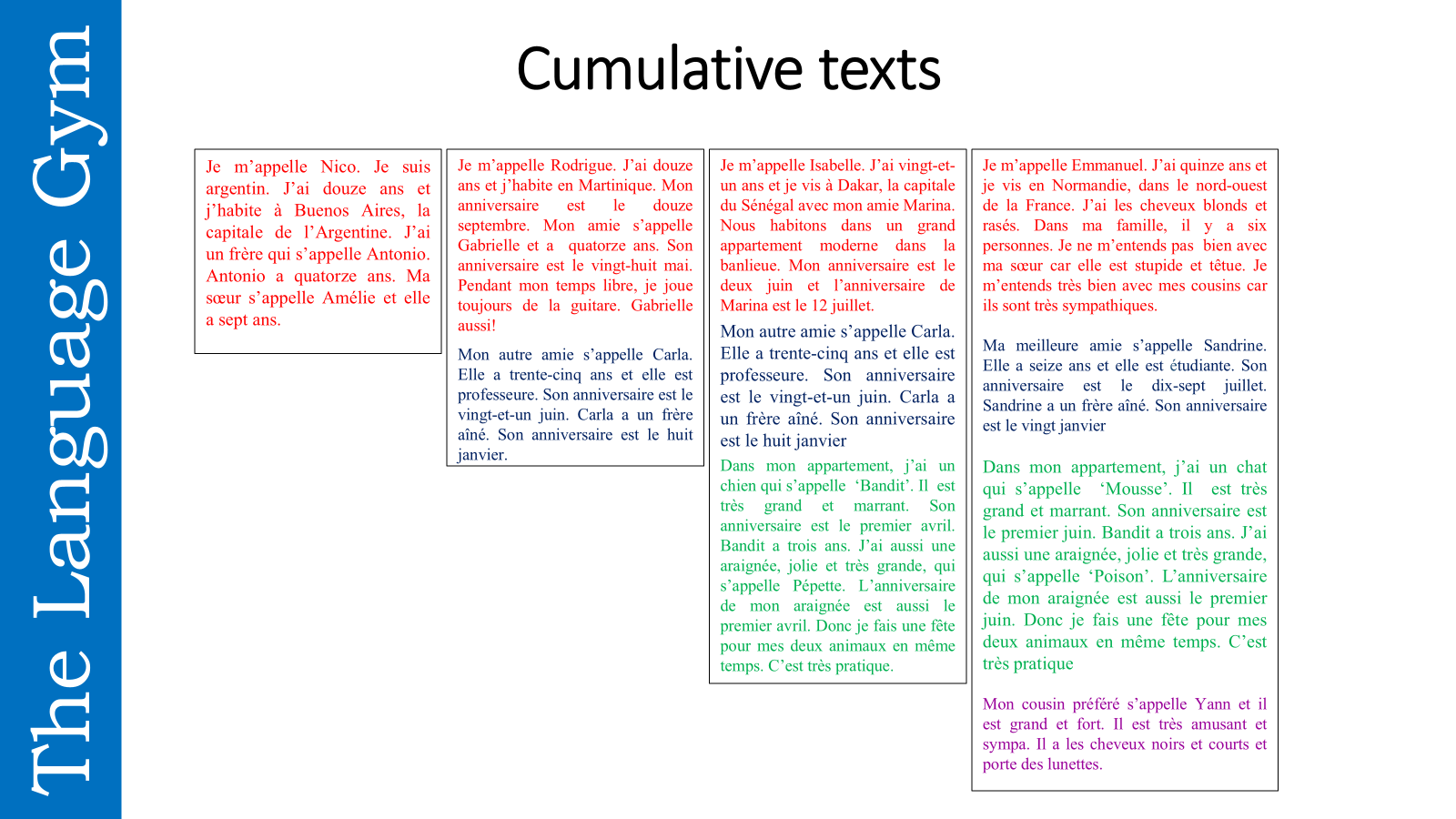
The EPI curriculum is a “spiral” where we use cumulative texts that intentionally embed material from all previous units. By building in “curriculum holes” and interleaving different topics, we force the brain to constantly retrieve language, which is essential for creating permanent neural pathways, because language that is not regularly re-activated during the learning cycle will inevitably be lost to the forgetting curve.
- Research Basis: Supported by the Spacing Effect (Cepeda et al., 2006) and Interleaving Theory (Rohrer, 2012), proving distributed practice is superior for long-term memory.
Figure 2 – Cumulative texts
11. Routinized High-Efficiency Classroom Habits
A high-performance classroom requires high-efficiency habits, utilizing snappy, low-stakes assessments every 6–7 lessons. Consistent classroom routines and Do-Now tasks maximize “time on task,” ensuring that every second of the lesson is dedicated to linguistic processing, although the atmosphere remains supportive because the students find the predictable structure comforting rather than stifling.
- Research Basis: Aligns with Rosenshine’s (2012) Principles of Instruction and Hattie’s (2009) meta-analysis on high-impact formative feedback.
12. Fluency Training (The Nation Influence)
Inspired by Paul Nation’s (2007) “Four Strands,” we incorporate timed activities to increase retrieval speed. By practicing known language under time pressure, we move to the “automaticity” phase, training the brain to access the lexicon with the rapid-fire speed required for conversation, even if the student is initially nervous about the time constraint.
- Research Basis: Grounded in Nation (2007) and Segalowitz’s (2010) work, emphasizing that fluency must be practiced using familiar language.
13. Integrated Grammar: Proactive vs. Reactive
Grammar is Proactively housed within Sentence Builders and clarified through Reactive “Pop-up Grammar” moments. This approach ensures that the explanation addresses the “how” and “why” only once the students have developed a mental representation of the structure, a strategy that is far more effective than traditional deductive methods, where students are often taught rules for language they have not yet encountered in a meaningful context.
- Research Basis: Supported by Macaro’s (2003) research, suggesting grammar is most effective when contextualized and tied to an immediate communicative need.
14. Low-Stakes Retrieval Practice
We use frequent retrieval tasks to pull language from long-term memory, strengthening the neural pathways. This creates a positive feedback loop where successful retrieval causes student anxiety to drop, especially when the tasks are gamified so that students forget they are being tested, which ultimately leads to a surge in self-efficacy and motivation.
- Research Basis: Rooted in the Testing Effect (Roediger & Karpicke, 2006) and the “Desirable Difficulties” framework of Bjork and Bjork (2011).
Conclusion
To wrap this up, it is essential to remember that while the cognitive engineering of the EPI approach provides the framework, the teacher provides the lifeblood. We aren’t just teaching a language; we are rebuilding the learner’s belief in their own ability to succeed.
By grounding our practice in these 14 staples, we move away from the “hit-or-miss” nature of traditional instruction and toward a universal standard of excellence that respects the limits of the human brain while celebrating its potential. When we harmonize the science of the synapse with the empathy of the classroom, we don’t just create speakers—we create confident, global citizens who no longer view a second language as an impossible barrier, but as a bridge they are fully equipped to cross.
*any moment during a task when learners stop to think about language itself — its form, meaning, or use.
Selected References
- Bjork, E. L., & Bjork, R. A. (2011). Making things hard on yourself, but in a good way: Creating desirable difficulties to enhance learning. Psychology and the Real World.
- Cepeda, N. J., et al. (2006). Distributed practice in verbal recall tasks: A review and quantitative synthesis. Psychological Bulletin.
- DeKeyser, R. M. (2007). Practice in a Second Language: Perspectives from Applied Linguistics and Cognitive Psychology. Cambridge University Press.
- Field, J. (2008). Listening in the Language Classroom. Cambridge University Press.
- Hattie, J. (2009). Visible Learning: A Synthesis of Over 800 Meta-Analyses Relating to Achievement. Routledge.
- Laufer, B., & Hulstijn, J. (2001). Incidental vocabulary acquisition in a second language: The construct of task-induced involvement. Applied Linguistics.
- Leow, R. P. (2015). Explicit Learning in the L2 Classroom: A Cognitive-pedagogical Theory. Routledge.
- Lightbown, P. M. (2014). Focus on Content-Based Language Teaching. Oxford University Press.
- Macaro, E. (2003). Teaching and Learning a Second Language. Continuum.
- Marsden, E., & Shintani, N. (2022). Input-based practice, production-based practice, and the development of L2 proficiency: A meta-analysis. Applied Linguistics.
- Nation, I. S. P. (2007). The four strands. Innovation in Language Learning and Teaching.
- Nation, I. S. P. (2013). Learning Vocabulary in Another Language. Cambridge University Press.
- Nation, I. S. P., & Webb, S. (2011). Researching Speaking. Heinle Cengage Learning.
- Puntambekar, S., & Hubscher, R. (2005). Tools for Scaffolding Students in a Complex Learning Environment: What Have We Gained and What Have We Missed? Educational Psychologist.
- Roediger, H. L., & Karpicke, J. D. (2006). The Power of Testing Memory: Basic Research and Implications for Educational Practice. Perspectives on Psychological Science.
- Rosenshine, B. (2012). Principles of Instruction: Research-Based Strategies That All Teachers Should Know. American Educator.
- Schmitt, N. (2010). Researching Vocabulary: A Vocabulary Research Manual. Palgrave Macmillan.
- Segalowitz, N. (2010). Cognitive Bases of Second Language Fluency. Routledge.
- Skehan, P. (2009). Modelling speaker performance in second language acquisition. Applied Linguistics.
- Sweller, J. (2011). Cognitive Load Theory. Psychology of Learning and Motivation.
- Tomasello, M. (2003). Constructing a Language: A Usage-Based Theory of Language Acquisition. Harvard University Press.
- Wong, W. (2005). Input Enhancement: From Theory and Research to the Classroom. McGraw-Hill.
- Woore, R. (2009). Investigating the development of beginner learners’ French pronunciation and sound-spelling knowledge. University of Oxford.
- Wray, A. (2002). Formulaic Language and the Lexicon. Cambridge University Press.

