
The events
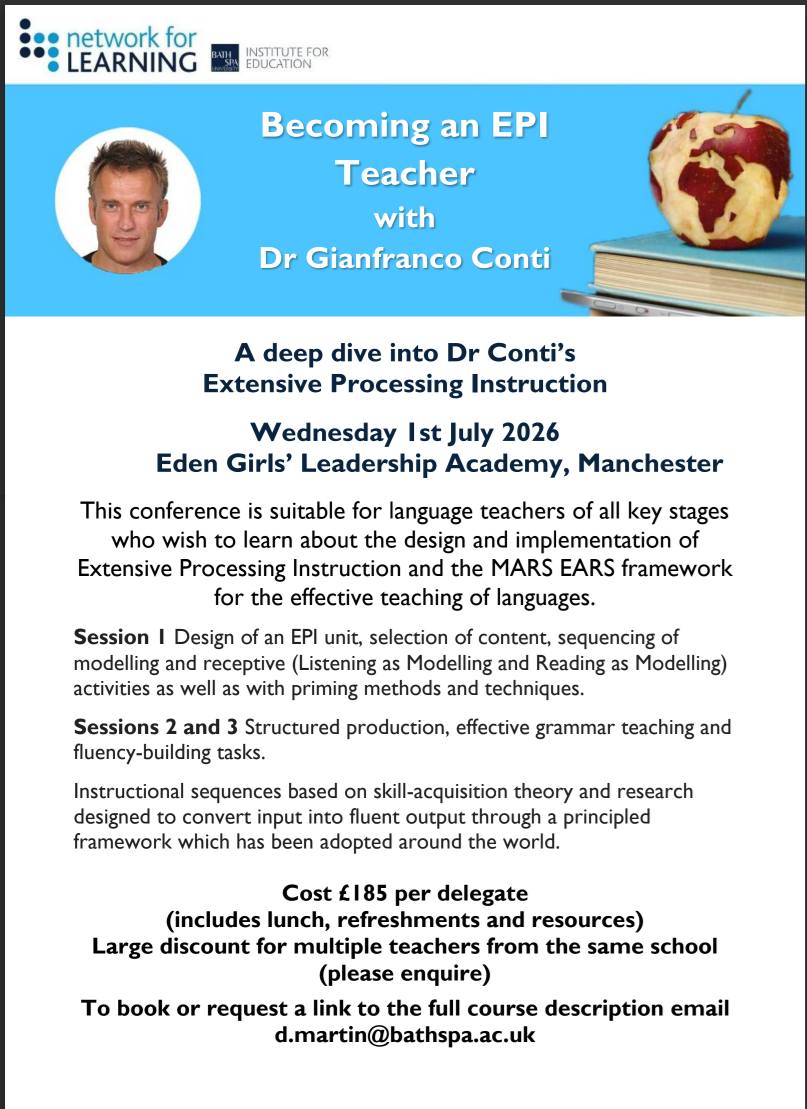
This June and July I will be delivering a ‘Teaching Lexicogrammar: from modelling to spontaneity’ workshop in London (17th June) and Manchester (1st July) focused on one of the biggest challenges in language teaching: how we help learners move from heavily scaffolded classroom performance to genuinely fluent and spontaneous communication. You can obtain the details of the workshops and information on how to enroll by contacting University of Bath Spa’s Denise Martin here: d.martin@bathspa.ac.uk.
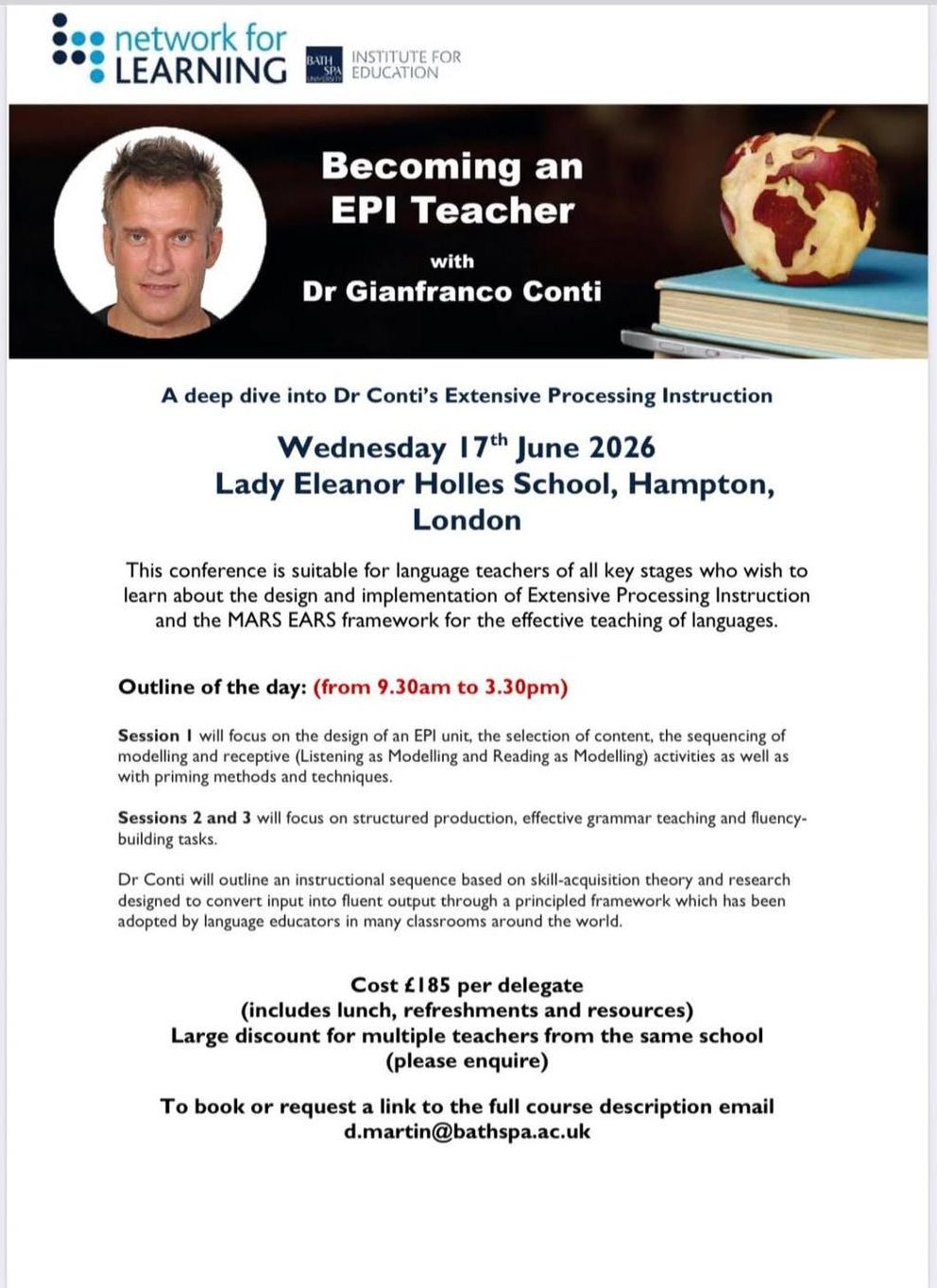
Although the workshop is rooted in Extensive Processing Instruction (EPI), it is absolutely not “just for EPI teachers”. In fact, much of what I will discuss applies to any teacher who wants students to remember more language, speak with greater confidence, retrieve language faster and become less dependent on prompts and memorised scripts.
One important feature of the session is that participants will not simply hear about the activities theoretically. Throughout the workshop, teachers will experience many of the tasks first-hand exactly as learners would. Malay — a language unfamiliar to most participants — will be used extensively to model and practise activities so that attendees can directly experience what it actually feels like to learn, retrieve and produce unfamiliar language under varying levels of cognitive load.
The content
The session will unfold progressively, following the same input-to-output journey we ideally want our students to experience in the classroom.
We will begin with the WHY behind EPI.
• Why many learners fail to become fluent despite years of study
We will look at what actually happens cognitively when students try to speak. Using simple teacher-friendly explanations of Levelt’s speaking model, I will show why speaking overloads so many learners: they must plan ideas, retrieve vocabulary, apply grammar, organise word order, pronounce accurately and self-monitor — all at speed.
At this stage, participants will experience short interactive activities in Malay designed to simulate the cognitive demands novice learners experience when attempting spontaneous production.
• Why “communicative activities” often fail weaker learners
We will discuss why throwing students into spontaneous tasks too early frequently leads to hesitation, guessing, anxiety and fossilised errors. I will explain why fluency is not built through pressure but through carefully sequenced processing and retrieval.
Teachers will take part in interactive demonstrations showing the difference between unsupported performance and carefully scaffolded processing.
We will then move into the EARLY PHASES OF FLUENCY BUILDING.
• Building strong phonological representations through oral input
Participants will explore how carefully structured oral work strengthens pronunciation, automatisation, listening accuracy and confidence whilst reducing cognitive overload.
A range of interactive Malay-language activities will be modelled at this stage so participants can experience how repeated oral processing gradually strengthens recall and fluency.
• Making repetition purposeful and engaging
One of the major themes of the workshop will be how to recycle language intensively without lessons becoming mechanical or repetitive. We will discuss how retrieval, repetition and interaction can coexist successfully when tasks are designed around cognitive principles rather than entertainment alone.
Teachers will participate in a series of highly interactive retrieval routines in Malay in order to experience how repeated processing can remain cognitively engaging and motivating.
The workshop will then focus on TRANSITIONAL TASKS.
• How to bridge the gap between comprehension and independent production
This is arguably the area where many language lessons break down. I will show how transitional tasks reduce cognitive overload whilst gradually increasing retrieval demand and learner independence.
Participants will work through staged Malay-language activities that demonstrate how learners can be guided progressively from recognition towards increasingly independent production.
• Helping learners proceduralise language rather than merely recognise it
We will examine how carefully sequenced retrieval and reconstruction tasks help learners move vocabulary and grammar from short-term performance to longer-term automatised use.
Again, the activities will be modelled interactively so teachers can directly feel the difference between shallow familiarity and proceduralised control of language.
We will then move into STRUCTURED SPEAKING.
• How oral scaffolds and sentence builders support fluency
I will show how oral scaffolds can be designed to balance challenge and accessibility, enabling students to speak successfully whilst gradually reducing support over time.
Teachers will complete scaffolded oral tasks in Malay that illustrate how effective support can increase confidence whilst still maintaining sufficient challenge.
• Moving from controlled production to freer communication
Participants will explore how highly structured oral work can gradually evolve into semi-structured communicative interaction and eventually into spontaneous communication.
At this stage of the workshop, teachers will participate in fluency-oriented communicative activities that gradually remove support and increase spontaneity.
Finally, the workshop will culminate with FLUENCY TRAINING.
• How to engineer fluency systematically
We will explore how cumulative retrieval, oral rehearsal and carefully sequenced communicative practice can build speed, confidence and automaticity over time rather than leaving fluency development to chance.
Participants will experience a sequence of fluency-training activities in Malay specifically designed to demonstrate how automatisation emerges through repeated successful retrieval and structured communicative practice.
Throughout the workshop I will continuously connect classroom practice to cognitive science and SLA research, but always in a very practical and teacher-friendly way.
Most importantly, teachers will leave with a much clearer understanding of how fluent performance develops and how classroom routines can be engineered to support that development more effectively, regardless of whether they identify as “EPI teachers” or not.
Why you may want to attend this workshops
Because many of us sense that there is often a gap between what our students can do with support in class and what they can actually retrieve and use independently under pressure. This workshop is about understanding why that gap exists and, more importantly, what we can do about it in practical classroom terms.
Whether you fully embrace EPI, partially draw on it, or do not use it at all, the session will provide a very large number of concrete, adaptable ideas rooted in cognitive science, skill-acquisition theory and real classroom practice. Above all, the workshop aims to help teachers build classrooms where students feel more successful, more confident and more fluent — not through gimmicks or unrealistic communicative demands, but through carefully engineered sequences that make language easier to process, retain and retrieve over time.
Importantly, one of the reasons EPI has attracted increasing attention internationally is that many teachers have reported substantial gains not only in fluency and retention, but also in student confidence, motivation and continuation rates. This aligns with research suggesting that learner self-efficacy — the feeling that “I can do this” — is one of the strongest predictors of sustained engagement and uptake in languages. By making input more comprehensible, reducing cognitive overload and allowing students to experience success earlier and more frequently, EPI seeks to create the conditions under which more learners remain motivated enough to continue studying languages beyond the compulsory years.

