
Walk into many language classrooms and you will hear a familiar refrain:
“Right, now discuss your holidays with your partner.”
The intention is admirable. After all, students learn to speak by speaking… don’t they? Not quite.
One of the most persistent misconceptions in language teaching is the belief that speaking practice, in and of itself, causes speaking development. But does it really? If simply getting students to talk were enough, why do so many learners, after years of pair-work, role plays and supposedly communicative activities, still struggle to express even the simplest ideas fluently and confidently?
How many times have we witnessed students perform perfectly during a listening or reading activity only to freeze completely when asked a simple follow-up question? Why do some learners appear successful during highly scaffolded classroom tasks yet struggle the moment the support is removed? And perhaps most importantly… how do we bridge the gap between knowing language and actually using it?
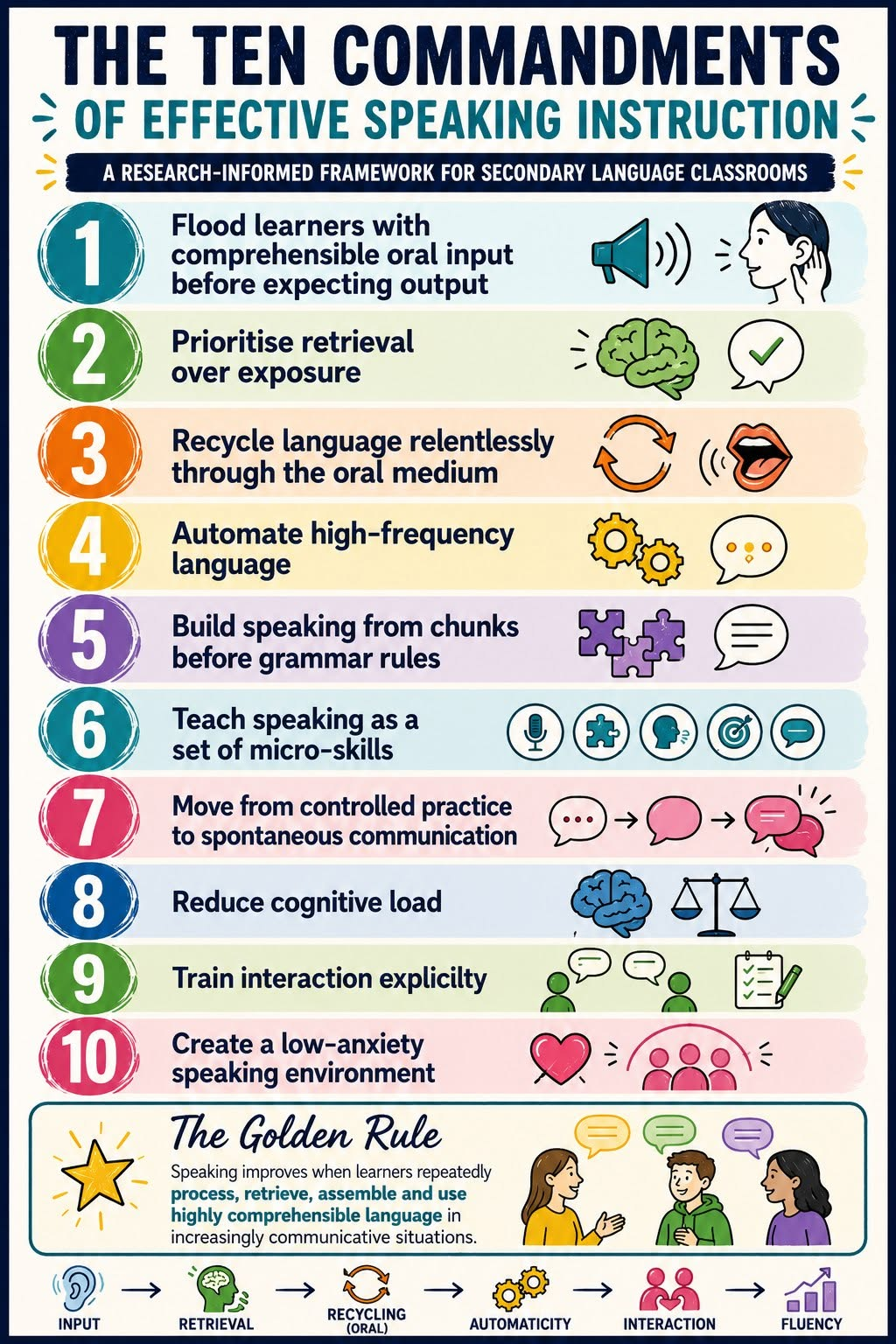
Decades of research in second language acquisition suggest that speaking proficiency emerges not from speaking alone but from a complex interaction between input, memory, retrieval, automatisation, interaction and fluency development (Krashen, 1985; Levelt, 1989; DeKeyser, 2007; Ellis, 2008). In other words, successful speaking instruction is not simply about creating opportunities for students to talk. It is about carefully engineering the conditions that make successful talking possible.
This distinction matters enormously in UK secondary schools and, indeed, in many Australian classrooms I have observed, where teachers must work with mixed-attainment groups, limited curriculum time, examination pressures and learners whose exposure to the target language is often restricted to just two or three lessons per week. Under such circumstances, every minute matters. Every activity matters. Every interaction matters!
The ten principles outlined below are not intended as a new methodology. Rather, they represent a synthesis of what we know from research, classroom observation and successful practice. Although many readers will recognise echoes of Extensive Processing Instruction (EPI), these principles extend far beyond any single approach. Whether one identifies as communicative, task-based, EPI-oriented or eclectic, the underlying cognitive and linguistic principles remain remarkably similar.
Ultimately, the question is not:
“How can I get my students to speak more?”
The question is:
“How can I make speaking possible for more students?”
1. Flood Learners with Comprehensible Oral Input Before Expecting Output
One of the most persistent misconceptions in language teaching is the idea that speaking practice causes speaking development. In reality, speaking develops primarily from extensive processing of comprehensible oral input. Before learners can produce a structure confidently, they need to have heard it repeatedly, processed it successfully and encountered it in multiple meaningful contexts (Krashen, 1985; Ellis, 2008; VanPatten, 2017).
This principle seems almost self-evident, and yet it is astonishing how often it is ignored. Students are routinely asked to discuss topics for which they possess neither sufficient vocabulary nor sufficiently automatised structures. The result? Hesitation, frustration and, ultimately, silence.
Approaches such as EPI have contributed significantly to the profession by foregrounding the importance of extensive teacher modelling, structured listening and repeated encounters with high-frequency language before any significant expectation of independent production (Conti & Smith, 2019). However, the principle itself extends well beyond EPI. It is supported by decades of research showing that language acquisition is fuelled primarily by successful comprehension.
Before students discuss free-time activities, for example, they might first:
- be pre-taught the key target vocabulary (in both the oral and written form)
- engage in narrow listening;
- listen to multiple short texts containing the same core language;
- complete listening discrimination tasks;
- engage in tasks targeting the various micro-skills of listening
- participate in teacher-led modelling;
- engage in choral repetition;
- complete simple comprehension checks.
Notice what is happening here: the teacher is not avoiding speaking, but, rather, they are building the foundations upon which successful speaking will later rest. After all, as I repeat ad nauseam in my workshops: how can students say something they have not yet heard?
2. Prioritise Retrieval Over Exposure
A common problem in modern language classrooms is the illusion of learning whereby, students often recognise language perfectly when they see it on a worksheet, a sentence builder or a PowerPoint slide, yet struggle to retrieve that very same language when asked to speak.
Why? Because recognition is not retrieval. Students may recognise a phrase instantly when they encounter it in print, yet, under the pressure of real-time communication, suddenly find that the language they appeared to know so well has somehow vanished. This is because recognising language and retrieving language are fundamentally different cognitive processes (Karpicke & Roediger, 2008).
Retrieval practice strengthens memory pathways, improves accessibility and dramatically increases the likelihood that language will be available when learners actually need it (Agarwal & Bain, 2019).
Many more language teachers these days are indeed embedding retrieval practice in their lessons. However, crucially, they tend to do it through worksheets or apps (e.g. Quizlet), not aurally and orally. This limits the limits of transferrability of retrieval practice to speaking tasks.
This is why in EPI, structured production lessons always contain opportunities for active oral retrieval:
- quick-fire translation;
- delayed repetition;
- oral ping-pong;
- retrieval grids;
- no-snakes-no-ladders;
- vocabulary races;
- sentence races;
- mini-whiteboard retrieval tasks.
The goal is not simply to revisit language but to force learners to reconstruct it repeatedly from memory and, as much as possible, through the oral medium.
3. Recycle Language Relentlessly Through the Oral Medium
One of the greatest weaknesses of many language programmes is not that language is insufficiently recycled, but that it is recycled predominantly through reading and writing. As we have mentioned in the previous paragraph, though, speaking fluency depends heavily upon repeated oral processing (Nation, 2007; Segalowitz, 2010).
A high-frequency chunk such as:
“Je pense que…”
should not simply appear in textbooks, worksheets and vocabulary lists. It should be heard, repeated, manipulated, retrieved, expanded and reused repeatedly over weeks, months and even years because automaticity is built through repeated successful processing. Effective oral recycling activities include:
- choral repetition;
- faulty echo;
- delayed dictation and repetition;
- oral sentence builders;
- either-or listening;
- oral retrieval games;
- Oral ping-pong
- Sentence-builder wars
- Trapdoor
- Things in common
- speed-dating conversations;
- Entry and Exit-ticket routines
The aim is not mindless repetition.The aim is repeated meaningful encounters that gradually transform fragile declarative knowledge into accessible procedural knowledge. And isn’t that precisely what fluency requires?
4. Automate High-Frequency Language
Fluency is largely a consequence of automatisation. As language becomes proceduralised, learners devote fewer cognitive resources to form and more to meaning, interaction and message construction (DeKeyser, 2007; Segalowitz, 2010).
This simple observation has profound implications for classroom practice. If learners must consciously assemble every utterance word by word, communication will inevitably be slow, effortful and fragile. However, when frequently used chunks become automatised, students suddenly appear more fluent, more confident and more spontaneous—not because they have acquired more grammar, but because they can access familiar language rapidly and efficiently.
This is why successful speakers possess extensive repertoires of high-frequency formulaic language. Such chunks function as cognitive shortcuts, reducing processing demands whilst simultaneously enhancing fluency.
GCSE Speaking Survival Chunks
| Function | French | Spanish | German |
|---|---|---|---|
| Giving an opinion | À mon avis | En mi opinión | Meiner Meinung nach |
| Personal opinion | Je pense que… | Pienso que… | Ich denke, dass… |
| Justifying | … parce que c’est… | … porque es… | … weil es … ist |
| Adding information | En plus | Además | Außerdem |
| Contrasting | Par contre | Sin embargo | Andererseits |
| Referring to the past | Le week-end dernier… | El fin de semana pasado… | Letztes Wochenende… |
| Referring to the future | À l’avenir… | En el futuro… | In Zukunft… |
| Talking about plans | J’ai l’intention de… | Tengo la intención de… | Ich habe vor… |
| Expressing preference | Je préfère… parce que… | Prefiero… porque… | Ich ziehe … vor, weil… |
| Describing a photo | Sur la photo, il y a… | En la foto hay… | Auf dem Foto gibt es… |
| Describing actions | On peut voir quelqu’un qui… | Se puede ver a alguien que… | Man kann jemanden sehen, der… |
| Speculating | Peut-être que… | Quizás… | Vielleicht… |
| Giving an example | Par exemple… | Por ejemplo… | Zum Beispiel… |
| Concluding | Pour conclure… | Para concluir… | Zusammenfassend… |
What makes these chunks particularly valuable is not their grammatical sophistication but their extraordinary transferability. They can be deployed across virtually every GCSE role play, photo card and conversation task. Students who can retrieve and deploy such chunks automatically gain thinking time, extend responses more naturally and reduce the cognitive burden associated with spontaneous communication (Nation, 2013; Segalowitz, 2010).
Activities specifically designed to build fluency through repeated retrieval and increasing time pressure are especially valuable. Examples include Paul Nation’s 4/3/2 Technique, Market Place and Messengers activities (Nation & Newton, 2009), as well as fluency-building tasks developed within EPI such as Chain Reaction, Faster, Fast and Furious, Timed Pyramid Translation and the Role-Play Carousel (Conti & Smith, 2019).
The objective is not merely repetition. It is successful repetition under gradually increasing communicative pressure. This is where automaticity begins to emerge…
5. Build Speaking from Chunks Before Grammar Rules
Research consistently suggests that learners initially acquire language as formulaic sequences rather than as abstract grammatical systems (Wray, 2002; Ellis, 2012).Unfortunately, classroom practice often reverses this process: students are taught rules first and language later.
Yet how many native speakers learned the imperfect tense before they learned how to say “I used to play football”? How many toddlers mastered subordinate clause formation before producing useful chunks? The answer is obvious: language comes first. Analysis later.
A more effective approach is often to teach useful high-frequency chunks before analysing the grammatical mechanisms that underpin them.
Grammar remains enormously important, but its role is often to explain, organise and extend language that learners have already encountered and begun to internalise (Ellis, 2008).
In other words, as I have often reiterated on this blog: grammar frequently works best when it follows acquisition rather than attempting to replace it.
6. Teach Speaking as a Set of Micro-Skills
One reason speaking can be so intimidating for learners is that it is not a single skill. It is actually a remarkably complex orchestration of multiple cognitive processes occurring almost simultaneously (Levelt, 1989). To answer even a simple question, learners must:
- understand the question;
- retrieve relevant vocabulary;
- encode grammar;
- assemble the sentence;
- pronounce accurately;
- monitor output;
- maintain interaction.
When teachers simply instruct learners to “have a conversation”, weaker students are often overwhelmed because too many demands are placed upon working memory at once.
Breaking speaking down into manageable micro-skills allows teachers to provide targeted support whilst reducing complexity. For example, before a role-play students might practise:
- Reading key sentences aloud (articulation and pronunciation)
- Engage in oral retrieval practice in pairs (lexical retrieval)
- Correct inaccurate sentences uttered the teacher or a partner (monitoring)
- Engage in an oral sentence puzzle race (sentence assembly)
Each component can then be combined gradually until genuine interaction becomes possible.
7. Move from Controlled Practice to Spontaneous Communication
One of the greatest mistakes in language teaching is assuming that spontaneous communication emerges suddenly. Of course, it does not. Like virtually every complex skill, speaking develops progressively through carefully sequenced practice (Anderson, 1983; DeKeyser, 2007).
An effective progression might look like this:
Comprehensible Input → Retrieval → Guided Practice → Structured Interaction → Semi-Spontaneous Interaction → Spontaneous Communication
Notice the gradual shift…Support is not removed abruptly. It is withdrawn progressively as competence develops. This principle is particularly important in mixed-attainment classrooms, where learners require different amounts of scaffolding before they can operate independently.
Teachers who rush too quickly towards free production often discover that students have little to say. Teachers who scaffold appropriately often find that students surprise themselves with what they can say.
8. Reduce Cognitive Load
One of the greatest strengths of EPI lies in its systematic management of cognitive load. Speaking places enormous demands on working memory because learners must simultaneously generate ideas, retrieve vocabulary, encode grammar, monitor pronunciation and sustain interaction (Sweller, 1988; Skehan, 1998).
How can we expect successful communication when learners are drowning in cognitive overload?
EPI addresses this challenge through a carefully sequenced progression. Learners first engage extensively with comprehensible input, ensuring that meaning is secure. They then move into chunking aloud, through teacher modelling, choral repetition and oral sentence-building activities. Once language has become increasingly familiar, learners engage in oral retrieval practice games such as Faster, Fast and Furious, Oral Ping-Pong and retrieval races. This is followed by structured role plays, where communicative demands remain tightly controlled, before eventually progressing towards more demanding information-gap activities, where learners must exchange genuinely unknown information.
Notice what happens at every stage…The linguistic challenge remains broadly familiar whilst the communicative challenge gradually increases.
Rather than asking learners to create language from scratch, the approach progressively increases independence whilst maintaining a high probability of success (Conti & Smith, 2019).
For mixed-ability classrooms, this careful sequencing is often the difference between participation and silence.
9. Train Interaction Explicitly
Real communication involves far more than producing accurate language. Learners must learn how to maintain conversations, negotiate meaning, respond appropriately and keep interaction moving forward (Long, 1996; Gass & Mackey, 2015). Yet interaction is often assumed rather than taught. Students are expected to converse without being given the tools necessary to do so.
Interactional competence deserves the same attention as grammar, pronunciation and vocabulary.
Role-play carousels, information-gap tasks, speed-dating conversations and collaborative problem-solving activities all provide opportunities to develop these skills. Through repeated participation in structured interactions, learners gradually develop greater flexibility and responsiveness.
Communication, after all, is not merely about producing language. It is also and more importantly about managing relationships through language.
10. Create a Low-Anxiety Speaking Environment
Speaking is frequently the most anxiety-provoking aspect of language learning (MacIntyre, 1999; Dörnyei, 2009). Students know that their mistakes are immediately visible. They know that hesitation can be noticed. They know that pronunciation errors are difficult to hide. Consequently, anxiety can consume valuable cognitive resources that would otherwise be available for communication.
This is why classroom climate matters so much. Teachers can reduce anxiety by:
- normalising mistakes;
- encouraging pair work before whole-class speaking;
- celebrating effort;
- providing structured support which is gradually faded (see above)
- ensuring frequent experiences of success.
- providing pre-task planning (giving the students preparation time to brainstorm key vocabulary, predict likely mistakes, etc.)
- allowing rehearsal before performance;
- staging priming tasks (easier tasks that prepare the students for more complex tasks)
- being diagnostic and formative more than summative (i.e. giving feedback that identifies and helps solve problem rather than assigning a grade)
What This Means for Mixed-Ability Classrooms
Perhaps the greatest challenge facing language teachers today is not the examination system, curriculum time or even student motivation. Rather, it is the reality that every lesson unfolds in front of learners whose linguistic knowledge, confidence, processing capacity and prior experience may differ dramatically.
How, then, do we create conditions in which all learners can experience success? This is precisely where the principles outlined above become so powerful. They do not depend upon every learner reaching the same endpoint at the same time. Instead, they focus on processes that are accessible to virtually all students: processing input, retrieving language, recycling high-frequency chunks, building automaticity and participating in structured interaction.
The strongest students may ultimately produce more sophisticated language, deploy a wider range of structures and express more nuanced meanings. Yet weaker learners can still participate successfully because they are drawing upon exactly the same core repertoire of language. The difference lies not in the process itself but in the extent to which each learner can exploit it.
This perhaps explains why approaches such as EPI have resonated so strongly with many teachers. Their emphasis on highly comprehensible language, extensive recycling, careful sequencing and systematic management of cognitive load provides practical solutions to some of the most pressing challenges facing mixed-attainment classrooms. However, it would be a mistake to view these principles as belonging exclusively to EPI. They are equally compatible with communicative approaches, task-based learning and many other contemporary methodologies because, at their heart, they reflect fundamental truths about how languages are learned.
Ultimately, speaking does not emerge because we tell students to speak. It emerges because we have spent weeks, months and years helping them process, retrieve, recycle, automate and recombine language until it becomes sufficiently accessible for communication to occur.
And that, surely, is the real challenge facing language teachers…
Not how to make students speak more.
But how to make speaking possible in the first place!
When speaking is treated as a process rather than a performance, more learners participate, more learners succeed and, perhaps most importantly, more learners begin to see themselves as genuine users of the language rather than merely students studying it.

