
Introduction
Here’s a very interesting guest post by a very talented and committed Coventry-based Head of Department working in a very large comprehensive school, who recently attended one of my workshops. When he told me about how he has implemented and adapted EPI to his setting, I was so impressed with the passion, determination and creativity which he injected into the process, that I felt compelled to ask him to write a blog post about it. Here’s the post. It has inspired me and I am sure it will inspire you too. Please note that I haven’t changed the original draft that Ryan sent to me a few days ago in a bid to preserve its authenticity,
Start with a why
My name is Ryan Cockrell and I am Head of Languages at a large comprehensive secondary school in Coventry. I have written this blog for those who are thinking of integrating EPI and MARSEARS but are unsure as to how they will introduce these ideas to their team.
As it stands, my department is at the end of its first academic year of implementing EPI and the MARSEARS sequence. As a department, we believe in our curriculum intent and we believe in EPI as the best implementation method to deliver that curriculum intent. Logistically, we have settled on a combination of centralised student booklets and teacher PowerPoint documents to support staff in delivering our curriculum. Despite my initial plan to focus specifically on redeveloping the Year 9 curriculum only, we now finish the year with the entirety of KS3 Spanish completely overhauled (French is on its way), a feat that would have been impossible without the dedication and work ethic of our hardworking staff who have bought into these ideas and are reaping the rewards as a result. However, we still have a lot of work to do, particularly around the implementation of these ideas at KS4.

A metaphorical introduction
Imagine you are exploring an area that is long-believed to have been abandoned, abandoned so long ago that no one seems to remember what was there. As you delve deeper into the forest (or other interesting setting), you come across a wall, a wall that is blocking your exploration. What should you do? Time is of the essence; this land must be explored. Some people would tear down the wall and continue with their exploration; the purpose of the wall is meaningless and only stands in the way of the truth, the new truth. Others, perhaps more wisely, would build over the wall, continuing their exploration of ‘new’ ground but also assuming that the wall must have some purpose. What would you do?
Upon taking the role of Head of Languages last summer, I faced a similar (although much less dramatic) situation. I had my vision, my ideas and my beliefs, but there was a ‘wall’. Years of work from professional, intelligent colleagues had formed a wall that I felt I needed to work around. Some of the bricks were strong but some parts of the wall were falling apart. It is not that what existed was ‘bad’, but it wasn’t mine and I certainly wasn’t able (or willing) to justify ideas that weren’t my own. Mainly, however, it was my view that this wall was not supporting all of our students.
I won’t disparage the work of my colleagues; I will share some of my concerns.
- The curriculum was structured around grammar and vocabulary but lacked relevance and communicative function.
- There was an over reliance on online textbooks (ActiveLearn?). PowerPoint resources were screenshots of the digital textbook. I don’t have a phobia of text books; my issue is that textbooks are generic and are not designed with our learners in mind.
- There was little consistency. A lack of centralised resources forced teachers to plan their own lessons without a common aim. The most surreal moment was when one Year 10 group was sitting Speaking mocks but no other groups were whilst two teachers had organised a listening mock in the hall for their groups but not the others.
So you can see that we had a problem, mainly consistency (this was also evident in the school’s faculty improvement plan and the previous Ofsted feedback). I knew we had to take action but I could not start the year off by pointing out all the problems without providing solutions. I wanted to relay some bricks, not tear the wall down.
First steps
First, I organised EPI training for all MFL teachers. This was a profound moment; in our next meeting, we shared our ideas and it was clear that we all understood where we were heading. In this meeting, I also shared the 14 principles that we would be focusing on in our first year of EPI (we will adapt these as we learn more about who we are as a department and what our students needs, but it was a helpful starting point).
Secondly, I made the decision to keep the Long Term Plan (LTP) in place, securing the foundations of the wall. It made clear to the team that we were not throwing everything out the window; we were developing our implementation, not the intent.
To develop the implementation specifically, I shared a Lesson Format with staff. The Lesson Format made direct, explicit reference to the MARSEARS sequence, a clear indication of our commitment to this teaching method. Much of this format was borrowed from www.katemayclassroom.com.
Our own twist was ‘the situation’, the story of the lesson, the contextual relevance and communicative function of the lesson. We wanted language learning to be relevant and we tried to create different, real-world solutions where the content of the lesson would be applicable.
Then, we decided to provide students with whiteboard packs to aid AFL and the EPI delivery method. All packs included two mini-whiteboards, two WB pens, a WB rubber, two red pens, two rulers and a glue sticks (these were removed later on).
Now, this did not solve all of our problems; the wall looked prettier but it was still unstable. These ideas were more readily implemented by certain members of staff and ownership and accountability was difficult to instil in resources that lacked a truly school-based identity. This is where we changed the most.

Curriculum characters
By Christmas, our best lessons were completely transformed by EPI and MARSEARS. Students were retaining language and growing in confidence every lesson. Students who had previously not enjoyed languages were proactively taking part and behaviour had improved across the board. I recognise this is anecdotal, but this blog is written as testimony to the transformative impact of these methods.
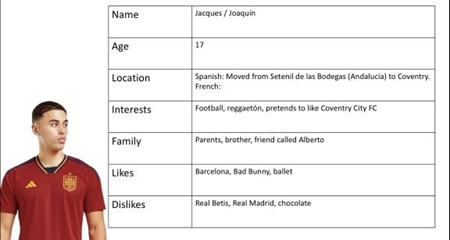
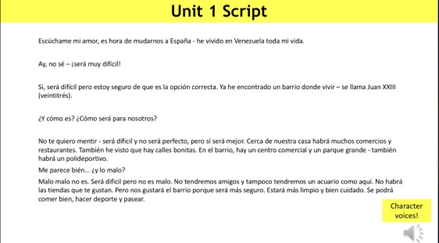
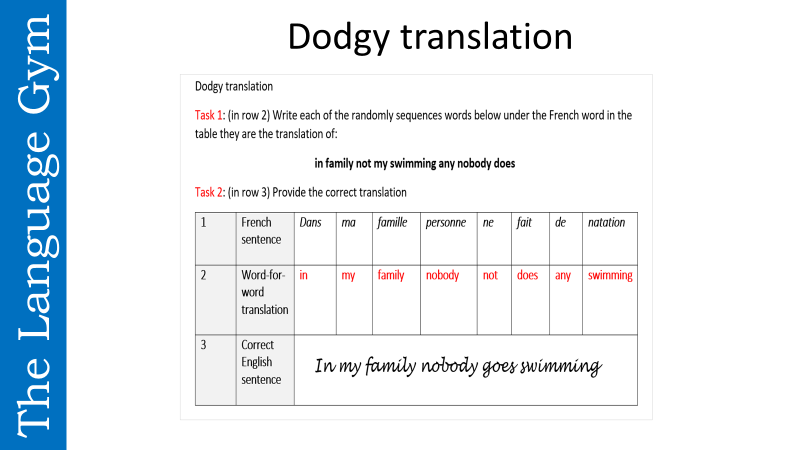
Over Christmas, I read an article about the use of longer texts and stories as the basis for relevance and authenticity in the curriculum. Immediately, I knew this was something we could replicate and create a true identity for our curriculum. I wrote a letter from the perspective of Joaquín to his friend Alberto. In the letter, Joaquín spoke about his recent holiday, his recent plans and reminisced about their childhood together – the idea was to deliver our teaching of the past tense through the story of Joaquín. The text was also translated into English and Dodgy English. I won’t overstate the impact, but it was pretty clear that students bought into the characters and embraced the uniqueness of the story. It felt real – some students asked whether Joaquín was a real person. I developed a scheme of learning with lessons based around different paragraphs from the letter. Again, however, I had to present this idea to staff and hope that it would not feel like too much change. In my mind, this was a direct development of ‘the situation’ that, in theory, should actually reduce the need to constantly come up with new situations. Instead, we would invest in high quality, semi-authentic and personal texts in the target language.
Upon reflection, I don’t know what I was worried about. The staff received this so positively that we immediately started brainstorming different characters. We had teachers creating backstories for a Chilean girl named Julieta, a Venezuelan man named Luciano and a French boy named Xavier. We had teachers planning the likes/dislikes of each character and we had teachers producing engaging resources with stock images for each character (Microsoft Office provides so many for free). By the following week, we had invested in a subscription to AI that generates authentic voices in all language/accents based on your input. Luciano didn’t just have a wife and children, they all had Venezuelan accents! The characters were now alive. It also dawned on us later that we could use this software to create custom exam-style listening tasks.


Booklets
At the same time, we also began to trial the use of booklets as the main resource for lesson delivery. Inspired by Sophie Newnham (she was kind enough to share her work with me), we set out on creating booklets that followed our school’s lesson framework (big picture, small picture; I do, We do, You do; AFL; etc…). The aim was was to establish consistency in our implementation through effective, explicit instruction and, as a result, raise the floor level of all language lessons. Some people worry that centralised resources limit teacher autonomy; I disagree and, unfortunately, we won’t be having that argument here. As HoD, you are accountable for what is being taught and how it is being taught so you need to believe in it.
Students would no longer use exercise books and teachers would not need to prepare individual PowerPoint lessons. Most importantly, teachers would not need to spend time (or money) on printing resources for each class. Teachers would display their copy of the booklet on the board with a visualiser and guide students through a series of I do and We do tasks before handing over to students to complete You do tasks independently. Each booklet would feature one Sentence Builder and would represent one Unit. Each Unit would be separated into MAR and SEA. After completing four Units of MAR/SEA, students would complete an RS booklet based on the previous four Units (this would serve as their assessment).
We started with Year 9 and, after a successful trial, we tried it with Year 8. As mentioned before, booklets are now used across KS3 French and Spanish. To really emphasise the success
Below, I have shared some screenshots from our Year 9 booklets. I have also made some resources available via my Twitter account (@RyanCockrell14). Soon, complete resources will be posted to TES but I will announce this on my Twitter account. If you want to see what a whole booklet looks like, here is the link to the whole year 9 booklet:
https://drive.google.com/drive/folders/1gVicuoQ4_0_sjMK7RGznJGW4vCkoSlrG

Ofsted
I won’t be going into too much detail in this section (as I’m sure you will understand) but I wanted to tell a brief story. In January, we were subject to a deep dive (my first ever). In regards to our intent, feedback was extremely positive. The best lessons that were observed made extensive use of EPI and booklets for explicit instruction and the engagement of students with EPI methods matched the intent perfectly. We knew what our feedback would be and it gave us even more encouragement that we were onto something special. My proudest moment was when the lesson I taught was praised in terms of its planning as well as its delivery. However, I had barely adapted the plan from the centralised EPI booklet resource produced by an ECT MFL teacher. To me, this is a clear indication that we are on the right track.
What next?
I wish we were in a position where our curriculum was complete. However, at the end of our first academic year I am incredibly proud of the effort of staff and students alike to get on board with our vision for language learning at our school. We have a lot of work ahead of us but we absolutely trust the process.
Our school is a true comprehensive; we have every kind of learner. This year, we have moved to establish Languages as an optional GCSE course; before this year, Languages had been compulsory at GCSE for five years. I was nervous about how many GCSE students we would recruit. However, at the first time of asking, we maintained 3/5 Spanish groups, 2/5 French groups and we very nearly ran a German group without teaching German at KS3! We have also recruited students for French and Spanish A Level after a couple of years of not doing so.
A special thank you to Dr. Gianfranco Conti who has inspired us so much along the way.
If anyone is interested in more of the nitty-gritty Head of Department side of things (faculty review documents, Ofsted deep-dive, ECM deep-dive, difficult conversations, lesson observations and learning walks, challenging difficult staff, behaviour management, etc…), I would be happy to provide more information and discuss my experience. I am currently planning a webinar that covers this specific angle so stay tuned if you are interested. Get in contact in the following ways:- Twitter: @RyanCockrell14- Email: ryan.cockrell@hotmail.co.uk
Links to external sources that were mentioned:
Sophie Newnham – Twitter: @MissNewnham-
Article about texts (https://gianfrancoconti.com/wp-content/uploads/2023/08/88961-12-huhlanguages.pdf)-
Barry Smith Podcast – Parallel texts (https://podcasters.spotify.com/pod/show/barry-smith95/episodes/French-using-parallel-texts-e1a8nv1)
Voice AI software (https://www.getlisten2it.com




 The Language Gym
You must be logged in to post a comment.