by Gianfranco Conti, PhD. Co-author of 'The Language Teacher toolkit', 'Breaking the sound barrier: teaching learners how to listen', 'Memory: what every teacher should know' and of the 'Sentence Builders' book series. Winner of the 2015 TES best resource contributor award, founder and CEO of www.language-gym.com, co-founder of www.sentencebuilders.com and creator of the E.P.I. approach.
Listening is often referred to as the “Cinderella skill” of language teaching—overlooked, under-instructed, and poorly understood. In many classrooms, it’s reduced to comprehension testing through multiple-choice or gap-fill tasks, with little or no explicit training. Yet decades of cognitive and applied linguistics research suggest that listening is not a passive process. It can be taught, developed, and practised like any other skill—if we do it right.
In this article, I outline ten research-backed principles that every language teacher should keep in mind when designing effective listening instruction. These insights are grounded in the work of researchers such as John Field, Christine Goh, Michael Rost, and others. Each principle has direct implications for classroom practice—and if implemented systematically, they can dramatically improve learners’ listening outcomes.
1. Start with decoding
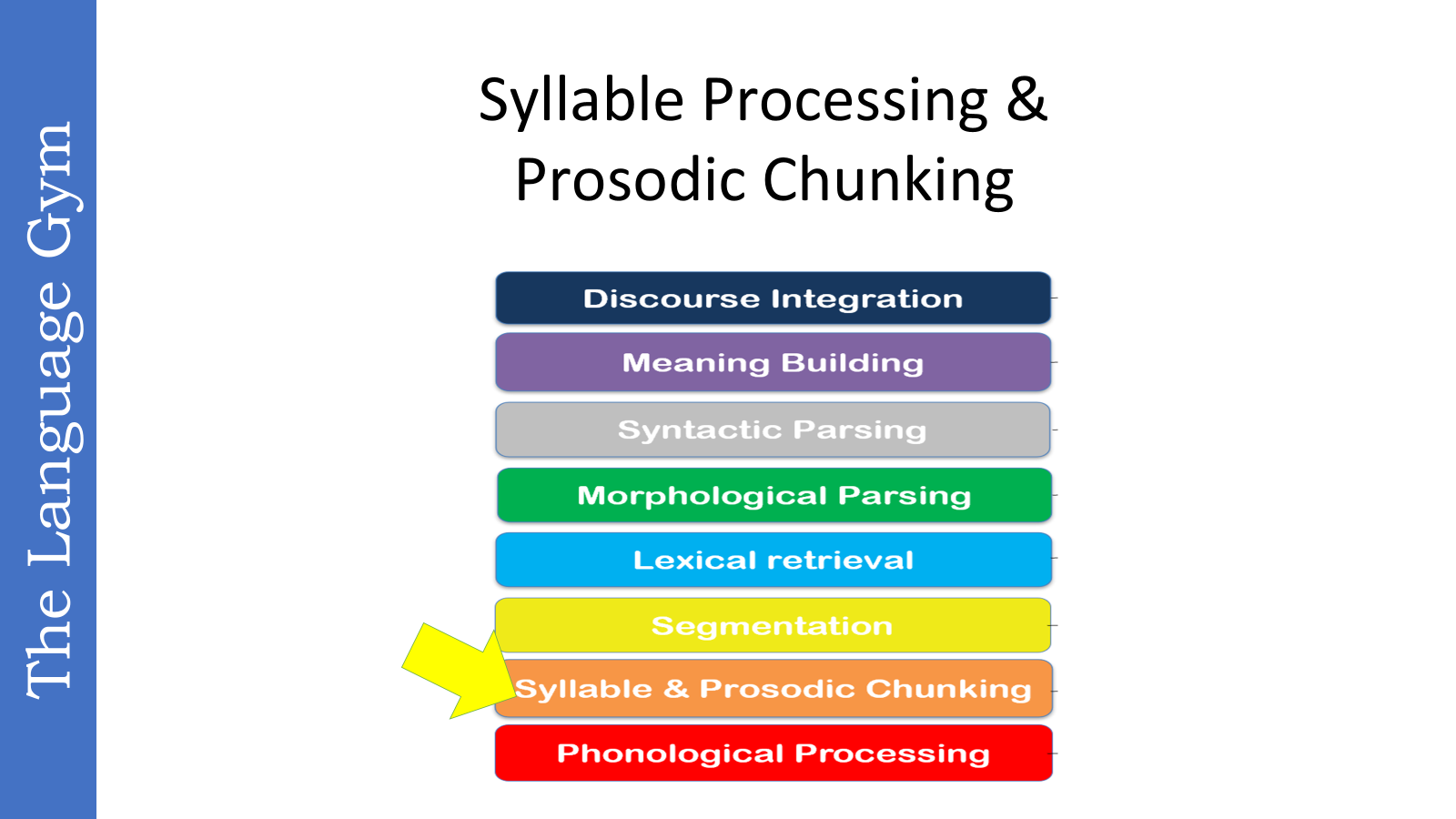
The most common barrier to listening is not lack of vocabulary, but an inability to decode fast, connected, and reduced speech. Training learners to segment the stream of speech into recognisable chunks improves fluency and comprehension. Field (2003); Cauldwell (2013); Vandergrift & Goh (2012)
2. Teach listening as a skill, not a test
Comprehension tasks do not teach listening. Without process-based training, learners stagnate. We must move away from “listen and answer” formats and instead develop learners’ perceptual and processing abilities. Field (2008); Wilson (2003); Rost (2016)
3. Break the skill into micro-processes
Listening is not monolithic. It involves bottom-up (e.g. segmentation, intonation) and top-down (e.g. predicting, inferencing) skills. Teaching these in isolation before reintegration builds more robust performance. Field (2003); Brown (2011); Rost (2011)
4. Address cognitive challenges
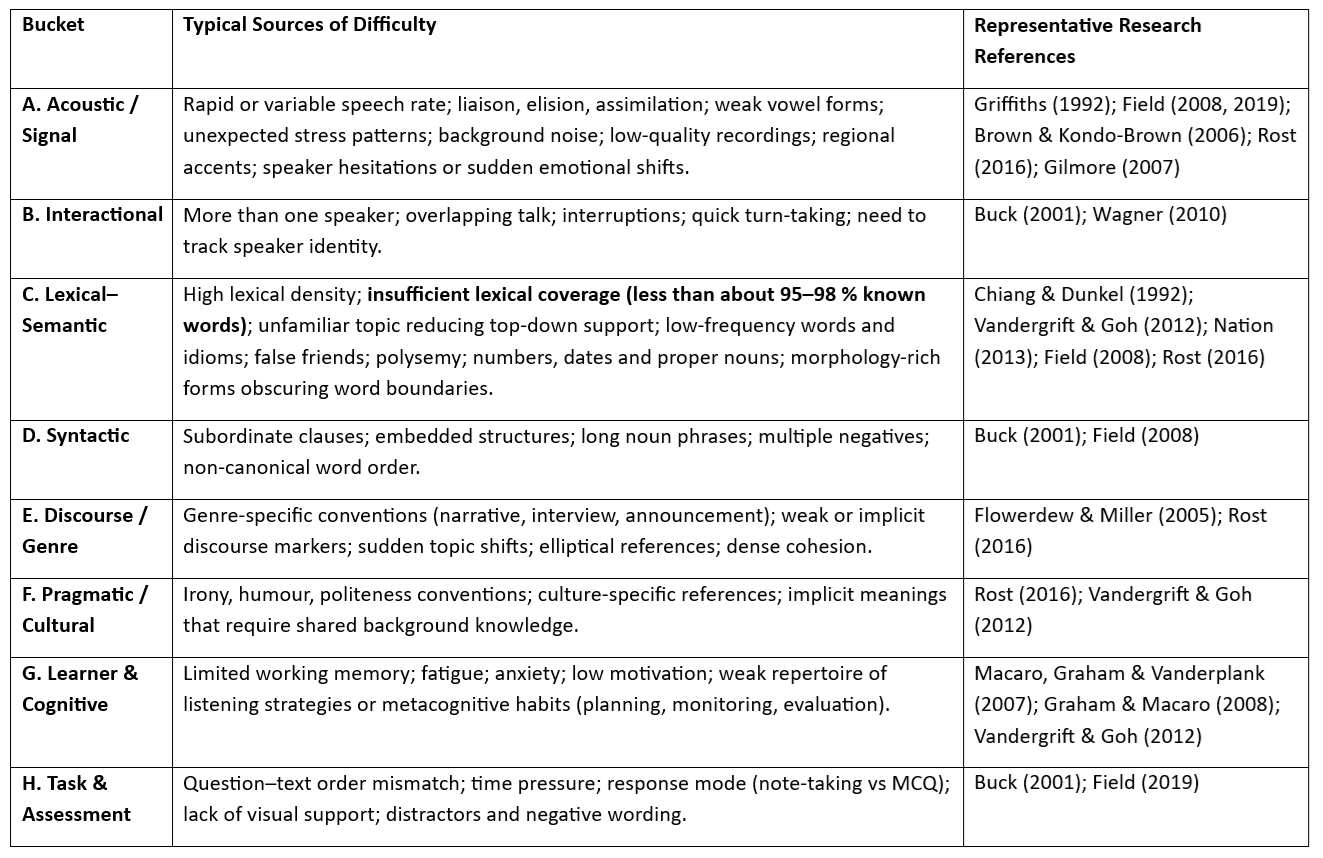
Working memory overload, not vocabulary gaps, often causes breakdowns. Training learners to process key segments and reducing task complexity helps reduce cognitive load. Understanding the factors that increase cognitive load whilst listening is key in this respect. Goh (2000); Vandergrift (2007); Field (2008)
Faster speech gives learners less time to process, decode, and segment the signal. It reduces opportunities for internal rehearsal or repair.
2. Lexical density
A high concentration of low-frequency or domain-specific vocabulary can overwhelm working memory and reduce decoding efficiency.
3. Accent and pronunciation variation
Unfamiliar regional or non-native accents require additional processing resources to match phonetic input to known forms.
4. Lack of pauses or chunking
Speech with fewer natural pauses makes segmentation harder, increasing processing load and reducing comprehension.
5. Background noise or poor audio quality
Competes for attentional resources and impairs bottom-up decoding.
6. Complex syntax
Subordinate clauses, relative clauses, passives, and embeddings require more syntactic parsing, taxing working memory.
7. Task type (e.g., open-ended vs. multiple choice)
Open-ended tasks require more inferencing, formulation, and metacognitive monitoring, increasing overall cognitive demand.
8. Ambiguity or unpredictability in the input
Lack of clear discourse markers or topic cues means listeners must do more predictive and inferential work.
9. Time pressure or high-stakes conditions
Anxiety and reduced processing time impair both decoding and comprehension, especially under exam-like conditions.
10. Lack of contextual support (e.g., visuals, prior knowledge)
When listeners can’t draw on schema or contextual cues, more mental effort is required to construct meaning from the audio alone.
5. Make form-focused listening a habit
Listening can and should be a context for grammatical noticing. Training learners to detect tenses, morphology, or syntax in audio strengthens both comprehension and grammar acquisition. This is rarely done and it is an innovative feature of the EPI approach, where these activities are common practice. Ellis (2006); Field (2008); Cross (2012)
6. Use authentic and semi-authentic input wisely
Naturalistic input is essential, but must be scaffolded. Start with modified speech (simplified, highly patterned, flooded with the target language items and uttered at moderate speed) then increase complexity and speed incrementally, enabling learners to bridge the gap to real-world listening. Gilmore (2007); Cross & Vandergrift (2015); Cauldwell (2013)
7. Design listening with purpose
Listening tasks should simulate real-world goals: identifying intentions, comparing viewpoints, following directions. Purposeful tasks drive motivation, attentional focus, and transfer. Gilmore (2011); Nation & Newton (2009); Willis & Willis (2007)
8. Revisit input repeatedly
One exposure is rarely enough. Repeated listening—combined with varying tasks—helps learners focus on different aspects of the input and build more fluent decoding. This is where EPI’s narrow listening tasks can be very useful. Field (2008); Vandergrift (2011); Goh & Aryadoust (2013)
9. Teach metacognition—but at the right time
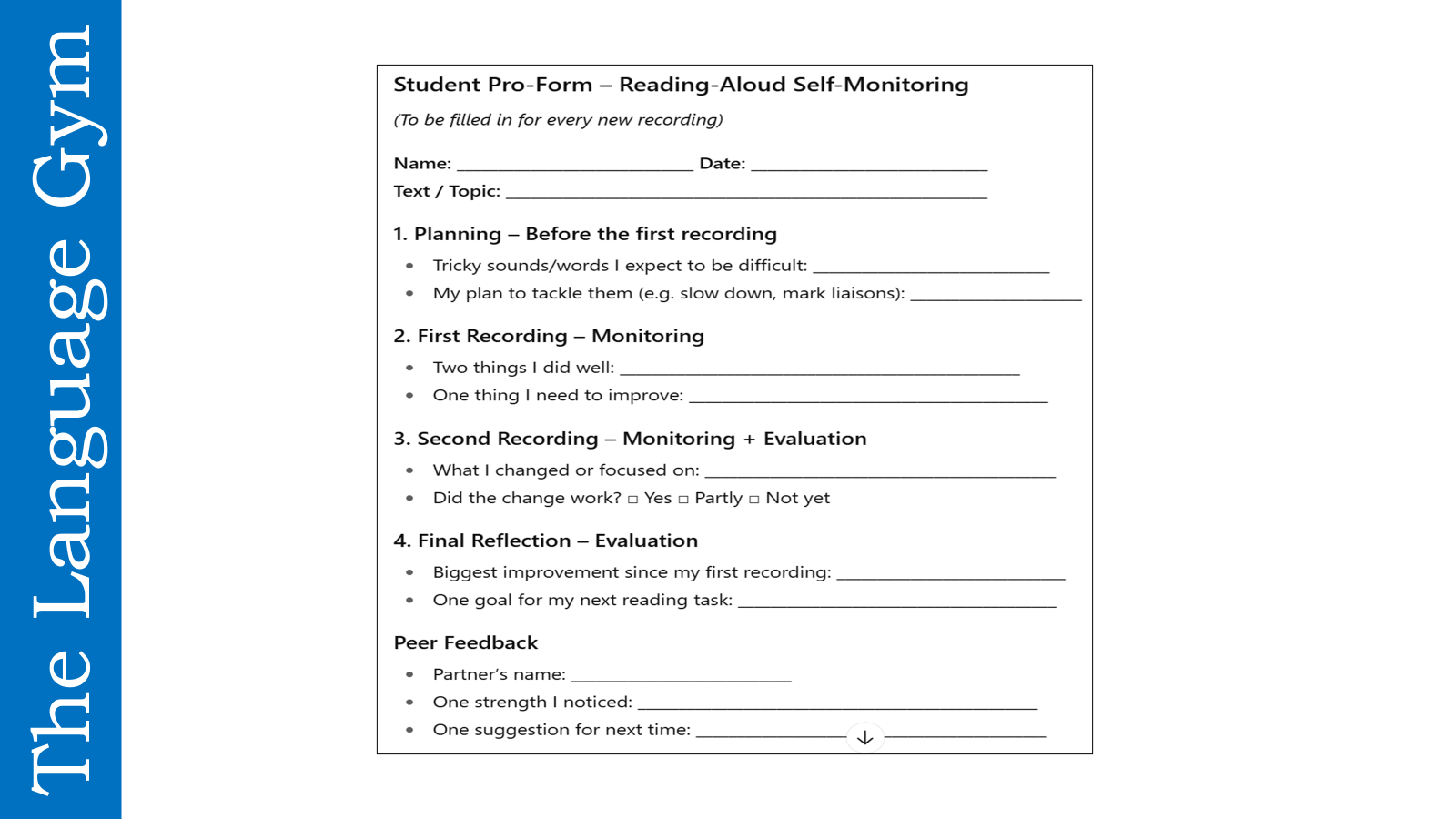
Planning, monitoring, and evaluating are crucial—but they must rest on a solid base of decoding skills. If learners can’t segment input, strategy training often leads to frustration. Do remember that metacognitive strategies are no substitute for vocabulary knowledge (which is the single strongest predictor of successful listening comprehension). Vandergrift & Goh (2012); Goh (2008); Cross (2011)
10. Give learners feedback on how they listen
Feedback should go beyond right/wrong answers. Reflection on how they listened—using transcripts, audio loops, or teacher commentary—improves awareness and long-term performance. Goh (2008); Cross (2011); Vandergrift & Goh (2012)
Final Thought
We need to stop treating listening as a black box or comprehension lottery. The skill can—and should—be taught explicitly, systematically, and progressively. These ten principles offer a research-informed roadmap for teachers ready to transform their listening curriculum:
If you’re looking for how to bring these principles to life in the classroom, you’ll find over 100 ready-to-use strategies in my book with Steve Smith: Breaking the Sound Barrier – Teaching Learners How to Listen (Conti & Smith, 2019). It’s designed to bridge the gap between research and practice, one decoding-rich, purpose-driven task at a time.
Having delivered 150-200 professional development workshops a year for the pastten years, I’ve been afforded a unique window into the wonderfully varied and occasionally hilarious ecosystem of Modern Foreign Language (MFL) teachers. From the most ardent pedagogical missionaries to the CPD escape artists seeking only coffee and a break from cover duty, the MFL CPD room is a rich field of sociological study.
What follows is a semi-serious taxonomy — lovingly compiled, half-anthropological, half-therapeutic — of the MFL professionals you’re likely to encounter at your next training session. If you don’t see yourself in one of these types, look again… or ask your colleagues. They’ll know.
For those of you with a more serious disposition, I’ve also included a research-informed taxonomy that I’ve consistently found useful as a professional development provider — both in preparing for and delivering my workshops and keynotes.
A semi-serious Taxonomy
1. The Enthusiast
AKA: The Smiler, The “This Is Gold!” Type
Behaviour: Front-row sitter, nods frequently, already tweeting out takeaways.
Quote: “This is exactly what I needed!”
Function: Injects energy and optimism into the room.
2. The Skeptical Veteran
AKA: The “Seen It All Before” Guardian
Behaviour: Arms folded, occasional smirk, references ‘old-school’ methods with fondness.
Quote: “We tried this in 2007. Didn’t work.”
Function: Keeps the hype in check and brings a long-view perspective.
3. The CPD Collector
AKA: The training addict
Behaviour: Mentions prior workshops with name-drops, quotes research unprompted.
Quote: “At the workshop in Leeds last term, we discussed something similar.”
Function: Brings depth and connects dots across sessions.
4. The Workload Drowner
AKA: The Overwhelmed One
Behaviour: Slightly panicked expression, visibly thinking about their to-do list.
Quote: “I like this, but when would I even have time to laminate it?”
Function: Represents the reality of teacher burnout. Deserves biscuits.
5. The Evangelist
AKA: The CPD apostle
Behaviour: Hails the CPD as a game changer. Already rewriting the schemes of learning in their heads.
Quote: “This will change everything!”
Function: The ultimate CPD cheerleader.
6. The Hostage
AKA: The Unwilling Participant
Behaviour: Didn’t choose to attend. Checks phone constantly. Doesn’t speak.
Quote: “I was told to come.”
Function: Seat-filler. Sometimes surprisingly moved by Slide 46.
7. The Absorber
AKA: The Sponge, The Silent Strategist
Behaviour: Quiet, focused, takes notes diligently. Rarely speaks, but often acts.
Quote: “I just need to sit with this and process it a bit.”
Function: CPD gold. Will quietly implement more than anyone.
8. The Contrarian
AKA: Devil’s Advocate, The Challenger
Behaviour: Constantly questions assumptions. Engages in intense debate.
Quote: “But where’s the empirical evidence that this actually works?”
Function: Raises rigour. Also blood pressure.
9. The SLT Tourist
AKA: The Suit, The Surveillance Drone
Behaviour: Makes strategic eye contact. Says very little. Evaluates silently.
Quote: “Interesting… carry on.”
Function: Keeps everyone a bit on edge. Might fund something.
10. The CPD Burnout
AKA: The Numb Veteran.
Behaviour: Emotionally done. Can’t muster enthusiasm. Responds only to caffeine.
Quote: “Another day, another acronym.”
Function: A warning sign. Deserves both empathy and a nap.
Rare but Remarkable Species
The Pedagogical Magpie
Behaviour: Hoards ideas, shiny strategies, and buzzwords like treasure.
Quote: “Wait! I can blend retrieval with escape room mechanics!”
Behaviour: Genius ideas unrecognised by SLT. Whispers “just between us” before showing their best work.
Quote: “We’re not officially allowed to do this… but look what happened!”
Function: Underground educational revolutionary.
The Inner Rebel
Behaviour: Smiles sweetly during plenaries but mutters anarchic thoughts under breath.
Quote: “Let’s just say I don’t always follow the scheme.”
Function: Keeps the spirit of autonomy alive.
The Transformer
Behaviour: Arrives sceptical. Leaves radiant. Plans a revolution over lunch.
Quote: “I’ve got a completely new vision now.”
Function: The true CPD butterfly. Proof metamorphosis is possible.
Summary Table
Type
Nickname
Main Behaviour
Core Function
Enthusiast
The Smiler
Engaged, excited
Boosts atmosphere
Skeptical Veteran
Seen-It-All Guardian
Cautious, experienced
Offers historical context
CPD Collector
Workshop Nomad
Well-informed, hyperlinked mind
Connects disparate insights
Workload Drowner
The Overwhelmed One
Distracted, realistic
Brings urgency and honesty
Evangelist
CPD Apostle
Zealous, contagious optimism
Promotes rapid adoption
Hostage
The Unwilling One
Passive, uninterested
Adds statistical weight
Absorber
Silent Strategist
Thoughtful, measured
Quiet implementation star
Contrarian
Devil’s Advocate
Critical, data-driven
Provokes higher standards
SLT Tourist
The Suit
Polished, formal
Adds institutional accountability
CPD Burnout
The Shell
Weary, glazed
Signals system strain
Pedagogical Magpie
The Idea Collector
Method-blender, playful
Sparks creative chaos
Innovator-in-Exile
The Maverick
Rules-optional genius
Quietly disrupts the system
Inner Rebel
The Sweet Subversive
Smiling insurgent
Keeps it real
Transformer
The Late Bloomer
Awakens mid-session
Delivers CPD payoff
A research-informed taxonomy
Here is a more serious taxonomy, based on research. As you will notice, there are quite a few overlaps with the one I have provided above.
Profile
Core Characteristics
Research Roots
Implications for CPD
The Pragmatic Adapter
Interested in usable, classroom-ready strategies; ignores the theory.
Implementation science; Timperley (2011)
Needs practical modelling and follow-up support.
The Reflective Practitioner
Enjoys critical engagement; seeks to link CPD to beliefs and context.
Schön (1983); Boud & Walker (1990)
Benefits from dialogic spaces and collaborative inquiry.
The Compliant Attender
Attends because it’s required; passive engagement.
Kennedy (2014) – transmissive vs transformative models
Risk of low impact unless agency is built in.
The Change Agent
Applies and advocates for new practices; influences others.
Desimone (2009); Fullan (2001)
Ideal for peer coaching and leadership development.
The Skeptical Consumer
Questions efficacy and credibility of approaches.
Kennedy (2005); Coldwell (2017)
Needs evidence, rationale, time to experiment.
The Overloaded Practitioner
Mentally engaged but emotionally depleted.
Burnout literature; Day & Gu (2007)
CPD must consider workload and wellbeing.
The Strategic Collector
Gathers ideas for future use; delays application.
Situated learning; Eraut (2004)
Needs nudges, mentoring, or low-stakes trials.
The Novice Explorer
New to teaching; eager but overwhelmed.
Clarke & Hollingsworth (2002)
Needs scaffolding, mentoring, and simplified frameworks.
The In-School Influencer
High social capital; their CPD stance shapes others’.
Social learning theory; Bandura (1977)
Can amplify or undermine school-wide CPD impact.
Why These Taxonomies Matter
It’s easy to dismiss CPD humour as light relief — but understanding who’s in the room helps us design better, more inclusive, and more effective professional learning experiences. The first taxonomy isn’t just a tongue-in-cheek portrait of MFL teachers; it’s a mirror for schools and trainers alike.
Recognising these types allows:
Facilitators to anticipate reactions, adapt tone, and avoid one-size-fits-all approaches.
Colleagues to build empathy, recognising that scepticism or silence isn’t always resistance — it might be burnout, overwork, or deep reflection.
Leaders to identify who might need more nurturing, who can be champions of change, and who could be gently nudged out of passive roles.
And for teachers? It’s an invitation to self-reflect. Are we always the same persona in every CPD? Or do we shift depending on context, energy, and topic? A strong CPD culture isn’t about converting everyone into an Evangelist — it’s about embracing the full cast, quirks and all, and ensuring each one leaves the room just a little more curious, hopeful, or empowered.
Conclusion
CPD isn’t just about content — it’s about community. These characters, in all their varied glory, are part of what makes MFL CPD vibrant, unpredictable, and oddly endearing. Whether you’re an Evangelist, an Escape Artist or somewhere in between, your presence shapes the room. And maybe, just maybe, you’re not just one type — but a bit of several, depending on the time of year, the topic, or how much coffee you’ve had.
So the next time you walk into a training room and scan the seating plan, look around: your tribe is there.
(Just don’t sit too close to the Contrarian. You’ve been warned.)
Imagine a classroom where learners speak not to produce, but to echo. They’re not asked to create original sentences, but to shadow a model voice—real time, word for word, tone for tone, breath for breath. To the untrained eye, it might look like mindless mimicry. But under the hood, shadowing is an advanced, cognitively rich technique, lauded for its potential to accelerate language acquisition, especially fluency and listening.
Long used in interpreter training and increasingly recommended in applied linguistics literature, shadowing is slowly making its way into communicative classroom settings. But for it to be effective—particularly with novice or intermediate learners—it must be carefully scaffolded, ideally following scripted listening activities (Conti & Smith, 2019) and explicit phonics instruction.
This post explores what shadowing is, how it works, why it works, what research says about it, how to avoid its pitfalls, and most importantly, how to implement it successfully in classrooms following the EPI model.
What Is Shadowing?
Shadowing is the technique of listening to a piece of spoken language and immediately repeating it aloud, trying to match the speaker’s intonation, pronunciation, stress, and rhythm. Unlike delayed imitation or choral repetition, shadowing is simultaneous, usually performed within milliseconds of the original input.
It was first formalised by Tamai (1992) in Japan and later refined by Kadota (2007, 2012) as a tool for training interpreters. The learner listens and speaks at the same time, forcing their phonological loop to operate at full capacity while building motor-auditory fluency.
Why Does Shadowing Work?
Shadowing is effective because it activates multiple learning mechanisms at once. Let’s break down the key benefits:
It Improves Auditory Discrimination and Working Memory According to Baddeley’s (2003) model of working memory, the phonological loop is responsible for storing and processing sounds. Shadowing keeps this loop constantly active, reinforcing sound recognition and mental rehearsal. Kadota (2012) found that shadowing boosts phonological encoding, leading to better short-term retention of language chunks.
It Develops Accurate Prosody and Pronunciation By synchronising with the speaker’s voice in real time, learners refine their intonation, pitch contours, and rhythm. Studies by Foote & McDonough (2017) and Mori (2011) show significant gains in pronunciation accuracy and prosodic fluency in ESL learners using shadowing with mobile tools.
It Proceduralises Grammar and Chunks Shadowing promotes implicit learning by encouraging learners to internalise grammatical structures and lexical chunks without conscious analysis. It facilitates proceduralisation—the transformation of declarative knowledge into fluent, automatic output (DeKeyser, 2007; Segalowitz, 2010).
It Sharpens Listening Skills Because it requires fine-grained attention to input, shadowing enhances decoding of connected speech, reductions, elisions, and weak forms, making learners more adept at parsing naturalistic input (Tamai, 1992; Hamada, 2016).
It Builds Cognitive Load Tolerance The simultaneous nature of shadowing trains learners to process input and output concurrently—developing mental agility and fluency under pressure (Kadota, 2012). This is especially valuable for interpreters and advanced communicators.
How Much Is Enough?
While there’s no magic number, research offers useful guidelines:
Kadota (2007) recommends 3–5 hours per week for measurable gains in fluency.
Tamai (1992) observed strong improvements with 15–20 minutes daily across several weeks.
Hamada (2016) found that lower-intermediate learners benefited significantly from short sessions (10–15 minutes, 3–4x per week) over 6 weeks.
As with most language input, regularity and quality matter more than quantity.
Foundations First: Scripted Listening and Phonics
For shadowing to yield optimal results, it should not be introduced in a vacuum—especially not with novice learners. It must follow foundational work that:
Makes input fully comprehensible (Krashen, 1982);
Familiarises learners with key structures and lexis;
Helps them decode sounds explicitly.
This is where Extensive Processing Instruction (EPI) comes in. EPI advocates for Scripted Listening (Conti & Smith, 2019)—intensive listening activities based on rich, recycled input with built-in scaffolds (e.g., narrow listening, aural match-ups, listening pyramids). These prime the learner’s brain with high-frequency structures and help them notice collocations and patterns.
Before or alongside shadowing, it’s also vital to carry out explicit phonics work, especially for English learners grappling with inconsistent sound-letter correspondences. Addressing common mispronunciations reduces the risk of fossilising errors during shadowing.
Pitfalls of Shadowing (and How to Avoid Them)
Pitfall
Risk
Solution
Mindless parroting
Learners repeat without understanding
Combine shadowing with comprehension tasks (e.g. summarising, back translation)
Cognitive overload
Particularly for beginners
Use graded materials, slow speed, transcript support
Fossilisation of errors
Incorrect forms get automatised
Do phonics work beforehand; use native audio; record and review output
Demotivation
Learners may find it stressful or boring
Use engaging content and gamify (e.g. shadowing speed challenges)
Classroom Implementation Tips
Start with “Scripted Shadowing” Learners shadow while reading the transcript. This builds phonological confidence.
Move to Audio-Only Once comfortable, learners shadow without transcript, chunk by chunk.
Use High-Frequency Chunks Focus on sentence builders and recycled structures already taught (Conti, 2021).
Incorporate Output Tasks Follow shadowing with retrieval practice: e.g., write a summary, answer comprehension questions, rephrase key chunks.
Record and Compare Learners record their shadowing and compare it to the model—great for noticing gaps in pronunciation or rhythm.
Keep Sessions Short and Focused 10–15 minutes of intensive shadowing is better than 40 minutes of fatigued mimicry.
How you can gamify Shadowing
Here are a few tried and tested Shadowing games that can be easily incorporated in your lessons.
Conclusion: Beyond Echoes
Shadowing may look like imitation, but it’s far more than echoing sounds—it’s a full-body rehearsal of fluency. When built upon a foundation of scripted listening, phonics, and lexical patterning, it can turbocharge learners’ listening comprehension, pronunciation, and spontaneous production.
For teachers working within an EPI framework, shadowing is not just an add-on. It’s the bridge between structured input and proceduralised output. Used judiciously.
References
Baddeley, A. (2003). Working Memory and Language. Psychology Press. Conti, G., & Smith, S. (2019). Breaking the Sound Barrier. The Language Gym. DeKeyser, R. (2007). Practice in a Second Language: Perspectives from Applied Linguistics and Cognitive Psychology. CUP. Foote, J. A., & McDonough, K. (2017). Using shadowing with mobile technology to improve ESL pronunciation. Journal of Second Language Pronunciation, 3(1), 34–56. Hamada, Y. (2016). Shadowing: Who benefits and how? Language Teaching Research, 20(1), 35–52. Kadota, S. (2007). Shadowing as a Training Method for Improving EFL Learners’ Listening and Speaking Skills. Tokyo: Taishukan. Kadota, S. (2012). Shadowing: Let’s Speak English Like an Interpreter! Tokyo: Cosmopier. Krashen, S. (1982). Principles and Practice in Second Language Acquisition. Pergamon. Mori, Y. (2011). The roles of phonological decoding and semantic access in L2 word recognition. Studies in Second Language Acquisition, 33(1), 1–30. Segalowitz, N. (2010). Cognitive Bases of Second Language Fluency. Routledge. Tamai, K. (1992). Shadouingu no Koka ni Tsuite no Kenkyuu [A Study on the Effects of Shadowing]. Tokyo: Kuroshio.
We often talk about what makes great language teaching: clear explanations, rich input, meaningful practice. But how often do we stop to ask: how does the brain itself process language?
The answer matters more than we might think. Understanding the key areas of the brain involved in speaking, listening, reading and writing gives us powerful clues about how to teach more effectively. Why is listening so crucial early on? Why does grammar overload learners so easily? Why do some students struggle to connect speech and text?
In this article, we’ll take a simple tour of the brain’s main language hubs — what each does, how they work together — and explore what this means for everyday classroom practice. You don’t need to be a neuroscientist to teach with the brain in mind… but knowing a few key facts can help you make better choices for your learners.
1. Broca’s area
Where it is: In the lower part of the left frontal lobe.
What it does:
Helps us plan and say words and sentences.
Handles grammar: putting words together correctly.
Deals with complex sentence structures.
Think of it as the “speech and grammar centre”.
2. Wernicke’s area
Where it is: In the upper part of the left temporal lobe.
What it does:
Helps us understand spoken and written language.
Links sounds to meanings.
The brain’s “understanding and decoding hub”.
3. Angular gyrus
Where it is: In the parietal lobe near Wernicke’s area.
What it does:
Links what we hear, see, and know.
Important for reading and writing.
Helps connect written words with how they sound.
The “integration centre” — essential for reading and writing.
4. Arcuate fasciculus (not a hub but a key connection)
What it does:
Connects Broca’s and Wernicke’s areas.
Lets comprehension and speaking areas work together.
If damaged, people can speak and understand well but struggle to repeat what they hear.
The “information highway” between understanding and speaking.
5. Primary auditory cortex (Heschl’s gyrus)
Where it is: In the upper part of the temporal lobe.
What it does:
Handles first processing of sounds.
Critical for hearing and recognising speech sounds.
The “entry point for speech sounds”.
6. Other areas involved in language
Prefrontal cortex: Handles higher-level things like planning conversations and using language appropriately.
Right hemisphere areas: Help with tone, emotion, humour, sarcasm, and rhythm in speech.
How a sentence is processed by the brain: hub by hub
Let’s imagine a learner hears the sentence:
“The cat is sleeping on the chair.”
Here’s what happens in their brain, step by step:
1. Primary auditory cortex (Heschl’s gyrus): first stop
As soon as the sound reaches the ears, it’s sent to the primary auditory cortex, which begins decoding the raw sound: pitch, rhythm, volume.
At this stage, the brain is simply recognising that “this is speech” and starts to break it into smaller units like phonemes.
2. Wernicke’s area: comprehension and decoding
Next, Wernicke’s area gets involved to identify words and attach meaning to them: recognising “the”, “cat”, “is”, “sleeping”, etc.
This is where the learner understands what each word means, tapping into their mental vocabulary.
3. Angular gyrus: multimodal integration
The angular gyrus might also activate, especially if the learner is imagining the sentence’s meaning (“cat” → picture of a cat; “chair” → picture of a chair).
If they’re reading the sentence instead of hearing it, the angular gyrus would link the written words to their sounds and meanings.
4. Broca’s area: preparing a response and analysing grammar
Broca’s area now steps in to unpack the grammar: it identifies that “the cat” is the subject, “is sleeping” is the verb phrase, “on the chair” is a prepositional phrase showing location.
If the learner is planning to repeat or comment on the sentence (e.g., saying “The cat is sleeping!”), Broca’s area also prepares the speech plan to produce that utterance.
5. Arcuate fasciculus: connecting comprehension to production
If the learner needs to repeat the sentence aloud, the arcuate fasciculus carries the information from Wernicke’s area (understanding) to Broca’s area (speaking).
6. Prefrontal cortex and right hemisphere: nuance and pragmatics
The prefrontal cortex may also be engaged if the learner is thinking about how to respond, planning what to say next.
If there’s additional nuance (e.g., tone of voice suggests sarcasm or excitement), the right hemisphere areas help interpret this.
Implications for language teaching
Knowing what these areas do gives us useful ideas for how we should teach language.
1. Listening is essential
The auditory cortex and Wernicke’s area need lots of good-quality listening input to help learners distinguish and understand sounds.
Implication: Listening should be a central part of teaching, especially at the start. We should give plenty of listening practice with feedback on pronunciation.
2. Grammar needs careful handling
Broca’s area is sensitive to how much information it can handle at once.
Implication:
Start with simple grammar before moving to more complex structures.
Teach language in useful chunks and phrases to reduce overload. This is key, especially with beginners.
Use repetition and scaffolding to help patterns stick before adding variation. The repetitions need to be many more than what typical textbooks afford (50+) and should cut across as many modalities as possible,
3. Use different modes together
The angular gyrus links visual, sound, and meaning information.
Implication: Combine speaking, listening, reading and writing activities (like dictations, reading while listening, shadowing) so learners use all senses.
4. Build automaticity
The arcuate fasciculus helps us speak and understand quickly and smoothly.
Implication:
Do lots of retrieval practice and fluency work (like fast drills with feedback).
Give learners practice speaking and listening at natural speeds early on.
5. Don’t forget tone and emotion
While grammar and vocabulary mainly use the left side of the brain, the right side deals with intonation, feelings, and meaning beyond words.
Implication: Teach not just correct grammar but also natural-sounding speech: tone, emphasis, humour, irony.
Conclusion
If we want our teaching to match how the brain works, we need to:
Focus heavily on listening at first.
Teach grammar carefully and gradually.
Mix speaking, listening, reading and writing so they support each other.
Give learners lots of chances for quick recall and practice.
Include tone, emphasis and “how language sounds in real life”.
This is not about gimmicks or brain myths — it’s about respecting how the brain naturally learns language so we can teach in a way that really works.
This post was prompted by a series of interactions I recently had in a Facebook group for language teachers—interactions that were, frankly, surprising and unsettling. The tone was unexpectedly hostile, the responses unreasonably oppositional, and the overall atmosphere more combative than collegial. What struck me most was that this behaviour came not from random internet trolls, but from fellow educators—professionals who, by the very nature of their vocation, are expected to model empathy, patience, and open-mindedness.
It led me to a simple but uncomfortable question: Why are teachers, of all people, sometimes so rude online? What happens when the professional ethos of mutual respect and thoughtful dialogue seems to dissolve the moment we step into virtual spaces? This post explores some of the psychological, social, and professional dynamics that may explain these lapses in civility—and what they might reveal about the pressures and pitfalls of teaching in the modern age.
What research says
Here are some of the causes of online ‘lapses in civility’ according to researchers.
1. Online Disinhibition Effect
Psychologist John Suler (2004) coined the term “online disinhibition effect” to describe the way people behave more aggressively or inappropriately online than they would face-to-face. Factors include:
Anonymity or reduced accountability: Even in named accounts, there’s a psychological distancing effect.
Lack of social cues: Without facial expressions or vocal tone, intent is easily misread.
Asynchronous communication: People post impulsively, then log off without processing consequences.
“People say and do things in cyberspace that they wouldn’t ordinarily say and do in the face-to-face world.”
— Suler, 2004
This means even well-intentioned sharing (e.g. “Here’s a new sentence builder resource I tried”) can be met with undue scepticism or sarcasm—especially if the reader interprets it as self-promotion, virtue-signalling, or a veiled critique of others’ practice.
2. Identity Threat and Insecurity
When someone shares a pedagogical approach or resource that contradicts another teacher’s methods, it can trigger a form of professional identity threat—even unintentionally.
“When core professional beliefs are challenged, individuals may respond with defensiveness or hostility to protect their self-concept.”
— Kelchtermans (2005), on teacher identity
For instance:
A teacher who uses traditional PPP (Presentation-Practice-Production) sees a post advocating for EPI or TL-only instruction.
Rather than engaging with the content, they lash out—because the post feels like a criticism of their competence.
This is worsened by a perception of status threat, especially in online spaces where some individuals (rightly or wrongly) are seen as “influencers.”
3. Social Comparison and Envy
Festinger’s Social Comparison Theory (1954) suggests people constantly evaluate their own abilities and value by comparing themselves to others. In professional social media groups:
Posts about student success, innovative strategies, or high engagement can stir envy, particularly among teachers struggling with motivation, behaviour, or leadership.
Rather than expressing insecurity, some respond with passive-aggression, sarcasm, or dismissal.
“Exposure to curated success narratives can increase feelings of inadequacy and antagonism in viewers.”
— Vogel et al., 2014
This is particularly common in subjects like MFL, where teachers often feel isolated or under-valued in their institutions.
4. Toxic In-Group Norms and Gatekeeping
Specialist teacher groups sometimes develop insular cultures—marked by unspoken norms, hierarchies, or cliques. Newcomers or those who don’t conform (e.g. by promoting new pedagogies or asking basic questions) may be:
Mocked for being “naïve”
Dismissed as “selling something” or “jumping on the latest bandwagon”
Criticised for promoting “fads” or “non-evidence-based fluff”
This reflects a form of gatekeeping, where dominant voices enforce norms and defend territory. It’s also linked to status preservation, where attacking others is a way to assert authority.
“Groupthink and gatekeeping are common in professional online spaces, limiting innovation and diversity of thought.”
— Carpenter & Krutka, 2015
5. Burnout and Emotional Spillover
Many rude online interactions aren’t truly about the article, method, or resource being shared. They’re emotional spillovers from frustration, burnout, or low self-efficacy.
“Teachers under high stress and emotional strain are more likely to externalise negativity, especially in anonymous or low-consequence environments.”
— Chang, 2009
This means that behind a hostile reply might be:
An overworked teacher marking at 11pm.
Someone who just had a lesson observation go poorly.
A teacher who’s been repeatedly unsupported by their leadership team.
Social media becomes an outlet—unfortunately, often at the expense of a well-meaning peer.
What Can Be Done?
Normalise Professional Vulnerability Encourage communities where people can say: “I don’t understand this method” or “This isn’t working for me” without shame. (See Hargreaves & Fullan, 2012, on collaborative professionalism.)
Model Generous Interpretation Assume that most people are sharing in good faith—not to boast or belittle. Leaders and moderators should publicly reward constructive tone.
Encourage Reflective Practice, Not Comparison Posts that reflect on “what didn’t work” or “how I improved this” create safer climates than curated perfection.
Design Safer Group Structures Moderation policies, norms for feedback, and opt-in “critique zones” can help maintain civility and psychological safety. That’s what we strive to achieve in the Global Innovative Language Teachers group.
Conclusion
When teachers are rude in specialist social media groups, it’s rarely about the content shared. It’s about identity, threat, status, insecurity, or accumulated frustration.
The research shows clearly: online spaces are emotionally charged, performative, and fragile. But with the right culture of empathy, transparency, and reflection, they can also become powerful ecosystems of mutual growth.
Key References
Suler, J. (2004). The online disinhibition effect. CyberPsychology & Behavior, 7(3), 321–326.
Kelchtermans, G. (2005). Teachers’ emotions in educational reforms: Self-understanding, vulnerable commitment and micropolitical literacy. Teaching and Teacher Education, 21(8), 995–1006.
Vogel, E. A., Rose, J. P., Roberts, L. R., & Eckles, K. (2014). Social comparison, social media, and self-esteem. Psychology of Popular Media Culture, 3(4), 206–222.
Carpenter, J. P., & Krutka, D. G. (2015). Engaged learning through social media: How teachers use Twitter to support professional development. Teaching and Teacher Education, 35, 9–23.
Chang, M. (2009). An appraisal perspective of teacher burnout: Examining the emotional work of teachers. Educational Psychology Review, 21(3), 193–218.
Hargreaves, A., & Fullan, M. (2012). Professional Capital: Transforming Teaching in Every School. Routledge.
A huge thank you to the authors of the Language Trends Engand 2025 report, Dr Ian Collen and Jayne Duff, whose work continues to provide vital insights and guidance for language education in England.
Every year, the Language Trends England report offers crucial insights into the health of language learning across English schools. Commissioned by the British Council and conducted by Queen’s University Belfast, the 2025 edition draws on a broad dataset from primary, secondary, and independent schools across the country. The survey includes over 1,500 responses, providing one of the most reliable barometers of Modern Foreign Languages (MFL) provision in England.
Its aim is simple yet vital: to track trends in uptake, identify inequalities, explore teacher experiences, and assess the impact of policy, curriculum reform, and innovation. In the current post-Brexit, post-pandemic context—and amid significant GCSE and A-level reforms—this year’s report paints a picture of cautious optimism, persistent inequality, and emerging shifts in classroom practice.
Key Findings Across the Sectors
1. Primary Languages Provision
French remains the dominant language, taught in 70% of primary schools, followed by Spanish (26%) and German (6%). However, uptake varies regionally and demographically.
A significant barrier in primary remains teacher confidence and subject knowledge, with 63.6% of languages being taught by generalist primary teachers.
Only 25.6% of primary schools report having access to a language specialist, making curriculum depth and progression more difficult to achieve.
Time constraints continue to impact delivery. Around 18.9% of schools say they’ve reduced time for languages due to pressures from English and Maths.
Multilingual awareness initiatives (e.g., celebrating home languages, multilingual displays) are more common in urban and multicultural schools. About 47.8% of schools promote linguistic diversity actively.
AI use is minimal in primary: over 75% of schools never use AI for language teaching.
2. Transition from KS2 to KS3
Only 50% of primary schools have any contact with local secondary MFL departments, despite KS2–KS3 transition being a long-standing issue.
Just 2% of secondary schools report that all of their Year 7 students continue with the same language studied in primary school.
Information-sharing is weak: only 27.5% of secondary schools receive any detail on pupils’ prior language knowledge or attainment.
Schools involved in NCLE Language Hubs report slightly improved transition communication but acknowledge that transition remains disjointed in most areas.
3. Secondary Language Study and Inequality
Spanish continues to grow, particularly in inner-city schools, while German is now taught in fewer than 1 in 10 schools. When taught, German tends to be concentrated in more affluent areas. French continues to be the most offered language at KS3, while Spanish retains more pupils at the age 14 and age 16 transition points;
There is a stark social divide: students in more affluent areas are much more likely to take a language GCSE. In Quintile 1 schools (least deprived), 69% of students study a language at GCSE; in Quintile 5 schools (most deprived), the figure drops to 47%.
On average, responding secondary school teachers estimate 53 per cent of their Year 11 pupils are currently learning a language for GCSE;
GCSE reforms introduced in 2024 have been broadly welcomed, with 34.2% of teachers saying they expect increased uptake as a result.
Curriculum time for MFL is under pressure in lower-attaining schools, where leaders report competing priorities (e.g. English, Maths catch-up).
4. Teacher Recruitment and Staffing
Recruitment challenges are widespread. 63% of state secondary schools report difficulties in hiring MFL teachers, and retention is particularly poor in areas with high deprivation.
Some schools rely heavily on non-specialists or teachers with limited training, particularly in Spanish.
Independent schools face fewer staffing issues, reflecting broader inequalities in resourcing and training provision.
5. Home, Heritage and Community Languages (HHCL)
While 78% of secondary schools cover the cost of GCSE or A-level exam entries for HHCLs, these are often treated as extracurricular or parental responsibilities.
Very few schools formally integrate HHCLs into their curriculum or timetabled lessons.
Access to community-based provision remains uneven, with many students reliant on weekend schools or religious organisations.
Some students are dissuaded from sitting exams due to concerns over complexity, unfamiliar question types, or lack of academic support.
6. International Engagement and Exchange
74% of secondary schools now offer international visits or exchanges again, marking a recovery from pandemic-era cancellations.
Independent schools are more likely to offer multiple trips and longer exchanges, while state schools report increasing costs and parental affordability as barriers.
The Turing Scheme is still underutilised: 49% of teachers say they’re not familiar with it, and many cite bureaucratic obstacles or lack of administrative support.
7. Technology and Innovation
AI tools are beginning to appear in some secondary classrooms, although only 12% of schools report regular use.
Teachers express interest in using AI for grammar practice, sentence generation, and differentiation, but cite time, training, and trust as barriers to full adoption.
Primary schools show very low levels of AI engagement, with most citing lack of access to appropriate devices or software.
A Spotlight on Extensive Processing Instruction (EPI)
The 2025 report highlights a notable trend in language pedagogy: the increasing adoption of Extensive Processing Instruction (EPI) in secondary schools. According to the findings, one-third of secondary schools explicitly mentioned EPI as their preferred approach for teaching modern foreign languages.
Schools describe EPI as being used consistently from Year 7 to Year 11, with teachers characterising the approach as structured and systematic. It is commonly integrated across six thematic units per year and is valued for helping teachers deliver grammar, vocabulary, and phonics in a cohesive and coordinated manner.
One head of department explained its use in practice:
“Extensive Processing Instruction is now fully embedded from Y7 to Y11 in French and Spanish. Use of sentence builders and parallel texts to deliver 7 codified Key Skills per year group, focusing on opinions in Y7, present and near future in Y8 and past, present and future in Y9. Skills run through 6 topics, one per term, and are layered vertically (by target level) and horizontally (to build year on year).”
Many teachers also describe mixing EPI with other techniques, adapting it flexibly within their departmental context. As one head of languages reported:
“We use a mixture of styles. We do use explicit instruction rather than an investigation style approach. We do include the 3 pillars: phonics, vocabulary and grammar. We find there is not much room in the curriculum for the creative and fun things. Any that we do have are planned in! We do use sentence builders and some aspects of EPI approach. But we agree that we have a variety of learners and a one style approach does not suit all.”
Conclusion
The Language Trends England 2025 report offers a detailed and timely snapshot of the challenges and opportunities facing MFL education. While barriers persist—particularly around staffing, primary–secondary transition, and socioeconomic inequalities—there are clear signs of progress and innovation.
The revival of international exchanges, a growing interest in structured methodologies like EPI, and a steady increase in Spanish uptake show that MFL teaching in England is adapting to a changing educational and political landscape. To build on this momentum, greater investment in training, policy coherence between phases, and inclusive curriculum design will be essential. Above all, the report calls for sustained, system-wide support to ensure that all learners, regardless of background, can access the benefits of language learning.
Instructed Second Language Acquisition (ISLA) is shaped by a range of learner characteristics, among which cognitive abilities—such as working memory, grammatical sensitivity, and processing efficiency—play a central role in developing language proficiency. Alongside these cognitive factors, affective variables such as motivation, anxiety, and self-efficacy significantly influence learners’ success in acquiring a second language (L2). In this context, Wen and Skehan’s (2011) model of language aptitude offers a valuable framework for understanding the complex interplay between cognitive and affective factors in second language development. This article explores their model, focusing on its three key components, and suggests classroom strategies to mitigate common barriers faced by beginner learners. The article also integrates additional cognitive and affective challenges such as attentional control, inhibitory control, anxiety, and self-efficacy, offering practical classroom responses to each.
Wen and Skehan’s (2011) Model of Language Aptitude
Wen and Skehan’s (2011) model builds on earlier conceptualisations of language aptitude (e.g., Carroll, 1962; Skehan, 1998), incorporating findings from cognitive psychology and working memory research. Rather than viewing aptitude as a fixed trait, their model conceptualises it as comprising three interrelated components:
1. Phonological Working Memory (PWM)
PWM refers to the capacity to temporarily store and manipulate auditory information. It is essential for processing phonological forms, acquiring vocabulary, and maintaining syntactic sequences in short-term memory. PWM enables learners to recognise and recall sound patterns, thereby facilitating both comprehension and production.
2. Grammatical Sensitivity
Grammatical sensitivity is the ability to perceive and internalise morphosyntactic patterns in input. It supports learners in recognising, generalising, and applying grammatical rules—even when they are not taught explicitly. This sensitivity is fundamental for inductive grammar learning and for mapping form to function in the target language.
3. Processing Efficiency and Automatization
This component refers to the speed and ease with which a learner can process language in real time. As learners move from controlled to automatic processing, they can produce language more fluently and spontaneously. High processing efficiency enables rapid, accurate communication in both spoken and written modalities.
Each component contributes uniquely to language acquisition, and difficulties in any of these areas can hinder learners—particularly at the beginner level. In addition to these three core aptitude components, other cognitive and affective barriers also play a significant role in shaping learners’ classroom experiences and outcomes. This article therefore addresses the following key barriers:
Phonological Working Memory limitations – difficulty retaining and manipulating sound-based information.
Grammatical Sensitivity deficits – difficulty detecting and internalising grammatical patterns.
Processing Efficiency limitations – difficulty processing language quickly and automatically.
Attentional Control difficulties – inability to sustain focus on relevant input or task demands.
Inhibitory Control weaknesses – difficulty suppressing L1 interference or incorrect linguistic forms.
Anxiety – emotional responses such as fear of failure or embarrassment that interfere with performance.
Low Self-Efficacy – a lack of belief in one’s own ability to succeed in language learning tasks.
The following sections examine each of these barriers in detail and offer practical, classroom-based strategies to support learners who may be affected by them.
1. Limitations in Phonological Working Memory
PWM is central to retaining and manipulating sound-based information long enough to process it. Learners with low PWM may struggle to remember new words, distinguish between similar sounds, or follow longer utterances, thereby affecting both comprehension and production.
Why PWM Matters in SLA
PWM underpins both receptive and productive skills. Comprehension requires learners to retain words and their meanings long enough to construct meaning, while production involves recalling vocabulary and grammar in real time. Limited PWM may result in slower language development, especially in early stages.
Classroom Activities to Support PWM
To support learners with limited PWM, teachers can use the following strategies:
Sound discrimination activities – Faulty Echo, Minimal pairs, Write it as you hear it, etc.
Flashcard Activities: Students review vocabulary or short phrases using flashcards, promoting recall and rehearsal of phonological forms.
Phonemic Drills: Students practise difficult or unfamiliar sounds through repetition and articulation exercises.
Chunking aloud games: Mind reader, Sentence Stealer, Lie detector, etc.
Shadowing: Students repeat what they hear immediately, mimicking pronunciation and rhythm, often using audio recordings.
Delayed repetition
Choral Repetition: The teacher says a sentence aloud and the whole class repeats it together, reinforcing sound patterns and memory.
2. Grammatical Sensitivity Deficits
Learners with low grammatical sensitivity often struggle to detect or generalise grammatical rules, even after repeated exposure. This can result in difficulties with word order, verb conjugation, and tense/aspect distinctions.
Why Grammatical Sensitivity Matters
Grammatical sensitivity enables learners to decode structural regularities in input and construct grammatically accurate output. It is especially important for inductive learning, which is common in communicative and implicit instruction contexts.
Classroom Activities to Support Grammatical Sensitivity
Sentence Builders: Learners arrange jumbled words or chunks into grammatically correct sentences.
Error-Spotting Tasks: Students identify and correct errors in model sentences, developing grammatical awareness.
Pattern-Contrast Activities: Learners compare two or more sentence patterns to notice grammatical contrasts (e.g., tense or word order).
Parallel Texts: Bilingual texts are used side by side so learners can compare grammatical structure across languages.
Structured Dialogues: Pre-written conversations highlighting specific grammar points that learners practise aloud in pairs.
Transformational Exercises: Learners change sentence features, such as tense, voice, or speech type (e.g., direct → indirect speech).
3. Processing Efficiency Limitations
Learners with low processing efficiency often struggle with fast speech, slow production, and keeping pace with conversation. These difficulties can result in hesitation, fragmented sentences, and communication breakdowns.
Why Processing Efficiency Matters
Fluency in an L2 depends on the ability to process input and produce output quickly and automatically. With practice, learners can move from conscious rule application to intuitive language use.
Classroom Activities to Support Processing Efficiency
4-3-2 Technique: Learners speak about the same topic three times, in decreasing time frames (4, 3, then 2 minutes), increasing fluency.
Market Place Activity: Learners interact with peers in a role-play “market,” quickly exchanging information to complete a task.
Fast and Furious: Timed oral questions with rapid-fire answers to train quick thinking and reduce hesitation.
Timed Dictation: Short passages are dictated within a time limit to improve listening, decoding, and writing speed.
Sentence Relays: Students take turns quickly completing sentence stems in a group relay format.
Speed Races: A competition to complete cloze tasks or grammatical transformations as fast as possible.
4. Attentional Control Deficits
Attentional control refers to a learner’s ability to focus on relevant linguistic input while ignoring distractions. Learners with weak attentional control—often those with ADHD or high distractibility—may struggle to maintain focus during input-rich tasks, leading to missed cues and incomplete intake.
Why Attentional Control Matters
Attention is a gateway to learning. Without focused attention, learners may not process grammatical or lexical input sufficiently for it to be retained or internalised.
Classroom Activities to Support Attentional Control
Chunked Listening: Listening tasks are broken into short segments, each followed by comprehension or focus questions.
Notice-the-Form Tasks: Learners highlight or underline target grammar forms during reading or listening tasks.
Classroom Signals: Teachers use visual or auditory cues (e.g., bells, lights, hand signals) to re-direct attention.
Time on Task Challenges: Short, timed tasks that challenge learners to stay focused (e.g., “spot 5 verbs in 90 seconds”).
5. Inhibitory Control Difficulties
Inhibitory control is the ability to suppress irrelevant or competing information—such as L1 interference or incorrect hypotheses. Learners with poor inhibitory control may perseverate with incorrect forms despite corrective feedback.
Why Inhibitory Control Matters
Inhibitory control allows learners to suppress overlearned or default responses in favour of new, target-like forms. It is essential for restructuring interlanguage and learning from feedback.
Classroom Activities to Support Inhibitory Control
Contrastive Analysis Tasks: Learners explicitly compare L1 and L2 structures to notice differences and avoid negative transfer.
Error Inhibition Routines: Learners practise pausing before speaking or writing to self-monitor for common errors.
Delayed Repetition Tasks: Students hear a sentence and must repeat it after a short delay, which inhibits automatic (often incorrect) responses.
Focused Correction Activities: Learners track personal error patterns using logs or correction slips, then practise suppressing these errors.
6. Anxiety
Language anxiety, whether trait-based or situation-specific, can significantly impair performance, especially in speaking and listening. Learners experiencing high anxiety may avoid participation, disengage from risk-taking, or freeze during interaction.
Why Anxiety Matters in SLA
Anxiety affects the affective filter (Krashen, 1982), reducing the efficiency of input processing and impeding working memory. It can disrupt speech planning and lead to underperformance despite high aptitude.
Classroom Activities to Lower Anxiety
Think-Pair-Share: Learners think individually, then discuss in pairs before sharing with the class, reducing pressure.
Error-Tolerant Environment: Teachers model how to respond positively to mistakes, encouraging risk-taking and learning from errors.
Choice Boards: Students select how they demonstrate learning (e.g., orally, visually, in writing), increasing control and comfort.
Role Play in Pairs: Learners practise dialogues in pairs before performing in larger groups, easing them into public speaking.
7. Low Self-Efficacy
Self-efficacy is the belief in one’s capacity to succeed in specific tasks. Learners with low self-efficacy often avoid challenges, give up quickly, and underestimate their capabilities, even when aptitude is sufficient.
Why Self-Efficacy Matters
High self-efficacy leads to greater persistence, willingness to take risks, and resilience after failure—critical attributes for mastering a language.
Classroom Activities to Build Self-Efficacy
Success Journals: Students record and reflect on small wins and progress to boost confidence.
Mastery Experience Design: Teachers scaffold tasks to start with easy wins and gradually increase complexity.
Peer Modelling: Learners observe peers of similar ability succeed, which helps them believe they can do the same.
Feedback Focused on Growth: Teachers provide feedback that highlights improvement and effort rather than just correctness.
Conclusion
Overcoming cognitive and affective barriers in second language acquisition requires a comprehensive approach targeting learners’ limitations in working memory, grammatical sensitivity, processing efficiency, attentional control, inhibitory control, anxiety regulation, and self-belief. Research-informed strategies—such as the 4-3-2 technique, market-place tasks, think-pair-share, and delayed repetition—can accelerate language development by enhancing both automaticity and emotional engagement. These techniques not only develop specific cognitive skills but also foster the motivation, confidence, and resilience learners need to persist. By addressing these barriers explicitly in the classroom, educators can create more inclusive, effective, and enjoyable language learning experiences for all students—especially those just beginning their language journey.
References
Carroll, J. B. (1962). The prediction of success in intensive foreign language training. In R. Glaser (Ed.), Training research and education (pp. 87–136). Pittsburgh, PA: University of Pittsburgh Press.
Krashen, S. D. (1982). Principles and Practice in Second Language Acquisition. Pergamon Press.
Skehan, P. (1998). A Cognitive Approach to Language Learning. Oxford University Press.
Wen, Z., & Skehan, P. (2011). A new perspective on language aptitude: Introducing the Working Memory Language Aptitude Model. In Z. Wen, M. B. Mota, & A. McNeill (Eds.), Working Memory and Second Language Learning: Towards an Integrated Approach (pp. 15–34). Multilingual Matters.
Dörnyei, Z. (2005). The Psychology of the Language Learner: Individual Differences in Second Language Acquisition. Lawrence Erlbaum Associates.
Ellis, R. (2005). Principles of instructed language learning. System, 33(2), 209–224.
Segalowitz, N. (2010). Cognitive Bases of Second Language Fluency. Routledge.
MacIntyre, P. D., & Gardner, R. C. (1991). Language anxiety: Its relationship to other anxieties and to processing in native and second languages. Language Learning, 41(4), 513–534.
Bandura, A. (1997). Self-efficacy: The exercise of control. New York: W.H. Freeman.
What does effective language teaching look like? Decades of research in second language acquisition (SLA), cognitive science, and classroom pedagogy have given us clear answers. This guide brings together twelve essential principles for designing, sequencing, and delivering powerful MFL lessons that lead to real learning—not just short-term performance.
These strategies are not meant to be tick-boxes, but deeply interconnected elements that reinforce one another—from input to output, from decoding to motivation.
1. Phonics and Pronunciation Foundations
Explicit phonics instruction builds essential decoding and listening skills, especially in opaque orthographies like French. But on its own, it’s not enough. The most effective classrooms combine explicit phonics with implicit exposure in listening and reading.
Why the synergy matters:
Explicit phonics teaches decoding rules (e.g. “in” sounds like /ɛ̃/).
Implicit phonics builds fluency through pattern recognition in authentic input.
The combination enables both conscious control and automaticity.
Why it matters:
Improves listening comprehension and oral production
Builds spelling and reading confidence
Supports independence and reduces fear of unfamiliar words
Research:
Woore (2018); Saito (2014); Conti (2023)
Example:
Teach “in, on, an” sounds explicitly → play a short story with matin, champignon, enfant → follow up with dictation and discrimination tasks.
2. Comprehensible Input First
Before output, learners need abundant exposure to understandable language slightly above their current level (i+1). This is the foundation of acquisition.
Why it matters:
Builds mental representations of grammar and lexis
Prepares learners for later production and retrieval
Supports subconscious pattern recognition
Research:
Krashen (1982); Ellis (2005); VanPatten (2002)
Figures:
Most vocabulary needs 6–12 meaningful exposures (Webb, 2007)
Listening becomes efficient at 95–98% known-word coverage (Nation, 2013)
Example:
Before using the passé composé, immerse learners in short texts, stories, and audio with rich repetition of that structure.
3. Teaching in Chunks and High-Frequency Language
Rather than isolated vocabulary or grammar points, learners benefit from high-frequency chunks that reflect how language is stored and retrieved.
Teach “il y a”, “je voudrais”, and “on peut” as formulaic expressions—not word by word.
4. Extensive and Varied Input
Structures and lexis must be encountered across different contexts, modalities, and registers to become embedded.
Why it matters:
Deepens encoding and retention
Provides multiple retrieval cues
Reflects naturalistic acquisition
Research:
Nation (2013); Webb (2007)
Example:
Teach weather vocabulary through texts, audio reports, dialogues, games, and video captions across multiple lessons.
5. Careful Scaffolding of Tasks and Language
Students need support before being expected to produce independently. Scaffolds can include sentence builders, visuals, modelled responses, and rehearsed listening.
Teacher: “Ah, tu veux dire ‘il est allé’ — super.”
11. Output Opportunities—But at the Right Time
Output should come after rich input and structured rehearsal. Otherwise, learners will guess or rely on L1 transfer.
Why it matters:
Consolidates form-function links
Builds monitoring and self-correction capacity
Encourages linguistic risk-taking
Research:
Swain (1995); Izumi (2002)
Example:
After a week of listening to examples of modal verbs (on peut / on doit), students write their own school rules.
12. Fostering Motivation and Self-Efficacy
Students who believe they can succeed and feel supported are more likely to persevere and participate meaningfully.
Why it matters:
Enhances long-term language learning outcomes
Increases engagement, resilience, and independence
Research:
Bandura (1997); Dörnyei (2001); Ushioda (2011)
Example:
Praise effort and strategies (not just results), offer task choice, show progress graphs, celebrate risk-taking.
No.
Principle
Core Purpose
Brief Example
1
Phonics & Pronunciation Foundations
Develop decoding and listening fluency via explicit + implicit input
Teach nasal sounds (“in/on/an”) with stories and dictation
2
Comprehensible Input First
Build understanding through rich, accessible exposure before output
Flood learners with past tense texts before production
3
Chunks & High-Frequency Language
Promote fluency by teaching ready-to-use expressions
Teach “il y a”, “je voudrais”, “on peut” as full chunks
4
Extensive & Varied Input
Deepen retention through repetition across modes and contexts
Weather vocab through texts, games, audio, and captions
5
Scaffolded Tasks & Language
Reduce overload and build confidence with structured support
Use sentence builders before writing about weekends
6
Noticing Grammar (Implicit + Explicit)
Help learners detect and internalise key patterns
Highlight forms in texts, reorder jumbled sentences, then produce
7
Retrieval Practice & Spaced Repetition
Strengthen long-term memory through recall over time
Weekly low-stakes quizzes and delayed dictations
8
Interleaving of Topics & Structures
Improve transfer by mixing topics instead of teaching in blocks
Include all three tenses in regular reviews
9
Meaningful Communicative Practice
Use language for real purposes to boost engagement and interaction
Roleplays, debates, information gaps, problem-solving
10
Corrective Feedback & Gentle Challenge
Support accuracy and confidence with timely, supportive feedback
“Tu veux dire ‘il e
Conclusion
Effective language teaching is not about chasing trends or ticking off isolated strategies. It is about orchestrating a coherent, research-informed system where each element—input, practice, motivation, feedback—supports the others.
The twelve principles outlined in this guide draw on decades of empirical research in second language acquisition, cognitive psychology, and classroom pedagogy. They remind us that:
Comprehensible input is the bedrock of acquisition.
Phonics, chunks, and scaffolds accelerate decoding and confidence.
Practice, retrieval, and feedback consolidate learning and fuel fluency.
Motivation and self-efficacy are not optional extras—they are essential drivers of long-term success.
Above all, these principles empower teachers to design sequences that are both rigorous and humane—challenging yet supportive, structured yet flexible.
There is no single “magic method.” But there is a growing consensus around what works. And when that knowledge is combined with professional judgment, creativity, and care, we get classrooms where all learners can thrive—and where language learning becomes a joy, not a grind.
References
Bandura, A. (1997). Self-efficacy: The exercise of control. New York: W.H. Freeman.
Bjork, R. A., & Bjork, E. L. (2011). Making things hard on yourself, but in a good way: Creating desirable difficulties to enhance learning. In M. A. Gernsbacher, R. W. Pew, L. M. Hough & J. R. Pomerantz (Eds.), Psychology and the real world: Essays illustrating fundamental contributions to society (pp. 56–64). Worth Publishers.
Boers, F., & Lindstromberg, S. (2012). Experimental and intervention studies on formulaic sequences in a second language. Annual Review of Applied Linguistics, 32, 83–110.
Cepeda, N. J., Pashler, H., Vul, E., Wixted, J. T., & Rohrer, D. (2006). Distributed practice in verbal recall tasks: A review and quantitative synthesis. Psychological Bulletin, 132(3), 354–380.
Conklin, K., & Schmitt, N. (2008). Formulaic sequences: Are they processed more quickly than nonformulaic language by native and nonnative speakers? Applied Linguistics, 29(1), 72–89.
Conti, G. (2021). Breaking the Sound Barrier: Teaching Learners How to Listen. Woodbridge: The Language Gym.
Conti, G. (2023). Fluency Matters: The Skills-First Approach to Language Teaching. Woodbridge: The Language Gym.
Conti, G., & Smith, S. (2021). Memory: What Every Language Teacher Should Know. Woodbridge: The Language Gym.
Dörnyei, Z. (2001). Motivational Strategies in the Language Classroom. Cambridge: Cambridge University Press.
Ellis, N. C. (2002). Frequency effects in language processing. Studies in Second Language Acquisition, 24(2), 143–188.
Ellis, R. (2003). Task-based Language Learning and Teaching. Oxford: Oxford University Press.
Ellis, R. (2005). Principles of instructed language learning. System, 33(2), 209–224.
Hammond, J., & Gibbons, P. (2005). Putting scaffolding to work: The contribution of scaffolding in articulating ESL education. Prospect: An Australian Journal of TESOL, 20(1), 6–30.
Hattie, J., & Timperley, H. (2007). The power of feedback. Review of Educational Research, 77(1), 81–112.
Izumi, S. (2002). Output, input enhancement, and the noticing hypothesis. Studies in Second Language Acquisition, 24(4), 541–577.
Kang, S. H. K. (2016). Spaced repetition promotes efficient and effective learning. Policy Insights from the Behavioral and Brain Sciences, 3(1), 12–19.
Krashen, S. D. (1982). Principles and Practice in Second Language Acquisition. Oxford: Pergamon.
Long, M. H. (1996). The role of the linguistic environment in second language acquisition. In W. C. Ritchie & T. K. Bhatia (Eds.), Handbook of Second Language Acquisition (pp. 413–468). San Diego: Academic Press.
Lyster, R., & Ranta, L. (1997). Corrective feedback and learner uptake. Studies in Second Language Acquisition, 19(1), 37–66.
Mackey, A. (2006). Feedback, noticing and instructed second language learning. Applied Linguistics, 27(3), 405–430.
Mackey, A., & Goo, J. (2007). Interaction research in SLA: A meta-analysis and research synthesis. In A. Mackey (Ed.), Conversational interaction in second language acquisition (pp. 407–452). Oxford University Press.
Nation, I. S. P. (2013). Learning Vocabulary in Another Language (2nd ed.). Cambridge: Cambridge University Press.
Roediger, H. L., & Karpicke, J. D. (2006). Test-enhanced learning: Taking memory tests improves long-term retention. Psychological Science, 17(3), 249–255.
Saito, K. (2014). Effects of explicit phonetic instruction on pronunciation development. Language Learning, 64(3), 660–703.
Swain, M. (1995). Three functions of output in second language learning. In G. Cook & B. Seidlhofer (Eds.), Principle and Practice in Applied Linguistics (pp. 125–144). Oxford: Oxford University Press.
Sweller, J. (1998). Cognitive load theory. Learning and Instruction, 8(4), 251–266.
Ushioda, E. (2011). Motivating Learners to Speak as Themselves. In Z. Dörnyei & E. Ushioda (Eds.), Motivating Learners in the Classroom (pp. 11–19). Cambridge: Cambridge University Press.
VanPatten, B. (2002). Processing instruction: An update. Language Learning, 52(4), 755–803.
VanPatten, B. (2004). Input Processing in Second Language Acquisition. In B. VanPatten (Ed.), Processing Instruction: Theory, Research, and Commentary (pp. 5–31). Mahwah, NJ: Lawrence Erlbaum.
Webb, S. (2007). The effects of repetition on vocabulary knowledge. Applied Linguistics, 28(1), 46–65.
Willis, D., & Willis, J. (2007). Doing Task-Based Teaching. Oxford: Oxford University Press.
Woore, R. (2018). Languages in the Curriculum: A Guide to Teaching MFL 11–16. Oxford: Oxford University Press.
Wray, A. (2002). Formulaic Language and the Lexicon. Cambridge: Cambridge University Press.
Extensive Processing Instruction (EPI) is a research-informed approach to language teaching that has gained significant traction in recent years. With its growing success in classrooms around the world, EPI continues to inspire educators who seek a more effective and inclusive way to build real language competence. However, as with any innovative pedagogical model, it has also become a target of misunderstanding—and, in some cases, of politically motivated misrepresentation. These misconceptions are sometimes spread deliberately by individuals or groups resistant to pedagogical change or who perceive EPI as a challenge to entrenched norms and commercial interests.
Even influential figures in the educational landscape have occasionally offered remarks that appear to misrepresent both the spirit and the substance of EPI. Such misunderstandings risk distorting the public discourse around effective language teaching, especially when they gain traction in professional networks or inspectorate frameworks.
This post aims to clarify thirteen of the most common myths surrounding EPI. It draws on extensive research evidence to highlight the approach’s effectiveness, flexibility, and strong theoretical foundation. In addition to scholarly perspectives, this post is grounded in the lived experiences of teachers across the globe. Testimonials shared recently in the Global Innovative Language Teachers Facebook group—by practitioners from Canada, Australia, New Zealand, the Middle East, South-East Asia, and the UK—offer compelling anecdotal evidence of EPI’s positive impact on student learning and teacher confidence.
Thirteen misconceptions about EPI
1. Misconception: EPI is just about repetition and drills Reality: While EPI does rely on repetition, it is purposeful, structured, and embedded in meaningful contexts. The repetition is not mechanical but designed to promote fluency, automaticity, and a deeper understanding of grammatical structures and vocabulary chunks. Techniques like input flood and task repetition, as well as tasks like narrow listening, sentence puzzles, jigsaw reading, dictogloss, chunking aloud, oral retrieval practice and fluency games ensure the language is processed deeply and repeatedly, but in ways that keep learners engaged and focused on communication. Repetition is always tied to meaning, not just form. Research Insight: Repeated exposure to meaningful language input enhances retention and fluency. Research by Barcroft (2007) and Nation (2013) supports the value of input-based learning, while studies on retrieval practice (Roediger & Karpicke, 2006) highlight its impact on long-term memory.
2. Misconception: EPI ignores grammar Reality: EPI teaches grammar implicitly through repeated exposure to high-frequency structures in meaningful contexts. Learners internalize rules without overt instruction initially, and grammar points are often clarified after the chunks have been acquired, making the grammar more memorable and meaningful. EPI teaches grammar in a way that is cognizant of processability theory, learner readiness, and cognitive load theory. It introduces grammar at a more realistic pace, aiming to entrench a manageable set of non-negotiables each term. This approach facilitates routinisation in an inclusive manner, ensuring that all learners—regardless of background—can consolidate key structures. The process involves intensive and extensive teaching through spaced retrieval over a longer period of time than traditional textbooks usually allow, ensuring that grammatical knowledge is retained and applied fluently. Research Insight: VanPatten (2002) emphasizes the importance of input in grammar acquisition, and Krashen’s Input Hypothesis (1982) supports the idea that comprehensible input is key to developing grammatical accuracy.
Figure 1 – EPI enhances students’ grammar competence but not at the cost of fluency and spontaneity
3. Misconception: EPI is only suitable for beginners Reality: EPI can be scaled to all levels of proficiency. For beginners, it introduces foundational chunks and sentence structures. At intermediate and advanced levels, it incorporates more complex syntax, idiomatic expressions, and nuanced communicative tasks. Teachers can easily adapt the language and cognitive load of the tasks to match learner ability, making it an effective framework for all stages of language acquisition. Research Insight: Ellis (1996) and Boers & Lindstromberg (2008) show that chunk-based and lexical approaches are beneficial across all stages of learning, not just at the beginner level.
Figure 2 – EPI makes grammar accessible and learnable through pop-up grammar, syntactic priming and full-blown grammar lessons. The difference: grammar is taught intensively after the taregt chunks have been routinised
4. Misconception: It neglects spontaneous speech Reality: EPI explicitly develops spontaneous speech through careful scaffolding. Learners progress from controlled production to semi-controlled and finally to free output. Activities such as oral translation slaloms, communicative pair tasks, and rephrasing challenges foster fluency and flexibility. Because students are already familiar with the chunks and structures, they can speak more confidently and accurately when engaging in real-time communication. Research Insight: Automatization theory (DeKeyser, 2001) and models of skill acquisition (Schneider & Shiffrin, 1977) show that repeated practice with meaningful output leads to spontaneous language use.
5. Misconception: EPI doesn’t prepare students for exams Reality: EPI builds the foundational skills—listening comprehension, vocabulary range, grammatical accuracy, and fluency—that are essential for exam success. In fact, many of the core EPI tasks, such as reading aloud, dictation, translation, picture-based speaking, semi-structured communicative tasks and guided speaking activities (e.g. role plays with English prompts), have long been a part of the EPI approach—well before the design of the most recent GCSE reforms. These tasks are closely aligned with the exact formats and skills now tested in the new exam specifications. Thus, rather than being exam-agnostic, EPI actually anticipated the current exam model and provides students with repeated, structured exposure to all its task types. Research Insight: Laufer & Nation (1995) and Hulstijn (2001) show that vocabulary acquisition and automaticity are key predictors of exam success.
6. Misconception: Students memorize phrases without understanding Reality: Understanding is central to EPI. Activities such as meaning-matching, sentence building, faulty translation correction, and gap-fills ensure learners comprehend what they are using. The chunks are not taught in isolation but in contexts that require students to process meaning, interpret nuance, and use them flexibly. This type of learning leads to deeper retention and transferability of language skills. Research Insight: Deep processing theory (Craik & Tulving, 1975) shows that learners retain information better when they understand and manipulate meaning rather than memorizing form alone.
7. Misconception: EPI requires technology Reality: EPI is fully adaptable to low-tech or no-tech classrooms. Although platforms like The Language Gym and sentencebuilders.com provide digital tools, all EPI tasks can be delivered using printed worksheets, whiteboards, and simple classroom routines. The power of EPI lies in the task design and sequencing, not the medium of delivery, making it accessible and sustainable in any educational setting. Research Insight: Pashler et al. (2007) emphasize that instructional effectiveness is driven more by design principles than delivery platforms.
8. Misconception: EPI is rigid and prescriptive Reality: EPI is a highly flexible and adaptable framework. Teachers can modify the order, pace, and nature of activities based on their students’ needs, curriculum demands, and teaching style. It provides a structured but open approach that encourages professional judgment and creativity, allowing for culturally responsive and differentiated instruction. Research Insight: Tomlinson (2011) argues that effective language teaching must be adaptable and sensitive to context, which aligns well with EPI’s flexible structure.
9. Misconception: EPI ignores culture Reality: EPI integrates cultural content naturally by embedding chunks and grammar within authentic, culturally rich contexts. Whether discussing festivals, daily routines, or social values, EPI promotes intercultural awareness through language. Tasks are designed to be both linguistically and culturally meaningful, helping students connect language learning to real-world understanding. Research Insight: Byram (1997) and Kramsch (1993) underline the inseparability of language and culture in language learning.
10. Misconception: EPI is boring or mechanical Reality: EPI lessons are dynamic, varied, and engaging. The repetition is disguised through games, puzzles, problem-solving, and communicative challenges that stimulate interest and participation. Because students experience frequent success and are actively involved in tasks, motivation remains high. EPI activities are designed to balance fun with serious language development. Research Insight: Dörnyei & Ushioda (2011) demonstrate that motivation increases when learners experience success and engagement, both core features of EPI tasks.
Figures 3 and 4 – As this testimonials indicate, EPI favourably impacts motivation
11. Misconception: EPI can’t be used with textbooks Reality: EPI complements textbooks by transforming textbook content into communicative chunks and processing-rich tasks. Teachers can lift vocabulary and grammar points from a textbook and restructure them into EPI-style lessons, enhancing both engagement and retention. This allows departments bound to textbook schemes of work to modernize their delivery while meeting institutional requirements. Research Insight: Tomlinson (2003) supports the adaptation of textbook content to suit learners’ needs and increase task-based effectiveness.
12. Misconception: EPI isn’t research-based Reality: EPI draws from robust research in second language acquisition, cognitive science, and memory studies. Principles like retrieval practice, input enhancement, spaced repetition, and chunking are core to EPI and supported by decades of empirical research. The method is a practitioner-led synthesis of evidence-informed strategies tailored to real classroom contexts. Research Insight: Roediger & Karpicke (2006), Sharwood Smith (1993), and Schmidt (1990) provide the cognitive and SLA foundations that EPI builds upon, particularly in retrieval, input, and noticing theory.
13. Misconception: The MARSEARS cycle makes EPI too slow Reality: While the MARSEARS cycle involves deliberate steps to guide processing, it does not slow down learning when planned and sequenced effectively. On the contrary, the cycle ensures repeated, varied processing of the same content across modalities and contexts, leading to stronger long-term retention. This depth of processing means that, by the time students reach Years 10 and 11, they do not need to relearn foundational content. Many traditional approaches waste valuable curriculum time reteaching grammar, vocabulary, and structures that were superficially taught and quickly forgotten. EPI front-loads robust learning that frees up time for deeper work later on. Research Insight: Research on spaced repetition and memory consolidation (Cepeda et al., 2006) and long-term retention (Carpenter et al., 2012) confirms that distributed and repeated exposure is key to enduring mastery.
Summary Table The following table provides a quick-reference summary of each misconception, the corresponding reality, and a key research insight:
No.
Misconception
Reality (Summary)
Research Insight (Summary)
1
EPI is just about repetition and drills
Repetition is meaningful, engaging, and tied to context.
Grammar is taught through chunks, with attention to readiness, cognitive load, and long-term retrieval.
Input and timing matter more than isolated grammar drills.
3
Only for beginners
Tasks can be adapted for any proficiency level.
Lexical approaches benefit learners across stages.
4
Neglects spontaneous speech
Scaffolded tasks build confidence for fluent real-time speech.
Practice with input/output leads to automaticity.
5
Doesn’t prepare for exams
Longstanding tasks align closely with current GCSE requirements.
Vocabulary fluency supports exam success.
6
Students memorize without understanding
Tasks ensure deep processing of meaning.
Deeper semantic processing leads to stronger retention.
7
Requires technology
Fully adaptable to low/no-tech environments.
Instructional design trumps delivery format.
8
Rigid and prescriptive
EPI is flexible and teacher-adaptable.
Effective methods adapt to local context.
9
Ignores culture
Cultural content is naturally embedded in communicative tasks.
Culture and language are inseparable.
10
Boring or mechanical
Activities are engaging, interactive, and varied.
Success and variety increase motivation.
11
Can’t be used with textbooks
Textbook content can be reframed through EPI structures.
Adapting resources enhances learning outcomes.
12
Not research-based
Built on principles from SLA, memory science, and cognitive psychology.
Robust evidence supports EPI foundations.
13
The MARSEARS cycle is too slow
With planning, it boosts durable retention and avoids re-teaching.
Spaced, repeated exposure consolidates mastery and saves time long-term.
Conclusion
Extensive Processing Instruction is not a trend—it is a principled, flexible, and evidence-informed framework for building real language competence. Far from being a rigid or narrow methodology, it is built on robust psycholinguistic and pedagogical foundations that adapt to learners’ needs and institutional constraints. When implemented with fidelity and creativity, EPI does not just meet curricular demands—it exceeds them, offering a path to deep, lasting, and confident language use. As a teacher put it in one of the testimonials above, it is not a silver bullet, but it appears to enhance both teacher and student’s self-efficacy and motivation.
References
Barcroft, J. (2007). Effects of opportunities for word retrieval during second language vocabulary learning. Language Learning, 57(S1), 35–56. Boers, F., & Lindstromberg, S. (2008). Cognitive Linguistic Approaches to Teaching Vocabulary and Phraseology. Mouton de Gruyter. Byram, M. (1997). Teaching and Assessing Intercultural Communicative Competence. Multilingual Matters. Carpenter, S. K., Cepeda, N. J., Rohrer, D., Kang, S. H. K., & Pashler, H. (2012). Using spacing to enhance diverse forms of learning: Review of recent research and implications for instruction. Educational Psychology Review, 24(3), 369–378. Craik, F. I., & Tulving, E. (1975). Depth of processing and the retention of words in episodic memory. Journal of Experimental Psychology: General, 104(3), 268–294. DeKeyser, R. M. (2001). Automaticity and automatization. In P. Robinson (Ed.), Cognition and Second Language Instruction. Cambridge University Press. Dörnyei, Z., & Ushioda, E. (2011). Teaching and Researching Motivation (2nd ed.). Routledge. Ellis, N. C. (1996). Sequencing in SLA: Phonological memory, chunking and points of order. Studies in Second Language Acquisition, 18(1), 91–126. Hulstijn, J. H. (2001). Intentional and incidental second-language vocabulary learning: A reappraisal of elaboration, rehearsal and automaticity. In P. Robinson (Ed.), Cognition and Second Language Instruction. Cambridge University Press. Kramsch, C. (1993). Context and Culture in Language Teaching. Oxford University Press. Krashen, S. (1982). Principles and Practice in Second Language Acquisition. Pergamon. Laufer, B., & Nation, P. (1995). Vocabulary size and use: Lexical richness in L2 written production. Applied Linguistics, 16(3), 307–322. Nation, I. S. P. (2013). Learning Vocabulary in Another Language (2nd ed.). Cambridge University Press. Pashler, H., Bain, P. M., Bottge, B. A., et al. (2007). Organizing Instruction and Study to Improve Student Learning (NCER 2007-2004). U.S. Department of Education. Roediger, H. L., & Karpicke, J. D. (2006). Test-enhanced learning: Taking memory tests improves long-term retention. Psychological Science, 17(3), 249–255. Schmidt, R. (1990). The role of consciousness in second language learning. Applied Linguistics, 11(2), 129–158. Schneider, W., & Shiffrin, R. M. (1977). Controlled and automatic human information processing: Detection, search, and attention. Psychological Review, 84(1), 1–66. Sharwood Smith, M. (1993). Input enhancement in instructed SLA: Theoretical bases. Studies in Second Language Acquisition, 15(2), 165–179. Tomlinson, B. (2003). Developing principled frameworks for materials development. In B. Tomlinson (Ed.), Developing Materials for Language Teaching. Continuum. Tomlinson, B. (2011). Materials Development in Language Teaching (2nd ed.). Cambridge University Press. VanPatten, B. (2002). Processing instruction: An update. Language Learning, 52(4), 755–803.
In the last ten years, I’ve been called into many schools to support the turnaround of struggling MFL departments—schools where behaviour is difficult, attendance is low, and both students and teachers are often disillusioned about the value of language learning. These experiences, combined with my ongoing research in the field of instructed second language acquisition, have given me a nuanced understanding of what works—and what doesn’t—when it comes to reviving a department in distress. In this post, I aim to share some of the most effective, research-informed strategies for supporting MFL departments that are trying to rebuild. These aren’t silver bullets, but they are rooted in evidence and shaped by the practical realities of life in challenging schools.
In many such schools—especially those grappling with entrenched social and economic disadvantage—the MFL department can find itself caught in a spiral of low uptake, poor outcomes, and dwindling morale. Classrooms are often marked by low-level disruption. Students arrive with gaps in prior learning, and some question why they’re learning a language at all. Staff, meanwhile, are tired. Resources are stretched thin. And the subject may be seen as peripheral by leadership.
But improvement is possible. I’ve seen it happen. With targeted interventions, realistic planning, and a focus on people—not just systems—departments can begin to thrive again. Teachers can rediscover belief in their professional impact. Students can experience success and enjoyment in language learning. And schools can begin to build a culture where MFL is seen not as an optional extra, but a valued part of a broad and rich curriculum.
First: Understanding the Struggle
Before change can happen, there needs to be clarity. Too often, well-meaning interventions misfire because they don’t address the real root causes of the department’s challenges. Effective diagnosis means not only looking at data, but also listening—to staff, students, and even parents. The picture that often emerges in struggling MFL departments includes a mix of structural, cultural, and emotional obstacles.
Diagnostic Focus
Key Insight
Real barriers to progress
Motivation and behaviour often intersect, amplifying disengagement (Muijs & Reynolds, 2017)
Student perception of MFL
Seen as culturally distant and irrelevant in low-SES contexts (Graham et al., 2020)
Overly thematic or fragmented curricula reduce long-term retention and transferability
Leadership signals
SLT messaging and timetabling determine perceived value of the subject
Enjoyment and motivation
Without positive emotion, uptake and retention are drastically reduced (Taylor & Marsden, 2014)
Department-Level Actions: Building a Collaborative Culture
1. Prioritise Curriculum Clarity and Simplicity
Simplify the curriculum down to what really matters: high-frequency chunks, core structures, and transferable functions. Remove “decorative” vocabulary that rarely recurs. Organise learning into tightly sequenced, high-utility units. This reduces cognitive load, supports retrieval, and boosts fluency. Avoid over-thematisation and map the curriculum backwards from core assessments.
2. Unify Lesson Structure and Pedagogy
Consistency builds clarity. Use a shared lesson sequence across classes—e.g. retrieval, input, modelling, practice, fluency. Align activities to a robust, tried and tested MFL framework (e.g. Extensive Processing Instruction). Shared routines build student confidence, and shared formats make planning and resourcing much more efficient.
3. Build Teacher Efficacy with Collaborative CPD
Teacher belief in their impact is a powerful predictor of student outcomes. Offer CPD focused on manageable, high-impact strategies like choral translation, sentence builders, listening mats, and writing scaffolds. Use video snippets for discussion. Invite peer drop-ins and promote a no-blame ethos. Equip teachers with what works, then empower them to adapt.
4. Create a Department Resource Ecosystem
Set up shared folders of editable PowerPoints, sentence builders, model texts, and retrieval starters. Unless you are able to create them as a team (sharing out the workload), save time by using trusted online platforms which provide high-quality instructional materials instead of ineffective legacy resources (e.g. http://www.language-gym.com or sentencebuilders.com). This reduces duplication and ensures that all classes benefit from consistent exposure and spaced practice.
5. Strengthen Teacher Self-Efficacy
Teacher self-efficacy grows from professional agency and visible success. Celebrate small wins and show impact through micro-data (e.g. retrieval starter progress). Provide coaching and trust-based observations. Allow autonomy within a clear framework, so teachers feel respected and empowered.
6. Enhance Student Self-Efficacy
For students, build belief through success-first tasks, scaffolds, and visible learning strategies. Start with achievable tasks to build early confidence. Use “I can” progression ladders to make learning visible and goal-driven. Model successful student work to offer vicarious experience. Provide daily retrieval starters and formative feedback. Track effort and celebrate improvement, shifting the focus from innate ability to controllable effort.
Strategies to Boost Student Self-Efficacy
Example
Success-first tasks
Begin units with tasks that all can succeed in easily to build momentum.
Progression ladders
Use “I can” checklists to make gains visible.
Daily retrieval starters
Use 5-minute quizzes or flashbacks to strengthen long-term memory.
Modelling successful responses
Showcase real student work to offer aspirational targets.
Vicarious experiences
Narrate stories of peers who improved over time.
Focused formative feedback
Provide timely, actionable feedback on performance.
Effort-based praise
Praise processes, strategies, and habits, not talent.
7. Enhance Enjoyment Systematically
Purposeful enjoyment matters. Use gamified routines like Faulty Echo, Spot the silent endings (in French), Retrieval starters, Sentence Stealer, Oral retrieval practice, Quizlet or Language Gym live games. Inject humour and drama into oral practice. Incorporate culturally rich mini-projects such as TL music, short films, or food tasting. Reward engagement and celebrate progress. Enjoyment doesn’t mean fluff—it’s a motivator and memory enhancer.
8. Promote Positive Cultural Perceptions
Combat the idea that languages are “boring” or “not for people like me.” Use inclusive media, TL TikToks, food tasting, and real interviews. Link language to identity, career, or activism. Position MFL as a gateway, not a wall.
9. Engage Parents and Carers
Especially in low-SES schools, parent involvement correlates with student persistence. Send positive texts. Invite parents to cultural tasters or MFL showcases. Translate communications and post home language versions on displays. Enlist community members to share their language stories.
Priority Area
Core Strategy
Curriculum Design
Strip curriculum to essential high-frequency chunks, core grammar, and transferable language functions.
Unified Pedagogy
Use a consistent, research-informed lesson structure across the department (e.g. EPI model).
Strengthen professional identity with coaching, micro-successes, and trusted autonomy.
Student Self-Efficacy
Use scaffolds, success-first tasks, and visible progress ladders to increase belief in ability.
Enjoyment & Motivation
Gamify learning, reward progress, and include rich cultural inputs (music, food, TL films).
Cultural Perception Shift
Use inclusive media and community voices to break stereotypes and increase relevance.
Parental Engagement
Use multilingual communication, cultural showcases, and positive contact to draw in families.
Classroom-Level Focus: Where It All Comes Together
The classroom is where change becomes visible. For struggling MFL departments, especially in schools with low SES intake and entrenched underachievement, the quality of day-to-day classroom experiences is the single most important driver of improvement. It’s here that beliefs can shift, confidence can grow, and a new narrative of success can emerge.
But to do that, we need more than a toolbox of activities. We need clear principles and smart pedagogy anchored in what the research says about effective language teaching—particularly in contexts of disadvantage. Below are the most powerful areas to focus on, with actionable examples and rationale for each.
1. Build Engagement Through Predictable Routines and Variety
Low-attaining students often struggle with unpredictability. Establishing a familiar rhythm to lessons (e.g. retrieval, input, practice, feedback, exit) reduces anxiety and frees up cognitive space for learning. Within that frame, vary the mode of engagement—visual, auditory, kinesthetic—to accommodate different preferences and sustain energy.
Example: Start every lesson with a retrieval starter (low-stakes quiz, pair Q&A), followed by clear input, a guided task (sentence builder or listening grid), and a reflective plenary. Make this rhythm habitual.
2. Prioritise Comprehension Before Production
Many students are expected to speak or write too soon. Build confidence through structured listening and reading first. Use rich input, repeated exposure, and supported interpretation before asking learners to output language.
Research insight: Nation & Newton (2009) emphasize that strong receptive foundations improve accuracy and fluency when learners eventually produce language.
Example: Use “Read, Cover, Translate” or “Narrow Listening” before any speaking task.
3. Reduce Cognitive Load With High-Frequency Chunks
Teaching students to memorise disconnected word lists or translate isolated sentences is cognitively overwhelming. Instead, use lexical chunks—e.g. “je voudrais + noun”, “il y a + place”—to build fluency and reduce load.
Example: Focus on sentence-level practice with structures like “je suis allé(e) à…” rather than separate verb, noun, and adjective drills.
4. Foster Fluency Through Repetition With Variation
Fluency develops when students can manipulate known language in meaningful, slightly varied contexts. Repetition is essential—but it should never feel boring. Use fun repetition: reordering, gapped texts, mini-dialogues, ‘mind reader’ guessing games.
Example: Ask students to re-tell a story with different characters or settings using the same core chunks.
5. Scaffold for Success and Build Up Complexity Slowly
Students with low self-belief must experience success quickly and regularly. Provide highly scaffolded tasks at first—gap-fills, matching, sentence stems—then gradually increase independence.
Example: Move from sentence-builder gap-fill ➝ scrambled sentence ➝ structured speaking ➝ open response.
Research insight: Cognitive apprenticeship (Collins et al., 1991) supports this gradual release of responsibility.
6. Make Learning Visible and Goal-Oriented
Show students exactly what progress looks like. Use “I can” statements, self-assessment ladders, or mini-checklists to make outcomes tangible. Share model responses and explain why they’re good.
Example: Have a visible “progress tracker” on the board where students can see which functions or tenses they’ve mastered.
7. Recast Errors Supportively and Publicly Celebrate Improvement
Low self-efficacy learners fear getting things wrong. Normalise error correction by treating it as learning. Use recasts (“You said ‘il suis’—great try! It’s ‘il est’”) and highlight student growth over perfection.
Example: Weekly “Growth Champion” award for effort, improvement, or helping others—celebrating what’s within students’ control.
8. Promote Language Ownership and Personal Relevance
Students engage more when they can relate the content to their lives. Include identity-linked tasks and personalisation from early on.
Example: After learning “je vais + place,” ask students to create a comic strip of their dream weekend and narrate it using target chunks.
9. Use Technology to Reduce Isolation and Boost Feedback
In low-resource contexts, technology can supplement stretched teacher capacity. Sites like Language Gym, SentenceBuilders.com, or voice-recording apps allow students to practise independently and receive immediate feedback.
Example: Flip oral practice for homework using tools like Vocaroo or Flipgrid, then play back selected responses in class.
10. Build Belonging and Collective Success
Create a classroom ethos where everyone feels part of something bigger. Use team points, collaborative challenges, or class targets. Emphasise that effort, not talent, drives success.
Example: Run a class-wide “language challenge week” with collective goals (e.g. 100 words mastered, 10 perfect scores) and a shared reward.
By focusing on these ten pillars—grounded in research and adapted for challenging school settings—teachers can not only improve student outcomes but reignite the belief that MFL can be for everyone. And that’s when departmental change becomes a lived reality, not just a strategic plan.
Strategy
Description
Reset Routines
Reinforce behaviour with visible structures and clear expectations.
Start with Strengths
Build momentum through diagnostic assessment and early wins.
Model Thinking Aloud
Make metacognition visible; model planning, checking, and revision.
Close the Feedback Loop
Use guided DIRT and live feedback rather than marking alone.
Make Learning Visible
Use anchor displays and cumulative review (e.g. flashbacks, quizzes).
Identity in the Subject
Celebrate subject identity; use praise that links to future roles and careers.
Oracy & Comprehensible Input
Prioritise teacher modelling, visuals, and repetition to aid access.
Systematic Retrieval
Build spaced practice into weekly routines using varied formats.
Scaffolded Autonomy
Use structured supports (e.g. sentence builders) then transition to freer production.
Develop Reflective Learners
Encourage regular reflection with prompts, exit tickets, and review routines.
Conclusion: A Blueprint for Hope and Progress
Reviving a struggling MFL department isn’t about grand gestures—it’s about sustained, strategic work grounded in evidence, empathy, and belief. Focused curriculum design, shared pedagogical vision, and a culture of trust and success can transform even the most disheartened of teams. For students to believe that languages matter, we must show that we believe it too—and equip our colleagues with the means to succeed. If we get this right, we won’t just improve outcomes. We’ll change lives.
References
Bandura, A. (1997). Self-Efficacy: The Exercise of Control. New York: Freeman.
Conti, G. & Smith, S. (2019). Breaking the Sound Barrier. Woodbridge: John Catt.
Graham, S., Macfadyen, T., & Tierney, D. (2020). Motivation, Attitudes and Language Learning in Disadvantaged Contexts. Language Learning Journal.
Muijs, D., & Reynolds, D. (2017). Effective Teaching: Evidence and Practice. Sage.
Nation, P. (2013). Learning Vocabulary in Another Language. Cambridge University Press.
Roediger, H. L., & Butler, A. C. (2011). The critical role of retrieval practice in long-term retention. Trends in Cognitive Sciences.
Taylor, F., & Marsden, E. (2014). Perceptions, Attitudes, and Motivation of Learners of Languages. Language Teaching Research.
Tschannen-Moran, M., & Hoy, A. W. (2001). Teacher Efficacy: Capturing an Elusive Construct. Teaching and Teacher Education, 17(7).
Ushioda, E. (2011). Language Learning Motivation, Self and Identity: Current Theoretical Perspectives. Computer Assisted Language Learning.
You must be logged in to post a comment.