
Introduction
I have written extensively in my books and on this blog about the more obvious fundamentals of vocabulary teaching: retrieval practice, recycling, chunking, spacing and interleaving.
So, let us be clear: this is not another post about those things.
This post is about some of the less obvious reasons why vocabulary often does not stick or, just as importantly, why words that pupils apparently “know” are not available quickly enough when they need them most, especially in GCSE listening, speaking and writing.
1. Vocabulary needs an explicit input-to-output journey
A major weakness in vocabulary teaching is not that words are never recycled. The recently published MFL textbooks do recycle important vocabulary a few times. The bigger problem is that there is often no systematic relationship between the vocabulary encountered in input and the vocabulary subsequently expected in output. This is a major flaw that I have noticed in every single one of the MFL books published by ‘big’ publishers in the last five years. Especially in the new GCSE books.
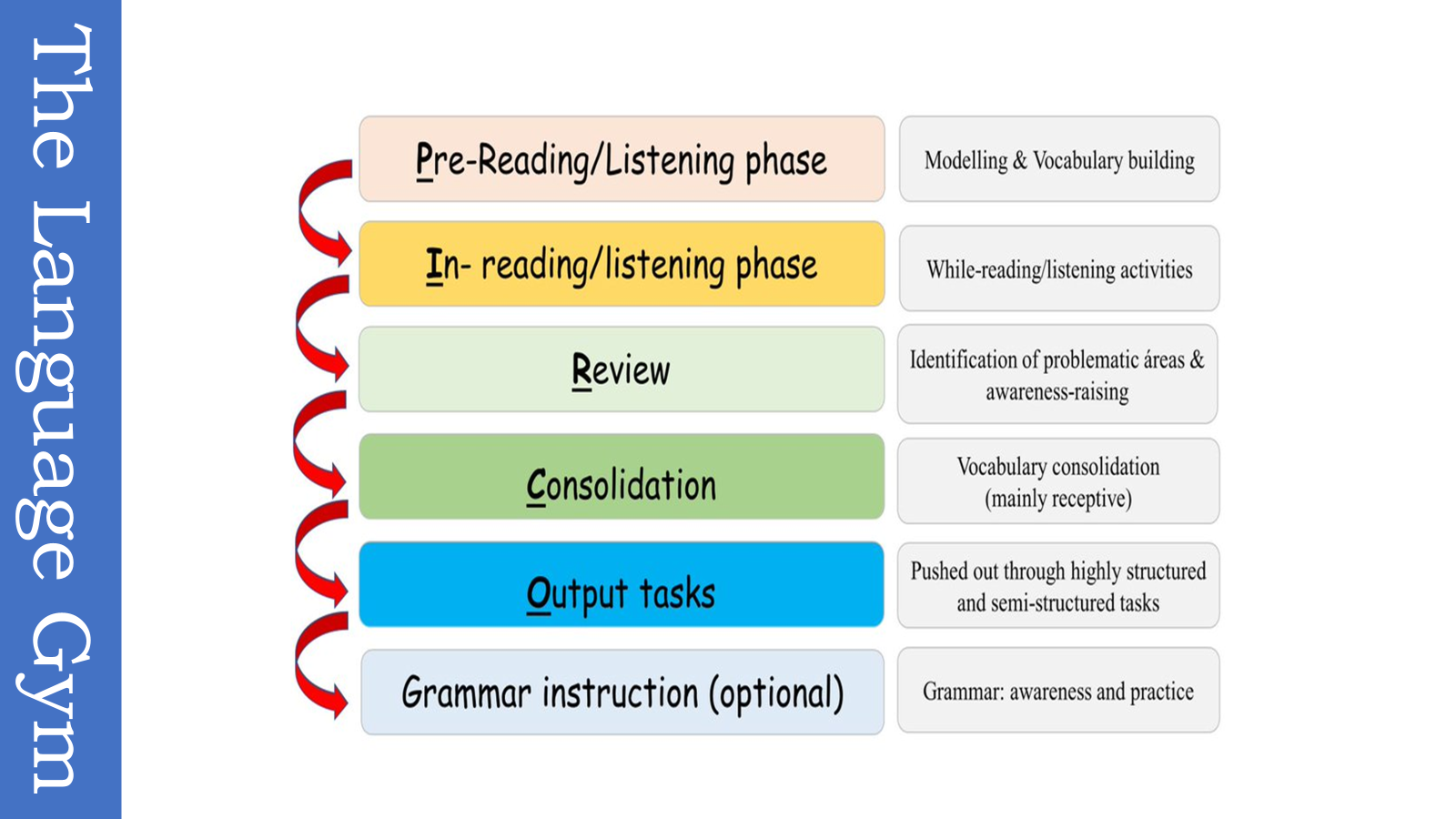
By an input-to-output sequence, I mean something very simple: pupils first establish the meaning of a carefully selected core of language; they then encounter and process that same language repeatedly through listening and reading; once it has become sufficiently familiar, they retrieve and manipulate it with support before eventually using it more independently in speaking and writing. In other words, there is a substantive phase in which the target vocabulary is taught, an even more substantive input phase flooded with that vocabulary, and finally a pushed-output phase in which the target vocabulary initially taught is practised through interactional speaking and writing.
Boers (2021) is particularly useful here. His research synthesis discusses enhancing vocabulary learning through input, the movement from input to output, retrieval and practice rather than assuming that exposure alone will result in productive command. Research comparing input-only conditions with input followed by learning tasks has likewise found substantially greater vocabulary gains when learners have to do something further with the language rather than merely encounter it (Duong, Montero Perez, Desmet & Peters, 2021).
Why does this matter for GCSE? Because pupils can recognise vocabulary during classroom reading yet fail to retrieve the same language during speaking or writing! Repeated experiences of “I knew it but couldn’t use it” are also hardly conducive to self-efficacy (Bandura, 1997; Mills, Pajares & Herron, 2007).
The fix:
- Decide on your high-value core first.
- Pre-teach it.
- Flood subsequent listening and reading with it.
- Move through structured retrieval.
- Only then expect freer production.
This continuity is central to MARS EARS, PIRCO (see image below) and the Sentence Builders approach: the language pupils are eventually expected to use is systematically prepared beforehand rather than appearing almost by accident at the production stage.
2. Do not make new vocabulary and new grammar compete for attention
This follows directly from point 1. A common curriculum sequence introduces a substantial amount of unfamiliar vocabulary and, at almost exactly the same time, asks pupils to understand a new grammatical rule.
That is asking working memory to deal with two major sources of novelty simultaneously, with potentially disastrous consequences for the less able and/or focused students.
Cognitive Load Theory reminds us that working-memory capacity is limited when processing unfamiliar information (Sweller, Ayres & Kalyuga, 2011). In second-language learning, the problem is particularly acute because even apparently simple sentences may require learners simultaneously to decode unfamiliar words, hold their meanings in memory, notice morphology and word order, and work out the underlying message.
The result can be superficial learning of both vocabulary and grammar, which later produces the familiar Year 11 complaint: “But we covered this.” Perhaps. But covering something and establishing a usable representation in long-term memory are very different things.
The exam consequences are obvious: if pupils have never had enough processing capacity to consolidate the lexical material properly, they will struggle to access it under pressure. If language lessons repeatedly generate overload and failure, pupils’ sense of competence can suffer too — important when self-efficacy is strongly related to persistence and achievement (Bandura, 1997; Mills et al., 2007).
The fix:
- Establish the new lexical material first through highly comprehensible listening and reading.
- Once much of that language has become familiar, use it as the known linguistic material through which pupils notice and work on the new grammatical pattern.
- Only then move into heavier manipulation and freer use.
This is precisely why MARS EARS and PIRCO delay heavier grammatical manipulation until learners have built sufficient familiarity with the lexical material: reduce unnecessary novelty first, then ask pupils to analyse and manipulate.
3. Vocabulary needs to be taught through listening in context
This is one of the most important points in this post. Vocabulary learning in school is still heavily associated with print: vocabulary lists, knowledge organisers, textbook pages, flashcards and written retrieval.
Meanwhile, listening has historically been far more likely to be tested than systematically taught (Graham, 2017; Graham & Macaro, 2008). More recent work by Graham and Zhang has demonstrated that vocabulary can indeed be deliberately taught through listening and that different forms of explicit lexical support during oral input can promote vocabulary learning (Zhang & Graham, 2020; Graham & Zhang, 2024). Steven Smith and I have also advocated for substantive teaching of vocabulary to occur in every single input-to-output pedagogical cycle.
The consequence of a print-heavy diet is that a pupil can know perfectly well what a word looks like while possessing a far less stable representation of what it sounds like.
Listening also gives learners very little time. Native spoken-word processing begins extraordinarily quickly: lexical candidates can start being activated within roughly the first 100–150 milliseconds of speech input, and spoken-word recognition proceeds incrementally as the acoustic signal unfolds. For an L2 learner whose phonological representation of a word is weak, this is obviously brutal!
Matthews and Cheng (2015) found that the ability to recognise high-frequency words in speech correlated very strongly with listening comprehension; recognition of vocabulary at one frequency band alone accounted for 52% of the variance in listening scores in their sample. Masrai (2022), working with Arabic-speaking learners, similarly found a strong relationship between phonological vocabulary knowledge and listening comprehension.
So this is not solved merely by doing more phonics, reading aloud or dictation. Phonics matters because it helps stabilise sound–spelling representations, but pupils also need to meet vocabulary repeatedly in meaningful connected speech.
The fix:
- Teach vocabulary through short, highly comprehensible listening contexts from the beginning.
- Recycle the same lexical material through connected speech, not isolated word audio.
- Gradually increase processing speed and complexity.
- Keep sound–meaning mapping central throughout.
This is exactly why we created The Language Gym Listening Trainer, Dictation Trainer and Audio Boxing: to make pupils process familiar vocabulary repeatedly through the ear, in context and under progressively greater time pressure — not merely recognise it on a vocabulary sheet.
4. Knowing the meaning is not the same as knowing the word
A pupil sees chien and knows that it means dog. Good, but that does not demonstrate full lexical knowledge.Nation’s influential framework distinguishes knowledge of spoken form, written form, word parts, meaning, associations, grammatical behaviour, collocations and constraints on use (Nation, 2001). Schmitt (2010, 2014) likewise stresses that lexical knowledge has both breadth and depth.
Breadth asks how many words do I know? Depth asks how well do I know each one?That distinction matters enormously in the current GCSE climate because a finite prescribed vocabulary list can encourage the seductive idea that learning means accumulating form–meaning pairings. However, a pupil may know the basic meaning and still:
- mishear the word;
- spell it incorrectly;
- place it incorrectly in a sentence;
- fail to inflect it;
- fail to recognise a common derivative;
- fail to combine it with the right words;
- or simply retrieve it too slowly.
Any of those can affect examination performance. From the learner’s perspective, repeatedly “knowing” vocabulary during revision but being unable to mobilise it successfully in an assessment is confusing and demoralising.
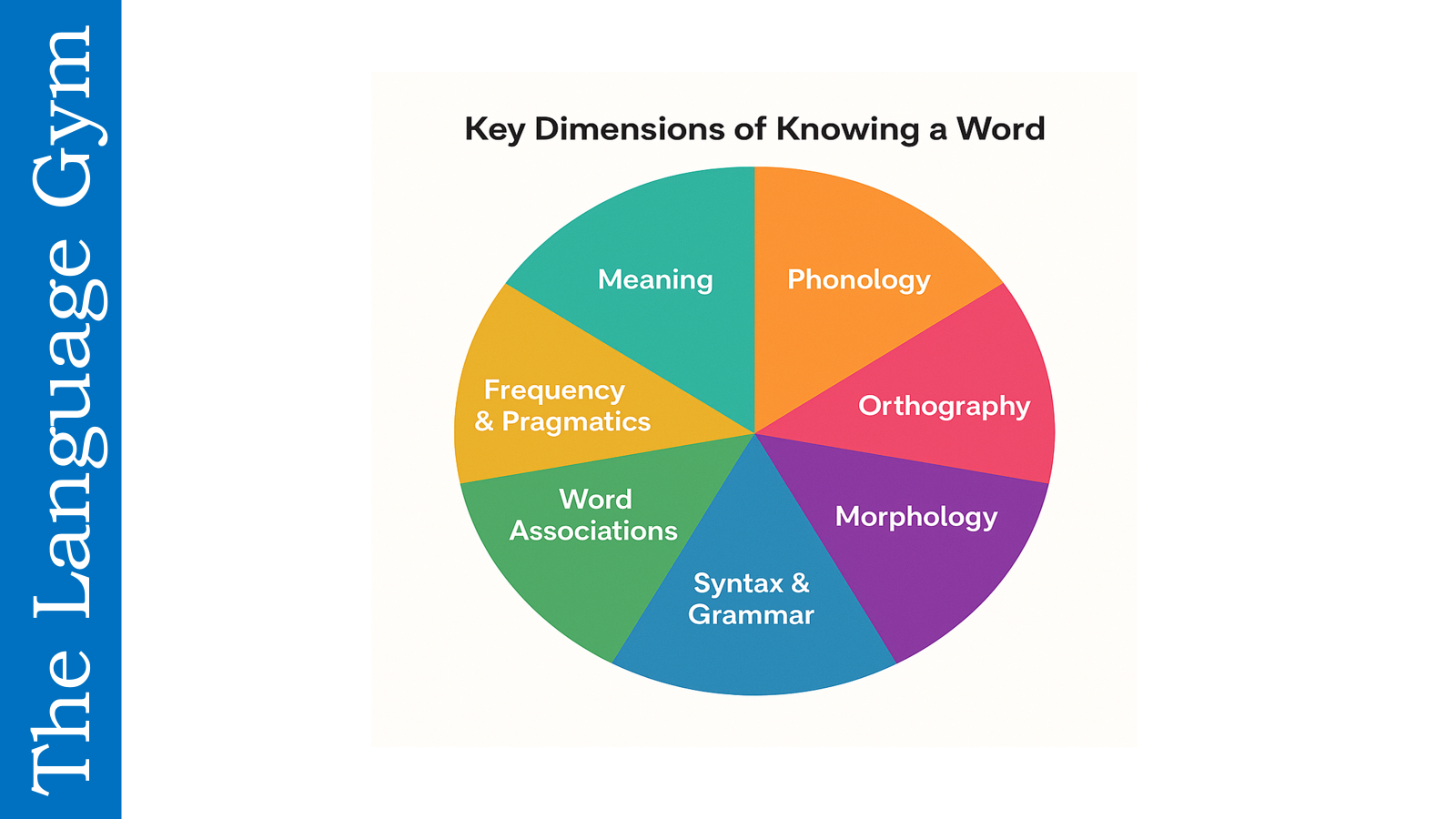
The fix: for your most important vocabulary, deliberately practise different dimensions of word knowledge. Sometimes identify the word aurally; sometimes reconstruct the spelling; sometimes manipulate the morphology; sometimes retrieve the surrounding chunk; sometimes place it in a new sentence.
This multidimensional treatment is built into the Sentence Builders books and Language Gym workouts: important lexical material is not simply presented and translated; it is repeatedly processed through different operations.
5. Pupils usually need many more encounters than neat CPD soundbites suggest
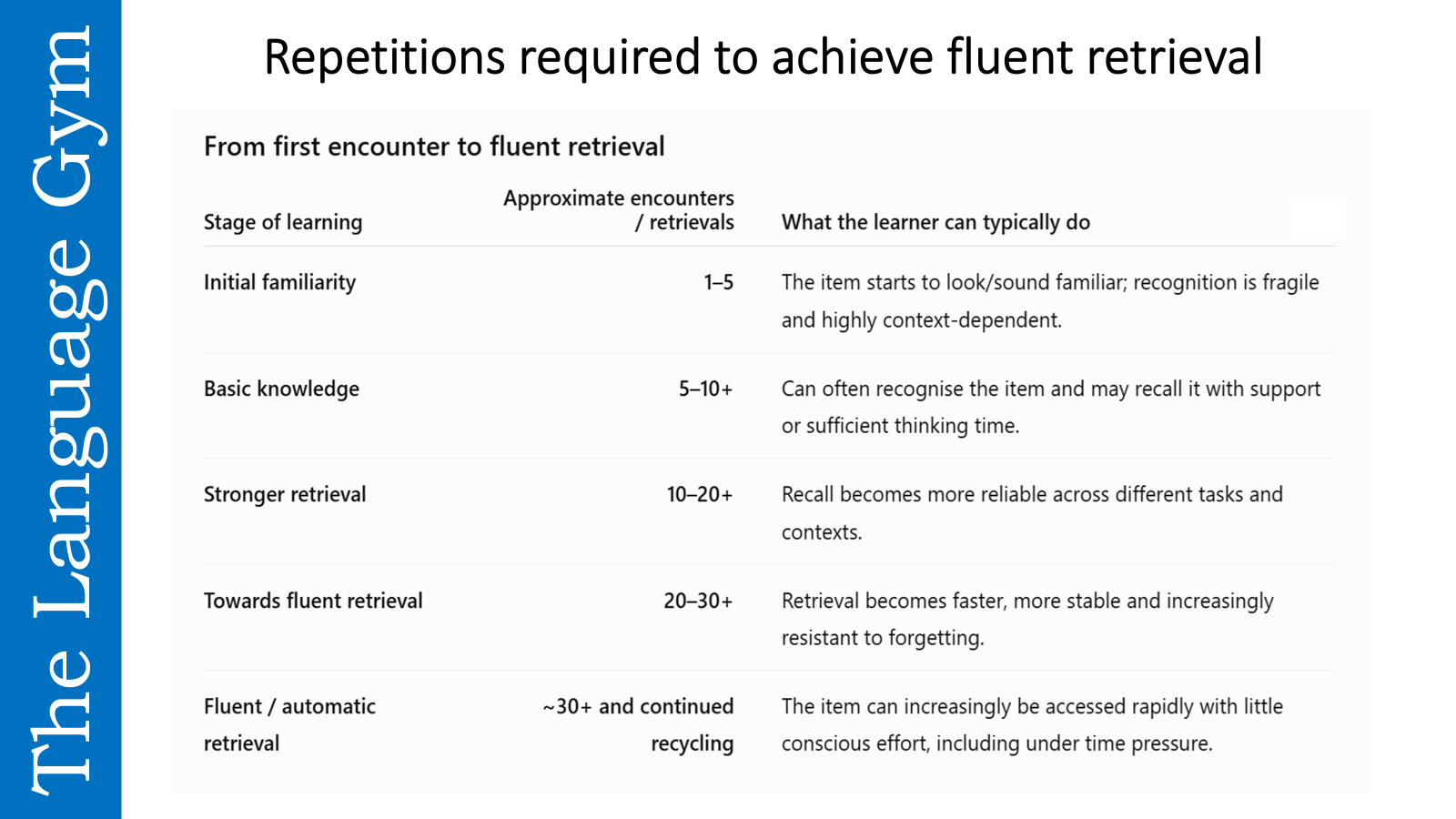
There is no magic number of encounters after which a word suddenly becomes “learned”. That needs saying clearly.Webb (2007) demonstrated continued growth across repeated encounters and, crucially, showed that different dimensions of vocabulary knowledge develop at different rates. Uchihara, Webb and Yanagisawa’s (2019) meta-analysis confirmed the general relationship between frequency of encounter and incidental vocabulary learning.
The problem is that research findings are sometimes translated into suspiciously tidy CPD claims such as “six encounters” or “eight encounters”. However, Six or eight encounters may produce some learning under certain conditions, but that is very different from saying they will produce a durable, multidimensional lexical representation capable of rapid retrieval months later.
This distinction matters because neat low encounter numbers are extremely convenient for overloaded schemes of learning and compact textbooks. If hundreds of items have to be “covered”, reassuring teachers that a handful of encounters will do makes the curriculum fit the available pages. Thing is tthe learner’s memory does not care how many pages the publisher has.
A textbook study by Bergström and colleagues, for example, found that target vocabulary in the materials they examined was not recycled sufficiently to support vocabulary development — a useful warning against equating textbook appearance with genuine learning opportunities.
The fix:
- Stop asking “How many times have I taught this?”
- Start auditing how many meaningful encounters your core vocabulary actually receives across a unit, term and year.
- Distinguish basic familiarity from durable, fast, productive knowledge.
This is why our Sentence Builders materials and Language Gym resources deliberately recycle a relatively constrained lexical core intensively. I would rather pupils know 100 high-value items extremely well than “cover” 300 that disappear three weeks later.
6. Spacing is not enough: number, quality, modality and phonological stability all matter
Everyone has heard about spacing, distributed practice and interleaving. Important? Absolutely. But spacing weak learning does not magically turn it into strong learning.Four other variables matter enormously:
- How many encounters pupils receive.
- What they actually do during those encounters.
- Which modalities they process the word through.
- How stable the phonological representation becomes.
First, number matters, as we have just seen (Webb, 2007; Uchihara et al., 2019).
Second, quality matters. Depth-of-processing work and vocabulary-specific research suggest that encounters requiring richer semantic and formal processing are generally more memorable than superficial exposure (Craik & Lockhart, 1972; Laufer & Hulstijn, 2001).
Third, modality matters, although teachers should resist simplistic claims that “more modes are always better”. Research on multimodal vocabulary learning is mixed, partly because extra visual information can help under some conditions and create extra cognitive load under others. The important point for MFL is much more basic: vocabulary required for both listening and reading cannot sensibly be practised almost exclusively in print.
Fourth, the phonological representation has to stabilise. A pupil who is uncertain what a word actually sounds like is going to struggle to recognise it rapidly when embedded in connected speech, however confidently they can recognise the spelling.
GCSE exposes all four weaknesses. The listening paper does not reward vocabulary that exists only orthographically; spontaneous speaking does not reward vocabulary that requires four seconds of conscious search.
The fix: plan the learning history of high-value vocabulary across:
- sound and print;
- receptive and productive processing;
- recognition and retrieval;
- shallow and deeper processing;
- repeated encounters over sufficient time.
This is very much the design principle behind PIRCO, MARS EARS, the Sentence Builders books and the Language Gym: repeated encounters, yes — but repeated encounters that actually do different cognitive work.
7. Eventually vocabulary has to become fast
This is one of the most neglected distinctions in school vocabulary teaching. A pupil can retrieve parce que after four seconds. Technically, they know it. The provlem is that in real-time listening or speaking, four seconds is an eternity.
Fluent language processing depends partly on automaticity: frequently required linguistic material has to become accessible with progressively less conscious attention (DeKeyser, 2007; Segalowitz, 2010).
This matters because working memory is limited. If a learner has to consciously search for the meaning of every second word, very little capacity remains for understanding the message. Likewise, in speaking, if almost every lexical item requires deliberate retrieval, the learner has fewer attentional resources available for syntax, morphology, pronunciation and planning the next part of the utterance.
The listening data discussed earlier make the point starkly. Matthews and Cheng’s learners’ ability to recognise spoken high-frequency vocabulary was very strongly associated with overall listening comprehension.
GCSE listening is therefore partly a race against processing time. Knowing vocabulary is not enough; learners need to access it quickly.
The fix:
- Establish the vocabulary accurately first.
- Practise increasingly rapid recognition and retrieval through familiar language.
- Introduce time pressure gradually.
- Keep success rates high enough that speed practice strengthens rather than destabilises knowledge.
This is one reason Language Gym games such as Audio Boxing and the vocabulary/listening trainers use repeated, increasingly rapid responses. The target is not frantic speed. The target is automatic access.
8. Small structural words deserve far more attention
Vocabulary teaching naturally privileges content words such as environment, cinema, holidays, football, and technology. They are salient, carry obvious semantic meaning and look good on vocabulary lists.
However, language is held together by large numbers of high-frequency function and structure words: articles, pronouns, auxiliaries, prepositions, conjunctions, particles, negators and similar items. 55% of every text we read or listen to consists of such words.
Field (2008) demonstrated how L2 listeners tend to rely heavily on content words and can underprocess function words. The latter are particularly difficult because they are often short, unstressed and phonologically reduced in normal connected speech.
This matters because the pupil can recognise all the impressive content vocabulary and still completely misunderstand the message if they:
- miss the negative;
- miss the pronoun;
- miss the tense-bearing auxiliary;
- miss the preposition;
- miss the conjunction expressing contrast.
The whole interpretation may then change! This has obvious implications for GCSE listening and reading papers, but also for speaking and writing accuracy. The irony is that many of these words are among the highest-frequency items in the language, yet they often receive less deliberate practice precisely because teachers assume they are easy.
The fix: when planning a unit, identify not merely the topic vocabulary but the small structural words and chunks that pupils need to process automatically. Give them deliberate listening and retrieval practice too.
This is why Sentence Builders do not consist merely of lists of nouns and adjectives. The recurring small structures surrounding the content words are part of what pupils repeatedly process and retrieve.
9. Not every word needs the same level of mastery
Vocabulary lists often imply that every item deserves equal treatment. However, research distinguishes clearly between receptive and productive vocabulary knowledge (Nation, 2001; Webb, 2008). Learners normally understand substantially more vocabulary than they can spontaneously produce. That is not a defect; it is a normal feature of lexical development.
The curriculum-design mistake is assuming that every item on a GCSE list needs to become equally retrievable in speaking and writing. Trying to automatise everything can actually result in automatizing nothing, because practice gets spread too thinly.
Some words are so useful that pupils should be able to retrieve them rapidly and accurately across many contexts. Others need to be readily recognised in reading and listening but may not justify the same investment in productive practice. A third group may be useful extension vocabulary for some learners.
This distinction is particularly important where curriculum time is limited. Every five minutes spent repeatedly retrieving a very low-value productive item is five minutes unavailable for a word or chunk pupils may need constantly.
The fix: classify vocabulary explicitly into:
- productive core;
- productive extension;
- receptive recognition.
Then teach accordingly.
This principle runs throughout the Sentence Builders approach and our Language Gym resources: prioritisation matters. The aim is not to pretend every item is equally important but to ensure that the highest-value language receives the heaviest processing and retrieval load.
10. Retrieval practice is excellent. A culture of constant judgement is not necessarily excellent.
I have advocated retrieval practice for years. The evidence supporting it is strong: retrieving information from memory improves later retention more effectively than simply restudying it (Roediger & Karpicke, 2006; Karpicke & Roediger, 2008). In my opinion, though, there is a difference between retrieval as learning and retrieval as constant judgement, and that distinction is getting blurred.
In many schools, retrieval has become the compulsory Do Now at the beginning of every lesson, often with marks attached. For the pupil who repeatedly succeeds, this is absolutely fine. But what about the pupil who repeatedly scores:
- Monday: 3/10.
- Wednesday: 4/10.
- Friday: 2/10.
And this happens in the first five minutes of the lesson. You have just begun every lesson by reminding that pupil that they are failing.
Agarwal and colleagues (2014) found that low-stakes retrieval can actually reduce test anxiety, but the operative words are low stakes. The motivational consequences are different when every retrieval episode becomes a scored judgement.
This also risks widening attainment gaps when the bulk of vocabulary learning is effectively delegated to pupils at home. Organised learners with strong routines and support arrive prepared, retrieve successfully and become more confident. The pupils who do not study effectively arrive behind, fail the quiz and fall further behind.
A Matthew-effect dynamic can then emerge. If the same learners spend three years beginning language lessons by being shown that they are poor at vocabulary, departments should not be surprised when some of them do not opt for GCSE.
The fix:
- Keep retrieval frequent.
- Make much more of it in-class.
- Keep it predominantly low-stakes.
- Engineer high-success practice.
- Give immediate corrective feedback.
- Use formal vocabulary tests diagnostically rather than turning every lesson into a mini judgement day.
The Language Gym trainers were designed precisely to generate huge amounts of individual retrieval without requiring every error to become another public or formal mark.
11. Relevance matters as much as frequency – if not more!
This point is especially important in England under the reformed GCSE.
The increased use of frequency evidence in selecting examination vocabulary has a perfectly sensible rationale. High-frequency vocabulary has high utility and gives learners greater coverage across texts and contexts. However, frequency is a linguistic statistic. It is not a theory of motivation. A word can be highly frequent in a corpus yet have little immediate relevance to the life of the children you teach! Conversely, something that pupil desperately wants to say may not sit high enough on somebody’s frequency list.
Research informed by Self-Determination Theory reminds us that perceived competence, autonomy and meaningfulness can influence engagement and persistence (Deci & Ryan, 2000). Dörnyei’s work on L2 motivation likewise shows the importance of connecting language learning to learners’ developing identities and goals (Dörnyei, 2009).
That matters in England because the challenge is not merely achieving good GCSE grades; it is persuading enough pupils to take the GCSE in the first place.
A curriculum driven exclusively by frequency risks becoming highly efficient statistically while being emotionally and communicatively remote from the learner. That is not an argument against frequency; it is an argument against making frequency the sole criterion.
The fix:
- Retain a carefully selected high-frequency lexical spine.
- Leave controlled space for language pupils actually want to understand and say.
- Use relevance as a motivational complement to frequency, not a replacement for it.
This is something we have always tried to do in the Sentence Builders books: combine high-frequency reusable language with content that gives pupils something worth communicating.
12. Do not mistake a vocabulary list for a vocabulary curriculum
This final point brings everything together: a vocabulary list tells you what pupils may need to know. It tells you almost nothing about how well they will know it. A list cannot tell you:
- whether pupils can recognise the words in connected speech;
- whether their phonological representations are stable;
- whether they can retrieve them rapidly;
- whether they know their grammatical behaviour;
- whether they have met them enough times;
- whether the encounters involved sufficiently deep processing;
- whether they can use them productively;
- whether they will remember them six months later.
That distinction matters particularly under an examination system built around prescribed vocabulary. There is an understandable temptation to equate curriculum quality with coverage: “We have taught 400 words this year.”
That figure is almost meaningless without knowing what pupils can actually do with those words.
Nation (2001), Schmitt (2010) and Webb and Nation (2017) all point in different ways towards the same central conclusion: lexical knowledge develops incrementally and along multiple dimensions.
The real unit of curriculum planning therefore should not simply be the word introduced. It should be the learning history of the word.
The fix: for the highest-value vocabulary, ask four questions repeatedly:
- How often have pupils processed it?
- How deeply have they processed it?
- Through which modalities?
- How quickly can they now access it?
That is also, ultimately, the rationale behind MARS EARS, PIRCO, Sentence Builders and The Language Gym. They are not simply different activities; they are attempts to engineer a coherent learning journey so that language does not merely get taught but becomes available.
The bottom line
Why do words fail to stick? Usually because:
- they were not processed sufficiently often;
- they were not processed sufficiently deeply;
- they were not processed through enough useful modalities;
- their phonological representations remained unstable;
- they were recognised but not retrieved enough;
- they were learned but never made fast.
Why do pupils sometimes “know” a word but fail to recognise it in listening? Because knowing its written form and meaning does not guarantee a sufficiently robust phonological representation or sufficiently rapid aural lexical access.
Why can pupils succeed on vocabulary tests but fail in GCSE speaking and writing? Because successful isolated retrieval does not automatically guarantee fluent access while working memory is simultaneously dealing with grammar, meaning and message construction.
And why can a curriculum apparently cover huge amounts of vocabulary without producing confident linguists? Because coverage is not mastery.
So I would stop asking “Have they learned the vocabulary?” and ask instead:
- How deeply do they know it?
- How long will they retain it?
- Can they recognise it in connected speech?
- Can they retrieve it accurately?
- Can they access it fast enough when they actually need it?
References
Agarwal, P. K., D’Antonio, L., Roediger, H. L., McDermott, K. B. & McDaniel, M. A. (2014). Classroom-based programs of retrieval practice reduce middle school and high school students’ test anxiety. Journal of Applied Research in Memory and Cognition, 3, 131–139.
Bandura, A. (1997). Self-Efficacy: The Exercise of Control. Freeman.
Boers, F. (2021). Evaluating Second Language Vocabulary and Grammar Instruction: A Synthesis of the Research on Teaching Words, Phrases, and Patterns. Routledge.
Craik, F. I. M. & Lockhart, R. S. (1972). Levels of processing: A framework for memory research. Journal of Verbal Learning and Verbal Behavior, 11, 671–684.
Deci, E. L. & Ryan, R. M. (2000). The ‘what’ and ‘why’ of goal pursuits: Human needs and the self-determination of behaviour. Psychological Inquiry, 11(4), 227–268.
DeKeyser, R. M. (Ed.). (2007). Practice in a Second Language: Perspectives from Applied Linguistics and Cognitive Psychology. Cambridge University Press.
Dörnyei, Z. (2009). The Psychology of Second Language Acquisition. Oxford University Press.
Duong, T. M., Montero Perez, M., Desmet, P. & Peters, E. (2021). Learning vocabulary in spoken input- and output-based tasks. TASK.
Field, J. (2008). Bricks or mortar: Which parts of the input does a second language listener rely on? TESOL Quarterly, 42(3), 411–432.
Graham, S. (2017). Research into practice: Listening strategies in an instructed classroom setting. Language Teaching, 50(1).
Graham, S. & Zhang, P. A. (2024). Learning vocabulary through listening: The role of strategy use and linguistic proficiency. AILA Review, 37(2), 241–265.
Karpicke, J. D. & Roediger, H. L. (2008). Repeated retrieval during learning is the key to long-term retention. Journal of Memory and Language, 57, 151–162.
Laufer, B. & Hulstijn, J. (2001). Incidental vocabulary acquisition in a second language: The construct of task-induced involvement. Applied Linguistics, 22(1), 1–26.
Masrai, A. (2022). The relationship between two measures of L2 phonological vocabulary knowledge and L2 listening comprehension. TESOL Journal.
Matthews, J. & Cheng, J. (2015). Recognition of high-frequency words from speech as a predictor of L2 listening comprehension. System, 52, 1–13.
Mills, N., Pajares, F. & Herron, C. (2007). Self-efficacy of college intermediate French students: Relation to achievement and motivation. The Modern Language Journal, 91(3), 417–442.
Nation, I. S. P. (2001). Learning Vocabulary in Another Language. Cambridge University Press.
Qian, D. D. (2002). Investigating the relationship between vocabulary knowledge and academic reading performance. Language Learning, 52(3), 513–536.
Roediger, H. L. & Karpicke, J. D. (2006). Test-enhanced learning: Taking memory tests improves long-term retention. Psychological Science, 17(3), 249–255.
Schmitt, N. (2010). Researching Vocabulary: A Vocabulary Research Manual. Palgrave Macmillan.
Schmitt, N. (2014). Size and depth of vocabulary knowledge: What the research shows. Language Learning, 64(4), 913–951.
Segalowitz, N. (2010). Cognitive Bases of Second Language Fluency. Routledge.
Sweller, J., Ayres, P. & Kalyuga, S. (2011). Cognitive Load Theory. Springer.
Uchihara, T., Webb, S. & Yanagisawa, A. (2019). The effects of repetition on incidental vocabulary learning: A meta-analysis of correlational studies. Language Learning, 69(3), 559–599.
Webb, S. (2007). The effects of repetition on vocabulary knowledge. Applied Linguistics, 28(1), 46–65.
Webb, S. (2008). Receptive and productive vocabulary sizes of L2 learners. Studies in Second Language Acquisition, 30(1), 79–95.
Webb, S. & Nation, P. (2017). How Vocabulary Is Learned. Oxford University Press.
Zhang, P. A. & Graham, S. (2020). Vocabulary learning through listening: Comparing L2 explanations, teacher codeswitching, contrastive focus-on-form and incidental learning. Language Teaching Research, 24(6).


You must be logged in to post a comment.