
Why doing more GCSE listening papers isn’t necessarily going to make your students better listeners, and why understanding what goes wrong when they listen may be the key to improving their exam performance.
1. We keep testing listening. But are we actually teaching it?
Picture this: it’s a Year 10 French lesson and your students have just completed a GCSE-style listening comprehension task which, judging by the expressions on their faces and the rather disappointing scores you’ve just collected, hasn’t exactly gone according to plan. A few students have scored eight or nine out of ten, a sizeable group have managed four or five, and a handful have barely got anything right. We have all been there!
So what happens next?You play the tricky bits again, explain what the speaker said, perhaps put the transcript on the board, underline the relevant words and point out the clues they should have picked up. You might even tell them to listen more carefully next time, as though careful listening were something they could simply switch on at will…
Then, in the following lesson, another listening comprehension exercise, and guess what? The same students struggle again!
I’ve seen this scenario countless times in my teaching career and I suspect most MFL teachers will recognise it, but here’s the question I would like you to consider: when a student scores 4/10 on a listening comprehension task, what exactly have we learnt about their ability to listen?
That they didn’t understand six answers? Certainly, but why didn’t they understand them, and more importantly, what are we going to do about it?
Was it because they didn’t know the words, because they knew the words but couldn’t recognise them when spoken, because they couldn’t work out where one word ended and the next began, because they missed a negative or a tense marker, or because they understood the individual bits but couldn’t hold everything together long enough to answer the question?
Different problems, different causes and potentially very different interventions, yet we often respond to all of them in exactly the same way: replay, explain, correct, move on… and then we wonder why listening scores don’t improve as much as we’d like!
The problem, in my view, isn’t necessarily that we’re not doing enough listening, because in many classrooms students complete plenty of listening comprehension exercises, but that we often use those exercises to assess comprehension without doing enough to investigate the cognitive and linguistic processes responsible for comprehension breakdowns.
Are we teaching students how to listen, or are we simply finding out, over and over again, how much they fail to understand? This is where diagnostic listening comes in.
2. What exactly is diagnostic listening?
Put simply, diagnostic listening is what we do after a listening comprehension task to find out why students got particular answers wrong, rather than merely giving them another listening test, displaying the transcript and showing them where the answers were, or replaying the same recording until everyone eventually gets it right.
It involves a systematic investigation of comprehension breakdowns, undertaken with the specific purpose of deciding what needs to happen next instructionally, and rests on three questions which, although closely related, need to be distinguished:
- Assessment: What did my students understand?
- Diagnosis: Why did they fail to understand certain parts?
- Intervention: What can I do to address those difficulties?
Consider a student who hears Je suis allé au cinéma avec mes amis samedi dernier and gets the question about when the speaker went to the cinema wrong, even though, at first glance, the sentence appears relatively straightforward.
Perhaps they don’t know what samedi dernier means, in which case we’re dealing with a vocabulary knowledge problem; perhaps they know the expression perfectly well when they see it written down but fail to recognise it in the recording, suggesting a possible spoken-word recognition problem; or perhaps they recognise samedi but fail to pick up dernier, which might involve segmentation, lexical recognition or insufficient familiarity with the expression.
Alternatively, they may understand the entire sentence when you play it in isolation but lose the information when it’s embedded in a longer passage, because the effort required to process the incoming language leaves insufficient attentional capacity for retaining and integrating what they’ve heard.
The same wrong answer, four different possible explanations, and potentially four different instructional responses, which raises a rather obvious question: would you prescribe the same treatment to four patients presenting the same symptom but suffering from four different conditions?
Of course not, yet mutatis mutandis, that is precisely what we sometimes do when we give students more generic listening practice without investigating what is actually going wrong!
And before anyone accuses me of suggesting that teachers should become amateur cognitive psychologists, let me clarify that diagnostic listening doesn’t require sophisticated laboratory equipment or lengthy individual assessments, merely a sound understanding of listening processes and a repertoire of carefully chosen activities that allow us to investigate plausible causes of failure.
The sequence, in essence, is straightforward: comprehension task, identification of errors, diagnostic investigation, targeted intervention and independent reassessment, although putting it into practice consistently is rather less straightforward than describing it…
Because, as we say in Italian, tra il dire e il fare c’è di mezzo il mare. Between saying and doing lies the sea.
3. What actually goes wrong when students listen?
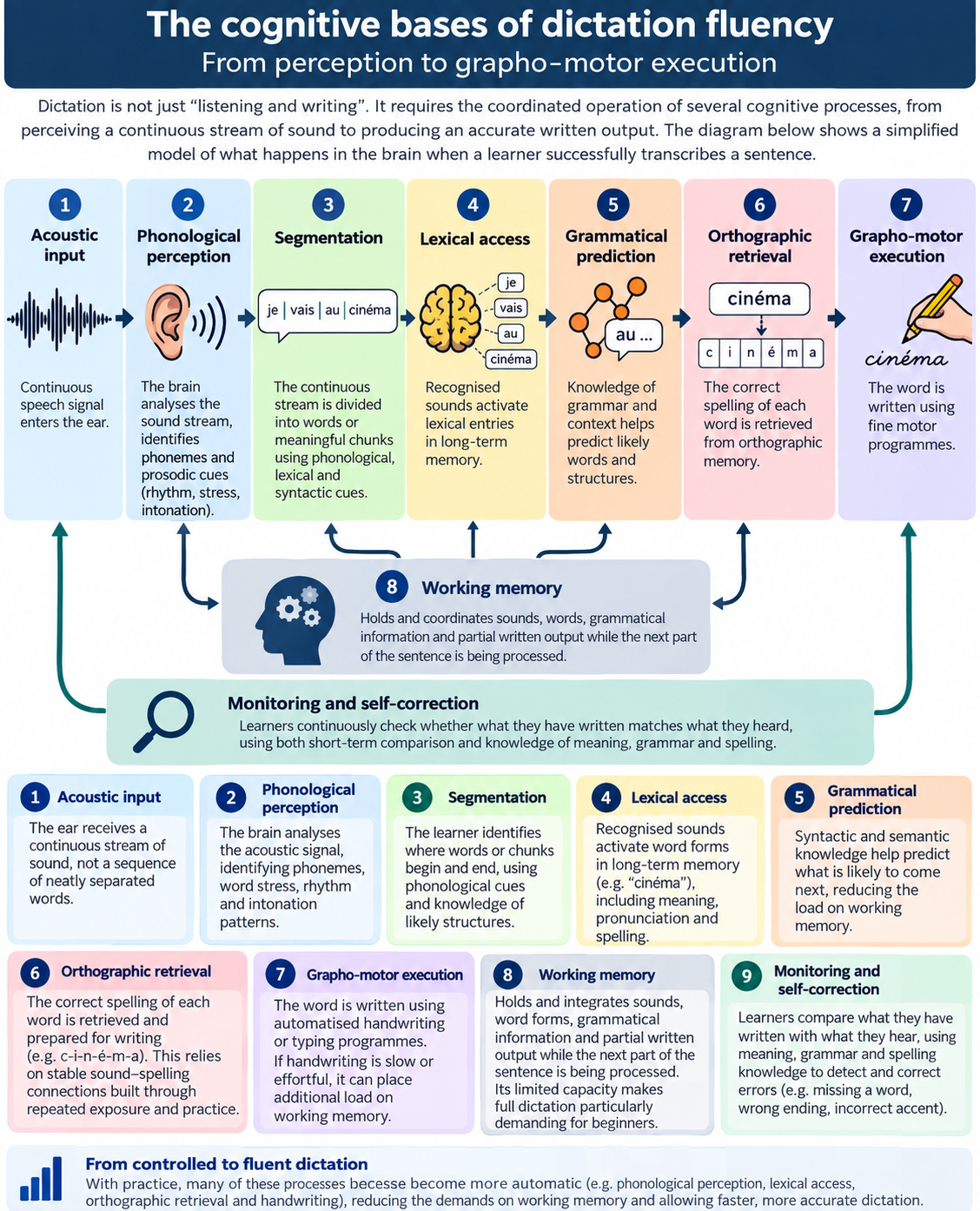
Before we can diagnose listening difficulties, we need at least a basic understanding of what the brain has to do when processing speech, because without some understanding of the processes involved, how can we possibly know what to investigate?
As I have often written on this blog and in my books, listening isn’t simply recognising words and translating them into English, but a highly demanding, time-pressured activity in which several cognitive and linguistic processes must operate simultaneously in a very limited timed window, often under conditions that are far less forgiving than those encountered during reading.
First, learners need to discriminate the sounds of the language and identify relevant syllabic and prosodic patterns, since stress, rhythm and intonation provide cues that help listeners organise the incoming speech stream and, in some languages, distinguish meanings that would otherwise be difficult to identify.
They then need to segment the continuous speech stream into recognisable words and chunks, a process which, especially in French, can prove extremely challenging because liaison, enchaînement and other connected-speech phenomena may make familiar expressions sound rather different from the forms students have encountered in isolation.
Next comes lexical recognition, whereby the learner identifies familiar spoken words and retrieves their meanings quickly enough to keep pace with the recording, followed by grammatical processing, which involves attending to the little words, endings and structural cues that tell us who did what, when, to whom and under what circumstances.
Finally, learners must integrate the information they have decoded, connect ideas across sentences, track references, interpret discourse markers and make inferences where necessary, all while the recording continues playing…
Now, if a student is using up most of their attentional resources simply trying to recognise individual words, how much capacity will they have left to construct and retain the overall meaning? Not much, I would suggest, which is one reason why vocabulary knowledge alone doesn’t guarantee successful listening, and why a student who can translate every word in a sentence when presented in writing may nevertheless fail to understand that same sentence when spoken at a natural pace.
Of course, these processes don’t operate in a neat, linear sequence, but interact continuously, with prosody supporting segmentation, lexical knowledge helping listeners identify word boundaries, and contextual information facilitating recognition, although the latter can sometimes encourage inaccurate guessing.
Distinguishing these processes is nevertheless pedagogically useful because it provides us with a framework for investigating why comprehension has failed.
4. Eight listening problems worth investigating
I am certainly not suggesting that teachers should diagnose eight different processing skills after every listening comprehension exercise, which would be neither practical nor necessary, but rather that when a pattern of errors emerges, we should ask which processing difficulty might plausibly explain it before selecting one or two targeted activities to investigate.
1. They couldn’t discriminate the sounds
Sometimes the problem starts at the phonological level, as English-speaking learners of French may struggle with the distinction between /y/ and /u/, as in tu and tout, while German learners may have difficulty with vowel length contrasts and Spanish learners may fail to perceive certain consonantal distinctions or stress patterns that contribute to meaning.
If a comprehension error appears to involve a particular sound contrast, I might use Faulty Echo, an activity I frequently use in my listening workshops, in which I say a familiar word or short chunk, then produce a second version which is either identical or slightly different, and students decide whether the echo is correct or faulty.
For example, I might produce Tu viens ? followed by Tout vient ?, asking students to identify whether the second utterance faithfully reproduces the first.
The important thing is to choose the contrasts carefully, because what we want to establish is whether students can actually perceive the relevant phonological distinction, rather than whether they can infer the answer from the surrounding context.
If they consistently fail to discriminate the sounds, what is the point of immediately giving them another long listening passage containing the same contrast, when what they need first is focused perceptual practice?
2. They struggled with syllables, stress or prosody
This is an area I think we have neglected far too much in MFL teaching, because prosody isn’t some decorative extra that we teach when we have time, but a set of features, including stress, rhythm, intonation and syllabic organisation, that contribute to how listeners process the speech stream and whose role in segmentation and lexical recognition deserves considerably more attention than it typically receives.
Take Spanish hablo and habló, where failure to perceive the stress distinction may result in a missed grammatical contrast, or German words such as AUFstehen and verSTEHen, where stress contributes to the identity of the spoken word.
One activity I use is Syllable Building Blocks, in which students are presented with a selection of eight to ten familiar syllables before listening to words or short chunks containing one of them, their task being to identify which syllable they heard, an apparently simple exercise which can nevertheless reveal whether learners are able to detect familiar syllabic units when embedded in larger stretches of speech. Another is Stress Detective, where students identify the stressed syllable or compare two spoken versions.
Simple activities? Certainly, but potentially revealing ones, particularly when the teacher has reason to suspect that the original comprehension breakdown involved failure to perceive relevant syllabic or prosodic information, and why should focused phonological work be boring anyway?
3. They couldn’t segment the speech stream
This is a big one, because students may know every word in a sentence and still fail to recognise those words when they occur in connected speech.
Consider Il est allé au cinéma, a sentence which, on paper, is hardly challenging for a Year 10 student, but which, when spoken naturally, requires the learner to identify plausible boundaries before accessing the relevant lexical items.
One way of investigating this is through Break the Flow, where students listen to a short extract and identify the words or familiar chunks they can hear, or through Chunk Tracking, in which students listen for specific chunks embedded in longer utterances.
For example, students might hear Le weekend | je joue au tennis | avec mes amis | parce que c’est amusant, with the teacher investigating whether they can identify the familiar chunks within the continuous speech stream.
If students recognise the chunks individually but fail to locate them in the recording, segmentation is a plausible source of difficulty, although lexical recognition and familiarity with the chunks may also contribute, and the intervention should therefore involve repeated exposure to familiar chunks in connected speech, with support gradually faded, rather than another generic comprehension worksheet.
4. They knew the words but couldn’t recognise them
This is probably one of the most common problems I encounter, because you can ask students what souvent means and they’ll tell you immediately, or write je voudrais on the board and they’ll recognise it, but play a recording containing those same expressions and suddenly they seem to disappear into the speech stream.
Why? Because knowing a word’s written form and meaning is not the same as having a sufficiently robust spoken representation of it, or being able to retrieve that representation rapidly enough for real-time comprehension.
To investigate this, I might use Word Grab, where students listen to a short extract and identify familiar words or chunks from a selection of plausible alternatives, or Sentence Bingo, where they listen for familiar expressions embedded in different sentences.
If the problem is slow or unreliable recognition, activities such as Audio Boxing and the Language Gym Listening Trainer can provide repeated opportunities to process familiar language under increasingly demanding conditions, with the aim not simply of making students faster but of making recognition accurate, reliable and eventually more automatic.
And why does this matter? Because when word recognition becomes less effortful, more attentional resources become available for constructing meaning!
5. They missed the grammar
Here’s another familiar scenario in which the student hears Fußball, spielen and gestern, but fails to process the grammatical structure that establishes exactly what happened, or recognises the main verb in a French sentence but misses the negative, or hears hablo when the speaker actually said habló.
In these cases, the student may have understood the topic without understanding the message accurately, which is why I might use Grammar Detective, playing two sentences containing largely the same vocabulary but different grammatical meanings, such as Er spielt Fußball and Er hat Fußball gespielt, before asking students to identify the time reference.
Another possibility is Faulty Transcript, where students hear Nous avons mangé au restaurant but see Nous allons manger au restaurant written down and have to identify the discrepancy.
But here’s the crucial question: did they fail to hear the grammatical distinction, or did they hear it without understanding its significance? Two very different problems, and therefore two different starting points for intervention.
6. They couldn’t process the language quickly enough
Sometimes students understand an utterance perfectly well when it’s played in isolation, but fail when the same language occurs in a longer recording, because they are still processing one chunk when the next one arrives, with information being lost and comprehension compromised as a result.
To investigate this, I might compare recognition of familiar expressions in short and longer utterances, or use timed recognition tasks, although we need to be careful because a student who struggles with fast speech doesn’t necessarily have a general processing-speed problem, as their lexical representations may simply not be sufficiently established.
Similarly, slowing down the recording doesn’t always solve the problem, since artificially slowed speech can distort natural rhythm and prosody, which is why the instructional response should focus on repeated, varied processing of familiar language, gradually increasing demands as accuracy improves.
7. They couldn’t retain or integrate the information
A student may understand the first part of a sentence but lose it by the time the speaker reaches the end, as might happen with Je suis allé au cinéma avec mes amis samedi dernier, mais nous sommes rentrés tôt parce que le film était ennuyeux, where the learner recognises the important expressions but struggles to retain and integrate the information.
We often call this a working-memory problem, but I’d be cautious, because what looks like poor memory may actually be inefficient decoding or lexical recognition, with the effort required to identify each word leaving fewer resources available for maintaining the message.
A useful diagnostic approach is to compare performance on shorter and longer utterances containing similarly familiar language, while recognising that increasing length also increases linguistic and integration demands, so that if students manage the shorter versions but struggle as length increases, we have a reason to investigate further rather than immediately attributing the problem to memory.
8. They understood the sentences but not the whole text
Finally, some students understand individual sentences but struggle to connect them, as in Paul voulait aller à la piscine. Cependant, il faisait trop froid. Il a donc décidé de rester chez lui. Son frère, lui, est sorti avec ses amis, where learners may recognise the vocabulary but lose track of who stayed home, who went out and why Paul changed his plans.
Activities such as Pronoun Chain, Connector Snap and Track the Structure can help us investigate these difficulties, for example by replaying the relevant section and asking students to identify what il refers to, or whether cependant introduces a contrast.
If they understand the individual sentences but fail to integrate them, we need to work on discourse processing rather than simply revising vocabulary.
Eight possible sources of comprehension breakdown, one incorrect answer, and still convinced that simply replaying the recording and explaining the answer is enough?
5. The transcript: A diagnostic goldmine
I have nothing against using transcripts after listening comprehension, quite the opposite, but what I object to is using them simply to show students where the answers were, because when we display the transcript, underline the relevant expression and hear students say, “Oh, yes, I know that!”, we should be asking why, if they knew it, they failed to recognise it.
Here’s a routine I would recommend, starting with students completing the comprehension task independently, followed by a replay of the problematic extract during which they identify what they think they heard, before the transcript is displayed and they highlight words and chunks they already knew but failed to recognise in the recording, using a different colour for genuinely unfamiliar vocabulary.
This simple distinction is enormously useful, because a student who didn’t know cependant needs something different from a student who knew it perfectly well but failed to recognise it in connected speech.
This is also the stage at which metacognition can be explicitly scaffolded, because simply asking students to reflect on why they got an answer wrong is unlikely to produce particularly useful insights, especially when they lack the vocabulary or understanding of listening processes needed to explain their difficulties. Rather than expecting students to diagnose their own problems independently, we can provide simple, structured prompts that guide them through a sequence of questions: What did I fail to understand? What does the transcript reveal? Did I not know the language, or did I know it but fail to recognise it when spoken? Was the problem identifying individual sounds, separating words, noticing grammatical clues or keeping track of meaning? By asking students to select one or two plausible explanations, identify the specific word or chunk that caused difficulty and decide what they need to practise next, we gradually develop their ability to monitor and evaluate their own listening, while giving the teacher valuable information to investigate further. The important thing is that these scaffolds support metacognitive reflection without turning it into an exercise in guesswork or excessive form-filling! The two pupil-friendly diagnostic forms below, one for Years 7–8 and the other for Years 10–11, are designed precisely for this purpose and can be used during the post-transcript and audio-processing phase, ideally followed by a brief teacher-led diagnostic probe and targeted intervention.
HERE ARE TWO READY-TO-USE PUPIL LISTENING DIAGNOSTIC FORMS: ONE FOR YEARS 7–8 AND ONE FOR YEARS 10–11. USE THESE AFTER STUDENTS HAVE LISTENED AGAIN AND COMPARED THE AUDIO WITH THE TRANSCRIPT, TO HELP THEM IDENTIFY WHAT WENT WRONG AND WHAT TO PRACTISE NEXT.
(1) Form 1 — Years 7–8
LISTENING DETECTIVE (Years 7 to 8)
My Listening Check-Up
Name: ____________________ Class: __________ Date: __________
I’ve listened again and looked at the transcript. Now I want to find out what made listening difficult.
1. What went wrong?
Tick up to TWO boxes.
☐ I didn’t know what some words meant.
☐ I knew the words when I read them, but didn’t recognise them when I heard them.
☐ The words sounded joined together.
☐ I mixed up two sounds or words.
☐ I missed a little word or ending that changed the meaning.
☐ I understood some bits, but forgot them or got lost.
2. Find the tricky bit!
Copy ONE word or short phrase from the transcript that was difficult to hear or understand.
3. What should I practise next?
Tick ONE box.
☐ Learning the meaning of words
☐ Recognising words I already know
☐ Hearing sounds and syllables
☐ Finding words in a sentence
☐ Noticing little words and endings
☐ Following longer sentences
4. Did the practice help?
Listen to a NEW example without looking at the words.
☐ Yes! I understood it on my own.
☐ A little, but I still need practice.
☐ Not yet. I still need help.
Remember: A wrong answer is a clue! Finding out WHY you got it wrong helps you become a better listener.
(2) Form 2 — Years 9-11
WHY DID I MISS THAT?
GCSE Listening Diagnosis
Name: ____________________ Class: __________ Date: __________
Question(s) I got wrong: __________________________
You’ve completed the listening task, checked the transcript and listened again. Now identify WHY you lost marks and what you need to improve.
1. What was the likely problem?
Tick ONE or TWO boxes.
☐ Vocabulary knowledge: I didn’t know the meaning of a key word or expression.
☐ Spoken-word recognition: I knew the word or expression in writing but didn’t recognise it when spoken.
☐ Sound or syllable recognition: I confused similar sounds, syllables or stress patterns.
☐ Segmentation: I couldn’t separate the stream of speech into familiar words or chunks.
☐ Grammar processing: I missed a negative, tense marker, pronoun or another grammatical clue.
☐ Processing and retention: I recognised parts of the message but couldn’t keep up or remember enough information.
☐ Connecting ideas: I missed a contrast, reason, sequence of events or who was being referred to.
2. What is your evidence?
a. Copy the exact word, chunk or sentence from the transcript that caused difficulty.
b. Why do you think you missed it?
I knew / recognised ____________________________
but when listening, I ___________________________
3. What should I practise next?
With your teacher, choose ONE priority.
☐ Sound or syllable discrimination
☐ Recognising familiar words and chunks in connected speech
☐ Identifying word boundaries in continuous speech
☐ Noticing and interpreting grammatical clues
☐ Following and remembering longer utterances
☐ Tracking meaning and connections across sentences
☐ Learning unfamiliar vocabulary
4. Did the intervention work?
After practice, listen to a NEW extract containing a similar challenge, without the transcript.
☐ I understood it independently.
☐ I improved, but still missed some details.
☐ I still needed support.
My next listening target:
Remember: Knowing WHAT you got wrong is useful. Understanding WHY you got it wrong is what helps you improve!
Don’t put the transcript away just yet!
There is another important point I would make about the post-comprehension phase, because once students have compared the audio with the transcript and reflected on their errors, why should we simply put the transcript away and move on to another text? In my view, this is a missed opportunity, since the original recording and its transcript can provide the basis for a further round of purposeful listening activities, either targeting the processing difficulties identified through diagnosis or simply giving students additional opportunities to process familiar language more accurately and efficiently. If students struggled to recognise familiar chunks, for example, I might use Word Grab or Chunk Tracking; if they missed grammatical cues, Faulty Transcript or carefully designed contrastive listening activities; and if segmentation proved problematic, tasks requiring them to identify familiar words and chunks within the continuous speech stream. Even when comprehension was successful, revisiting the same recording through different processing activities can be valuable, because understanding a text once doesn’t mean that students can necessarily recognise its language rapidly and reliably under less supportive conditions.
But there is also a powerful motivational dimension to this practice which, in my view, we should never underestimate, especially for those students who initially performed poorly and may have come away from the comprehension task feeling frustrated, inadequate or simply convinced that listening isn’t their thing. Think about it: a student who has just scored 3/10 or 4/10 is given another opportunity to engage with the very same recording, this time through carefully scaffolded activities that make previously inaccessible language increasingly recognisable, until eventually they can follow stretches of speech that only minutes earlier seemed like an incomprehensible blur. What a difference that can make to their sense of competence! Instead of walking away with yet another disappointing score, they experience progress, and crucially, progress they can actually hear for themselves, which may help strengthen their self-efficacy and willingness to persevere with future listening tasks. Of course, success with a familiar recording isn’t proof that they can now understand unfamiliar speech, but as a confidence-building experience, particularly when the support is gradually withdrawn and students realise they can manage independently, it can be immensely valuable. And isn’t that precisely the sort of experience we want our weaker listeners to have, rather than repeatedly exposing them to failure and then moving on?
The important thing is that each replay should have a clear processing purpose, rather than becoming another passive listening exercise, and that we gradually move from audio supported by the transcript to audio alone, before checking whether students can process similar language in a new recording. After all, why waste a perfectly good listening text when we’ve only just begun to exploit its learning potential?
We can then go further, asking students to identify where the speech stream became difficult to segment, where they missed grammatical cues or where they lost the thread of the message, although we should remember that students’ explanations aren’t always reliable, since they may think they missed a word because it was spoken too quickly when the real issue was weak lexical knowledge.
That’s why we need to follow up with short diagnostic probes and, after the intervention, check whether students can process similar language in a new recording without transcript support, otherwise we may simply have taught them to understand the original recording…
A rather important distinction, wouldn’t you agree?
6. But what about a class of 30?
Whenever I discuss diagnostic listening with teachers, this question inevitably comes up, and it’s a perfectly reasonable one, because we don’t have the time to interview every student individually after every comprehension exercise, although fortunately we don’t need to!
Let’s say 18 students in your Year 10 class have misunderstood a question involving past time reference, in which case, instead of immediately explaining the answer, you could spend three or four minutes investigating the problem by playing two contrasting verb forms and asking whether students can hear the difference, before presenting the forms in short, familiar sentences to establish whether they can recognise them in context.
Next, ask students to identify the time reference to see whether they can interpret the grammatical meaning, and finally embed the forms in slightly longer utterances to check whether they can still process them accurately, collecting responses through mini-whiteboards, response cards or another whole-class response system.
Within minutes, you have a much clearer picture of what might be going wrong, because perhaps most students can hear the distinction but don’t interpret it correctly, perhaps they manage the forms in isolation but fail when they occur in connected speech, or perhaps only a small group continues to struggle, suggesting the need for more targeted support.
The secret is not to diagnose everything. It’s to investigate one suspected bottleneck at a time!
Over several lessons, patterns emerge, and you begin to see which students consistently struggle with phonological discrimination, which ones have weak spoken lexical recognition, and which ones have difficulty integrating information across longer utterances, with that information influencing what happens next in your teaching.
No elaborate spreadsheets required, no individual diagnostic interviews, just a clear hypothesis, a well-chosen activity and careful observation.
7. From diagnosis to intervention: Don’t just give them another listening test
This is where diagnostic listening becomes genuinely useful, because once we’ve identified a likely cause of comprehension breakdown, we need to do something about it, and the intervention should match the difficulty.
If students struggle with phonemic discrimination, use focused contrastive listening activities; if they can’t segment familiar language, provide repeated opportunities to identify words and chunks in connected speech; if lexical recognition is slow, use repeated, varied recognition activities, including Audio Boxing and other rapid-processing tasks; if they miss grammatical cues, use structured input-processing activities that require them to attend to those cues to interpret meaning; and if they struggle with discourse, use short connected texts requiring them to track references, contrasts and causal relationships.
The key is to avoid the all-too-common response of simply giving students another listening comprehension passage and hoping for the best, because the purpose of diagnosis is precisely to identify what needs strengthening.
And, as we say in Italian, “Non si può curare un male senza conoscerne la causa” (you cannot cure an ailment without knowing its cause), which, when you think about it, captures precisely what diagnostic listening is about: how can we possibly expect to remedy a comprehension difficulty if we haven’t first made a serious attempt to understand what caused it?
There are three principles I would insist on.
First, target the suspected cause rather than the symptom, because a wrong answer involving past time reference doesn’t automatically mean students need another lesson on the past tense.
Second, gradually remove support, since transcripts, repeated exposure and shorter extracts can be useful during intervention, but students ultimately need to understand unfamiliar recordings independently.
Third, check for transfer, because if students can recognise an expression after hearing it six times, that’s encouraging, but does it necessarily mean the underlying difficulty has been resolved, and can they recognise similar language in a new recording, with a different speaker, or a week later?
That’s the evidence we’re looking for, and a fortiori, if a student cannot recognise a familiar expression in a short, carefully controlled utterance, why would we expect them to process it successfully in a longer, faster and less predictable GCSE recording?
8. Where does diagnostic listening fit within MARS EARS?
For teachers familiar with my Extensive Processing Instruction framework, diagnostic listening fits naturally within MARS EARS, because the entire approach is built around the principle that students need extensive, carefully sequenced processing of language before we can reasonably expect accurate and increasingly spontaneous performance.
During Modelling and Awareness-raising, we anticipate potentially challenging phonological, prosodic and grammatical features and make them salient, while during Receptive Processing, we provide extensive, carefully sequenced opportunities to process familiar language through listening and reading, using brief diagnostic probes when difficulties emerge.
During Structured Production and Expansion, we continue reinforcing relevant sound–meaning and form–meaning relationships while gradually developing students’ productive control, whereas at the Autonomy checkpoint, we establish what students can understand independently, without sentence builders, transcripts or substantial scaffolding.
These low-stakes assessments are particularly useful starting points for diagnostic investigation, because they tell us what students can actually process without the support that may have helped them succeed during earlier stages.
During Routinization, we aim to make recognition increasingly accurate, rapid and automatic, while as learners move towards Spontaneity, they must process language under progressively less predictable conditions.
Within the EPI schemes of learning I’ve been developing, the Autonomy checkpoints at the end of successive MARSEA sub-units assess listening, reading, writing and speaking respectively, with the listening checkpoint providing an opportunity to identify comprehension difficulties and use the findings to inform subsequent instruction.
But diagnostic listening isn’t confined to that checkpoint, since it can follow any listening comprehension task that reveals a meaningful pattern of errors.
One important principle of EPI is that we don’t simply move on because we’ve taught something; we need evidence that students can process it independently and increasingly efficiently, otherwise what exactly are we moving on from?
9. A ten-minute diagnostic listening routine you can try tomorrow
Let’s make this concrete by imagining that your Year 10 French class has just completed a listening comprehension task containing the extract Samedi dernier, je suis allé au cinéma avec mes amis, mais nous sommes rentrés tôt parce que le film était ennuyeux, and that several students have misunderstood when the event occurred or why the group returned home early.
Here’s what I would do.
Minutes 1–2: Go back to the error. Replay the relevant extract and ask students to identify which part of the message they failed to understand, without giving them the answer yet.
Minutes 3–4: Check recognition. Establish whether students can recognise samedi dernier, sommes rentrés, mais and parce que when heard in short, familiar utterances, using mini-whiteboards to collect responses.
Minutes 5–6: Investigate the suspected difficulty. If students recognise the words but fail to interpret the relationships between events, use short contrastive sentences such as Nous sommes rentrés tôt parce que le film était ennuyeux and Nous sommes rentrés tôt, mais le film était intéressant, asking students to identify whether the second clause gives a reason or introduces a contrast.
If the problem is lexical recognition instead, use short Word Grab or Chunk Tracking activities targeting the expressions students missed.
Minutes 7–8: Use the transcript intelligently. Display the relevant section, ask students to identify precisely what they failed to hear or interpret, and provide a brief, focused intervention.
Minutes 9–10: Check again. Play a new sentence containing similar features, such as Dimanche dernier, nous sommes allés au parc, mais nous sommes partis tôt parce qu’il pleuvait, and establish whether students can now identify when the event occurred and why the group left.
This isn’t a definitive test of learning, of course, because immediate improvement doesn’t necessarily translate into durable acquisition, but it gives us an indication of whether our intervention is moving things in the right direction, and surely that is preferable to simply replaying the original recording, displaying the transcript and moving on?
10. Ten mistakes to avoid when diagnosing listening
Before wrapping up, here are ten pitfalls worth keeping in mind, particularly because even well-intentioned diagnostic work can become misleading if we draw conclusions too quickly or fail to control the demands of the tasks we use.
1. Assuming every wrong answer is a vocabulary problem, when students may know the words but cannot recognise them in speech.
2. Confusing a comprehension score with a diagnosis, since a score tells us how well students performed, not why.
3. Jumping to conclusions after one error, rather than looking for patterns and converging evidence.
4. Assuming that understanding the transcript means the listening problem has been solved, when reading and listening are not interchangeable.
5. Always slowing down the recording, even though slower speech may alter natural prosodic cues and conceal rather than resolve the underlying problem.
6. Blaming working memory for everything, when what looks like a memory problem may actually be inefficient lexical recognition.
7. Using diagnostic tasks that are too complicated, so that reading, memory, grammar and lexical demands become difficult to disentangle.
8. Failing to distinguish unfamiliar language from familiar language that students cannot decode, despite the fact that these require different responses.
9. Diagnosing without intervening, which rather defeats the purpose of finding out what went wrong.
10. Checking improvement only on the original recording, instead of establishing whether students can process similar language independently in new contexts.
11. So, how do we get from 4/10 to 8/10?
Let’s return to the student who scored 4/10 and suppose that, after investigating their errors, we discover that their main difficulties involve recognising familiar chunks in connected speech, processing spoken tense markers and interpreting relationships between clauses.Instead of giving them another ten GCSE listening papers, we spend the next few weeks systematically targeting those difficulties, using short, engaging micro-listening activities, recycling familiar language in varied contexts, gradually increasing processing demands and checking whether recognition is becoming more accurate and automatic.
We continue to use comprehension tasks, of course, but not just to measure performance, because we also want to establish whether our interventions are making a difference, whether students can process similar language independently and whether any improvement survives beyond the immediate lesson.
Perhaps the student eventually scores 6/10, perhaps 8/10, although there are no guarantees and I certainly wouldn’t claim that diagnostic listening automatically produces a particular increase in exam marks, because that would require evidence from controlled studies which, as far as I am aware, we do not yet have for this particular instructional approach.
But here’s what I would argue: if a student repeatedly fails at listening comprehension, giving them more listening comprehension exercises without investigating the causes of failure is unlikely to be the most efficient way of helping them improve.
After thirty years of teaching languages, one thing I’m increasingly convinced of is that we need to spend less time simply checking whether students understand and more time developing the processes that enable them to understand, because without that shift in emphasis we risk perpetuating a cycle in which students repeatedly experience failure without ever receiving the targeted support they actually need.
As we say in Italian, non basta sapere dove si cade, bisogna capire perché, meaning that it’s not enough to know where you fall; you need to understand why, which is precisely what diagnostic listening is about.
Not abandoning comprehension tasks, not turning every lesson into a laboratory experiment and certainly not drowning students in metacognitive questionnaires or lengthy self-assessment forms, but simply making better use of the information their errors provide.
The next time your students complete a GCSE listening exercise, don’t just look at the scores, but examine the wrong answers, ask yourself what might have caused them, replay the relevant extracts, investigate the suspected difficulties and select activities that address them, before checking whether students can process similar language independently…
Ultimately, the point of diagnostic listening isn’t to become better at explaining why students got questions wrong, but to use that knowledge to help them get more questions right next time and, more importantly, to become better listeners!
Research and further reading
- Field, J. (2008). Listening in the Language Classroom. Cambridge University Press.
- Vandergrift, L., & Goh, C. C. M. (2012). Teaching and Learning Second Language Listening: Metacognition in Action. Routledge.
- Cutler, A. (2012). Native Listening: Language Experience and the Recognition of Spoken Words. MIT Press.
- Rost, M. (2011). Teaching and Researching Listening (2nd ed.). Pearson.
- Conti, G., & Smith, S. (2019) Breaking the Sound Barrier: Teaching Learners How to Listen. Piefke Tradimg


You must be logged in to post a comment.