
Introduction
What research tells us about developing accurate, fluent and independent readers.
Reading aloud is a staple of the modern foreign languages classroom. Yet it is often poorly sequenced, insufficiently scaffolded and used without a clear understanding of the cognitive processes involved. Effective reading aloud requires learners to coordinate orthographic recognition, phonological decoding, lexical retrieval, articulation and prosody. For novice learners, these processes can place considerable demands on working memory. Here are ten common mistakes, organised around the progression from initial phonological preparation to independent reading fluency.
1. Moving to reading aloud without sufficient receptive processing and explicit phonics instruction
Many teachers I have observed over the years, including my former self, model the pronunciation of words and sentences before asking students to read them aloud. However, hearing a model once or twice is not the same as having processed the language sufficiently to reproduce it accurately and fluently. Learners may recognise words when they hear them but still lack sufficiently stable phonological representations, secure sound–spelling connections and rapid access to the relevant lexical sequences.
In my recent post on how to scaffold dictation fluency, I emphasised the importance of carefully sequencing activities along a continuum from receptive to productive processing, gradually withdrawing support as learners become more proficient. The same principle applies to reading aloud: productive performance should emerge from extensive, carefully structured receptive processing, not merely follow a brief demonstration.
An important component of this progression is explicit phonics instruction. However, before expecting learners to apply grapheme–phoneme correspondences independently, we should ensure that they have had sufficient opportunities to perceive, discriminate between and become familiar with the target sounds.
This is where carefully designed auditory discrimination and phonological awareness activities become particularly valuable. For example, Faulty Echo, in which learners detect deliberate discrepancies between a model and its repetition, can encourage close attention to phonological detail. Similarly, aural sorting, sound contrasts and syllable-identification tasks can help learners notice distinctions they might otherwise overlook.
These activities can prepare learners for explicit attention to sound–spelling relationships. In French, for instance, learners might first discriminate between the vowels represented by u and ou, before learning to recognise and apply the corresponding graphemes in familiar and unfamiliar words.
The progression can be conceptualised as follows:
Auditory modelling (teacher models target sounds, words and phrases through repeated listening)
↓
Phonological discrimination (e.g. Faulty Echo, identifying whether two words sound the same or different, aural sorting)
↓
Phonological awareness (e.g. identifying syllables, recognising individual sounds, locating sounds within words)
↓
Explicit sound–spelling mapping (e.g. matching sounds to graphemes, identifying recurring spelling patterns, contrasting French u and ou)
↓
Supported decoding (e.g. echo reading, choral reading, reading familiar words and phrases with teacher support)
↓
Independent reading aloud (reading familiar language without an immediate model, applying learned sound–spelling correspondences to new word combinations)
Importantly, this is a pedagogical progression, not a rigid sequence of isolated stages. Sound–spelling correspondences can be modelled from the outset, and auditory processing, phonological awareness and explicit phonics instruction can overlap and reinforce one another. The essential principle is that learners should not be expected to apply correspondences independently before they have had sufficient opportunities to perceive, recognise and practise them.
In conclusion: before expecting independent reading aloud, provide repeated opportunities to listen to, discriminate between, recognise and process the target language. Use activities such as Faulty Echo, aural sorting, syllable identification, matching audio to written text and identifying recurring sound–spelling patterns. Explicitly teach high-frequency grapheme–phoneme correspondences and provide supported decoding practice before gradually withdrawing auditory and visual scaffolding.
Research basis: Baddeley (2003); Ehri (2014); Share (1995).
2. Failing to teach learners how to segment written language into meaningful chunks
One of the defining characteristics of fluent reading aloud is the ability to process and articulate language in meaningful units rather than as a succession of isolated words. Skilled readers draw on familiar lexical sequences, syntactic structures and prosodic patterns to organise their reading. This reduces the need for laborious word-by-word processing and facilitates more natural rhythm, stress and intonation.
Chunking is therefore both a cognitive and a prosodic phenomenon. Familiar multiword sequences can be retrieved and processed relatively efficiently, while prosodic chunking helps readers organise speech into meaningful phrases. These two processes are related but not identical: a prosodic phrase may contain several lexical chunks.
Consider the following examples, where slashes indicate natural or pedagogically useful phrase boundaries:
- French: Le week-end dernier / je suis allé au cinéma / avec mes amis.
- Spanish: Cuando tengo tiempo / me gusta salir / con mis amigos.
- German: Am Wochenende / gehe ich oft / mit meinen Freunden / ins Kino.
- Italian: Quando ho tempo / mi piace andare al cinema / con i miei amici.
A novice reader may decode these sentences word by word, producing frequent pauses and unnatural stress patterns. A proficient reader is more likely to recognise familiar sequences and syntactic groupings, allowing articulation to proceed more smoothly. The exact prosodic boundaries will, of course, vary according to emphasis, speaking rate and context.
Why does this matter for fluency? When word recognition and access to familiar sequences become more automatic, fewer attentional resources are needed for local processing. This makes it easier to plan articulation, anticipate upcoming material and produce appropriate prosody. Skilled reading aloud thus involves both efficient recognition and the organisation of speech into meaningful units.
Instead: Teach learners to identify and rehearse meaningful phrases. Use visual chunking, teacher modelling, echo reading and repeated phrase-level practice. Gradually remove the visual boundaries and check whether learners can reproduce appropriate phrasing independently.
Research basis: LaBerge & Samuels (1974); Ellis (2002); Kuhn & Stahl (2003); Rasinski (2004).
3. Asking learners to decode too much unfamiliar language at once
Reading aloud is cognitively demanding because it requires the coordination of several processes, often under considerable time pressure. Novice learners must recognise written symbols, access or construct their phonological forms, retrieve relevant lexical information, organise articulation and produce speech with appropriate rhythm and intonation. When too much language is unfamiliar, these processes compete for limited attentional and working-memory resources.
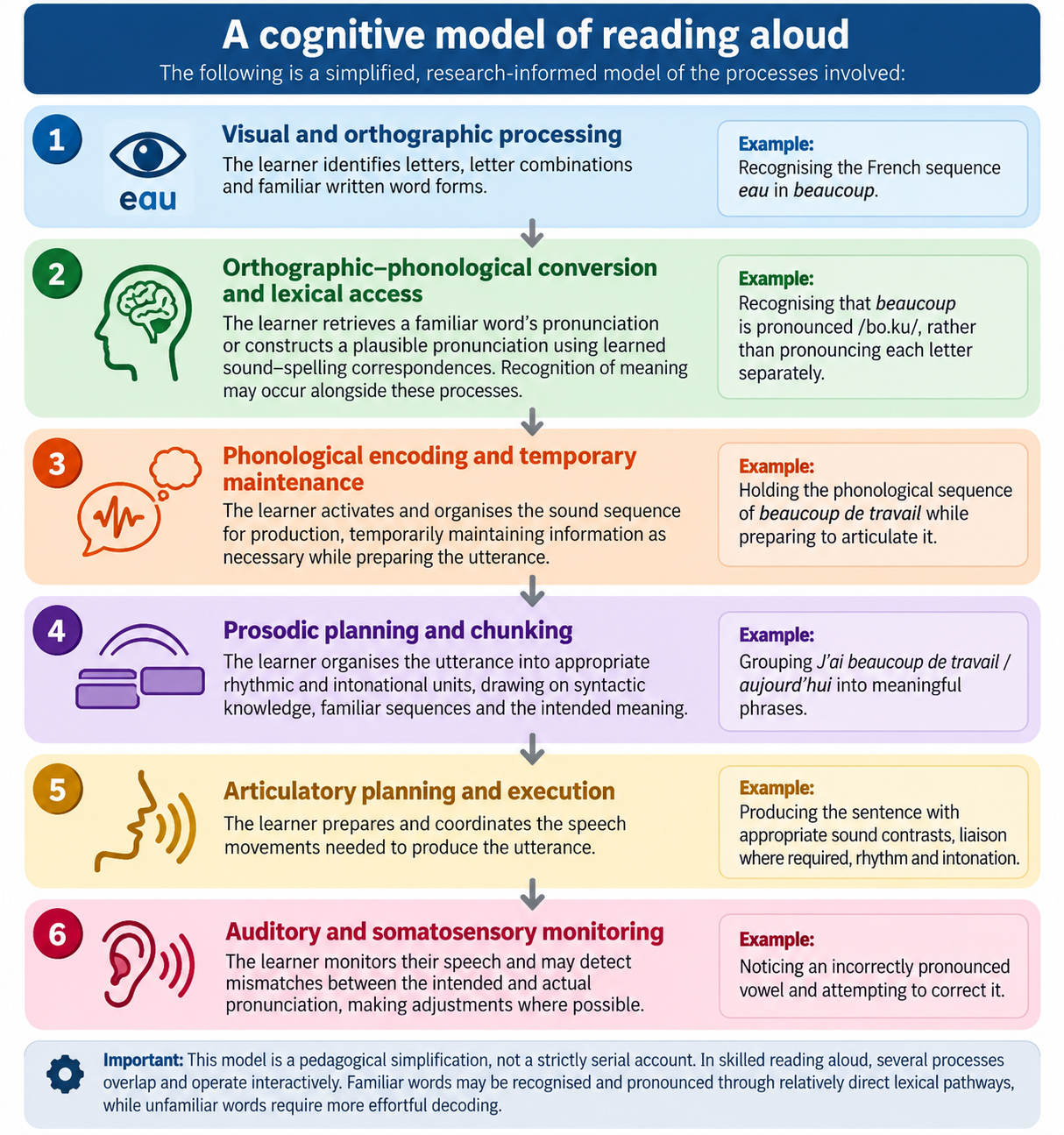
A cognitive model of reading aloud
The following is a simplified, research-informed model of the processes involved:
1. Visual and orthographic processing
The learner identifies letters, letter combinations and familiar written word forms.
Example: Recognising the French sequence eau in beaucoup.
↓
2. Orthographic–phonological conversion and lexical access
The learner retrieves a familiar word’s pronunciation or constructs a plausible pronunciation using learned sound–spelling correspondences. Recognition of meaning may occur alongside these processes.
Example: Recognising that beaucoup is pronounced /bo.ku/, rather than pronouncing each letter separately.
↓
3. Phonological encoding and temporary maintenance
The learner activates and organises the sound sequence for production, temporarily maintaining information as necessary while preparing the utterance.
Example: Holding the phonological sequence of beaucoup de travail while preparing to articulate it.
↓
4. Prosodic planning and chunking
The learner organises the utterance into appropriate rhythmic and intonational units, drawing on syntactic knowledge, familiar sequences and the intended meaning.
Example: Grouping J’ai beaucoup de travail / aujourd’hui into meaningful phrases.
↓
5. Articulatory planning and execution
The learner prepares and coordinates the speech movements needed to produce the utterance.
Example: Producing the sentence with appropriate sound contrasts, liaison where required, rhythm and intonation.
↓
6. Auditory and somatosensory monitoring
The learner monitors their speech and may detect mismatches between the intended and actual pronunciation, making adjustments where possible.
Example: Noticing an incorrectly pronounced vowel and attempting to correct it.
Important: This model is a pedagogical simplification, not a strictly serial account. In skilled reading aloud, several processes overlap and operate interactively. Familiar words may be recognised and pronounced through relatively direct lexical pathways, while unfamiliar words require more effortful decoding.
Why unfamiliar language creates problems
When orthographic recognition and phonological decoding are not sufficiently automatic, they consume attentional resources that could otherwise support prosodic planning, articulation and monitoring.
The result may be hesitant reading, inaccurate pronunciation, inappropriate pauses and reduced fluency.
Instead: Reduce unnecessary processing demands by using familiar vocabulary, previously modelled sound–spelling patterns and short, highly patterned sentences. Introduce new decoding challenges selectively and progressively. As recognition and decoding become more automatic, gradually increase sentence length, syntactic complexity and the proportion of unfamiliar language.
The objective is not to eliminate challenge but to manage cognitive demands so that learners can practise the processes targeted by the activity without being overwhelmed by competing demands.
Research basis: Coltheart et al. (2001); Levelt, Roelofs & Meyer (1999); Baddeley (2003); Sweller (1988); LaBerge & Samuels (1974).
4.Using round-robin reading as the main form of practice
Having students take turns reading sentences or paragraphs aloud provides limited active reading time for each learner. It can also create unnecessary performance pressure, particularly among less confident readers.
Instead: Maximise simultaneous participation through choral reading, paired reading and repeated short rehearsals. Reserve individual performances for carefully selected opportunities, ideally after learners have had sufficient preparation.
Research basis: National Reading Panel (2000); Kuhn & Stahl (2003).
5. Correcting every pronunciation error immediately
Constant correction can interrupt the flow of reading, increase self-consciousness and divert attention from the overall task. Moreover, not all pronunciation errors have the same implications for intelligibility or learning.
Instead: Prioritise errors that affect intelligibility or reveal important gaps in sound–spelling knowledge. Use selective feedback, brief modelling and opportunities for immediate self-correction or another attempt. Where appropriate, delay feedback until the learner has completed a meaningful phrase.
Research basis: Lyster & Ranta (1997); Saito & Lyster (2012).
6. Mistaking successful supported reading for independent mastery
A student who reads a sentence accurately immediately after hearing it may simply be reproducing a recently activated phonological sequence. Successful performance under these conditions does not necessarily demonstrate durable decoding ability.
Instead: Revisit the language after a delay, remove the model and present familiar words in unfamiliar combinations. Check whether learners can decode accurately without immediate auditory support. This provides a more meaningful indication of whether sound–spelling correspondences have been consolidated and can be applied independently.
Research basis: Share (1995); Ehri (2014).
7. Neglecting stress, rhythm and intonation
Accurately pronouncing individual words does not automatically result in fluent, natural reading. Learners also need to develop prosodic control: appropriate stress, rhythm, phrasing and intonation.
Instead: Explicitly model sentence stress, rhythm, intonation and meaningful pauses. Use echo reading and repeated phrase-level practice to develop expressive, intelligible delivery. Encourage learners to imitate the prosodic features of whole utterances, not merely the pronunciation of individual words.
Research basis: Rasinski (2004); Kuhn & Stahl (2003).
8. Prioritising reading speed before accuracy and expression
Reading quickly is not necessarily reading fluently. When learners are encouraged to accelerate before they have developed sufficiently – aa when we ansk them to read aloud tongue twisters meant for native speakers – accurate and stable decoding skills, they may resort to guessing, omit words, distort pronunciation or sacrifice natural phrasing. Fluency involves the efficient coordination of accuracy, automaticity and prosody, not speed in isolation.
Instead: Establish accurate decoding and appropriate phrasing before introducing speed as an explicit performance target. Initially, learners should concentrate on recognising words reliably, articulating them correctly and grouping them into meaningful prosodic units. Once these processes are reasonably secure, increasing reading rate becomes a legitimate and valuable instructional objective.
Research basis: National Reading Panel (2000); Kuhn & Stahl (2003).
9. Failing to systematically develop reading automaticity through fluency-building activities
However, the fact that speed should not be prioritised prematurely does not mean that it should be neglected. Quite the opposite. Once learners have developed reasonably accurate decoding skills, teachers should deliberately create opportunities for them to read familiar language increasingly quickly and effortlessly.
Reading-aloud fluency does not develop simply through exposure to written texts or occasional opportunities to read aloud. Learners need a carefully staged sequence of activities that progressively develops accuracy, automaticity and prosodic control.
Importantly, automaticity is not simply the by-product of accurate reading: it is an instructional objective in its own right. Repeated, appropriately challenging practice can help learners reduce the time and attentional effort required to recognise, retrieve and articulate familiar language.
This is where purposeful EPI fluency-building activities such as timed repeated reading, paced reading and personal-best challenges become particularly valuable. They introduce an element of challenge, make progress visible and encourage learners to process familiar language more efficiently, without sacrificing accuracy or expression.
Instead: Organise reading-aloud instruction around a progression that initially prioritises accurate, supported decoding and subsequently incorporates deliberate fluency-building practice. Once learners can read the target material accurately, introduce repeated readings with gradually reduced completion times, paced reading and other carefully calibrated speed challenges.
The objective is not to make learners rush. It is to accelerate automaticity so that fluent reading becomes progressively less effortful.
A possible progression towards fluent reading aloud
Stage 1 – Phonological familiarisation
Learners listen to short phrases and sentences, focusing on pronunciation, stress and intonation before attempting to read them aloud.
Stage 2 – Sound–spelling mapping
Learners identify recurring grapheme–phoneme correspondences in familiar words and practise recognising these patterns in other lexical items.
Stage 3 – Supported decoding
Learners read short, familiar phrases with visual support, teacher modelling and echo reading.
Stage 4 – Chunked reading
Learners practise reading sentences divided into meaningful phrases, gradually developing more natural phrasing and prosody.
Stage 5 – Repeated reading and timed fluency practice
Learners rehearse short passages several times, aiming for progressively greater accuracy, automaticity and expressive delivery.
Once accuracy is established, introduce activities such as:
- Timed repeated reading: Students read the same short, familiar passage aloud several times, recording how long each attempt takes and trying to improve their previous performance without sacrificing pronunciation or prosody.
- Beat your personal best: Students repeat a familiar passage, attempting to reduce their completion time while maintaining an agreed accuracy criterion.
- Timed chunk reading: Students repeatedly read short, meaningful phrases, gradually increasing the rate at which they can recognise and articulate them accurately.
These activities make progress visible and introduce a motivational element of self-competition. The objective is not simply to speak faster but to reduce the attentional effort required to recognise, retrieve and articulate familiar language.
Stage 6 – Independent reading and paced reading
Learners read familiar texts without immediate modelling or visual chunking cues, demonstrating increasing control over decoding and prosody.
At this stage, paced reading can provide an additional challenge. Students read accessible passages within predetermined time limits, with targets gradually adjusted as their processing becomes more efficient.
For example, learners might read a short passage aloud at a comfortable rate, establish a baseline and then practise towards a modestly faster rate over subsequent attempts. Accuracy and natural phrasing remain essential.
The principle is similar to the timed reading approaches discussed by Chung and Nation (2006), although their research primarily concerns silent L2 reading speed rather than oral reading fluency.
Stage 7 – Delayed transfer
Learners read new combinations of familiar language after a delay, demonstrating that they can apply established decoding and prosodic skills beyond the original practice material.
Where appropriate, teachers can also compare reading accuracy, rate and prosody across different occasions to determine whether improvements are retained and transferable rather than restricted to a repeatedly rehearsed passage.
Why timed practice can help
The theoretical rationale is straightforward. As recognition and decoding processes become more automatic, they require fewer attentional resources, potentially freeing capacity for articulation, prosodic planning and comprehension.
Repeated, appropriately challenging practice can contribute to this automatisation. Timed activities add a measurable performance goal and may increase motivation, particularly when learners compete against their own previous performance rather than against classmates.
Nevertheless, faster reading is not automatically better reading. Excessive time pressure can encourage guessing, omissions and unnatural delivery. Timed practice should therefore be introduced only when learners can already read the material with reasonable accuracy, and improvements should be judged against accuracy and prosodic quality, not speed alone.
The key is to increase processing demands systematically while progressively reducing scaffolding, rather than simply asking learners to read longer or more difficult passages.
This progression is a pedagogical synthesis informed by research on automaticity, orthographic learning and guided oral reading, rather than a single experimentally validated instructional programme.
Research basis: LaBerge & Samuels (1974); National Reading Panel (2000); Kuhn & Stahl (2003); Ehri (2014); Chung & Nation (2006).
10. Failing to develop learners’ ability to self-monitor and self-correct their reading aloud
Reading aloud is not simply a matter of decoding written language and articulating it. It also involves monitoring one’s own speech, detecting discrepancies between intended and actual pronunciation, and making adjustments where necessary. Skilled readers can use auditory and articulatory feedback to regulate their performance, whereas novice learners may struggle to recognise their own errors, particularly when much of their attention is devoted to decoding.
This creates an important instructional challenge: learners cannot reliably correct pronunciation errors they are unable to perceive. Moreover, even when they notice that something sounds wrong, they may lack the phonological knowledge or articulatory control needed to correct it.
Self-monitoring therefore needs to be developed explicitly and progressively, rather than simply expecting learners to recognise and correct their mistakes independently.
Instead: Incorporate activities that gradually develop learners’ ability to evaluate and regulate their own reading aloud. For example:
- Listen, compare and correct: Learners record themselves reading a short, familiar passage, listen to an accurate model, identify discrepancies and attempt a second recording.
- Focused self-monitoring: Learners listen back to their reading with one specific target in mind, such as French nasal vowels, silent final consonants or appropriate phrasing, rather than attempting to monitor everything simultaneously.
- Best Recording (a variation of Paul Nation’s activity of the same name): Learners work in pairs, taking turns to read aloud a short, familiar passage while their partner records them. After each attempt, they listen to the recording together, identify aspects that could be improved (e.g. pronunciation, phrasing, stress or intonation), and rehearse before recording again. The process is repeated until the learner is satisfied that they have produced their best possible version. The partner provides focused feedback and helps the reader notice discrepancies they might otherwise overlook. The emphasis is on successive improvement through repeated performance, self-evaluation and peer support, rather than simply producing a flawless recording on the first attempt.
Initially, the teacher should provide substantial support through modelling, focused listening tasks and explicit feedback. As learners become more proficient, this support can be progressively withdrawn, encouraging greater independence in error detection and correction.
Importantly, self-monitoring should not become so intrusive that it disrupts reading fluency. The aim is to develop increasingly accurate internal monitoring, not to encourage learners to interrupt themselves after every word. During early practice, listening back to recordings may be more productive than attempting continuous self-correction while reading.
Ultimately, the goal is to help learners move from dependence on external correction towards greater autonomy in evaluating and improving their own oral reading performance.
Research basis: Levelt (1983); Levelt, Roelofs & Meyer (1999); Saito & Lyster (2012).
Concluding remarks
Effective reading-aloud instruction is not about getting students to pronounce a passage successfully on a particular occasion. It is about developing the cognitive processes that eventually make accurate, fluent and independent reading possible.
This requires a carefully sequenced progression:
Phonological familiarisation → Sound–spelling mapping → Chunking → Supported decoding → Guided oral practice → Selective feedback → Prosodic development → Automaticity → Independent transfer.
Purposeful fluency-building activities, including timed repeated reading and paced reading, can be embedded within this progression to make practice more engaging and encourage increasingly efficient processing.
From an Extensive Processing Instruction (EPI) perspective, reading aloud should therefore be embedded within a broader input-to-output sequence, rather than used as an isolated pronunciation activity.
One important qualification: much of the strongest evidence on oral reading fluency and orthographic learning comes from first-language literacy research. The implications for MFL instruction are plausible and pedagogically useful, but should not all be presented as findings directly demonstrated in secondary foreign-language classrooms. Likewise, findings on timed silent reading should not automatically be generalised to reading aloud.
The central principle remains:
Model before expecting performance. Scaffold before demanding independence. Consolidate before accelerating. And test transfer before assuming mastery.
Selected references
- Baddeley, A. (2003). Working memory: Looking back and looking forward. Nature Reviews Neuroscience, 4, 829–839.
- Chung, M., & Nation, I. S. P. (2006). The effect of a speed reading course. English Teaching, 61(4), 181–204.
- Coltheart, M., Rastle, K., Perry, C., Langdon, R., & Ziegler, J. (2001). DRC: A dual route cascaded model of visual word recognition and reading aloud. Psychological Review, 108(1), 204–256.
- Ehri, L. C. (2014). Orthographic mapping in the acquisition of sight word reading, spelling memory, and vocabulary learning. Scientific Studies of Reading, 18(1), 5–21.
- Ellis, N. C. (2002). Frequency effects in language processing: A review with implications for theories of implicit and explicit language acquisition. Studies in Second Language Acquisition, 24(2), 143–188.
- Kuhn, M. R., & Stahl, S. A. (2003). Fluency: A review of developmental and remedial practices. Journal of Educational Psychology, 95(1), 3–21.
- LaBerge, D., & Samuels, S. J. (1974). Toward a theory of automatic information processing in reading. Cognitive Psychology, 6(2), 293–323.
- Levelt, W. J. M., Roelofs, A., & Meyer, A. S. (1999). A theory of lexical access in speech production. Behavioral and Brain Sciences, 22(1), 1–38.
- Lyster, R., & Ranta, L. (1997). Corrective feedback and learner uptake. Studies in Second Language Acquisition, 19(1), 37–66.
- National Reading Panel. (2000). Teaching Children to Read. National Institute of Child Health and Human Development.
- Rasinski, T. V. (2004). Assessing Reading Fluency. Pacific Resources for Education and Learning.
- Saito, K., & Lyster, R. (2012). Effects of form-focused instruction and corrective feedback on L2 pronunciation development. Language Learning, 62(2), 595–633.
- Share, D. L. (1995). Phonological recoding and self-teaching: Sine qua non of reading acquisition. Cognition, 55(2), 151–218.
- Sweller, J. (1988). Cognitive load during problem solving: Effects on learning. Cognitive Science, 12(2), 257–285.

