
Why getting grammar right does not necessarily mean getting it — and how assessment can genuinely advance acquisition.
Introduction: What are we actually assessing?
Imagine a Year 10 French class completing a sequence on the passé composé and imparfait. After modelling, listening, reading, retrieval and structured output, students average 85% on a grammar quiz. The result is encouraging. But what exactly does that 85% tell us? Can they identify the contrast in speech? Understand how it changes meaning? Retrieve the forms without prompts? Select them while narrating an unfamiliar experience? Still use them three weeks later?
Accuracy is evidence of performance under particular conditions, not a direct measure of acquisition. Ellis (2005, 2009) distinguishes different kinds of grammatical knowledge and the difficulties involved in measuring them. VanPatten (1996, 2004) shows why processing grammatical form in input cannot be taken for granted. Pienemann (1998) proposes developmental constraints on grammatical processing; DeKeyser (1997, 2007) examines how practice can make skills increasingly efficient. Bjork and Bjork (2011) distinguish immediate accessibility from durable learning.
A danger of mini-whiteboards, quizzes and other quick checks is that the easier a response is to collect and count, the easier it becomes to overinterpret it. Thirty correct answers might reflect recognition, a recently rehearsed rule, copied language or independent retrieval. These are not interchangeable. Equally, an incorrect response may reflect a processing bottleneck, unfamiliar vocabulary or task pressure rather than the absence of relevant grammatical knowledge. The question is not simply “Who got it right?” but “What did this task require, what can I legitimately infer, and what should I teach next?”
The three stages of grammatical skill acquisition
Skill Acquisition Theory, drawing on Anderson (1982, 1983) and applied to L2 morphosyntax by DeKeyser (1997, 2007), provides a useful three-stage account of how practice can change grammatical performance. In the declarative stage, learners can consciously recognise or apply rules, often slowly and with support. During proceduralisation, retrieval and application become increasingly accurate and efficient, although still variable and attention-demanding. With automatisation, well-practised procedures can become more fluent, reliable and less demanding, freeing attention for meaning and communication. Whilst the first stage can be attained after a few hours of practice, automatization may require 100s.
Figure 1. A simplified account of grammatical skill development (Anderson, 1982; DeKeyser, 1997, 2007).
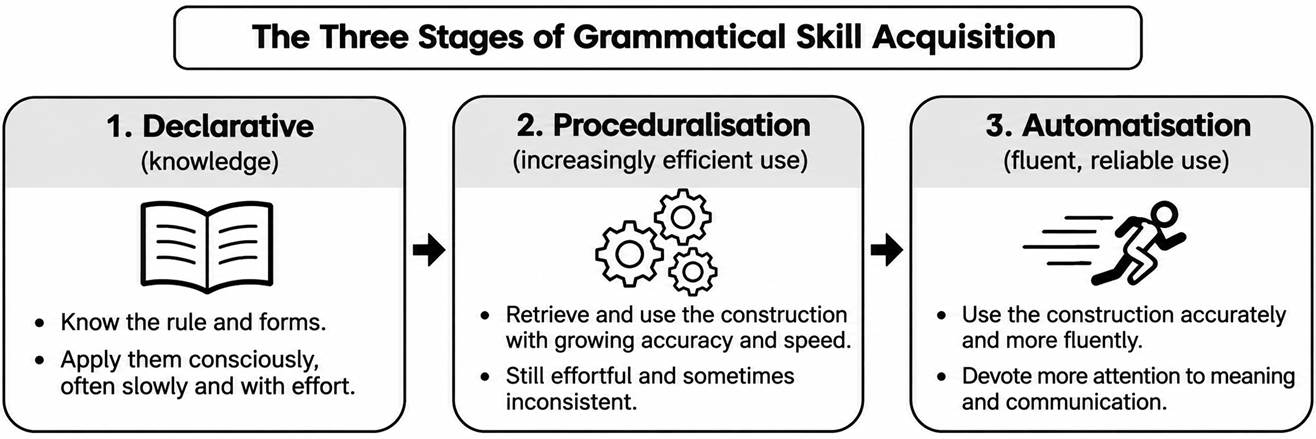
These categories must guide our assessment inferences. A multiple-choice item may provide evidence of recognition; a translation without a model may probe independent retrieval; an unrehearsed exchange with an unexpected follow-up can probe flexible use under communicative pressure. None is a pure test of an internal stage, and automaticity cannot be established from one successful response. Nor does Skill Acquisition Theory imply that all implicit L2 knowledge originates in explicit rules. Pienemann’s Processability Theory concerns developmental constraints and should not be conflated with the efficiency changes described by skill theory. A learner may be accurate yet slow, quick yet unreliable, or fluent with one construction but not another.
The fourteen principles at a glance
| Principle | Assessment question | Research |
| 1. Alignment | Does the task assess the intended skill? | Biggs, 1996 |
| 2. Validity | What conclusion does this performance support? | Messick, 1989; Ellis, 2005 |
| 3. Diagnosticity | Where does difficulty arise? | Ellis, 2005; DeKeyser, 2007 |
| 4. Triangulation | Does performance hold across task types? | Bachman & Palmer, 1996; Ellis, 2009 |
| 5. Developmental appropriateness | What can learners do without support? | Pienemann, 1998 |
| 6. Cognitive load | How does complexity change performance? | Sweller, 1988; DeKeyser, 2007 |
| 7. Form–meaning processing | Are grammatical cues used to understand? | VanPatten, 1996, 2004 |
| 8. Actionable feedback | Does correction transfer? | Lyster & Saito, 2010 |
| 9. Responsiveness | What instructional response fits the evidence? | Black & Wiliam, 2009 |
| 10. Retrieval and spacing | Can forms be retrieved after intervals? | Roediger & Karpicke, 2006 |
| 11. Durable learning | Does performance survive delay and novelty? | Bjork & Bjork, 2011 |
| 12. Learner agency | Can students monitor their own output? | Sadler, 1989; Nicol & Macfarlane-Dick, 2006 |
| 13. Reassessment | Did the response make a difference? | Black & Wiliam, 2009 |
| 14. Equity and inclusion | Are irrelevant barriers distorting evidence? | Messick, 1989; CAST, 2018 |
1. Alignment: assess the skill, not merely the topic
Biggs (1996)
We sometimes say that students have ‘done the past tense’, as though a grammatical topic were a single skill that could just be ticked off. Yet recognising a past form in speech, understanding the time relationship it expresses, selecting an auxiliary and narrating an event are quite different achievements!
Biggs’ (1996) principle of constructive alignment gives us a useful starting point: before assessing anything, specify what learners should actually be able to do. If our goal is comprehension, a conjugation table is not a substitute for evidence of comprehension.
Suppose the target is interpreting time reference in spoken French. Read aloud Je fais du sport, J’ai fait du sport and Je vais faire du sport, without displaying the sentences or supplying time adverbs. Students show PRESENT, PAST or FUTURE on their mini-whiteboards. Repeat with different familiar verbs and, once the contrast is secure, longer utterances. If the objective instead concerns German weil-clauses, students might listen to a justification and identify the reason expressed; if the goal is production, they must construct a justification themselves.
Correct responses in the French task suggest that students can discriminate and interpret those spoken constructions; they do not tell us whether they could produce them. Where answers are weak, I would first establish whether students heard the relevant forms accurately before reteaching their meaning. The quality of the assessment depends on the match between the intended skill and the processing the task actually requires.
2. Validity: correct does not necessarily mean acquired
Messick (1989); Ellis (2005)
A high score is seductive but it is also remarkably easy to overinterpret. Validity, in Messick’s (1989) sense, concerns whether the interpretation we attach to a result is truly warranted. A learner who select voyagerais rather than voyagerai may be recognising a familiar pattern or consciously applying a rule. Neither response tells us, on its own, how that learner would manage an unexpected question in conversation. Ellis (2005) is particularly relevant here: different tasks place different demands on grammatical knowledge. The question is not simply whether the answer is correct, but what that correctness allows us to infer.
Display Si j’avais plus de temps, je… and ask the students to choose between voyagerai and voyagerais. Then remove the model and ask for a translation of ‘If I had more money, I would travel more.’ A further check might ask them to respond, without preparation, to Que ferais-tu pour améliorer ton école ? These tasks progressively reduce the cues available and increases the need to select language independently.
If students succeed on the choice but struggle to construct the sentence, that is useful information about the gap between recognition and retrieval. If they produce a correct translation but hesitate in conversation, we should not automatically infer that the grammar is absent: speaking imposes additional demands. Validity resides in the claims we make from the evidence, not in the apparent neatness of the score.
3. Diagnosticity: the same error can conceal different problems
Ellis (2005); DeKeyser (2007)
Two learners may make exactly the same error for entirely different reasons ! One has not noticed the ending; another recognises it but attaches the wrong meaning to it; a third knows the distinction yet cannot retrieve the appropriate form quickly enough while speaking. A mark scheme records the error but diagnostic assessment asks what might have produced it. This matters because the remedy should depend on the difficulty, not merely on the visible mistake (Ellis, 2005; DeKeyser, 2007).
Consider the French contrast Je jouais au football / J’ai joué au football. Without obvious time adverbs, ask students how the two forms present the past event: the imperfective view from within the situation, as opposed to a bounded event. Then supply short contexts in which one interpretation is appropriate, before asking students to produce a fresh sentence about what they were doing when something happened. In a separate listening check, compare je fais and j’ai fait: first establish whether students can hear the contrast, then whether they can interpret it, and finally whether they can retrieve it.
The pattern of responses is more informative than any single answer. A learner who hears the forms but misinterprets them needs a different response from one who understands the contrast but cannot construct it. Even so, these tasks narrow the plausible explanations; they do not reveal an internal acquisition stage with certainty. We should use the evidence to formulate and test instructional hypotheses, not to attach premature labels to students.
4. Evidence triangulation: compare task conditions
Bachman & Palmer (1996); Ellis (2009)
If one task can mislead, the solution is not simply to administer three versions of the same task. Triangulation means examining a particular grammatical construction under meaningfully different conditions. Can the learner interpret it? Construct it when prompted? Use it when the message, rather than the form, is the immediate focus? Bachman and Palmer (1996) remind us that language performance is inseparable from task conditions, while Ellis (2009) cautions against treating one task type as a transparent window onto competence.
For French relative clauses, begin with C’est le garçon qui regarde la fille and C’est le garçon que la fille regarde. Ask students to write who is looking at whom in each sentence. Because the nouns stay the same, students must attend more closely to the grammatical relationship. Next, remove the examples and ask for a translation requiring qui or que. Finally, ask for an original description of a photograph using a relative clause.
The three responses need not agree. A student may interpret both sentences correctly yet fail to retrieve que during independent production; another may reproduce a rehearsed relative clause without reliably interpreting unfamiliar ones. That discrepancy is precisely why triangulation is worth doing. Rather than averaging the results into one score, use them to decide what kind of practice should follow.
5. Developmental appropriateness: distinguish scaffolding from readiness
Pienemann (1998)
We should be wary of assuming that a grammatical structure becomes independently available simply because it has been explained and practised. Pienemann’s (1998) Processability Theory draws attention to developmental constraints on certain productive processing procedures.
This is not the same as saying that every error signals developmental unreadiness, or that more practice is futile. It does mean that accurate imitation should not be mistaken for evidence of independent grammatical control.
Take the German subordinate clause. Students first see Ich denke, dass Deutsch interessant ist and replace interessant with nützlich. Then the model disappears and they translate ‘I think that learning languages is important.’ Finally, they formulate an original opinion with dass. A similar progression could use Ich glaube, dass er heute kommt, followed by unfamiliar subordinate clauses in which the learner must independently position the finite verb.
If word order deteriorates as support disappears, we have discovered something about the learner’s current performance, not definitively identified a Processability Theory stage. I would sample several examples across occasions, maintain meaningful input and scaffold output judiciously. Developmental sensitivity means calibrating our expectations to what learners can currently process and produce, while continuing to create opportunities for growth.
6. Cognitive load: accuracy depends partly on processing demands
Sweller (1988); DeKeyser (2007)
A pupil who writes an accurate conditional sentence in a quiet exercise may omit the same ending when arguing a point in conversation. Has the grammar vanished? Not necessarily. During communication, learners must retrieve vocabulary, organise ideas, monitor form and respond to an interlocutor, often at the same time. Sweller’s (1988) account of cognitive load and DeKeyser’s (2007) work on skill development help explain why grammatical performance can become less reliable as demands multiply. Low accuracy under pressure can underestimate what a learner knows, just as high accuracy with scaffolding can overestimate independent control.
Begin with ‘I would travel more if I had time’ and ask for a French translation. Next, remove the model and ask students to write an original hypothetical statement about school. Finally, ask an unexpected hypothetical question orally. The grammatical relationship remains similar, but the demands on lexical selection, independence and real-time processing increase. You could make the comparison more diagnostic by keeping vocabulary constant while changing only the amount of support, before introducing other demands.
A fall in accuracy is a prompt to investigate, not proof that cognitive load caused the error. If performance improves when lexical choice is reduced, vocabulary retrieval may be part of the problem; if errors persist even in a short, familiar sentence, the grammatical construction itself may need more attention. Good formative assessment distinguishes a difficulty with the grammar from a difficulty using that grammar while doing several other things.
7. Form–meaning processing: grammar must carry the answer
VanPatten (1996, 2004)
One of the most persistent traps in grammar assessment is asking a question that students can answer without processing the grammar we intended to test. A student can sometimes arrive at the right interpretation by recognising a familiar noun or a time adverb, while barely attending to the ending on which the teacher’s explanation focused. If the grammar is not needed to obtain the answer, the task offers weak evidence that it was processed.
German case marking offers a useful illustration. Contrast Der Lehrer sieht den Schüler with Den Lehrer sieht der Schüler, then ask who sees whom. In the second sentence, assuming that the first noun must be the agent produces the wrong answer; case marking matters. French provides a parallel example: C’est la fille qui appelle le garçon versus C’est la fille que le garçon appelle. Students identify the caller in each, and you repeat the contrast with new nouns to reduce memorised responding.
If students repeatedly follow word order rather than case marking, I would use structured-input activities that make attention to the relevant grammatical cues necessary for interpretation. Then I would reassess with unfamiliar examples. Recognising that a grammatical form exists is not the same as using it to construct meaning.
8. Actionable feedback: correction is not the endpoint
Lyster & Saito (2010); Hattie & Timperley (2007)
We have all seen the gratifying moment when a student corrects a sentence immediately after feedback. It is progress of a kind, but what kind? The correction may reflect a genuine improvement, a consciously applied rule or simply the recent activation of the teacher’s model. Research on corrective feedback (Lyster & Saito, 2010) and on the conditions under which feedback helps learning (Hattie & Timperley, 2007) encourages a more demanding question: can the learner use the information to improve subsequent performance beyond the original item?
Show Si j’aurais plus d’argent, j’achèterais une voiture. Students correct j’aurais to j’avais, but do not stop there. Remove the sentence and ask for ‘If I had more free time, I would learn another language.’ Then invite an original hypothetical statement about school rules. Revisit the same conditional relationship in a later lesson with different verbs and subjects.
Immediate repair tells us that the student responded to feedback. Successful use in a new sentence suggests transfer under those conditions; delayed retrieval provides stronger evidence that the improvement has endured. If only the original sentence is corrected, I would revisit the form–meaning relationship and vary the practice rather than record the misconception as resolved. Feedback is formative when it changes what learners can subsequently do, not merely what they can correct in front of us.
9. Instructional responsiveness: let evidence change teaching
Black & Wiliam (2009); VanPatten (2004)
A diagnostic result is only the beginning. Black and Wiliam (2009) remind us that evidence becomes formative when it informs what happens next. This is where Principle 9 differs from Principle 3: diagnosis asks what may be going wrong; instructional responsiveness asks what experience is most likely to help. If students cannot interpret a grammatical contrast, more rule-based production may miss the problem. If they understand the meaning but cannot retrieve the form, repeating the comprehension exercise may be equally unhelpful.
Take the Spanish contrast Leía en el jardín / Leí en el jardín.
The imperfect presents the past situation from within, without marking its endpoint; the preterite presents it as bounded. The imperfect does not, by itself, mean ‘used to’. Provide short contexts in which these viewpoints matter, and ask students to choose and justify a form without relying on overt time adverbs. Repeat with Escribía una carta / Escribí una carta. Then remove the models and ask students to express both ‘I was reading when the phone rang’ and ‘I read the letter and replied’.
If students cannot interpret the viewpoint contrast, meaning-focused input is a plausible next step (VanPatten, 2004). If interpretation is secure but endings disappear during writing, scaffold-fading and retrieval may be more useful. And if both are secure in controlled tasks but accuracy falls in discussion, the next practice should vary communicative demands. The same percentage of errors can justify quite different teaching decisions.
10. Retrieval and spacing: do not mistake recency for learning
Roediger & Karpicke (2006); Bjork & Bjork (2011)
A construction practised ten minutes ago is often surprisingly easy to retrieve. That ease can create a comforting but misleading sense of security. Retrieval practice requires learners to bring information to mind, while spacing distributes opportunities to do so over time. Roediger and Karpicke (2006) and Bjork and Bjork (2011) help explain why what is accessible immediately after practice may not remain accessible next week. This principle concerns how we organise opportunities to retrieve and revisit grammar; Principle 11 concerns whether learning subsequently proves durable.
Without notes, ask students to translate ‘I would like to travel more’, ‘I have been learning French for five years’ and ‘If I had more time, I would read more’. Revisit the constructions several days later and again after two or three weeks, changing the vocabulary. You might similarly return to French depuis with the present tense: ‘I have been studying French for three years’, ‘She has been living here since 2022’, then an original statement about a hobby.
Record which constructions remain retrievable and which require renewed support. But remember that translating from English prompts is not the same as selecting the construction spontaneously during communication. Spaced retrieval can both strengthen accessibility and reveal weaknesses; it cannot, on its own, certify automatisation.
11. Durable learning: test delayed transfer, not rehearsed answers
Bjork & Bjork (2011); DeKeyser (2007)
Sometimes a lesson ends with near-perfect responses, only for the same grammar to reappear as a stumbling block a fortnight later. Bjork and Bjork’s (2011) distinction between temporary accessibility and more durable learning is essential here. DeKeyser (2007) also reminds us that practice and developing skill must be considered over time. The crucial question is not only whether a learner can perform today, but whether the construction survives delay and can be applied when the surface features of the task change.
Three weeks after teaching French relative clauses, ask students to translate ‘It’s a film that I watched last weekend.’ Follow with an unfamiliar sentence requiring qui as a subject relative, and then invite students to incorporate a relative clause into an original description. Keep the vocabulary accessible enough that failure cannot be attributed too readily to an unfamiliar noun or verb.
These three tasks distinguish delayed retrieval, selection of a contrasting form and a degree of transfer. A student may succeed on the first and struggle on the third; that pattern matters more than an aggregate score. Revisit the relevant form–meaning contrasts and reassess after a further interval. Delayed success is stronger evidence of retention, though it still does not prove that the grammar has become automatic or implicit.
12. Learner agency: develop self-monitoring without mistaking it for fluency
Sadler (1989); Nicol & Macfarlane-Dick (2006)
Formative assessment should not leave students permanently dependent on the teacher to tell them whether their grammar is acceptable. Sadler (1989) and Nicol and Macfarlane-Dick (2006) make a compelling case for helping learners understand standards, notice discrepancies and act on feedback. Yet self-correction is itself a demanding skill. The student who spots an error during leisurely proofreading may still make it during spontaneous speech, when attention is divided between form and meaning.
Display Si j’étais riche, je voyagerai partout dans le monde. Rather than immediately revealing the correction, ask students to judge the sentence against a criterion: does it express a hypothetical situation, and do the forms reflect that relationship? They correct voyagerai to voyagerais, then construct a new example with the criterion still available. Next remove the prompt and ask them to review a short paragraph for consistency.
What matters is whether the student begins to apply the criterion independently, not simply whether the first correction was right. I would gradually withdraw the prompts and later check how the same construction fares in extended writing and oral interaction. The goal is to develop learners who can increasingly monitor and improve their own language, while recognising that monitoring and automatic use are not identical.
13. Reassessment: verify the instructional response
Black & Wiliam (2009)
A teacher notices a weakness, teaches the point again and sees students complete another worksheet successfully. Has the intervention worked? Perhaps—but the completion of additional practice is not evidence enough. Black and Wiliam (2009) place instructional decisions at the centre of formative assessment, and those decisions themselves need checking. Principle 9 is about choosing a response; Principle 13 is about finding out whether that response was followed by better performance.
Before a lesson on Spanish past viewpoints, present four brief contexts and ask students to select or interpret preterite and imperfect forms. After targeted meaning-focused instruction, use four new but comparably demanding contexts, keeping vocabulary and complexity as similar as possible. Repeat a smaller check the following week. Do not recycle the identical sentences: students may remember answers rather than demonstrate understanding.
A gain is encouraging, but pre- and post-items are rarely perfectly equivalent, and a simple classroom comparison does not prove what caused the improvement. Look at the pattern of errors as well as the score. If learners now interpret the contrast but still cannot produce the forms, the next teaching decision should reflect that distinction. Reassessment closes the formative loop by testing our instructional judgement against fresh evidence.
14. Equity and inclusion: remove irrelevant barriers, not grammar
Messick (1989); CAST (2018)
Fair assessment is sometimes mistaken for making tasks easier. That is not the point. Messick (1989) helps us distinguish the construct we want to assess from irrelevant demands that may distort the result; CAST (2018) offers a broader rationale for accessible learning and assessment. If the objective is to interpret a spoken grammatical contrast, requiring a lengthy written explanation may tell us as much about writing speed and literacy as about grammatical comprehension. We should remove unnecessary barriers without removing the grammar that gives the task its purpose.
Read aloud Si j’avais de l’argent, je voyagerais davantage and Quand j’avais de l’argent, je voyageais davantage. Students respond with HYPOTHETICAL or PAST SITUATION, rather than composing a full explanation. Be precise about what this assesses: si and quand themselves provide meaningful cues, so the task checks interpretation of the construction as a whole, not isolated recognition of the verb morphology. If the latter is the objective, redesign the task to control those cues.
The same principle applies when assessing written agreement: familiar vocabulary and short, clear instructions can reduce unrelated demands, while the agreement contrast remains intact. Later, if the objective becomes extended writing, those additional demands are part of the construct and should not be stripped away. Fairness means making sure the result tells us about the skill we intended to assess, not an accidental obstacle we introduced.
From scores to instructional decisions: ELICIT → DIAGNOSE → RESPOND → VERIFY
ELICIT evidence of a precisely specified skill, with a task that actually requires the targeted grammatical processing. DIAGNOSE the most plausible difficulty, comparing interpretation, retrieval, supported production and communicative use when necessary. RESPOND with the right kind of teaching: structured input, modelling, retrieval, feedback, guided output or communicative practice. VERIFY with new, comparable and sometimes delayed evidence. This cycle is more important than the particular tool used to gather responses.
For example, a class may score 85% on a written conditional exercise yet fail to interpret hypothetical statements in listening. This does not prove a lack of grammar knowledge; it suggests a question about auditory recognition or form–meaning processing. Another class may interpret those statements successfully yet fail to use the conditional in an unrehearsed discussion, suggesting a different bottleneck. The score does not tell us what to do next; the pattern of evidence helps us decide.
Conclusion: assess grammar more intelligently, not simply more frequently
Mini-whiteboards, gap-fills, translations, grammaticality judgements and quizzes are not intrinsically superficial. Each can be useful when the inference is appropriately modest. The danger begins when we treat correct answers as interchangeable evidence of rule knowledge, form–meaning processing, efficient retrieval and spontaneous use. These fourteen principles are overlapping lenses rather than fourteen mutually exclusive psychological constructs: validity governs inference; diagnosticity identifies the likely difficulty; triangulation strengthens the evidence; responsiveness chooses the next step; reassessment checks it; spaced retrieval is a practice, while durable learning is an outcome. None of the sample tasks is presented as a validated diagnostic instrument.
The most useful question is therefore not simply “Have they got it?” but “What can they currently do with this construction, under what conditions, with how much support and effort, and what experience is most likely to move their learning forward?” That is how assessment stops being a record of performance and becomes a tool for advancing grammatical competence.
Selected references
Anderson, J. R. (1982). Acquisition of cognitive skill. Psychological Review, 89(4), 369–406.
Anderson, J. R. (1983). The Architecture of Cognition. Harvard University Press.
Bachman, L. F., & Palmer, A. S. (1996). Language Testing in Practice. Oxford University Press.
Biggs, J. (1996). Enhancing teaching through constructive alignment. Higher Education, 32, 347–364.
Bjork, E. L., & Bjork, R. A. (2011). Making things hard on yourself, but in a good way: Creating desirable difficulties to enhance learning. In M. A. Gernsbacher, R. W. Pew, L. M. Hough, & J. R. Pomerantz (Eds.), Psychology and the Real World: Essays Illustrating Fundamental Contributions to Society. Worth Publishers.
Black, P., & Wiliam, D. (2009). Developing the theory of formative assessment. Educational Assessment, Evaluation and Accountability, 21, 5–31.
CAST (2018). Universal Design for Learning Guidelines, Version 2.2.
DeKeyser, R. M. (1997). Beyond explicit rule learning: Automatizing second language morphosyntax. Studies in Second Language Acquisition, 19(2), 195–221.
DeKeyser, R. M. (Ed.). (2007). Practice in a Second Language: Perspectives from Applied Linguistics and Cognitive Psychology. Cambridge University Press.
Ellis, R. (2005). Measuring implicit and explicit knowledge of a second language: A psychometric study. Studies in Second Language Acquisition, 27, 141–172.
Ellis, R. (2009). Implicit and explicit learning, knowledge and instruction. In Implicit and Explicit Knowledge in Second Language Learning, Testing and Teaching. Multilingual Matters.
Hattie, J., & Timperley, H. (2007). The power of feedback. Review of Educational Research, 77, 81–112.
Lyster, R., & Saito, K. (2010). Oral feedback in classroom SLA: A meta-analysis. Studies in Second Language Acquisition, 32, 265–302.
Messick, S. (1989). Validity. In R. L. Linn (Ed.), Educational Measurement (3rd ed.). Macmillan.
Nicol, D. J., & Macfarlane-Dick, D. (2006). Formative assessment and self-regulated learning: A model and seven principles of good feedback practice. Studies in Higher Education, 31(2), 199–218.
Pienemann, M. (1998). Language Processing and Second Language Development: Processability Theory. John Benjamins.
Roediger, H. L., & Karpicke, J. D. (2006). Test-enhanced learning: Taking memory tests improves long-term retention. Psychological Science, 17, 249–255.
Sadler, D. R. (1989). Formative assessment and instructional systems. Instructional Science, 18, 119–144.
Sweller, J. (1988). Cognitive load during problem solving: Effects on learning. Cognitive Science, 12, 257–285.
VanPatten, B. (1996). Input Processing and Grammar Instruction: Theory and Research. Ablex.
VanPatten, B. (Ed.). (2004). Processing Instruction: Theory, Research, and Commentary. Lawrence Erlbaum Associates.

