
Introduction
Nine activities. One goal: making sentence production faster, more accurate and more automatic.
One of the greatest challenges in language teaching is bridging the gap between knowing vocabulary and grammar and being able to retrieve and deploy that knowledge accurately, fluently and under time pressure. A student may recognise every word in a sentence, understand the grammar rule governing its construction and even translate it correctly when given enough time. Yet ask that same student to produce the sentence spontaneously, and the whole process often grinds to a halt.
Why? The main reason is that knowing the components of a language is not the same as being able to assemble them efficiently in real time.
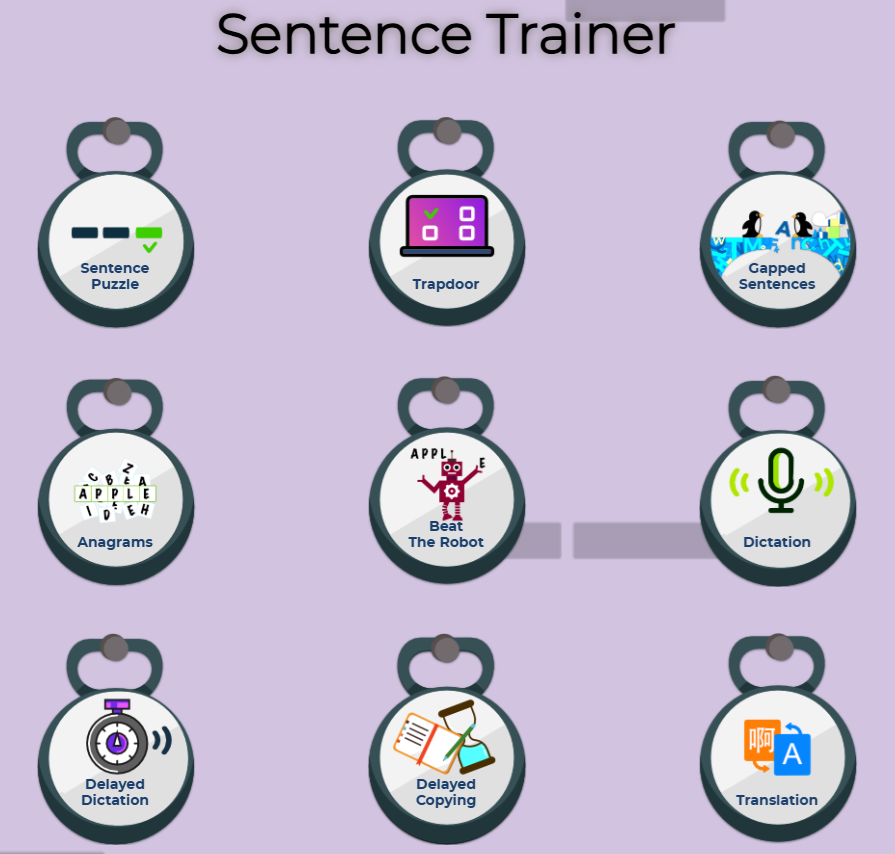
This is precisely the challenge that The Language Gym’s Sentence Trainer was designed to address by implementing process-based instruction: rather than treating sentence production as a single, indivisible skill, the Sentence Trainer offers nine activities targeting different aspects of the processing involved in retrieving, assembling, monitoring and producing sentences.
1. Why sentence-level practice matters
In instructed second language acquisition, a fundamental distinction is made between declarative knowledge (what learners know about the language) and procedural knowledge (what learners can actually do with it). In other words, a learner might know that a French reflexive verb requires a reflexive pronoun, but still struggle to produce Je me lève à sept heures quickly and accurately.
Producing even a relatively simple sentence requires the coordination of several processes:
- Retrieving the relevant vocabulary and multiword chunks.
- Selecting appropriate grammatical structures.
- Assembling words into a meaningful, well-formed sentence.
- Accessing accurate orthographic or phonological representations.
- Monitoring the output for errors.
- Doing all of the above within the constraints of working memory.
When these processes are insufficiently practised, sentence production becomes slow, effortful and error-prone.
The pedagogical answer is not simply to explain the grammar again. It is to provide structured opportunities to practise the processes that make accurate language production possible.
2. Nine activities, nine opportunities to strengthen sentence processing
The Sentence Trainer currently features nine activities, each providing a different form of sentence-level practice.
Sentence Puzzle — Reconstructing sentence structure
Sentence Puzzle invites learners to reconstruct sentences from their constituent elements. Its potential value lies in directing attention towards word order, grammatical relationships and the organisation of meaningful chunks. Rather than recalling isolated vocabulary, learners must consider how words fit together to produce a coherent utterance.
This can support the development of sentence assembly skills, particularly when learners subsequently practise producing the same structures without prompts.
Trapdoor — Repeated processing with variation
Trapdoor provides a framework for repeated encounters with sentence patterns while introducing variation. This combination is pedagogically valuable because repetition supports consolidation, while variation can encourage learners to attend to the elements that change and those that remain constant. The aim is not simply to memorise one sentence, but to become increasingly familiar with a family of related constructions.
Gapped Sentences — Production under constraints
Gapped Sentences requires learners to complete sentences by supplying missing words or chunks. Unlike activities where all the linguistic elements are provided, gapped sentences introduce a retrieval demand: learners must identify what is missing and recover the appropriate language from memory. The surrounding sentence provides contextual and grammatical cues, making the task less demanding than producing an entire sentence independently.
This makes Gapped Sentences particularly useful for strengthening:
- Lexical retrieval: recovering words and chunks from memory.
- Grammatical selection: choosing forms appropriate to the sentence context.
- Collocational knowledge: recognising which words naturally occur together.
- Form–meaning connections: retrieving language that fits both the intended meaning and the grammatical structure.
- Accuracy monitoring: checking that the completed sentence is well formed.
The pedagogical value lies in the balance between support and retrieval demand.
A well-designed gap directs learners’ attention towards a particular linguistic feature while preserving enough context to make successful retrieval possible. As learners become more proficient, support can be gradually reduced and the retrieval demands increased.
Gapped sentences are therefore a useful bridge between recognition and independent sentence production.
Anagrams — Orthographic retrieval and reconstruction
Anagrams targets the ability to reconstruct written language from disordered elements. Such practice can strengthen attention to letter sequences and orthographic accuracy. This is particularly relevant in languages where spelling presents significant challenges, including French.
However, orthographic reconstruction should complement, rather than replace, meaningful sentence production.
Beat the Robot — Retrieval under time pressure
Beat the Robot introduces a competitive, time-sensitive dimension to practice. Time pressure can encourage learners to retrieve familiar language more rapidly, reducing their reliance on slow, deliberate reconstruction. The important qualification is that speed should be introduced after sufficient modelling and accuracy-focused practice.
Premature speed can reinforce errors; appropriately timed speed can help consolidate accurate retrieval.
Dictation — From sound to written language
Dictation is far more than a spelling exercise. To transcribe a spoken sentence, learners must identify the speech stream, segment it into words, recognise familiar sequences, retrieve orthographic representations and monitor what they have written. It therefore brings together listening, phonological processing, lexical recognition and written accuracy. This makes it especially valuable in languages where sound–spelling correspondences are challenging.
Delayed Dictation — Holding and reconstructing language
Delayed Dictation introduces a memory demand by separating exposure to the spoken input from its written reproduction. This encourages learners to maintain and reconstruct linguistic information rather than simply transcribe it immediately. The activity can therefore place demands on verbal working memory, lexical retention and sentence reconstruction.
The delay must, however, be calibrated carefully. Excessive memory load can overwhelm learners before they have had the opportunity to process the language successfully.
Delayed Copying — Strengthening orthographic representations
Delayed Copying requires learners to retain written language briefly before reproducing it. Unlike ordinary copying, which can become a largely mechanical exercise, delayed copying creates a retrieval demand. Learners must attend more closely to spelling, word order and the structure of the sentence. With appropriate scaffolding, this can encourage more active processing of written language.
Translation — Retrieving and assembling language from meaning
Translation provides a particularly useful bridge between meaning and form. When learners translate into the target language, they must retrieve vocabulary, select grammatical structures and assemble a sentence that conveys the intended meaning. Unlike recognition tasks, translation can require substantial independent production. It also provides opportunities for diagnostic feedback: errors can reveal difficulties with lexical retrieval, sentence assembly, grammatical selection or orthographic accuracy.
Translation is therefore most useful when it is embedded within a wider progression of modelling, guided practice and increasingly independent language use.
3. Why the combination matters more than any single activity
The strength of the Sentence Trainer is not simply that it offers nine different exercises. It is that these activities can be combined to create a progression from supported processing to increasingly independent production. Some tasks provide substantial linguistic support. Others place greater demands on retrieval, memory, accuracy or speed. This is important because fluent language production does not emerge merely from repeated exposure to vocabulary and grammar rules. Learners need opportunities to retrieve and manipulate familiar language across different conditions.
The sequence should not be rigid. A teacher might begin with sentence reconstruction, move towards retrieval-based production, introduce dictation for sound–spelling consolidation and finish with translation or timed practice.
What matters is that the activities are selected according to the processing demands learners are ready to handle, not simply for variety or entertainment.
4. The connection with cognitive science and second language acquisition
Several research traditions help explain why this kind of practice can be valuable.
Skill Acquisition Theory (DeKeyser, 2007) emphasises the role of practice in developing increasingly efficient performance. Repeated, meaningful opportunities to apply linguistic knowledge can reduce the attentional demands of language production.
Retrieval practice research (Karpicke & Roediger, 2008) demonstrates that retrieving information from memory can strengthen subsequent retention. Activities requiring learners to reconstruct language without constantly referring to a model are therefore potentially more valuable for retention than repeated passive review.
Working memory research (Baddeley, 2000; Cowan, 2001) reminds us that the capacity to hold and manipulate unfamiliar information is limited. This provides a rationale for carefully controlling task complexity, particularly with novice learners.
Transfer-appropriate processing (Morris, Bransford & Franks, 1977) suggests that learning benefits when practice engages processes relevant to subsequent performance. If the goal is accurate sentence production, learners need more than recognition exercises: they need to practise retrieving, assembling and producing sentences.
None of these theories establishes that a particular digital activity automatically produces fluency. The benefits depend on how the activity is designed, sequenced, supported and followed up.
5. Where the Sentence Trainer fits into EPI
Within Extensive Processing Instruction, the Sentence Trainer can be particularly useful during the transition from intensive modelling to increasingly independent production.
After learners have encountered and processed target constructions through listening and reading, the Trainer can provide additional opportunities for consolidation.
Its activities can support several complementary objectives:
- Consolidation: strengthening recently modelled language.
- Retrieval: encouraging access to language without continuous visual support.
- Accuracy: focusing attention on sentence structure, spelling and grammatical choices.
- Automaticity: increasing the efficiency of familiar retrieval and assembly processes.
- Diagnostic assessment: helping teachers identify which aspects of sentence processing remain insecure.
It can also be used for homework, retrieval starters and additional practice between lessons.
Crucially, the Trainer should not replace communicative language use. Rather, it can help prepare learners for the demands of communication by strengthening some of the component processes on which it depends.
6. An added bonus
The Sentence Trainer recycles every single item in the Rock-Climbing game. Hence, it is great either as a primer, to prepare the students for the Rock-Climbing game or as a consolidator after playing that game.
Conclusions
We would never expect a basketball player to become proficient simply by memorising the rules of basketball nor would we expect them to improve solely by playing full matches without practising shooting, passing, dribbling, movement and decision-making. Language learning is very much the same!
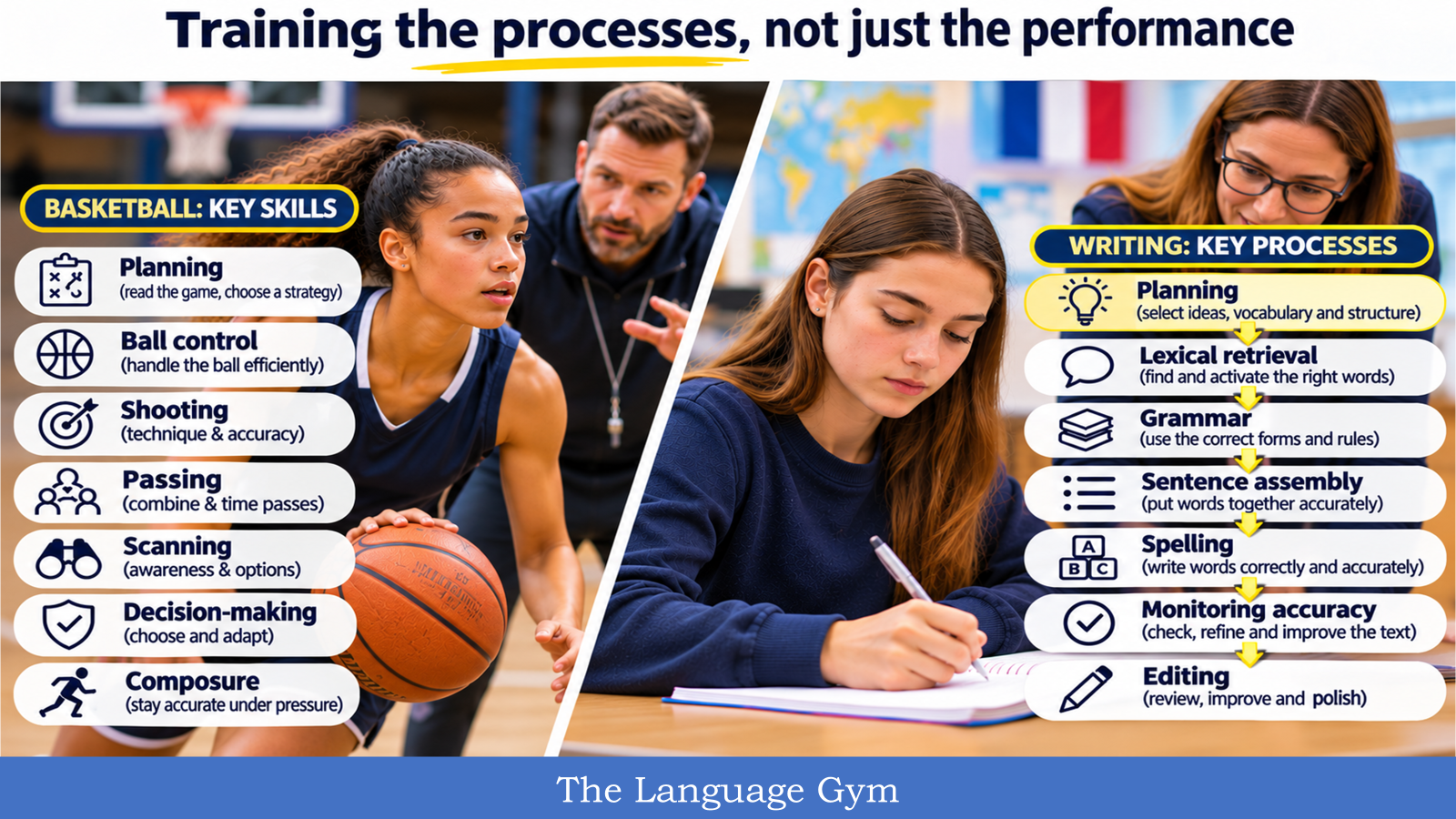
If we want students to produce accurate, fluent sentences, we must give them opportunities to practise the underlying processes: lexical retrieval, sentence assembly, grammatical selection, spelling, monitoring and increasingly rapid access to familiar constructions.
The Sentence Trainer is designed around this principle: help learners become better at the processes that underpin successful language performance.
References
- Baddeley, A. (2000). The episodic buffer: A new component of working memory? Trends in Cognitive Sciences, 4(11), 417–423.
- Cowan, N. (2001). The magical number 4 in short-term memory: A reconsideration of mental storage capacity. Behavioral and Brain Sciences, 24(1), 87–114.
- DeKeyser, R. (Ed.). (2007). Practice in a Second Language: Perspectives from Applied Linguistics and Cognitive Psychology. Cambridge University Press.
- Karpicke, J. D., & Roediger, H. L. (2008). The critical importance of retrieval for learning. Science, 319, 966–968.
- Morris, C. D., Bransford, J. D., & Franks, J. J. (1977). Levels of processing versus transfer appropriate processing. Journal of Verbal Learning and Verbal Behavior, 16(5), 519–533.


You must be logged in to post a comment.