How I teach lexicogrammar (PART 2) – The  8 tenets of Extensive Processing Instruction in the novice-to-intermediate classroom

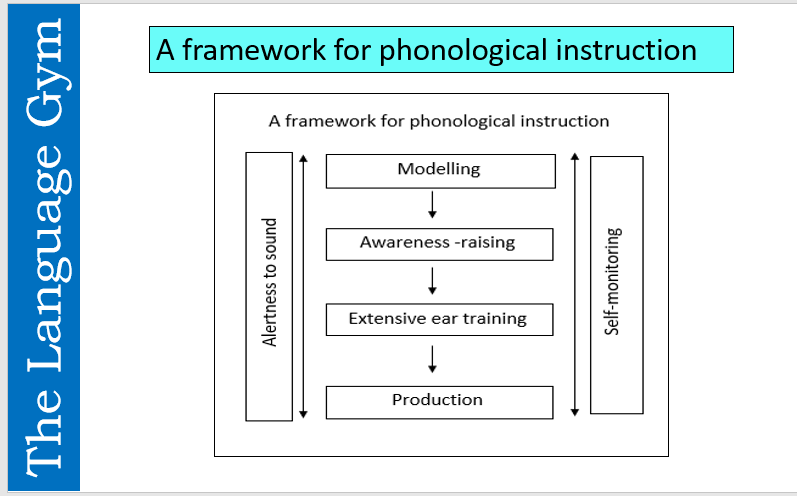
Fig.1 – the MARS EARS framework

MARS

0. Introduction

In the first post in this series dedicated to my teaching approach, Extensive Processing Instruction (or E.P.I.), I discussed the M.A.R.S. E.A.R.S. framework in its broad lines.

In the present post I will concern myself with the eight key principles that are crucial for the success of my approach and anyone wanting to adopt E.P.I. ought to heed.

Note that if you haven’t read my previous post, ‘How I teach lexicogrammar (Part 1)‘ I strongly recommend you do before reading on, so as to gain a better understanding of what follows.

1. Chunking

E.P.I. prioritises the teaching of chunks derived from Communicative Functions (see post here) over the teaching of single words and traditional grammar, in the belief that this approach (1) reflects the way the brain is hard-wired to acquire languages; (2) speeds up fluency as it is a faster and more efficient way of producing language; (3) facilitates processing by reducing the cognitive load on working memory; (4) makes language learning more about communication and implicit learning and less about explicit learning and application of rules.

Whilst grammar still places a prominent role in EPI, it serves the expression of communicative functions, hence EPI is about communicative lexicogrammar, construction grammar and usage-based grammar.

For more on the rationale and implementation of chunking, please refer to this previous post of mine  

2. Comprehensible Input

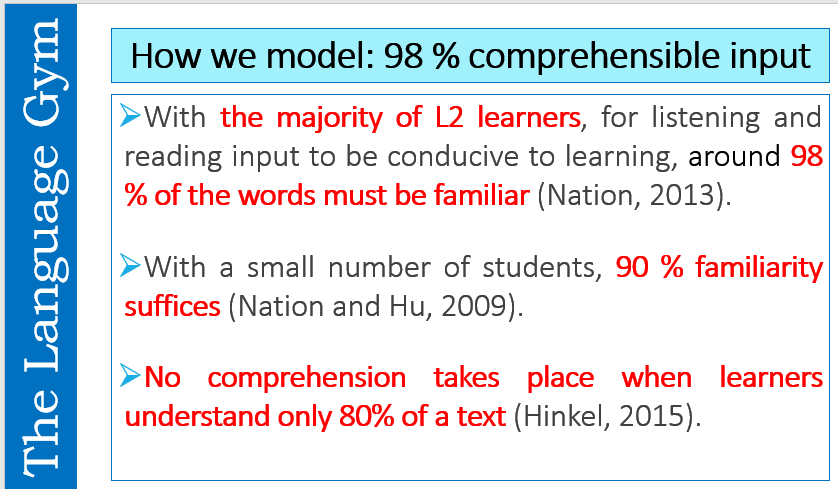
Masses of research have evidenced that with average-ability learners any L2 input that is less than 98 % comprehensible (i.e. understandable by the listeners/readers without help) is very unlikely to be conducive to learning. With more gifted learners, 90 % may suffice. Any input below the 80% comprehensibility threshold is likely to cause serious comprehension issues .

It is obvious, then, that if we aim to model L2 language through aural/writen tasks, , we must provide students with comprehensible input which contains language they are largely familiar with. This is very rarely the case with most of published world languages teaching materials, especially coursebooks and, in my experience, with a lot of target language input given by instructors in EFL and WL/MFL classrooms worldwide. The main reason: the belief, rooted in the CLT approach, that students should be given input which is as ‘authentic’ as possible.
However, asking students to perform listening/reading comprehension tasks on aural texts containing a substantive amount of language beyond their comprehensibility threshold encourages the deployment of compensatory strategies (e.g. guessing) rather than the promoting of noticing and modelling of syntax, morphology, lexis and phonology.

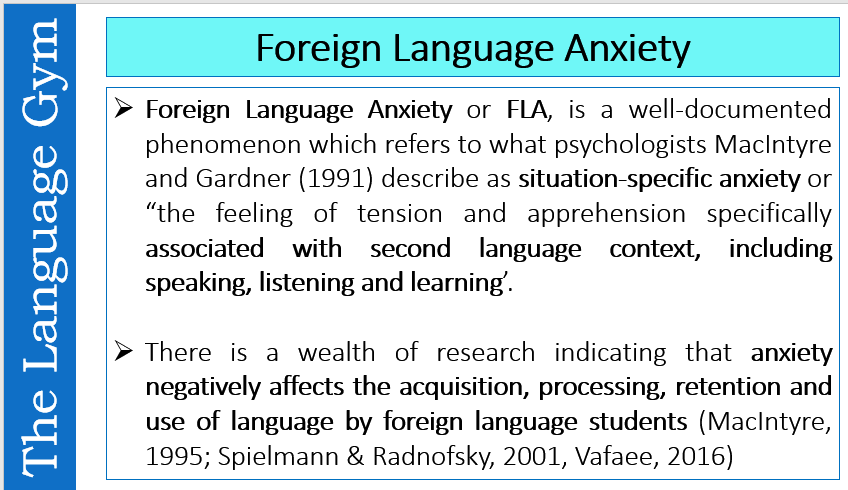
Moreover, this practice may be perceived as unfair by the students (e.g. “why am I being asked to listen to/read something I haven’t learnt and don’t understand?”), may engender student anxiety and, should the student fail, undermine their self-efficacy and motivation.

Another dimension of input comprehensibility relates to the speed rate at which aural texts are usually delivered. As noted previously, speed of processing is a function of listening fluency, hence, a beginner student-listener should not be asked to perform a task on texts delivered at native or near-native speed. Yet, this practice is very common in secondary schools in England, with negative consequence for L2-student motivation.

I believe the speed of delivery with beginners ought to be commensurate to their level of listening fluency even at the risk of sounding patently non-native, and should be increased gradually and judiciously as L2 learners’ proficiency grows.

3. Flooded Input

Mothers excel at providing their infant children with masses of input which is simplified, repetitive, highly patterned and rightly pitched to their current level of language proficiency. They ‘flood’ their input with instance after instance of the words or phrases they want their little ones to learn, going back to those words in various ways in their input; in other words, they provide ‘flooded input’.

E.P.I. is big on flooded input. I believe that, at the risk of not sounding authentic, L2 teachers must provide their students with masses of input ‘flooded’ with occurrences of the target linguistic patterns.

This is intuitive: if we want our students to acquire a specific pool of new chunks or to consolidate previously learnt ones, we need to ensure that they occur many times over in our (98% comprehensible) input in order to facilitate their noticing and retention.

Fig. 2 – Nursery rhymes contain lots of flooded input

flooding

Flooded input is especially crucial when we deal with items which are less easily noticed by L2 learners (e.g. prepositions, connectives, pronouns, copulas, word-endings) because of their morphology, position in a sentence or simply because of their frequency in L2 input and are consequently acquired quite late by L2 learners. By flooding the aural input with such items thereby increasing the students’ exposure to them, we are more likely to enhance their chances to notice and consequently acquire them.

By the same token, by patterning the input, we ensure that it follows a repetitive and predictable structure which facilitates understanding and retention of the target items. This is very much what happens in the nursery rhymes, songs and stories that children are fed throughout their infancy.

Fig. 3 – A patterned poem flooded with the same target structure

flooding

Our emphasis on flooded and patterned input is another major reason why E.P.I. advocates the use of aural/written texts ‘manufactured’ for L2 teaching purposes. One of the benefits of such texts is that they may contain as many instances as we feel fit of items that occur very rarely in the aural input students normally process in the typical L2 classroom. Think about ‘negatives’, for instance: how many ‘authentic’ texts describe events using lots of negative structures?

Narrow reading (NR) and Narrow listening (NL) texts are extreme examples of flooded and highly patterned input.  NR and NL consist of clusters of texts (I typically use 4 to 6) which are totally identical except for a few details here and there (see examples in figures 4  and 5 below.

Fig 4 – a set of Spanish narrow reading texts with tasks designed for a year 8 class

flooding


Fig 5 – EFL narrow reading texts for French students

flooding

Every single interactive read-aloud game described here (e.g. the globally successful ‘Sentence stealer’) aims at providing lots of flooded input.

Fig 6 – The read aloud game ‘Sentence Stealer’ in a lesson on the immediate future in Spanish. Even to non Spanish-speakers the input-flooding is quite obvious.

flooding


4. Controlled Input

We believe that in instructed L2 instruction the input we provide our students with needs to be tightly controlled in order to possess all of the attributes discussed above. Note that at the initial stage of a new EPI instructional sequence  the input provided to the learners in the Receptive Processing phase (the R in the MARS sequence) does not deviate in any way from the new language patterns and lexical items presented in the modelling phase

L2 learners respond very well to controlled input, because (1) it allows for more recycling of the new items; (2) at the early stages of an instructional sequence, it facilitates processing and reduces cognitive load, as the students do not need to resort to dictionaries or expert help to understand the input; (3) it makes them feel ‘safer, as it decreases the chances of encountering material they are not familiar with.

5. Thorough processing

As noted above, the reading and listening tasks typically found in textbooks and most other published resources usually require students to answer questions on a text that range from ‘who , where, how, etc.’ questions to ‘True or False’ ones. This encourages what we call Partial processing, as the students do not process the text in its entirety; rather, they skim and/or scan for key words or other intra- or even extra-textual cues which may help them answer the questions. They may, once identified the portions of the text which contain the needed information, read them more thoroughly; however, unless the questions or tasks on the text are numerous and cover every single sentence in the text, several parts of that text will not be processed deeply enough to impact learning.

Moreover, one of the most serious limitations of working memory is its inability to focus on form and meaning at the same time. Hence, if students are asked to perform on texts only task which focus on meaning (e.g. typical ‘who?’, ‘where?’, ‘what ?’ ‘when’ or ‘True or false’ comprehension questions) they will not be able to learn much about the linguistic features in the text, especially the less salient ones.

Yet, for those who, like us, lay a strong emphasis on repeated exposure to the target chunks, lexical patterns and structures in the belief that repeated exposure enhances L2 acquisition, this is an important shortcoming; we want our students to process the text in its entirety; to pay attention to each and every target item so that (1) they become more aware of the way known items behave in a range of phonological, lexical and structural contexts  thereby enhancing their acquisition; (2) notice unknown items thereby beginning their acquisition and, (3) if the text contains material that may enhance their knowledge of the world or their well-being, they benefit from it to the fullest extent rather than gathering ‘bitty’ information.

Hence, we advocate that L2 reading and listening tasks should mostly involve thorough processing of the target texts. Typical examples of thorough processing tasks are translations, dictations and error-identification tasks. Some of my favourites:

  • Bad translation: the students are given a text in the target language and a translation of the text containing and X number of mistakes. The students are tasked with spotting the mistakes in the translation
  • Faulty description: the students are shown a picture and given four narrow reading texts each providing a description of the picture in the target language which contains one more inaccuracies. The students are tasked with spotting the inaccuracies
  • Spot the intruder: the students are given a text which contains extraneous words which don’t fit grammatically or in meaning (depending on the focus). The task is to spot the extraneous word
  • Sentence puzzles: the students must reconstruct a jumbled-up sentence containing the target sentence pattern and lexis
  • Delayed dictation: the teacher utters a sentence that the students will be familiar with, or at least 95-98 % comprehensible input, and tell them to ‘hold it inside their heads’. As they try to keep it in their heads, s/he makes funny noises or utter random words in the target language to distract them for a few seconds. Finally, s/he asks them to write the words on their mini whiteboards and show you.
  • Gapped parallel texts: the students are given a text in the target language and a translation of that text whose gaps are designed to draw the students’ attention to specific linguistic features.

Fig 7 – A ‘Bad translation’ task for students of Spanish

flooding.png

Fig 8 – Gapped Parallel text for learners of Spanish as a foreign language

flooding.png

6. Pushed Output

As just discussed, I believe that with novice learners the input we provide needs to be tightly controlled in order to possess all of the attributes discussed above. I do also believe that they must be given a wide range of opportunities for transforming every single bit of the input they process receptively into output.

This calls for an approach to the design of oral and written tasks which elicit the production, at the end of a typical instructional sequence (what I call ‘Structured production’), of the very same L2 vocabulary and structures that were modelled and practised through listening and reading at the very beginning of that sequence.

Hence, if, say, you presented and practised through listening and/or reading 20 new vocabulary chunks and 2 new syntactic patterns, you would engage your students in oral and written tasks that force them to produce all of those vocabulary items and patterns many times over – alongside previously learnt linguistic items (interleaving) if you feel these will not cause cognitive overload and interference.

Fig 9 – From controlled input to pushed output

flooding.png

This points to the full integration E.P.I. envisages for listening/reading and to the key role listening holds in priming oracy. It also points to an important difference between Communicative Language Teaching (in its stronger forms) and EPI,  i.e. the fact that before engaging in unstructured productive oral and written tasks,  L2-learners must sit through an intensive phase of highly structured communicative tasks and drills which recycle the target L2 items to death.

In my opinion, one of the greatest shortcomings of common classroom practice in England is that teachers go way too soon from the Presentation Phase to open-ended tasks and questions which do not enable the teacher to recycle and consolidate at will every single target item, as their students have the freedom to answer as they please -often using the same answer / set of answers in the same way from year 7 to year 11 !

Only highly structured production and targeted retrieval practice can provide sufficient opportunities for the L2 teacher to recycle the target chunks and patterns whilst staying within the limited scope of Feasible Output, i.e. output we know the students are capable of producing.

The effective E.P.I. teacher creates frequent opportunities in the Structured Production phase for Pushed Output which is Controlled (i.e. it is limited to the target patterns and chunks) and Feasible.

Fig 10 – An oral translation game for learners of Spanish as a foreign language involving retrieval practice

flooding.png

Translation drills, mostly interactional games, are the preferred means of elicit pushed output for the reason that they allow the teacher to control the student output as much as possible thereby ensuring that the target items are recycled at will. My favourite translation games and tasks are described here. The rationale for the preference of translation over pictures is that:

  • it promotes noticing key differences and similarities between he L1 and the L2, which promotes acquisition;
  • it forces the students to use specific chunks/patterns whereas pictures are less narrow in the output they elicit;

As explained in my previous post, after the students have had extensive Pushed Output practice, the teacher will stage tasks involving less structured speaking and writing tasks which involve more creativity and autonomy.

Fig 11 – Oral communictaive drills for learners of French as a foreign language

flooding.png


7. Recycling

I have discussed this point extensively in previous posts. Effective teaching is not just about the effective first lesson on a target item, but also about ensuring that after the intensive recycling that occurs at the initial stages of an instructional sequence that item is extensively recycled over the months and even years to come.

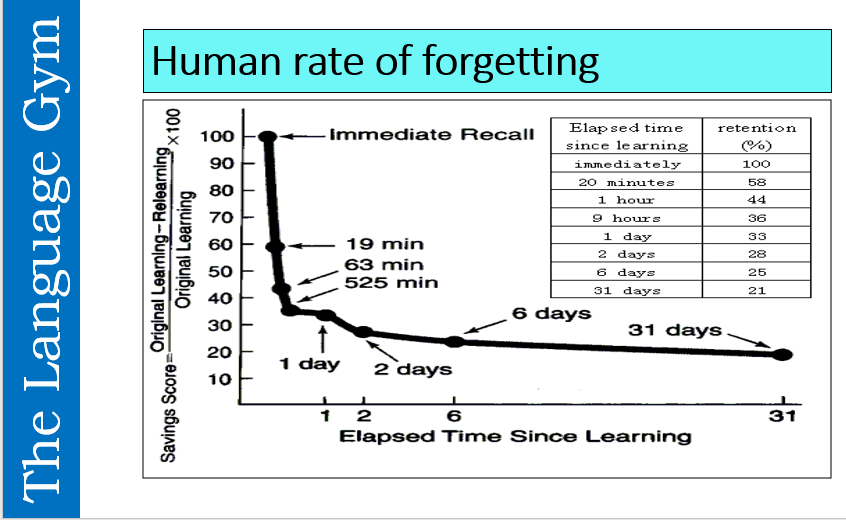
As I have often reiterated in this blog, intensive intra-lesson and inter-lesson recycling are both crucial, as most forgetting (around 56 % ) occurs one hour after processing a to-be-learnt item and after six days, in the absence of reinforcement, the learner is left with very little (30 %).

Fig 12 – Ebbinghaus curve of human forgetting rate

flooding.png

This is why my method is called E.P.I. , where the ‘E’ in the acronym stands for ‘Extensive’ and alludes to the emphasis my methodology lays on carefully planned recycling through Interleaving (explained in detail here), whereby any new set of chunks/patterns is learnt and practised with previously learnt items and recycled with new ones at spaced intervals.

Fig 13- Spaced practice

flooding.png

In the Expansion phase of a typical E.P.I. instructional sequence, for instance, having taught and practised structure ‘Y’ (e.g. Time marker + perfect tense of irregular verbs + prepositional phrase) and being satisfied that the students after a few lessons have routinised the structure in the context of the function ‘Talking about what I did yesterday’, before moving on to a new unit and new material, they will make sure (a) that structure ‘Y’ is practised with structures ‘X’ and ‘W’ learnt in previous units and (b) that it will be practised in all the units to come in some shape or form.

Fig 14 – The Expansion phase in the MARS EARS sequence

flooding.png

The best form of recycling involves of course, spaced practice, whereby material is revisited systematically at intervals that are frequent at the initial stages and become gradually sparser.

Of course, effective recycling require skillful and careful curriculum design and is much harder to implement when one teaches one meaty unit of work every six-seven weeks with two hours of contact time per week.

Hence, my advocacy of a ‘Less is more’ approach, whereby curriculum design in the formative years of L2 learning focuses more on the quality than the quantity of coverage and on the development of automaticity – which brings me to the next point.

8.Automaticity

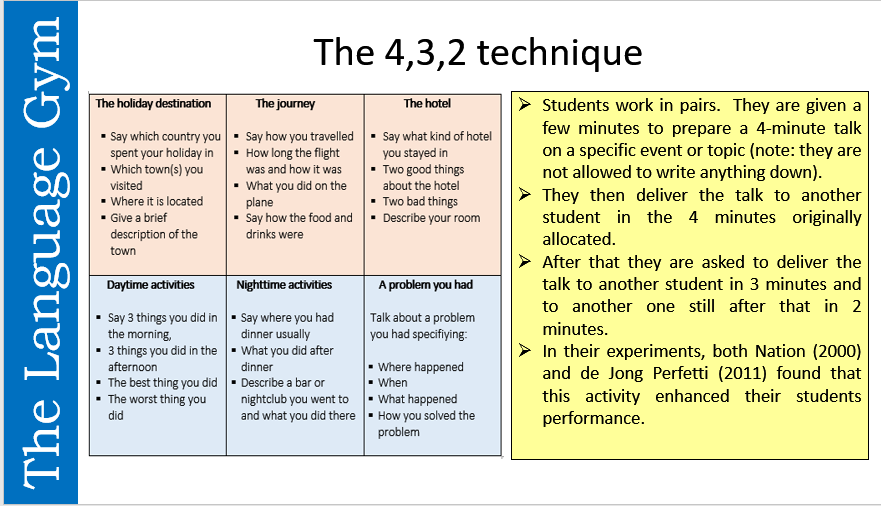
Automaticity is the ultimate goal of E.P.I., as it is a key prerequisite of fluency. Hence, great emphasis is lain by the E.P.I. teacher on practising speed of retrieval. During the recycling phase, what I called ‘EARS’ in my previous post, tasks such as the ‘4,3,2 technique’, ‘Market place’, ‘Speed dating’, ‘Chain reaction’ and ‘Fast and Furious’ are staged alongside traditional communicative tasks ( e.g. information gap activities) in order to train students in producing language under Real Operating Conditions.

Fig 15 – The 4,3,4 technique

flooding.png

Fig 16 – Chain Reaction. The students, who have three lives, are lined up and are tasked with translating orally on the spot (give them 5-6 seconds) from their L1 into the target language, each chunk as it appears on the slides, losing a life each time they get it wrong. Every time they pass or get something wrong they lose a life. Great as a starter or plenary.

flooding.png


9.Conclusion

Before venturing in subsequent posts in a more detailed account of the various stages in the MARS EARS sequence, from the M (modelling) to the S (spontaneity), I have hereby attempted to outline the key principles of my approach. Any language educator embracing EPI must heed such principles as they are all interdependently crucial to its effectiveness. 


PATTERNS FIRST – HOW I TEACH LEXICOGRAMMAR (PART 1)

chunks

INTRODUCTION: TEACHING THROUGH CHUNKS

In the last few weeks I have been asked by many of my readers and colleagues on the Facebook professional group I founded (Global Innovative Language Teachers) the following questions:

(1) what I mean by teaching through chunks and patterns / constructions as opposed to single words and traditional grammar,

(2) where I get the chunks and patterns from and

(3) how I teach them.

Whilst I reserve to answer question (3) in a much more detailed post in the very near future outlining my MARS EARS sequence step by step, here I will deal with (1) and (2) as I know that many teachers are currently in the process of re-designing or tweaking their schemes of learning in preparation for the next academic year.

Here are the key principles of my curriculum design and classroom teaching.

2. LANGUAGE TEACHING SHOULD SERVE REAL WORLD COMMUNICATION

This is the bread and butter of Communicative Language Teaching. The teaching of lexis and grammar should serve communication, hence language learning should be about learning to perform real world communicative tasks through a range of high frequency L2 chunks and constructions.

Consequently, grammar should not be taught to novice-to-intermediate learners in futile abstract categories such as ‘Perfect tense’, ‘Imperfect tense’, or ‘Prepositions’; by the same token, vocabulary should not be selected randomly and taught through uncontextualized single words, based on a theme that means all and nothing, e.g. sports, house, holidays.

Our choice of the grammar and lexis we want to impart on our students should be driven instead by the communicative functions we believe are most important for our students to master in the real world.

But what do we mean by Communicative Functions (CF)?

In my latest professional development tour of England, I realised that the vast majority of England-based language teachers are not familiar with the concept. Here are some examples of key communicative functions:

– creating questions

– describing people

– describing places

– reporting an event in the past

– talking about the way one used to be

– talking about future plans

– comparing and contrasting

– expressing a purpose, etc.

A full list of CF, adapted from Finocchiaro and Brumfit (1983),  one of many freely available on the internet, can be found here .

3. THE STARTING POINT: COMMUNICATIVE FUNCTIONS AND ‘THE MAJESTIC 12’

The starting point of any L2 curriculum design and teaching should be the communicative functions that one wants to cover by the end of the academic year, course, key stage 3 (i.e. years 7 to 9) or even key stage 4 (i.e. years 10 to 11).

Choose with your colleagues the top 20, 15 or 12 (depending on the time and resources available) functions that you believe your students MUST master by a specific stage in their L2-learning journey and decide how many you should teach each year and plan for their systematic recycling over the years. Remember: LESS IS MORE.

I usually choose 12 top Communicative Functions that I want my students to learn by the end of year 9, which I break down in micro-functions. I call them The Majestic 12.

Example of  a macro-function: Describing people.

Examples of micro-functions: describing their character, describing their physical appearance, comparing and contrasting people, saying what the worst and best things about them are, etc.

If you were to choose your own Majestic 12, what would they be?

4. IDENTIFYING KEY PATTERNS AND CHUNKS

Once identified the CFs, you then identify the key patterns and chunks used most frequently to express them:

Example:

FUNCTION: Comparing and contrasting

PATTERNS AND CHUNKS:

X is more + adjective than Y

X is as + adjective as Y

Z is less  + adjective than Y

Compared to X, Y is more + adjective

Teaching patterns is key. Without pattern recognition and activation students’ growth as L2 listeners, speakers, readers and writers is substantively stunted.

The Structural Deficit Hypothesis (SDH) attributes difficulties in the acquisition of reading to syntactic processing deficiencies (Bentin, Deutsch and Liberman, 1990; Menyuk et al., 1991; Scarborough, 1991). The SDH claims that an absence of syntactic knowledge or lack of processing ability interferes with higher level text comprehension.

MFL teachers in England often complain about their students using Google translator. However, if one doesn’t explicitly and systematically teach syntactic patterns, how can one expect their students to be able to string single words together grammatically and logically without help?

Take the list of subordinate clauses in Figure 1 below: how many of those do you explicitly teach and recycle over and over again from year 7 to year 11? When I ask this question in my workshops, only one or two participants put their hands up.

FIGURE 1 – List of key subordinate clauses in English
subodnate.png

5. CHOOSING  THE CONTEXT

At this stage you choose the context that best suits the teaching of that function in the launching phase and in the subsequent recycling phases. This is different from what is customarily done in my experience in English schools, where one usually chooses the context first (e.g. talking about hobbies) and then the target linguistic items (usually expressed in terms of words and grammar structures).

This is how I go about it:

Example:

FUNCTION: Comparing and contrasting

SUITABLE CONTEXTS

Talking about family (launching)

Talking about school subjects / teachers (recycling)

Talking about people I met during the holidays (recycling)

etc.

6.COMMUNICATION DRIVES THE TEACHING OF GRAMMAR

This way, communication drives your choice of the grammar and the theme. And when you share your objectives with your students, you will share a communicative purpose, e.g.: ‘Today we are going to learn how to talk about plans for the week-end. By the end of the lesson you will be able to understand the meaning of the  patterns and vocabulary in this sentence builder (or any other knowledge organiser you may want to use) and some aspects of their usage.’

Similarly, when approaching the teaching of the imperfect tense in French, you will not teach all the seven rules of the imperfect  – which overloads students and puts them off this tense; rather, it will be in one instance: ‘talking about how you and your family/friends used to be’ a function which will allow you to recycle time markers, adjectives, family members, adverbials, etc. killing several birds with one stone. In another instance: describing a past event (weather, places). In another instance still: describing what you were doing when something (e.g. an accident) happened. Each instance with its own contextualised chunks and patterns. Nothing wrong, of course, after coming across several instances of the Imperfect in pulling all the threads together and unifying them under the metalinguistic umbrella-term ‘the imperfect’.

When communication drives your selection of the grammar you teach, you don’t risk overloading your students with a myriad of rules and sub-rules and exceptions to them, that classic grammarians many centuries ago categorised under one convenient label (e.g. ‘Prepositions’, ‘Adverbs’, ‘Conditional’) artificially separating the inseparable: grammar from vocabulary.

Grammar and Lexis are too closely intertwined to be considered as distinct from one another: learning the word ‘beautiful’ in French (‘beau’) means learning its word-class, its word-order, its feminine and plural form, its grammatical attributes, not simply its meaning.


7. GRAMMAR LEARNING AFTER CHUNKS LEARNING – THE SEQUENCE MARS’ EARS

In my approach, grammar learning occurs organically after much exposure to and use of the target chunks and pattern through activities constantly recycling the same language over and over again (highly controlled input followed by  highly controlled output).

Here is how a typical instructional sequence of mine (MARS’ EARS) unfolds over two or three lessons:

1.Modelling – this phase models the use of X number of chunks and patterns presented IN CONTEXT through sentence builders / story telling / songs / etc. My modelling tool par excellence are sentence builders such as the one in the picture below, because:

1. They are a great way to teach lexical and syntactic patterns in context;

2. They allow you to model chunks and patterns through listening and reading – reinforcing print to sound correspondence. You make and read aloud sentences, whilst the students translate them on mini white boards;

3. They are very clear and accessible knowledge organisers;

4. They help prevent agreement mistakes in languages like French, German, Spanish, Italian, etc. For instance, in the sentence builder below, clothes are taught together with the feminine or masculine form of the related adjective from the word go;

5. They help create a vocabulary-rich learning environment;

6. They can be used as a scaffold in students’ books or – as I do – constantly on the classroom screen as students interact orally;

7. They are a fantastic way to recycle old material and to plant the seed of new linguistic items you plan to teach in the near or distant future (implicit learning). Just put such items in a column of the sentence builder with the translation and they will be learnt effortlessly through exposure;

8. You can play many interactive games with them (e.g. sentence puzzles, guess what comes next, faulty echo, etc.)

9. Students love them – in every single student voice questionnaire I administered, the children rated them as the single most useful resource I gave them. Possibly because ‘they allow students to take ownership of their learning, resulting in active engagement early on’, as noted by my colleague Ursula Maley.

FIGURE 2 – sentence builders for a year 7 French class on describing  clothes

Sb clothes pic

2.Awareness-raising –  the learners are concisely sensitised to the patterns/rules governing the target chunks; their formation and use. This is not the typical lengthy explanation on a Power Point but rather ‘pop-up grammar’.

3. Receptive processing – provides high-intensity processing of enriched input practice through the receptive skills (Controlled Input). ‘Death by chunks’ through highly structured activities such as these fun read aloud games,(e.g. mind reading with prompts, sentence stealer, find someone who with cards, find your match) engaging narrow reading and listening tasks involving problems solving and thorough processing, sentence puzzles (e.g. the rock climbing game on http://www.language-gym.com or mosaic writing in FIGURES 3a and 3b), dictations, gapped parallel texts, etc. Every text is manufactured in order to be flooded with the same chunks and patterns over and over again and to contain 90 to 95 % comprehensible input. Scaffolding is available throughout (e.g. sentence builder on desks or classroom screen).

FIGURE 3a – Sentence puzzle (1):  Mosaic writing

mosaic writing

FIGURE 3b – Sentence puzzle (2) : rock-climbing game from http://www.language-gym.com

rock climbing.png

4. Structured production – provides intensive scaffolded and HIGHLY CONTROLLED production practice (Pushed Output). The chunks are now used in structured tasks. These include fun translation games, highly structured information-gap activities (see example in picture 6a and 6b below),  Narrow translation, creative tasks (see example in picture 7), Interactional writing . Scaffolding is  still available throughout.

Translation and other tasks that elicit highly controlled output are crucial at this stage, as you want your students to produce every single chunk you taught them, not simply come out with the same answer to a given question from year 7 to 11 (e.g. Q: ‘What did you do last week-end?’ A: ‘I played football, went to the cinema and ate pizza’). Pushed output tasks allow you to practise the production of as wide a range of target chunks as possible whilst recycling old material (Interleaving); this means you have total control over the output, something that traditional communicative tasks usually don’t allow.

FIGURE 4 – Oral translation board game – ‘No snakes no ladders’. The game is played in three, two players and a referee who has the solutions. When one mistake is made, the referee reads out the correct translation to the player who waits for his turn; if s/he gets it right the second time, s/he can cast the die and continue the race.

oral boardgame.png

FIGURE 5 – Oral ping pong translation – two players challenging each other. Scoring: 3 points for 100% accurate sentence; 2 points if mostly accurate; 1 point if only verb is accurate.

oral boardgame.png

Figure 6a – A classic information-gap game – two detectives on different shifts are following the same person. They call each other and must fill in the details missing from their notes asking their partner.

oral boardgame.png

Figure 6b – An oral interaction scaffold designed to support a conversation on family. Questions are listed with a range of possible answers including the target chunks (translations provided)

induictive.png

.5. Expansion: two things happen in this phase:

(1) the target patterns/chunks are learnt in greater depth in order to teach the students how to make sense of the target patterns/constructions. This is your typical grammar lesson, except that it occurs after the students have already memorised the chunks and have been sensitised to the underlying grammar through relentless exposure and use .

Learning grammar by deconstructing the chunks one has already used over and over again is evidently much easier than learning it ex novo through decontextualized examples on a PowerPoint slide or textbook page.

(2) the target chunks are practised with old and new vocabulary and structures overtime through systematic recycling (INTERLEAVING). This is vital; since memory is context-dependent, learning the perfect tense within the topic ‘holidays’ doesn’t necessarily mean that it will be transferred automatically to other contexts.

Scaffolding may still be necessary during this phase.

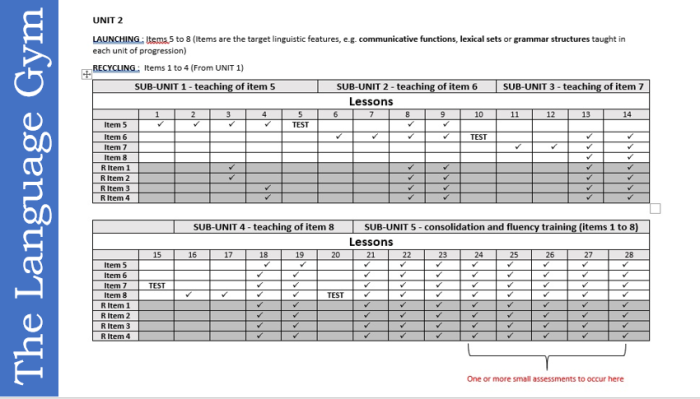
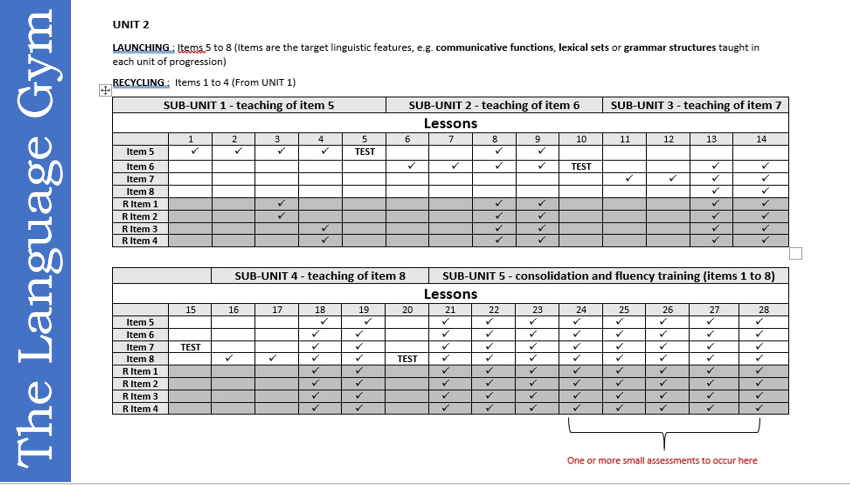
6.Autonomy – This phase marks the end of each sub-unit in the Conti Matrix in figure 7. It is the phase in which you stage a set of low-stake assessments to verify the students  are ready to move on to the next sub-unit and sets of items (in my approach: a new construction). The assessment will consist of two or three tasks, easy to mark and targeting mainly the receptive skills for the first three sub-units – you will move to the productive skills towards the end of the unit. I don’t usually tell my students there will be a test.

In essence, in this phase you want to find out if any scaffolding material (e.g. the sentence builders) can be phased out and the students are ready to stand on their own two feet. Do bear in mind that in the new MARSE cycle (beginning after this phase in the next sub-unit) you must keep recycling the material you have just covered (see the ticks in the Matrix below) as much as possible through constant retrieval practice across all four skills.

Figure 7 : The Conti Matrix for the planning of a unit of work (one term / trimester). Each unit of work is made up of five sub-units. In each of the first four sub-units you would stage a MARSE cycle for each new target item. In the last sub-unit, you will focus solely on fluency and spontaneity.

Untitled 

7.Routinization – focus is on recycling throughout the academic year and beyond through interleaving and fluency and automation-promoting activities. Some tasks simply recycle; others are designed to foster speed of retrieval and automatization (see 4,3,2 technique in picture 8, below). Other sample tasks here.


Figure 8 – the 4,3,2 technique

4,3,2

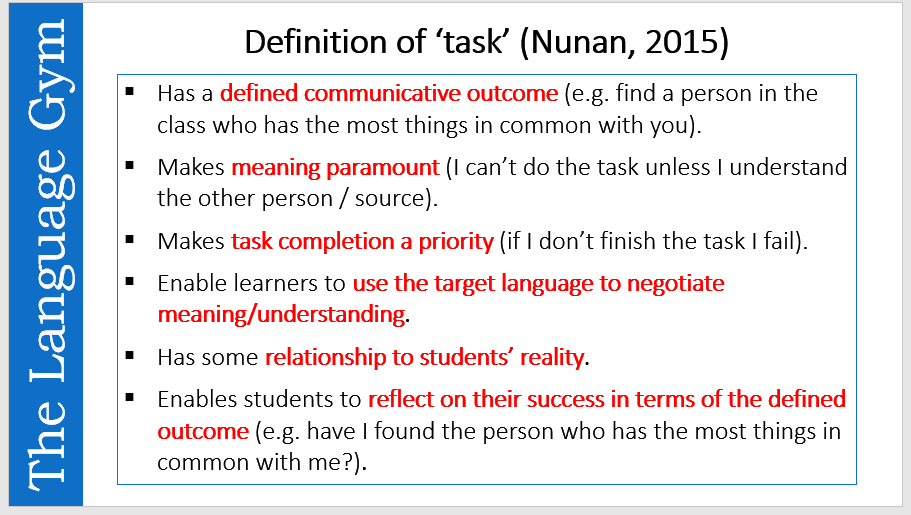
8. Spontaneity – This phase occurs at the end of a unit and continues throughout the subsequent units in the months and year to come, through deliberate and carefully planned recycling. It is the most important phase, as it is the phase you have been working for throughout the unit thus far: this is where all the things you have taught up to this point in the unit are put to use in the context of communicative tasks (see figure 9 for a definition of ‘task’).

Figure 9 – Definition of tasks (Nunan, 2015)

Cumbria transfer mistake

If you follow my unit-planning matrix (in figure 10, below), you will stage this phase in the final weeks of each term. You will possibly allocate to this phase 6-8 full lessons. This means doing away with the typical high-stake end-of-unit assessment that many departments in the UK stage at the end of a typical term. The rationale for this choice and how to implement it is explained in detail here.

Figure 10 – The Conti recycling matrix

Untitled

I would normally stage two ‘rich’ communicative tasks which elicit the use of all the L2 items practised in the unit so far and the recycling of items learnt in previous units. The two tasks will be very similar in terms of the cognitive operations and procedures they involve, as well as in the type of language they require to be executed, in order for the second task to reinforce what was learnt in the previous one. They also integrate all four skills. The framework for the implementation of rich tasks is sketched out in figure 11 below.

Figure 11 – Framework for the implementation of a rich task

rich task

The first rich task is usually staged at the end of a series of smaller and less complex pre-tasks designed to activate prior knowledge and practise the structures and routines required by the richer task. These smaller tasks will include fairly straightforward “information-gap’, ‘opinion’ and ‘reasoning’ communicative tasks, role-plays and games such as the 4,3,2 technique, Messengers and Marketplace.

Each rich task is also preceded by a planning phase which involves (1) brainstorming of the language relevant to the task; (2) prediction of potential problem areas and (3) cooperative strategies such as ‘think, pair and share’. A post-task review involving feedback to the students on their (linguistic and non-linguistic) performance will follow both rich tasks. 

Figure 12 – Type of tasks

Besides this task-supported phase, practice in unplanned response to a stimulus (a picture, a set of questions, a problem) is also provided at spaced intervals over the year to assess students’ ability to perform the target item(s) in the form of one or more termly teacher-student sessions. This is assessment for learning, not a traditional high-stake assessment. Students’ performance in these tasks is not graded; feedback is only positive, to foster willingness to talk.

Figure 13 – The MARS EARS pedagogic cycle

MARS.png

8. GRAMMAR MATTERS BUT IT IS TAUGHT AFTER A LOT OF PROCESSING OF CHUNKS

In sum, only after the students have learnt the patterns as vocabulary, as chunks, does the teacher actually explain the grammar rules that govern the use of the target constructions in order to enhance their generative power, i.e.: to enable the students to manipulate them creatively and spontaneously, at will. Or, even better, if you have the right students, you will ask them to inductively work out the rule by themselves – my favourite approach (see picture 9 below). 

Figure 14- Inductive task on French negatives
induictive

9. CONCLUSION – GRAMMAR VS LEXICOGRAMMAR

It will be obvious by now that I don’t teach grammar; not the traditional way at least. I teach chunks of language and constructions which convey a communicative function. Grammar is not necessary, but it is valuable in expanding the power of the chunks for future use, to enhance their expressive range and depth. 

In other words I am teaching grammar through lexis and lexis through grammar – i.e. lexicogrammar.

This is a faster way to learn and activate what we traditionally call grammar and to help students get how grammar relates to real-world communication. Because ‘talking about how we used to be’ makes more sense to younger learners than the term ‘Imperfect’. Because learning through the ‘deconstruction’ of what one is familiar with already is easier than building from scratch. Because concrete, hands-on and contextualised information is easier to grasp than abstract notions presented in a vacuum.

It is worth reminding the reader that in my approach the content is reduced substantively compared to the norm (in my case from 6 to 3 units per year), as the main focus of instruction is not to accrue flimsy intellectual knowledge about the language or to memorise lists of words; rather, it is to bring about automaticity, fluency and spontaneity in the receptive and productive skills. However, the use of Implicit learning routines and other strategies discussed here , along with the vocabulary-rich environment you will have created through all the activities mentioned above, will eventually make up for the explicit content you cut out.

This goes beyond mere retention of information, hence it requires lots of recycling and tasks which foster speed of retrieval and execution. The aspirational goal being not having to re-teach in the years to come the same basic structures over and over again (as often happens !) and to forge student who can think in the L2 on the spot, with confidence and  without much hesitation.

Focused Error Correction – how you can make a time-consuming necessity more effective and manageable

Please note: this post was co-authored with my dear colleague Dylan Vinales

I have written extensively about Error Correction on this blog, often reiterating the point that whilst there is some evidence pointing to its effectiveness in enhancing L2 writing accuracy (e.g. Ashwell, 2000 ; Chandler, 2003), the gains obtained do not justify the enormous amount of time and effort invested by teachers in the process.

Take Chandler (2003)’s findings: she calculated that teachers’ marking time amounts on average to around 1 minute per 100 words, the time being slightly less ( around 48”) if one simply underlines errors. Then consider that

(a)   correction of whole texts can achieve significant results (i.e. 10% reduction in error rate) provided the students write in the region of 5,000 words a semester on first drafts

(b)   many types of error are resistant to eradication (Alroe,2011). In other words, improvements accompany large amounts of writing and consequently large amounts of correction.

and do the maths: is this modest benefit worth the effort?

Whilst the answer is probably ‘No’, teachers often do not have much choice, as surveys of student and parent opinion clearly show (Conti, 2001) , both groups of stakeholders expect errors to be corrected. So, chances are that your boss will demand that you correct.

Why the effects of Error Correction are so limited

Learning a language is not merely about accruing intellectual knowledge of the target language. As Truscott (1996) pointed out, learning to master a specific grammar rule doesn’t occur as a sudden revelation resulting from the information a teacher passes to a student through oral or written feedback.

L2 acquisition is much more complex than that: it is a long and painstaking process which may start with the understanding of how a given language item works, but requires extensive practice in the deployment of that item across a wide range of linguistic contexts before it can be said to have been brought to completion. Think about the mastery of Imperfect usage in L2 French, Spanish or Italian; how many years does your average student require in order to fully acquire it? Three? Four? Five years?

There are many factors which undermine commonly practised error-treatment methodologies (thoroughly discussed here). In previous blogs I identified the following ones as key:

(a) Corrective intervention neglects the intentionality dimension of learning from one’s mistake, i.e. it is not proactive in arousing students’ desire to eradicate errors. Yet, this affective dimension is vital to the success of error correction (James, 1998; Conti, 2001).

(b)   As many studies have pointed out, L2 students do not invest sufficient cognitive effort in the corrective process. They do not process the corrections deeply enough; at best, they make a mental note of the mistakes and the relative corrections and move on (Cohen and Cavalcanti, 1990; Conti, 2001; Alroe, 2011).

(c)    The corrective treatment rarely involves a long-term, sustained effort to eradicate mistakes. Yet, this is crucial to the success of error remediation.

(d)   For corrective feedback on item X to be effective, students need to process it many items over. This doesn’t always happen with less frequently occurring L2 items. Item X may occur two or three times in Essay 1 in September but never re-occur until Essay 5 later on in the year. This is a common shortcoming of error correction; one that is way too often overlooked, especially in contexts where highly structured writing tasks and translation are not assigned for fear of stifling creativity and/or negatively impacting student motivation. Yet, corrective feedback, like any other form of instruction, benefits greatly from frequent spaced (distributed) practice.

(e)   usually, teachers are concerned with fixing errors but not with training students in becoming effective independent editors of their own written output. Yet, several studies (see Macaro, 2003) have shown the benefits of enhancing L2-learner ability to self-monitor through a synergy of awareness-raising (what mistakes do I make more often?), error-targeting (what mistakes am I going to eradicate?) and editing strategies (what strategies work best with this error type?)

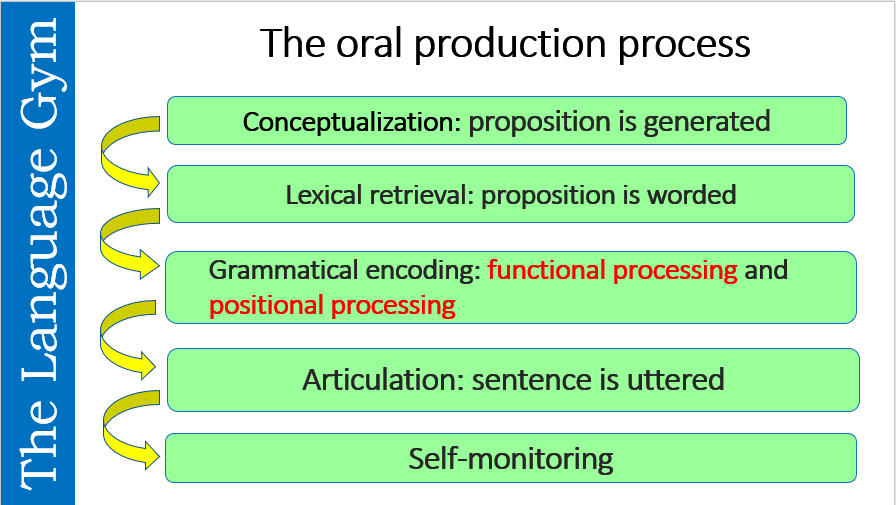
(f)    L2 writing (see picture 1 below) poses enormous cognitive challenges to novice L2 student-writers attentional resources . As I have discussed in detail here, errors are often the result of Working Memory processing inefficiency rather than lack of knowledge; i.e. the brain is juggling so many demands arising from writing a given sentence that mistakes are made not because the student doesn’t know the grammar rules governing the use of the items in that sentence but rather because of lack of fluency in the application of those rules. Corrective intervention through Indirect Correction (teacher underlines and student self-correct) does not address this very important issue; underlining errors and asking students to self-correct does not prepare them for the cognitive juggling they have to perform as they write in real time; in other words, it does not enhance their editing fluency.

This post is about how I have attempted to address the above issues in my own teaching practice over the last seven months or so.

Picture 1 – Hayes and Flower’s (1981) Cognitive model of the writing process

the writing process.png

Enter Focused Correction

Another common (potential) weakness of corrective feedback, which I did not discuss in previous posts, but which is extremely relevant to the present one, is the fact that Error Correction is rarely, if ever, intentionally and systematically closely tied in with the current objectives of the curriculum. So, if in term 1 your students are learning about the communicative function ‘talking about a past event’ in the context of the topic ‘media and leisure’ many teachers would typically correct an essay assigned on that topic not merely on errors relating to the wrong use of time markers and past tenses, but also on other errors they find in that essay.

In my own research a decade ago, for instance, I found that both at university and secondary level, the approach adopted by most of the teachers I studied, tended to be more comprehensive than selective and when it was indeed selective, it was not consistently based on a specific set of criteria (e.g. frequency, perceived gravity or incomprehensibility) but it appeared to be somewhat ‘random’; moreover, and more importantly, it didn’t focus on the same areas systematically over a longer period of time.

My findings were that less proficient student writers appear to be more likely to benefit from correction when:

(a)   it concentrates on only two or three major target areas (so that their attentional resources can be used more efficiently);

(b)   such areas are perceived as relevant to their current learning (so that they feel more motivated to address them);

(c)    it provides frequent feedback on the same target areas week in week out (so that it enhances their understanding and keeps them constantly focused on the same error types week in week out);

(d)   students have the declarative knowledge for self-correcting the errors with minimal prompting by the teacher (so that students are self-reliant in the process );

(e)   the students’ levels of accuracy in the target areas has a substantive bearing on the grading system adopted (so that students are more motivated to be more accurate).


The criteria described in (a) to (e) above refer to an approach described in the AL literature as ‘Focused correction’ (henceforth FC). A number of studies have indicated that FC is significantly more effective than unfocused error correction (Alroe, 2011). Sheen (2007), for instance, compared the effect of FC on the writing accuracy of ESL learners with those of unfocused correction and no correction. She found that FC resulted in a significant reduction of mistakes in the five target areas (i.e., article, copular ‘be’, regular past tense, irregular past tense and preposition). Ellis et al. (2008) studied the effects of FC on indefinite/definite article use in writing. A control group was contrasted with two experimental groups one of which received focused treatment (only article errors were corrected) and one of which received unfocused treatment (other errors were also corrected).  The experimental groups were significantly better and the trend in the experimental groups suggested that focused feedback may be more effective in the long run.


How I implement Focused Correction

Two years ago I was  required by my previous head of department to adopt a corrective approach (strongly criticised in this Language Gym classic), which involved underlining randomly selected errors categories, coding them using a ludicrously lengthy and laborious coding system and asking students to self-correct.

Having found this methodology ineffective for the reasons discussed above, this year my current head of Department gave me ‘carte blanche’, and after discussing the issue at length, I was given the go-ahead to experiment with FC with my beginner to lower-intermediate classes (years 7 to 9 in the English system).

This is how I have implemented it:

(1)    I selected three FCAs (Focus Correction Areas) per term for all students in a given class. The FCAs were based on the main curricular objectives of the term; for example, with my year 7 beginner class, in Term 1 I focused on adjectival agreement; articles and number of nouns.

(2)    With more gifted students, one or two more FCAs were added;

(3)    Students were free to use L.I.F.T. (Learner Initiated Feedback Technique) a student-driven procedure whereby the students write in the margin of their written piece questions on any doubts they may have about a language item they have used (e.g. ‘Sir, is the use of the article I have underlined correct?); the teacher then replies with a metalinguistic explanation.

(4)    In order to enhance the students’ ability to edit, identify and correct errors in the FCAs, I have staged short and snappy ‘Spot the error’ tasks and other editing-enhancement activities (e.g. ‘Error Auctions’, explained here).

(5)    As the term proceeded, I have increasingly resorted to indirect feedback with error coding (i.e. self-correction). Although, as noted above, I am usually against indirect feedback with coding, in my context, the coding system was (a) much easier to manage for both teachers and students, as it referred only to three error categories, (b) tied in with the topics under study, (c) used in synergy with editing instruction (see point 6 below).

(6)    To further scaffold the process, I have used editing checklists like the one in picture (2) below; the students were expected to go meticulously through their written pieces before handing them in noting down every occurrence of any items referring to the FCAs and ticking it to signal they checked it. Note that this process was totally managed by the students who handed in the checklist with the assignment.

Picture 2 – Editing checklist

editing checklist pic.png

(7)    The tasks have been graded based on Effective Communication (i.e. the extent to which they communicated the requested information) and Accuracy across the FCAs, 70 % of the marks being allocated for the former and 30 % for the latter (10% per FCA).

(8) With some classes I have used error tally sheets in which students logged the number of errors in each category from week to week to enable us to track their error-making trends overtime in each of the FCAs.

It must be noted that in order to ensure that the student output contained as many instances of the target FCAs as possible, the written tasks included alongside unstructured assignments (e.g. ‘Write a 100-words piece about your family’) highly structured tasks designed to elicit the use of specific structures. For instance, to get my year 7 to demonstrate effective production of adjectival agreement, number of nouns and articles:

Write a 100-word piece about your family. Include the following information:

(1)    name, age, birthday;

(2)    a description of yourself both in terms of personality and appearance (including hair and eyes);

(3)    a description of each family member’s appearance;

(4)    a description of their personality;

(5)    a description of one or more pets you have;

I have also used short translation tasks (e.g. narrow translations) for the very same purpose.

Other types of tasks adopted

As I will discuss in a future post, my students do not simply engage in highly-structured tasks. I typically assign six other types of writing tasks:

(1)    Brainstorming writing – (usually in pairs) students brainstorm ideas on a given topic and note them down in full sentences in the target language. Accuracy is not a concern, as the purpose of this activity is to train them in idea generation.

(2)    Unstructured communicative writing – accuracy not a concern. Grading based on effective communication only.

(3)    Fluency writing – the students are asked to write about a topic in a very short amount of time

(4)    Editing tasks – (see above)

(5)  Transformative writing (e.g sentence combining; paraphrasing; summarising)

(6) Creative writing

Did it work?

The results were very encouraging. A survey showed that my year 9 students found Focused Correction more helpful than previous forms of error correction they had experienced, because they felt it was more manageable and the narrower range of mistakes to deal with meant they knew what to look for when they were editing and/or asked to self-correct.

Although there were fewer mistakes in all the FCAs targeted throughout the year at post-test than pre-test, to attribute the observed increases in accuracy solely to the corrective methodology adopted is problematic. The reduction in error-making is likely to be the result of the synergy between teaching and corrective feedback, and in particular the fact that the two supported each other more closely than in the error treatments traditionally adopted.


Concluding remarks

Error Correction is a time-consuming necessity. Over the years, I have experimented with various techniques. When it comes to beginner-to-novice students, Focused Correction combined with explicit editing instruction has been the most effective with my novice-to-intermediate for the following reasons:

(a) it concentrates on only two or three major target areas (so that the students’ attentional resources can be used more efficiently);

(b) such areas are perceived as relevant to their current learning (so that they feel more motivated to address them);

(c) it provides frequent feedback on the same target areas week in week out (so that it enhances their understanding and keeps them constantly focused on the same error types week in week out);

(d) students have the declarative knowledge for self-correcting the errors with minimal prompting by the teacher (so that students are self-reliant in the process );

(e) the students’ levels of accuracy in the target areas has a substantive bearing on the grading system adopted (so that students are more motivated to be more accurate).

Give it a try !


My favourite read-aloud tasks and how I use them

Introduction

As discussed in previous posts, although reading-aloud (RA) techniques have not always been favourably considered in L2 classrooms in the last 3 or 4 decades, the usefulness of this approach for the development of lower-level processing efficiency has been widely confirmed in L2 reading research (e.g., Birch, 2007; Janzen, 2007; Gibson, 2008). Much research has clearly shown that reading aloud helps:

(1) develop L2 learners’ accurate phonological representations (e.g., Gibson, 2008);

(2)  raise their awareness of rhythm, stress and intonation, by using connected texts rather than decontextualized vocabulary items (e.g., Kato, 2012);

(3) significantly improve silent reading rate (Suzuki, 1998),

(4) enhance reading performance (Miyasako, 2008),

(5) reproduction of key words and phrases. Miyasako (2008), for instance, investigated the contribution among upper-secondary level Japanese EFL users of six weeks of RA  practice for L2 reading performance; it was found that RA significantly improved phonological decoding and reading comprehension performance, and that this practice effect was more pronounced with less proficient readers.

(6) improve listening ability – Kato and Tanaka (2010) for instance concluded that “the establishment of pronunciation accuracy/ fluency is crucial for the development of listening ability and that this impact of production ability may linger to a fairly advanced stage of L2 listening learning, in particular as a function of factors such as participants’ L1 – L2 relationship and the relationship between their L2 proficiency and the familiarity and difficulty of listening materials.”

(7) boost motivation (Shinozuka et al., 2017).

(8) enhance recall, especially when you repeat the words aloud to another person (Boucher et al (2015).

(9) develop oral fluency by (1) training the articulators, i.e. all the organs involved in the production of sounds (the end stage of oral production); (2) exposure to auto-input through the aural medium. For instance, Seo (2014) found that her experimental group spoke longer after the treatment than they did before, while the control  group did not show a difference in length of time. Moreover, the experimental group used a richer grammar after the treatment while the control group did not show progress;

(10) develop coding ability which in turns facilitate processing and learning vocabulary. Practice in reading aloud connected speech facilitate our ability to chunk vocabulary (chunking is an essential process in vocabulary acquisition). This enables working memory (the articulatory loop) to process words more rapidly, thereby enhancing our ability to commit a larger amount of words to long-term memory. The fact that many children in England, as highlighted by Erler’s (2011) landmark study (see Picture 0 below) seem to have very poor decoding skills, is quite worrying in this respect.

Picture 0 – Erler (2011) study summarised 

lynn erler

The role of reading aloud in my teaching approach

In my teaching method, E.P.I. (or Extensive Processing Instruction), reading aloud plays an important role for the following reasons:

  • (1) My approach lays a lot of emphasis on the development of decoding skills/pronunciation;
  • (2) Provided that one’s students are confident in their decoding skills (i.e. turning written words into sounds), reading aloud activities of the sort described below, provide a non-threatening opportunity for students to interact orally with each other, thereby providing L2-input to themselves (auto-input) and others;
  • (3) Following on from point (2) – when provided with oral scaffolds of the sort shown in Picture 1 below, one can stage oral (pair-work) communicative tasks with students since the early stages of starting a topic;
  • (4) Since E.P.I. is all about frequent and extensive exposure to and production of key patterns through all four skills, if the interaction referred to in the previous points involves reading aloud texts which repeat those very patterns to death, then it clearly serves the main pedagogic objective of my approach.


Picture 1 – Page 1 of an oral scaffold for conversation on holidays I designed for a year 8 Spanish class

oral scaffold

Important Caveats

  • (1) It is crucial, if you do stage a lot of read-aloud games, that you lay a lot of emphasis on the teaching of decoding skills and pronunciation from day one of your course. I, for one, when it comes to French and English, place decoding skills as my main priority during the first semester of my teaching – yes, even more important than vocabulary and grammar!


  • (2) Let me reiterate, once again, that every single read-aloud activity I stage in my lessons would be designed to recycle the same target pattern(s) over and over hence the texts used contain highly structured input which is flooded with the target items;


  • (3) The role of the teacher is pivotal for the success of these activities. S/he must monitor, prod, and provide feedback all the way through, picking up any problematic areas to address in whole-class feedback prior to the next activity.


My favourite reading aloud tasks

In this section I describe a few of my favourite read-aloud tasks.

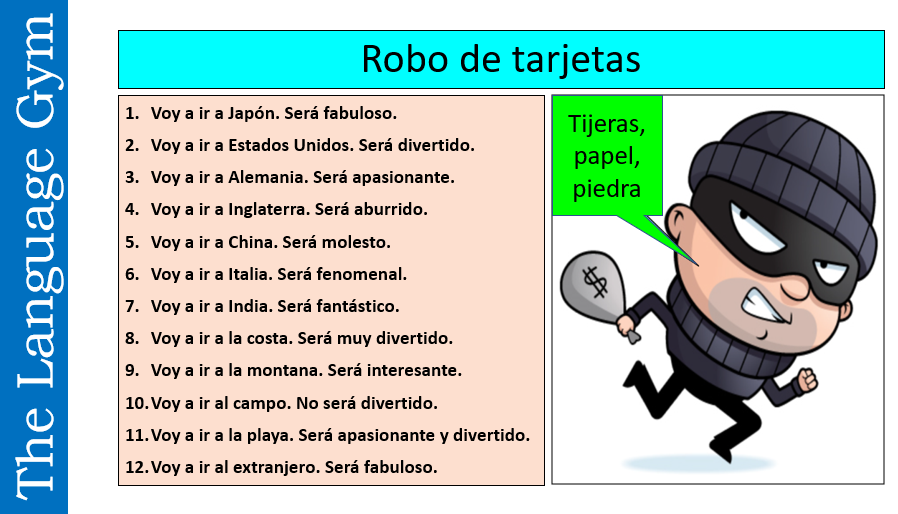
1.Sentence stealer (aka ‘Au Voleur’ or ‘Robo de tarjetas)


This is a very popular game I came up with to make reading aloud as interactive and fun as possible with my younger learners. It has gone viral in our faculty and everyone does it fairly regularly. It takes zero preparation and children love it. Here is how it unfolds:

Step 1 – The students are shown on the classroom screen a list of twelve L2 model sentences they have been practising. Each sentence has a number from 1 to 12.

Step 2 – They are given four blank cards each and asked to secretly write on each card any one of those sentences or simply the number for it.

Step 3 – The game consists of ‘stealing’ as many cards as possible from one’s peer in the five minutes allocated, i.e. classmate ‘X’ will approach classmate ‘Y’ and read out from off the screen any four sentences; if a sentence that ‘X’ reads is on one of ‘Y’’s cards, ‘X’ will have the right to ‘steal’ that card.To make it more fun students play rock, paper, scissors (repeating the three words aloud in the target language) to win the right to guess;

Step 4 – The student with the most cards at the end of the game will win.

Please note, the students cannot interact with the same class mate more than once.

I usually stage this game after I model the target patterns through my sentence builders. Picture 2 illustrates an example from a lesson with absolute beginner EFL learners drilling in ‘I would like + container/quantity + food’ (context: buying food and drinks).

Picture 2 – Sentence stealer gamelexico grammar.png


2.Mind-reading


This is another very popular zero preparation game which I usually play as a warm-up for the ‘Sentence stealer’ activity. The teacher-led version plays out as follows:

Step1 – Write a set of target chunks on the board;

Step2 – Write secretly one on a mini-board;

Step 3- Choose chunks containing sounds you know they find phonologically challenging and/or containing the target sounds;

Step 4 – Ask the students to guess the hidden chunk reading out any one of the sentences on and reward correct answers.

Picture 3 illustrates an example of this game, designed to recycle the same sentences practised in the ‘Sentence stealer’.

Picture 3 – Mind reading game

mind reading.png

In the student-led version, two children – who play against each other – secretly write on their mini-whiteboards three or more sentences (taken from those displayed on the classroom screen or whiteboard). They then take turns at guessing each other’s sentences.

  1. Ghost time


Shadow-reading is a technique which consists of reading aloud a transcript / text as you follow a recording / reading of the text in order to imitate the speaker/reader’s rhythm, intonation and pronunciation, etc.

Ghost time’ is a shadow-reading technique I have come up with and use with my primary classes on a regularly basis. I call it ‘ghost time’ as I ask my students to whisper like ghosts to make it more fun. They absolutely love pretending to be ghosts. Besides the motivational rationale, ‘reading like ghosts’ forces them to slow down and enunciate more clearly the chunks I break down the text into as I read.

Please note that if your aim is to develop your students’ phonological memory you could simply ask your students to repeat what you hear from memory rather than give them the text that you are reading out.

Currently I am carrying out an experiment with this technique. One of my year 5 French (9 year olds) groups partakes in 5 minutes of ghost time per day, whereas with another group I do 5 minutes of dictation. At the end of the year I will get two of my colleagues to evaluate their reading-aloud accuracy and their phonological memory (their ability to repeat a unit of speech they hear accurately) to identify any differences.


  1. Find someone who with cards


It is played like ‘find someone who’ except that the students are given cards containing each one or more details, expressed in the target language. For instance, on the topic of food, one card may read ‘My name is Mark, I like chicken because it is tasty and healthy’ (in the target language of course). The students are also given a grid with a series of questions such as, on the topic of food, ‘Find someone who likes chicken’, ‘Find someone who loves meat’, etc. For each question, they need to find a person with the matching card and write their name in the grid asking questions in the target language, such as ‘What food do you like?’

The reason why I prefer ‘Find someone who with cards’ to the traditional ‘Find someone who’ is because (1) it turns it into a read aloud activity  and (2) it allows me to control the students’ output thereby eliciting exactly the patterns I want them to practise (which will be the same, incidentally, that they will have practised in the other activities).


Picture 4 – Find someone who with cards 

fsw


  1. Sentence hunt


This game is meant for younger learners. It is played like hotter and colder.

Step 1 – come up with ten or more short sentences containing the target patterns, grammar structure, chunk and display them on the classroom screen/board

Step 2 – get hold of thirty or more post-its. On ten post-its you will write the ten sentences (one sentence per post-it). On the remaining post-its you will write ‘distractor ‘sentences which are different from the target sentences but similar in structure. I usually recycle the same distractors over and over again throughout the year to minimize waste

Step 3 – scatter the post-its around the classroom on the walls, desks, chairs, anywhere, in as many places as possible

Step 4 – select and send a searcher out of the classroom

Step 5 – now take one of the post-its containing one of the target sentences and place it near other distractor post-its. Make sure the class knows exaclty where it is

Step 6 – now refer back to the list of sentences on the classroom screen/board and point to the students which sentence was on the post-it you have just hidden and instruct the class to repeat it louder and louder as the searcher gets closer to the target post-it and quieter and quieter as they move away. Orchestrate the volume with your hands.

Step 7- call the searcher back in the classroom, instruct him to find the post-it containing the sentence the class are repeating aloud and play the game until the post-it is found. Then do as many rounds as you like. I usually fit about 6 searchers in 5-6 minutes.


  1. Find your match


This activity is not too dissimilar to ‘Find someone who’. In a previous post I described a version of this game with cards. The version below is a ‘no-frills’ one that requires zero preparation.

Step 1 –  the students write secretly on their mini-whiteboards one sentence (or more) from a list you will have put up on your classroom screen/board. For instance, the list might include a range of responses to the question ‘How are you?’ and John might write ‘I am very well, thank you;

Step 2 – the students go around the classroom asking ‘How are you?’. Their task is to find another student with the same sentence on their mini-white boards.

I usually stage several rounds of this game in the same lesson as the students usually find their match quite quickly. You can easily go through five or six rounds in ten minutes and kids enjoy it.


  1. The ‘something’ game (originally ‘The algo game’)


This game, created by my colleague Dylan Vinales, requires minimal preparation, gets the students to practise listening and reading aloud eliciting a strong focus on accurate pronunciation. Students really enjoy it and get very competitive.

Step 1 – Sit the students in pairs, back to back.

Step2 – Give Student 1 sheet A and Student 2 sheet B. Both sheets have different version of the same list of sentences; the sentences which are gapped on student A’s sheet are complete on students’ B sheet and vice versa (see picture below).

Step 3 – Students take turns in reading one gapped sentence each. As they read their gapped sentences they say ‘something’ (or ‘algo’ in Spanish) to signal the presence of a gap (note: each gap corresponds to a key target chunk). When Student B hears student A say ‘something’ s/he will have to read the whole sentence including the missing chunk out twice, whilst his/her opponent writes it down and vice versa.

Step 4 – At the end of the game the students compare the two sheets to see who was more accurate.

Picture 5 – Two students playing the ‘Something game’ (courtesy of Dylan Vinales and Global Innovative Language Teachers)

algo game.png

  1. Musical chairs walk-aloud


This is played like musical chairs except that the students walk around with a text which the students take turns reading aloud; when the reader utters a word belonging to a specific word class (e.g. an adjective or a verb) or part of set of words recently studied (e.g. animals) or containing a specific sound (e.g. ‘th’ as in ‘think’ in English), the class will have to sit down. If you are focusing on sound, make sure you choose ‘readers’ with very good decoding skills and diction.


  1. Critical listening pairwork


This activity is designed to enhance the students’ alertness to sounds fostering metacognition and a climate of self-direction in L2 learning. Although it may seem elaborate, it requires no preparation and elicits a lot of great learning conversations on sound. This is how I structure it:

Step 1 -The teacher reads aloud to class a text on a familiar topic flooded with opportunities for practice of specific phonemes. Students shadow-read;

Step 2- (prep time)The students are given the text and 10 minutes to prepare (on their own) reading aloud with a focus on pronunciation. They identify problems and attempt to solve them with the help of peers. I ask them to note down the main issues identified and the solutions they found/worked out;

Step4 – (At the end of prep time) the teacher provides recording of him/herself reading text. The students are allowed to listen to it for a few minutes before recording themselves;

Step5 – The students now record themselves reading the text;

Step 6 – The students listen to themselves and to a partner and identify targets for improvement (recording can be used in the process).

Step 7 – The students write down their findings, targets and reflections (I usually administer the survey in Picture 6 to elicit these data);

Step 8 – The students review their partner’s self-reflections to see if they would add something else.


Picture 6 – Post-task retrospective survey

fsw.png

These are the advantages of this activity observed by my colleagues and I:

  1. Students focus on pronunciation and listen to themselves and others critically with the added incentive of a wider audience;
  2. Students are given responsibility for identifying targets and strategizing, hence the process helps them become more metacognizant and autonomous in this area of their learning;
  3. The process makes them critical friends and builds relationships, diplomacy and empathy;
  4. It provides the teacher with a wealth of material which helps for future planning and enhances teacher’s awareness of students’ pronunciation issues.


  1. Translistening’

‘Translistening’ is a task I do with my keenest linguists which combines reading aloud, listening and metalinguistic work. I designed it to focus my students on accuracy and to make them pay selective attention to a specific set of error types they kept making, especially word order, agreement, verb formation and mistakes with small function words (e.g. articles and prepositions).

Step 1 – The students are shown a short text in the L1 on the topic-at-hand, flooded with the lexical chunks and/or grammar structures they have been practising lately;

Step 2 – They are put in pairs and given an accurate L2 translation of the text (prepared by the teacher) and two different faulty L2 translations of the same text (which was allegedly produced by two anonymous students from a previous cohort) – one each;

Step 3 – Both translations contain the same number of occurrences of 3 or 4 types of error the class commonly make in their writing.
Step 4 -The students are told that both faulty L2 translations contain the same number of mistakes and their task is to listen to their partner as they read their faulty translation out (twice); with the help of the accurate L2 translation, they must spot as many mistakes as possible. The student who will spot more mistakes will win.

Step 5 – The students are now tasked with noting down and describing briefly the mistakes they identified in the translations, and the grammar rules they relate to;

Step 6 – The students are then asked to translate an L1 text which is extremely similar in structure and vocabulary to the one they have just dealt with.

The task (which take my classes around 50 minutes) elicits thorough processing, as the students really need to pay attention to every single detail they hear and allows the teacher to focus the students on a specific set of mistakes thereby priming them for selective attention to those mistakes in the translation task which follows, usually resulting in a more carefully crafted and more accurate final product.

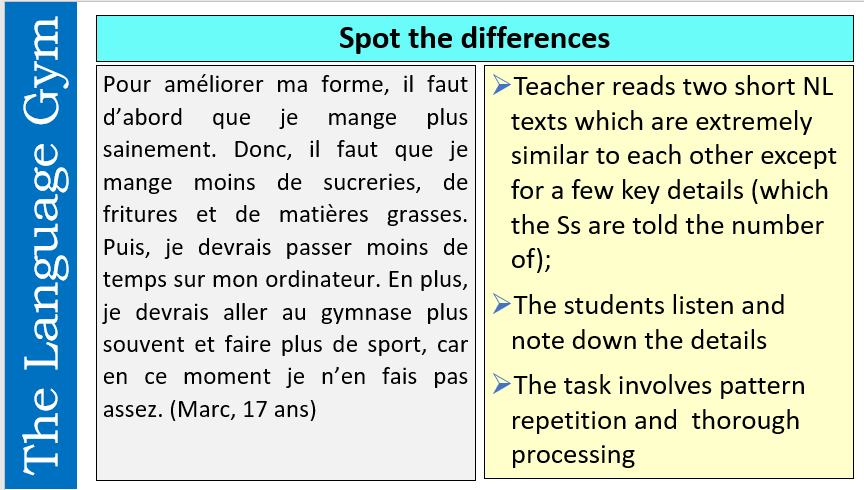
10. Spot the differences

I have described this task previously as a teacher-centred activity. This is a student-led pair-work version of the game. Student A and B are given two nearly identical texts which differ only in terms of 8-10 words. As Student A reads aloud his text, Student B must spot the differences in his text.

This task combines reading aloud and listening whilst eliciting thorough processing, as Student B must really pay close attention to each and every word being read aloud to them.

11.Interactional Oral Communicative tasks

Of course, any interactional oral task done with a written scaffold is a form of reading aloud. Picture 1 above (reproduced below )shows part of a resource used to scaffold oral interaction in Spanish on the topic ‘Talking about a past holiday . Student A asks the questions and Student B responds in Spanish whilst Student A notes down (in English) his interviewee’s answer. You will find that after a few rounds many of the students will rely less and less on the scaffold, especially if you will have staged several of the read-aloud games discussed above prior to that.

Picture 1 – first page of oral scaffold for Spanish conversation on holiday

oral scaffold

12. Concluding remarks

‘Reading aloud’ was criticised by the proponents of CLT for not being an ‘authentic’ activity which prepares students for life in the real world. However, recent research points to a range of beneficial effects on L2 acquisition, ranging from fostering speaking fluency to enhancing listening skills.

In my approach to language teaching, which lays a lot of emphasis on oral interaction and sensitisation to key lexical/structural patterns, the activities I have just described play a pivotal role at the initial stages of my pedagogic sequence (MARS + EARS), as they allow for masses of repetition of those patterns in a highly structured, non-threatening and fun and engaging way. In my own classroom research, I found the impact of such activities on retention, oral fluency, pronunciation/decoding skills, self-efficacy and general motivational levels to be significant, especially with younger and less able learners.

Of course, the role of the teacher as a vigilant ‘monitor’, motivator and feedback-provider cannot be overplayed when it comes to read-aloud pairwork. Good classroom management is, of course, a must.

I usually stage a battery of read-aloud pairwork activities (3 o 4) after introducing new language through a sentence builder and before engaging in reading and listening tasks. This allows for lots of recycling of the target chunks in a fun and memorable way prior to less structured and more challenging work requiring deeper information processing and aimed at ‘unpacking’ and consolidating the retention of those very chunks, as well as integrating them in a wider range of linguistic contexts.


It is not just about ‘how often’, but ‘how’ you recycle – five learning principles that make it or break it in L2 grammar instruction

1.Introduction

In this very concise post I deal with five factors which are often neglected in grammar instruction, yet curriculum designers and teachers ought to heed as they are crucial to its success. In particular, I will focus on the most important dimension of acquisition of an L2 structure, i.e. its extensive receptive and productive recycling over the long period of time required for an L2 learner to fully acquire it. As I will argue, this crucial phase is usually undermined by the erroneous belief held by many practitioners, that recycling is just about the quantity of exposure and practice; whereas, in actual fact, the quality of the recycling is as – if not more – important

Caveat: this post is based on the premise that if students are developmentally ready they can acquire a given grammar structure through the kind of extensive recycling envisaged below.

2. Extensive recycling and interleaving 

Many of us teach grammar in the belief that through much practice it will be finally acquired or automatized. As I often write in my posts, this requires curriculum designers and teachers to keep whatever structure we are imparting on our students ‘alive’ by recycling it over and over throughout the months or even years that follow. Common sense, right?

What cognitive science suggests is that teachers should teach grammar structures A, B, C over time following an ABCABCABC rather than AAABBBCCC pattern.

The ABCABCABC distributed/spaced-practice recycling pattern, also referred in the literature as ‘Interleaving’, allows one’s students to revisit the target structures over and over again in a systematic manner – something that, incidentally, textbooks rarely do.

The AAABBBCCC massed-practice pattern, on the other hand, allows for an intensive exposure/practice phase of each structure but because of the way the brain works, no recycling will mean that automatization will not occur, and memory decay will likely set in.

3. It is not simply about how often you recycle but how you recycle

However, recycling a structure many times over is not enough. Successful acquisition is not merely about the quantity is also about the quality of the recycling; whilst frequency of recycling is a must, for acquisition to occur, effective grammar teaching must take into account other very important factors which determine successful retrieval. These factors affect the way our students process L2 items thereby facilitating or hindering their learning of a given grammar structure / morpheme

4. Five make-it-or-break factors affecting learning


FACTOR 1 : Skill- specificity                                                                                                        

In recycling, we must heed the fact that what we learn through extensive listening or reading practice will result in gains specific to listening or reading not necessarily transferrable to the other three language skills. In other words, most L2 learning is skill-specific.


Implications for teaching: to be effective, the recycling of a target structure needs to occur through all four language skills.


FACTOR 2:  Context-dependency
According to the TAP  (transfer appropriate processing) principle, the context we learn information in plays a massive role in our ability to recall the same information in the future. This is because memory is context dependent. Consequently, a structure learnt through oral mechanical drills may not be retrieved from long-term memory during a more natural spontaneous conversation. By the same token, extensive reading practice may not result in the students being able to do other reading tasks (e.g. Jigsaw reading).


Implications for Teaching: make sure that recycling occurs across as wide a range of tasks, semantic areas and linguistic contexts as possible. If you are using apps such as Quizlet or Memrise, ensure that you vary the structures and  vocabulary the target structure co-occurs with, so as to increase the range of semantic and linguistic retrieval cues.

FACTOR 3 : Deep processing
The most effective recycling is one which involves the learners in deep rather than shallow processing. In other words, the learners’ cognitive investment in the task through which you are recycling goes beyond mere repetition – of the like that Quizlet and Memrise require of them.


Implications for teaching: make sure the target structure is recycled through tasks which (1) require problem solving (e.g. inductive grammar learning tasks, grammaticality judgement tasks, spot the error tasks); (2) asks of them to use the target structure in a real life communicative task to fill an information gap (e.g. a pair-work task whereby student A knows something about what someone they know did yesterday that student B doesn’t know and vice versa, the task being finding out from one another in the past tense the missing information); (3) involve creativity (e.g. If you were a fruit/car/food/colour what would you be and why?; writing a poem using the target structure).

FACTOR 4 – Form-meaning competition
When L2 learners attend to tasks requiring them to focus on the  meaning of the input/output, they do not usually attend to form, especially when the task-at-hand uses up most of the cognitive resources available in their working memory. This is because the brain can only allocate so many resources to the execution of a task and meaning is always prioritised over form unless the task specifically require them to focus on form. Conversely, when the task’s focus is on form, the brain is likely to neglect meaning.


Implications for teaching: recycling should occur through a synergy of tasks which require the students to focus on form (e.g. mechanical drills) and others which require focus on meaning (e.g. communicative  tasks)


FACTOR 5:  Salience


The salience of a grammar item refers to the extent to which it is noticeable by the learner in the input they receive. The more noticeable an item is, the more likely it is that your students will pick it up from the input you give them. The opposite will be true of less salient items.

There are a number of factors which contribute to the noticeability of a morpheme/grammar structure. The most important ones – perceptual salience, semantic weight, regularity, frequency, affective response – have been discussed in this post: What they don’t notice they can’t learn – On the role of salience in instructed language acquisition. As I wrote in that post,

effective teaching is not just about classroom delivery, but also about the way we structure the linguistic input we provide our students with and the way we plan its recycling in our medium- and long-term planning. A teacher who is fully aware of the factors that make certain L2 items s/he sets outs to teach less salient than others and uses such awareness to implement strategies to make those items more noticeable is more likely to secure his learners’ uptake of those items than a teacher who isn’t. Take prepositions, discourse markers, word suffixes and pronouns. They are not semantically salient, i.e. they do not provide essential cues to the meaning of a sentence one is reading or hearing; hence, when we read or hear a sentence, especially a complex one, these items will occupy only peripheral awareness in our working memory (meaning: the brain does not pay much attention to them) hence, they are less likely to be noticed and learnt. This happens in our first language and even more so in a foreign language, especially if we are novice-to-intermediate learners. Add to this the fact that these words are usually quite short and don’t carry stress and are consequently less easy to perceive. A French example: on hearing the French sentence ‘J’y suis allé hier soir après l’école’, as pronounced by a native speaker, a novice is unlikely to perceive the ‘y’ (there). An English example: on processing aurally the sentence ‘Which one of them would you like?’, a novice is very likely not to clearly hear the preposition ‘of’. Unsurprisingly, articles, prepositions and pronouns are amongst the items that L2 learners of French notoriously find the hardest to learn and are usually acquired late in instructed (non-immersive) settings.


Implications for teaching: these factors must be taken into account by L2 instructors in building in recycling in the curriculum, as items which are less salient will require the implementation of instructional strategies and tasks designed to enhance their noticeability in the input and to increase their occurrence in learner output. Take the ‘frequency’ factor. It is obvious that the more high-frequency an L2 item is, the more likely it is that it will be noticed and eventually acquired. Since the opposite will be true of low-frequency L2 items, the instructor will have to ensure that the input they provide their learners with and the output they ‘push’ out of them will be ‘flooded’ with such items.

One very effective strategy to ensure that less salient items are firmly placed in our students’ focal awareness is by making them one of your universals.

More strategies to increase the learnability of less salient items can be found in the above mentioned article (here).


5. Conclusions


The success of recycling doesn’t simply hinge on the quantity of exposure to and practice with the target grammar items your students get from you. The quality of the recycling matters enormously too. Teachers must heed the five factors discussed above if they want to facilitate acquisition of the grammar structures they set out to teach. In my experience, of those factors two are the most commonly neglected by classroom practitioners. Firstly, the TAP principle, i.e. the context specificity of learning an L2 item; way too often these days the students practise and re-practise a given grammar structure using the very same Quizlet/Memrise task/game. Secondly, the issue of salience: less semantically and perceptually salient items do not receive in most curricula the enhanced emphasis they require in order to be learnable.


From Focused to Thorough processing: the mindshift that will enhance your students’ learning

(authored with Dylan Vinales )

1.The attributes of effective aural and written input

In my posts I often point out how, in my view, for the input we give our beginner L2 learners in aural and written texts to truly enhance learning, it ought to satisfy the following criteria:

  1. It has to be comprehensible – i.e. the learners should be able to access 95 % of it without resorting to the use of dictionaries or other resources.
  2. it has to be highly patterned and repetitive – i.e. the text(s) ought to be ‘flooded’ with as many occurrences as possible of the target phonological, lexical and structural patterns – even, I believe, at the expense of its ‘authenticity’; what applied linguists, e.g. Ellis (2010) call ‘enriched input’ (see here for my rationale for this assertion). Hence the notion, central to my pedagogic approach, that at lower levels of proficiency listening and reading tasks should concern themselves mostly with Controlled input rather than Authentic input
  3. It ought to have high surrender value – i.e. it should contain high frequency vocabulary and patterns that can be useful across a wide range of contexts – even if the application to other contexts require some morphological or syntactic manipulation.
  4. It must be learnable – i.e. it should be within the developmental grasp of the learner, e.g. no use asking a young learner to read Milton’s “Paradise Lost” as my English teacher required of me in middle school !
  5. It ought be engaging and memorable – i.e. its content, patterns and/or sounds stand out by virtue of their distinctiveness,  appeal, the cognitive and/or emotional arousal they bring about in the learner, their ‘catchiness’ (in the case of songs or nursery rhymes)

However, as I was brainstorming ideas for a workshop I am going to deliver next week, I realised that I have neglected to write about the most important staple of my pedagogic approach, what I call Thorough  Processing .

2.Thorough processing

As I often reiterate, the reading and listening tasks typically found in textbooks and most other published resources usually require students to answer questions on a text that range from ‘who / where / how/etc.’ questions to ‘True or False’ ones. This encourages what I call Partial ( or Focused)  processing’, as the students do not process the text in its entirety; rather, they skim and/or scan for key words or other intra- or even extra-textual cues which may help them answer the questions. They may, once identified the portions of the text which contain the needed information, read them more thoroughly; however, unless the questions or tasks on the text are numerous and cover every single sentence in the text, several parts of that text will not be processed deeply enough to impact learning.

Yet, for instructors like myself, who lay a strong emphasis on repeated exposure to the target chunks, lexical patterns and structures in the belief that repeated exposure enhances L2 acquisition, this is an important issue; we would want our students to process the text in its entirety; to pay attention to each and every target item so that (1) they become more aware of the way known items behave in a range of phonological, lexical and structural contexts  thereby enhancing their acquisition; (2) notice unknown items thereby beginning their acquisition and, (3) if the text contains material that may enhance their knowledge of the world or their well-being, they benefit from it to the fullest extent rather than gathering ‘bitty’ information.

3.What tasks elicit thorough processing?

The first answers that comes to mind are, obviously, translation and, in the realm of listening, dictation and transcription. No other tasks force a student to pay more attention to individual features of L2 input than these two. However, these tasks can be quite time consuming and many students, especially younger learners, may find them a bit tedious.

In a previous post, here, I have presented a wide range of tasks I devised in order to gamify translation or simply make it more enjoyable (e.g. Oral Ping-pong translation; No snakes no ladders; Narrow translation) and are very popular with students in my school. Please note that although those tasks are described in their L1-to-L2 version, I often use them with much success in the opposite direction, too.

Another technique involving translation and thorough processing from L2 to L1 involves the use of sentence builders. I use this technique, as my regular readers know, to introduce the meaning and model the use of new chunks, patterns and structures whilst recycling old ones. The technique is very simple: I make up sentences using the chunks of language in each column which I read out at moderate pace and ask the students to translate them on their mini whiteboards. As Figure 1 (a SB used with my year 5 French) below shows, my sentence builders are highly structured and contain the L1 translation in brackets. After a few lessons, the L1 translation is partially or completely eliminated.

Figure 1 – SB used with year 5 French students (8-9 years old) to teach family + adjectives

SB.png

As those who have attended my workshops know all too well – I usually spend about one and half hours on this ! –  there are numerous techniques and tasks which can elicit thorough processing, many of which I have described in previous blogs.

One of the most effective and engaging in my repertoire is ‘Bad translation’, a problem-solving task that I have created as a way to exploit Narrow Reading texts but can be used on any text. The task is for the students to spot eight or more mistakes the teacher deliberately made in a translation of a relatively short text to lay emphasis on certain vocabulary or structures. This forces the students to really process the target language texts in great detail and learn vocabulary incidentally as they do so”. Figure 2, below, illustrates an example I have used with an absolute beginner class

Figure 2 – example of ‘Bad translation’ task designed for and used with a Year 7 Spanish class (11 years old Ss)

spot the translation

Other tasks eliciting thorough processing which I have already described elsewhere:

  • Spot the differences’ –  another task I often stage and have described elsewhere, involves having two very similar texts which contain few differences for the students to spot thereby forcing the reader to more closely and thoroughly process the target text. Please note: the students need to explain what the differences they identified are in the L1 (e.g. text A says ‘X’ whilst text ‘B’ says ‘Y’) to verify whether they are actually processing the text semantically and not simply perceptually.
  • ‘Bad summary’ – a text is summarised in the L’1 or L2 but the summary contains a number of mistakes for the student to pick up. This forces the learner to read two texts at the same time if the summary is in the L2 !
  • ‘Bad description’ – a picture is described in detail. The student is tasked with spotting the errors in the description of the picture.
  • ‘Spot the intruder’ – there are several versions of this. The concept is that you place several extraneous items in a text which the students need to spot. The version I use the most is for perceptual thorough processing: I read a text to my students who are given a version of its transcript containing words which make sense and are grammatical, but are not included in the version I read out to them.  Another favourite of mine is a version whereby the extraneous elements consist of vocabulary items that don’t fit at all semantically (e.g. In my room there is a beautiful but stingy table); the students are simply tasked with crossing them out.
  • ‘Gapped parallel text’ – this consists of an L1 text with the L2 text alongside from which at least one chunk per sentence – not single words – has been removed. The rationale for this approach is that typical cloze tasks involving one-word gap every five words encourage focused processing, whereas more frequent gaps involving chunks, besides being more challenging, they require the learner to process more attentively what comes before and after each gap.
  • Any text reconstruction task  with L1 scaffold like the writing puzzle in Figure 3 below. I often stage this technique as a dictogloss task with beginner classes, i.e. the students, working in groups listen to a text being read and reconstruct it with the help of the L1 translation. You can find hundreds of such tasks on http://www.textivate.com, a website which also allows to create your own.

Figure 3 – Text reconstruction task with L1 scaffold designed for and used with a year 8 French class (12 years old Ss)

puzzle


Concluding remarks – A pivotal mindshift

Adopting a thorough-processing approach implies an important mindshift from the traditional CA (comprehension – answer) approach to reading and listening instruction to a modelling approach which purports to encourage noticing, high exposure to the core L2 chunks, patterns and structures and, ultimately, actually learning from the texts one reads and listens to .

A teacher who truly wants their students to learn from the listening and reading tasks they set them, will ensure that thorough receptive processing is a regular occurrence in their every lesson. Focused processing tasks requiring students to answer a set of closed questions do have their place in reading and listening instruction, too, of course, as skimming and scanning, inferencing and educated guessing are important strategies, too. We need, as teachers, however, to bear in mind that the primary purposes of reading and listening should be (1) to model and consolidate language; (2)  academic learning; (3) entertainment and (4) personal enrichment. Not to quiz.

The regular use of reading and listening tasks involving the thorough processing of narrow reading texts containing controlled, repetitive and highly patterned comprehensible input has yielded impressive results with my beginner to intermediate classes. I haven’t tried it with higher-proficiency students but I assume the outcomes would be as beneficial for the above discussed reasons.


On the very questionable value of error correction at intermediate level (as commonly practised)

We are language teachers for a reason: language learning is important to us; it is one of our primary foci in life, hence we pay attention to corrections, they are salient to us.

However, this may not be the case for most of our students. Many of the corrections we feed them, unless we make them very distinctive and they are easy to remember, will be forgotten at a ridiculously high rate (nearly 70% of the information decaying from Long-Term Memory within 9 hours from processing it).

What baffles me is how often some teachers seem to forget  that grammar correction is a form of instruction. Like instruction it does one or more of the following:

  1. it teaches
  2. it re-teaches (clarifies, expands, etc.)
  3. it consolidates

Would you ever be able to do any of the 3 things above effectively through a simple correction or sets of corrections in the margin of an essay? I wish grammar instruction was that simple!

Also, would you expect your average students to AUTOMATISE the faulty items thanks to your correction in the margin, by self-correcting or by having one, two or even three remedial error correction sessions devoted to it after marking an essay? Obviously not.

Would you teach several grammar structures in one lesson, as way too many teachers do during post-essay remedial sessions, by providing a PPT with one slide for each error they found in their students essay? No, of course, because they will cause divided attention in most – not all – of the students.

Would you expect most of your students to transfer the corrective information in your feedback to the next essay they write? Of course not, unless you heavily prompt them before they write the next essay through a reminder or checklist (like, I must admit, I often do).

Would you expect most of your students to learn grammar independently? To do the automatisation work that grammar learning requires on their own through hours and hours of self-initiated practice? Maybe from the highly motivated few.

Finally, would you expect your child, when you tell them they have done something wrong to take it onboard straight away, even if they know you are right and never do it again? And if they do that naughty thing all the time, will they stop doing it unless you promise some sort of punishment they fear or some enticing reward?

Mistakes are part and parcel of the process of learning a language. Many of them are developmental and will disappear at some point through much practice and judiciously administered negative feedback. Many others are due to the fact that you are asking your students to write too much too soon thereby causing cognitive overload and processing inefficiency. Others still because we may have not taught and scaffolded a given structure effectively.

A friend of mine once compared error correction to teaching vocabulary through flashcards; you would not teach a word or phrase by showing the same flashcard once or twice using the same technique, she said. Rather, you would show that flashcard many times over; play a range of games with it; alternate choral and individual repetition, etc.

For correction to truly work with MOST of your students you have to re-teach a problematic item over and over again extensively through masses of exposure to aural and written input and lots of productive practice across a wide range of contexts. The results will take a long time before they actually show because language learning is about the invisible, inaudible, intangible process that unfolds inside the students’ heads day in day out and not the correct sentence in the next essay which gives us the (often false) reassurance that they have ‘got’ it.

Language acquisition is not the linear process that many teachers take it to be. Errors may disappear, then reappear and finally disappear again following a U-shaped developmental pattern than has been documented my much research and is regulated by complex cognitive processes and constraints that are not as yet fully understood.  As teachers, it is crucial we recognize this and shy away from short-term, intensive remedial interventions that, as research clearly shows, do not work and imply a very simplistic view of language acquisition.

In conclusion, in order to improve writing output one needs to do a lot of modelling through comprehensible input and guided practice. Corrective feedback, better if personalised and provided in one-to one-sessions, can indeed assist in the process, but only if it is sustained over the long term and may work only if the student is motivated and perseverant and willing to work independently.

But even so, it will be your modelling and scaffolded practice which will ultimately do the trick. Modelling through Listening and Reading, of course, doesn’t mean giving a text and a few comprehension questions, but getting the students to process what they read and listen to in detail (e.g. through narrow reading tasks or TPRS-like circling) so that they may notice the key grammar structures and/or lexical patterns you aim to teach or consolidate.

Corrections worked for us language teachers and may work for the keenest of our students because they value our corrections and love languages. But what about the average student?

You know my conclusions already if you are a regular reader of mine: better investing your time in planning and resourcing your teaching more effectively.


Are they truly ready to write that essay? – Challenges and solutions for your struggling intermediate student-writers (Part 1)

14322719_10153708319066744_962110694165759072_n

Introduction

So your students are writing fairly long essays in the target language, but there are lots of mistakes in them, mistakes they often can self-correct when you point them out to them. A lot of mistakes are recurrent ones; they relate to things that you have ‘taught’ them over and over again in lessons and through your feedback and you have spent a lot of time drilling in; things like forgetting to make adjectives and nouns agree; wrong conjugations of verbs; omission or overuse of the definite article; wrong word order; omission of plural endings.

You are frustrated because you feel they should master them by now.

Other mistakes refer to function words, such as prepositions and conjunctions, things you may have not have emphasized enough and in true earnest are not massively important – but still annoy you.

So what is the way forward?

Before attempting to answer this question, let me remind you of the way the brain of an average student who has been taught grammar explicitly and vocabulary through single words processes language as s/he writes:

1- The proposition is created

2- The words that convey that idea are activated and retrieved from Long Term Memory

3- The words are then temporarily held in Working Memory for processing

4- Whilst in Working Memory the words are assembled together in the correct syntactic order and grammar rules are applied

5- The product of the previous phase is physically translated into graphemes

The above described process is quite cumbersome when it doesn’t occur automatically and the brain has to use every little bit of Working Memory’s very limited resources in order to execute each and every process involved.

Let us remember that WM can only process four items at any one time. If the students are used to handling single words – not chunks –  in their language production, that means 1 item = 1 word. This means that if the sentence the student is holding in WM in phase 4 is longer than four words the brain will have issues in monitoring the accuracy of the whole sentence.

For instance: take a French intermediate student having to translate the sentence ‘Yesterday she did not go out with her friends’. Whereas an expert speaker will not have to consciously apply any of the many grammar rules that underlie the production of this sentence, the intermediate learner will have to devote conscious attention to each and every step and take many micro-decision, i.e. Which tense? Is this a verb requiring the auxiliary ETRE or AVOIR? Where does the negative particle ‘pas’ go?  Etc. all these decisions will compromise the speed of execution; and to make things worse, due to the limitations of WM’s span, the items towards the end of the sentence are likely to end up receiving less attention and monitoring and therefore to be more vulnerable to error. Add to this that words decay from Working memory in a few seconds…

Another set of items that is more likely to receive less attention and hence will be more vulnerable to error will be those linguistic features whose contribution to the understanding of the sentence is less crucial; such items include function words, e.g. determiners, conjunctions, prepositions, etc. but also the execution of adjectival agreement, pluralization of nouns and verb conjugations. In other words, the brain will only focus on what is crucial for the expression of meaning – a sort of survival mechanism.

The whole issue is exacerbated by the fact that in the case of English learners of French, Spanish and other highly inflected languages, there is little transfer from the first to the target language in terms of the micro-skills involved in the execution and monitoring of agreement and verb conjugations – as in English you do not make nouns and adjective agree in gender and verbs are not highly inflected (i.e. conjugation are much simpler).

What is the solution then?

In answering this question the starting point will inevitably be another question: are your students actually ready to write extensively , considering the processing limitations just discussed?  Have you ensured that your students:

  • have received masses of practice in producing language under time constraints?
  • have been taught to produce language in chunks rather than single words?
  • have routinized verb formation under time constraints in context? Not simply being able to produce verbs in isolation?
  • have ‘formal accuracy’ firmly in their focal attention as they speak and write? – this is very important if you aim at high levels of formal accuracy. Bear in mind that they will only pay attention to form if you make a big issue out of it in every aspect of your teaching, from pronunciation to spelling, from word endings to sentence order. Way to often, the only time teachers really focus on accuracy is in their corrective feedback – that is a serious shortcoming.
  • have automatized at least the most basic forms of agreement?
  • can spell? – a students who is not confident with spelling, will have to focus attentional capacity on this level of production, which will eat into their WM’s processing capacity
  • have processed the language (grammar structures and lexis) that you expect them to produce in their essays extensively, through masses of exposure to comprehensible (95 % accessible without dictionary) input and productive practice under time constraints?

If the above pre-requisites have not been fulfilled, it is highly likely that your students are simply not ready to write that long essay – at least not as accurately as you expect them to. Chances are they are already doing a good enough job as it is considering their level of proficiency and the training in essay-writing they have received.

After all, they can only put down on paper what you taught them, right?

Hoping that your corrective feedback is going to do the trick is naïve to say the least. Yes, it will increase their awareness of what mistakes they make and maybe will sensitize them to the issue of accuracy; but only very few of your students will massively improve as a result of your corrections or reflection on corrections.

Correction may only work when it becomes remediation, i.e. sustained long-term instruction which targets the problematic items through extensive exposure and skill – not knowledge- based practice.

Concluding remarks

In my next post I will deal with the strategies that you may want to implement to tackle the deficits in your students’ writing. In the meantime, do consider the question in this post’s title: Are they really truly ready to write that essay or am I pushing  them way beyond the boundaries of their processing – not necessarily knowledge – capacity. Is asking your students to produce fairly long essays at the stage they are at in their proficiency development a productive way to foster their development as writers? Is it likely to erode their self-efficacy and motivation?

You might reply that exams are getting closer, only a few months away and you have no choice. Well, in that case, you may have to change the way you teach your students and prepare them for that task.

To start with, ditch single words lists and teach high-frequency chunks; increase the focus on formal accuracy; practise reading and listening for modelling (e.g. through narrow-reading tasks) rather than quizzing purposes (i.e. provides tons of comprehensible input in the aural and written texts you give your students); provide tons of practice in agreement, conjugation and function words usage through micro-writing tasks; give them a lot of text reconstruction tasks (like the ones you can find on the great Textivate website).

More on this and other strategies in my next post on writing.


More on universals, desirables, controlled input and implicit learning

This very concise post was motivated by the fact that many colleagues seem to have misunderstood what my ‘universals’ are about and by the high level of interest for this strategy shown by the teachers who attended my recent rounds of workshops in England and Australia.

My ‘universals’

So let me spell it out clearly: the ‘universals’ are high surrender value grammar structures, lexical patterns and/or functions that you feel your students are currently not learning effectively due to insufficient exposure or practice in your extant input.

By making such language items your ‘universals’, you commit yourself to embed them systematically in your daily input, week in week out from the beginning to the end of the year. This entails embedding them in your classroom talk, in your learning management routines (from instructions to oral and written feedback), in your every resource, in your every receptive and productive task.

Hence, my ‘universals’ are not – as some seem to believe – the dream list of ‘recyclables’ (key connectives, high frequency verbs, useful idioms, etc.) cutting across all topics that many teachers put on a sheet for their students to refer to whenever they write an essay or deliver a presentation. Far from it.

Rather, they are a very effective strategy to provide extensive exposure to and practice with language items that you are not currently teaching successfully; they are not to stay on a list that your students keep in their books ; you MUST ensure they are part of the comprehensible input you feed your students every day, and of the output that you push out of them.

For example, in my context, I was dissatisfied with my pre-intermediate students’ mastery of the French negatives and phrases used to compare and contrast; with their ability to create questions and with their repertoire of verbs. So, in every single lesson of mine I now make sure that my students get tons of implicit exposure to these structures and patterns across all four skills. Here is the full list of my year 7 French universals (see figure 1 below).

Figure 1 – year 7 French Universals

Untitled.png


The hoped-for outcome: that by processing receptively and productively these items for a few minutes every day the whole year through they will become so familiar and embedded in my students’ cognition that by the end of term 3 they will be acquired by most if not all of them.

My ‘desirables’

My ‘desirables’ are also language items that I aim to teach implicitly. However, differently from the ‘universals’ they are aimed at only the most talented, inquisitive and proactive of my students. They consist of structures or patterns that are more complex and advanced and which I include in my input on a daily basis too hoping for the top 5 – 10 % of my students to notice and pick up.

An example of ‘desirables’ for my year 11 students refers to the subjunctive and patterns such as ‘bien que / sans que / pourvu que + subjunctive’ which I have been planting in my resources since last year. Another example, with the same group: the pluperfect indicative.

Comprehensible controlled input and feasible pushed output as crucial to the effective teaching of universals and desirables

Obviously, you cannot implicitly teach universals and desirable without constantly recycling them through controlled input which is highly patterned, repetitive and 95 % comprehensible. Authentic texts will not include as many instances of your universal or desirable items as you need to drill them in effectively. Moreover, authentic texts rarely include comprehensible input.

By the same token, unstructured tasks will not ensure that your students will include them in their output; hence the need to provide extensive productive practice which elicits their deployment task after task, the easiest and safest way of achieving this being oral and written translation tasks involving feasible output (e.g. those discussed here).

In my next post ‘The two keys to effective language teaching and learning: controlled input and pushed output’ I will elaborate on this further.

Conclusion

This post was motivated by the fact that some colleagues have equated my universals to Barry Smith’s top tens or to examination boards lists of essential structures/lexical patterns, what teachers often refer to as ‘recyclables’.

Unlike the above, my ‘Universals’ and ‘Desirables’ are what YOU want them to be; I conceived them as a way to keep in my attentional focus the structures and/or lexical patterns I was teaching less successfully so that they would feature day in day out in my input and in my students output.

For the universals/desirable strategy to truly impact your students they need to be recycled systematically and methodically in your lessons. The more they occur in your input and your students’ output the better.

The universals ILRs (implicit learning routines) I use in my daily practice ( e.g. ‘grumpy time’ or ‘question time’) take very little time and allow me to never lose track of my universals, whatever the topic-at-hand is (see here for discussion of my ILRs). Scaffolds like the one below (see figure 2) will assist your students when they are asked to produce the universals orally or in writing.

Figure 2 – scaffold I use to model and encourage use of negatives

Untitled.png

I have tested this strategy many times over and it has never disappointed me.

Translation tasks and techniques that have significantly enhanced my teaching

(This post was co-authored with Dylan Vinales during last week’s Garden International School professional learning afternoon)

1.Introduction: the case for translation 

In the last forty years or so, most emerging L2 methodologies have dismissed the use of translation as a counterproductive practice. In particular, the emphasis on 100 % use of the Target Language lain by CLT and other approaches has often resulted in an outright ban of the L1 from the modern language classroom, and with it, evidently, the dismissal of translation.

As I identified in a recent review of the relevant literature (Conti, 2016), translation has been out of favour for the following reasons:

  • It is associated with the Grammar translation approach;
  • It is assumed that L1 use in the classroom hampers L2 acquisition;
  • Translation is seen by many as a mechanical transfer of meaning from one language to another – not a communicative activity;
  • Translation tasks are perceived as boring;
  • Translation is seen as independent of the other four skills;
  • Translation takes up lots of valuable time that could be devoted to more beneficial communicative activities;
  • Translation is believed to be appropriate only for training translators.

In recent years, however, theorists and researchers working in the Cognitive paradigm have been re-assessing the role of the L1 and translation as a means to support and enhance L2 acquisition. Numerous studies seem to indicate that translation does indeed provide numerous cognitive advantages in instructed L2 settings over 100% Target Language.

Consequently, as often happens in modern language education, the pendulum has swung back again and the new England-and-Wales GCSE Modern Language Exam now includes a mandatory translation module.

The most valuable advantage of translation pertains, in my opinion, to the cognitive comparison between the L2 and the L1 it promotes, which often results in noticing the gap between the two languages, thereby potentially pre-empting/correcting L1 negative transfer or, conversely, providing confirmation for L1 positive transfer. An example: last week one of my students, whilst playing one of my oral-translation games (see below) noticed that when saying ‘Il est avocat’ in French, unlike English, the indefinite article is not used. He subsequently asked me if that was the rule in French and once I confirmed, he translated the next sentence in the challenge ‘She is a teacher’ (=elle est enseignante) correctly.

In my post ‘The case for translation in foreign language instruction’ I have written about the pros and cons of translation extensively and provided a number of important recommendations as to how to design and implement translation tasks. Hence, in the below I will not delve into a discussion of the merits of translation practice in the L2 classroom.

My position statement is that translation from and into the L2 can be effective in instructed L2 settings in scaffolding and enhancing acquisition. However, it should NOT dominate classroom practice, and should be used judiciously when dealing with less able and motivated learners. Also, I do believe that in lesson time, with novice to intermediate learners, oral translation practice should be preferred to written translation, as the development of oral fluency should be our main concern. Finally, with the few exceptions of snappy high-pace starts such as ‘quick-fire’ translation starters (see below), written translation ought to be mainly used for out-of-the classroom consolidation work, as it is time-consuming and has the potential to be boring.

In conclusion, I refer the reader to the link to my previous post for an in-depth evidence-based discussion of the benefits of translation practice; in the below, I reserve to outline the most successful translation teaching techniques I have been using over the years with novice to intermediate students. Before proceeding let me list a few caveats

2. Caveats

Please note that in a typical less of mine:

  1. the translation tasks are ‘chunk-’ rather than single-words based; although the students will have to monitor the accurate manipulation of inflected forms of individual verbs, adjectives and nouns, I do devise the to-be-translated texts as sequence of chunks and patterns rather than strings of words. This is reflected in my assessment too, which is chunk-, rather than word-based too;
  2. the chunks selected for inclusion in the to-be-translated texts are high-surrender value lexical items. I often include in my texts my ‘universals’ (see here if you are not familiar with this term). In this sense, my translation tasks become very valuable recycling tools, which allow my students to revisit past and present vocabulary across all units of work;
  3. the translation tasks below are intended to elicit output which recycle ‘chunks’ and ‘patterns’ extensively practised beforehand . In other words, the to-be-translated text contains what I call ‘feasible output’, i.e. output that the average student is able to translate with little support from the teacher or other reference materials in the target performance conditions. The notion of ‘feasible output’ is central to my design of any to-be-translated text , as what puts students off translation is usually the fact that they have to consult reference materials time and again and their lack of linguistic relevance to previous learning (and I am talking about the relevance to the linguistic content – not to the topic, here).
  4. as it is obvious from the previous point, translation tasks are fully integrated in the instructional sequence at hand. They are not simply intended to practise translation skills; they are a means to reinforce the chunks and patterns at hand’;
  5. translation tasks for use at lower levels of proficiency should be designed in a way that minimizes cognitive overload. This means that with average ability students I never place more than one challenging item per sentence. For instance, if I know my students struggle with the perfect tense of verbs requiring Etre as an auxiliary I will not include in that sentence a lexical item or morphological or syntactic structure that is likely to cause divided attention.

3. My favourite translation tasks and techniques

Here are some of my favourite translation tasks and techniques. I have been using them for years with great results with my novice to intermediate students and have become integral part of my everyday instructional sequences, both in the Receptive processing stage (as L2 to L1 translation) and in the Structured production phase of my M.A.R.S. sequence.

3.1 Narrow translation

The traditional translation-practice model adopted by Modern Language teachers consists of the following phases:

1. task is assigned

2. task is executed

3. feedback on student performance is provided

After phase (3) the text is usually never to be seen again.

I devised Narrow translation (NT) to overcome the limitations of the above model. Based on the same principle as narrow reading, NT consists of three or more short to-be-translated texts that are extremely similar in terms of chunks and patterns, the differences amounting to 10-15% per cent of the text maximum. So for instance, if to-be-translated-text 1 contains the sentence ‘I live in a small town by the sea’, text 2 will contain the sentence ‘I live in a large town by a lake’, text 3 ‘I live in a small village by a river’ and text 4 ‘I live in a tiny village in the countryside’.

NT texts are short, shorter when they are meant for classroom use rather than as homework assignments and because the texts consist of chunks the students have been exposed to and have practised to death prior to the task, the students complete them quite quickly and usually accurately, which gives them a sense of achievement.

With novices or lower ability students, I usually provide alongside the to-be-translated texts 1,2 and 3 a text ‘0’ which has its L2-translation alongside. This gimmick functions as a motivational scaffold for less confident learners.

Narrow translations have been very successful with my students as they have allowed me to enhance the recycling of the target chunks many times over. They also provide me with a valuable opportunity for transferability of the target chunks and structures to a variety of linguistic contexts which are similar enough to be familiar but sufficiently different to still present a challenge. This doesn’t usually happen with traditional translation tasks whereby the student normally completes a translation, gets feedback on it, but doesn’t typically get the opportunity to have several goes at using the full range of patterns they have just practised in the translation.

In administering narrow-translation tasks I go through three phases:

(1) the texts differ from each other only in terms of lexical items in conjunction with same patterns/chunks; the verbs and tenses stay the same; so for instance, if text 1 was in the first person of the verbs used, so will be the other texts.

(2) the texts differ in terms of lexical items and the persons of the verbs used, e.g. if texts 1, 2 and 3 were in the first person singular, text 4 will be in the third singular, text 5 in the first plural, etc. (see example in figure 1 below).

(3) the differences also encompass change in tenses and the inclusion of subordinate clauses.

The moves in phases 2 and 3 are necessary at higher levels of proficiency to encourage expansion and autonomy (the ‘E’ and ‘A’ in my MARS +EARS framework).

Fig. 1 – Sample Narrow Translation Texts – The words in bold indicate the instances in which the texts differ from one another

narrow translation

My classes have reported learning a lot and most importantly gaining a lot of confidence in translation thanks to NT. Do bear in mind that I use NT sparingly in classroom time, I  mainly assign it as homework. If you do use NT texts in the classroom, do ensure they are quite short.

3.2 Oral translation games (OB)

3.2.1 No Snakes No Ladders (NSNL)

The no-frills (no fancy visuals, cards, etc.) oral-translation boardgame ‘No snakes no ladders’ is extremely useful and very simple to make and use. It is due its simplicity and high effectiveness that has gone viral in our Department.

It consists of a track made up of about 30 cases (see picture below). Each case contains a to-be-translated chunk that the students will have practised to death prior to the game. The chunks become increasingly difficult as the game unfolds. Figure 2 below, shows an example I used last week with a year 9 French mixed-ability class

Figure 2 – Sample No-Snakes-No-ladders game

board game

The rules are as follows: in groups of three students (2 player + 1 referee) or five (2 teams of two players and one referee), players take turn in rolling a dice. Whichever case the player/team lands based on their dice score, they will have 10-15 seconds to translate the relative sentence(s) into the target language orally. The referee will then tell the players (with the help of the answer sheet) if their translation is correct. If the translation is correct they will have another go and casting the dice and will advance to the next case where they will have to translate the next sentence and so on. However, if their translation isn’t correct, the referee will read to them the right version twice in order for the players to attempt to memorize it for the next round when they will have another go. After the opponents’ turn the player will have another chance at casting the dice; if they answer the question they originally got wrong correct. The person who is closer to the finishing line ten minutes into the game will win.

The role of the student referee is key to the success of the game. I observed many a lesson in which teachers used similar board games without providing the answer key . How on earth are the students going to know, unless the teacher is constantly around, if their output is correct or not?

My students love it and report learning lots from it. A google slide template of the game (track and referee card) prepared by Dylan Vinales can be found here . My pdf template can be found here.

3.2.2 Oral translation ping pong

This is a very simple totally student-centred GCSE translation revision starter or plenary which requires little preparation. I have been using it recently in the run-up to the orals and my students seemed to enjoy it.

The students work in pairs. They have a sheet with the same English sentences to translate into French, but Partner A has the translation of half the sentences (e.g. sentences 1 to 10), whereas Partner B has the translation of the other half (e.g. sentences 11 to 20).

I call it ‘Oral ping-pong translation’ because the two partners take turns in challenging each other with a sentence. After one partner has attempted the translation, his/her opponent shows him/her the correct answer and points are awarded (3 for perfect sentence, 2 for one mistake only, 1 if there are mistakes but at least the verb is correctly formed). I give the students a time limit (10 minutes); when the time is up the person with the higher score wins. Best to have people of similar ability in each pair. Figure 3 illustrates an example I made for an able year 11 group of mine. Obviously, the activity can be done in writing too.

Fig 3 – Oral ping pong partner A and partner B sheets

oral ing A.png

oral ping B.png

As a follow-up activity, I get the students to make a note of the most serious mistakes they made in their books so that I have an idea of what their problem areas are.

3.3 Find someone who with L1 (first language) cards

This game is an adaptation of the find-someone who with L2 cards I have discussed in previous posts. Each student is given (1) a grid like the one in figure 4a before, with prompts such as ‘Find someone whose father is a lawyer’; (2) a card with a number with fictitious details (e.g. my father is a lawyer).

Figure 4a . Find someone who with cards in the first language : grid with task prompts for students to fill in

find someone who_L1_grid

Figure 4b . Find someone who with cards in the first language – cards to cut up which students will translate in answering their classmates’ questions

find someone who_L1_cards

The students’ task is to find the people with the card which contains the details they are looking for and they must do so by asking questions in the target language. In this version, the cards are in the L1 (see figure 4, above); hence, the students need, each time they ask and are asked a question, to answer translating orally the prompts on the grid and on their card from the L1 to the L2.

So, whilst the find-someone-who version with L2 cards is mostly a receptive processing task (the only production aspect of it being reading aloud the L2 questions and answers), this version is both productive and receptive.

5. Oral Communicative Drills (OCDs)

These consist of very short L1 dialogs to translate into the L2. Again, I put students in groups of three. Two students translating their respective lines into the target language and a third students (who has the target language version of all the dialogs) giving feedback.

OCDs are not fun and students are not crazy about them. In the student voice I have carried out they usually get a rating of 3 out of 5. However, the students find them beneficial in preparing them for the less structured communicative activities that follow, In fact, this is the purpose of  these drills, to practise the target chunks and patterns in a highly structured conversation in order to prepare for less controlled tasks such as surveys, interviews or role plays.

Figure 5 . Oral communicative drills- Students take turn translating questions/answers whilst a third student, who has the target language version of each card, listens critically and provide corrective feedback

  cd-1

6. Quick-fire translation starter

 I use this as a starter in nearly every lesson of mine. It requires minimum preparation and all you need is your voice, mini-whiteboards and markers. You utter sentences in the L1 or L2 and students need to translate in a fixed time limit.

I usually start with L2 sentences to translate into the L1 and then vice versa, making sure that the sentences used in the second round are pretty much the translation of the ones used in the first round or are at least very similar in structure.

An observer once noted that whilst some students manage to complete the translation easily in the time allocated, others struggle. As a way to differentiate you may want to give an extra sentence for those who finish earlier whilst extending the time for those who struggle.

7.Translation with metalinguistic cues

Translating challenging sentences from L1 to L2 can pose a massive strain on a less able or novice’s working memory executive function. As a result, some students make mistakes due both to cognitive overload and/or ineffective self-monitoring.

This technique may help a lot in this respect as it consists of cueing the students as to the presence of specific items they usually find challenging or make mistakes with whilst providing a cryptic comment in brackets that may help them getting them right by inviting caution or providing a heuristic. Take a look, for instance, at this extract from a text I gave one of my year 9 French classes last week; in my comments in brackets I provided the students with reminders as to issues I know they usually struggle with.

Yesterday we went (Etre verb) to the shopping mall. The place was (perfect tense or imperfect?) very crowded and noisy. My father and I went down (Etre verb) to the ground floor to buy a new (careful: word order) phone whilst my mother and my sister went up (Etre verb) to the top floor to buy gifts. After that I had (do not use ‘avoir’ here) an ice cream. It was (prefect tense or imperfect) delicious.

The purpose of this very valuable technique is to scaffold self-monitoring and to sensitize the students to common mistakes in their output.

8. Translation with pre-task problem identification

Whether I am about to stage oral or written translation tasks in my lessons, I do want to know what aspects of the task my students find challenging, which ones can be solved with the help of reference materials and which ones require my intervention. Moreover, I would like the students to approach the task with as high a sense of self-efficacy as possible.

A way to kill both birds with one stone is to ask them prior to the task to go through it and write on a Padlet wall, Google Doc or simply on their mini-boards what they think they will struggle with.

Then put the students in groups of three or four and ask them to work collaboratively on solving the issues flagged – do group students judiciously. If possible, provide them with access to the internet for them to do some research on the problematic items. Throughout this stage you will go around the class monitoring, providing cues and asking questions that may lead them in the right direction but never giving the solution. Do ensure all students take part in the discussions.

After this collaborative-learning phase, the students do the task. The information gathered throughout the two phases above will have provided you with very valuable information about the issues your students have with regards to the task-at-hand and about some of their learning problems. You will treasure those data and let them inform your future planning.

9. Translation with pre-task self-monitoring

This is a technique whose effectiveness I tested during my PhD. It consists of getting the students, prior to engaging in the task, to look at the most frequent mistakes they made in previous translation activities. Where do they get this information? The most time-consuming way is for them to go back to your feedback on each translation task they did before. A faster way is to ask them to keep a record on a tally sheet of their most frequent mistakes every time you provide them with corrective feedback.

Then you will ask them to use the information gathered to make up a checklist of the errors to look out for in the editing phase of the translation. A metacognitive activity.

10. Concluding remarks

Translation can be a very valuable tool, regardless of the bad press it has received over the last forty years, mainly due to its association with the Grammar Translation Method but also because of the emphasis that many emerging schools of thought place on the importance of conducting foreign language lessons entirely in the L2.

I do believe that, unless we are solely concerned with equipping our students with L2 survival skills, translation can have an enhancing effect as a proficiency booster if used judiciously and the to-be-translated texts contain feasible output, i.e. output the students are capable to translate with little assistance from reference materials or L2  experts.

The translation tasks we give our students must be relevant to prior learning. They often are not. Whilst they are losely related to the topic-in-hand they do not recycle the language we have taught our students – a very serious shortcoming. For translation practice to add to the learning process, it MUST recycle and has to be fully integrated with every single instructional sequence.

In the above I have discussed the most effective translation-teaching techniques I use in my lessons. Narrow Translation is valuable due to its recycling and scaffolding power; it massively helps consolidation whilst building learner confidence. The oral translation games, Oral Ping-Pong, No snake No ladders and Find someone who make translation enjoyable by adding a competitive element and being totally student-centred. Finally, I suggested two techniques which provide cognitive scaffolding as they are designed to support less confident learners and/or boost their chances to succeed at the task-in-hand.

To find out more about my approach to teaching get hold of the book Steve Smith and I co-authored ‘The Language Teacher Toolkit’.