
Introduction
According to much research (e.g. Segalowitz, 2010), fluency, understood here as the ability to communicate smoothly and effectively with relatively little conscious effort, and spontaneity, which involves initiating and responding to communication without prior rehearsal, are not simply the by-products of getting students to speak as often as possible.
Whilst practice is undoubtedly essential, the assumption that more speaking automatically leads to better speaking is, in my view, one of the most persistent misconceptions in modern foreign language pedagogy.
We have known for decades that practice does not necessarily make perfect and that, on the contrary, under certain conditions, poorly designed practice may even consolidate inefficient processing routines or inaccurate language patterns. As research into skill acquisition, automaticity and second language speech production has repeatedly demonstrated, the transition from knowing a language to being able to use it efficiently in real time is neither straightforward nor guaranteed (Anderson, 1982; DeKeyser, 2007; Segalowitz, 2010).
Consider a student who can conjugate verbs accurately, explain the rules governing adjective agreement and score highly in a grammar test, yet struggles to describe what they did last weekend without lengthy pauses, false starts and repeated recourse to English. Such a student may possess substantial declarative knowledge of the language but lack the procedural competence and processing efficiency required to deploy that knowledge under the time constraints of spontaneous communication.
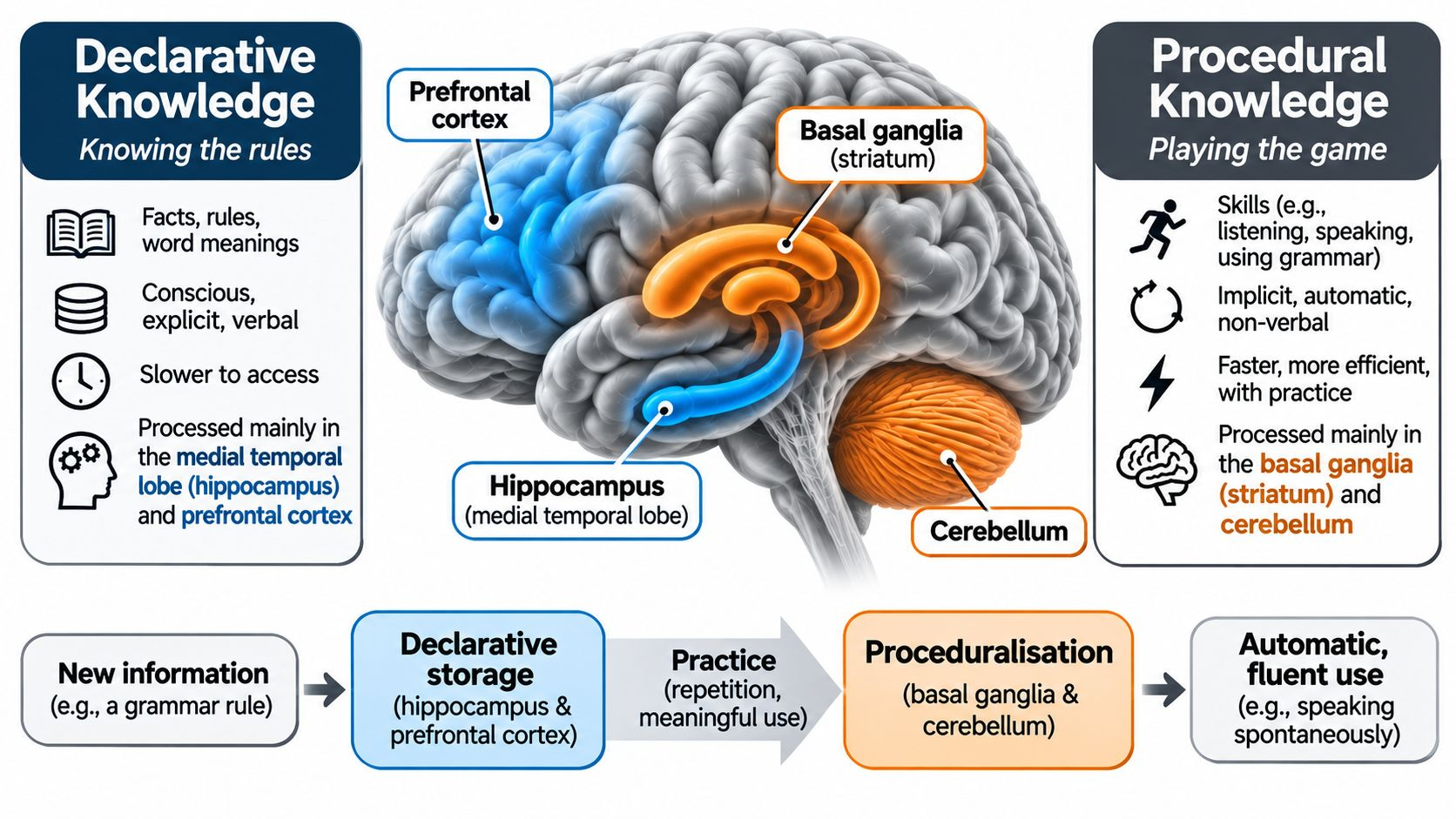
This distinction between knowing the language (Declarative Knowledge) and being able to use it (Procedural Knowledge) is arguably one of the most important that a language teacher should understand, because it has profound implications for curriculum design, instructional sequencing, practice and assessment.
Image 0 – Declarative vs Procedural knowledge
In instructed language acquisition, especially in school settings characterised by limited contact time and relatively little exposure to the target language outside the classroom, we cannot afford to leave the transition from Declarative Knowledge to Proceduralised (usable-in-real-time) Knowledge to chance. We need to ensure that the practice we provide is not only frequent but also purposeful, appropriately sequenced, cognitively manageable and sufficiently varied to promote flexible, transferable learning. Transferrability is, of course, as key to fluency as speed, as fluency, as we shall discuss below, is very much task-dependent: I may be very fluent in describing a family picture having practised describing family pictures a hundred times, but become hesitant when I need to apply the very same language in being interviewed about my family or describing my family in writing.
This conviction has informed much of my work on Extensive Processing Instruction (EPI), particularly its emphasis on extensive modelling, receptive processing, structured retrieval, systematic recycling, gradual scaffold fading and the development of automaticity before learners are expected to engage in increasingly demanding spontaneous communication.
What follows are ten factors which, in my experience, remain insufficiently addressed in many language classrooms, together with practical examples of how they can be incorporated into everyday teaching.
From knowing the language to being able to use it: declarative versus procedural knowledge
One of the most important distinctions in cognitive psychology and second language acquisition is that between declarative knowledge, which refers to what learners consciously know about the language (e.g. grammatical rules, vocabulary meanings and conjugation patterns), and procedural knowledge, which underpins their ability to use that language efficiently in real-time communication, often with little conscious attention to the rules involved. A student may know perfectly well how to form the French perfect tense, for example, yet struggle to recount what they did last weekend without lengthy pauses, hesitation and errors.
The crucial question, which has generated considerable debate in SLA research, is whether, and to what extent, declarative knowledge can become proceduralised through practice. Three broad positions have traditionally been proposed. According to the strong-interface hypothesis, associated with skill acquisition theorists such as Anderson (1982) and DeKeyser (2007), declarative knowledge can, under appropriate conditions, be transformed into increasingly proceduralised and eventually more automatic performance through extensive, meaningful practice. The non-interface hypothesis, associated with Krashen (1982), maintains that consciously learnt knowledge and implicitly acquired competence constitute fundamentally separate systems, with explicit knowledge serving primarily a monitoring function rather than becoming implicit competence through practice. Between these positions lies the weak-interface hypothesis, associated with researchers such as Ellis (1993) and N. Ellis (2005), which suggests that explicit knowledge can facilitate implicit learning indirectly, for example by directing learners’ attention to relevant linguistic features, promoting noticing and helping them process subsequent input more effectively, even if it does not directly convert into implicit knowledge.
These positions should not be treated as three equally comprehensive explanations of all aspects of language learning, since the distinction between explicit and implicit knowledge does not map perfectly onto that between declarative and procedural knowledge. Nevertheless, they raise a fundamental pedagogical question: is knowing a rule enough to develop the ability to use it spontaneously, or must learners repeatedly engage in the very processing operations that real-time communication requires? Whilst the precise relationship between these knowledge systems remains debated, there is compelling evidence that explicit grammatical knowledge alone does not guarantee fluent performance and that repeated, appropriately designed practice plays an important role in developing processing efficiency (DeKeyser, 2007; Segalowitz, 2010).
My own position is broadly aligned with the strong-interface hypothesis, particularly the skill acquisition account advanced by Anderson (1982) and DeKeyser (2007), although I also recognise the important role of implicit learning and the contribution of explicit knowledge to noticing and input processing, as emphasised by weak-interface theorists.
In other words, I believe that declarative knowledge can, under the right instructional conditions, support the development of increasingly proceduralised and automatic language use, but that this transition is neither inevitable nor achieved through repetition alone. It requires extensive, carefully sequenced practice which engages the very cognitive processes involved in real-time communication. This is one of the central theoretical premises underpinning EPI: knowing how the language works is not enough; learners must be systematically trained to use it efficiently, accurately and increasingly spontaneously.
1. Listening to extensive amounts of high-quality comprehensible input
One of the most striking contradictions in language teaching is that we expect students to speak fluently despite providing them with remarkably little sustained exposure to the language we want them to produce. Worse still, a considerable proportion of classroom listening consists of comprehension tests disguised as learning activities, in which students listen to a recording, answer a handful of questions, check their responses and move on, often without having meaningfully processed the linguistic features which would subsequently support their own speech.
This is one of the reasons Steve Smith and I wrote Breaking the Sound Barrier (2019), and why Listening as Modelling (LAM) occupies such a central place in EPI. Listening should not merely involve extracting meaning from an acoustic signal; it should also develop robust phonological representations, strengthen form–meaning connections, improve lexical segmentation and provide repeated encounters with the high-frequency chunks and grammatical patterns learners will eventually need to retrieve and manipulate in speech.
Research by Field (2008), Vandergrift and Goh (2012), and Rost (2016) has highlighted the complexity of listening and the importance of developing its underlying processes rather than simply assessing comprehension outcomes. This is particularly relevant to speaking because learners who cannot reliably recognise and segment familiar language in the speech stream are unlikely to develop efficient access to the same language when attempting to produce it.
In my workshops, I often recommend aiming for very high levels of comprehensibility, typically around 90–95% or above when modelling target language, although these percentages should be regarded as pedagogical heuristics rather than scientifically established thresholds applicable to every task.
The crucial issue is that learners should have sufficient processing capacity available to notice, recognise and consolidate the language patterns we want them to acquire, rather than having to devote most of their attentional resources to deciphering the message.
What might this look like in the classroom?
Take a Year 8 French class learning to describe what they did at the weekend. Rather than introducing the perfect tense through a grammatical explanation followed immediately by sentence construction, I might begin with a Sentence Builder containing a carefully selected repertoire of high-frequency chunks such as je suis allé, j’ai joué, j’ai regardé, avec mes amis and parce que c’était amusant.
I would then expose students to these expressions through several short, highly patterned listening activities, each targeting a different aspect of processing.
In Faulty Echo, I might say Samedi, j’ai joué au foot avec mes amis, whilst displaying a sentence containing one deliberate discrepancy, such as Dimanche, j’ai joué au foot avec mes amis. Students would identify and correct the discrepancy, initially with the Sentence Builder available and subsequently with reduced support. This would encourage close attention to the acoustic signal, form–meaning mapping and precise discrimination rather than reliance on general comprehension.
In Listening Slalom, students would follow a route through a grid of familiar expressions as I read increasingly long sentences aloud, with the alternatives becoming progressively more similar. This would require learners to discriminate between closely related lexical and grammatical forms whilst repeatedly processing the same high-frequency language.
I might follow this with Sentence Bingo, using the same linguistic repertoire, before moving to short, connected descriptions in which learners identify who did what, when and with whom.
Only after this receptive processing would I expect students to retrieve and manipulate the target language orally, initially with substantial support and later with progressively less.
The point is not that these activities are intrinsically superior to every other listening task, but that each has a clearly identifiable processing purpose and contributes to the development of representations which can subsequently support production.
It is worth remembering that Duong et al. (2023) found no significant fluency gains from their input and task-repetition interventions, a useful reminder that exposure and repetition do not automatically translate into more fluent speech. What matters is the nature of the input, the processing it elicits and the opportunities learners subsequently receive to retrieve and use the language.
2. Understanding the processes speaking involves and targeting them through deliberate practice
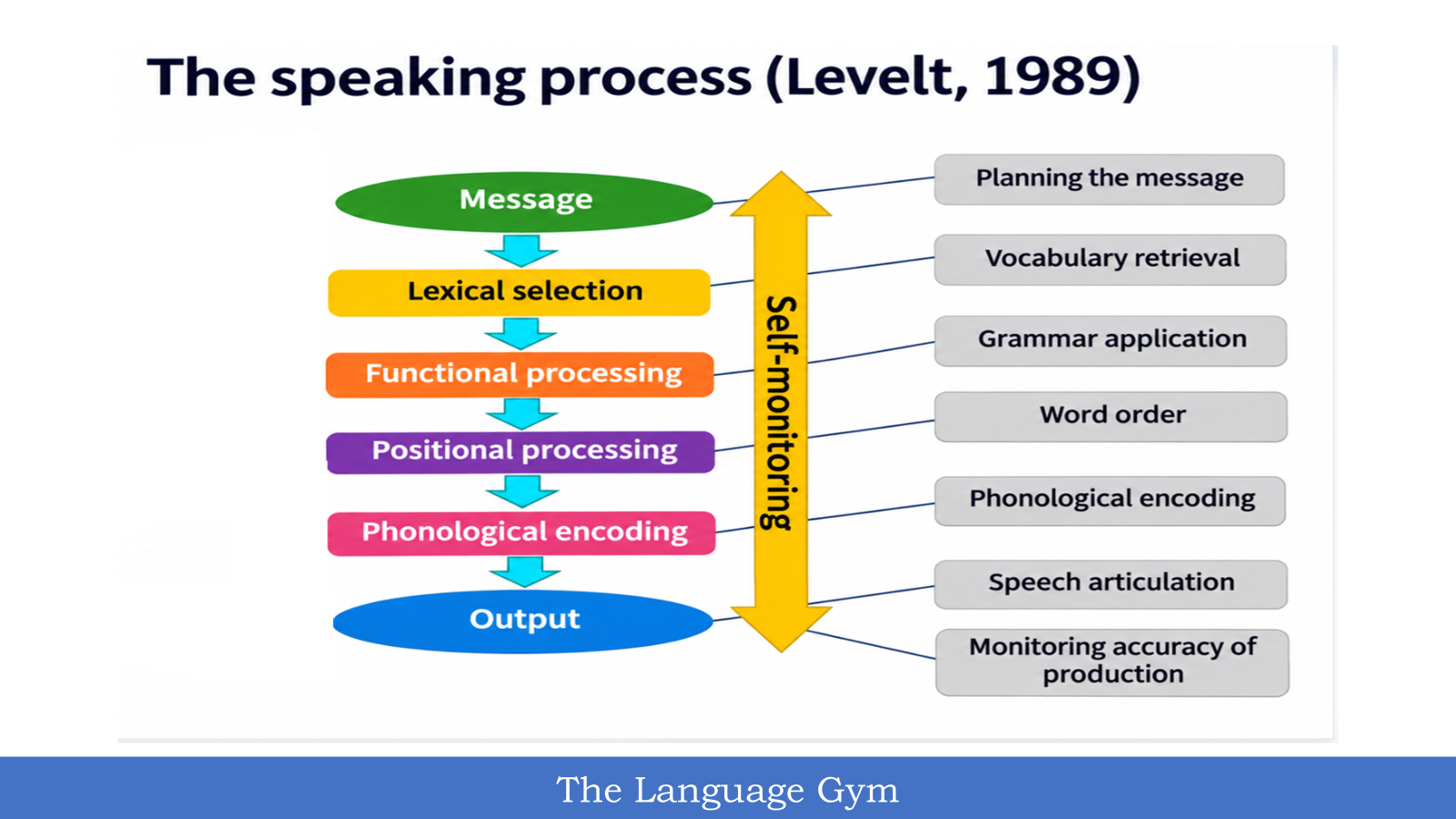
Speaking is not a single, indivisible skill but the product of several interacting cognitive processes, including conceptualisation, lexical retrieval, grammatical encoding, phonological encoding, articulation and self-monitoring (Levelt, 1989; Kormos, 2006). Yet, despite this complexity, we often treat speaking difficulties as though they all had the same cause and could therefore be remedied simply by providing more opportunities for conversation.
A student who hesitates because they cannot retrieve vocabulary quickly enough does not necessarily need the same intervention as one who struggles with sentence formulation, pronunciation, discourse organisation or conversational turn-taking. Unless we identify the specific bottleneck, we risk prescribing practice which is only loosely related to the difficulty we are trying to address.
This is where the concept of deliberate practice becomes particularly useful. Ericsson, Krampe and Tesch-Römer (1993) emphasised the importance of structured practice targeting specific dimensions of performance, supported by feedback and opportunities for improvement. Although their original research was not conducted in second language classrooms, the underlying principle is highly relevant to instructed language acquisition.
Before staging a speaking activity, therefore, we should ask ourselves which component of speaking competence we are attempting to develop, what processing demands the activity imposes and what evidence would indicate that learners have improved.
Image 1: The speaking process by Levelt (1989)
What might this look like in the classroom?
Imagine that a Year 9 Spanish class can describe their daily routines accurately in writing but produces hesitant, fragmented speech when asked to do so orally. Rather than immediately organising a free conversation, I might begin with a brief diagnostic sequence using mini-whiteboards.
First, I would display familiar English prompts such as I usually get up at seven and ask students to retrieve the Spanish equivalents under manageable time constraints. If many struggle, lexical retrieval may be one of the principal bottlenecks.
Next, I might provide the relevant vocabulary and ask learners to assemble complete sentences, allowing me to establish whether grammatical encoding presents an additional difficulty.
I would then ask students to articulate familiar sentences aloud, paying attention to pronunciation, hesitation and the location of pauses. To practise articulation further, we could stage a Mind Reading game or any of the other fun activities detailed in this post.
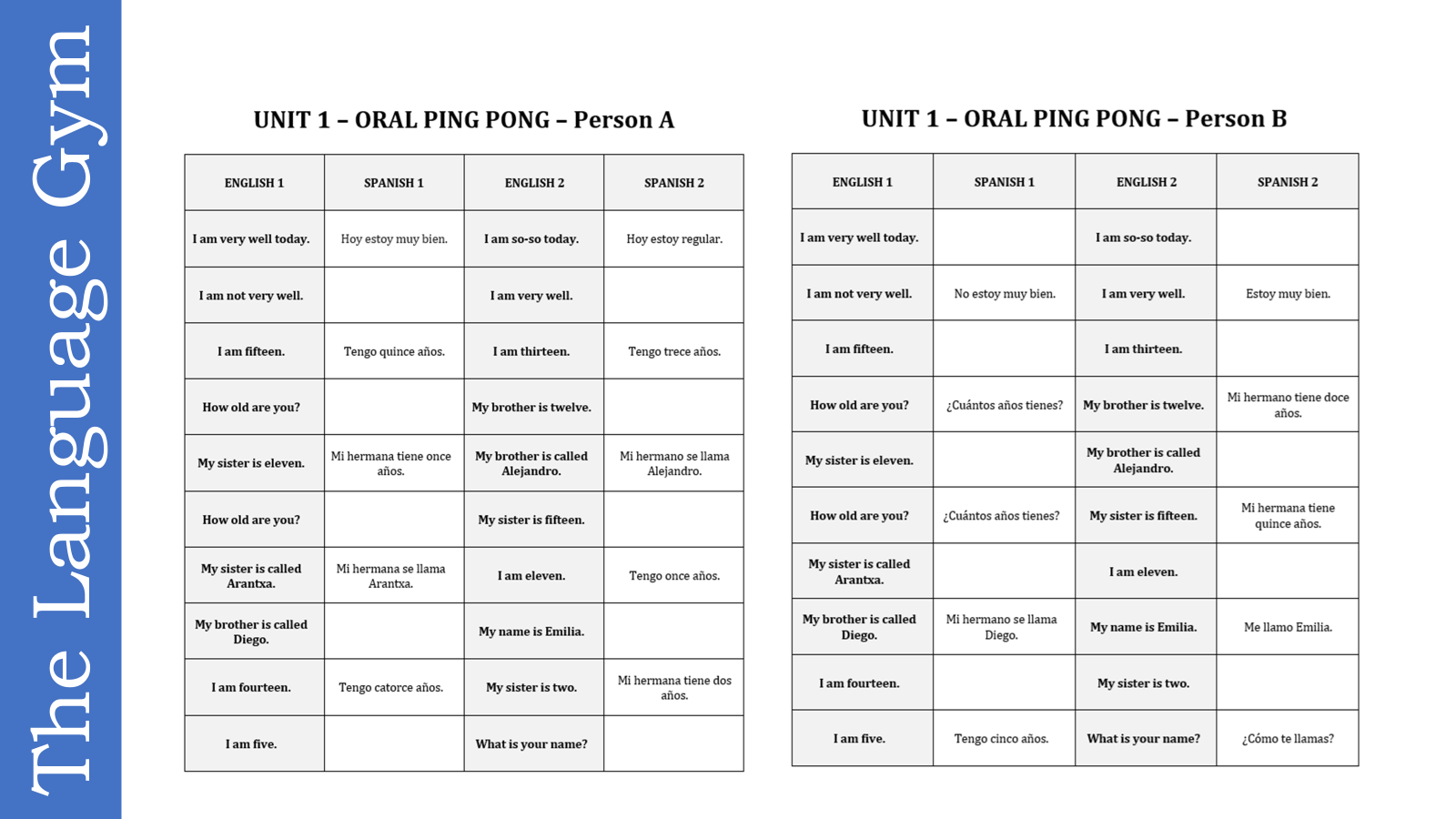
This would be the time to stage oral retrieval practice activities, such as Oral ping-pong, No snakes no ladders, or other peer-testing activities. Why? Because, as you can see from Levelt’s model of speaking above, we know that the first cognitive process in speaking (after planning) us retrieving vocabulary in its ORAL form. Hence, a lot of the retrieval practice students must engage in must be through the oral medium. And, of course, if this practice occurs as pairwork, we make much more efficient use of classroom time!
Image 2 – Oral ping-pong, a peer-testing activity whereby student 1 and 2 challenge each other at translating the sentences on their respective cards fo which the other student doesn’t have the solution
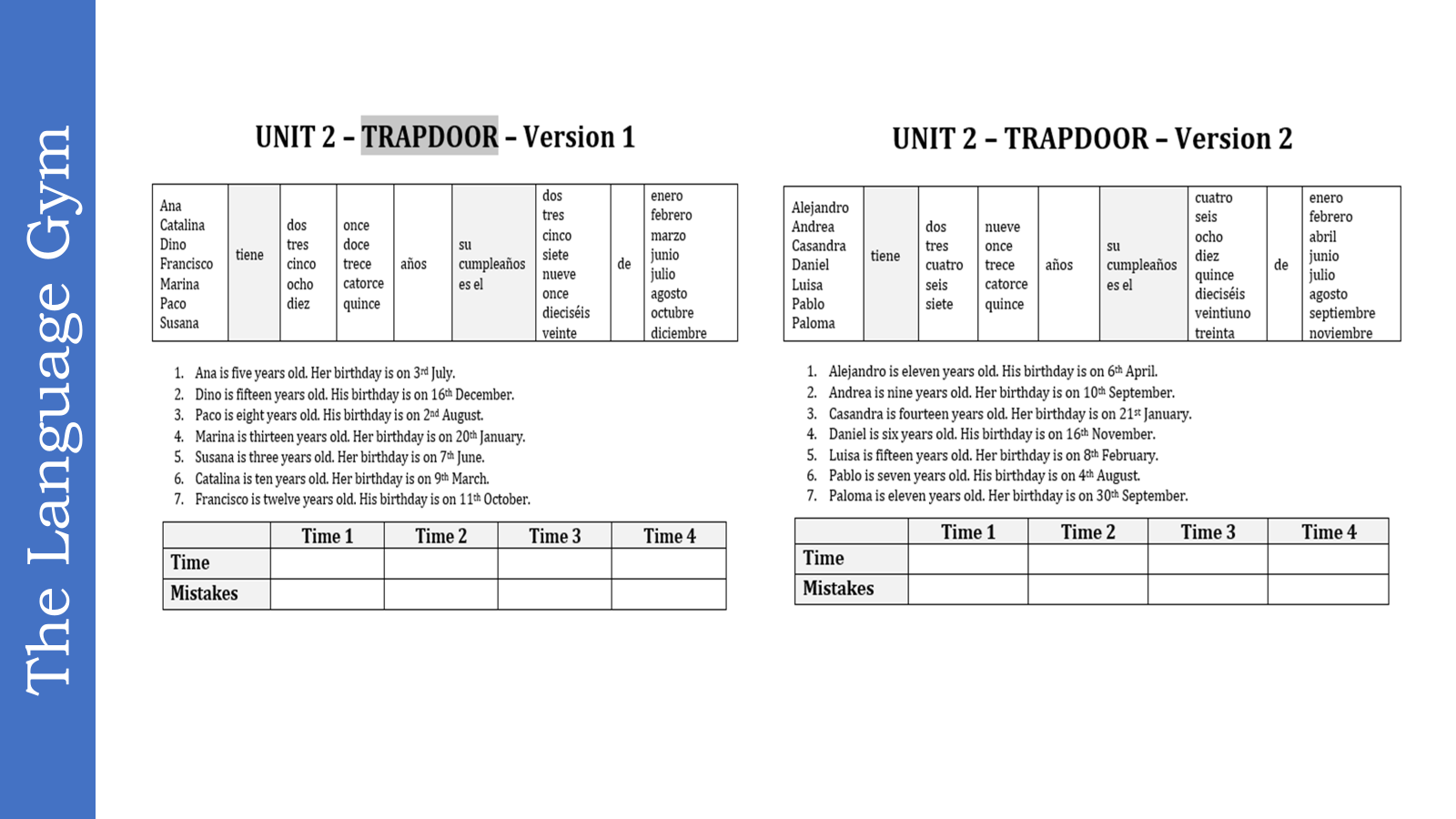
A good way to prime the students for Oral Ping-pong and other retrieval practice games, is the game Trapdoor. See Image 2 below.
Image 2: Trapdoor game (from our Trilogy 1 French speaking book): with the support of a sentence builder, student B must translate orally the English sentences that student A throws at them and viceversa
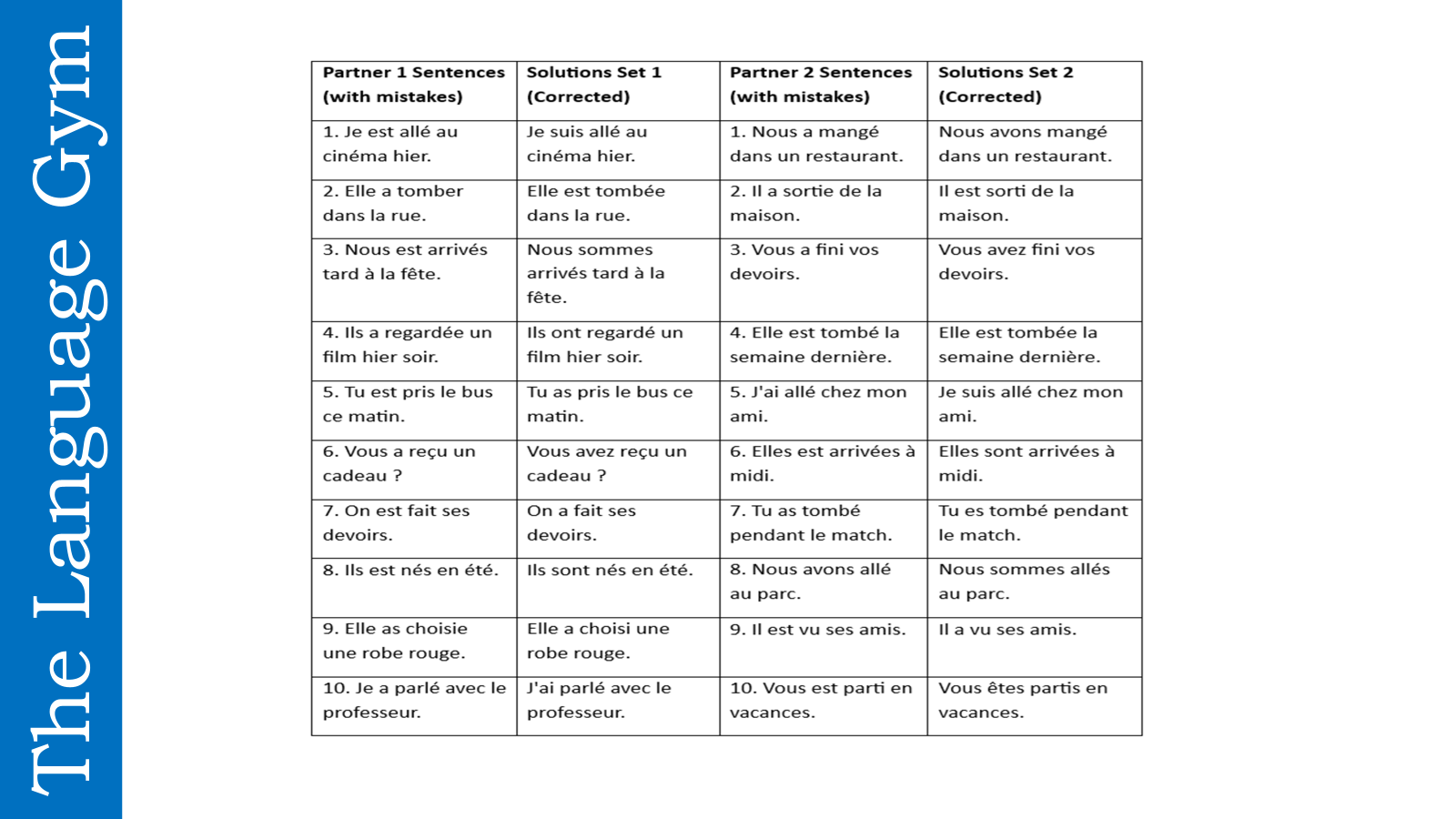
If I observe stubborn mistakes, I might stage a Fixy Echo game, whereby two students, working in pairs, must correct erroneous sentences correcting specific mistakes, orally, within a limited time-window. The list of sentences and the solution are provided, of course by the teacher.
Image 3: the Fixy Echo game
Depending on what I observe, I might then use Pyramid Translation, in which learners retrieve progressively longer utterances, moving from I get up to I usually get up at seven because I have to go to school. The gradual increase in utterance length allows learners to practise retrieving and assembling familiar language whilst managing progressively greater processing demands.
If pronunciation is the main issue, I might instead use short cycles of modelling, paired reading aloud and focused corrective feedback before returning to oral retrieval.
If the difficulty lies in interactional competence, I might organise highly structured mini-roleplays in which students practise asking follow-up questions, responding to unexpected answers and requesting clarification, initially with prompts and subsequently without them. The Role Plays will recycle the non negotiable patterns and vocabulary I set out to teach as part of the unit-at-hand.
Before proceeding to communicative tasks where a more spontaneity is required, I might want to work on speedy retrieval. I could therefore stage automaticity-training activities such as, Faster, Fast and Furious, Role-play Carousel,
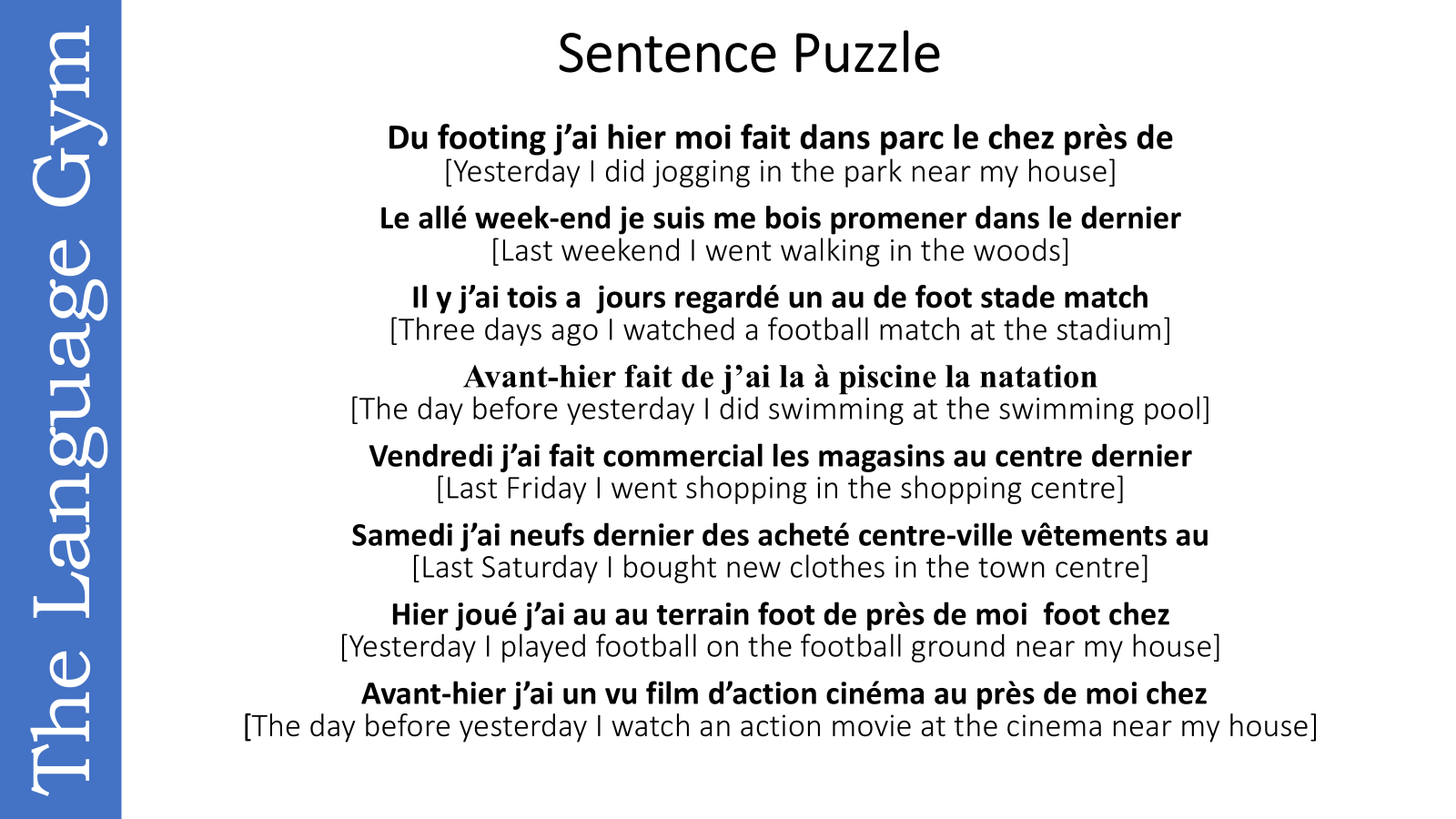
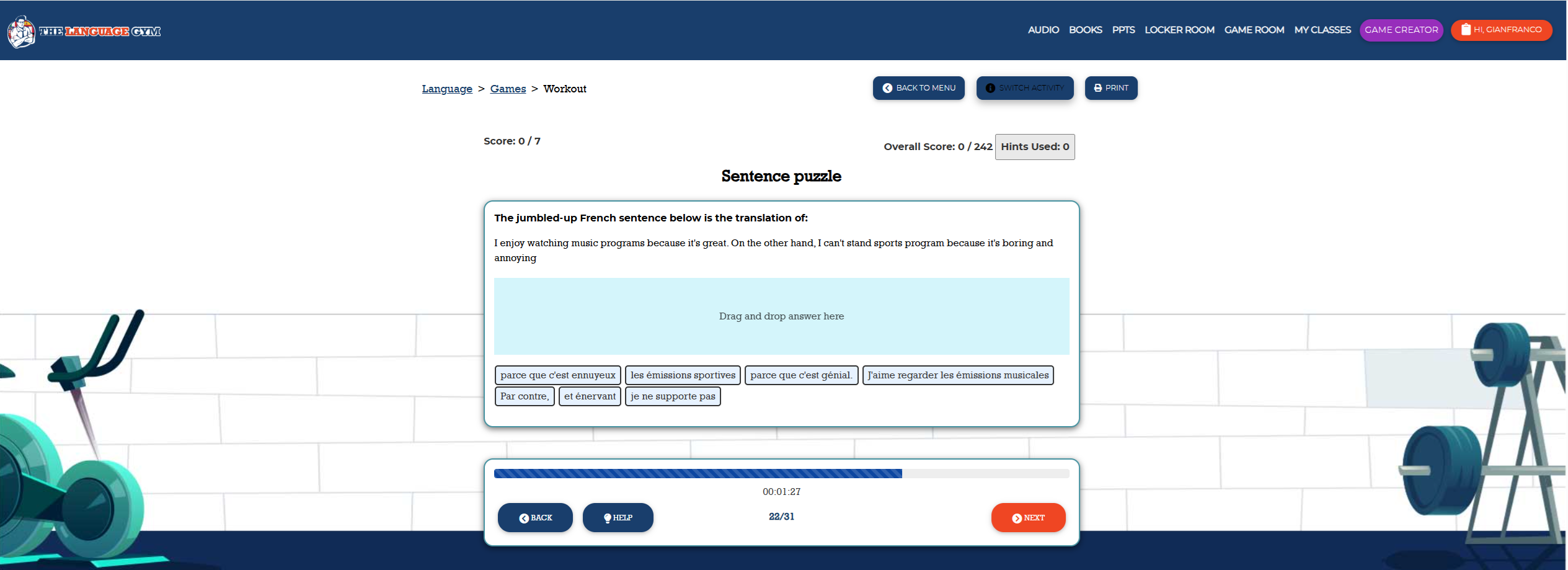
To focus the students on sentence structure, if I think it might be tricky for some students, we might stage a sentence puzzle race
Image 4: Sentence puzzle race: the students read aloud the sentences in the correct word order. Student 1 first, then student 2. Their performance is timed and one extra second is added for each error. The student with the fastest time wins.
I would then move to easier communicative tasks such as Surveys and/or basic information gap activities, before moving to more complex communicative tasks. Please note that, to better manage cognitive load, you might want to give the students some planning time, through, for instance, a think-pair-share routine or staging a priming task or two.
As you can see, this way I would have targeted every single micro-skill of speaking: articulation
This is an example of process-based instruction, a methodology that I have often discusses on this blog, whereby the teacher targets through micro-speaking tasks all the speaking sub-skills.
Effective speaking instruction should therefore be process-led rather than merely activity-led, with the teacher selecting practice on the basis of the specific cognitive and communicative demands involved.
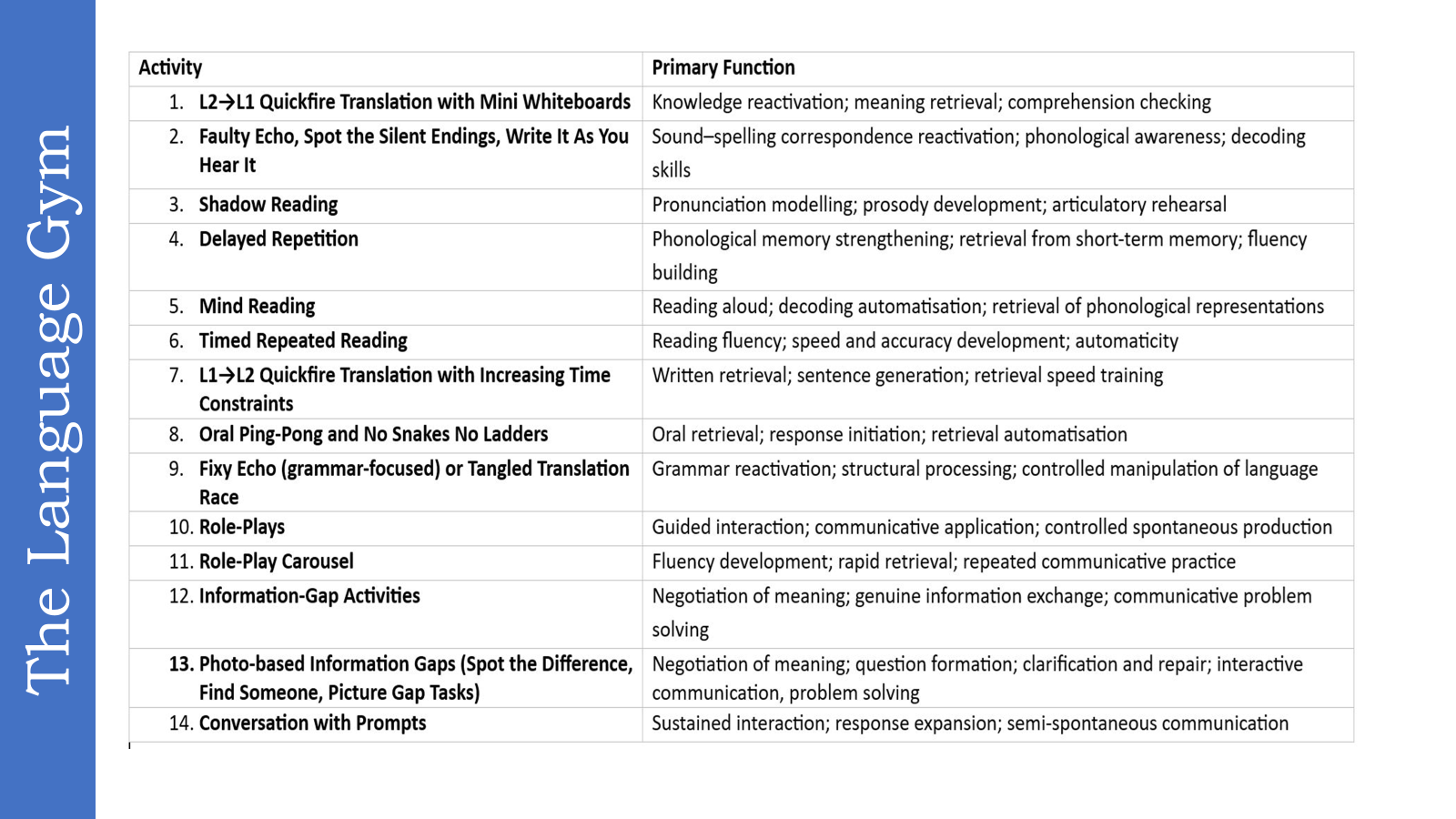
Image 5 – Oral task sequence from chunking aloud to communicative tasks, sequenced by increasing cognitive demands and complexity
3. Making sure students learn to chunk language
Fluent speakers do not construct every utterance from scratch by retrieving individual words and consciously applying grammatical rules to assemble them. Instead, they draw extensively on frequently encountered combinations of words, formulaic sequences and reusable constructions which can be accessed and processed relatively efficiently (Wray, 2002; Wood, 2010; Ellis, 2002).
This is one of the principal reasons why I advocate teaching language through high-frequency chunks and sentence patterns rather than relying predominantly on isolated vocabulary and grammatical explanations.
Consider the processing demands faced by a learner who must assemble I would like to go to the cinema because I enjoy watching films word by word, compared with those faced by a learner who can retrieve I would like to, go to the cinema and because I enjoy as familiar units. The latter is likely to have more attentional resources available for conceptual planning, selecting appropriate vocabulary and monitoring the message.
However, chunking should not be confused with teaching students to memorise long, fixed sentences which they can reproduce but cannot manipulate. The real objective is to develop a repertoire of reusable, adaptable constructions which learners can combine, expand and modify across communicative contexts.
Research by Eguchi and de Jong (2022) suggests that the reuse of lexical and more abstract constructions during task repetition can contribute to improvements in aspects of oral fluency, reinforcing the importance of repeated encounters with familiar linguistic patterns in varied contexts.
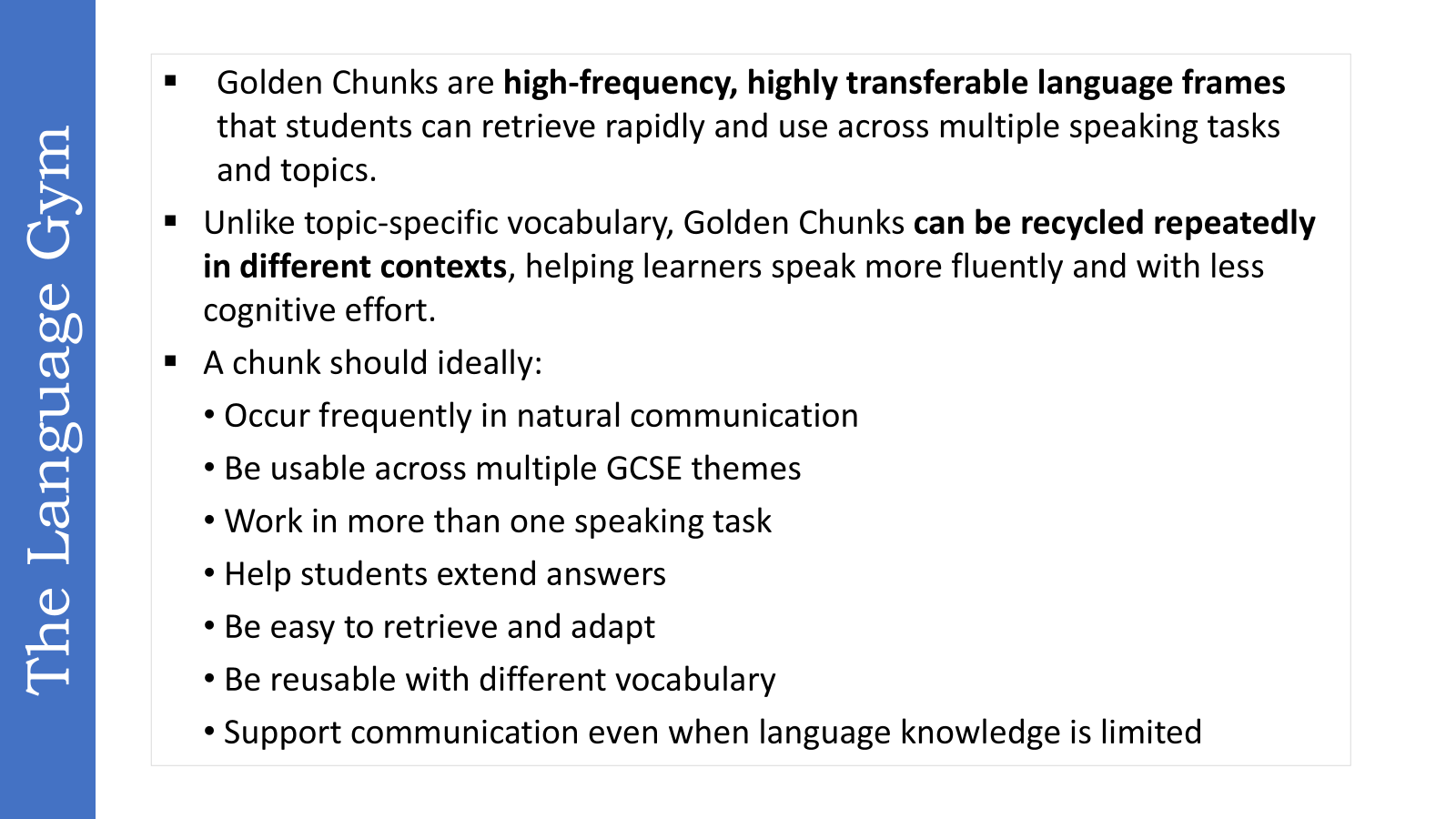
Even if one doesn’t adhere to the letter of my approach, EPI, a fluency accelerating strategy refer to the selection of a repertoire of what I call ‘Golden Chunks’ i.e. high-frequency, highly transferable language frames that students can retrieve rapidly and use across multiple speaking tasks and topics. Depending on the students’ ability and level of proficiency, one may teach 3 or 4 such chunks per term, recycling them in as many lessons and tasks as possible associating them with as many words as possible.
Image 6 – Golden chunks
What might this look like in the classroom?
Suppose a Year 7 German class is learning to express opinions about school subjects using chunks such as ich finde Mathe interessant, mein Lieblingsfach ist Englisch and weil der Lehrer nett ist.
After extensive modelling and receptive processing, I might introduce Mind Reading, displaying ten or twelve familiar sentences and asking each learner to select three secretly. Their partner would attempt to guess the selected sentences aloud, with points awarded for successful guesses.
Although the activity is playful, its instructional value lies in the repeated articulation and retrieval of familiar constructions, particularly when students subsequently change partners or the linguistic support is reduced.
I might then use Sentence Stealer, in which students secretly select four sentences from a displayed set and circulate around the classroom attempting to identify their classmates’ choices. Because learners repeatedly retrieve the same structures whilst interacting with different partners, they receive substantial practice without the monotony associated with traditional drilling.
At a later stage, I would introduce substitution and expansion tasks in which students modify familiar constructions by changing the subject, tense, opinion or justification.
For instance, Ich finde Mathe interessant, weil der Lehrer nett ist might become Meine Schwester findet Deutsch langweilig, weil es schwierig ist, provided the relevant language has already been introduced and practised.
This progression from recognising and retrieving chunks to manipulating and recombining them is essential, because the ultimate goal is not the memorisation of sentences but the development of flexible linguistic resources which can be deployed with increasing efficiency.
4. Task repetition
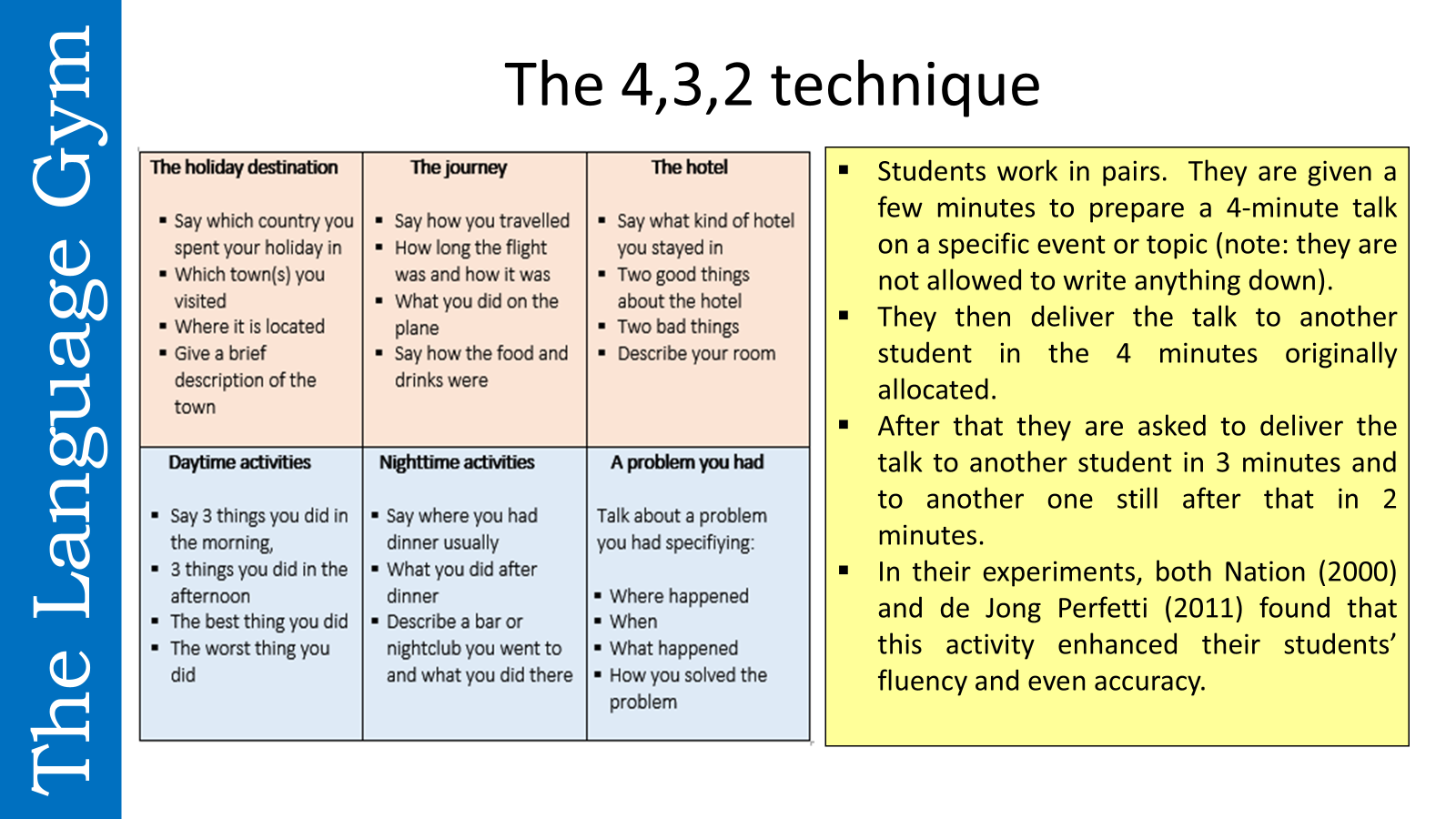
Task repetition has attracted considerable attention in instructed second language acquisition, with studies by Bygate (2001), de Jong and Perfetti (2011) and others demonstrating its potential to improve different aspects of oral performance. The ‘4,3,2’ technique and Market Place are possibly the most famous and studied activities in our field, when it comes to task repetition. My students have always enjoyed both games.
Image 7: The 4,3,2 technique
The underlying rationale is relatively straightforward: during the first performance of a task, learners must devote considerable attentional resources to conceptual planning, lexical retrieval, grammatical formulation and articulation, whereas subsequent performances may reduce some of these demands and allow greater attention to accuracy, complexity or fluency.
However, the relationship between task repetition and fluency development is more nuanced than is sometimes acknowledged.
A 2025 meta-analysis by Abdi Tabari, Zhuang and Farahanynia reported positive effects of task repetition across several dimensions of oral performance, with stronger effects on syntactic complexity and accuracy than on fluency and lexical complexity. Similarly, the 2026 scoping review by Hanzawa, Suzuki, Yanagisawa and Fukuta highlights the importance of distinguishing improvements in immediate task performance from the development of transferable speaking skills.
This distinction is particularly important in the classroom, where students may become highly proficient at reproducing a rehearsed dialogue without necessarily becoming more capable of handling unfamiliar communicative situations.
What might this look like in the classroom?
One activity I frequently recommend is the Role-play Carousel, in which students repeat a broadly similar communicative task with several partners whilst progressively introducing variation.
For example, in a French unit on ordering food, students might initially practise a short restaurant exchange with access to a Sentence Builder, before repeating the interaction with a different partner and reduced support.
During subsequent rounds, the teacher might introduce new constraints, such as an unavailable dish, a change of order, a request for clarification or an unexpected question about preferences.
The linguistic demands remain manageable because much of the core language is familiar, but the interaction becomes progressively less predictable.
Another useful activity is 4–3–2, in which learners communicate broadly similar content three times, initially for four minutes, then three and finally two, with different partners. The aim is not simply to speak faster but to become more efficient at retrieving and organising familiar language.
With younger or less proficient learners, I would use much shorter intervals, perhaps 60, 45 and 30 seconds, ensuring that the time constraints remain realistic.
I would also revisit similar tasks several lessons later, changing the communicative context whilst retaining the underlying linguistic resources.
For instance, students who have practised describing their own weekend might subsequently describe a friend’s weekend, compare two weekends or discuss what they would have preferred to do.
The key principle is that repetition should gradually reduce unnecessary processing demands whilst introducing enough variation to encourage flexible language use and transfer.
5. Sequencing speaking tasks effectively
One of the most common mistakes in language teaching is to ask learners to perform communicative tasks before they have developed the linguistic resources and processing efficiency required to succeed.
A teacher introduces a grammatical structure, provides a brief explanation, asks students to complete a few written exercises and then expects them to use the structure spontaneously in conversation. When the students struggle, the conclusion is often that they need more speaking practice, whereas the real problem may be that the preceding instruction has not adequately prepared them for the demands of real-time production.
Research on cognitive load (Sweller, 1988), skill acquisition (DeKeyser, 2007) and second language speech production (Kormos, 2006) provides a compelling rationale for sequencing instruction in ways that manage processing demands and progressively increase independence.
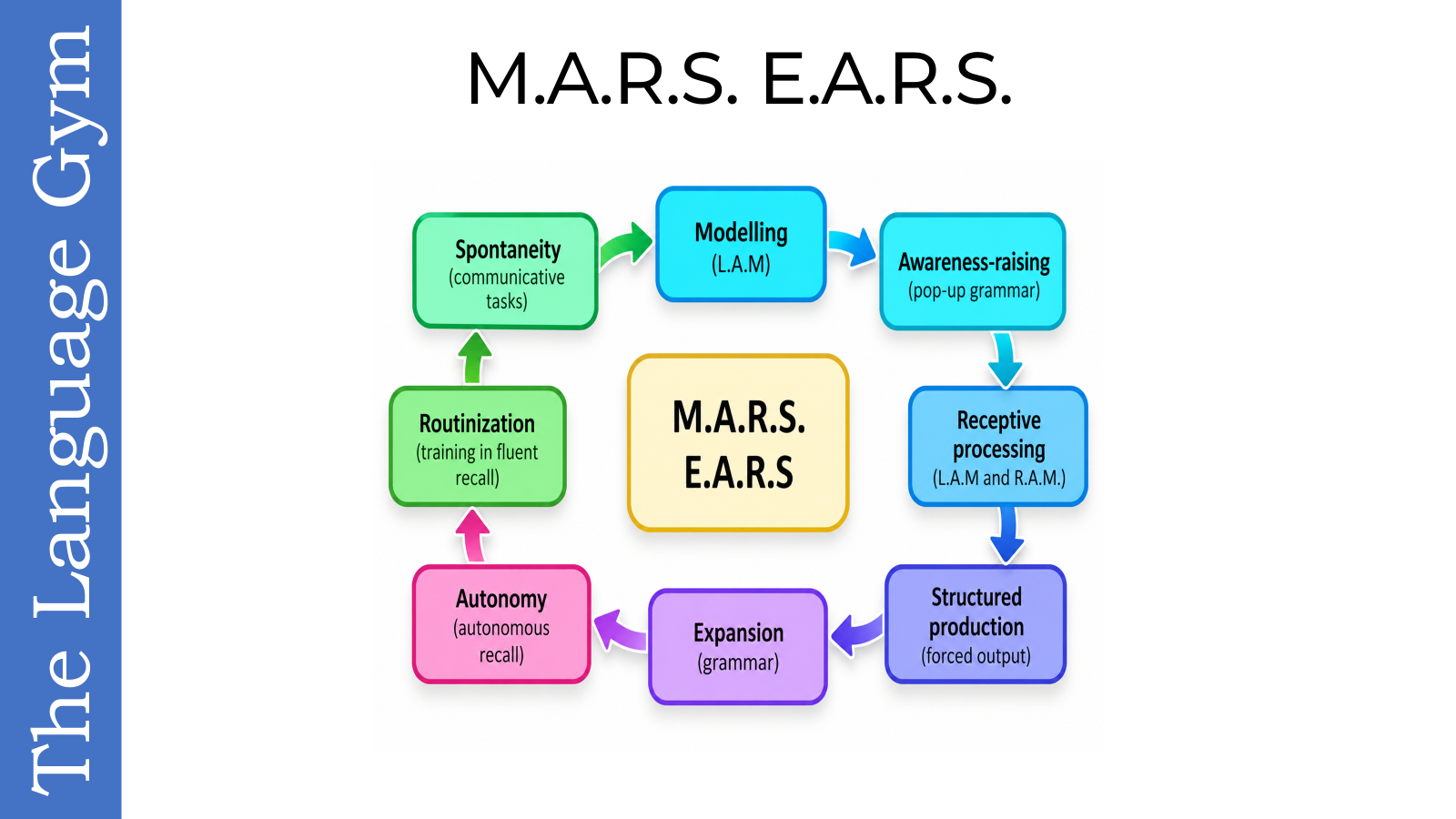
This is one of the central principles of EPI, where learners move from extensive modelling and receptive processing towards structured production, expansion, autonomous retrieval, routinisation and, eventually, increasingly spontaneous communication.
What might this look like in the classroom?
Consider a Year 8 Spanish unit on describing holidays.
In the initial modelling phase, students might listen to short, highly patterned descriptions supported by a Sentence Builder, using activities such as Faulty Echo, Sentence Bingo and Listening Slalom to strengthen sound–meaning connections.
During receptive processing, they might complete increasingly demanding listening and reading tasks, progressing from isolated sentences to short connected texts and identifying recurring grammatical patterns.
Structured production would then involve paired oral retrieval, in which one student provides English prompts and the other retrieves the Spanish equivalents, initially with access to the Sentence Builder and subsequently with progressively reduced support.
This could be followed by mini-roleplays involving short exchanges about destinations, accommodation, activities and opinions, with students initially using prompts and then attempting the same exchanges independently.
During expansion, learners might manipulate the familiar language by changing the person, tense, destination or justification, whilst autonomous production would involve producing short descriptions or dialogues without access to the original scaffold.
Finally, the unit might culminate in an information-gap or reasoning-gap task in which students compare two holiday options, negotiate preferences and respond to questions they have not rehearsed.
This sequence does not imply that every activity must occur in a rigid order or that spontaneous exchanges should be excluded from earlier lessons. Rather, it reflects the principle that communicative demands should increase in line with learners’ developing competence, so that students are challenged without being consistently overwhelmed.
6. Preventing anxiety and nurturing the motivation to talk
Even the most carefully designed instructional sequence is unlikely to achieve its full potential if learners are too anxious to participate or lack the confidence to attempt communication.
Foreign language anxiety has been extensively investigated since Horwitz, Horwitz and Cope’s (1986) seminal work, whilst the meta-analysis by Teimouri, Goetze and Plonsky (2019) found a substantial negative relationship between second language anxiety and achievement.
However, it would be simplistic to assume that every hesitant learner is anxious or that eliminating challenge is the answer. In my experience, what learners often need is not less challenge but better calibrated challenge, accompanied by sufficient preparation and repeated opportunities to experience success.
This is where Bandura’s (1997) concept of self-efficacy becomes particularly relevant, especially his emphasis on mastery experiences as a source of confidence.
Students do not become confident speakers simply because we tell them that they are capable; they become more confident when they repeatedly experience themselves succeeding at tasks which they initially perceived as challenging.
What might this look like in the classroom?
I often advocate what I call small achievement challenges, in which learners are presented with a sequence of manageable tasks that gradually increase in difficulty whilst remaining within their current capabilities.
For example, in a Year 7 French class, I might begin by asking students to retrieve three familiar sentences about their hobbies, before challenging them to produce five, then to add a justification and finally to respond to an unexpected follow-up question.
At each stage, success provides evidence of growing competence, whilst the teacher can adjust the level of support according to learners’ needs.
A Scaffolding Ladder can be particularly useful here, with students progressing from full Sentence Builder support to partial prompts, key words, visual cues and eventually independent production.
Importantly, scaffold removal should be contingent on successful performance rather than dictated by an arbitrary timetable, since withdrawing support prematurely may undermine precisely the confidence and processing efficiency we are attempting to develop.
I would also make extensive use of paired rehearsal before whole-class performance, allowing learners to practise with a trusted partner, receive focused feedback and improve their response before speaking in a more public setting.
Another important consideration is the communicative purpose of the task.
We need to avoid what I call the dreaded so what? effect, whereby students are asked to engage in conversations which have no meaningful purpose beyond satisfying the teacher.
An information-gap task in which students must discover genuine differences between two holiday itineraries, for instance, may provide a more compelling reason to communicate than asking them to exchange information which is already visible to everyone.
MacIntyre et al.’s (1998) model of willingness to communicate reminds us that speaking behaviour depends not only on linguistic competence but also on confidence, interpersonal relationships and the immediate communicative context.
The implication is that confidence, competence and willingness to communicate should be developed together, through tasks which are manageable, purposeful and sufficiently challenging to generate a sense of achievement.
7. Specific training in automatic retrieval
This is arguably one of the most neglected dimensions of speaking instruction, despite its central importance to fluency development.
A student may possess accurate knowledge of the target vocabulary and grammar yet struggle to retrieve and assemble that knowledge quickly enough during real-time communication, because successful performance under untimed conditions does not necessarily imply automaticity.
As Segalowitz (2010) explains, second language fluency involves complex relationships between underlying cognitive processing, observable speech performance and listeners’ perceptions of fluency. It is therefore important to distinguish between merely increasing speaking speed and improving the efficiency of the processes which support communication.
Nation (2007) identifies fluency development as one of the four essential strands of a balanced language programme, yet many classroom activities continue to prioritise either accuracy or communication without deliberately targeting the speed and efficiency of retrieval.
What might this look like in the classroom?
One useful activity from my fluency-training workshops is FASTER!, in which students respond to familiar prompts with progressively greater speed whilst maintaining acceptable accuracy.
For example, after a unit on daily routines, students might be shown a series of visual or English-language prompts requiring them to retrieve familiar Spanish expressions. The initial emphasis would be on successful retrieval, with time constraints introduced only once students demonstrate sufficient accuracy.
Another activity is Timed Pyramid, in which learners produce progressively longer utterances under carefully calibrated time constraints.
A student might begin with Je joue au foot, expand this to Je joue au foot avec mes amis, then produce Je joue au foot avec mes amis le samedi and finally add a justification.
The instructional value lies in repeatedly retrieving familiar components whilst gradually increasing the demands of sentence formulation and articulation.
I might also use Timed Pyramid Translation, where students retrieve increasingly elaborate sentences from English prompts, or short cycles of paired oral retrieval in which the same high-frequency constructions are revisited across several lessons.
At a more advanced stage, students might undertake repeated short monologues or conversations with changing partners, gradually reducing preparation time and introducing unexpected follow-up questions.
However, I would be cautious about introducing speed too early, since excessive time pressure can encourage inaccurate production, avoidance strategies and anxiety, particularly when learners have not yet consolidated the relevant language.
Research by de Jong and Perfetti (2011) provides evidence that fluency training can produce improvements which transfer to unpractised tasks, whilst Suzuki (2021) demonstrates the importance of practice schedules in determining the nature of fluency gains.
The pedagogical message is that automaticity should be trained deliberately, but only through practice which learners can perform successfully and with sufficient accuracy.
8. Having classroom routines which provide repeated opportunities for meaningful language use
Classroom routines are a potentially valuable source of repeated exposure to and retrieval of high-frequency language, particularly in school settings where contact time is limited.
Because routines are predictable, they reduce the demands of conceptual planning and allow learners to devote more attention to retrieving and producing the relevant linguistic forms.
This is consistent with usage-based accounts of language acquisition, which emphasise the importance of frequency, distribution and repeated encounters in strengthening linguistic representations (Ellis, 2002).
However, routines should not be reduced to the mechanical repetition of a handful of fixed expressions, since learners who can reproduce familiar exchanges may still struggle to adapt the language to less predictable contexts.
What might this look like in the classroom?
A simple entry routine might involve students responding to a question about how they are feeling, what they did yesterday or what they intend to do later.
Initially, the relevant language might be displayed on a Sentence Builder, with students selecting an appropriate response and adding a short justification.
Over time, the teacher could introduce greater variation by changing the question, asking for additional information or requiring students to respond to a classmate’s answer.
For example, a routine exchange beginning with Comment ça va aujourd’hui? might gradually develop into a short conversation involving reasons, comparisons and follow-up questions.
Another useful routine is a two-minute paired retrieval starter, in which students revisit high-frequency chunks from previous units, alternating between prompting and responding.
This can be followed by a brief mini-whiteboard check, allowing the teacher to identify persistent retrieval difficulties before moving on.
I would also incorporate The Unexpected Comeback, an activity in which language taught two or three weeks earlier reappears without warning in a short retrieval or communicative task.
This provides useful evidence of retention and helps prevent the common problem whereby students perform well at the end of a unit but rapidly lose access to the language once the class moves on to a new topic.
The important consideration is that routines should evolve, with support gradually withdrawn and the linguistic demands periodically increased.
A few minutes of purposeful retrieval in every lesson can provide valuable cumulative practice, particularly when the language is recycled across different topics and communicative contexts.
9. Knowing when to go to production
One of the most consequential decisions a language teacher makes is determining when learners are ready to move from receptive processing to production.
Too often, students are asked to produce language which they have barely had time to process, with the teacher introducing a new structure, modelling it briefly and then expecting learners to use it independently.
When errors emerge, the response is frequently to provide additional explanation or correction, whereas the underlying problem may be that the relevant phonological, lexical and grammatical representations are not yet sufficiently robust to support efficient retrieval.
Research on speech production and skill acquisition provides a strong rationale for extensive preparatory processing (Kormos, 2006; DeKeyser, 2007), although this should not be interpreted as evidence that production must always be delayed until receptive mastery has been achieved.
Swain’s (1985) Output Hypothesis reminds us that production itself can contribute to learning by encouraging learners to notice gaps in their knowledge, test hypotheses and process language more deeply.
The crucial issue is therefore not whether learners should produce language early or late, but whether the production task is feasible given their current level of competence and the support available.
What might this look like in the classroom?
Before moving to independent oral production, I often use a series of brief diagnostic checks to establish whether students can recognise, interpret and retrieve the target language reliably.
In Listen and Choose, students hear one of three closely related sentences and indicate which one was spoken, allowing the teacher to assess their ability to discriminate between similar forms.
In Meaning Discrimination, learners hear a sentence and select the correct interpretation, with distractors designed to reveal misunderstandings involving tense, negation, pronouns or other grammatical relationships.
I might then use Grammar Detective, in which students answer a meaning-focused question requiring them to process a specific grammatical feature, rather than merely identify or label it.
Once receptive processing appears sufficiently secure, I would move to Complete, Transform and Retrieve, asking students first to complete a partially supported sentence, then modify one of its elements and finally reconstruct it without the original scaffold.
This progression provides useful evidence of whether learners can move beyond recognition towards independent retrieval and manipulation.
At a later stage, I might introduce Independent Response, in which students select and produce an appropriate utterance without being given the precise wording, followed by a short communicative task requiring them to respond to a partner.
Mini-whiteboards are particularly useful throughout this sequence because they provide simultaneous evidence of understanding and retrieval, allowing the teacher to identify difficulties before students are exposed to the greater processing demands of spontaneous interaction.
The decision to move towards freer production should therefore be informed by what students can actually do, rather than by the number of activities completed or the amount of time allocated to a particular phase of the lesson.
10. Finally, the goals and content of your curriculum matter
The way we organise the curriculum has profound implications for the kind of competence our students develop.
If the curriculum is organised primarily around grammatical structures, teachers may naturally devote considerable time to explaining rules, practising forms and assessing explicit grammatical knowledge, whilst the development of processing efficiency and spontaneous communication becomes a secondary consideration.
Students may learn the present tense, the perfect tense and the future tense in successive units, demonstrating increasingly sophisticated grammatical knowledge without necessarily developing the ability to deploy that knowledge fluently in real-time communication.
This is not an argument against explicit grammar teaching, which can be highly beneficial when appropriately integrated into meaningful language use, but rather a reminder that grammatical knowledge should serve communicative competence rather than become an end in itself.
A curriculum organised around communicative functions, high-frequency constructions and meaningful language use is more likely to encourage systematic recycling, retrieval and the gradual development of processing efficiency.
What might this look like in the classroom?
Rather than designing a Year 9 French unit primarily around the perfect tense, I might organise it around recounting past experiences, explaining what happened, expressing reactions and comparing events.
The relevant grammar would still be taught explicitly where appropriate, but within a communicative framework which gives it purpose and provides repeated opportunities for meaningful use.
The unit might begin with highly patterned listening and reading texts describing past experiences, followed by Sentence Builder activities targeting the relevant lexical and grammatical constructions.
Structured production could then involve oral retrieval, sentence transformation, mini-roleplays and short recounts, with subsequent lessons introducing comparison, justification and increasingly independent communication.
Towards the end of the unit, students might complete a reasoning-gap task in which they compare two accounts of a holiday, identify inconsistencies and negotiate a plausible explanation, or an information-gap task requiring them to reconstruct an event from incomplete information.
These tasks would require learners to draw on previously practised language whilst responding to information they could not fully anticipate.
Crucially, the same high-frequency constructions would continue to reappear in subsequent units, perhaps when discussing school experiences, leisure activities or memorable events.
This is where curriculum design and fluency development become inseparable, because automaticity cannot be expected to emerge from language which is taught intensively for a fortnight and then largely abandoned.
In EPI, the starting point is therefore not simply which grammatical structures should be covered, but what learners should ultimately be able to understand and communicate, which linguistic resources they will require and how those resources can be systematically modelled, processed, retrieved, recycled and deployed with increasing independence.
Conclusion: Planning for spontaneity
These are ten of the most important, yet frequently overlooked, dimensions of fluency and spontaneity development, and what they have in common is the recognition that speaking practice is not a homogeneous activity whose benefits can be measured simply in terms of how long students spend talking.
One of the things that has always puzzled me is the tendency to claim that a particular classroom activity develops fluency or spontaneity without explaining precisely which cognitive processes it targets, how it contributes to learning or why the gains should transfer beyond the immediate task.
I have seen role-plays, conversation cards, games and even Jenga blocks presented as effective ways of promoting spontaneous speaking, often with little consideration of the linguistic demands involved or the extent to which learners have been prepared to meet them.
Now, I have nothing against Jenga blocks, and I am certainly not suggesting that enjoyable activities have no place in language teaching. However, the fact that students happen to speak whilst playing a game does not necessarily mean that the activity is developing fluency, just as the successful performance of a rehearsed dialogue does not necessarily demonstrate spontaneous communicative competence.
What matters is the quality of the processing and practice taking place, the degree to which the task targets specific dimensions of speaking competence and the likelihood that the resulting learning will transfer to less familiar communicative situations.
This is why I believe we need to move beyond activity-led teaching towards process-led teaching, in which instructional decisions are informed by our understanding of how language is perceived, represented, retrieved, formulated, articulated and monitored.
Instead of asking ourselves which speaking activity might be entertaining or engaging, we should be asking which aspect of speaking competence our students need to develop, what is currently preventing them from performing successfully and which form of practice is most likely to address that difficulty.
The distinction is not merely theoretical, since it affects everything from the way we sequence a unit to the kinds of feedback we provide, the timing of scaffold removal, the frequency of retrieval and the nature of the communicative challenges we set.
Fluency is not simply about speaking faster, and spontaneity is not simply about speaking without preparation. Both depend on the gradual development and coordination of multiple linguistic, cognitive and interactional processes, supported by extensive modelling, robust linguistic representations, deliberate practice, systematic recycling and repeated opportunities to retrieve and deploy familiar language under increasingly demanding conditions.
Nor should we underestimate the emotional dimension of this process, since learners who experience repeated success, perceive themselves as increasingly competent and feel secure enough to take communicative risks are more likely to engage willingly in the very practice through which their competence can develop further.
Ultimately, the goal is not to produce students who can perform a particular activity successfully because they have rehearsed it repeatedly, but learners who can draw flexibly and efficiently on their linguistic resources when faced with communicative situations they have not fully anticipated.
This is what I mean when I argue that spontaneity needs to be planned rather than left to chance, because the quality of what happens before a speaking task may be just as important as the task itself.
And perhaps that is the most important message of all: practice does not automatically make perfect; carefully designed practice makes more efficient, accurate and increasingly spontaneous performance possible.
Selected references
Abdi Tabari, M., Zhuang, J., & Farahanynia, M. (2025). Task repetition and L2 oral performance: A meta-analysis. System. https://doi.org/10.1016/j.system.2025.103868
Anderson, J. R. (1982). Acquisition of cognitive skill. Psychological Review, 89(4), 369–406.
Bandura, A. (1997). Self-Efficacy: The Exercise of Control. W. H. Freeman.
Bygate, M. (2001). Effects of task repetition on the structure and control of oral language. In M. Bygate, P. Skehan & M. Swain (Eds.), Researching Pedagogic Tasks. Longman.
Conti, G., & Smith, S. (2019). Breaking the Sound Barrier: Teaching Language Learners How to Listen. Language Gym.
De Jong, N., & Perfetti, C. A. (2011). Fluency training in the ESL classroom: An experimental study of fluency development and proceduralization. Language Learning, 61(2), 533–568.
DeKeyser, R. M. (Ed.). (2007). Practice in a Second Language: Perspectives from Applied Linguistics and Cognitive Psychology. Cambridge University Press.
Duong, P.-T., Montero Perez, M., Nguyen, L.-Q., Desmet, P., & Peters, E. (2023). The impact of input, input repetition, and task repetition on L2 lexical use and fluency in speaking. Studies in Second Language Learning and Teaching, 13(1), 101–124.
Eguchi, M., & de Jong, N. (2022). Does the reuse of constructions promote fluency development in task repetition? A usage-based perspective. TESOL Quarterly, 56(4), 1290–1319.
Ellis, N. C. (2002). Frequency effects in language processing: A review with implications for theories of implicit and explicit language acquisition. Studies in Second Language Acquisition, 24(2), 143–188.
Ellis, N. C. (2005). At the interface: Dynamic interactions of explicit and implicit language knowledge. Studies in Second Language Acquisition, 27(2), 305–352.
Ellis, R. (1993). The structural syllabus and second language acquisition. TESOL Quarterly, 27(1), 91–113.
Ericsson, K. A., Krampe, R. T., & Tesch-Römer, C. (1993). The role of deliberate practice in the acquisition of expert performance. Psychological Review, 100(3), 363–406.
Field, J. (2008). Listening in the Language Classroom. Cambridge University Press.
Hanzawa, K., Suzuki, Y., Yanagisawa, A., & Fukuta, J. (2026). A scoping review of oral task repetition: Evolving concepts for speaking skills development. Research Methods in Applied Linguistics. https://doi.org/10.1016/j.rmal.2025.100292
Horwitz, E. K., Horwitz, M. B., & Cope, J. (1986). Foreign language classroom anxiety. The Modern Language Journal, 70(2), 125–132.
Kormos, J. (2006). Speech Production and Second Language Acquisition. Lawrence Erlbaum Associates.
Levelt, W. J. M. (1989). Speaking: From Intention to Articulation. MIT Press.
MacIntyre, P. D., Clément, R., Dörnyei, Z., & Noels, K. A. (1998). Conceptualizing willingness to communicate in a L2: A situational model of L2 confidence and affiliation. The Modern Language Journal, 82(4), 545–562.
Nation, I. S. P. (2007). The four strands. Innovation in Language Learning and Teaching, 1(1), 2–13.
Rost, M. (2016). Teaching and Researching Listening (3rd ed.). Routledge.
Segalowitz, N. (2010). Cognitive Bases of Second Language Fluency. Routledge.
Suzuki, Y. (2021). Optimizing fluency training for speaking skills transfer: Comparing the effects of blocked and interleaved task repetition. Language Learning.
Teimouri, Y., Goetze, J., & Plonsky, L. (2019). Second language anxiety and achievement: A meta-analysis. Studies in Second Language Acquisition, 41(2), 363–387.
Wood, D. (2010). Formulaic Language and Second Language Speech Fluency. Continuum.
Wray, A. (2002). Formulaic Language and the Lexicon. Cambridge University Press.


You must be logged in to post a comment.