
0. Introduction: From repeated encounters to increasingly fluent language use
As I often reiterate in my posts, one of the greatest challenges facing language teachers is not necessarily getting students to understand new vocabulary or grammatical structures in the first place, but ensuring that they remember them, can retrieve them efficiently and, eventually, deploy them accurately and fluently in real-time communication. We have all experienced lessons in which students appear to have mastered a structure, only to discover a week or two later that much of what they had seemingly learned has disappeared. This is hardly surprising. Understanding something, remembering it and being able to use it spontaneously are three very different things.
This is one of the reasons why I created The Language Gym: to provide learners with extensive opportunities to revisit, retrieve and manipulate previously taught language through a wide range of interactive activities. The underlying principle is straightforward: learning something once is rarely enough, and successful retrieval today does not guarantee successful retrieval tomorrow. However, the platform was never intended to replace classroom instruction, nor to dictate how teachers should teach. Its primary purpose is to complement good teaching by providing the kind of sustained, varied and systematic consolidation that is often difficult to accommodate within the limited time available in the classroom.
1. The WORKOUTS
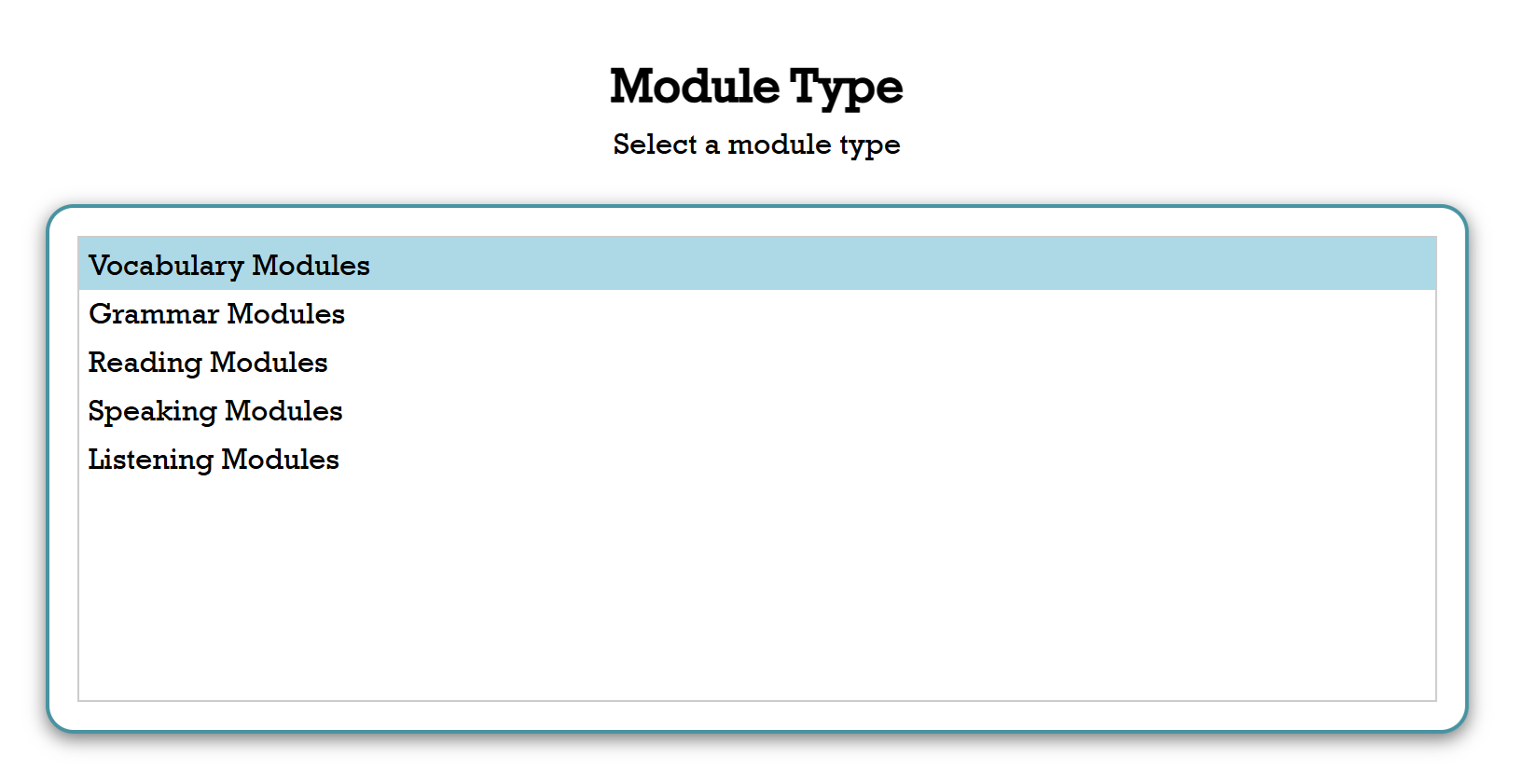
In this post I intend to discuss the contribution of a big section on our website, The workouts, which include sets of activities aimed at modelling and practising through 20 to 30 different tasks the target vocabulary and grammar moving gradually from simple receptive tasks through more challenging ones. Based on memory research, cognitive theory and process-based instruction, the Workouts target deliberate processes (orthographic encoding, aural decoding, sentence reconstruction, semantic processing), offer multimodal encoding (images, sound, print), provide masses of recycling (the same word/chunk is recycled at least 10 times!) and scaffold progression skilfully by managing cognitive load very carefully. Structured variety is the name of the game.
There are several types of workouts: Vocabulary, Grammar, Reading and Listening workouts. The Listening ones are currently being developed and whilst you will find a sizeable set for GCSE practice, they are by all means not complete yet. The Speaking ones are also work in progress The Vocabulary, Grammar and Reading modules are by far the strongest, the richest in content and variety and…the most time-consuming to make!
Please note that now the Workouts are fully aligned with the new Trilogy book series.
One important thing to note about the Workouts: they have been carefully hand-crafted without any help from AI or any other sort of automated system. Ronan, Dylan and myself alongside a host of native-speaker collaborators have been toiling for countless hours to ensure that we applied the most important techniques imported from memory research: deep processing, recycling, task-essentialness, input flood, scaffolding, task-induced relevance (for the reading and listening comprehensions), repeated processing, structured and patterned input, retrieval practice, instant feedback on performance, etc.
2. Thirty activities: not thirty compulsory tasks
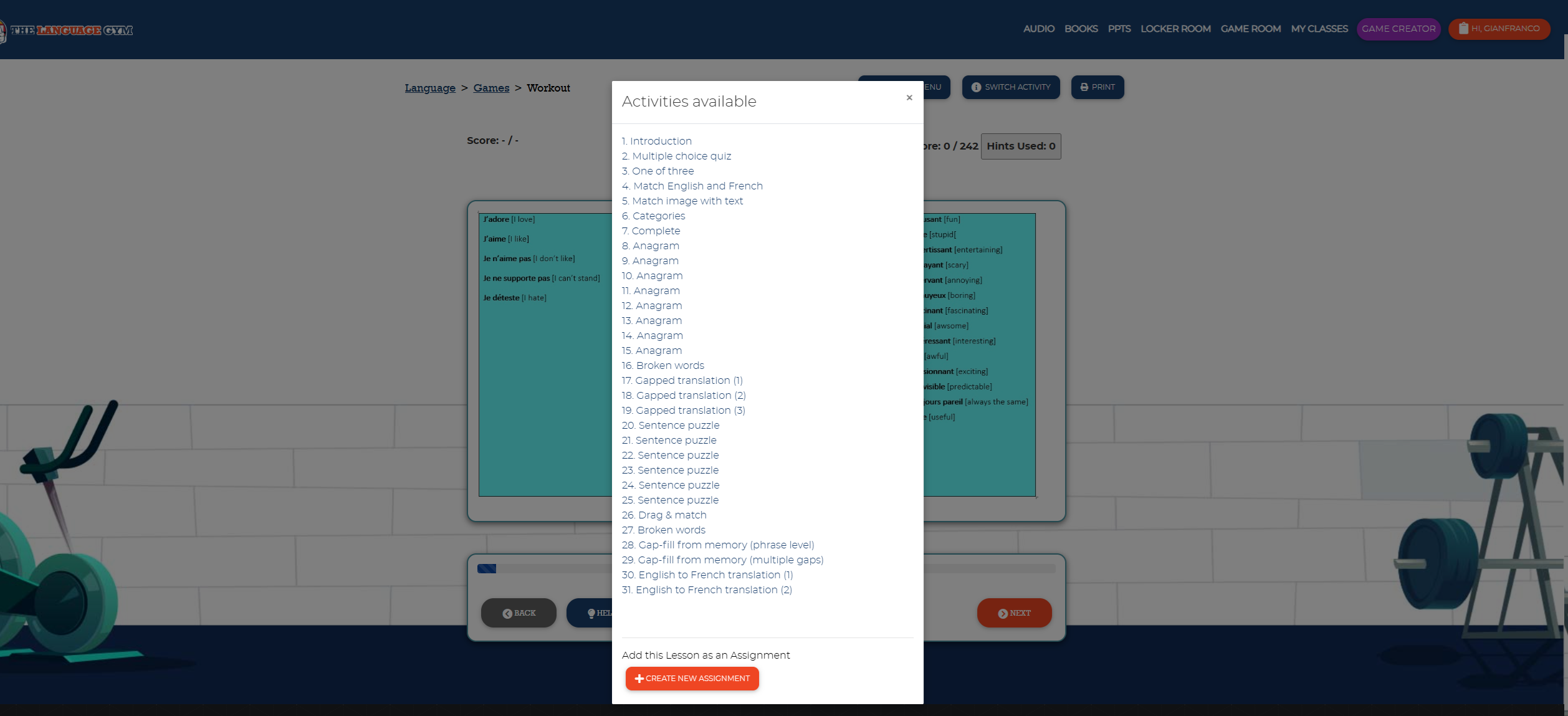
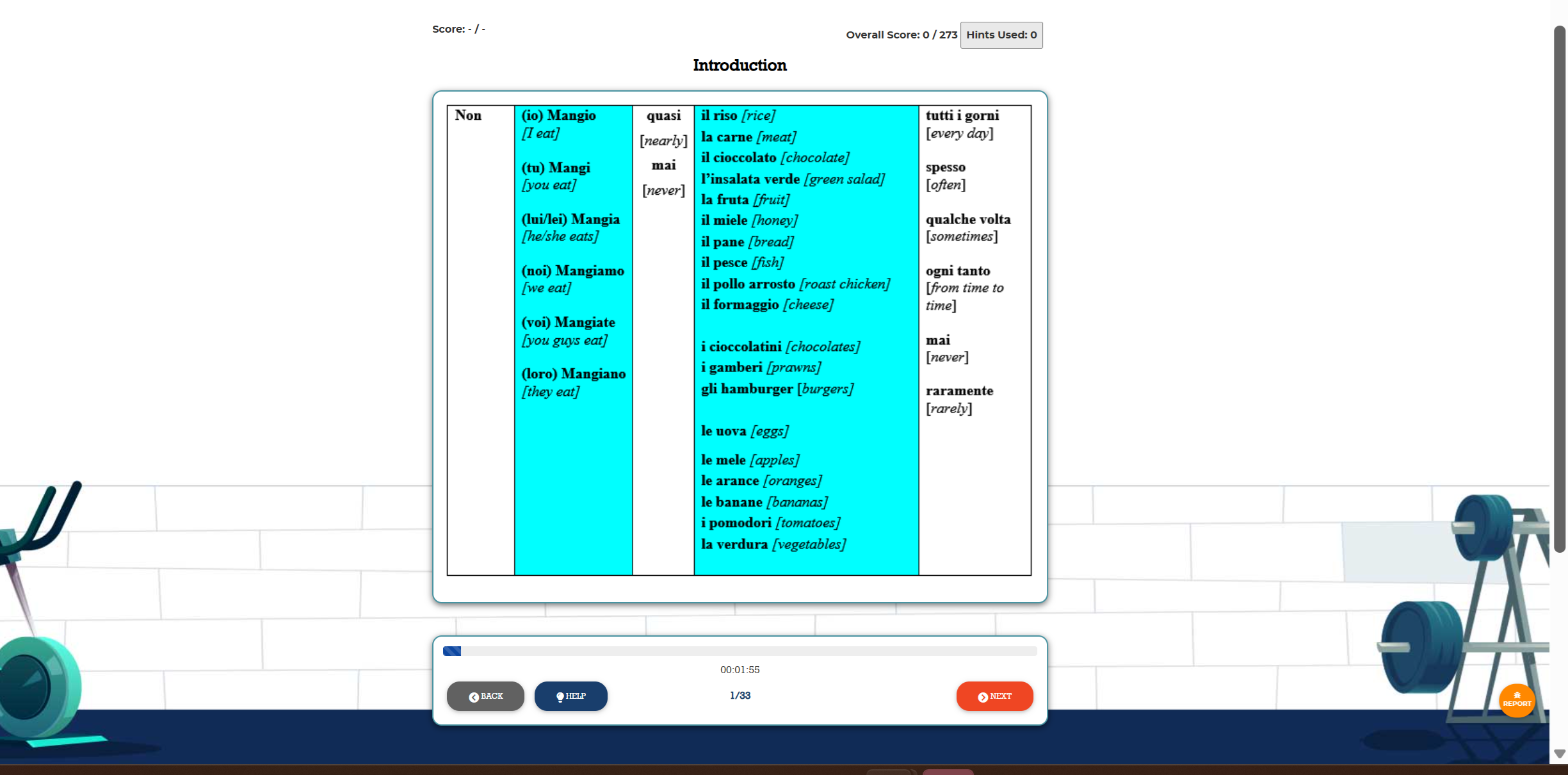
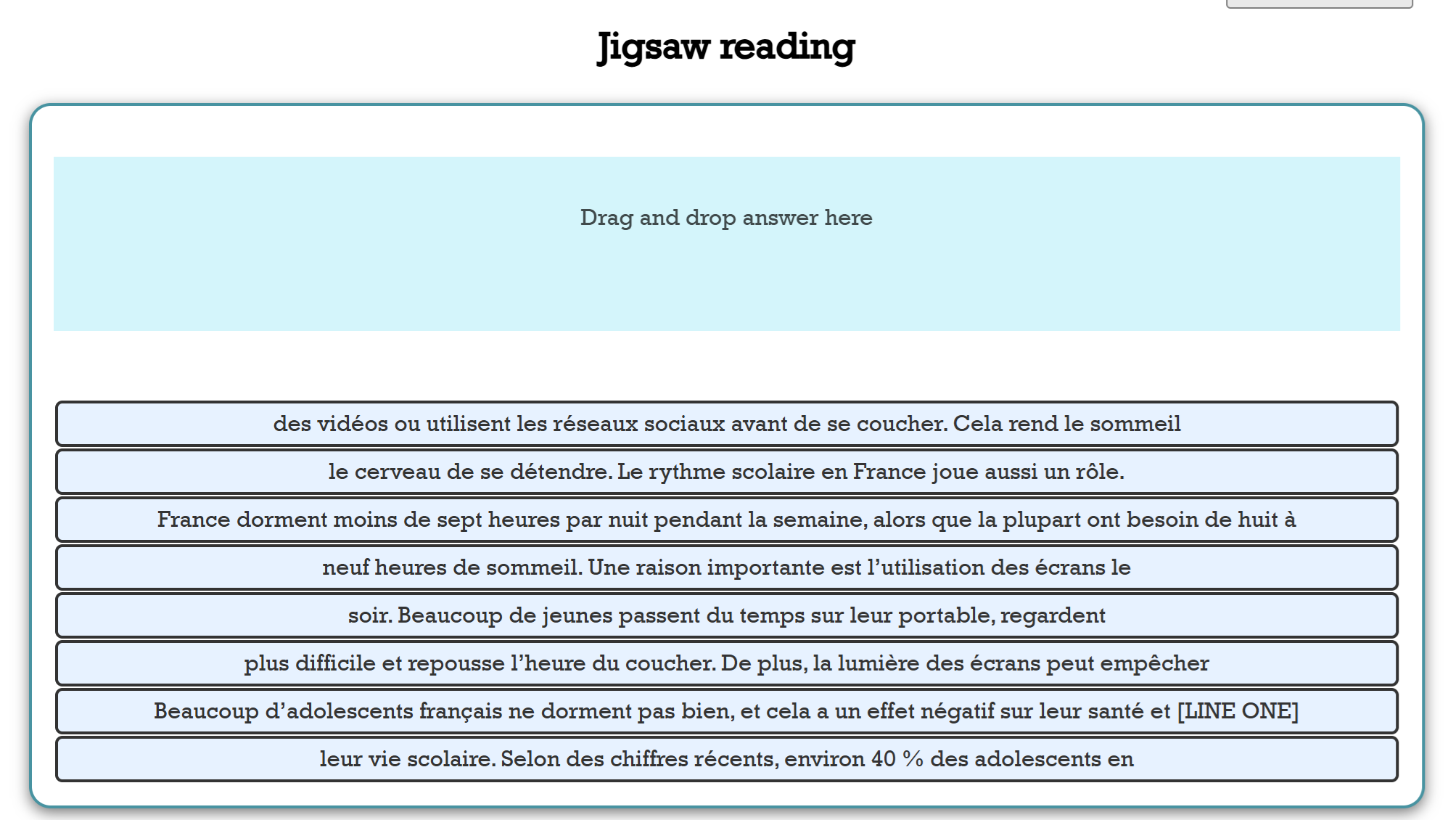
A typical workout on The Language Gym may contain around 20 to 30 activities, although the precise number, sequence and nature of the tasks vary from workout to workout. Besides an introductory bilingual Sentence Builder modelling the target construction and vocabulary, these may include matching exercises, multiple-choice questions, anagrams, sentence puzzles, translation, verb-completion tasks, gap-filling, split sentences, split words, odd-one-outs, picture to word/phrase match-ups, Jigsaw reading/listening activities, L2 -L1 and L1-L2 translation tasks and other activities requiring learners to recognise, retrieve or manipulate linguistic material.
At first glance, this might seem excessive. Do students really need to complete thirty-three activities on the same set of language items? But this question rests on a misunderstanding of how the platform is intended to be used. The activities constitute a bank of practice opportunities, not a compulsory sequence that every student must complete in a single sitting. When setting an assignment using the teachers can, thanks to a newly-created function, decide which activities to assign, which to omit and how to distribute them across classroom work and homework.
The activities constitute a bank of practice opportunities, not a compulsory sequence that every student must complete in a single sitting. When setting an assignment using the teachers can, thanks to a newly-created function, decide which activities to assign, which to omit and how to distribute them across classroom work and homework.
A teacher might assign five activities immediately after a lesson, another four a few days later and a further selection the following week. Alternatively, they might choose particular activities to address weaknesses identified through formative assessment, or assign different combinations to different groups of learners.
This flexibility is fundamental to the platform’s design philosophy. The technology provides the practice opportunities; the teacher makes the pedagogical decisions.
3. Repetition without simply doing the same thing over and over again
One of the most important features of these workouts is the variety of cognitive operations learners are required to perform. Add to this that the activities start by providing lots of receptive practice before venturing in production, which is what research indicates we should do. Finally, the transition from easier to harder tasks is gradually and skillfully scaffolded (hence the high number of activities).
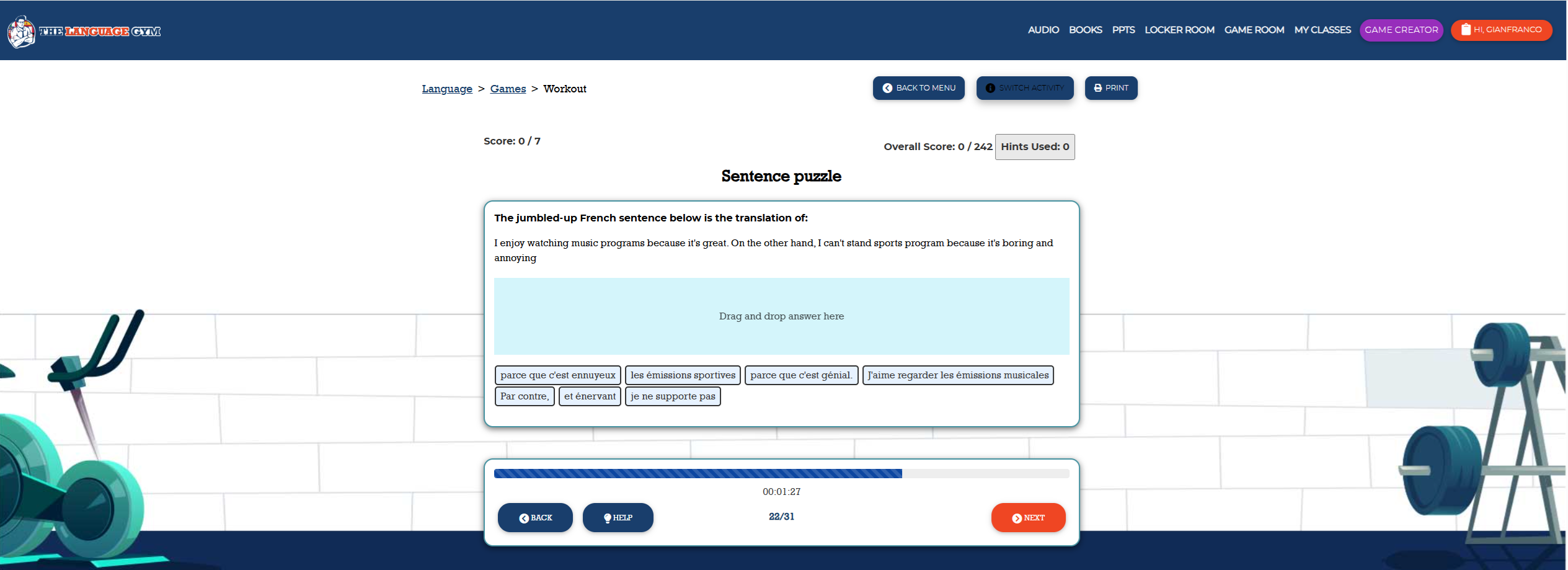
Consider a student learning a set of sentences containing a particular grammatical structure. In one activity, they may be asked to match a sentence to its English equivalent. In another, they may need to identify the correct verb form, reconstruct a sentence from scrambled words, complete a missing ending or translate a short sentence.
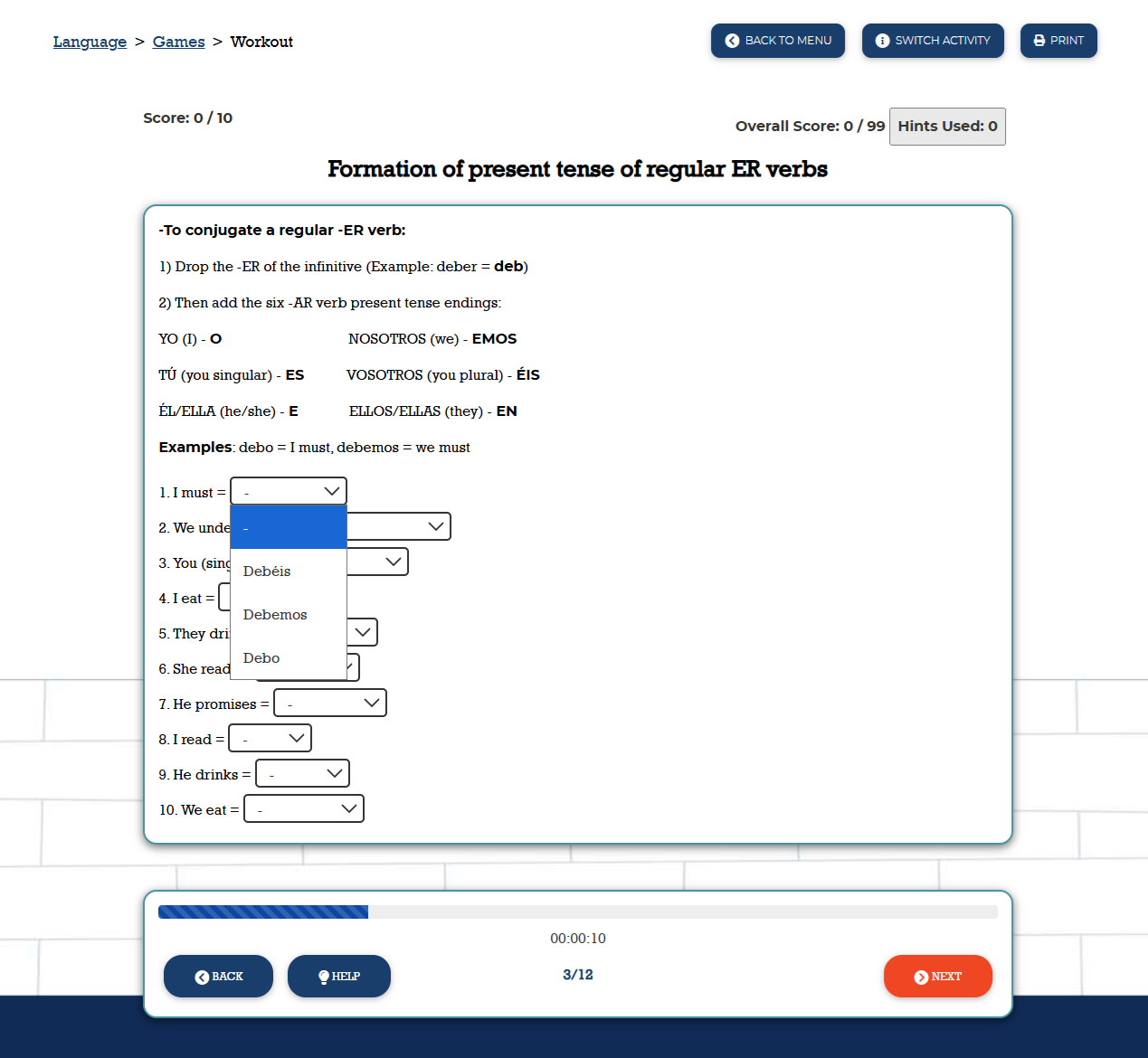
The linguistic material may remain broadly the same, but the processing demands change.This distinction matters because repetition of linguistic content does not necessarily mean repetition of the same cognitive operation. Recognising the correct answer among three alternatives is not equivalent to retrieving that answer without cues, just as rearranging words into the correct order is not equivalent to producing a sentence independently.
Different activities can direct learners’ attention towards different aspects of language, including meaning, lexical form, morphology and syntax. Some provide relatively accessible opportunities for successful retrieval, while others place greater demands on memory and linguistic processing.
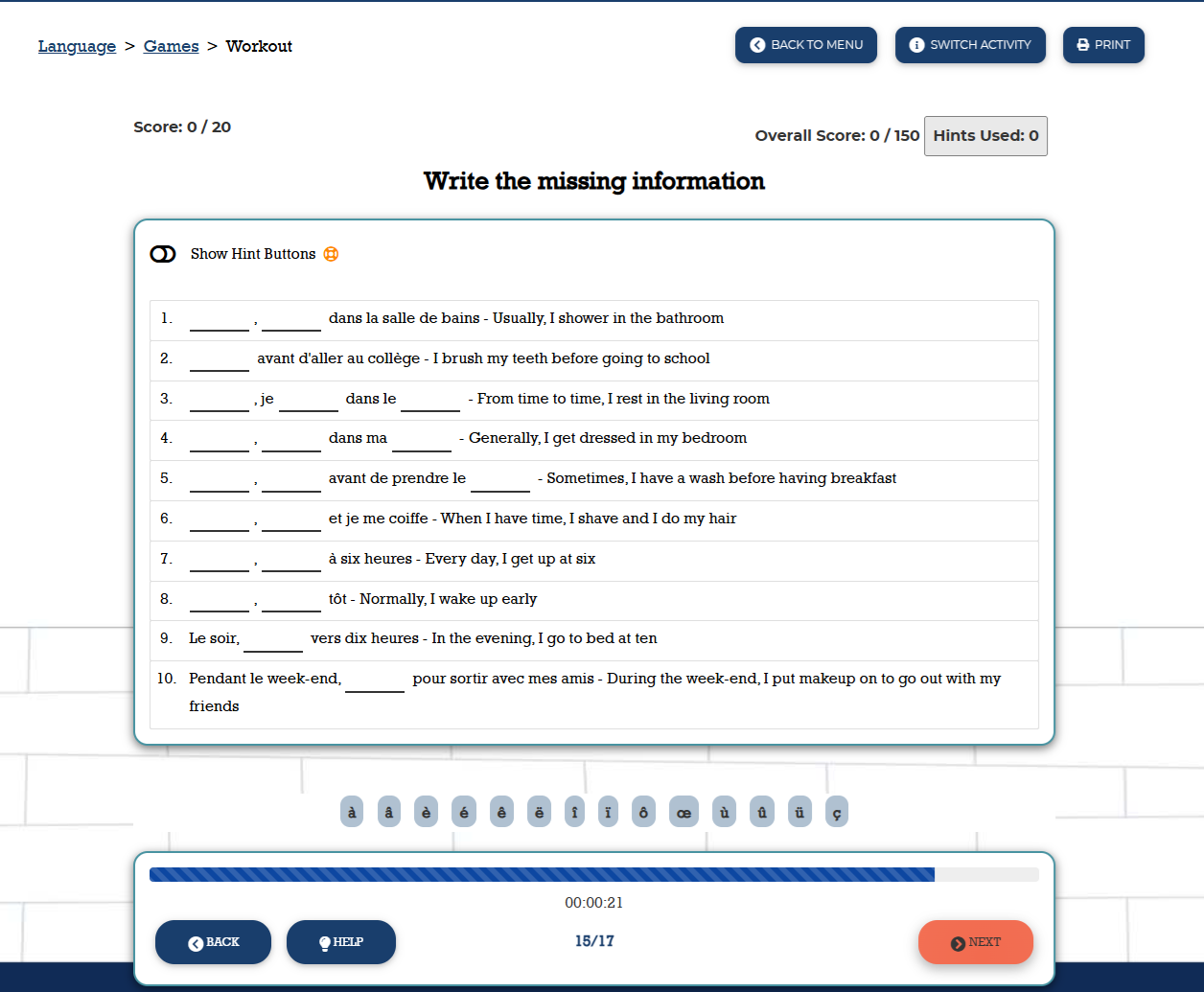
Research on retrieval practice suggests that actively recovering information from memory can strengthen subsequent retention more effectively than simply restudying it (Karpicke & Roediger, 2008). However, not all retrieval tasks are equally demanding, and recognition-based exercises should not be confused with independent production.This is why variety matters, provided that it serves a clear pedagogical purpose rather than merely making practice more entertaining.
4. From declarative knowledge to increasingly proceduralised performance
Another important rationale for The Language Gym comes from Skill Acquisition Theory, particularly the work of Anderson (1982) and DeKeyser (2007).A distinction that I frequently emphasise in my workshops is the difference between declarative knowledge, or knowing about the language, and procedural knowledge, or being able to use it efficiently.
A student may know perfectly well that a particular verb requires a certain ending, yet still hesitate, make errors or fail to retrieve the correct form when speaking. This is because explicit knowledge of a rule does not automatically translate into fluent performance.
There are competing theoretical accounts of the relationship between explicit and implicit knowledge. Strong-interface positions, associated with skill acquisition approaches, propose that explicit knowledge can become increasingly proceduralised through appropriate practice. Weak-interface accounts suggest that explicit knowledge may facilitate acquisition under certain conditions, while non-interface positions, notably associated with Krashen, argue that consciously learned knowledge does not convert into acquired implicit knowledge.
My own pedagogical position is broadly compatible with a skill-acquisition-oriented interface account, although I would not claim that all aspects of implicit linguistic competence can be developed simply through explicit rule practice.
What matters for the present discussion is that repeated, appropriately designed practice can make access to previously learned language more accurate, efficient and less effortful. Segalowitz (2010) reminds us that fluency involves more than simply performing the same task faster; it entails changes in the efficiency and stability of the processes underlying performance.
This is where The Language Gym Workouts + Vocab Trainer + Boxing games + Sentence Trainer can make a valuable contribution. By repeatedly requiring learners to access and manipulate familiar linguistic material, the workouts can support the gradual strengthening of retrieval and processing routines.
However, completing sentence puzzles quickly is not the same as speaking spontaneously. The development of communicative fluency also requires listening, interaction, time-pressured production and opportunities to use language in less predictable contexts. The Language Gym is therefore best understood as one important component of a broader instructional approach, rather than a substitute for communicative language use.
5. The importance of high-density practice
Another feature worth highlighting is the sheer amount of practice that these workouts can potentially generate. In a conventional classroom lesson, opportunities for individual responses are inevitably constrained by time, class size and the need to manage whole-class interaction. Even in a well-run lesson, students may spend considerable time listening to others, waiting for their turn or completing tasks that generate relatively few individual retrieval attempts.
Digital practice environments can help address this limitation by allowing students to work through numerous short tasks at their own pace.A workout containing thirty-three activities may generate a substantial number of individual responses, depending on how many items each activity contains. More importantly, those responses can involve repeated engagement with vocabulary, grammatical structures and sentence patterns that students have previously encountered.
Of course, response quantity should never be confused with learning quality. A hundred superficial clicks are not necessarily more valuable than twenty demanding retrieval attempts. What matters is whether the tasks require meaningful processing, provide appropriate challenge and create opportunities to strengthen memory.
Nevertheless, when the activities are well designed, high response density can be a considerable advantage, especially for consolidation.
6. Why shorter assignments may be better than one long workout
Although a workout may contain more than thirty activities, there is no pedagogical reason why students should complete all of them in one sitting. Indeed, research on distributed practice suggests that spreading learning opportunities across time generally produces better long-term retention than concentrating the same amount of practice into a single session (Cepeda et al., 2006).
This has obvious implications for how teachers might use The Language Gym. Instead of assigning an entire workout on Monday, a teacher could select a small number of activities for Monday evening, another selection for Thursday and further activities the following week. Some of these could revisit the same material through different formats, while others could target items that students previously found difficult.
The point is not to maximise the number of activities completed in a single session, but to maximise the likelihood that previously taught language will still be accessible days, weeks and months later.
There is also an important distinction between repeating an activity immediately and retrieving the same language after a delay. The latter generally places greater demands on memory and can therefore be particularly valuable for retention, provided that the task remains achievable. In practical terms, I would much rather see students completing several carefully selected short assignments over two or three weeks than rushing through an entire workout once and never returning to the material.
7. Teacher autonomy: the technology should serve the pedagogy
Perhaps the most important aspect of The Language Gym’s design is that teachers retain control over the selection of activities.There is a tendency in educational technology to equate personalisation with algorithms that automatically determine what students should do next. Adaptive technology can certainly be useful, but it is not the only, or necessarily the best, way to personalise learning.
Teachers possess information that an algorithm may not have. They know what has been taught, which structures students have struggled with, which errors are recurring, how demanding a particular lesson has been and what learners are expected to do next.
The ability to select activities from a larger workout allows teachers to exercise that professional judgement. For example, after a lesson on past-tense narration, a teacher might notice that students can retrieve the relevant vocabulary but continue to struggle with verb endings. Rather than assigning the entire workout, they could select the verb-completion and sentence-reconstruction activities that address precisely that weakness.
Another class might need more support with basic vocabulary recognition, while a more confident group might benefit from activities requiring greater independence.
The same workout can therefore serve different purposes for different learners and at different points in the learning sequence.
This is teacher-led personalisation rather than technology-led prescription.
It is also consistent with a principle I consider fundamental to effective curriculum design: teachers should have access to a rich repertoire of activities, but those activities should be selected according to learning objectives, not simply because they are available.
8. Where The Language Gym fits within EPI
Within my Extensive Processing Instruction framework, The Language Gym is particularly useful for recycling, consolidation and the strengthening of previously established form–meaning connections.
In the MARSEARS instructional sequence, initial modelling and input processing provide learners with repeated exposure to carefully selected language. Subsequent activities help students consolidate those representations, retrieve them with increasing independence and eventually use them in more demanding communicative contexts.
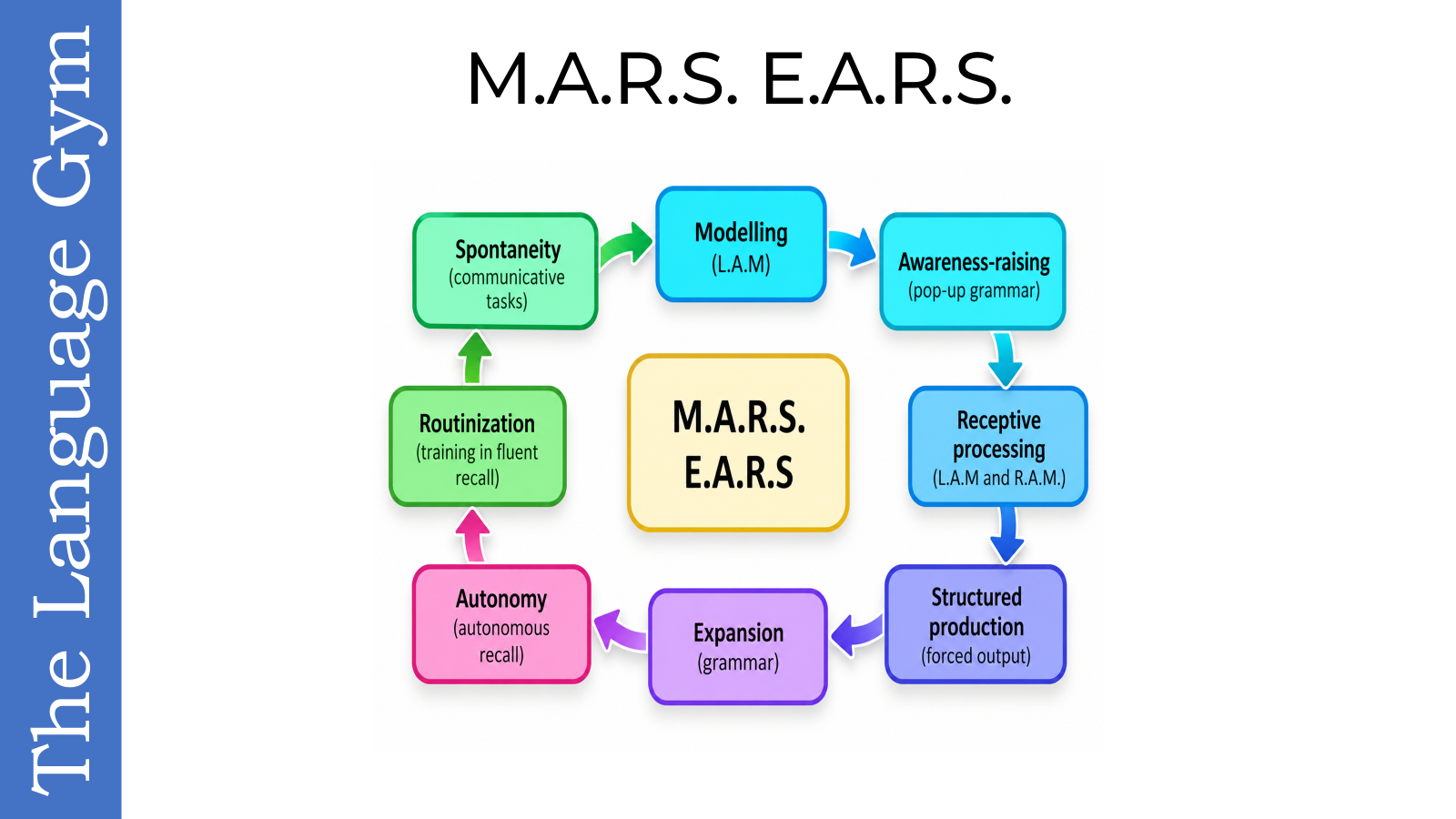
The Language Gym can support this process by providing additional practice between lessons, when forgetting is likely to occur and when classroom time is unavailable.
For example, after a lesson involving extensive listening and reading practice, students might complete a short selection of matching and sentence-reconstruction activities at home. Later in the week, they might revisit the same structures through gap-filling, verb completion or translation.
These activities do not replace the listening, speaking and communicative work carried out in class. Rather, they can help ensure that the linguistic material needed for those tasks remains accessible. This is especially important in contexts where students receive only one or two language lessons per week. Without opportunities for consolidation between lessons, a substantial proportion of classroom time may be spent re-establishing knowledge that students had apparently mastered previously.
The Language Gym offers teachers a practical way of extending learning beyond the classroom without requiring them to create every additional practice activity from scratch.
9. What the research supports — and what it does not
I think it is important to distinguish between the research underpinning the design of The Language Gym and direct evidence of the platform’s effectiveness. There is a substantial research base supporting distributed practice, retrieval practice, repeated encounters with linguistic material and the role of practice in developing more efficient performance.
However, this does not mean that every activity format is equally effective, that completing more exercises invariably leads to better learning or that performance gains on digital tasks automatically transfer to spontaneous communication. Nor would I claim that the precise sequence or number of activities in a workout has been scientifically established as optimal.
The stronger and more defensible argument is that The Language Gym brings together several well-supported principles of learning in a practical environment that teachers can adapt to their instructional needs.
Ultimately, the effectiveness of any workout will depend on the quality of the activities, the learners’ prior knowledge, the timing and distribution of practice, the feedback available and the extent to which the targeted language is subsequently used in meaningful contexts.
10. Conclusions: consolidation is not an optional extra
One of the recurring weaknesses I observe in language teaching is the tendency to move on too quickly. New vocabulary and structures are introduced, practised briefly, assessed and then replaced by the next set of content, often before learners have developed sufficiently stable and accessible representations of what they have supposedly learned.
The result is predictable: students may perform reasonably well immediately after instruction but struggle to retrieve the same language a few weeks later, let alone use it fluently under communicative pressure.
The solution is not simply to teach less or repeat everything indefinitely. It is to design learning sequences in which previously taught language is systematically revisited, retrieved and recombined over time.
This is the philosophy underpinning The Language Gym.
Its workouts provide a rich bank of varied practice opportunities, with substantial recycling of vocabulary, grammar and sentence patterns. Their length and density are deliberate, but they are not intended to impose an equally lengthy workload on every student. Teachers decide which activities to use, when to use them and how much practice is appropriate.
For me, that combination of extensive recycling, varied processing demands, distributed practice and teacher autonomy is what makes the model pedagogically valuable.
The objective is not to keep students busy clicking through exercises. It is to help them retain more of what they have been taught, retrieve it more efficiently and become better prepared for the demands of real-time language use.
Because, ultimately, what matters is not how much language students have been taught, but how much of that language they can still access and use when they need it.
Selected references
- Anderson, J. R. (1982). Acquisition of cognitive skill. Psychological Review, 89(4), 369–406.
- Cepeda, N. J., Pashler, H., Vul, E., Wixted, J. T., & Rohrer, D. (2006). Distributed practice in verbal recall tasks: A review and quantitative synthesis. Psychological Bulletin, 132(3), 354–380.
- DeKeyser, R. M. (Ed.). (2007). Practice in a Second Language: Perspectives from Applied Linguistics and Cognitive Psychology. Cambridge University Press.
- Karpicke, J. D., & Roediger, H. L. (2008). The critical importance of retrieval for learning. Science, 319(5865), 966–968.
- Nation, I. S. P. (2013). Learning Vocabulary in Another Language (2nd ed.). Cambridge University Press.
- Segalowitz, N. (2010). Cognitive Bases of Second Language Fluency. Routledge.

