
1. A little experiment
I would like to start this post with a little experiment which I use in my workshops on vocabulary acquisition. Before reading any further, please read the following text and answer the ten comprehension questions underneath it. Give yourself no more than three minutes.
An unusual holiday
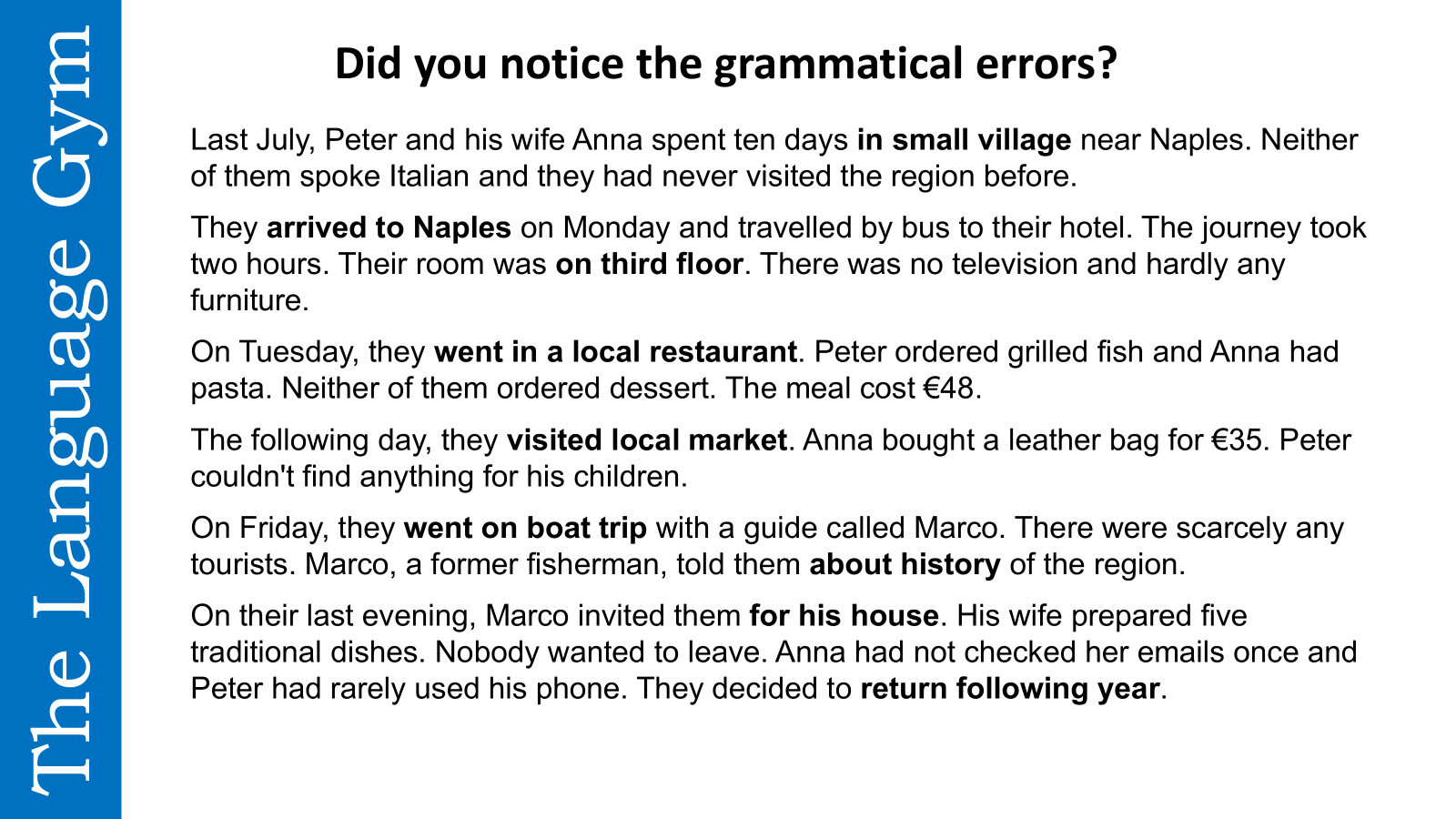
Last July, Peter and his wife Anna spent ten days in small village near Naples. Neither of them spoke Italian and they had never visited the region before.
They arrived to Naples on Monday and travelled by bus to their hotel. The journey took two hours. Their room was on third floor. There was no television and hardly any furniture.
On Tuesday, they went in a local restaurant. Peter ordered grilled fish and Anna had pasta. Neither of them ordered dessert. The meal cost €48.
The following day, they visited local market. Anna bought a leather bag for €35. Peter couldn’t find anything for his children.
On Friday, they went on boat trip with a guide called Marco. There were scarcely any tourists. Marco, a former fisherman, told them about history of the region.
On their last evening, Marco invited them for his house. His wife prepared five traditional dishes. Nobody wanted to leave. Anna had not checked her emails once and Peter had rarely used his phone. They decided to return following year.
Comprehension questions
- How long was their holiday?
- Where did they arrive?
- How long was the bus journey?
- Which floor was their room on?
- What did Peter eat?
- How much was their meal?
- What did Anna buy?
- How much did it cost?
- What was Marco’s former job?
- How many dishes did his wife prepare?
Fairly straightforward, wasn’t it? I suspect most readers will have scored ten out of ten.
Now, without looking back at the text, answer the following questions:
- Did you notice any missing words? Which ones?
- Did you notice any grammatical errors? Which ones?
- Besides the past tenses, which grammatical feature occurred particularly frequently throughout the text?
- Can you recall six different ways in which that feature was expressed?
Not quite as straightforward, is it?
2. What did your brain filter out?
Let’s look at some of the deliberately planted errors and omissions:
| Original text | Correct version |
|---|---|
| In small village | In a small village |
| Arrived to Naples | Arrived in Naples |
| On third floor | On the third floor |
| Went in a local restaurant | Went to a local restaurant |
| Visited local market | Visited a local market |
| Went on boat trip | Went on a boat trip |
| About history of the region | About the history of the region |
| Invited them for his house | Invited them to his house |
| Return following year | Return the following year |
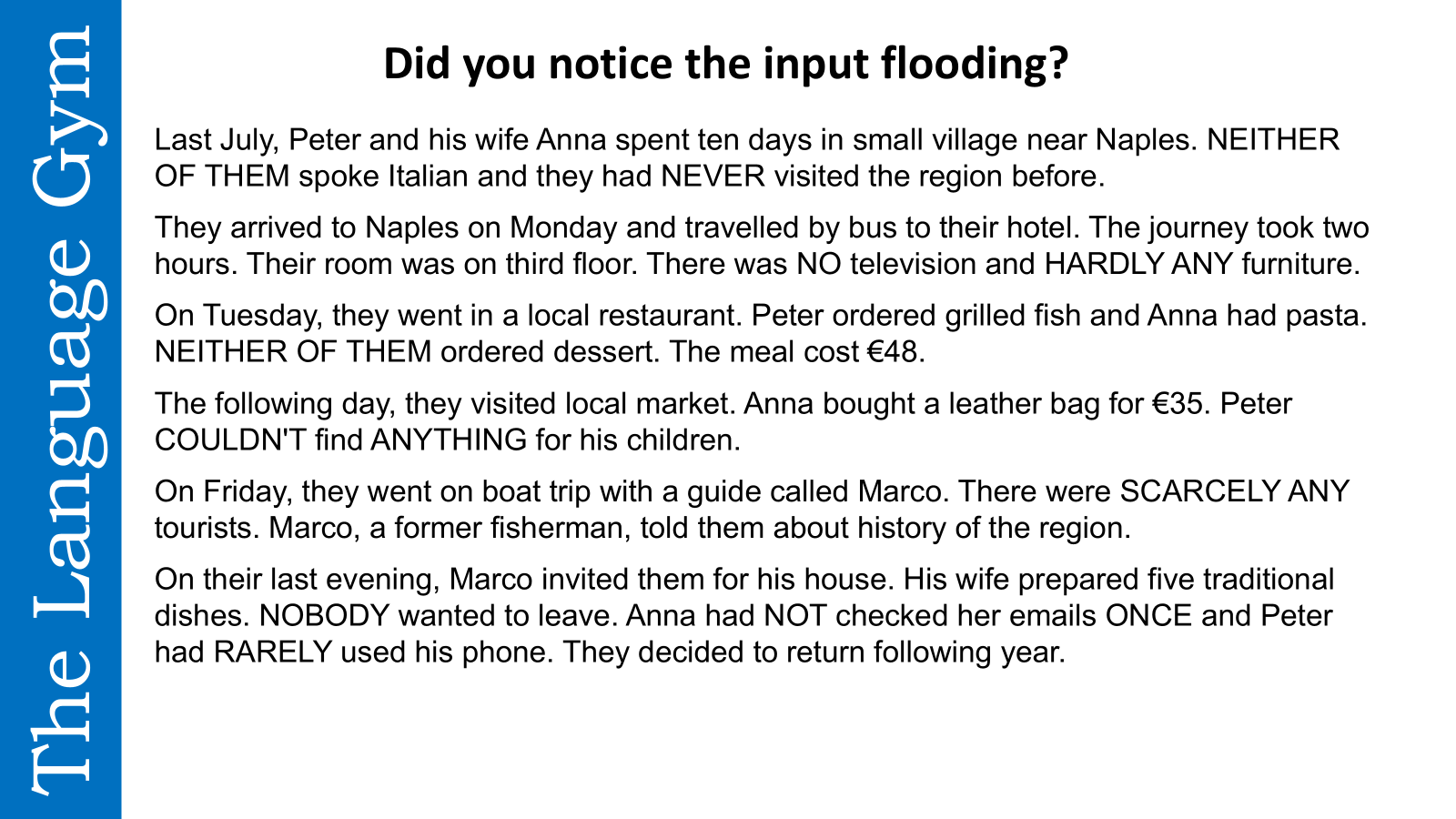
Moreover, I deliberately flooded the text with a range of negative and near-negative structures:
- Neither of them
- Never
- No
- Hardly any
- Couldn’t … anything
- Scarcely any
- Nobody
- Not … once
- Rarely
How many did you consciously register? And how many could you recall immediately after reading the text?
Of course, some of you, particularly as language teachers, will have noticed several of these features. This is not a controlled scientific experiment, but a simple demonstration of an important phenomenon: successful comprehension does not necessarily entail thorough linguistic processing.
Your brain was primarily concerned with extracting the information required to answer the questions. Much of the remaining linguistic information was of little relevance to the task you had been assigned.
Now consider the implications of this phenomenon for a Year 8 student learning French, Spanish or German, whose linguistic knowledge and processing efficiency are considerably more limited than yours when reading English.
3. The invisible half of language
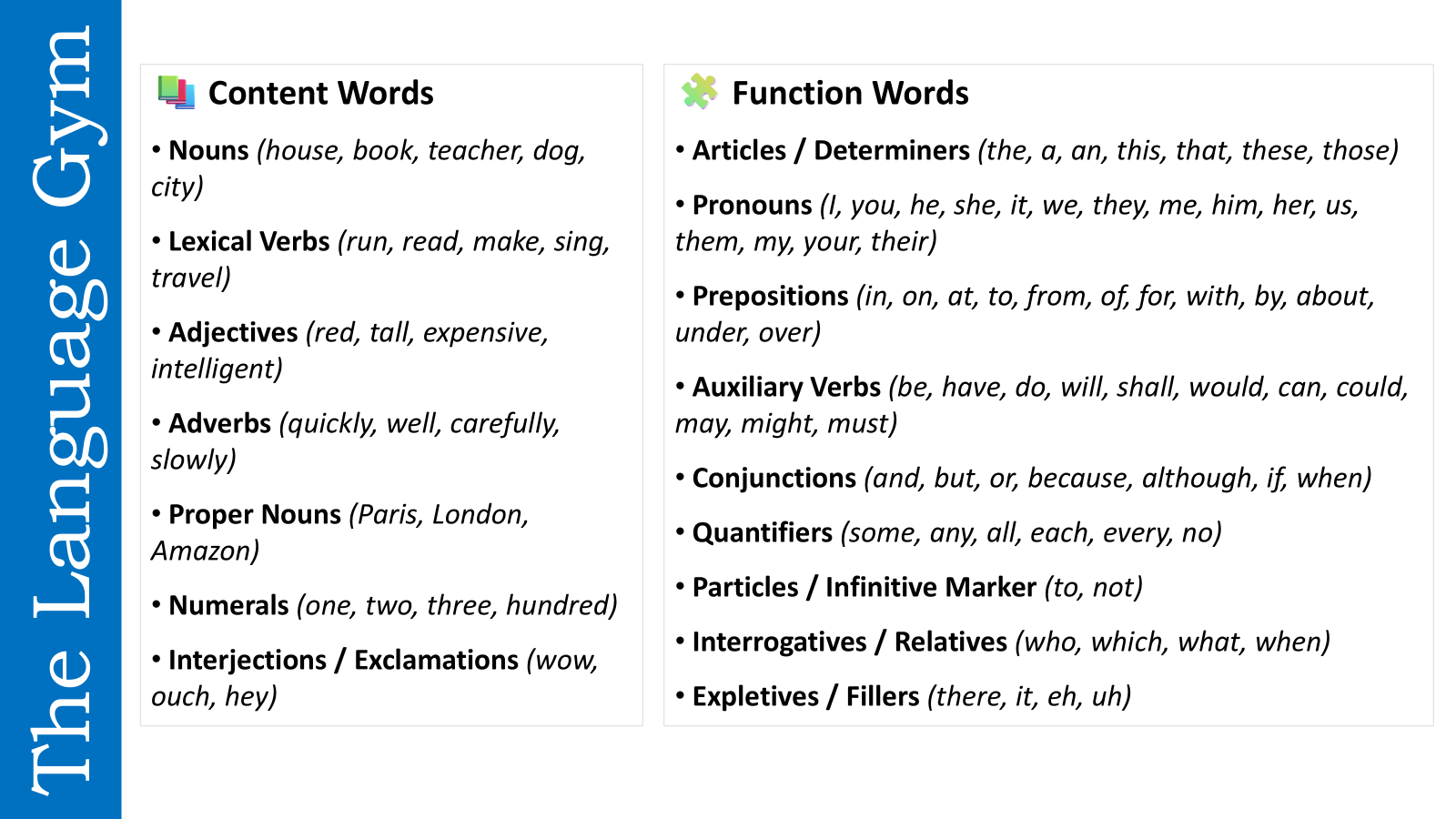
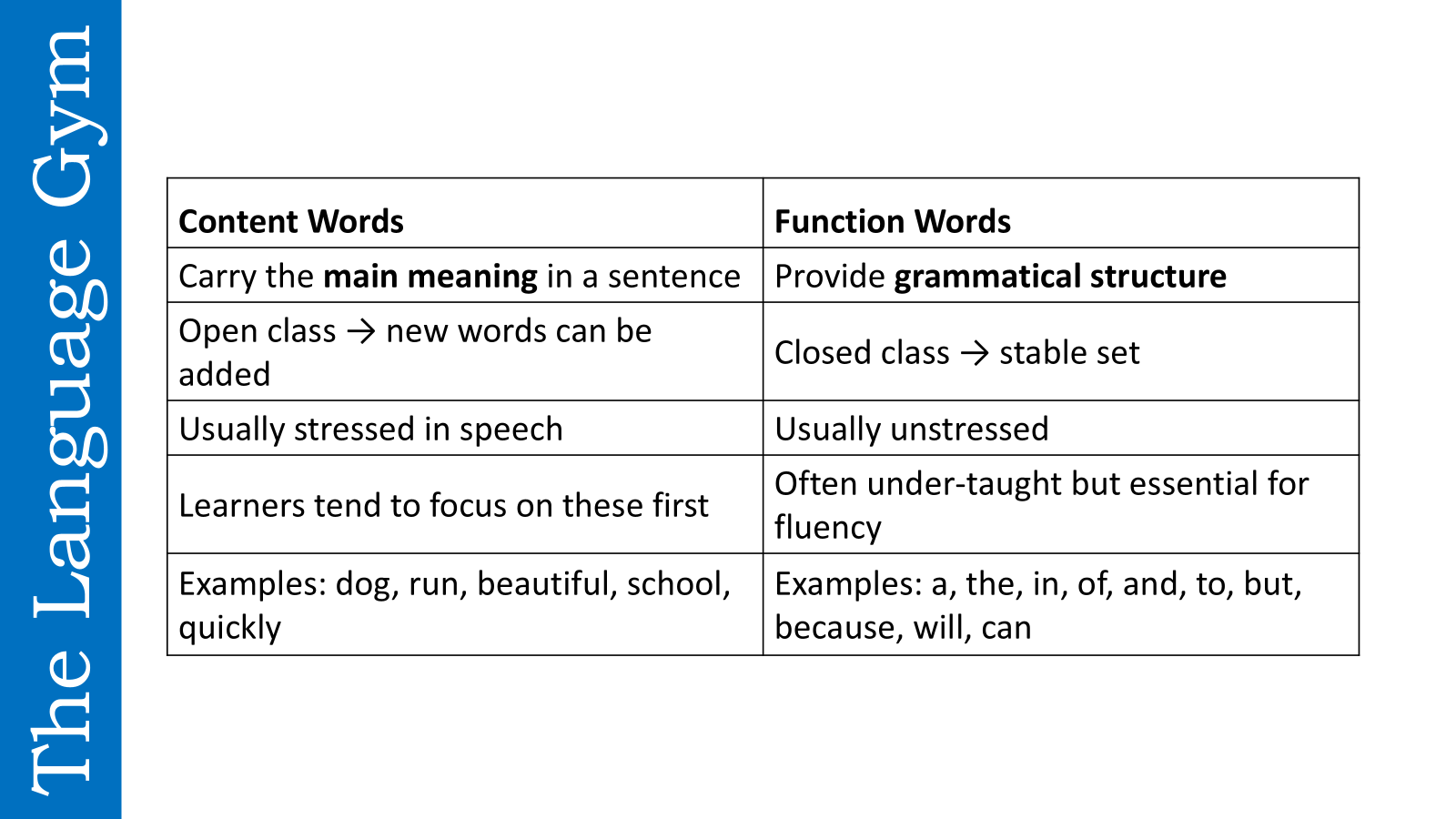
In vocabulary instruction, we tend to devote considerable attention to what linguists refer to as content words: nouns, lexical verbs, adjectives and adverbs. These are the words which typically carry much of the propositional meaning of an utterance.
However, there is another category of words which deserves considerably more attention in our teaching: function words.These include articles, prepositions, pronouns, conjunctions, auxiliary verbs and various other grammatical particles.Depending on the language, text type and classification criteria, function words can account for around half or more of the running words in a text.
Yet, precisely because many of them carry relatively little independent semantic information, are short and are often unstressed in connected speech, they are particularly vulnerable to being overlooked by learners.
Consider the following French sentence:
Le week-end dernier, je suis allé au cinéma avec mes amis.
A beginner might extract much of the intended meaning by recognising:
week-end – dernier – allé – cinéma – amis
However, what about the auxiliary suis, the contracted article au, the possessive mes and the preposition avec?
The learner may have understood the message without attending sufficiently to some of the very features which we would like them to acquire and subsequently use accurately in their own production. This is one of the reasons why I believe that vocabulary instruction which focuses predominantly on isolated content words is insufficient.
Knowing lots of nouns, verbs and adjectives does not necessarily equip learners with the linguistic resources required to assemble accurate sentences fluently. Content words carry much of the message; function words provide much of the architecture which holds that message together.
4. Why the brain prioritises meaning over form
VanPatten’s work on input processing (1996, 2004) is particularly relevant here. One of the central tenets of his model is that learners tend to process input for meaning before processing it for grammatical form. When attentional resources are limited, they tend to prioritise linguistic information which is most useful in establishing the meaning of an utterance.
Consider for instance:
Hier, j’ai joué au tennis.
The word hier tells the learner that the event occurred in the past. The words joué and tennis provide much of the remaining information.From a purely comprehension-oriented perspective, there may be little incentive to process the auxiliary ai or to pay close attention to the morphological features of joué.This is particularly important when two linguistic features convey essentially the same information. If one feature is easier to process, the learner may rely on it at the expense of the other.
The problem is compounded in listening, where the input is transient, many function words are acoustically inconspicuous and learners have very little time to allocate attention to individual linguistic features. This has important implications for the way we design listening and reading activities.
A student who scores ten out of ten in a comprehension task may have demonstrated that they can extract ten pieces of information from a text. They have not necessarily demonstrated that they have processed its grammatical architecture, acquired its vocabulary or strengthened the linguistic representations required for future production.
Key take-away: we must not confuse evidence of comprehension with evidence of acquisition.
5. The limitations of traditional comprehension questions
One question I would encourage language teachers to ask themselves when designing a reading or listening task is:
Which words and structures do my students actually need to process in order to complete this task successfully?
Consider the following sentence:
Hier, je ne suis pas allé au cinéma parce que j’étais malade.
Imagine that the comprehension question is:
Why was the person ill or unable to go out?
The learner may focus almost exclusively on malade, depending on the precise wording of the question.
Now consider a different set of questions:
- Did the person go to the cinema?
- Was the person planning to go or describing a past event?
- What prevented them from going?
The attentional demands of the task have changed. The negative structure, the temporal reference and the causal relationship have become more relevant to successful task completion.
The text has not changed. What has changed is the way in which the learner is required to process it. This is what I refer to as task-induced relevance: designing tasks in such a way that processing the target linguistic features becomes relevant, and ideally essential, to successful task completion.
The implications are considerable. Two teachers can use exactly the same text and create very different opportunities for language acquisition simply by designing different tasks around it.
6. Why I advocate teaching lexico-grammatical chunks
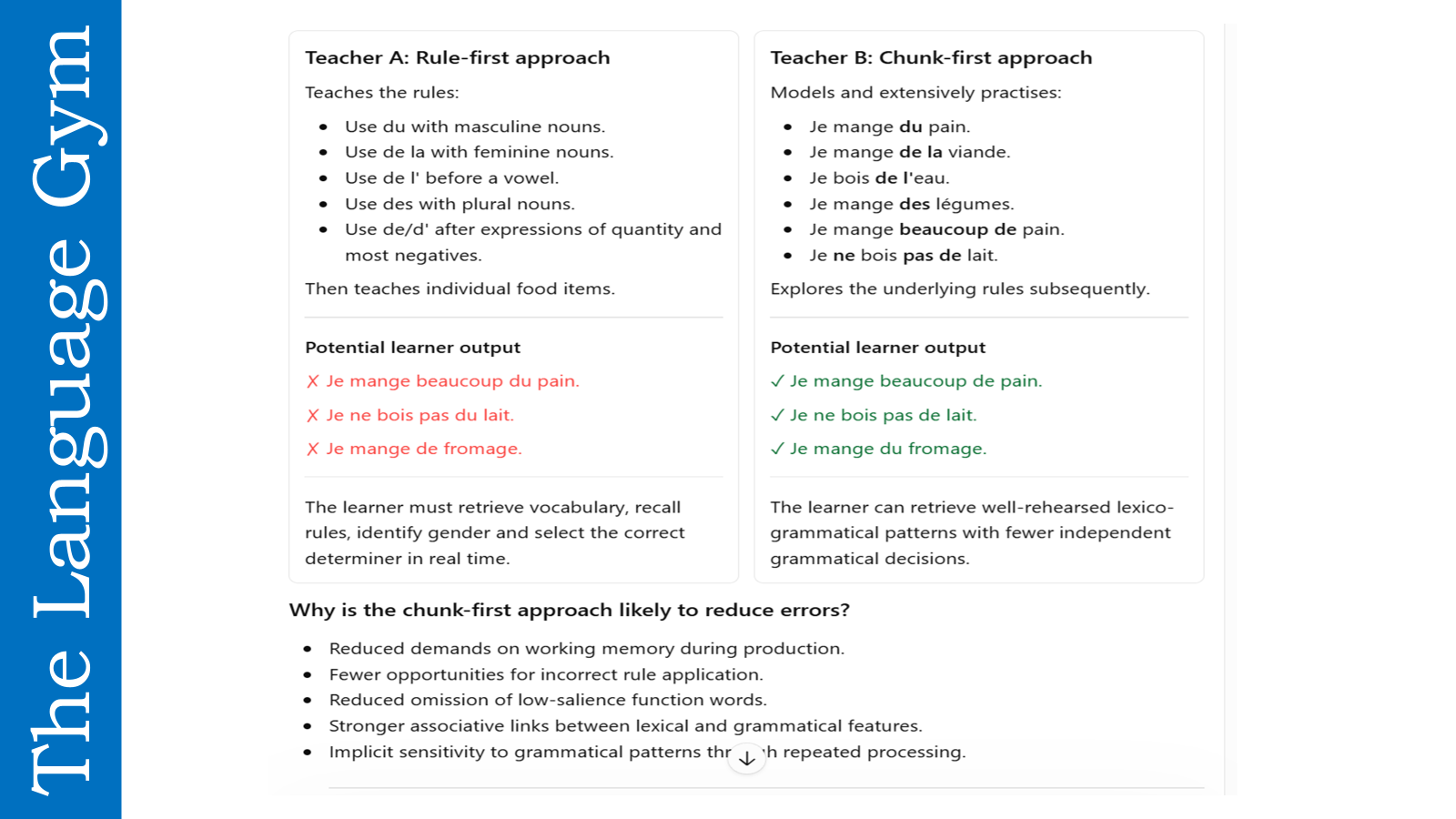
Another way of addressing the problem is to teach vocabulary in chunks which incorporate the very function words that learners might otherwise overlook. Imagine two French teachers teaching the language of food and drink.
Teacher A teaches a list of food items and subsequently explains the rules governing the use of the partitive article.
Teacher B models and extensively practises chunks such as:
- Je mange du pain.
- Je mange de la viande.
- Je bois de l’eau.
- Je mange des légumes.
- Je mange beaucoup de pain.
- Je ne bois pas de lait.
Teacher B subsequently explores the grammatical patterns underlying these chunks. The difference between the two approaches is not that one teacher teaches grammar and the other does not. It is primarily a difference in instructional sequencing and in the nature of the linguistic representations being established in memory.
By repeatedly processing and retrieving beaucoup de, je ne bois pas de and je mange du as meaningful units, learners can develop stronger associative links between lexical and grammatical information. When producing language, they may consequently need to make fewer independent grammatical decisions in real time.
This can reduce the demands on working memory and potentially decrease the likelihood of errors such as:
- Je mange beaucoup du pain.
- Je ne bois pas du lait.
- Je mange de fromage.
Of course, chunk learning alone does not guarantee grammatical generalisation. Learners also need opportunities to manipulate, analyse and recombine the language they have learnt. However, establishing a repertoire of accurately encoded, extensively practised chunks can provide an excellent foundation for subsequent grammatical instruction and spontaneous language production.
7. Five ways of engineering attention
If exposure and comprehension alone do not guarantee that learners will process the features we intend them to acquire, what can we do about it?
7.1. Input flooding
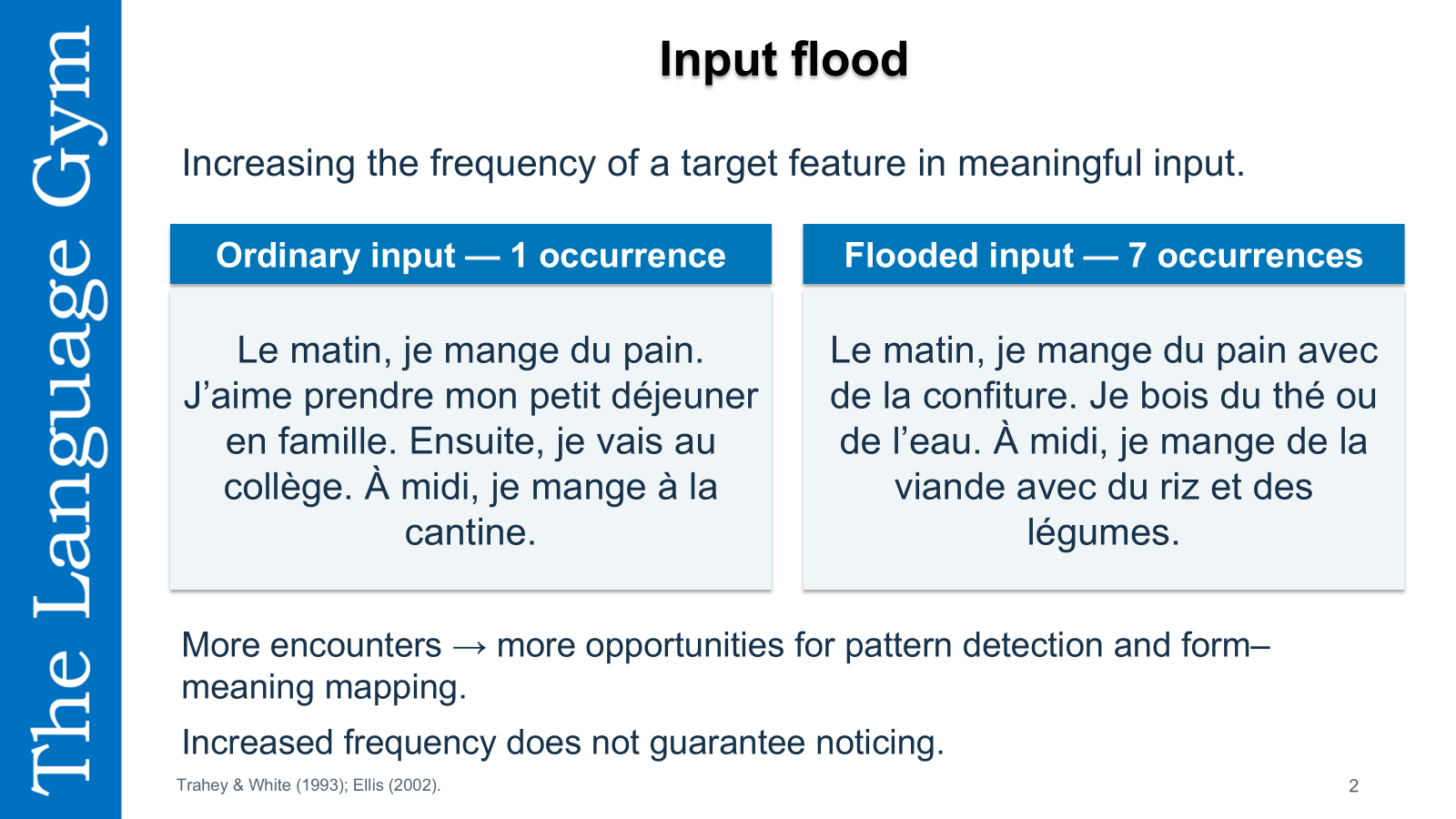
Input flooding involves increasing the frequency of a target linguistic feature in meaningful input.
If I want my students to acquire the French partitive article, I might expose them to the following text:
Le matin, je mange du pain avec de la confiture et je bois du thé. Je mange aussi des fruits, mais je ne bois pas de café.
À midi, je mange du poulet avec du riz et des légumes. Je bois beaucoup d’eau, mais je ne bois jamais de boissons gazeuses.
Le soir, je mange de la soupe avec du fromage. Quelquefois, je mange des pâtes, mais je ne mange pas de viande.
The frequency of the target features creates numerous opportunities for learners to process them and potentially detect recurring patterns.
However, as our opening demonstration illustrates, frequency alone does not guarantee noticing.
7.2. Input enhancement
Input enhancement (Sharwood Smith, 1993) involves increasing the perceptual salience of the features we want learners to attend to.
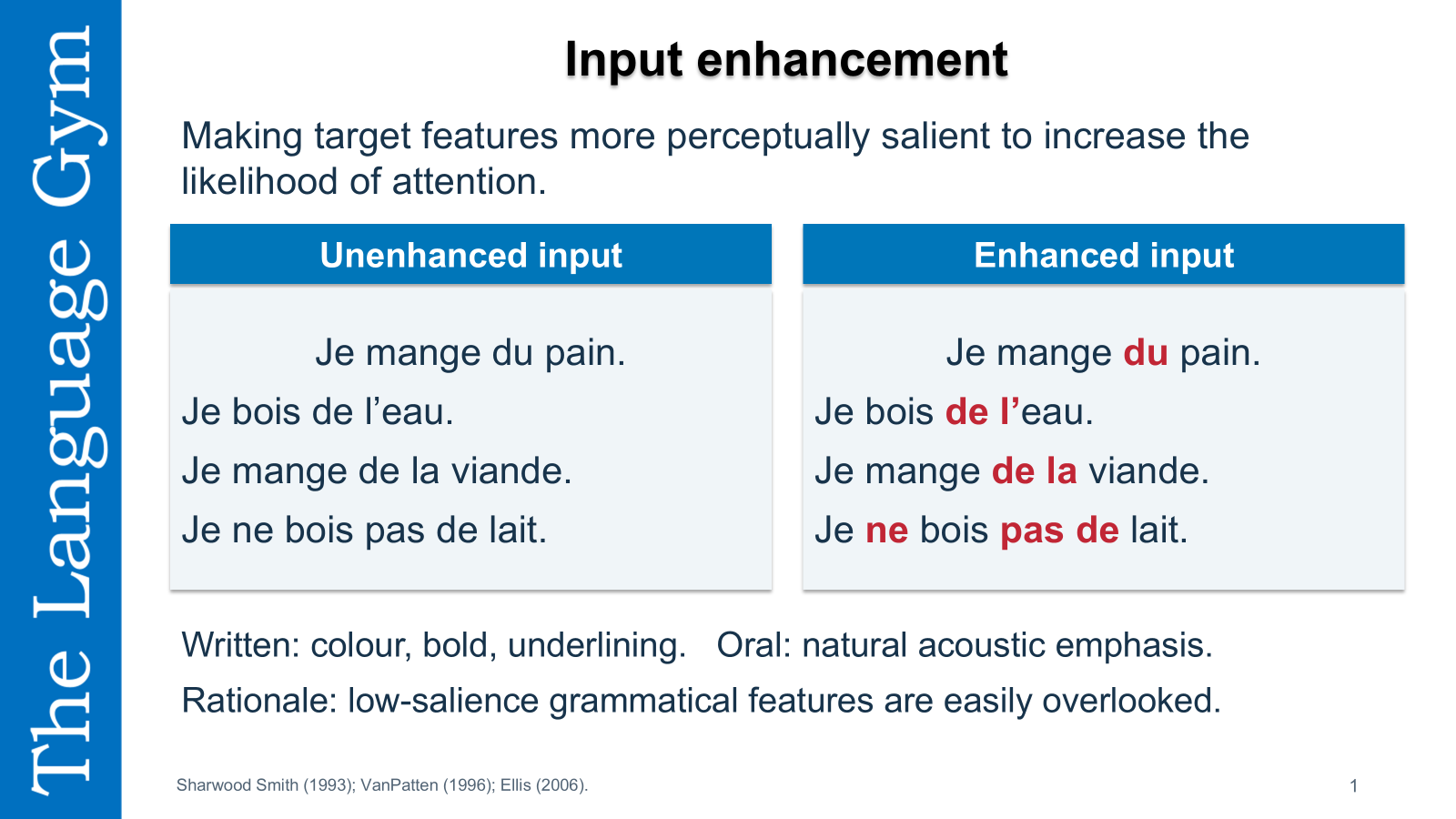
Consider the same text:
Le matin, je mange du pain avec de la confiture et je bois du thé. Je mange aussi des fruits, mais je ne bois pas de café.
À midi, je mange du poulet avec du riz et des légumes. Je bois beaucoup **d’**eau, mais je ne bois jamais de boissons gazeuses.
Le soir, je mange de la soupe avec du fromage. Quelquefois, je mange des pâtes, mais je ne mange pas de viande.
Through bolding, colour-coding or underlining, I can increase the likelihood that learners will attend to the target features.
In listening, I can initially achieve something similar through carefully calibrated acoustic emphasis, whilst subsequently exposing learners to more natural pronunciation.
Combining input flooding and input enhancement addresses two complementary dimensions of input processing: frequency and perceptual salience.
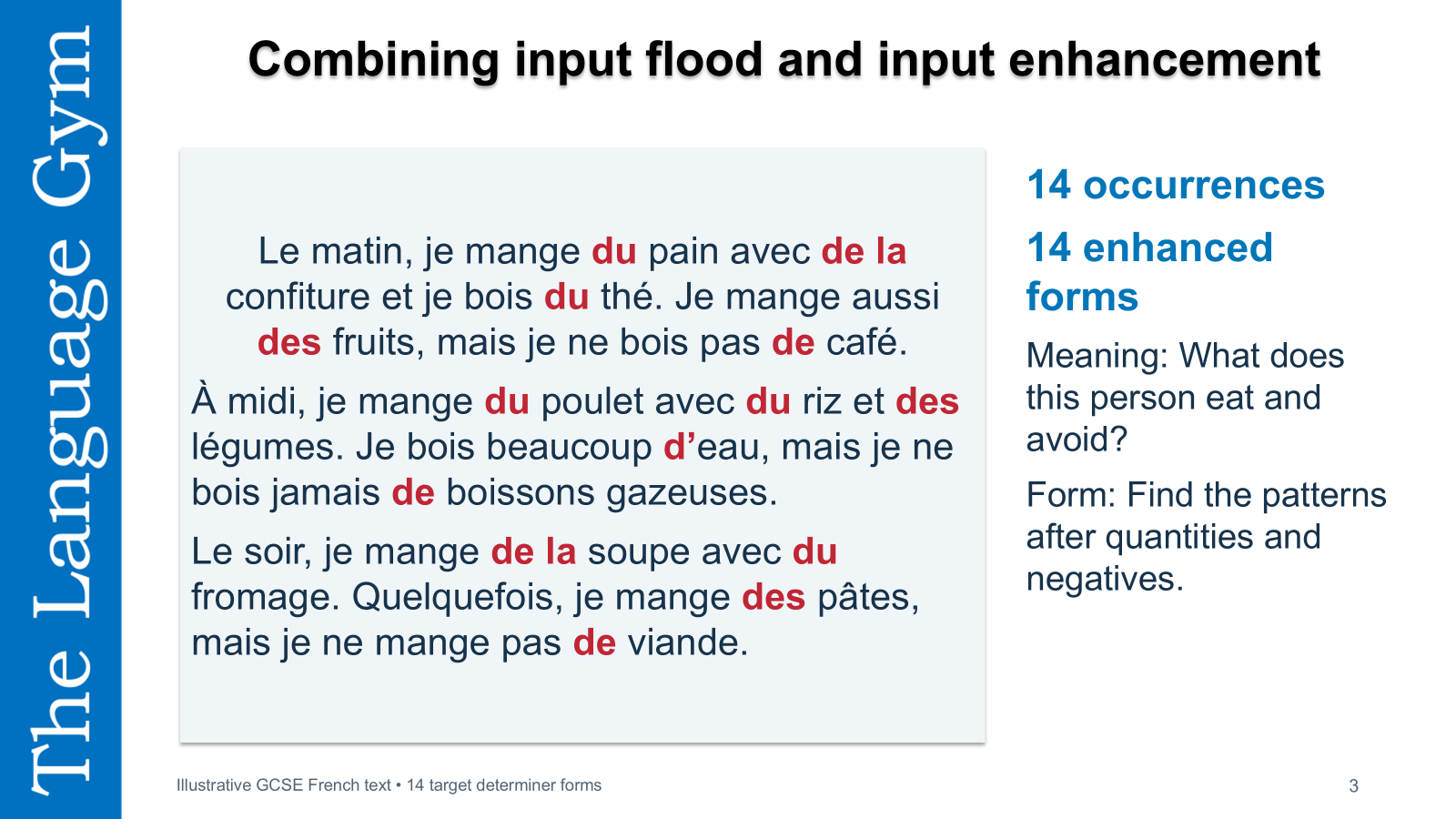
However, research suggests that the effects of input enhancement alone are variable and can be modest (Lee & Huang, 2008). Highlighting a feature is not tantamount to teaching it.
7.3. Explicit selective attention
Rather than simply hoping that learners will notice the enhanced features, I can explicitly direct their attention towards them.
For instance:
- Find all the expressions containing beaucoup.
- What happens to the article after a negative?
- Find three examples of du and two examples of des.
- Listen to the recording and identify which determiner precedes each food item.
Such activities encourage learners to allocate attentional resources to features which they might otherwise disregard.
This need not involve lengthy grammatical explanations. Sometimes a thirty-second noticing task is sufficient to redirect learners’ attention.
7.4. Task-induced relevance
I can also design meaning-focused tasks which make processing the target linguistic feature necessary.
For instance, students read or listen to the following sentences:
- Je bois beaucoup de lait.
- Je bois un peu de lait.
- Je ne bois jamais de lait.
- Je bois trop de lait.
- Je ne bois plus de lait.
They then match each statement to the corresponding description of the person’s drinking habits.
Recognising the words bois and lait is insufficient. To complete the task successfully, learners must process the expressions of quantity, frequency and negation.
In other words, the target features are no longer peripheral to comprehension. They are central to it.
This is, in my view, one of the most powerful ways of reconciling a focus on meaning with a focus on linguistic form.
7.5. Repeated and varied processing
Finally, I would not expect one encounter, one noticing task or even one successful lesson to result in durable acquisition.
The same linguistic features need to be processed repeatedly, across different tasks, contexts and modalities.
This is one of the core principles underpinning Extensive Processing Instruction (EPI).
I might use the same text, or slightly modified versions of it, for:
- Reading and listening comprehension.
- Listening discrimination.
- Dictation and gap-filling.
- Sentence reconstruction.
- Translation and reformulation.
- Pattern identification.
- Oral and written retrieval.
- Communicative activities.
Each activity requires learners to engage with the language in a slightly different way, thereby creating further opportunities to strengthen the relevant memory representations and develop increasingly efficient access to them.
The objective is not merely to get students to notice a linguistic feature once. It is to get them to process it often enough, and in sufficiently varied ways, for it to become part of their usable linguistic repertoire.
8. From comprehensible input to acquisition-oriented input
I am a strong advocate of extensive exposure to comprehensible input. However, comprehensibility is only one of several properties that make input conducive to acquisition.
When designing input for instructional purposes, I would want to ensure that:
- It is sufficiently comprehensible for the learners.
- It contains frequent occurrences of the target linguistic features.
- Those features are made sufficiently salient.
- Learners’ attention is selectively directed towards them where appropriate.
- Processing them is relevant to successful task completion.
- They are subsequently recycled and retrieved across a range of activities and contexts.
In other words, we need to consider not only the accessibility of the input but also the quality, frequency and nature of the processing it elicits.
There is an important distinction between using a text to assess comprehension and using a text as a vehicle for language acquisition.
Both are legitimate instructional objectives. However, they require somewhat different approaches to task design.
9. Concluding remarks
The next time your students score ten out of ten in a reading or listening comprehension task, by all means celebrate their success.
But also ask yourself:
- What language did they actually have to process?
- What language could they afford to ignore?
- Which features of the input are they likely to remember?
- Which of those features will they be able to retrieve and use independently next week, next month or next term?
These are particularly important questions in instructed foreign language learning contexts, where exposure to the target language is extremely limited and every encounter with the language counts.
We cannot afford to assume that everything we expose our students to is being processed, that everything being processed is being learnt, or that everything being learnt will be retained.
Effective language teaching is not simply about engineering comprehensible input. It is also about engineering attention, repeated processing and durable learning.
Ultimately, the question we should be asking ourselves is not merely:
Did my students understand the text?
But rather:
What did processing this text contribute to their ability to understand and produce the language in the future?
Selected references
- Ellis, N. C. (2002). Frequency effects in language processing: A review with implications for theories of implicit and explicit language acquisition. Studies in Second Language Acquisition, 24(2), 143–188.
- Ellis, N. C. (2006). Selective attention and transfer phenomena in L2 acquisition: Contingency, cue competition, salience, interference, overshadowing, blocking, and perceptual learning. Applied Linguistics, 27(2), 164–194.
- Lee, S. K., & Huang, H. T. (2008). Visual input enhancement and grammar learning: A meta-analytic review. Studies in Second Language Acquisition, 30(3), 307–331.
- Schmidt, R. (1990). The role of consciousness in second language learning. Applied Linguistics, 11(2), 129–158.
- Sharwood Smith, M. (1993). Input enhancement in instructed SLA: Theoretical bases. Studies in Second Language Acquisition, 15(2), 165–179.
- Trahey, M., & White, L. (1993). Positive evidence and preemption in the second language classroom. Studies in Second Language Acquisition, 15(2), 181–204.
- VanPatten, B. (1996). Input Processing and Grammar Instruction in Second Language Acquisition. Ablex.
- VanPatten, B. (Ed.). (2004). Processing Instruction: Theory, Research, and Commentary. Lawrence Erlbaum Associates.

